

Show Notes
As an ADHD therapist, coach, and entrepreneur, navigating professional and personal life comes with unique challenges—and opportunities.
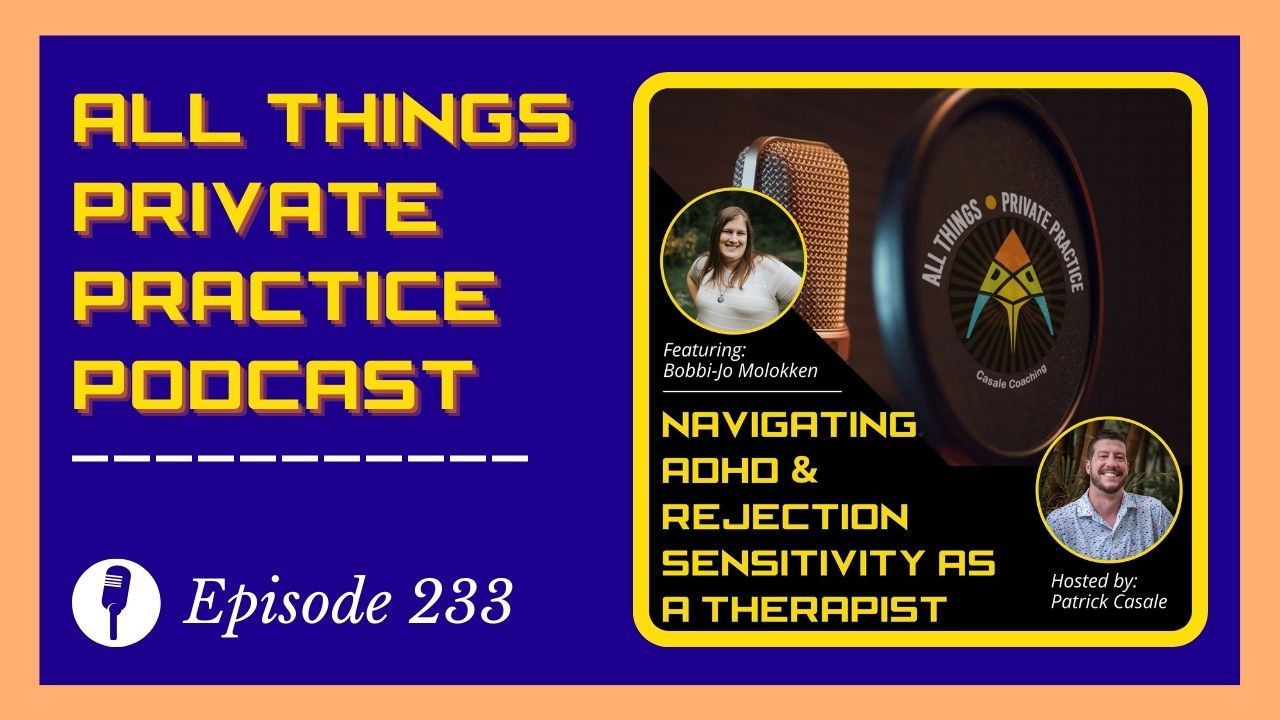
In this episode, Patrick Casale and Bobbi-Jo Molokken, psychotherapist, ADHD coach, and founder of Embrace the Muchness, LLC, dive into topics like Rejection Sensitive Dysphoria (RSD), real-life ADHD accommodations for therapists, and the importance of authentic self-disclosure with clients.
Here are 3 key takeaways:
- Accommodations Are Essential, Not Optional: Implementing simple strategies like concurrent note-taking, scheduled sending of emails, and pausing to address recurring thoughts can increase effectiveness in both sessions and business operations.
- Name and Normalize Your Experience: Recognizing and labeling RSD can help you create space between feeling and reaction, leading to healthier decision-making and emotional regulation—especially when facing criticism or feedback.
- Model Neurodivergent Coping Tools for Clients: Transparently sharing your own supportive strategies in sessions doesn’t just help you—it's also invaluable modeling for ADHD clients who need to see that accommodations are not a weakness but a strength.
If you’re a therapist or entrepreneur navigating ADHD, remember: relatability fosters accessibility. Embrace your muchness, and don’t be afraid to show up as your authentic self—for your clients and your community.
More about Bobbi-Jo:
Bobbi-Jo Mol-okken, LISW, CCTP, is a psychotherapist and ADHD coach based in Iowa. Diagnosed with ADHD as an adult and a parent of ADHD children, she brings both personal and professional insight to her work. She is passionate about providing neurodiversity-affirming education and resources that empower individuals and professionals to better understand and support ADHD.
She is the founder of Embrace the Muchness LLC, where she offers ADHD coaching, professional development training, clinical consultation, and digital resources designed for neurodivergent individuals and those who support them. She recently released the Inner Equilibrium Audit, a three-phase self-reflection tool that helps individuals explore patterns of time use, energy balance, and executive functioning in daily life.
- Instagram: instagram.com/embracethemuchness
- Free Facebook Group: facebook.com/groups/embracingthemuchness
- Website: embracethemuchness.com
🎙️Listen to more episodes of The Neurodivergent Entrepreneur Podcast
🎙️Spotify
🎙️Apple
🎙️YouTube Music
▶️ YouTube
✈️ Check out available Retreats
🗨️ Join the free Empowered Escape FB Community
A Thanks to Our Sponsors: The Receptionist for iPad!
I want to thank The Receptionist for iPad for sponsoring this episode.
The Receptionist for iPad is a HIPAA-ready digital check-in system that eliminates the need to walk back and forth from your office to the waiting room to see if your next appointment has arrived. Clients or patients can check in for their appointments, and you'll be immediately notified by text, email, or your preferred channel. Break free from interruptions and make the most of your time, because it is valuable. Start a free 14-day trial of the Receptionist for iPad by going to thereceptionist.com/privatepractice. Make sure to start your trial with that link to get your first month free if you decide to sign up.
Free Gifts for Our Listeners
Get a practical podcasting workbook for therapists considering starting a podcast, created by Patrick Casale, host of the podcasts The Neurodivergent Entrepreneur and Divergent Conversations.
You'll get a practical structure for therapists who want to start a podcast but don’t want to rush, perform, or build something they can’t sustain.
Grab your free copy: ndpod.org/Free-Podcasting-Workbook
✨ Move Beyond Private Practice As A Neurodivergent Entrepreneur
Move Beyond Private Practice As A Neurodivergent Entrepreneur is a FREE 5-part mini-course designed for therapists who want sustainable financial independence beyond one-on-one work.
Access your free mini-course here: ndpod.org/Neurodivergent-Entrepreneur
Transcript
PATRICK CASALE: Hey, everyone. Welcome back to the All Things Private Practice podcast. I'm joined today by Bobby-Jo Molokken. She is an LISW, CCTP. I always love all of the different acronyms throughout our country, psychotherapist and ADHD coach based in Iowa. Think you're our first Iowa guest on here.
BOBBI-JO MOLOKKEN: Yeah. [CROSSTALK 00:01:19].
PATRICK CASALE: Diagnosed with ADHD as an adult and a parent of ADHD children. She brings both personal and professional insight into her work. And she is the founder of Embrace the Muchness LLC, I like that, where she offers ADHD coaching, professional development training, clinical consultation, and digital resources designed for neurodivergent individuals and those who support that.
She recently released The Inner Equilibrium Audit, a three-phase self-reflection tool that helps individuals explore patterns of time use, energy balance, and executive functioning in daily life. Welcome to the show.
BOBBI-JO MOLOKKEN: Yeah, thanks for having me.
PATRICK CASALE: So, in true ADHD fashion, you pitched a few ideas. And I liked all of them. And I really think the one that stands out to me is how to manage your ADHD struggles or experiences as an ADHD therapist, combined with the experience of rejection sensitivity dysphoria, or RSD.
Now, obviously, they go hand in hand. And for those of you who don't know what that is, we'll get into that. But yeah, I love the topic. I'm an AuDHDer. So, you have the ADHD specifics focus and experience. So, yeah, tell us what it's like to be an ADHD therapist and business owner.
BOBBI-JO MOLOKKEN: Yeah. So, I think it's always interesting to look at the ways that ADHD shows up, kind of in the therapy room, right? And those specifics, as well as, then, certainly, you know, the business owner side, and kind of the non-clinical stuff, and the ways that it impacts our ability to do all of that.
I have the privilege of kind of specializing and supporting therapists. So, not only doing my own experience, but I have a couple of groups for therapists with ADHD on the coaching side. And so, these are topics that we're constantly talking about a lot.
And so, some of the big things I see where folks are noticing that are showing up in the therapy room are memory issues. So, like, just tracking the client's story, remembering if I gave somebody homework last week, remembering to follow up with that. If I tell a client that I'm going to send them a resource, having a system and remembering to actually follow through with sending them that thing. So, that's a big one.
Another one that I hear about a lot is just dealing with our own distraction in session.
PATRICK CASALE: Yeah.
BOBBI-JO MOLOKKEN: So, obviously, we want to be as attuned as possible to clients and our own ADHD brain. There's like several different ways that seems to show up.
PATRICK CASALE: Absolutely.
BOBBI-JO MOLOKKEN: So, one of the things, you know, I think, is just like distractions, where I am super curious, and so I'm always like, I have a thousand questions about everything the clients are bringing in. And I have to learn how to sort through, like, just because I'm curious, and it's just my brain's curiosity versus like, what may actually be helpful for this client, right?
PATRICK CASALE: Sure. Yeah, that's a really important distinction and point that you made. And I think that's probably one a lot of people can relate to, is like, okay, I am curious, and what is actually going to be helpful? And when do I feel like I need to insert my curiosity or my question while the client might be sharing or offering their perspective?
BOBBI-JO MOLOKKEN: Yeah, and I think, you know, there's also a line sometimes that like I had one just the other day, where somebody I'm working with works in a particular field. And it's kind of a specialized version of that field. And they do talk a lot about their work, right? And they had never given me some clarification of kind of how their day works. And it was one of those where I was kind of really on the fence of, like, do I pause and say, like, explain this to me? Or can I just keep going? Does it matter?
And I had been noticing this question had came up for me in multiple sessions now. And because then it is a distraction for me, I made the choice to just go ahead and ask. And get that out of the way. It wasn't going to be a long explanation, you know, for the most part.
PATRICK CASALE: True.
BOBBI-JO MOLOKKEN: Or client to not be talking about their work, it wouldn't have been relevant, but they are. And I needed, kind of, I think, to be able to give them some feedback on some of the things. I needed to have a little bit more clarity about exactly what was going on there, right? And so, that was a recent example that came up for me where it was a lot of, you know, do I? Don't I.
And so, there is some times where, if it feels like my brain's not going to let this go at all, sometimes the better choice is ask. Like, get it over and move on. But most of the time, I'm able to now. And I certainly don't think I was nearly as good at this in my earlier career, but like now, I have a lot of ways that I can usually sort that out.
I do concurrent note-taking for myself. And so, a lot of times what I'll do is I'll sometimes write, like type out the question, just so I don't forget, which allows my brain to let me move on, but I don't necessarily ask it. And so, that way I can wait and kind of see where the client takes us. And if it still feels important later and relevant, then it's there for me to come back to.
PATRICK CASALE: I like that.
BOBBI-JO MOLOKKEN: That helps my brain be able to kind of move on. Otherwise, because my working memory is so poor, my brain will just repeat things in my head because it doesn't want me to forget, kind of, and so…
PATRICK CASALE: Yeah. It’s like this rumination experience, right? Of like, let me repeat this over and over and over again. But once that starts happening, how can I actually shift my energy, focus, and ability to absorb this information, if all of my brain is just focusing on this question?
So, I can totally relate to needing to get that out, because that's what keeps a lot of us up at night, is some of those experiences.
BOBBI-JO MOLOKKEN: And, you know, I work with a few different models. IFS is kind of one of the primary ones. And so, that has its own kind of course. And so, that also actually helped me in a lot of ways, because a lot of the context isn't quite as important in that model. And so, much of the time, then I can easily tell myself, “This is my curiosity.” Because if I'm connecting with a part, this specificity isn't usually relevant to the work that the client and I are doing in that moment.
And so, in some ways, I think using certain models where context isn't always as important is also helpful. And there's some kind of background of, if I start questioning that, I can always come back to the foundational training of where do you go next in the process. And that also helps with some of that decision-making weights as well.
PATRICK CASALE: Yeah, that's almost an accommodation in itself. Of saying like, “Hey, I can use a model where I don't have to necessarily be focusing on every single detail.” And we can be exploring and be a lot more curious in how we move through this therapeutic approach.
BOBBI-JO MOLOKKEN: Yeah, yeah. And then, for myself, like, my other accommodation I use is, like, if I have random thoughts that just pop in that are personal, like, “Hey, don't forget, you got to pick your kid up tonight at five o'clock.” That's where, again, like the writing it down, you know, just putting it out there, usually, lets my brain let go of it. You know, and then that works.
If it's usually about like, “Hey, I said I was going to send a client a thing.” If it isn't going to take me long, I often, honestly, just have them wait and say… Because they don't mind, because it's important to them to get whatever we agreed upon. And so, I'm like, “I'm just going to take a moment and send that to you right now so that you get it.”
PATRICK CASALE: Yep, yep.
BOBBI-JO MOLOKKEN: And so, that solves that in most cases. You know, obviously, there's times where I need to go look something up or find referrals for something. In those cases, I will usually just use the same thing, though, and tell my client, like, “I'm going to write myself a note to send you this thing.” And then, I put it into my other organizational systems that I'm using so that I've got that visual cue to come back later.
PATRICK CASALE: [CROSSTALK 00:09:49] have a really important modeling as well.
BOBBI-JO MOLOKKEN: Exactly.
PATRICK CASALE: And when I go out on a limb and assume you work with a lot of ADHDers, and you know, I think it is about modeling and deconstructing how we would move through and try to, like, almost power through in more of an ableist lens of like, “I'm going to just continue on without writing this down, or stopping, and pausing, because that's what I should be able to be doing.”
And in reality, it's like, “Well, my brain really doesn't work that way. And this is just going to cause and wreak havoc for both of us. So, this is in the best interest.”
This is why I love schedule sending things. Like, if those thoughts are coming up, right? And my working memory is really struggling, schedule sending emails, messages, reminders, even to myself, just because, like one, it's going to take up way too much space, because I am going to be so fearful of forgetting.
And two, like you mentioned, getting it out of my brain, but acknowledging that it's captured somewhere so it's safe enough to, like, not fall through cracks, is a relief. And I think just all my new, like, micro accommodation that I make on a daily basis, and I need to be doing it all the time.
BOBBI-JO MOLOKKEN: Yeah, yeah. And I do see primarily ADHDers. And agree, even with sometimes that question asking if there is one of those where it's a moment where my brain's not going to let me move on unless I ask, I almost name that to say, you know, I know this might not be directly relevant. But my brain's not going to let go until I ask this curious question.
And also, that's me accommodating myself. I'm giving them permission to do the same thing and modeling that for them. And again, you know, while others might argue about me taking up space to meet my need in that way, I actually think on a deeper level that is extremely therapeutic for my ADHD clients to see, because it's modeling for them how they could do the same things.
PATRICK CASALE: 100%. Agree with that wholeheartedly. I'm actually experiencing something that we're talking about right now, where, in the last podcast I did right before you, I noticed the picture on my wall to the left is uneven. And in my brain, I said, “I'm going to fix that in between these podcasts.” And I did not, because I forgot, until I looked at it again right now, and I'm like, “There it is.”
But you know, it's like those moments of going through our lives, especially in a therapeutic sense, where there's so much that we're absorbing, and tracking, and paying attention to, and how we're trying to support. And when our brains are almost working against us in a sense of, “Hey, there's too much information going on.” There's a lot of distractibility and, hell, potentially, impulsivity, right? Like you mentioned earlier on in your career, you may not have done that. I know earlier on in my career, I probably was interrupting clients in a way where it was not helpful for either party.
BOBBI-JO MOLOKKEN: Yep, yeah. And I think, another thing I know from that, like earlier career that often comes up is, since ADHDers, kind of, we tend to think a little bit in associations, right? And so, what happens is, as clients are talking about things, we often relate and might think of something that feels useful based on our own personal experience. And so, of course, there's kind of individual decisions about comfort with kind of self-disclosure and things like that.
I probably did more self-disclosure that was helpful early in my career. And one trick that I will share, that I think that I learned, that I really liked, is that, so in a lot of times for me, I always like to name to, when I am doing a lot of self-disclosure now, it's usually about me sharing about a strategy and sharing how I use it. And in the end, I'm really not telling people that much. They already know I have ADHD. So, like, I'm not telling them that much about myself. So, part of that is also that a lot of ADHDers can learn better through concrete examples, versus just dropping a vague kind of concept on them.
PATRICK CASALE: Right.
BOBBI-JO MOLOKKEN: And so, like, if they can get how it works for me, then I shift into applying it to whatever prompted this to come up in the first place. And then, once they get it, then I will sometimes try to take the next step out to, like, how do we generalize this to other situations that you might be able to use the same skill with?
Which I think is kind of backwards for a lot of times, how therapists generally teach skills, but kind of coming back to that, you know, with that, the thing that I learned just to say, some people find it helpful to blah, blah, blah. I am some people, in whatever the tip is that I am sharing there. But like that feels different than. And so, like that was, like an earlier on tip of that, just instead of saying, “Oh, I do this.” Or, “I find it helpful.” I can use some people. You don't need to know that I am the some people I'm referring to. And I'm not then, like, turning the attention onto myself.
But as I said, I do still use a lot of examples. But again, you know, all that you're going to know about me, even though I might have shared some things, is that, like, I don't like doing dishes, and this is now how I do them better and in a way that works, and something else, right?
PATRICK CASALE: Also, I just think that, like the relatable component, right? And I say this all the time on here, that I think relatability equates to accessibility. And I think when we're working with clients who are in any sort of marginalized group, the ability to be relatable, to just share a little bit of self, can create such a sense of calm, and relief, and humanization of like, “Holy shit, it's not just me.” Or like, “My therapist also struggles with this thing that I'm struggling with.” And I think that's really powerful.
BOBBI-JO MOLOKKEN: Yeah. And I think that if you are working with the right-fit clients, it's usually not a problem, right? I think there are times that you might have some clients who maybe either don't know that they have this, or they are holding a lot of ableism. And so, some of these traits may bother them. And that's okay, then I'm not going to be the best fit for them. And it's probably better that we figure that out sooner rather than later, anyhow. And that's just where they're at, and they have different needs, and that's okay.
But yeah, so I think, like, that relatable stuff, is one that comes up of managing those internal thoughts that happen because our brain really pulls those associations a lot, which I also would say, is where, of course, we always advocate in our field for doing your own work.
But like, you know, one thing I do, too, is I always have a Google Keep tab open. And that's just the app I choose to use for all of my random notes. But within there, one of them is specifically like for myself for therapy, and because I also see an IFS therapist. Like, sometimes when I'm in sessions with clients, my parts will be connecting with something that the client is talking about. And while I can notice that, I will often make a note for myself so that outside of session, I have that cue to maybe do a deeper check-in if something is especially coming up.
And I think that happens for all therapists, but I do think that that, like, association-based thinking that we tend to have, can make that be more common or more frequent-
PATRICK CASALE: For sure.
BOBBI-JO MOLOKKEN: …for ADHDers. And so, being a therapist-
PATRICK CASALE: I think the same is for autistic people as well, you know? Needing that association and offering that context of how I'm relating to what you're saying based on my experiences.
And a lot of people can look at that as like, “Oh, that's self-absorption. You never really want to have reciprocal conversation.” And it's like, well, no, it's how I relate to conversation. And that can be really tricky to navigate as well when you're in your pre-discovery phase, or if you're working with a population who, like you, said, there's not a lot of synchronicity there. And I think that's important to acknowledge as well.
So, I like that Google Keep tab idea. I have my own strategies for all of the ideas that are in my head, and all of my projects, and plans, and things that I can't let go of. And I think we all need something like that, just creating some sort of accommodation that works for you, right?
So, if you're listening and you're like, “I need something to help me with all of the ideas, the associations, the deep dives, the things I don't want to forget.” Even if it's just a simple Google Doc. Like, whatever you need it to be, but having it be accessible and easy to use, because I do think that's a great strategy.
Now I want to pivot a little bit, because I think one thing that's important here, when we're talking about ADHD experiences for therapists, in general, and just ADHD, in general, is the RSD component.
BOBBI-JO MOLOKKEN: Yeah.
PATRICK CASALE: So, early on in my therapeutic career, I experienced what I thought at the time was a lot of like, impostor syndrome, self-doubt, etc. And it was constantly in the framing of, like, “You’re a shitty therapist. You don't know what you're doing. This person hates you. You said something the wrong way.” Voila. Here we are today. And it's like, “Oh, that was probably a lot of RSD-driven thought and experience.” So, can you take us through the RSD kind of framework and so to speak.
BOBBI-JO MOLOKKEN: Yeah. And you know that rejection sensitivity, I guess, I can share a little bit about how I like to frame RSD, because there's a lot of discussions around that in our field as a whole, and different people view it differently. And you know, my specializations are adult, ADHD, and trauma. And so, a lot of folks will say RSD is just trauma. And as the parent of ADHDers and knowing, seeing RSD show up in my own kids, knowing that they don't have any big T traumas, at least, I can still point a lot of like the big emotional responses that they have often, if you can look through that RSD framework, fit with that, right?
And I've talked with enough other parents that really, I don't believe that trauma is necessary for folks to experience RSD. What I do like to say is add a lot of more nuance, that I think that it is that sensitivity towards that is innate. And though, I think the more experiences of rejection that we have, and the more relational traumas that we have that also, just like increases further how much it shows up, and how much of an issue that can be for us. So, there's, like, this interconnected piece of it.
And the reason for me it feels important to clarify is that like, if we, I think then for some folks who conceptualize that it's just trauma, well, we do have a lot of trauma treatment methods. And I will say, I do think many of them can be helpful with some of that. But also, the therapist needs to have the right expectation that, like, just because you do a bunch of work doesn't mean that this will stop happening at all for, you know, that person that's experiencing RSD. And so, I guess that's just kind of how I frame it as a whole.
PATRICK CASALE: Yeah. Love that.
BOBBI-JO MOLOKKEN: And then, thinking about it and how it shows up for therapists that experience, there's just a lot of different ways little things, I think that even in our clinical relationships or professional relationships that we can see that.
And when I first learned about RSD, I like, recognized it, and was like, “Oh yeah, I see that in my clients.” I didn't really think it applied to me. But the more that I learned about it, you know, I am much more of an internalizer. And so, you know, for me, my reactions during RSD things are either to just withdraw, kind of, and like, I guess I won't talk to you anymore, or, you know, that kind of thing, or more like anger, but in words. Like, I am just saying, you know, you did this and you did this, but I won't say that out loud to the person.
PATRICK CASALE: Sure.
BOBBI-JO MOLOKKEN: And so, so again, I think I didn't acknowledge it, because most of my behaviors and back end stuff was happening internally. But as I learned more, and being able to see that, like, some things that would bother me, I previously worked at a college counseling center. And while we didn't necessarily have assigned folks like a lot of times if client would request to see another therapist without any explanation.
And again, now, you know, the logical therapist sides of me were like, I totally support that, and I absolutely want the client to have the best experience. And this other part of me would be really bothered by that. What did I do? You know, why don't they like this? I did something terrible that they don't want to see me again, whatever. You know, I think just clients deciding to terminate, especially unexpectedly, or that kind of thing, is another time that we can see that.
Supervision and consultation is a big one, that there's a lot that often will come up there. And just fears of being judged, or people giving other feedback, and feeling like you're being questioned about what you're doing.
PATRICK CASALE: Competency coming into play. Like, do I really know what I'm doing? Do these people around me, who I consider my peers, and my supervisor, my colleagues, think I am like, not good enough, or I don't do a good enough job. You know, all of those thoughts can come swirling in.
BOBBI-JO MOLOKKEN: Yeah, another one that's smaller sometimes is, this one makes me laugh a little bit, but like when clients will listen to a podcast and come in and tell you about this thing that they learned about, that you have talked about with them 1000 times before, but now this other person and like, it's a subtle one, but that one can kind of bring up some stuff, of like, “Oh, well, why is what they've said, great, but everything we've said, what does that mean about how you feel about me?” And all of that.
I think just if there's a decision that you need to prefer somebody out, even if it's your own decision and conclusion, it's another time that we can see that. If you’re, I think, even just sometimes suggesting a intervention, or a strategy, or something, and the client just doesn't respond well to it, that's another small place that can show up. Reading any kind of reviews or satisfaction surveys.
PATRICK CASALE: Yes.
BOBBI-JO MOLOKKEN: I mean, I think that one is true for all folks, but…
PATRICK CASALE: Hits a little closer to home sometimes, yeah.
BOBBI-JO MOLOKKEN: Yeah. I used to supervise some student workers. And I would, like, purposefully, like, okay, because we would do reviews after they offered workshops and things. And I would have to, like, “Here's a whole bunch of context you need to know about how people fill these things out before you take any of this too personally.”
But yeah, so those are just, like, some smaller things, I think, that even just within that relationship, that the RSD can show up within the war, you know. Of course, outside of that, just how other people feel, or sometimes feeling slighted if, I don't know, somebody I thought was, you know, a close friend starts referring to somebody else who has the same specialty as me and didn't think of me. Like, people will have RSD reactions in those situations as well.
And so, yeah, so those are some of the different specific ways that I hear about that folks see that showing up for them. And again, a lot of these are maybe more smaller scale ones, but when we start to really contextualize what's happening there.
And I think it often feels puzzling for folks too, because there is that internal like, you know, if it's a client wanting to work with someone else, it’s like, “You know, totally respect that, and clinically, that's fine. I want the best for you.” But there's also this other reaction, and often people are confused by that, like, discrepancy that they're feeling internally.
PATRICK CASALE: Yeah, it feels like misaligned in a way. And it's like, “I totally respect that decision and... This is like, hurting my feelings, and I'm starting to question my own sense of self.”
And I know you're you know you're doing more trainings and consultations now, and creating more of like a reach on social media. For those of you listening, like, talk about a way to really trigger RSD reaction is to start making social media content and putting yourself out into the world because you're like, “Not enough people liked it. Too many people commented, someone trolled me about A, B, and C.” Like, there are so many ways that RSD can show up in that space. So, it's also a certainly a complicated one to navigate.
BOBBI-JO MOLOKKEN: For sure, I will be honest that I think I have not put as much energy into social media content for that exact reason. Like, when I see folks that I really respect their content and I'm like, my video, I don't know how they deal with all of that. Like, just the thought of even all of that feels overwhelming to me, often. And I do think that I have not put as much effort into social media, specifically, sometimes because there's a certain vulnerability and putting yourself out there. And…
PATRICK CASALE: Absolutely.
BOBBI-JO MOLOKKEN: I know I've been feeling that also in a few of the different things I've created more recently, specifically because I have a couple of different projects I've been working on that like, you know, I've been building some of these kind of tools for a couple of years now, and they are things that feel like it really is my own creation, right? And so, you know, which has meant a lot of times I've asked lots of other people to look at it first.
And I've had a really hard time even deciding when is this done enough to put out into the world, because I think underlying all that, there's some fear about how will this be received, and what if somebody questions this, and what if somebody thinks that it's, you know, trash? And I can't directly cite how it works, because I'm pulling my brain, pulling all these different things together into one.
So, yeah, there's been definitely more nervousness around that. And another way that that kind of shows up within that. Then perhaps, like, you know when I'm doing other trainings, and I'm just kind of regurgitating all of the information, versus this is something that feels like my own brain child, and…
PATRICK CASALE: Absolutely. Yeah, there's certainly more vulnerability in that, right? Of like, this is something maybe I've created, or I've come up with. If someone's going to pick this apart, that's kind of a deep reflection of me. And that's painful to experience.
So, I hear this from a lot of my ADHD colleagues, and friends, and entrepreneurs who are like, “I want to get this going. I want to launch this thing. I want to put this out into the world. And again, like I am so nervous about how it's going to be received.” And it's a painful experience. And as someone who's gotten kind of callous to it over the last four or five years, it sometimes feels really, really painful and deeply personal.
And I will say it does get easier, but I also will say that there are moments where you are really questioning everything and anything. And it's a mind fuck sometimes, honestly. Yeah. Okay, as we are getting ready to wrap in a couple of minutes, a strategy or two for those of the people who are listening at home who are like, “That's my life in a nutshell. Like, I experience this all the time.”
BOBBI-JO MOLOKKEN: Yeah. I think one of the things with RSD that is helpful is just naming, but that, like, this might just be my RSD right now. And that alone is honestly a really helpful thing that usually gives us some space from that.
I think other things for me are like, I kind of have rules for myself that if I feel big emotions coming up in response to something that I just don't allow myself to respond to it in that moment, because I know that I may feel, you know, I need to sleep on it for a day, at least, if it's like a message, like a text message, and somebody's not directly in front of me. And I can have that space of I know I may feel differently later. And I know my response is likely to be more grounded and useful if I make it later when I'm not activated. And so, I think like that is something that also helps, is just, if it's a situation where some kind of response is needed, and giving yourself space at a later point to kind of check in, because that can prevent things from escalating further and becoming a bigger thing.
PATRICK CASALE: For sure.
BOBBI-JO MOLOKKEN: Yeah, I think other pieces are just for me personally, what's helped a lot, and I have more recently done some, like, intentional work in my own therapy. But like, even when I had noticed at one point, just from having done a lot of my own therapy work, and for me, that was through IFS. Like, just noticing when I started to see the differences, instead of, like, these parts of me, the angry one, and you know, kind of isolation part, stepping back, I was able to just, like, notice that they were all happening versus, and so I think, just like doing a lot of our own work therapeutically, also, in general, helps to create some more of that space that, you know? Initially, it's not like I could stop it, but I could now take that step and see it as it was happening.
PATRICK CASALE: For sure.
BOBBI-JO MOLOKKEN: And so, I think that's another thing that helps over time. And then, also just, kind of in those moments, having your own comfort things that help you. Like, it's really hard to give a concrete one, because everybody's RSD’s emotional response is different, right? So, if you tend towards having angry responses, you might need to do something that is more calming in nature to bring that back down. If you tend to be more isolated, maybe you need to work towards actually connecting, you know, with other people. And that might feel better. So, I think it's pretty individualized.
But I think a lot of it, too, is just learning what is your own pattern. And then, as usual, what strategies work for that particular emotional response for you, and acknowledging, and making sure those things are accessible to you at the times that this might come up.
PATRICK CASALE: Yeah, now that's really well said. And I think it's not a one-size-fits-all. So, it's important to really get familiar with your own triggers, and experiences, and soothing strategies as well.
Well, we are basically at time. So, I want to give you a minute to kind of share your creation with the world, and where people can find you and your information. And I just want to thank you again for coming on and making the time to have this conversation.
BOBBI-JO MOLOKKEN: Yeah, so the thing that I've released most recently is called The Inner Equilibrium Audits. And it originally started as part of my therapist with ADHD group of really trying to help folks have better balance across work and personal life. And then, also, thinking about all of the executive functioning pieces that tend to get in the way when we're trying to get tasks done.
And so, essentially, what it does is it has folks really collect a bunch of data on all of the tasks that they do in their work and their personal lives. There's also some optional educational or parenting kind of sections as well, and things like, how long does this task take? You know, what's it feel like energy-wise? What type of energy does it take? Some sensory kinds of pieces. And so, really just analyzing your relationship with every single task.
And then, kind of stepping back and reflecting of how do I use this information, then when I build my schedule, so that I can find the right balance for myself of kind of how many energizing things in a row versus draining things in a row? And is there certain times a day that, you know, can I match my most difficult task to my most focused time of day? Those kinds of things.
And so, trying to kind of move away from neurotypical time management, which is simply just block of time task, boom. And there's an expectation that you can just do the thing at that time, and that just doesn't work for a lot of us.
And so, instead, it's really trying to help bring that self-awareness to what are all of these factors that influence you. And then, how do I control the things that I can functionally manage or control, to try to set myself up to have the best chance to do the things. That's kind of what’s that all about. And so, that that resource, then, is available.
I have a training, kind of to teach any clinicians, or coaches, or others that might be interested in using it with folks, kind of how to use that or integrate that. It's also available if individuals wanted to do just on their own, but most probably would prefer to have some supports. And so, that will be available at my website, which is www.embracethemuchness.com.
PATRICK CASALE: Very cool. And we will have that link in the show notes for all of you, so you have access to everything Bobby-Jo just talked about and listed. And it sounds like a wonderful resource. Congrats on putting that out into the world. I'm sure it took a lot of energy and a lot of work, and a lot of second-guessing, and trepidation as well.
BOBBI-JO MOLOKKEN: Yeah.
PATRICK CASALE: And thanks again for coming on and making the time.
BOBBI-JO MOLOKKEN: Yeah, thank you for having me.
PATRICK CASALE: You're welcome. And to everyone listening to the All Things Private Practice podcast, new episodes are out on Saturdays on all major platforms and YouTube. You can like, download, subscribe, and share. Doubt yourself, do it anyway. We'll see you next week.
FREE PRIVATE PRACTICE GUIDE
Join the weekly newsletter for private practice tips, podcast updates, special offers, & your free private practice startup guide!
We will not spam you or share your information. You can unsubscribe at any time.






![Episode 264: Creating Through the Chaos of a Neurodivergent Life [featuring Bre "BR3"]](https://kajabi-storefronts-production.kajabi-cdn.com/kajabi-storefronts-production/file-uploads/sites/2147507511/images/a14004-cc3d-8aba-5fb8-2442fdfc650_TNDE_YouTube_episode_264.jpg)
![Episode 263: Your Symptoms Are Real—Even When Medicine Doesn’t Have The Answers [featuring Dr. Zachary Spiritos]](https://kajabi-storefronts-production.kajabi-cdn.com/kajabi-storefronts-production/file-uploads/sites/2147507511/images/84bc15-1ce4-1a0b-8f85-f5812bce75_TNDE_YouTube_episode_263.jpg)
![Episode 262: Your Brain Isn’t the Problem. The System Needs Reimagining. [featuring Dr. Mel Houser]](https://kajabi-storefronts-production.kajabi-cdn.com/kajabi-storefronts-production/file-uploads/sites/2147507511/images/42c858d-0b15-7581-e6ac-f636e7a1fa1_TNDE_YouTube_episode_262.jpg)
![Episode 261: Dragons, Dopamine, and Autistic Special Interests [featuring Mandi Dixon]](https://kajabi-storefronts-production.kajabi-cdn.com/kajabi-storefronts-production/file-uploads/sites/2147507511/images/25ae562-4a0a-44e-04f6-4caeaa5c8bd_TNDE_YouTube_episode_261_new_.jpg)