Show Notes
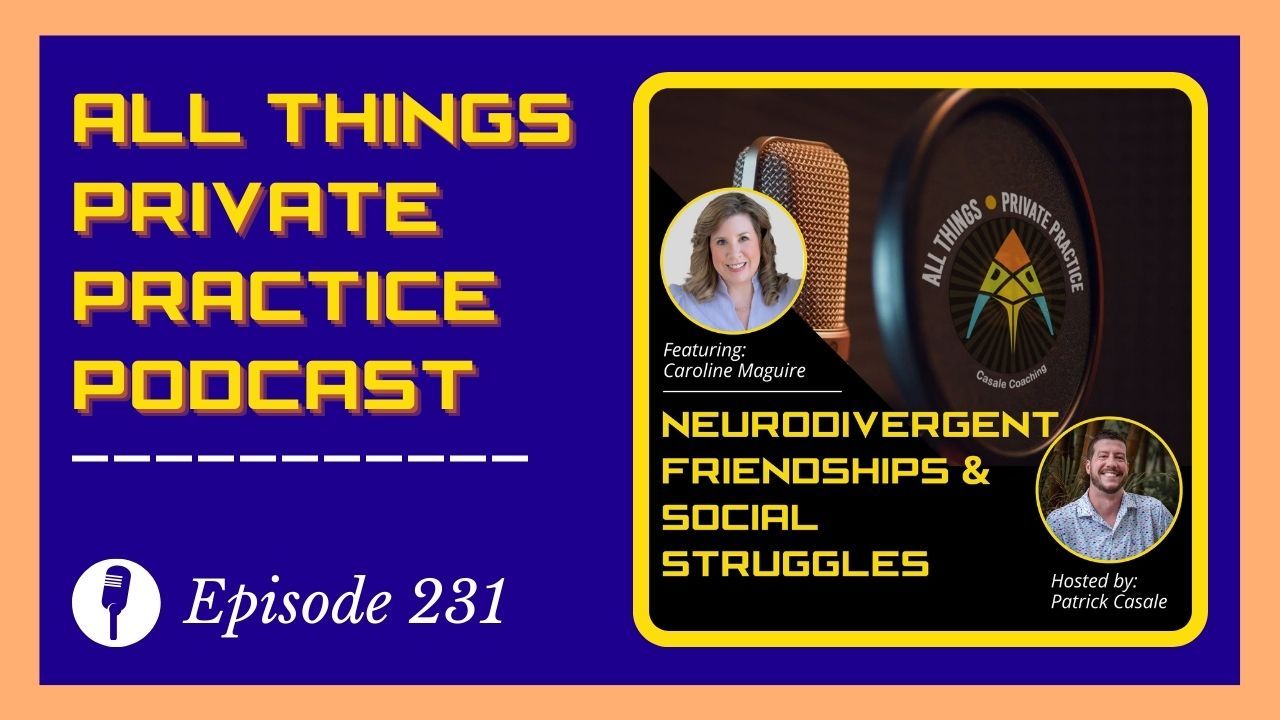
In this episode, Patrick Casale talks with Caroline Maguire, ACCG, PCC, M.Ed. Caroline is an award-winning author and coach whose work inspires crucial conversations around social skills, friendship, and belonging—especially for neurodivergent adults. Patrick and Caroline discuss everything from unmasking and authentic connection to the real-life struggles and victories of forming meaningful relationships as adults who think differently.
Here are 3 key takeaways:
- Go with Your Gut: Whether you’re writing, working, or building friendships, trust your instincts. Embracing confidence in your own voice—even when it means not pleasing everyone—is essential for authenticity and fulfillment.
- Friendship Isn’t One-Size-Fits-All: Forget “traditional” networking advice. For neurodivergent adults, it’s about finding high-interest, safe spaces and understanding your own sensory needs. Deep connection can happen outside the typical social settings—there’s no single path to friendship.
- Honor Your Energy and Needs: Setting boundaries and being honest about what drains or energizes you is vital. The friends who respect your limits (whether it’s choosing not to be in social situations, preferring smaller gatherings, or picking shade over sun) are your people.
More about Caroline:
Caroline Maguire, ACCG, PCC, M.Ed., is an award-winning author, coach, teacher, and keynote speaker whose work has inspired important conversations about social skills, friendship, and belonging. Caroline has been a rock for thousands of people who struggle to make friends. Her book “Why Will No One Play With Me?” has won several awards, including the Best Book Award from American Book Fest, Mom’s Choice Award for Honoring Excellence, and Book Authority’s award for Best ADHD Books of All Time. Caroline’s next book for adults, Friendship Skills for the Neurodivergent: A Guide for the Quirky, Anxious, and Easily Distracted, will release in April 2026.
- Website: carolinemaguireauthor.com
- Facebook: facebook.com/AuthorCarolineM
- Instagram: instagram.com/authorcarolinem
- YouTube: youtube.com/channel/UCnDmu0c8kr0co2ppXo3EC8A
- Twitter: twitter.com/AuthorCarolineM
- LinkedIn: linkedin.com/in/authorcarolinecm
- TikTok: tiktok.com/@authorcarolinem
- Pinterest: pinterest.com/AuthorCarolineM
- New book release soon - Friendship Skills for Neurodivergent Adults is on sale: amazon.com/Friendship-Skills-Neurodivergent-Adults-Distracted/dp/1538773082
🎙️Listen to more episodes of The Neurodivergent Entrepreneur Podcast
🎙️Spotify
🎙️Apple
🎙️YouTube Music
▶️ YouTube
✈️ Check out available Retreats
🗨️ Join the free Empowered Escape FB Community
A Thanks to Our Sponsors: The Receptionist for iPad!
I want to thank The Receptionist for iPad for sponsoring this episode.
The Receptionist for iPad is a HIPAA-ready digital check-in system that eliminates the need to walk back and forth from your office to the waiting room to see if your next appointment has arrived. Clients or patients can check in for their appointments, and you'll be immediately notified by text, email, or your preferred channel. Break free from interruptions and make the most of your time, because it is valuable. Start a free 14-day trial of the Receptionist for iPad by going to thereceptionist.com/privatepractice. Make sure to start your trial with that link to get your first month free if you decide to sign up.
Free Gifts for Our Listeners
Get a practical podcasting workbook for therapists considering starting a podcast, created by Patrick Casale, host of the podcasts The Neurodivergent Entrepreneur and Divergent Conversations.
You'll get a practical structure for therapists who want to start a podcast but don’t want to rush, perform, or build something they can’t sustain.
Grab your free copy: ndpod.org/Free-Podcasting-Workbook
✨ Move Beyond Private Practice As A Neurodivergent Entrepreneur
Move Beyond Private Practice As A Neurodivergent Entrepreneur is a FREE 5-part mini-course designed for therapists who want sustainable financial independence beyond one-on-one work.
Access your free mini-course here: ndpod.org/Neurodivergent-Entrepreneur
Transcript
PATRICK CASALE: Hey, everyone. Welcome back to All Things Private Practice, joined today by Caroline Maguire, who is an ACCG, PCC. We have to figure out what those acronyms mean in a second, master’s in education, an award-winning author, coach, teacher, and keynote speaker whose work has inspired important conversations about social skills, friendship, and belonging.
Caroline has been a rock for thousands of people who struggle to make friends. Her book, Why Will No One Play with Me? has won several awards, including the Best Book Award from American Book Fest, Mom's Choice Award for Honoring Excellence and Book Authority’s Award for Best ADHD Books of All Time.
Caroline's next book for adults, Friendship Skills for the Neurodivergent: A Guide for the Quirky, Anxious, and Easily Distracted, will release in April of 2026.
Thanks for coming on and making the time. And congrats on all that. Super cool.
CAROLINE MAGUIRE: Thanks so much for having me. It's been a journey.
PATRICK CASALE: Yeah, I'm sure it has. So, I know I'm in the midst of writing a book right now, for the same imprint. And it's the same editor. And it's a process. It's a vulnerable process. I have never been in this position before, so I question every single second of every single day while writing the manuscript. And just curious about your process going into your second book compared to the first.
CAROLINE MAGUIRE: I got kind of lucky in the sense that the first book, I definitely think I was masking too much. I think I was doing more what I was told, even if it went against my gut. And I think it's a great book.
But I think that there were things that I didn't push back on. And this time, I was fortunate enough to help Jessica McCabe from How to ADHD with her book. And through that journey, I started having, like, lots of thoughts. I'd always worked with, not only kids, but also adults, partly because, starting at the Hallowell Center, like, way back in like, 2005, Dr. Ned Hallowell, like, would be like, you know, “Come lead this group. Come do this thing. Come whatever.”
And so, I really, like, had a lot of forethought about the book and working with my clients, working with a bunch of groups where I would go in and, like, lead adults through how to make friends. And I think that made it a different journey. Maybe I also got more confident, less masking to be like, okay, like, there are times when you have to make decisions. And my advice to everyone would be, go with your gut. Like, get advice sometimes. And I've definitely done that where I've, like, brought stuff to people I trust. But I also think, like some of this is like, go with your gut. Because my gut was like, I know this community, I've always worked, you know, with this population. And so, I was like, there were times when I was just like, “Oh, I think this is the hill I'm dying on.” Right? So, I think that some of it is like you get more confident.
PATRICK CASALE: Yeah, that's great advice. And going with your gut, trusting your instincts, and just acknowledging that you have to be able to stand behind what you're putting out there, I think, is super important.
And I think there's an immense amount of vulnerability in a project like this. A lot of my listeners are entrepreneurs. And they want to probably pursue book writing, or any of those things where you're putting yourself out there in the public, you're always going to be met with some level of criticism and critique, right? Like you can't please everybody. You're not going to be able to speak for everybody.
And I think that keeps a lot of people from getting started, that fear of, like, rejection, sensitivity, being perceived, just the whole thing. So, I think it's so courageous just to put your story on paper and to say, like, here it is to the world and open yourself up for that. And the really realization of like this is going to help so many people who have been in these positions, right? Those quirky, maybe weird, eccentric kids, adults who struggle so much socially, who cannot figure out, like, “Why can't I make friends?” And I think that is a huge topic that doesn't get talked about a lot, especially from the adult perspective.
CAROLINE MAGUIRE: It doesn't get talked about a lot. And I don't know why. Like, when I was first starting out, 21 years ago, I would bring it… Now, then the internet wasn't the same, so there were gatekeepers, right? And I would go to, like, conference, chair people. And I would say, like, “This is what my clients care about, this is what I want to talk about.”
And then, at the time, I was like, “And this is what I'm getting a master's degree in.” Right? And they would be like, “People have to get to work. Time management's more important.” Blah, blah, blah. And I was like, “But being happy is important.” And having been a kid, I was bullied. Like, I am our population, they are me, right?
And the only reason I started down this road was my clients were so miserable. And I had been miserable. And I was like, we all need to stop being miserable. Like, we need to figure this out. And the solutions that were out there are just for typical people. So, it's like, I always say to people, you're never going to stop blurting and interrupting. You're going to learn tricks, you're going to curb it, and then you're going to have bad days. I do, right?
So, I feel like part of this has been such a journey. I think I overcame my fear, and not that I don't have fear, because I definitely have a lot of fear, because I was annoyed, very ADHD trait, right? That people said this isn't important, when every ADHD adult, AuDHD, autistic adult I meet is like, no, like, it's really important.
PATRICK CASALE: Yeah, yeah, yeah, for sure. And I think, like the age-old hack of, “If you want to make friends at the workplace, go out networking after work, go grab a beer, go to, like, the social gatherings with like shitty fluorescent lighting and like funny people sitting around, like small talking.”
And you're like, “But this doesn't align for me, right? This doesn't feel like I can be my true self.” And if I can't be my true self, and I have to mask, or I have to make excuses as to why I can't participate, and that further makes me feel disconnected from belonging and this group that I have to spend time with. And just the reality of like, there are going to be so many different ways that people can show up authentically, when we embrace who we are, but better understand our needs and our neurology, especially for me. Like, sensory wise, I am so overwhelmed in situations that before I discovered I was autistic and ADHD, I would mask significantly. And I masked copiously with lots of alcohol. And like, the reality was, I always felt like shit. I never felt like my true self. I always felt disconnected. I always felt alone, even when surrounded by people.
And like, not until I discovered who I truly am, and what I like, and what I prefer, to then be able to start reconnecting with parts of myself, but also, with people who get it. And I think that has made such a monumental difference. But, you know, I still struggle socially. And that will never change for me, at least. And I'm acknowledging that. But I also acknowledge, like, there are lots of ways that I can build and form deep, meaningful connections that matter to me.
CAROLINE MAGUIRE: And I think what you're saying is so important and such a centerpiece of the book, which is like, I'm not saying we all don't have things we have to do in the workplace, right? There are things that are going to have too much of a consequence. So, like, you've got to go to that Christmas party, you've got to go to whatever.
My husband used to have all these trips we would have to go on. And I hated them, because you have to be on, i.e., masking. And there's this, like, perfectionistic tendency. I just hated it. And I think, like the going to the bar, you know, that's the advice. Like, I have hundreds of books on friendship in this house. Like, if it comes out, I basically buy it. And so many of them are basically like, “Here's the avenues.”
And I just don't think that's true. I think if you go to high-interest safe spaces, right? So, you can be yourself. I can be myself. I don't drink. So, that seems to bother lots of people. It doesn't bother me. I'm pretty exuberant no matter what.
But like, you know, I go to a safe place where people aren't going to get on me about that. And then, places where I'm interested, because if I'm not interested, I'm so bored, and all I want to do is leave. And where there's an opportunity for interaction, right?
And I think that, to me, is a viable path for us. But I also would say to everyone, and I say this in the beginning of the book, like I'm not saying there's only one path. And I think a lot of friendships books, that's what they say. They're like, “Do this. Go to that badly lighted place. And if you don't, you're doomed.” And that's like, so draconian. Like, that's so mean.
PATRICK CASALE: Yeah, yeah. And most of those books are not written for people like ourselves, right? So, like, you're getting advice from one perspective, and one outlook of like, this is how people move through the world, without the realization that there are so many different pathways of how to move through the world.
And for me, I'd rather prioritize, like, high depth, quality, smaller groups, obviously known, familiar environments, super important for me. But I've realized over time, like it also has meant, like, I've had to set boundaries about what I say yes and no to in terms of socializing.
So, a lot of my friends will make fun of me here, where they're like, “I know you only want to go to the same four places if we're going to go out to get food or do something.” And I'm like, “Yeah, that's kind of true. Like, and I'm going to stand behind that now, because I have such a grasp on my sensory system and, like, my sensory struggles.”
So, you know, I think it's about better understanding how you feel energized, what you feel connected to, and what you feel really drained by, and having to kind of do a values inventory sometimes, of like, is the juice worth the squeeze if I put myself in this position?
CAROLINE MAGUIRE: I always say that, is the juice worth the squeeze? And I think like it's also that sometimes, if people can't adapt to those four places or the need for sensory, to me, they're not my people, right?
PATRICK CASALE: Yeah.
CAROLINE MAGUIRE: Because I really talk a lot, you know, in Friendship Skills for Neurodivergent Adults, my goals was to honor, like, yeah, you have sensory stuff. Yeah, you have, you know, fears. Yeah, you probably were bullied, right?
And like to honor, that is also to say, and if people really are your friends, then you can use what I call a communist relation, where you explain your needs and your preferences, and you don't have to use a diagnostic label if you don't feel comfortable. Like, if it's a new workplace or a workplace where that's not acceptable because of their prejudices, then you can say, like, “I just am a person who needs this.” Right?
PATRICK CASALE: Yeah.
CAROLINE MAGUIRE: But if I explain that and nobody cares, or they're not willing to honor that, then are you really my people? Because, in all reality, like people have allergies now, right? People have all kinds of stuff. And I honor that for them.
PATRICK CASALE: For sure.
CAROLINE MAGUIRE: And I just want you to give me the same kindness, right? Like, many times I'm going, like, out of my way to a restaurant because they can't eat at a place where, you know, garlic is the main ingredient because they're allergic to garlic. I just want you to not want to go to, like, the most crowded place where I can't hear, and I start to just, like, shut down.
PATRICK CASALE: Yeah, absolutely. That's well said. I think it's about really… And for some people, they might be thinking like, well, I don't know who my people are? Or I have a group of people who are really not my people. How do I start from scratch? How do I start over?
And I think the same goes for people who are like, working from home more often in remote settings where they're like, I don't really see people very often. Like, I don't leave my house. My wife's running joke with me, well, she might have not be joking, but she always asks, “Have you left the house today?” And I'm like, “No, I haven't. I haven't planned on it.” And that's a lot of my day. And that's a lot of my life.
So, I know there are a lot of people in these, like, nomadic spaces now, especially in my age bracket of like late 30s, early 40s, where people are kind of trying to figure out where they belong.
And I think it feels really challenging in adulthood to figure out, like, where do I start to try really hard to develop at least one good friend, at least someone who I can connect with, because something that resonated with me about when I was reading your manuscript was like there are moments where, like, maybe you don't have someone to talk to about a really scary medical experience. Maybe you don't have someone to talk to about the things you want to celebrate, like, and how lonely in existence that can become when it's like I don't know who to turn to for these things.
CAROLINE MAGUIRE: Yeah, an autistic, wonderful woman that I interviewed for the book, because I interviewed like dozens and dozens and dozens of people so that I wouldn't just have, like, a myopic perspective, right? Just the Caroline. She said to me, “I really love you, and you're so great. But like, I'm going to just tell you that I'm pretty cynical that this could ever work.”
And I was like, “Okay.” And she knows my work. So, she knows, like, it can work. And so, I really felt like I had to address like, why do this? And then, also that cynicism? Because I have cynicism about certain things. Like, I know that when I filter in the world that bullied left out girl filters through the lens of, like, are you going to hurt me? Like, I fully know that I do that. And I've had a ton of therapy and a ton of trauma therapy. So, now I'm aware I do it. I just still know that I do it.
And I agree with you. And I think one of the goals I had, too, was to show ways, because so many people work from home. I work from home too. And I actually go out every day to get coffee as like a step toward not being so in the house all the time. Because as my kids get older, like, my daughter drives herself now. So, I don't have to drive her anywhere. I don't even, you know?
But like, I try to address that. I try to address, like, how do you start, especially if you're unmasking doing sort of, like, what are my values? Who are my people?
And I love a good questionnaire, Patrick. Like, I love a good worksheet. And so, I have a lot of that, those kinds of exercises, because I think a lot of us were told, like, “Mask up, make these people your people.” And we're so lonely because we are with a crowd, a crowd of people don't understand us.
PATRICK CASALE: Yep, absolutely. Actually, I want to address a couple things that you just said. One, cynicism. That's like my brand. I feel like the most cynical human on planet Earth.
Two, I was like, going out of my way to go get coffee every day at a small business nearby, just for the social contact, you know? Just to be like this is a part of my routine. I speak to a human for three minutes. It makes me feel connected to humanity. I leave. That was wonderful. And I loved doing that. I need to get back into the practice of that.
But I want to talk about the masking and late in life discovery and unmasking. Because what happens, right? Is like you like you said, you're masking because that's what you've been told to do, or you've trained yourself to do, to fit in, and belong, and not stand out and get bullied. And then, you feel really disconnected.
And I said this in my TED Talk, where I said I felt surrounded by people who love me, but I could not access it. I did not feel like I could experience it, take it in, or feel it. And what I realized from all that masking behavior, and then unmasking, you start to almost like unravel in terms of like, who the hell am I? And what do I even enjoy doing? What do I like to do?
And you have to really step back and do a lot of deconstruction and introspection to say, what are my values? What are the things that I care about? What are the things that I enjoy? Have I done some of these things all of my life because I was told to? I've had to even start questioning, like, why did I play soccer for like 30 of my 39 years? Was it because I enjoyed it?
And you start to really like question everything, but as you start to unmask more and become more aligned with, like, true authentic self, you start to really kind of gravitate towards people who are going to accept you for true authentic self. And for me, that is like so invaluable.
And one example I would give is I have a good friend here who is also an AuDHDer. And sometimes we'll just text each other, “Hey, do you want to get dinner? I don't want to talk. I don't even want to have contact with you. I just want to be in proximity.” And the answer is always like, “Yes, absolutely I want that. Do you want to do that tonight or tomorrow?” And it's like, the most wonderful, lovely thing, where you feel like so seen and so understood in those moments.
CAROLINE MAGUIRE: I feel like parallel play is such a thing that we do. And, you know, when we're little, everybody is like trying to break us of that, right? Because my clients, you know, that is really how they feel, that is really what they enjoy. I'm like that at night. Like, my poor husband, like last night, I was like, “I've had the longest day, and the one 30-minute break I had, I ended up having to talk to a college counselor for my daughter, who made me angry.” So, I was like, “I need to just lay here.” And I've been binge watching, like old 90s shows. And I was like, “I can't talk.” Right?
And so, I think that that has to be something. And I also think, like, there's levels of friends, right? So, the person who I can say, like, I can't go to that restaurant, right? Or I need to see you, but I want to play video games next to you, and not speak, that person is like a good friend.
And I think one of the mistakes we make because we just didn't really understand the friendship universe, maybe we didn't have access to it, like nobody really was with us. So, we didn't have friends, we didn't know is, like, there's different levels of friends. And so, I can't get that from everyone, but if I get it from someone, then that fulfills that. And I may not get it from everyone. That doesn't mean we can't expand our friendship universe. But you know, you don't get the same thing from every friend.
PATRICK CASALE: Yeah, absolutely.
CAROLINE MAGUIRE: And the other thing you said that I really want to, like, just chime in on is, like, I think so much, especially if you were taught to mask by your family of origin, I think so much of our lives, I'm 50, so I'm older than you, but so much of my life was, “You should do this Caroline.” And it was everything from, “You should want to cook.” I don't. I don't cook. I hate it. “You should have a dining room set and like register for China when you get married.” Why? We never use it. Like, “You should play soccer. You should do this.”
And I'm not saying there aren't things that benefit us in health and well-being, but I think when we go to unmask, we do have to deconstruct, because, you know, some things, I'm like, you know what? That was good for me, right? Like, but then there's so many things that I'm like, I don't even know why I do this. I don't like it. I don't enjoy it. Like, I'm not going to make friends in a cooking class because I loathe cooking, right? I don't enjoy it. I find it boring. And I don't follow directions, right? So, that's really rough, right? Like, do you know what I mean?
Like, so I think you have to know that stuff as you unmask in order to make friends, because otherwise, I'm signing up to do stuff that I don't want to do with friends. And so, we have an inherent problem, right? We're disconnected because they want to cook or talk about cooking, and I'm like, “No, thank you.”
PATRICK CASALE: Right. Yeah, exactly. That's really well said. And that's a good point. I think that's like the delineation between masking and unmasking, right? Because if I'm unmasking and I know I don't want to cook, am I going to force myself into environments where I have to cook to make friends? And the answer is like, well, you're probably not going to have a good time. You're probably not going to connect with the people who are having a good time. And then, that's going to feel unnatural to you.
So, I try to think about it in terms of like, since we have such interest-driven minds and nervous systems, trying to pay more and more attention to like, the things that light me up, the things that don't, and put more energy into the bucket that does. Because, I mean, my capacity is so low. And I've said this on Divergent Conversations with Dr. Megan Neff, of like, my social motivation is very, very high. My social capacity is very, very low. So, those things are constantly at war with one another, where it's like, yes, I want to be social. Yes, I want connection. No, I don't have capacity for it.
And that can be a struggle. So, it is like really having to pick and choose moments to spend time with people. And I've realized over time, like the people that I say no to or flake out on last minute, or, you know, say like, “No, I can't do that this week or this month.” Who still continue to show up, those are the people I want in my life. And it makes a world of difference to be able to say like, “No, I have zero interest in doing that. No, I don't want to check out this like, really loud new restaurant you want to go to. I'm sure you can ask someone else, you know?”
Like, and in the past, I would have forced myself to do it. And I would have forced myself to be miserable and either dissociate and shut down or pay for it for days on the afterwards. And then, just have to be in recovery mode. And it's just not worth it to me anymore.
CAROLINE MAGUIRE: Yeah, I mean, I think that we weren't brought up to think about our energy, but yet, a lot of stuff in life requires you to think about your energy. Writing this book, like not everybody understands, but Monday was one of my big writing days. I can't do stuff on Sunday night. I can't do stuff that drains my energy. Yes, I am an old soul. And I require going to bed at like 8:30, 9:00 o'clock at night, because I get up at like 5:00 in the morning. It's just the way my rhythms work. My grandfather was a milkman, so I feel like I'm just like living his life.
And so, not everybody understands that, but like I had to preserve my energy because Monday, I had to boogie, right? And I think when we come to socialization, we feel so bad about preserving our energy or saying, “If I do this, if I go to this concert.” Like, I don't like concerts. Okay, don't come for me, people, but I do not go to concerts.
PATRICK CASALE: I don't either.
CAROLINE MAGUIRE: They're late, they're loud, they're super overwhelming.
PATRICK CASALE: Yep.
CAROLINE MAGUIRE: And I'm, like, the person who, I'm dating myself, but like, I'm a one hit wonder person. Like, I really liked it when we had tapes, and you could buy someone's like, one single and then, like, throw it out when it became annoying. And so, I don't really like that many people's, like, full catalog. So, it's like I used to feel bad, but then if I go, my energy is drained for like weeks. And then, I'm not able to do the things I want to do. I'm not as there for the people I care about.
I think it's okay to say, you know, my motivation is high, my capacity is low. So, I'm going to pick and choose. And I think also we don't honor online stuff enough. And I went deep into this in the book, because I feel like we're shamed about online stuff. But I'll just speak for myself and my clients, a lot of us do better with like an online group where we game, or an online book club, or whatever, versus like I go in person.
PATRICK CASALE: Right. Yep, exactly, especially as so many of us have, like, more sensitive immune systems as well and struggle with so many medical issues. And I agree, online spaces are really wonderful for parallel play, for connection, for opportunities to connect with people in a low sensory way, wherein, like you're saying, I am also not a concert fan at all.
My best friend who lives here, like, goes to all these metal shows, and all these punk shows, and he's always asking me, and I'm like, “I can't be that person for you, man. I really want to be, and I really can't, because my idea of a good Friday night is going to dinner at like 5:00 PM because nobody's there. And I can just, like, get in and out, and I can be in my bed by like eight o'clock. And that is, like, really wonderful for me.”
So, he actually texted me this week. He's like, “There's a basketball game that starts at 10:00. I know you're an old ass man, but would you want to come?” And I was like, “I don't want to come, sorry buddy. I'm going to sit this one out.” But just being able to say that confidently without fear of, like, rejection, or if I'm going to be asking for my needs to be met, this person's not going to, like, disconnect, run off, cut us off, right?
And that can happen. And I know there's a lot of fear for that, for people, of like, if I start asking for what I need, people are going to bail. And some people might. But also, the right people won't. And I've really tried to opt into that.
One thing that stands out to me as we get ready to rap is like a friend of mine, she's a ADHDer through and through, and we will try to make plans, and one of us will flake, and one of us will flake, but we will always come back to each other.
And I was going to get coffee with her one day. I’m sitting in my car, because I'm early to everything. It's a fucking problem. And I saw her sitting in the courtyard in this, like, very sunny spot, and she texted me. She said, I already got here. Do you want sun or shade? And I was like, “Well, always shade.” So, I saw her get up, take her stuff, move into this alleyway that was like, dark and ominous, but to me, such a good friend, to be like, your sensory sensitivities are going to be more impactful than my desire to sit in the sun right now. So, like, those are the people that are my people. And I love you all.
CAROLINE MAGUIRE: And I think, like wrapping up toward that, I know people are afraid. I know people are cynical. I know there's people who are going to buy my book. I know there're people who are going to burn me in effigy on the internet, like I'm prepared for that.
PATRICK CASALE: Yeah.
CAROLINE MAGUIRE: Here's what I want to say. There is no one path, and there is no one friend, right? And why I want to give people a possible, you know, avenue toward making friends is so that if they won't move from the sun to the shade, you're not trapped, and you don't feel like this is it. This is the only person I have. I have no one else.
And as a former bullied girl, I will tell you, I vowed when I was a kid never to be trapped again, and I will not be trapped. Like, I like to have friends for different purposes. And I think that's truly what friendship is. And for you, you're not that metal person's, you know, concert friend. Like, you're just not that person for them. But maybe you're something else.
PATRICK CASALE: Yeah, for sure.
CAROLINE MAGUIRE: And so, I think, like, online spaces can be really, really fruitful. And I also think your interests and your needs can be really fruitful. And I think we're afraid, but there are people who will move from the sun to the shade. And I know it because I'm living it. And, I'm living it pretty unmasked. I'm not saying I never mask, but I definitely feel like I'm pretty unmasked.
And there are times when I don't feel like I belong. And I just want to say to people, like, it's the worst feeling.
PATRICK CASALE: Yes.
CAROLINE MAGUIRE: And that's what I want for people. Like, I don't care if you have two friends, I want you to feel that moment of belonging. And part of what you experienced when they move from the sun to the shade is I matter to them, and they see me, and I belong.
PATRICK CASALE: Absolutely. Yeah, really well said. Very, very powerful. And I can attest to, you know, Caroline's book is great you all. And it's coming out in April. So, definitely make sure you get your copy.
And can you share a little bit about where they can do that, and anything else you want to share with the audience. And we'll link it to the show notes as well.
CAROLINE MAGUIRE: Okay, thank you. It's Friendship Skills for Neurodivergent Adults. It comes out in April. It's on presale now. And I have lots of free stuff that I'm going to be doing and giving away. If you go to @authorcarolinem on Instagram, you can find all the links to everything that I ever do or my website, carolinemaguireauthor.com. If you forget everything, if you literally just type in Why Will No One Play with Me? My entire life comes up because that was my first book and my first love. And I still want us all to have someone to play with. So, that's how you can find me.
And I also answer every single DM and email. And it’s not necessarily the best thing for me, but I also feel like people are out in the echo chamber and they need help. And so, I always respond.
PATRICK CASALE: Yeah. I love that. We'll have everything linked to the show notes. I highly recommend checking this out. You also have a podcast, right? So, I would recommend checking out Caroline's podcast.
CAROLINE MAGUIRE: The ADHD Social Playbook. And Patrick is gracing me with his presence and coming on soon.
PATRICK CASALE: Yeah.
CAROLINE MAGUIRE: And yeah, I'm so excited for this. And I'm so excited that we got to meet because we share a lot of mutual friends.
PATRICK CASALE: We do, we do. So, this is a cool connection, synchronicity. Thanks to Dr. Megan Neff for making the connection as well. And yeah, I'm looking forward to coming on. We will have this episode coming out soon so that you can pre-order Caroline's book. Make sure to do that ASAP. Thanks for coming on and making the time today.
CAROLINE MAGUIRE: Thank you.
PATRICK CASALE: And to everyone listening to the All Things Private Practice podcast, new episodes are out on Saturdays on all major platforms and YouTube. Make sure to join us in Portland, Maine, for the third annual Doubt Yourself, Do it Anyway summit, September 1st to the 3rd. See you next week.
FREE PRIVATE PRACTICE GUIDE
Join the weekly newsletter for private practice tips, podcast updates, special offers, & your free private practice startup guide!
We will not spam you or share your information. You can unsubscribe at any time.





![Episode 269: Neurodivergent-Friendly Spaces Aren’t Built by Accident [featuring Trina Haynes]](https://kajabi-storefronts-production.kajabi-cdn.com/kajabi-storefronts-production/file-uploads/sites/2147507511/images/70d8a83-24dd-42e8-cb48-83a524680760_TNDE_YouTube_episode_269.jpg)
![Episode 266: Healing Isn’t Just in Your Head: Rethinking What Therapy Can Be [featuring LeNaya Crawford]](https://kajabi-storefronts-production.kajabi-cdn.com/kajabi-storefronts-production/file-uploads/sites/2147507511/images/a2d5a4-e4bf-63b0-fa7f-6e6f62c466d5_TNDE_YouTube_episode_266.jpg)