
Show Notes
I just returned from an unforgettable month in Queenstown, New Zealand, which was top of my bucket list as a lifelong Tolkien fan, and my wife and I even did a vow renewal at Hobbiton. Beyond the scenery, the trip highlighted some powerful contrasts with life and business in the US, especially around community, culture, and personal well-being.
After years of building a "dream career"—hosting 22 international retreats, running multiple ventures, and chasing “success”—I’ve learned some hard lessons about burnout, intentionality, and redefining what matters.
3 Key Takeaways:
- Intentionality over Hustle: Success fueled by constant accomplishment and productivity isn’t sustainable or healthy. Prioritize what brings real meaning, not just external validation.
- Nervous System Matters: The environment and pace of life in New Zealand helped me realize what a regulated, safe nervous system actually feels like. Find spaces where you can unmask and genuinely recharge.
- Redefine Success: Stepping back can be the bravest move. Protect your capacity and focus on what truly aligns with your values—even if that means fewer events, more rest, and more saying no.
It's a myth that we have to grind ourselves down to be worthy. Life is short.
*I mentioned in this episode that during this trip, I got devastating news that one of my best friends has stage 4 brain cancer. I started a GoFundMe to help support him and his wife. If you would like to know how to contribute, you can use this link: gofundme.com/f/hes-the-guy-who-never-asks-for-help-im-asking-for-him
🎙️Listen to more episodes of The Neurodivergent Entrepreneur Podcast
🎙️Spotify
🎙️Apple
🎙️YouTube Music
▶️ YouTube
✈️ Check out available Retreats
🗨️ Join the free Empowered Escape FB Community
A Thanks to Our Sponsors: The Receptionist for iPad!
I want to thank The Receptionist for iPad for sponsoring this episode.
The Receptionist for iPad is a HIPAA-ready digital check-in system that eliminates the need to walk back and forth from your office to the waiting room to see if your next appointment has arrived. Clients or patients can check in for their appointments, and you'll be immediately notified by text, email, or your preferred channel. Break free from interruptions and make the most of your time, because it is valuable. Start a free 14-day trial of the Receptionist for iPad by going to thereceptionist.com/privatepractice. Make sure to start your trial with that link to get your first month free if you decide to sign up.
Free Gifts for Our Listeners
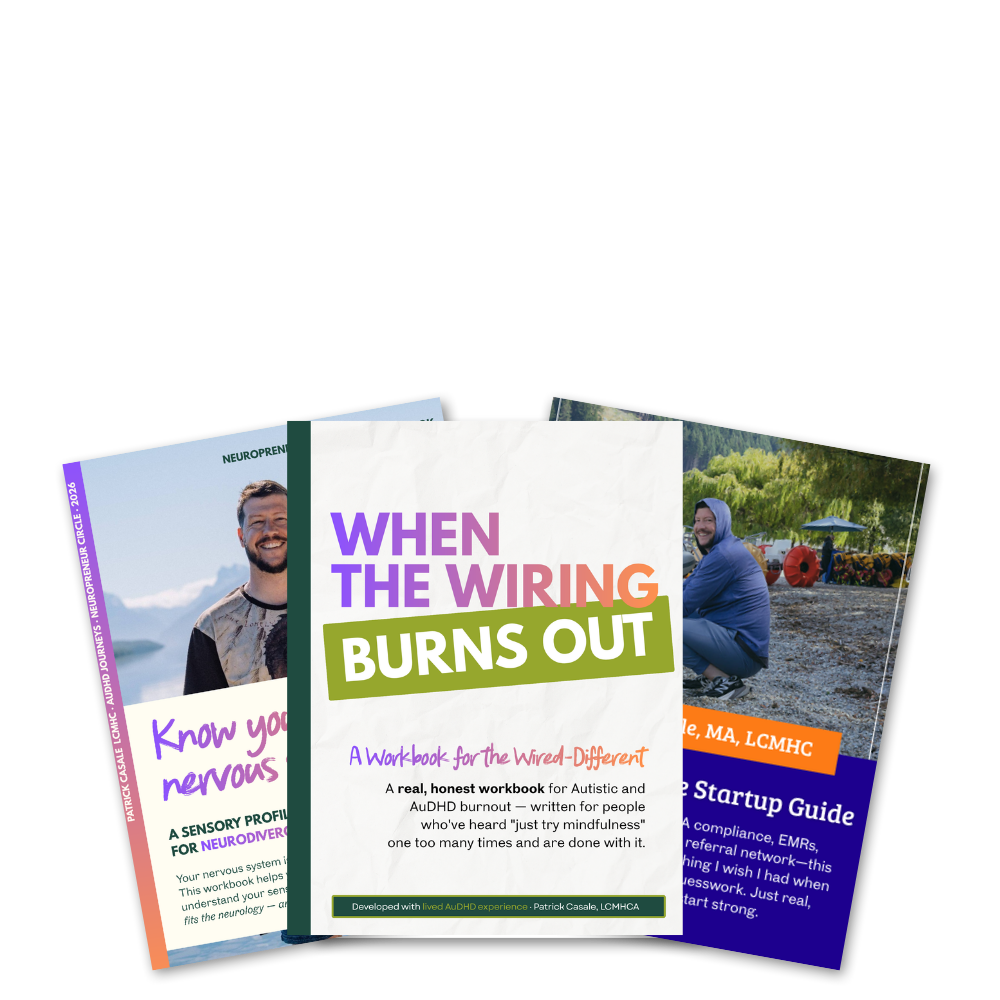
Get a practical podcasting workbook for therapists considering starting a podcast, created by Patrick Casale, host of the podcasts The Neurodivergent Entrepreneur and Divergent Conversations.
You'll get a practical structure for therapists who want to start a podcast but don’t want to rush, perform, or build something they can’t sustain.
Grab your free copy: ndpod.org/Free-Podcasting-Workbook
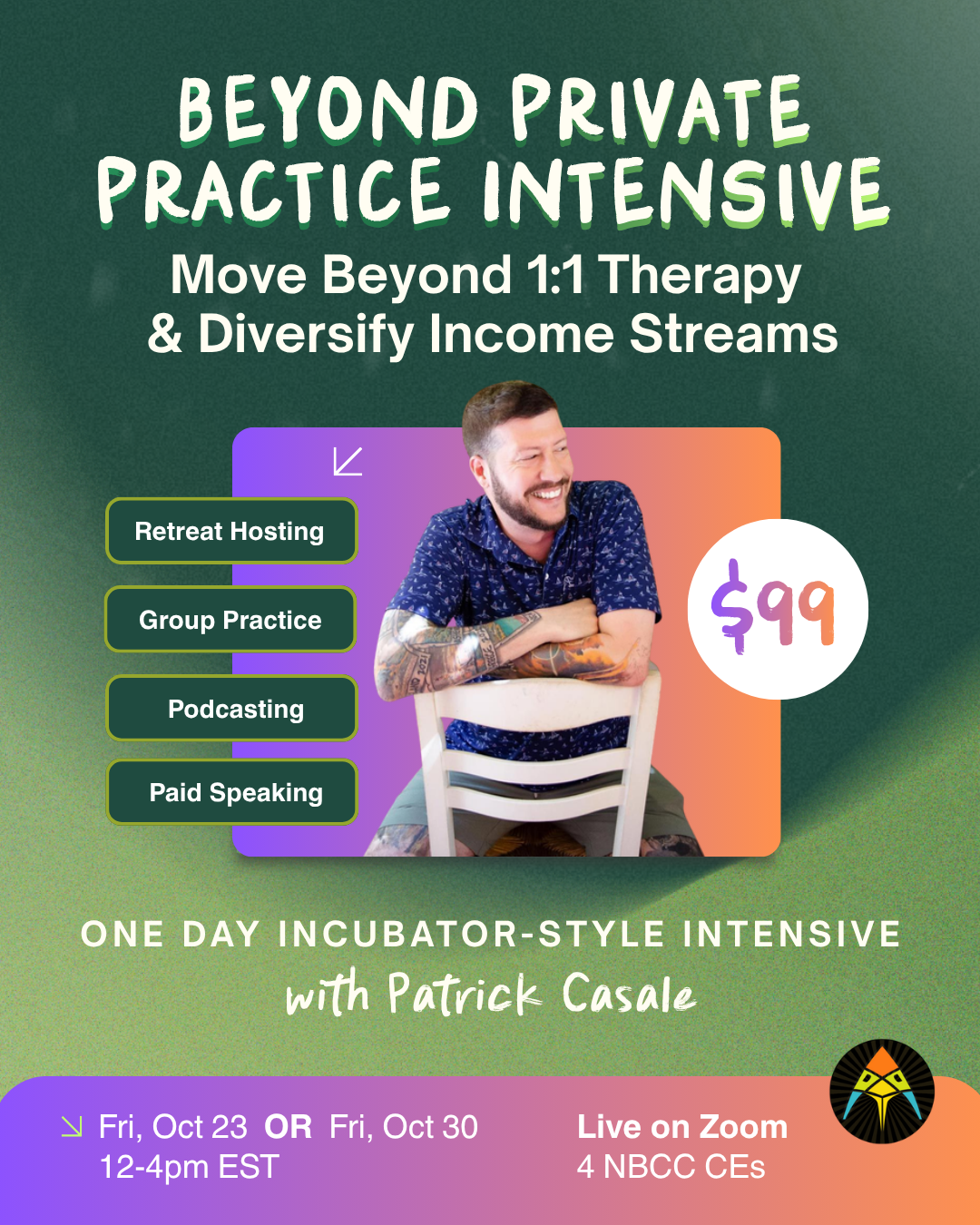
✨ Move Beyond Private Practice As A Neurodivergent Entrepreneur
Move Beyond Private Practice As A Neurodivergent Entrepreneur is a FREE 5-part mini-course designed for therapists who want sustainable financial independence beyond one-on-one work.
Access your free mini-course here: ndpod.org/Neurodivergent-Entrepreneur
Transcript
PATRICK CASALE: Hey, everyone. So, I just got back from a month in beautiful Queenstown, New Zealand, which was top of my bucket list for a lot of reasons, mainly, as you can imagine, if you know me, Lord of the Rings, Hobbit, Middle-earth, Tolkien, everything. I actually even started the trip off by doing a vow renewal with my wife at Hobbiton, which is like my inner child dream, autistic special interest joy times a million.
And fun fact, I am friends with the actor who played Sauron in the movies. His name is Salah Baker, wonderful guy from New Zealand. And he and his wife were actually in New Zealand during the time. And I asked him, like, “Do you want to come to my vow renewal at Hobbiton?” And he was like, “Yeah. The bad guys never get to go to Hobbiton.” So, anyway, they joined us that day. And that was super special.
So, I've had a lot of reflections during a month away from the United States, especially in a country where everything is opposite, not only the side of the road that they drive on, and the way that the toilets flush, but culturally.
And let me be clear, New Zealand is not without its own problems, right? Like, how they've treated the Maori indigenous community, for sure, is a problem. But once you start doing compare and contrast to the United States, like, it's night and day.
I went to New Zealand last April with my dad to do recon for the two retreats that my friend Gabrielle and I just co-hosted in Queenstown, that I just got finished doing. By the way, I got back a day and a half ago. And I am still super jet lagged, 18-hour time difference being away for 30 days, it's going to take a while. But this is fresh in my mind.
So, I went to do recon last April. And I remember thinking and saying out loud like, “This is the first time I've ever not been anxious 24/7, 365. Is this what it feels like to be regulated and to have your nervous system feel safe?” And I started to think about that.
And some of it is probably related to special interest joy of being in like real-life Middle-earth, but I think a lot of it is because of the culture there.
And as an autistic ADHD human, thinking about the pace of life there is super slow. In America, and the States, and North America, too, everything is a grind. Everything is hustle. You are working to survive. We live in a capitalist hellscape here. And it sucks. It fucking sucks.
And I realized that the pace of life was different. They didn't care about the things that we care about. They're not concerned about the things that we are concerned about. And I know some of you may be thinking like, “Well, it's apples and oranges, right? Our country's huge. Theirs is not. Our population is massive. Theirs is not.”
All true. That doesn't mean that we have to live the way that we live, though. We've been sold a bag of goods that is complete bullshit. And I've noticed this around the world throughout my travels, not just in New Zealand, but in so many other countries where community is paramount. And in our country, things feel very isolated and siloed. Like, how many of you even know your neighbors' names?
And what I realized was that I felt so much safer there. They don't have gun violence. You're not looking over your shoulder at a movie theater, or on the street, or at a bar, or at a school, or anywhere else. They don't have it. It's not a thing.
Everyone has healthcare. While I was there, I found out one of my best friends has stage four brain cancer. And it fucking wrecked me. And I started a GoFundMe, because it's all I could do. It’s the only way I could help, was to help raise money, because I know what's to come, financially. He doesn't have great health insurance. He's a small business owner. I might link the GoFundMe in the show notes, by the way, so if you're interested in sharing or donating.
You know, so he's going to have to pay out of pocket for radiation and chemo, and to try to stay alive. And then whatever happens next, the after-effect for his wife, it's really fucking sad.
And people in New Zealand were asking me, “Why are you starting a fundraiser for his healthcare? Why wouldn't your government just help pay for it?” I kind of laughed, like in so many parts of the world, where people have access to free healthcare, and we do not, in a for-profit health capitalist hellscape where the outcomes are all determined on how much money their companies can make and whether or not you're worth saving, or worth protecting, or worth taking care of. It's fucking sickening.
And then, just from like a sensory perspective, New Zealand is wonderful. Everywhere looks like a postcard. The landscapes are dramatic. You're outside in the free, open air, all the time.
I was in Queenstown, which is very touristy, but one of the most beautiful, no, the most beautiful places I've ever seen in my entire life. The Lake Wakatipu, and then the mountain backdrop. It's unbelievable landscape. And you can feel it. You can feel it in the energy.
And while I was there, during our first retreat, people kept telling me, like, “You look so happy, I've never seen you look so comfortable, or at ease, or relaxed.” And that really started to sink in for me. And it sunk in last year when I was there, too. I was like, “Damn, moving here would be a dream.” It really would be a dream.
I feel more dysregulated in this country, in the United States, than I ever have in my life. A lot of it is about what's going on, too, people around us, specifically, that don't look like me. The cruelty, the war mongering, the constant gaslighting, the propaganda, the money for war, the money for destruction, the money for control, but never the money for healthcare, or for housing, or for humanity, or basic human rights, or for food security. You'll be told a million lies of why we can't do those things. And people buy into it, obviously, because our country has thrived off of it for 250 years. And it's just sickening to me.
And it made me realize, like, we don't have to live this way. We choose to, in a lot of ways, some of us don't have a choice. I mean, that's maybe my privilege talking when I say we choose to. But what I mean by that is like the rest of the world does not. And we've been kind of brainwashed into believing we're the best of the best at everything, right?
Even when COVID was happening, I remember some of the collective mentality was like, “It'll never happen here.” As if borders prevent disease spread. Sigh, anyway.
So, when I'm in New Zealand, the government is very inclined to protect the environment, the ecosystems. Everything is a historic landmark, or just protected in terms of, like, don't step on the moss in the forest. We want it to grow back. We're trying to regrow all of these trees in our forest. We're trying to reintroduce these rare, endangered bird species. Like, there's so much intentionality. It got me thinking about intentionality.
So, I have been hosting retreats on and off for almost five years now. New Zealand was number 21 and 22 over that span. In that span, I've gone to Ireland four times, Spain five times, Italy, Greece twice, Portugal, Scotland, parts of the United States. I'm sure I'm missing something. I don't even know off the top of my head. And it's been a dream. I have literally created a dream job.
And I did so alongside All Things Private Practice, as all of my business ventures were just exploding during the onset of COVID and until present day, coaching programs, courses, speaking engagements, retreats, group practice ownership, TEDx, book deals, blah, blah, blah, blah, blah, podcasts, et cetera.
And the reality was like I chased a lot of that success at first. I've had to deal with a lot of inner child wounding throughout my life, and especially these last couple of years, getting through the roots of trauma and this belief that I'm only as good as my next accomplishment, only as good as if I'm creating, right?
And our culture does that, too. Like, capitalism says if you are grinding and hustling, you're worthy. If you stop, or step on the brakes, or have to step away, you're lazy and unmotivated, and not deserving of help.
And that really plays a role in conjunction with inner child wounding, where I had a lot of CPTSD from childhood, and the way my parent’s divorce was, and the type of parents they were. And it's no shame to them now, you know? Like, they were doing the best that they could, but the best was not good. It was traumatic.
And all of my life, I've been seeking validation. And it made me realize, like, none of that has been healthy for me. When I became successful in my career, you start almost chasing it. It's like a dopamine rush, similar to my gambling addiction, right? It's like that slot machine lever, pulling it over and over and over again.
And fast forward to present day, was it all worth it? And I would say the answer was no. Did it help me have the experiences that I've had? Yes. And I'm eternally grateful for that. Has it burnt me out so bad that I am unsure if I will ever recover. Also, yes, both things can be true.
And I wish I had a time machine, because I would do it very, very differently. Yeah, I did not know that I was autistic when I started All Things Private Practice back in August of 2020. I found out the following fall, in September of 2021. I knew I was ADHD. I always attributed that to being an entrepreneur. Like, almost 75% of entrepreneurs are ADHD. And it made sense.
So, I was like, yeah, flow, creativity, different interests, thinking outside the box. Great, wonderful. I can do it. It's definitely a strength of mine. I mean, there's a lot of struggle that I have with my ADHD, and my dysfunction, and executive functioning, and working memory, and distractibility, and attention impulsivity, name it. Yeah, check all the boxes. But I knew it was also a strength as an entrepreneur.
When I discovered I was autistic, my business had already taken off wildly. Like, people would tell me you've had more success in your first year than most people ever have in their lifetimes in this career. And that never registered for me, because I've always been of the mindset of, like, on to the next thing, ADHD. And also, a high achiever.
So, I couldn't even take it in. I couldn't even, like, absorb it. I was never proud of the accomplishments, but I did chase them, especially at first. It was kind of exhilarating. It was kind of a rush. And I kind of lost myself along the way, to some degree. There are definitely decisions I've made that I would not make again, relationships that I would have never had or would have seen coming, people who took advantage of me in ways that I can't even put into words right now.
And the reality is, when I found out I was autistic, the wheels were already off. The train was already like, well, along its journey on the tracks. I had coaching programs exploding. I had coaching, individually exploding, podcasts, Facebook group exploding. My group practice started in January of 2021. Yeah, so it had just started. Okay, timelines are hard sometimes, especially when you're getting used to jet lag from being 18 hours ahead of normal day-to-day.
So, all of this stuff is happening at the same time. And I'm trying to, like, bounce from thing to thing to thing to thing. And I'm like, I don't know how to keep anything straight. Everything is very successful that I do, everything that I touch seems to turn to “gold” is what people told me. Coaching programs selling out. Courses selling out. I started launching retreats in March of 2022 in Ireland. I've talked about this in previous videos and on posts, and that took off. And then, that sold the next one out, and that sold the next one out, and it just got really intense.
And along the way, I had a second throat surgery. You probably can't see the scar, but I can feel it and see it every day, which paralyzed one of my vocal cords permanently. I've had to relearn how to speak, which was really tough, when your voice is your, in my opinion, my gift, and what I have to offer the world, was really harrowing experience, having to go through that and navigate. That was actually really fucking hard. Still is some days, especially in loud environments, when I can't speak over something, where people will ask me what I'm saying, and I'm like, “I can't speak any louder than I'm speaking.” So, yeah, that's still a thing.
But along the way, all the success breeds success, a lot of the times. And you can chase it, and you can kind of get consumed by it. And what I did to myself was I put my needs to the back burner, my nervous system. I didn't pay attention to how I was feeling throughout it until it was too late. I didn't really fully understand being autistic at the time, back in 2021. I still sometimes don't always understand myself, even in 2026.
But what I didn't realize was the sensory overwhelm that I was experiencing constantly, the social struggles, the amount of alcohol it takes me to host a retreat or an event, to actually be an active participant, but also be around 15 to 25 people for five to seven days. It's a lot of energy, a lot of interaction, a lot of fatigue and exhaustion.
And then, obviously, comes the culmination and a compounding of all of that into intense autistic burnout, where I've probably existed and lived for the last two years and tried to get out from under, but it has been too late.
My years have been planned out for the last five years. If you had asked me going into 2022, ‘23, ‘24, ’25, every single month was planned out. Okay, I'm doing this retreat in this country. Okay, I'm coming back, and I'm resting for a month, then I'm going back and doing it again. Okay, now I have these courses, these speaking engagements, the podcast, etc. So, like no rest, even when I was trying to be really intentional.
So, going into 2025, I had spoken to my previous therapist. I was like, “I need ironclad boundaries, because I'm destroying myself.” And I could see it, right? Like, I was in the thick of it, but I could see it. I knew it to be true, similarly to when I was gambling. And I knew I was destroying myself, but I couldn't get out of it. I was like, “I am just too far in it. I'm too far gone. I can't, like, get out from under the obligations, and the demands, and the expectations of it all.” Some of it was self-inflicted. Others were true commitments. Like, I would have retreats planned years in advance, and people had paid deposits, and then, large amounts of money. And I felt like, so guilty if I felt like I had to step away or take a step back.
And I started to in retreats, like, removing myself when experiencing sensory overwhelm, or social fatigue, or whatever. And I tried to model that. It wasn't enough. And going into ‘25, I said to my therapist, “I'm only going to host retreats in odd-numbered months. So, in even-numbered months, February, April, June, etc. I'm not doing anything, just resting.”
You want to know how long that lasted? I had a retreat in January, in Belize, okay, odd numbered month. Good to go. In February, I got asked to do a TED talk. I was like, “I got to say yes to that. That took an enormous amount of energy, going to Colorado in the middle of the winter, rehearsing for that, the nervousness, being on stage, all of it.
March, I had an Ireland retreat, my final one there. Very sad, lots of emotion tied to that. But I knew it was my final one. I just knew it in my soul. I did not ask to rebook for 2026 like I had the previous four years.
April, went to New Zealand to do recon for this year's event, although a vacation, also a working vacation, wasn't able to turn it off.
May, hosted a retreat in Spain. June, think June was the only month where I had a break.
July, hosted a summit in Scotland.
August, went to Portland, Maine, to do recon for an upcoming summit for this year, which is September 1st to the third. Links are in my bio. Doubt yourself, Do it Anyway summit, nine CEs, 14 speakers come to that.
Then I had the bold idea to co-host and do retreats back-to-back in September in Greece and Spain. Instead of coming home to the states and going back to Europe in November, I was like, “Let's just get it over with it. We'll be there. We'll hop from one country to the other.” Finished Greece, out, flew to Spain. Immediately got sick. Ended up coming home to the states, never even stepped foot on that retreat. My co-host did a great job. Everyone was in wonderful hands, but didn't even get to spend a single second with anybody.
That brings us to October, went to Spain with my wife for vacation. Immediately got sick, ended up in the hospital, and then the rest of the year was just rest.
And here we are in March of ’26. And I've been like counting down the days to get through New Zealand, because it had been on my calendar for two years. And I knew we were doing two seven-night retreats, with a week in between to recover. And I thought, “This is wild, but I'm going to see it through.” Despite my therapist telling me to bail, I was like, “No, I'm not doing that to these people on the other side of the world. I have to see this through.”
So, being in New Zealand for a month, right? Doing two, seven-night retreats. Usually, by like, halfway through most of my travel experiences and retreats, I'm like, “I'm ready to leave. I just want to go home. I'm so exhausted. I'm so burnt out. I'm so crispy. I'm so irritated. I'm so tired.” I never felt that way during this 30-day experience, not a single time.
Usually, as we get to the end of a trip, I always joke that my sign or my tell that I'm ready to go home as I start craving a Big Mac from McDonald's. I don't really eat fast food, but that's my tell. When I want that Big Mac, it's like, “It's time to go home to the United States.” Never happened to me in New Zealand. During that 30 days, there were hard days, for sure. My wife went home halfway through. So, I lost my co-regulating human. She was on the other side of the world, time differences, trying to communicate, two ships passing basically for two weeks.
And then, hosting a second retreat, running on fumes. But I never had the feeling of like I feel dysregulated. I feel overwhelmed. I was just tired, naturally, as anybody would be. But I never had the feeling of like, “This isn't enjoyable for me.” I just loved it there. The temperature in Queenstown is like 50 to 70 degrees every day. It's perfect for me, someone who really struggles to control temperature and is hot all the time and uncomfortable. It was wonderful.
The scenery, it was like a portrait. It looks fake. And being immersed in Lord of the Rings, Tolkien, Middle-earth culture. Amazing. The culture of New Zealand, like I mentioned, amazing. Everything just feels right there. It feels aligned.
And I know if I had a time machine, I would go back and do the last five years very differently, with so much more intentionality. And I said this during both retreats, we kind of talked about, like, what are you taking away from this? What are you letting go of?
And both retreats, I said, I am letting go of this internal narrative and dialogue that says you need to be productive and useful to be worthy. You need to be creating to be useful. You need to be answering questions and responding to comments in your DMS and emails immediately to be useful. I'm letting go of all of what it means to be successful. I need to save my life, because I will not recover from it if I don't. And that doesn't mean shutting everything down. I still enjoy podcasting. I still enjoy writing, but I really have to take a step back from doing live events, speaking opportunities, trainings, consulting, courses, programs, retreats. I just have to take a step back. And that's a hard moment for me to realize, like capacity and disability. And just being honest with myself and really transparent about it.
If I had a time machine, I would go back in time and only do what I did in New Zealand. I would do two events per year, all for neurodivergent entrepreneurs. Because what I realized during that first event, which was specifically for neurodivergent entrepreneurs, everyone was unmasking. I never had to, like, frame my communication a certain way. I didn't have to overthink what I was either going to say, how to respond, how to show up. There was just this expectation of like, we just get to be here, and exist, and sensory soothe, and work through burnout without the demands of life piling up. And it was really beautiful. It was really my most enjoyable retreat experience out of all 22.
I never knew that going into this New Zealand would be my final events. And I say final because I have nothing else planned this year besides Maine in September, which I don't really even count as a retreat, because it's a summit/conference. And it's the first year where every month of my calendar is not accounted for. It's kind of scary to start thinking about all the free time, and the restlessness, and what your nervous system does with that, but it's necessary.
And what I think is I would have intentionally done two or maybe even four events per year, only in New Zealand, only for neurodivergent entrepreneurs, and I would stay longer periods of time, instead of bouncing back and forth to the United States, to a different country, to, you know, different culture transitions, etc., stay for a longer period of time. Really integrate, really anchor in, really work through the transition struggles that a lot of us as autistic and ADHDers experience and other neurodivergent humans do. And the culture just agrees with me. The climate agrees with me. Everything agrees with me.
I was there for 30 days. I didn't get sick a single time. And I was around quite a few people in our second retreat who were definitely sick and masking, but still, it was like, “Oh my God, it's inevitable.”
All of that travel to get there, never got sick. That is beyond rare for me. If you have followed my stuff, you know this. So, something about that place is just really special.
And I think I didn't want to let my brain, like, go into visionary dream mode while I was there. But I know so many of you are struggling with autistic burnout. I know that my good friend Dr. Megan Neff is doing a lot for that community right now, where she's offering free scholarships for her autistic burnout course, because there's such a demand, which I think is a beautiful offering.
And there's so many people who have reached out to me while I've been talking about my burnout journey, asking me, like, “What do I do about it? Where do I go? I can't just take five days, seven days. Like, it's going to take an extended period of time.”
And I think part of my dream, and I'm not even going to put expectations on this, of when this could be created, but I would want to create a longer-term autistic burnout recovery center and situation in New Zealand where people came for at least a month, and just got to integrate, and sensory soothe, and unmask, and just exist without the demands. And that's a pipe dream. At this point, I think I could pull it off, but I don't have the capacity to even start thinking about it. But if I do recover from all of this, that's where I'm going to put my energy and my focus, because I know so many of you need it, so many of you need more than just a beach vacation or taking an extra day off work per week.
Life is so fucking stressful, and life is so fucking short. My friend, who got that news while I was in New Zealand about his unexpected brain cancer, right? It's so short, and it's so unpredictable, and we have to make the most of the life that we have. It's the only way. And it's the only one we've got.
And I was on this overnight cruise of Doubtful Sound in New Zealand, which was really special. No cell service, no Wi-Fi, so freaking beautiful, just in the middle of nowhere. And I noticed most of the people on the boat were over 65, 70, really struggling with mobility, really just struggling, in general. And I thought to myself, how many of these people have waited their entire lives to take this trip, and I get to have all of these bucket list experiences before I'm even 40?
And I think that feels really special. And I understand the privilege and how grateful I am for that, because I know so many people who are like, “I'm going to do this when I retire, I'm going to do this, you know, once I can travel freely.”
We just don't know what happens. We don't know what happens in this country. I'm not going to say things that, you know, but people can read between lines. We don't know what's going to happen in the world. And I think we just have to make the most of the opportunities that we have, and we need to do so, anchoring into our values, and with intentionality.
And I just want to thank all of you for being supportive of my journey, and whether you've supported me from afar or you've lurked on my social media and never said a thing. Or you've reached out via DM or email, or you've come to my courses, or my retreats, or listened to the podcast. Like, however, you've supported. I appreciate you.
And I hope you take with this, like, two things. Please don't do as I do. You don't want to be in the position that I'm in. It's not fun in my current state. And two, life is very short. Please make the most of your opportunities. Please doubt yourself, do it anyway, even when it feels hard, even when it feels scary. And I really appreciate you all listening.
FREE PRIVATE PRACTICE GUIDE
Join the weekly newsletter for private practice tips, podcast updates, special offers, & your free private practice startup guide!
We will not spam you or share your information. You can unsubscribe at any time.





![Episode 266: Healing Isn’t Just in Your Head: Rethinking What Therapy Can Be [featuring LeNaya Crawford]](https://kajabi-storefronts-production.kajabi-cdn.com/kajabi-storefronts-production/file-uploads/sites/2147507511/images/a2d5a4-e4bf-63b0-fa7f-6e6f62c466d5_TNDE_YouTube_episode_266.jpg)
![Episode 264: Creating Through the Chaos of a Neurodivergent Life [featuring Bre "BR3"]](https://kajabi-storefronts-production.kajabi-cdn.com/kajabi-storefronts-production/file-uploads/sites/2147507511/images/a14004-cc3d-8aba-5fb8-2442fdfc650_TNDE_YouTube_episode_264.jpg)
![Episode 263: Your Symptoms Are Real—Even When Medicine Doesn’t Have The Answers [featuring Dr. Zachary Spiritos]](https://kajabi-storefronts-production.kajabi-cdn.com/kajabi-storefronts-production/file-uploads/sites/2147507511/images/84bc15-1ce4-1a0b-8f85-f5812bce75_TNDE_YouTube_episode_263.jpg)