Show Notes
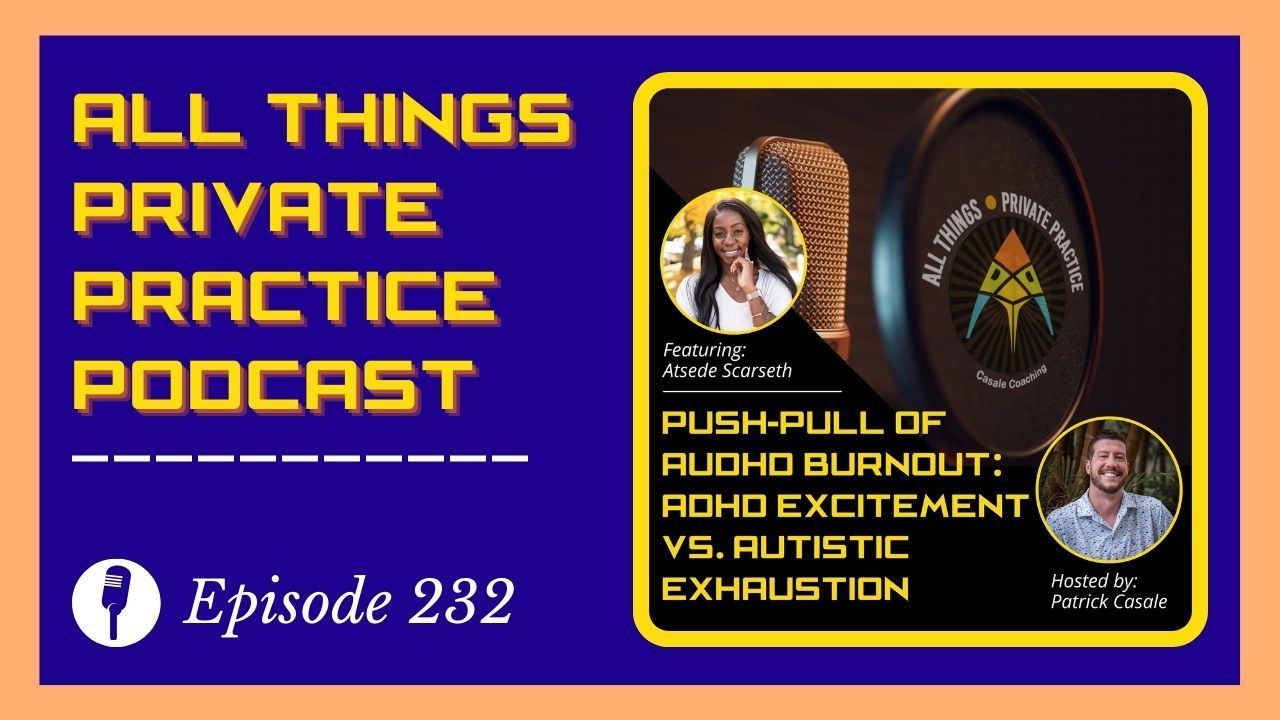
AuDHD Burnout goes beyond overwhelm felt from external forces in life and into an internal struggle of navigating the everyday tug-of-war needs and desires stemming from being both Autistic and ADHD.
In this episode, Patrick Casale talks with Atsede Scarseth, an AuDHD LPC, Coach, and Certified Yoga Teacher, about the complexities of AuDHD (Autistic + ADHD) burnout, masking, and the necessity of both self-acceptance and truly restorative rest, particularly as a neurodivergent entrepreneur.
Here are 3 key takeaways:
- Burnout is Nuanced: It’s not just about overworking; neurodivergent people often burn out from sensory overload, masking, or pushing past personal limits—not simply job stress.
- Integration is Key: Insight into your neurodivergence is only the beginning. Real transformation—and healing—happens when you learn to embody those insights and adjust your life accordingly.
- The Power of Neurodivergent Community: Building spaces (like specialized retreats) where unmasking is welcomed and rest is prioritized can be transformative. It’s about community, not just survival.
More about Atsede:
Atsede (At-sed-uh) is a Licensed Professional Counselor, Coach, and Certified Yoga Teacher. Originally from New York, she’s lived in Colorado for 10+ years. Atsede completed her Masters of Arts in Clinical Mental Health Counseling at Northwestern University. Her neurodivergence (Gifted, AuDHD), various life experiences, and unique worldview allows her to meet people where they are authentically. She enjoys music, nature, and intuitive movement as each one holds a significant place in her life and informs how she interacts and connects with those around her. Atsede spent much of her early years confused, overwhelmed, and anxious despite her ability to “successfully” navigate the majority of situations she was presented with. Her journey to understanding her needs and how to take care of herself included a holistic approach involving mental, physical, and spiritual wellness. She likes to balance evidence-based therapeutic modalities and spiritually aligned practices (yoga, psychedelic work, intuitive practices, etc.). She also enjoys traveling and experiencing different ways of living, which hosting retreats allows her to do while giving back to the communities she’s sharing space with.
- Retreat Offer: Check out Neurodivergent by Nature: A Lush Getaway in Ireland. This is a retreat for the Neurodivergent, highly sensitive feelers to get together, unmask, reset, rest, learn, and connect. Use code PATRICK for $300 off the experience. Learn more: unearthingchoicecounseling.com/ireland
- Instagram: instagram.com/atsedescarseth
- YouTube: youtube.com/@atsedescarseth
🎙️Listen to more episodes of The Neurodivergent Entrepreneur Podcast
🎙️Spotify
🎙️Apple
🎙️YouTube Music
▶️ YouTube
✈️ Check out available Retreats
🗨️ Join the free Empowered Escape FB Community
A Thanks to Our Sponsors: The Receptionist for iPad!
I want to thank The Receptionist for iPad for sponsoring this episode.
The Receptionist for iPad is a HIPAA-ready digital check-in system that eliminates the need to walk back and forth from your office to the waiting room to see if your next appointment has arrived. Clients or patients can check in for their appointments, and you'll be immediately notified by text, email, or your preferred channel. Break free from interruptions and make the most of your time, because it is valuable. Start a free 14-day trial of the Receptionist for iPad by going to thereceptionist.com/privatepractice. Make sure to start your trial with that link to get your first month free if you decide to sign up.
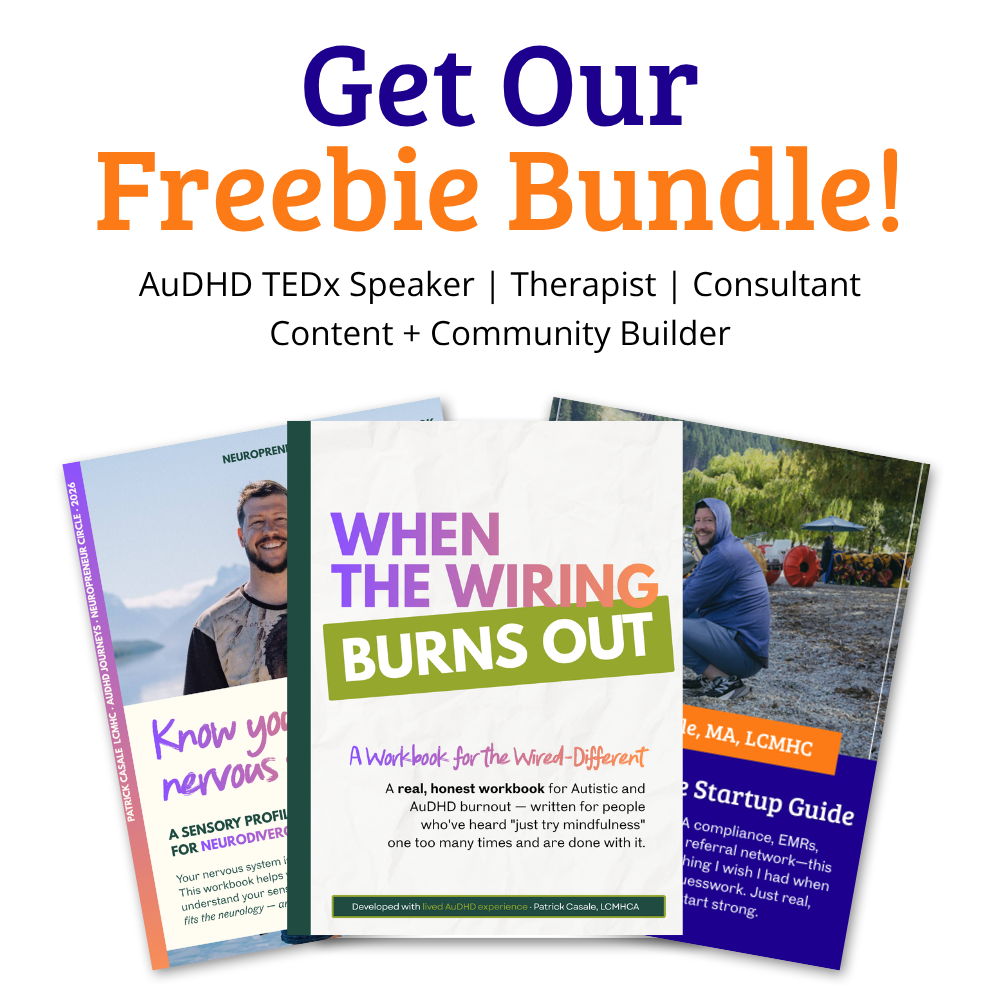
Free Gifts for Our Listeners
Get a practical podcasting workbook for therapists considering starting a podcast, created by Patrick Casale, host of the podcasts The Neurodivergent Entrepreneur and Divergent Conversations.
You'll get a practical structure for therapists who want to start a podcast but don’t want to rush, perform, or build something they can’t sustain.
Grab your free copy: ndpod.org/Free-Podcasting-Workbook
✨ Move Beyond Private Practice As A Neurodivergent Entrepreneur
Move Beyond Private Practice As A Neurodivergent Entrepreneur is a FREE 5-part mini-course designed for therapists who want sustainable financial independence beyond one-on-one work.
Access your free mini-course here: ndpod.org/Neurodivergent-Entrepreneur
Transcript
PATRICK CASALE: Hey, everyone. Welcome back to the All Things Private Practice podcast. I didn't even ask you how to say your last name. And now I'm just realizing that.
ATSEDE SCARSETH: It’s Scarseth.
PATRICK CASALE: Okay. I would have said it that way. So, I am joined today by Atsede Scarseth, who is a licensed professional counselor, coach, and yoga teacher. She's originally from New York, lived in Colorado for 10 plus years. And has a master's in arts and clinical mental health counseling from Northwestern.
Her neurodivergence, giftedness, AuDHD, various life experiences, and unique worldview allows her to see people where they are authentically. You are a retreat host, enjoy traveling, living, and allowing people to give back to the communities that you're sharing space with. Her journey to understanding her needs and how to take care of herself included a holistic experience and approach involving mental health, physical, and spiritual wellness. And also, likes to balance evidence-based practices, spiritually aligned practices like yoga, psychedelic work, and intuitive practice.
We were going to talk about integration today. And then, you reached out and said, “Can we just talk about burnout?” And specifically, ADHD burnout, not workplace burnout? I want to make that clear distinction. And I'm totally, totally on board, because that is where I am and have been. If you have been following my social media posts, you know that I am definitely in the thick of it. So, one, welcome to the show. And two-
ATSEDE SCARSETH: Thank you.
PATRICK CASALE: What made you want to talk about that, specifically?
ATSEDE SCARSETH: What a year it's been. Thank you [CROSSTALK 00:02:34]-
PATRICK CASALE: What a year it’s been?
ATSEDE SCARSETH: Yeah.
PATRICK CASALE: Yes. What an understatement, I think, even.
ATSEDE SCARSETH: Yeah, a true understatement. I mean, as I was having a breakdown last night, I was like, “Yeah, this is that burnout thing.” And it's so funny, because I've been convincing myself, like I've been coming in and out of it, and been like, “This isn't burnout. No, no, no, no.”
And then, just a few times this week, even, I've said, “Oh, I've hit my limit. Oh, I'm okay.” This is the first time I felt it in this way. Like, it's just been such a full year of a lot of very exciting things, which is wonderful. And I'm so tired. I'm exhausted. And it's that push-pull of the ADHD, constantly seeking, wanting more and more and more. And the autistic side of me is just like, can you please, please give me a break, and that fight back and forth. So, I was like, maybe we don't talk about integration. I mean, I think, it might weave its way in, because it's important and it's always around us. But the burnout felt very much at the forefront.
PATRICK CASALE: Yeah, yeah, you said it perfectly. It is that constant, like, push-pull navigation I talk about. The like AuDHD tug of war a lot. And I've been in probably major AuDHD burnout for over a year. I actually noticed that last year, going into, I was hosting a summit in Italy. And all I kept telling myself in my brain was like, “Get through Italy, then the rest of the year is done. And you're going to go to New Zealand. You're going to go on this two-week Lord of the Rings tour. You get to nerd out in your special interest the whole time. You get to relax. You don't have any more demands.”
That was like my brain telling myself, just push, push, push, and get done. Then here in Western North Carolina, immediately after Italy, Hurricane Helene came and just devastated and destroyed most of the area. And my wife kept saying, like, “You should still go.” And I'm like, “There's no fucking way I'm leaving you in the midst of this.”
So, like, since that time, it always feels like I'm playing catch-up, trying to, like, regenerate, restore, relax enough just to be okay to function for the day, because of all the events that I host. And then, the election. And then, this year has felt like 20 years. And I'm still surprised we're in 2025.
ATSEDE SCARSETH: It feels like I can't believe we're still in 2025 and I can't believe that the year is almost over and we're heading into 2026 so soon. It's very, very weird.
PATRICK CASALE: It is. Yeah, and I like that you named the excitement, of like, you have these good things going on. And then, that's really the ADHD side, right, of like, “We've got all these cool things to look forward to. Look how exciting this is.”
And then, in turn, because of all the exciting things, the autistic side is, like, over there, waving the white flag desperately saying, like, “Please don't put anything else on the calendar. I cannot do one more thing.” And it is that constant, like, clashing over, and over, and over, again.
ATSEDE SCARSETH: And then, what I notice is, if I'm looking out far enough and something comes up, and I'm like, “I'll probably be in a good enough space by then. It should be fine.” And then, we're talking about flying, too, because, obviously, travel is a big part of what we do with retreats. And it's like, “Oh, okay. Yeah, in like, four months off the fly and it'll be fine.” And the autistic side is like, “Please.” Like, “Uh.” But it's like, “Oh, no, no. Like, the ADHD is just so much louder, and excitable, and all of that.
PATRICK CASALE: I'm laughing because, like, Dr. Neff and I talk about this on the Divergent Conversations podcast all the time, about you're almost like forgetting because of the excitement and the romanticizing that the ADHD side does. You're forgetting the energy tax and toll that it takes to go through, flying, traveling, experiencing, hosting, new environment, whatever, transitioning. And you're like, “Oh, but that's in six months, and my calendar is clear, so it will be okay.”
But then, the ADHD side also starts to put things into your calendar, like, “Ooh, I should do more podcasts. Ooh, I should do this. Ooh, I should say yes to this opportunity. This sounds really exciting.” By the time you get to that six months, you're like, “Holy shit. I'm so worn down. I don't know if I can do this.” And it's that constant back and forth.
ATSEDE SCARSETH: It's exhausting. And I think there's a level of feeling a lot of privilege, that this is the life that I've built for myself, right? And I think that might be the autistic side, and some of that justice piece that comes out, where it's like, almost like there's not really space to complain. And it doesn't feel like complaining all the time. I do love to vent, though. I will say venting is a love language of mine. But there is a sense of maybe you really can't speak too much to how tired you are, because you're getting to go to all these beautiful places and enjoy this beautiful life. Just enjoy it more, right? There are people that can’t do what you're doing.
PATRICK CASALE: Yeah, be more present, be more in the moment, be more appreciative. Like, how lucky you are to go and do all these things that feel so extraordinarily amazing and just not the norm for our profession, where people are not often, you know, able to do these things or even attend the events that we host.
And I think about that a lot. I actually had a breakdown. It was like four months after my second throat surgery, and my throat and my voice were really struggling. I didn't give myself enough time to recover. I jumped right back into retreat season. And I remember having this breakdown outside because, one, I couldn't speak loud enough to actually, like, participate in what was happening around me. That was really a struggle. I would have to ask my guests, like, “Hey, can you get everyone's attention? Hey, can you, like, help me out here?” And that became a running joke for a while.
But I was so overwhelmed, sensory-wise. And I didn't know that was what was happening. It was right after my autism discovery. And I was just having like, intense sensory shutdowns and meltdowns, like, and I just went outside and I would just, like, scream at the top of my fucking lungs, because I was like, I have created a dream job that I can't really participate in because I am so overwhelmed all the time, and I'm so impacted all of the time that it's so hard to be, like, present and appreciative of what's happening around you, and also feeling like, unable to actually, actively participate in it. And it was really a mindfuck, because I was thinking, like, “Maybe I just need to give this up completely.”
ATSEDE SCARSETH: Yeah, thank you for naming all that, because I resonate in some ways, and also just see you. Like, it is so hard to do such a cool job and have your body feel like it's not on board all the time, and then [INDISCERNIBLE 00:10:04] up with what your brain is wanting to do, and give to people, and experience to the full.
PATRICK CASALE: Right.
ATSEDE SCARSETH: That language too, and that like “Oh, maybe I should just quit.” Or, “Maybe I should just be done with it all.” Feels like the alarm bell of burnout that sometimes I don't even step into or recognize. It's like, oh yeah, you're feeling like you don't want to do this anymore, but you know it's something you love, right? Again, that gets clouded, but it's something you love. It gets clouded, and it just turns into, oh, yeah. Like, maybe you're just not cut out for it [CROSSTALK 00:10:44]-
PATRICK CASALE: And it’s like nothing like the AuDHD experience in a nutshell, exactly that, right? Of like, I'm excited about this. My mind is really going, it's so excited. It feels creative. It feels connected. And your body is just like breaking down. And it's giving you signals. And sometimes it could be because of our own, sometimes internalized, ableism. It could be, I want to prove that I can do this. Like, I used to be able to do these things, why can't I push through now?
And if I listened to my body back in January 2023, which was at this New Orleans event, fast forward to present day, 15 retreats later, 15 countries later, end up in the hospital a month ago because of how broken down my body is from all the travel, all the hosting, getting sick constantly, being in burnout, pushing yourself beyond your limits, and your capacity, and eventually your body gives out. And that's exactly what happened, was, I was hosting back-to-back retreats. I thought this was a good idea in theory at the beginning of the year in Greece.
And then, flying directly to Spain to host another, because of what I said was that will be the end of my work year. What's the point of going back to the States for a month, recovering, and coming back? Just get them done. Do them back-to-back. I’ll never do that. Go through Greece, fly to Spain immediately. And I'm not even talking about a weekend. One day in get sick, think to myself, “Huh! I can fight this.” Gets worse, gets worse, gets worse. I never even stepped foot at that Spain retreat with all of the guests who waited a year to come to it. I had to send a WhatsApp chat to everyone, saying, like, “I'm sick, I need to go home. I'm sorry, but like, this is where I'm at, and I need you to have the best experience possible. You're in good hands.”
And that took so much, that was so grief-filled. And so much of me was like fighting that urge to say, like, “No, you're going to push through and do this.” I come home, I get super sick, recover for a month, go on my first vacation of the year with my wife to Spain. Get sick halfway through the trip, get more sick on the plane ride home, to the point where I thought I feel like one of my organs is going to burst. Like, that's the pain that I'm in. This is really scary. Get back to the states, tell my wife, “We need to go to the hospital in Atlanta.”
We drive four hours back to Asheville. I go to the ER. I'm there all night. I come back home with like two major infections. And it literally is your body saying like you're done. And you have to start listening to me, or this is going to get so much worse.
And I think for those of you listening, if you found yourself in these positions, you've got to listen to your body when you're feeling those red flags, or those signs, or those alarm bells are ringing because, like, if I had maybe I would not be in the position that I'm in and right now it really is a relearning process for me.
ATSEDE SCARSETH: Yeah, we're here two years later now from it.
PATRICK CASALE: Yep.
ATSEDE SCARSETH: The original moment. Thank you for saying all that and naming the grief in it, too, because-
PATRICK CASALE: I felt so much shame. You know, like being like, all of these guests have waited a year for this event. A lot of them signed up because of me, and I'm not even going to go. I can't even like, say hello. I can't even go to introductions. I can't even like participate. That felt so shitty.
And thankfully, my co-host, and I had really good speakers lined up. And they carried a lot of the weight. And my co-host did an amazing job, but it was not an easy decision for me to change my flight and say that to the group. Like, it really, really was very challenging.
ATSEDE SCARSETH: That takes so much courage, because, again, you've had this or and, yeah, I'll speak for myself too, this muscle is so overworked of just keep going. Just keep pushing. And so, to completely go against that, because you have to, it doesn't even feel like it's a choice at that point. Just that this is what has to happen. And there's some grief in that too, because it feels like your autonomy is taken by your own choices, which is kind of a mind fucking in itself.
PATRICK CASALE: It really is. I'm a PDAer. So, like, you know, pervasive drive for autonomy, for those of you listening, otherwise known as pathological demand avoidance. So, anytime I get faced with that, like, autonomy is being taken, I resisted at all costs. I'm like, “No, I want to be able to do the things that I want to be able to do.”
And then, it's been this way for so long. I try to trick the ADHD side all the time of like, we'll allow for like, going into 2025, I made this deal with my therapist where she was like, “Some major changes need to happen.” And I was like, “Yeah, I agree. In 2025, I will only do retreats in odd-numbered months. And I will only say yes to opportunities in odd-numbered months. And I will always give myself the even month to recover.”
And my autistic side really liked that. It was like, black and white thinking. And it was like, yes, even months you don't do anything. How long did that last? Like, maybe two months. And then, all of a sudden, a TEDx opportunity comes my way. And that's in an even-numbered month. And I was like, “Well, I can't say no to that.” And then, it throws my whole year off. And everything just spirals after that.
And I think you want to create this container for your ADHD parts, to give it enough room to be creative, to have those dreams, but trying to rein it in to the point where it's not running the show. And it's really hard. I mean, it's really challenging.
ATSEDE SCARSETH: So so hard. I'm even thinking about this from the standpoint of how I move my body, which is one of the ways that I like to regulate. The ADHD side of me gets so excited about dancing that I don't even like, it’s so silly. This past Sunday, in the midst of all this burnout, I was like, “Yeah, I just need to, like, move through. I just need to dance.” I was like, “Let me just do a split.” You haven't done a split in two years. What are you doing? Did it? Heard the pop, right? Little injury. And it's that exactly.
PATRICK CASALE: Yeah.
ATSEDE SCARSETH: On the cognitive level of you get too excited. You think you can do all the things, you're impulsive about it. It feels right. You just go for it. And then, you end up injured, or hurt, or having to backtrack and reset how you do things. And so, it's like this constant, not even like two steps forward, one step back. It's like you're sprinting in one direction, and then you hit a wall. And then, you have to very slowly, get yourself back up, actually check yourself out, dust yourself off, and then figure out how to get around the wall, or get over the wall.
And we call this energy, because you've been stopped, and then you've actually had a little bit of time to rest, not even recover, but a little bit of time to rest. And then, it kind of starts all over again. You blasted the wall, and then, there's another one.
PATRICK CASALE: Yeah, that's actually really good imagery for those of you listening and not watching the video. And honestly, like, that's so real. And I thought about this, like when I came home from Spain sick, right? After that retreat. I'm like, “I'm going to get into nature more.” So, we live in Blue Ridge Parkway. “I'm going to drive up there and go hiking a couple of times and really get out and get off my phone, disconnect.”
I push myself too hard because I haven't gone hiking in like a year. I come back after like a day of that, and my knees are all swollen. I sprained my ankle. And then, I have to pay the price. And then, your body feels like it's betraying you, but your mind is still very, very active.
And the one thing I've always struggled with, and I think it sounds like you can relate, is the ADHD side, the restlessness, that internal restlessness of feeling intellectually under-stimulated, where it's like, “I need something, right? Like, something has to be going on.”
But your body is like, I often have this image, and I've talked to Megan about this on the other podcast, of like, if my brain was just a brain in, like, one of those like, mechanical, robotic spaces, and then my body just wasn't around anymore because, like, my body betrays me all the time. And she said something so beautiful on Divergent Conversations one day, which was that the soul yearns for connection, but the body yearns for isolation. And I will never forget those words, because I resonate with that so, so, so fucking much.
ATSEDE SCARSETH: Yeah, I'm letting that land. I got chills at that, because it feels very true in a number of ways. And then, there is also that connection from that… How do I want to say this? Like, when I think of dance or being around other bodies, and sometimes the autistic side of me is like, I hate people. I can't do this. And it's that being perceived bit, I think, is part of it. But that's also the yearning for connection to me, too, right?
PATRICK CASALE: For sure.
ATSEDE SCARSETH: And that wearing the mask feels so safe in some ways. And also, I think, helps me feel like I have more capacity than I actually do when the mask is masking very well.
PATRICK CASALE: 100%.
ATSEDE SCARSETH: [CROSSTALK 00:20:32] drops. And it's like, “Oh, yeah, wait, there's no capacity here.” But that also feels like it can sever connection.
PATRICK CASALE: Yeah.
ATSEDE SCARSETH: Yeah, that language.
PATRICK CASALE: I think as humans, you know, we're striving and yearning for that connection and to feel like we want to be a part of. And I think as autistic people, we often feel like we are not a part of. Like, we don't get it, we don't belong, we don't understand the rules socially or societally, and we feel very isolated in that. And I think that the ADHD side sometimes helps us feel more social and connect more, because it yearns for that dopamine, and it yearns for that sensory seeking, sometimes in that way.
And I think it is that balance, because, you know, my social motivation is quite high. My social capacity is quite low. And those things are at war with one another, of like, I feel like I want connection. I want to be around people that I care about, but then I get so exhausted so easily. And it's like this constant reminder of having to create checks and balances to support your body and the ability to just rest. And I just find that to be so unbelievably challenging.
ATSEDE SCARSETH: How has your capacity shifted over the years as these discoveries have been happening?
PATRICK CASALE: It's a great question. I told my wife, and I've told some close friends that since I learned that I was autistic, which would have been back in 2021, I feel as I've unmasked more and more and more, that my capacity and abilities have exponentially shrunken. I feel like I am more impacted now and more disabled now than I have ever been in my life. And I know so many people who have discovered later in life that feel like I've found this discovery, I finally figured out the why, why is everything so much harder now?
And I think when you unmask, and you start to have this awareness of how impacted you are, and all of the ways that you've figured out how to belong and fit in which are not genuine or authentic to you, and then you start to get impacted, sensory-wise, by everything and anything. It's just so exhausting.
I hardly leave my house. Like, I think people think that I have this, like, really glamorous life based on social media, you know? Of like, “He’s in this country, he's doing this thing, he's creating this.”
And I'm like, “You all, 95% of my existence is spent on my couch or in this office that I'm in right now. Like, I don't leave my house.” And it's hard. It's gotten really hard. What about you? Did you discover AuDHD later in life or? Yeah, okay.
ATSEDE SCARSETH: Yeah. So, much of what you just said is like, did you just take that right out of my [INDISCERNIBLE 00:25:25].
Yeah, I discovered. And I also love that word. I love the word discover. That feels really spacious and just good for my system. Yeah, I discovered in 2020. And it was actually the ADHD first that I became aware of.
And it's so funny once you start piecing things together, and this is where I think the integration piece kind of comes in, because I think we're junkies for insight. I know that I am, right?
PATRICK CASALE: Same, 100%.
ATSEDE SCARSETH: [CROSSTALK 00:25:56] it's that the ADHD just like wanting to know more and wanting to know more and wanting to know more and more and more. And then, I think my special interest is also people, which is why I [CROSSTALK 00:26:04]-
PATRICK CASALE: Right.
ATSEDE SCARSETH: …do. But I do. But yeah, I discovered the ADHD first. And then, it was like, well, some bits of this aren't fully clicking. There's something else missing here. And then, I actually came across the list of highly sensitive, you know, assigned female at birth, or for women, something like that, this laundry list of things. And I was like, “Whoa. All of this is really checking out a little too much.”
And then, starting to look back on my life, and then learning about giftedness as it falls under the umbrella of neurodivergence. And then, 2E, like, twice exceptional. And so, my brain just basically exploded. And I was like, “So many things make sense.” But that was not enough, right? The insight is only a piece of it, and then the difficulty is integrating that and having that embodied shift of like, “Hey, this is what this looks like for you. You have been masking. You've been socialized to mask.”
And then, I think it's actually been made even worse or more prevalent, because I'm adopted and my parents are Caucasian, right? So, my whole life has been not having control over being perceived.
PATRICK CASALE: Yeah.
ATSEDE SCARSETH: That's one of the difficulties of being neurodivergent and already feeling like you don't fit. So, makes sense. I kind of flew under the radar for so long.
PATRICK CASALE: And you have these like degrees of separation, right? So, you're like, if you're this black assigned female at birth, adopted by Caucasian parents, having to mask, code switch, adapt to being in certain rooms and certain… My wife is a black woman. She works for the government. I always see government, Arielle. I see Arielle at home. I see Arielle with friends. I see Arielle with family and having to like, move through those different environments and be different people.
And I can't imagine how much extra energy goes into that, because I have so much privilege, right? To be like, I can basically act however the fuck I want to act in most situations, or say whatever I want to say in most situations, without ever, not ever, but often thinking about consequence.
And that was really interesting to me, post-discovery, to start examining. But like, what you're saying makes so much sense, and then having to try to integrate those parts, and you're constantly seeking that why, right?
Like, I think a lot of us AuDHDers are seeking information, trying to make sense of things all the time. When your reality doesn't make sense, or your existence doesn't make sense to you, and you get misdiagnosis, and you get misdiagnosis, and you get this, and you get told that this is why you're acting the way you're acting, or perceiving the way you're perceiving, or experiencing the way you're experiencing but yet none of that makes sense to you. It doesn't land.
And then, you finally figure it out later in life. And you're like trying to make sense of your entire existence now through a different lens, trying to move forward through this newfound lens. It almost becomes consuming. It almost becomes like everything I see now is through the autistic ADHD lens, and I can't unsee it. And that's really hard, too.
ATSEDE SCARSETH: It's both hard and such a relief.
PATRICK CASALE: Yes.
ATSEDE SCARSETH: I think that what feels most difficult about it is when you do discover something about yourself, and everything is starting to make more sense, and then you're sharing that with people and their understanding of you. Like, their mask slips a little bit, or they just show a little bit too much about how they feel, their ableism, or internalized ableism.
And then, the question of like, “Well, not everything can be about the ADHD, right? Like, that can't be the answer to everything, and why you show up the way that you do.” And I'm like, “It is to me. That's how I'm viewing it, because it's all made more sense.”
And I really appreciate labels. And it's so interesting. I know some people really hate labels, and they feel really confined by them. And for me, there's such a sense of safety and of knowing where to look, where to be, where to show up, who I can go to, and it's not going to be perfect science every time. But no, yeah, yeah, that constant [CROSSTALK 00:30:25]-
PATRICK CASALE: Yeah. I think that's true. And it's that grief relief paradox, in a way that's always talked about, you know, is like grief of former self, what could have been different, relief to finally understand yourself, relief to finally put language to experience, unbelievably powerful.
So, I want to pivot a little bit. We both host retreats. We both host retreats for neurodivergent humans. I actually have a neurodivergent entrepreneur retreat happening in New Zealand this March. I'm excited because I get to nerd the fuck out on all the Lord of the Rings stuff.
I'm actually doing a vow renewal at Hobbiton with my wife. And I am so pumped for that. I'm going to diverge a bit because I'm excited. But like, I saw the video of Elijah Wood crashing someone's wedding at Hobbiton, and I said to her, like, “Would you ever do a valve renewal there?” And she's like, “Yeah, sure. I guess so. I don't care.” She's not a fan at all. And I was just like, “Okay.”
And I messaged them at Hobbiton. And I was like, “Hey, I'm going to be here for this very small window that I can get to the North Island, get to Hobbiton. Is there an option?” And they were like, yeah. we can do it that day at this time. And I was like, “Ah, fuck, this is probably meant to be then.”
So, my co-host, Gabrielle, and I, and her husband Mike, and my wife are all going to drive. And I'm going to get to be really nerdy and special interest-filled before the retreat starts. So, I'm pumped for that.
Okay. Anyway, back on track. So, we both host these events. I saw your post in my Facebook group about the event that you're hosting in Ireland. And I have notoriously said this publicly to my friend group, on this podcast, that I would never go to anyone else's retreats. And it wasn't because you mentioned off-air that I think someone's going to do a bad job. Socially, I don't know my role, and I noticed throughout my life, I always have to have a role in social situations, because it takes pressure off of socializing. It takes pressure off of that awkwardness that I've always felt. Even at high school parties, I'd be like the one hosting the party, cleaning up, doing things behind the scenes. I need to be active. So, I was always fearful of, like, what does that mean for me if I go to someone else's event?
I also feel weirdly sometimes, like people have a lot of access to me because of podcasts, social media, etc., and that people view me more as like a source of information or support, whatever, and that feels weird to me. And I never know how to be perceived or received.
Anyway, you posted something that just really resonated with me. And then, I saw that it was in Ireland, one of my favorite places on earth. I've actually done four retreats there, been 10 times. I have Irish heritage. And I was like, “Oh, this might be something I actually need to sign up for.” And then, I sent your link to my friend group and to my wife, and they were all like, “Yeah, sign up for that. That sounds like exactly what you need.” So, I just want to say thank you for that, because I will be attending in May or in the end of April. And I am both nervous and excited, but I think it's going to be amazing.
ATSEDE SCARSETH: Yeah, I'm so glad that you'll be joining us and that you'll have the chance to figure out what it means to be a participant and be taken care of, because you do so much.
Yeah, the being worried about someone else doing a good job, that's my language of responsibility. That's what I'm worried about on other people's retreats. And a lot of that for me comes from not knowing that I was neurodivergent, and then being in all of these spaces, seeking that connection, and then being woefully failed by myself, right? For not knowing, and then by some of the people that were hosting.
PATRICK CASALE: Yeah.
ATSEDE SCARSETH: Had great marketing, but couldn't really back it up. And so, yeah, that’s the actual thing that kind of comes up for me. And so, yeah, this was really important and scary to put out. This is the first time I'm doing a retreat with the language in the title, Neurodivergent by Nature, right? And it's because I want people that do hold the title feel good about the labels, right? To have a space for themselves. And also, for me, too. I know a lot of the retreat creation that I've done so far has been like, what do I need? What do I want?
And it's that space where I'm not being told what to do. Everything is an option, but I have a lot of different things I can do, lots of different options to play around and either be seen if I want to be or be hidden, if that's what feels good to me, come in and out and not feel like you have to participate. It's just like feels icky.
PATRICK CASALE: I love that.
ATSEDE SCARSETH: Yeah.
PATRICK CASALE: Yeah, yeah. I totally love that. And I resonate a lot. And I always say this at the beginning of my events, of like, “Listen, if you want to participate, participate, feel no pressure. You don't even have to show your face. Please don't make eye contact. Go stim. Use your fidget toys. You're going to see me step away when I'm like overwhelmed. It's okay for you to step away.”
Language matters. And how we model our behavior matters. I have removed myself from so many experiences over the years at events. I used to feel really guilty, and now I just am like, I have to model that it's okay to take care of yourself.
And when I'm feeling really overwhelmed, I just send a message to the group of like, “I am having one of those times, and I'm not going to come to dinner, or I'm not going to come to whatever. I'm just going to rest in the darkness, and I will see you all tomorrow, because if I don't do this, and I mask and push through, tomorrow's version of me is not going to be one that is like able to share this experience, or be the host, or be the leader.” And I think it helps to model that. So, I really respect that, what you're doing.
Do you want to talk about why you created this event, or what it's going to entail? Because I think it seems like it's going to be really special.
ATSEDE SCARSETH: Thank you. Yeah, thank you for saying all that, too. It's something I'm still working with in my own head. The last retreat I did was in Portugal. And it was that ADHD, autistic push and pull. Like, staying up until 2:00 because people are around the fire and having fun, like, you know? [INDISCERNIBBLE 00:37:03]. And I'm like, “I want to be a part of it.”
And then it's like, “Hey, bestie, you have to wake up and teach yoga in the morning. Like, go to sleep.” So, yeah, perpetual, like, less than five hours of sleep the whole retreat. So, you know, it felt so good. And then, getting to the end, and it's like, there's that burnout.
So, separate of that, the reason I created this is just because I want people to come together in spaces. I want neurodivergent folks to come together in spaces and be perceived as their unmasked selves, and just feel that acceptance, whatever that might look like. And the mirroring that can come from that, the depth that is present when we all come together. And it's just like one person over here is stimming, and another person over here is like doodling, right? And everyone's getting what they need out of the space in a way that it doesn't look like, maybe in a classroom setting, people are getting what they are supposed to. I hope that makes sense. A little bit wordy there, but…
PATRICK CASALE: No, no. It makes perfect sense. I think that's what I envision when we have neuro-affirming events, is like, we have to think about, like, the way the space is organized. Do we have enough room for people to move around? I don't want to be sitting for like, hours at a time, you know? Like, trying to think about the things that I need, and prefer, and the things that I don't like at all. And I think that's an interesting evolution throughout the events that I've been hosting.
And I love that you're doing it in Ireland, in, like, the Wicklow, Glendalough area. It sounds like you've probably been there before, but it's amazing. I mean, you're talking about nature, we're talking about the woods, we're talking about lakes, we're talking about like beautiful Irish countryside.
And for me, there's nothing more sensory soothing than Ireland. And I always feel such a difference when my feet touch down there. And I've started to do more ancestral work. And I'm thinking about like some past life stuff. And I just know that there's an energy there for me that feels really calming.
And the same is true of New Zealand. Like, when I was in New Zealand in April, I told my dad this because he was with me. It was the first time I've ever not experienced 24/7, 365 anxiety. And I don't know what it was. I think it was a combo of the culture, the slowness, the nature, the beauty. I was also 18 hours ahead of people on the East Coast. So, I didn't have to answer my phone ever.
I would wake up. They'd be halfway through their day. I'd check on my wife, I'd check on some friends. By the time I was eating lunch, they were going to bed. And I was like, I can just be present and exist. For me, that was really powerful and really, really necessary.
ATSEDE SCARSETH: Yeah, thanks for saying that. I just got back from Costa Rica a few weeks ago. And that was, like, my fifth time being there. And this experience, I was there for a training that ended up being so much more than that, like a spiritual awakening in a number of ways, but a very similar feeling of like, “Whoa, this is the most grounded my body has ever been in.” I didn't even know this was possible.
PATRICK CASALE: Exactly.
ATSEDE SCARSETH: Like, you can't unlearn that once your body experiences it, which I think is a really important part about retreats, and what I really appreciate about them and this work.
And yeah, I think what I'm really excited for with this experience in Ireland is that I'm taking a lot of the pressure off of myself to be leading a lot of the things. I really want people to be able to come together and just for us to have chats, if that's what we want to do, of how different people are coping, and different ways that people are getting through and not necessarily masking, although I'm sure that will come up, but actually, taking the mask off and leaning into their neurodivergence in ways that feel really affirming, because I think we can all learn from one another and be like, “Oh, that wouldn't work for me.” And, “Oh, I've never tried that before. I want to try that.” And adding in some fun things, of like, we'll have some night hikes, we'll have some day hikes, we want to do gentle movement.
And then, some different classes, like one of the ones I'm really, really excited for. I don't want to give too much away, but we're going to be doing kind of like a foraging class, or [INDISCERNIBLE 00:41:35] about the land there, and eating the food directly from the land, too, so lots of grounding in that way.
And, yeah, I'm so excited for what it's going to be and what it already is. I love this idea that the facilitator at this training I was in in Costa Rica, so it was for brain spotting. And it was with Mariya Javed-Payne, incredible, incredible human. Highly recommend checking her out. She talks about how when she's creating her events, her retreats, or her intensives, she very consciously thinks about all the people that are meant to be there, and she calls them in.
And I felt that every single person that was there was meant to be there and brought something really special. And so, that's what I'm also trying to cultivate here, is like even my co-facilitator, Michelle, she's an incredible human being. And we actually met during our psilocybin training, and it was immediate. It was that immediate, like, I think I had a fidget or something like that. It’s one of the things that I do is I bring like, two or three fidgets on me at all times and anytime, like anywhere I pull it out. And then, whoever's like, “What is that?” I'm like, “Let's chat.” So, it was one of those.
And I gave her one of my fidgets, and we kind of sat next to each other. And then, ADHD was just like, ADHD was just like, pinging back and forth immediately. And so, that's what we're hoping to create with this, like, people coming from all over knowing that they're meant to be here in this space, kind of like just like you. You found it and you were like, “Oh, this is it.” Kind of goes against what I thought I was going to do, but it just feels right. That's what we're trying to cultivate. So, yeah, it's going to be a really special experience.
PATRICK CASALE: Love that. Yeah, I'm excited for it. And congrats on creating it and just doing that work. So, as we get ready to wrap, why don't you tell everyone where they can find what you're offering? And we will link it in the show notes as well. I believe Atsede has a code for you, if you do decide you want to come to Ireland, and looking forward to it very much.
ATSEDE SCARSETH: Yeah, you can find me on Instagram @atsedesscarseth, just my name. And then, same thing with Facebook. And then, my website is unearthingchoicecounseling.com or unethingchoice.com. And then, if you want to hear more about Ireland specifically, it's just backslash Ireland.
PATRICK CASALE: I love it. We'll have that in the show notes, so you have access to everything that you just listed. Looking forward to the experience. And thank you so much for coming on and making the time.
ATSEDE SCARSETH: Yeah, thank you so much for having me. I’m so excited to see you in Ireland. It'll be great.
PATRICK CASALE: And to everyone listening to All Things Private Practice podcast, new episodes are out on Saturdays and all major platforms. Like, download, subscribe, share. Doubt yourself, do it anyway. I'll see you next week.
FREE PRIVATE PRACTICE GUIDE
Join the weekly newsletter for private practice tips, podcast updates, special offers, & your free private practice startup guide!
We will not spam you or share your information. You can unsubscribe at any time.





![Episode 263: Your Symptoms Are Real—Even When Medicine Doesn’t Have The Answers [featuring Dr. Zachary Spiritos]](https://kajabi-storefronts-production.kajabi-cdn.com/kajabi-storefronts-production/file-uploads/sites/2147507511/images/84bc15-1ce4-1a0b-8f85-f5812bce75_TNDE_YouTube_episode_263.jpg)
![Episode 262: Your Brain Isn’t the Problem. The System Needs Reimagining. [featuring Dr. Mel Houser]](https://kajabi-storefronts-production.kajabi-cdn.com/kajabi-storefronts-production/file-uploads/sites/2147507511/images/42c858d-0b15-7581-e6ac-f636e7a1fa1_TNDE_YouTube_episode_262.jpg)
![Episode 261: Dragons, Dopamine, and Autistic Special Interests [featuring Mandi Dixon]](https://kajabi-storefronts-production.kajabi-cdn.com/kajabi-storefronts-production/file-uploads/sites/2147507511/images/25ae562-4a0a-44e-04f6-4caeaa5c8bd_TNDE_YouTube_episode_261_new_.jpg)
![Episode 260: ADHD Isn't a Superpower—Or a Life Sentence [featuring Kyrus Keenan Westcott]](https://kajabi-storefronts-production.kajabi-cdn.com/kajabi-storefronts-production/file-uploads/sites/2147507511/images/b0c566-7f47-48ae-004f-f66ed246b7_TNDE_YouTube_episode_260.jpg)