Show Notes
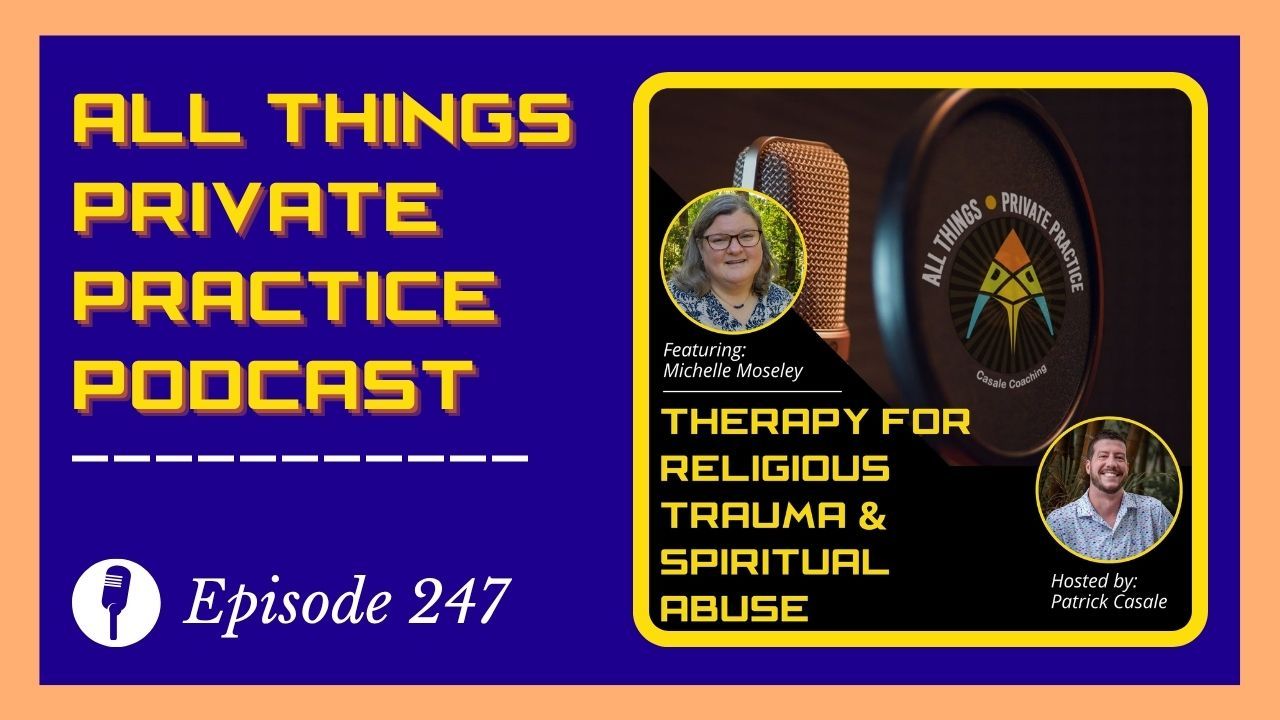
In this episode, Patrick Casale talks with Michelle Moseley, LCMHC, who provides trauma-informed, weight-inclusive, and neurodivergent-affirming counseling for survivors of religious/spiritual harm and individuals who struggle with body image.
They discuss the factors that play into religious and spiritual harm, including the impact it can have on a person, and what therapeutic approaches are helpful vs. harmful.
Here are 3 key takeaways:
- Specialization Goes Beyond Lived Experience: Lived experience with religious trauma can inform our work as clinicians, but true specialization comes from doing our own healing and seeking diverse, continuing education, not just relying on personal background.
- Common Themes in Religious Trauma: Clients often present with gender-based discrimination, purity culture wounds, and a struggle with autonomy—especially when coming from high-control or patriarchal religious environments.
- The Importance of Safe Community and Normalizing Questions: Questioning long-held beliefs is a healthy part of growth. Providing safe spaces and support groups can help those navigating deconstruction realize they’re not alone, and that curiosity is a sign of development, not wrongdoing.
More about Michelle
Michelle F. Moseley, LCMHC, (she/her) is a mental health counselor in North Carolina. She specializes in supporting folks who have received messages throughout life that they are "too much", yet somehow also "never enough." Her work includes providing trauma-informed, weight-inclusive, and neurodivergent-affirming counseling services to survivors of religious/spiritual harm and to those who struggle with body image or feeling disconnected from their body, as well as supporting late-identified neurodivergent individuals. In addition to her counseling services, she also provides consultation and continuing education courses for mental health professionals, as well as educational workshops for various groups and organizations. Michelle believes that ALL people deserve respect, compassion, and to feel heard.
Check out Michelle's continuing education courses. Info can be found at michellefmoseley.com/continuing-education
- Instagram: @therapy_with_michelle
- Facebook: facebook.com/MichelleFMoseleyCounseling
- Website: michellefmoseley.com
🎙️Listen to more episodes of The Neurodivergent Entrepreneur Podcast
🎙️Spotify
🎙️Apple
🎙️YouTube Music
▶️ YouTube
✈️ Check out available Retreats
🗨️ Join the free Empowered Escape FB Community
A Thanks to Our Sponsors: The Receptionist for iPad!
I want to thank The Receptionist for iPad for sponsoring this episode.
The Receptionist for iPad is a HIPAA-ready digital check-in system that eliminates the need to walk back and forth from your office to the waiting room to see if your next appointment has arrived. Clients or patients can check in for their appointments, and you'll be immediately notified by text, email, or your preferred channel. Break free from interruptions and make the most of your time, because it is valuable. Start a free 14-day trial of the Receptionist for iPad by going to thereceptionist.com/privatepractice. Make sure to start your trial with that link to get your first month free if you decide to sign up.
Free Gifts for Our Listeners
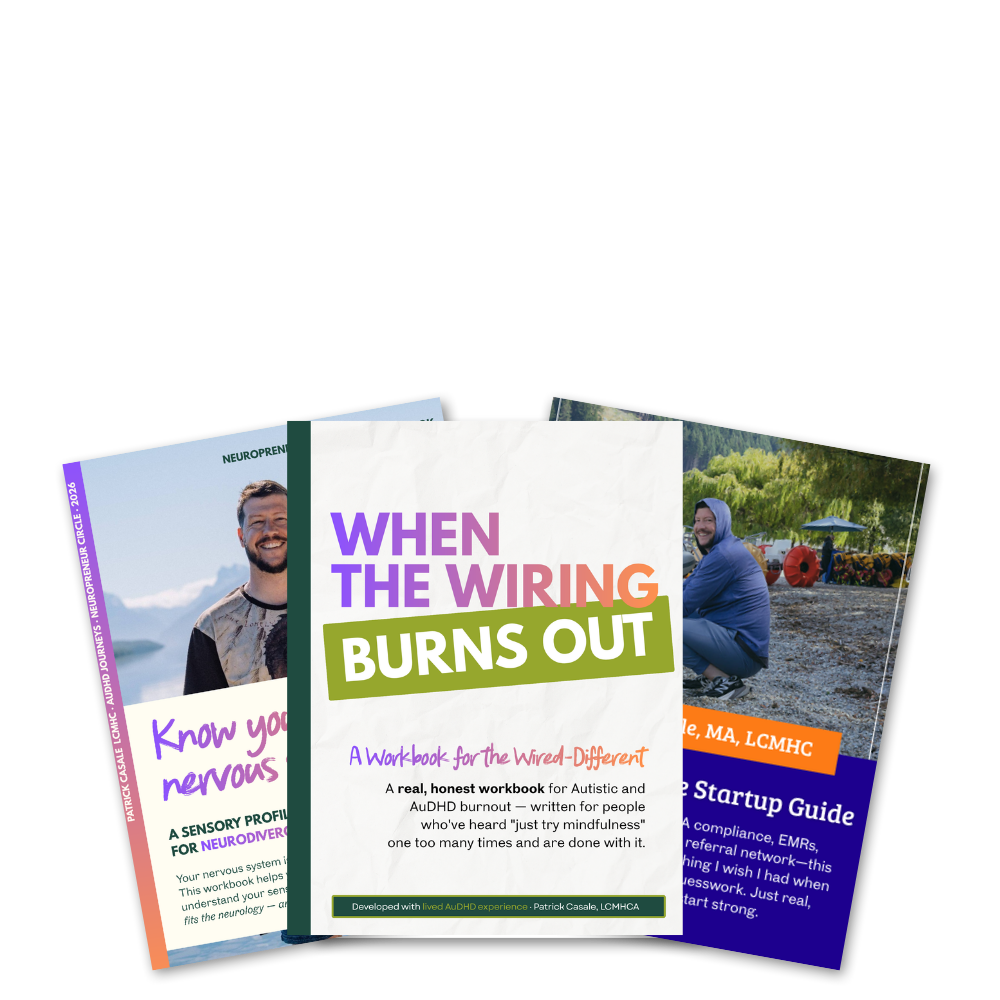
Get a practical podcasting workbook for therapists considering starting a podcast, created by Patrick Casale, host of the podcasts The Neurodivergent Entrepreneur and Divergent Conversations.
You'll get a practical structure for therapists who want to start a podcast but don’t want to rush, perform, or build something they can’t sustain.
Grab your free copy: ndpod.org/Free-Podcasting-Workbook
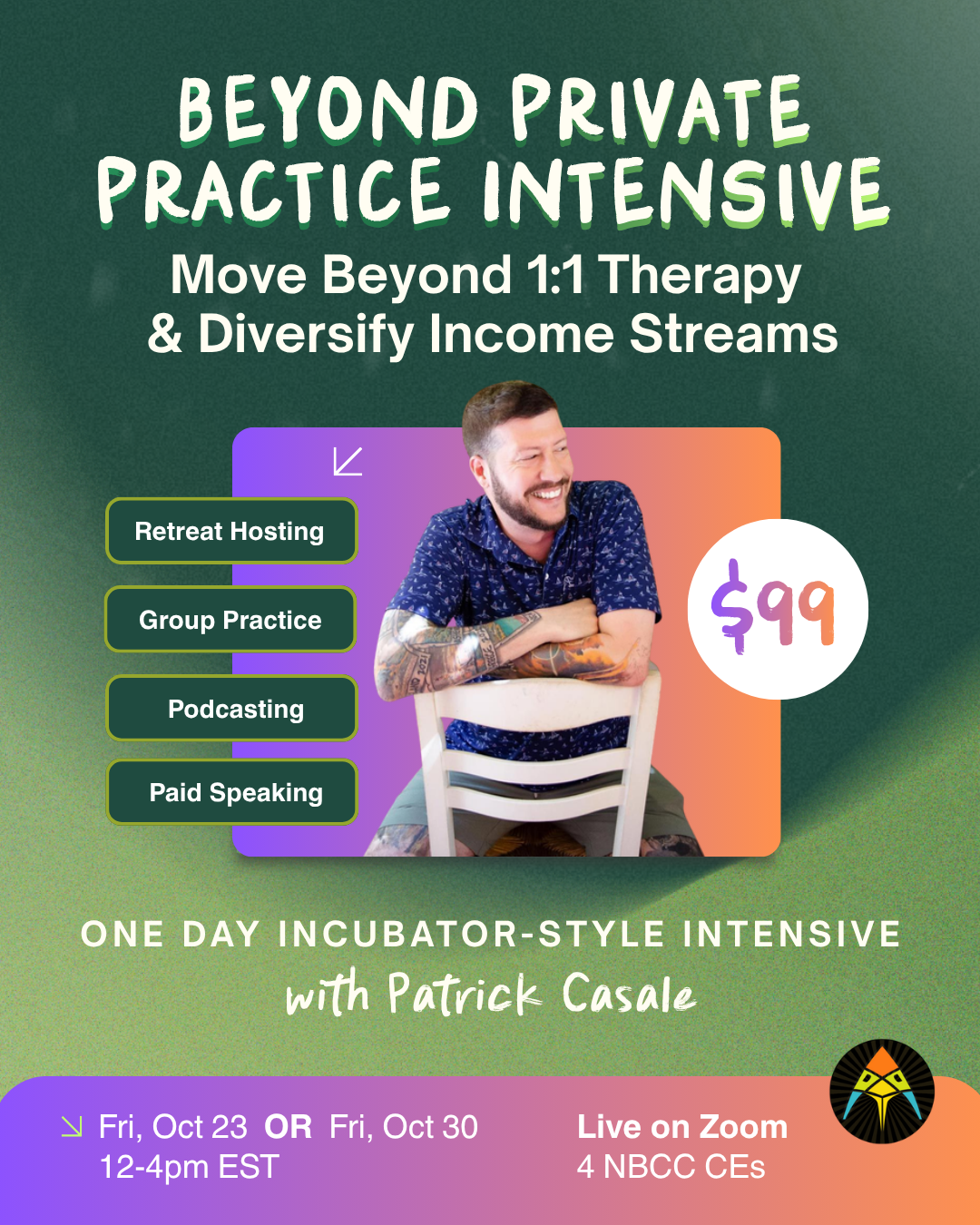
✨ Move Beyond Private Practice As A Neurodivergent Entrepreneur
Move Beyond Private Practice As A Neurodivergent Entrepreneur is a FREE 5-part mini-course designed for therapists who want sustainable financial independence beyond one-on-one work.
Access your free mini-course here: ndpod.org/Neurodivergent-Entrepreneur
Transcript
PATRICK CASALE: Hey, everyone. I am joined today by Michelle Moseley, who is an LCMHC here in North Carolina. She specializes in supporting folks who have received messages throughout life that they are too much, yet somehow also never enough.
Her work includes providing trauma-informed, weight-inclusive, and neurodivergent-affirming counseling services to survivors of religious and spiritual harm, and to those who struggle with body image or feel disconnected from their body, as well as supporting late-identified neurodivergent individuals.
In addition to her counseling services, she also provides consultation and continuing ed courses for mental health professionals, as well as educational workshops for various groups and organizations.
Really excited to talk about this topic today, because we have not touched upon what you love talking about, which is religious trauma and spiritual harm.
MICHELLE MOSELEY: Yeah. I'm excited to be here. And it's kind of an odd thing that I do enjoy talking about it. And I wish it didn't happen.
PATRICK CASALE: Yeah, yeah, that's well said. And I think that's probably for a lot of you listening, a place that you find yourself, if you're niched into your practice or your business, and you're thinking, “I'm really passionate about this thing, and I also wish it didn't happen to people, because it wouldn't exist for us to talk about.”
But if we know we don't have enough time in the day or the year to talk about religious harm from the historical aspect of what it's done to the world for thousands of years, but we can talk about today how it shows up, what you look for, how to support people, because what I'm noticing in a lot of the therapists' Facebook groups is we're seeing more and more people come out and say, like, “This is a specialty of mine, this is something I really feel like I want to support.” So, tell us a little bit about why this feels so important to you.
MICHELLE MOSELEY: Yeah, the short answer to that is that I have lived experience of spiritual abuse and religious trauma. I did not have those words when my experience happened. I actually, previously, worked in ministry, going into counseling as a second career for me. Did not intend to specialize in this area. And then, found that clients were coming to me for other things, but the religious piece would come up. And multiple clients would mention that they really felt like I got it, I understood why they valued their beliefs, and those were important, and also that harm had occurred to them. That I believed them when they told their story.
PATRICK CASALE: Yeah, and I think that's so important for any therapy setting, of just that client feeling heard and understood, and that you really do believe them. And that this has happened to them. And that they've experienced it in the way that they said that they've experienced it.
And I know how often that therapy rooms can sometimes be harmful in terms of a therapist really kind of bucking up against that. And not just religious harm, just in all areas of life. So, there's nothing more demoralizing than telling your therapist something and having the therapist not support you.
MICHELLE MOSELEY: Mm-hmm (affirmative). I've had so many folks that will come to me for consultation. I'm very public on my website that I work with religious trauma, work with religious harm. So, most of the time they're coming for that. And they will mention experiences they've had in therapy of not being believed, of being told it wasn't that bad, of feeling like they then had to take care of their therapist, because what they shared, the way it landed with the therapist. So, I love that more and more therapists are working in this area. And I think it is so important to have training, to be as sure as you can that you're not doing more harm.
PATRICK CASALE: Yeah. And that's a great segue, because I was actually about to ask you, so how can we differentiate between, like, I want to specialize in this, and this is who I support, and I've now done the training to be able to say that confidently, because I think what we see in therapy spaces a lot is I'm a specialist in A, B, and C now, because of my own lived experience. I still think as an autistic ADHD human, I could proclaim being a specialist in autistic affirming therapy, but if you haven't done the deconstruction work around it, around your own internalized ableism, around all of the core beliefs, I think you can still do harm even when being a part of that population or that community.
So, can you tell us a little bit about your thoughts on, like, what's the difference between I specialize in religious harm? I really specialize in religious harm.
MICHELLE MOSELEY: Yeah, I mean, I think lived experience can be an important piece of it. I don't think it's required. I know therapists who do really great work, who have lived experience, and those who don't have lived experience, and vice versa. Therapists who are not doing great work, because you know, they have lived experience, and maybe they haven't done enough of their own personal healing.
I know if I had gone straight into working with religious harm, you know, within a year of my own experience, I would not have been capable of doing great work, because everything would have landed in my nervous system as activating.
So, I think it is really important, if you are a person with lived experience, to have done your own healing work, whether that's therapy, you know, support groups, whatever it might be, that you've done your own healing work.
And then, that you have taken various trainings, I think it's important to look for continuing ed from various perspectives if you are going to work with people coming from multiple different backgrounds, trying to find folks who offer education around those backgrounds. And some of that might be continuing education that you get CE credits for as a mental health provider. Some of it might be, “Oh, this information is out here. And because I really want to understand this population, I'm also going to invest my time, my money, and my energy into this, even if I don't get CEs for it.”
PATRICK CASALE: Yeah, that's a great point. And we are seeing more and more trainings pop up, and more support groups, and more opportunities to learn from different perspectives. And I think that's important too, to seek out a variation of perspective and different takes on things.
When we're talking about religious trauma, spiritual harm, are we seeing any sort of like pretty common experiences that you're seeing clients come in with? Like, what are the things that are typical to be looking out for when you are starting to work with these populations?
MICHELLE MOSELEY: Yeah, yeah, a few big ones that I see very often. I see a lot of gender-based discrimination, violence, inequality. A lot of folks that have experienced religious harm come from very patriarchal systems. And I see it in both men and women. And I use gender binary terms, because in a lot of these systems, that's the only view of gender.
So, folks coming in with, I was told this is what it means to be a man or a woman, because I was assigned male at birth, or I was assigned female at birth, but I don't align with that. I'm seeing ways that that doesn't fit. I'm feeling this cognitive dissonance with what I'm being told and my own experience. So, the impacts of that.
Personally, identity development-wise, relationship-wise, you know? I see that come in a lot, things related to purity culture. So, a lot of teachings around there is no sexual activity outside of heterosexual marriage. Of course, you're going to get married in a heterosexual marriage. Some groups even have prohibitions around what kind of sexual activity is allowable within that context, you know? So, the impacts of that, of folks who maybe got married really young because they wanted to have sex and have that kind of normal or atypical part of life for a lot of people, and that was the only way that they could, or they were just impacted of like I don't feel connected to my body at all. I don't know how to experience pleasure in any sense. Those are two big ones.
And then, overall difficulty with autonomy, because if you've been in a high-control group where you weren't allowed to make any decisions, that feeling of being able to make decisions can be really challenging. And in some of these groups folks even get messages from scripture or from leaders that you can't trust yourself.
PATRICK CASALE: Right.
MICHELLE MOSELEY: You know, you have to trust me, or you have to trust God, or the higher power. You can't trust yourself, you're going to be wrong.
PATRICK CASALE: Absolutely.
MICHELLE MOSELEY: So, those are kind of the main things I see coming in.
PATRICK CASALE: Yeah, yeah. What comes up immediately for me as you're talking, when anyone's doing any sort of deconstruction work, is guilt and shame. Talk about the guilt and the shame piece for this, because I think that has to be a huge part of it.
MICHELLE MOSELEY: Yeah, yeah, those are two huge things that come up. I mean, a lot of these systems really have shame kind of baked into them. If we can make you feel wrong enough and small enough that you have to rely on the system, you have to rely on our beliefs in order to be worthy, then you're never going to try to leave.
PATRICK CASALE: Yeah.
MICHELLE MOSELEY: And then, a lot of these systems will add another layer of shame if somebody starts to deconstruct. So, from my perspective, deconstruction is simply questioning belief. And it is a normal part of growing as a human.
I think if we are growing as a human in any direction, it is natural to be like, “Oh, I have new information, I am now questioning the belief system I had previously, whether that is religious, political, family, you know? I'm questioning this, and I'm putting things together in a different way that makes sense based on the information I have now.”
PATRICK CASALE: Yeah.
MICHELLE MOSELEY: But a lot of folks are shamed for starting to ask questions. And they start internalizing that I am a bad person, I am not worthy, something is wrong with me.
PATRICK CASALE: Right, yeah. How dare I question this? That's been kind of ingrained in me for my entire life or this entire experience? And I think that can cause a lot of self-harm behavior, like a lot of substance use, probably starts to surface, and a lot of self-injurious behavior probably starts to surface. And again, falling back on, “There's something wrong with me.” It's not this whole picture that I'm trying to be curious about.
And I think when we're curious about any of this stuff, it brings up opportunities for us to start really questioning what we know. And if you're in a family that is not accepting of curiosity, it's going to feel really isolating, and having different perspectives around us is so healthy. And it's something that we don't often get to see in a lot of these situations where you might just be around people in like an echo chamber. And it's really hard to start thinking differently, and then you're exposed maybe by one interaction or one experience, and all of a sudden, it's kind of a ripple, like trickle-down effect. And you're questioning everything and anything.
And I mean, for me growing up, I was not brought up in a religious home by any means at all, actually. It was quite the opposite. But I was definitely brought up in an environment around a lot of people who were definitely unbelievably racist. And deconstructing from that of like what we know to be true from a white supremacist culture, and then going to college, and then going to have different experiences around different types of people, and you start to think this is bullshit, all of this is bullshit.
And that creates such friction in relationships that might have felt really important and really valuable to you. And that can feel really unbelievably alienating, in terms of, like, “Oh, I'm on my own now.”
MICHELLE MOSELEY: Yeah.
PATRICK CASALE: I imagine that's a lot of the same.
MICHELLE MOSELEY: Yeah, yeah. And I think that's one of the areas that it can be really important as a therapist, if you're working with somebody, to be sure that you're not trying to rush them to change course or to leave, because there really is a sense of, “I'm going to lose my whole community. Like, my religious community.” But depending on the context, “I may also lose my family.” Like, I may be coming from a context where my family literally is not allowed to speak to me anymore if I don't still believe this.
PATRICK CASALE: Yeah.
MICHELLE MOSELEY: And that's scary. And it can be really hard to be in that place of like, I don't believe this, I have interacted with other people, I have learned other information, my view has expanded, and I also have to hold on to this in some sense, because this is kind of a tether that I don't know that I'm ready to let go yet, even though I might recognize it's not healthy.
PATRICK CASALE: Absolutely, that's really well said. I don't want to put you on the spot, given the temperature of the moment, but how much of do you think what's going on right now has to do with the fact that there's such an intense amount of religious harm that's also being done to people in communities?
MICHELLE MOSELEY: Yeah, yeah. I've definitely seen a shift, really, in the past two years of folks that started questioning because they had been a part of a system, mostly Evangelical Christianity, because of my location in North Carolina.
PATRICK CASALE: For sure, yeah.
MICHELLE MOSELEY: That's a big one that I see.
PATRICK CASALE: Yeah.
MICHELLE MOSELEY: You know, I was taught that Jesus was loving, and kind, and cared for refugees and the least of these. And that's not what I'm seeing at all from all of these people who say they're Christians. And I don't know what that means.
And for some people, they're like, “I want to toss it all out.” Other people are like, “I still feel really connected to Jesus.” But I don't know what all this means, and I feel even further from my family or my close friends. Like, I didn't realize that they agreed with things that are happening. So, I've definitely seen an impact there.
And I've also seen an impact in the therapist community of how therapists react to, you know, some of my trainings or some of the things that I will say. For some folks, it feels like there's permission to push back in what feels like unhealthy ways, not, you know, good faith questioning of, “Tell me more about this. I don't know about this.”
PATRICK CASALE: For sure. Yeah, 100%. I think there's a level of cognitive dissonance that exists as well if you are feeling like, I'm very aligned with this evangelical mindset, and all of this stuff is happening. But somehow, I can overlook it, because this is what I believe to be true, or this is the community that I'm in.” And this is the messaging I'm receiving.
And as someone who's probably as atheist as they come, I just watch it, and it's just comically sad to me sometimes to see the things that people will like preach, but certainly not practice. And it's just a hard place to be, I think, culturally in society right now, where you are just seeing so much harm being done to immigrant populations, to trans people, to black and brown people across the board. And then, to be like, “But I still believe in Jesus.” And it's like-
MICHELLE MOSELEY: Yeah.
PATRICK CASALE: “This is a mind fuck.”
MICHELLE MOSELEY: And I think it's so hard. Like, I can really have compassion on folks, because I know religion can be incredibly supportive and like a source of meaning for folks, and I can have so much compassion for, “But this is what I know of Jesus, and that's not what I'm seeing.”
And I think, also, for folks of a certain age, folks who were in the church in the 90s, maybe early 2000s, and then, particularly, neurodivergent folks, because I am late-identified autistic as well, having those experiences and having pattern recognition, and realizing, like, why are some of you seeming so surprised about what's happening right now? Because this was what's happening 20, 30, 40 years ago. Like, the foundation was being laid for this…
PATRICK CASALE: Absolutely.
MICHELLE MOSELEY: At that point in time, you know? And I know, for me, like, I vividly remember early 2000s, a particular sermon in church that was very politically aligned, and I didn't have words to describe it, but I was like, “This feels off. Like, why are we endorsing a specific candidate in a sermon in church on a Sunday? Like, this doesn't feel right to me.”
PATRICK CASALE: Yeah, the whole like separation of church and state mentality doesn't exactly hold up in this light right now, or in general in anyways. So, it's interesting to then start like deconstructing that and saying, like, this doesn't hold up for me. This doesn't feel aligned for me. That's where the questioning starts to start. And then, it is becoming like, where do I go from here with this? Where do I feel safe enough to do so?
And I mean, people like yourself, who are hosting trainings, and speaking up and out about religious harm, spiritual harm, etc., such an important piece of a puzzle, because otherwise people feel really alone in it. And it really does come back to then sense of self or sense of morality, instead of feeling like, oh, there are so many people who have had similar experiences.
MICHELLE MOSELEY: Yeah, one of the really beautiful things that I will see, I facilitate a group for folks who've experienced religious spiritual harm, and I really created it as something that I wish had been available earlier in my healing journey. And so often, like, I can talk about you're not the only one experiencing this, but coming together in that group, and oh, like, we come from different backgrounds, we've had different specifics around our experience, but I'm not the only one. I'm able to connect with other people.
And also, a really beautiful thing in that group is that folks are often in different places in their own journey, and so, also, that experience of like we don't all have to be believing exactly the same thing. It's okay to interact with people who don't believe exactly what I believe or hold the exact same identities that I hold. Like, you're not scary because you're different.
PATRICK CASALE: 100%. Well said. Yeah, that's a really important point in all of this as well. So, I want to just thank you for coming on and talking about this, because again, like I mentioned, out of 200-plus episodes, this is the first time we've really delved into this at all. And I know how important this is, not just in the therapy space, culturally.
And we are in a moment in history right now, an iteration of history where I think we are going to see a lot of deconstruction happening around religious belief in general, as we continue to see religion being used as a weapon in a lot of ways as well. And a lot of people who like you mentioned, “I still want to have this faith, I still want to believe, I still am finding this to be helpful, but it needs to be done in a very different way for me to feel connected to it anymore.”
MICHELLE MOSELEY: Yeah, yeah, and really helping folks understand that the word deconstruction is not a dirty word.
PATRICK CASALE: Yep.
MICHELLE MOSELEY: In a lot of religious circles, it is viewed as a dirty word, and folks think of it as you're going to leave. If you start questioning, you're going to leave, which my whole adult life was like, “But if what I believe is the truth, then questioning is going to lead me back to the truth.”
PATRICK CASALE: Yeah.
MICHELLE MOSELEY: Like, so if we really believe that we have the truth, why are we afraid of questions?
PATRICK CASALE: For sure, yeah. And I think when you say that, right, like deconstruction can be viewed as a dirty word in certain circles, that sounds to me like it feels threatening in certain circles. So, if you're starting to say the word deconstruction, and that leads to you're going to leave, there's a feeling of like threat there. And there's a feeling of potential loss. But a lot of it also has to do with control.
And it's like this is a very complex topic, one that we could never talk about in the 25 minutes that we have. And I think this is just scratching the surface. So, for those of you listening, if this feels like it lands for you in any way, I implore and encourage you to do more of this work, to be more curious, to question more, to take a look at some of the trainings that people like Michelle are offering the community, or support groups that exist, and just to know that you are not alone in questioning or feeling this way, and really, hopefully, normalizing the fact that it's very, very, very healthy to question all of these things right now more so than ever.
MICHELLE MOSELEY: Yeah, yeah, I mean, questioning is a part of growth.
PATRICK CASALE: Yep.
MICHELLE MOSELEY: We want to grow as humans, questioning, finding answers, exploring, listening from other perspectives. Like, that is part of growing and being a healthy human.
PATRICK CASALE: Yeah, absolutely, absolutely. We don't grow in places of stagnation. So, I want to just thank you for coming on and sharing some of this. And I want to just also offer you the floor to share if you have anything coming up, or how people can reach out and work with you in this capacity.
MICHELLE MOSELEY: Yeah, so I am working on planning my continuing education calendar for the year. So, that information is all on my website for any mental health professionals that are interested. All of my trainings are NBCC-approved for CEs. So, the best places to find me would be my website, which is www.michellefmoseley.com.
I do blog there, so there's some long-form content about these same topics, if that is of interest. And then, I'm also on Instagram @therapy_with_michelle. So, if more short-form content is more your thing, I share resources and information around all of the religious harm, but also, the body image work, the late-identified neurodivergents, all of that there as well.
PATRICK CASALE: I love it. And we'll have that all in the show notes for those of you who are listening that want to connect further with Michelle, and to have some of these conversations and resources.
So, I want to just thank you for coming on and making the time. And yeah, it's been a pleasure really hearing this perspective and having this conversation with you.
MICHELLE MOSELEY: Thank you so much for the opportunity. I'm always happy to share more information about this with folks.
PATRICK CASALE: Yeah, you are very welcome. And to everyone listening to the All Things Private Practice podcast, new episodes are out on Saturdays on all major platforms and YouTube. You can like, download, subscribe, share. Make sure to join us in Portland, Maine, September 1st to the 3rd, for the third annual Doubt Yourself, Do It Anyway summit. We will see you next week.
FREE PRIVATE PRACTICE GUIDE
Join the weekly newsletter for private practice tips, podcast updates, special offers, & your free private practice startup guide!
We will not spam you or share your information. You can unsubscribe at any time.





![Episode 264: Creating Through the Chaos of a Neurodivergent Life [featuring Bre "BR3"]](https://kajabi-storefronts-production.kajabi-cdn.com/kajabi-storefronts-production/file-uploads/sites/2147507511/images/a14004-cc3d-8aba-5fb8-2442fdfc650_TNDE_YouTube_episode_264.jpg)
![Episode 263: Your Symptoms Are Real—Even When Medicine Doesn’t Have The Answers [featuring Dr. Zachary Spiritos]](https://kajabi-storefronts-production.kajabi-cdn.com/kajabi-storefronts-production/file-uploads/sites/2147507511/images/84bc15-1ce4-1a0b-8f85-f5812bce75_TNDE_YouTube_episode_263.jpg)
![Episode 262: Your Brain Isn’t the Problem. The System Needs Reimagining. [featuring Dr. Mel Houser]](https://kajabi-storefronts-production.kajabi-cdn.com/kajabi-storefronts-production/file-uploads/sites/2147507511/images/42c858d-0b15-7581-e6ac-f636e7a1fa1_TNDE_YouTube_episode_262.jpg)