
Episode 223
Dec 06, 2025

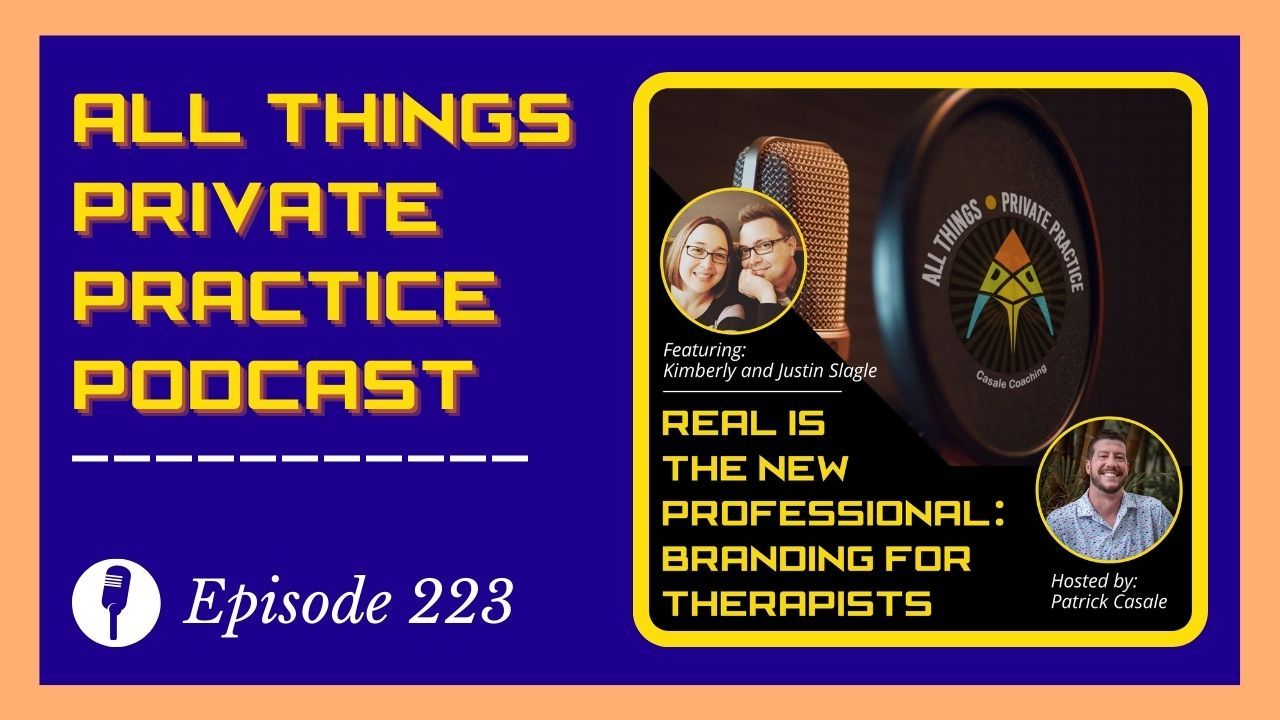
Real is the New Professional: Branding for Therapists [featuring Kimberly and Justin Slagle]

Hosted by: Patrick Casale
All Things Private Practice Podcast for Therapists

Show Notes

In this episode, Patrick Casale talks with Kimberly and Justin Slagle, branding experts and founders of Practicery, a no-BS branding studio for therapists, about why therapists (and all service providers) should ditch the outdated marketing cliches and embrace authentic, vulnerable branding.

3 Key takeaways:

  1. Authenticity Over Credentials: Credentials do matter—but what attracts clients is your realness, relatability, and willingness to show up as a human, not just a list of titles.
  2. Show, Don’t Tell: Paint the experience. Clients want to know what it’s like to work with you—use your content, visuals, and messaging to show that from the very first impression. Make your website and marketing feel like YOU.
  3. It’s OK to Pivot—and Imperfect is Better Than Invisible: Your brand should evolve with you. Don’t let perfectionism stop you from launching—put it out there, refine it as you go, and don’t be afraid to shift direction as you grow.

More about Kimberly and Justin:

Kimberly and Justin Slagle are the creative duo behind Practicery, a no-BS branding studio built by a therapist and a designer who actually get this field. They partner with helpers, healers, and therapist-run businesses to craft brands, websites, and messaging that sound and feel like the real you—human, grounded, and impossible to ignore.

If your brand or website feels a little “off” and you’re not sure what’s missing, they offer personalized web and brand audits—it’s honest, strategic feedback from people who actually get therapists and what you’re trying to build.

And they’re also about to launch something new that they are really excited about: Practicery Pop-Ins! These are creative, midday drop-in sessions for therapist business owners to brainstorm, get inspired, and connect with other people doing the same damn thing. No pressure, no fluff, just smart support and real talk.


๐ŸŽ™๏ธListen to more episodes of the All Things Private Practice Podcast here
๐ŸŽ™๏ธSpotify

๐ŸŽ™๏ธApple

๐ŸŽ™๏ธYouTube Music
โ–ถ๏ธ YouTube
โœˆ๏ธ Check out available Retreats
๐Ÿ—จ๏ธ Join the free Empowered Escape FB Community
๐Ÿ—จ๏ธ Join the free All Things Private Practice FB Community


A Thanks to Our Sponsors: The Receptionist for iPad & Alma!

โœจThe Receptionist for iPad

I want to thank The Receptionist for iPad for sponsoring this episode.

This podcast is sponsored by The Receptionist for iPad, a digital check-in system that eliminates the need to walk back and forth from your office to the waiting room to see if your next appointment has arrived. Clients can securely check-in for their appointments and you'll be immediately notified by text, email, or your preferred channel. Break free from interruptions and make the most of your time. I've been using them for almost three years now and it saves me hours in my week.

Start a 14-day free trial of The Receptionist for iPad by going to thereceptionist.com/privatepractice. Make sure to start your trial with that link. And you'll also get your first month free if you decide to sign up.

โœจAlma

I want to thank Alma for sponsoring this episode.

Building and managing the practice you want can be challenging. That’s why Alma offers tools and resources to help you build not just any practice, but your private practice. They’ll help you navigate insurance, access referrals who are the right fit for you, and efficiently manage administrative tasks — so you can spend less time on the details and more time delivering great care. You support your clients. Alma supports you.

Visit helloalma.com/ATPP to learn more.


Transcript

PATRICK CASALE: Hey, everyone. Welcome back to the All Things Private Practice Podcast. I'm joined today by Kimberly and Justin Slagle. I hope I said that right?

JUSTIN SLAGLE: You got it.

KIMBERLY SLAGLE: Hey, everyone.

PATRICK CASALE: A creative duo behind Practicery, a no bullshit branding studio built by a therapist and a designer who actually understand this field. They partner with helpers, healers, and therapists run businesses to craft brands, websites, and messaging that sound and feel like real you, human, grounded, and impossible to ignore.

If your brand or website feels a little off and you're not sure what's missing, they offer personalized web and brand audits. It's honest, strategic feedback from people who actually get therapists and what you're trying to build.

So, we are going to talk today about a topic that you suggested, which is that real is the new professional and branding from the inside out. That sounded like an ad that I just read. So, welcome to the show.

KIMBERLY SLAGLE: Yeah.

JUSTIN SLAGLE: Thank you.

KIMBERLY SLAGLE: Thank you for having us, Patrick.

PATRICK CASALE: Yeah. Did I miss anything? I know you own a group practice in Seattle. Is that correct?

KIMBERLY SLAGLE: I do. So, long-term therapist, some business and marketing background, maybe people here know about because I worked for Gottman Institute as a director for a while, but I think most people don't, maybe know that part about me.

PATRICK CASALE: Yeah, well, that's good to fill in the cracks and gaps. So, it's important. And I know you were talking before we started recording about, like, how I've branded myself over the years since you and I first met, like, four years ago.

And for me, it's interesting, because, like, I never thought of it as branding. I just thought of it as like, I'm just being myself, and then realize after the fact that people are attracted to the way I show up, because I'm being myself, and so it wasn't the other way around for me. For a lot of people, I think trying to figure out their brand can be like one of those head-scratching questions when they're trying to work with a marketing team or a branding team, because they're like, "I have no freaking idea."

KIMBERLY SLAGLE: Totally. And, you know, when we started this, we were like, "We can't say the word branding, because I don't think anyone knows what the fuck that is."

JUSTIN SLAGLE: Yeah, it's kind of an all-encompassing term, you know?

KIMBERLY SLAGLE: Like, how do we say we do what we do without calling it branding? Now, I feel like every day, people are talking about branding. And even though we might think we know what it means, maybe we do more than we did, but we still don't, I don't know. But yeah, it's so much more than just like a logo or being impressive. Or I think back in the day, it was like our professionalism, or even just like, who we work with is our brand.

PATRICK CASALE: True. Yeah, I think [CROSSTALK 00:03:46]-

KIMBERLY SLAGLE: We're therapists. We're supposed to be experts in something.

PATRICK CASALE: Yeah. And I mean, you know, when I'm thinking about, like, marketing, branding, all of the things, I always think about just like storytelling, how you can show up authentically you, anchor into realness, and authenticity, and vulnerability, and really being a human. Because we don't want robotic therapists. We don't want therapists that sound like AI-generated versions of human beings. Like, I don't want a walking DSM-5 as my therapist, if I'm being quite honest.

Like, and that's something I had to help so many therapists over the years deconstruct from grad school and community mental health, and messaging in the profession of like, this is how I'm supposed to show up. This is how I'm supposed to present. This is what I'm allowed to say and not say. And I'm like, "Where is this messaging coming from?" Like, there is a lot of that that really influences how this whole community shows up, in general.

KIMBERLY SLAGLE: Yes, I'm so glad you mentioned vulnerability, because I was kind of like coming into this thinking of this phrase that vulnerability is so much greater than our credentials, or all this therapy kind of clichés that you hear like, "I provide a warm, safe, non-judgmental space [CROSSTALK 00:05:10]-

PATRICK CASALE: I will walk alongside you, and maybe I've got some stacked rocks that like-

KIMBERLY SLAGLE: Yes. Rocks that everyone one of you know. A grounding like calm force. Yeah. I mean, I would hope that people are providing a safe space for their clients to show up with whatever they need to show up with. And I hope that they're, you know, warm and like, non-judgmental to an extent. I don't think that means we can't be directive, you know? And kind of like, push and challenge our clients at times.

But what makes me me? What makes you you? What makes Justin Justin is not those clichés, like I said. It's not even necessarily our credentials. That's about who we are. And if we're willing to share more of that, it doesn't mean we have to write every single thing about us on our website Home page, you know? Like, I bite my nails, maybe people don't know that. I'm not going to put that on my page.

But really, having the courage to get vulnerable and just allow ourselves to be seen so our clients can really connect with us. There might be something in them that feels connected with too, and then they know like we're the one that can probably like support them through the shit that they're going to through.

PATRICK CASALE: Yeah, absolutely. Justin, you have any thoughts on that? I don't want to oversight you.

JUSTIN SLAGLE: Yeah. I mean, I think, just to piggyback on what you guys have already said, it's like, I think we've just gotten to a place in society where it's just, I think, generally implied that, yes, you are an expert. You're a professional. You are going to provide this safe, non-judgmental place, right? And so, yeah, let's maybe push that aside and really focus on the things that make you you. I mean, you and your practice are one in the same, you know? So, really zeroing in on that piece and, you know, essentially branding from inside out.

PATRICK CASALE: Yeah. And I'm a big believer of this. And I say this all the time on here and elsewhere. But like, I believe that relatability equates to accessibility. And I think that is hugely important for those of you who work with marginalized groups of humans, where, if you work with the queer and the LGBTQIA+ population, the queer and trans population, in general, are you going to share about that experience, about how you're either an ally and how you show up, or about your own lived experiences, or struggles?

If you're a part of the autistic ADHD community, are you going to share about that? How are you going to talk about that? Are you going to give a little glimmer of what that's like to be a therapist, but also, someone who has their own struggles in their lives?

Addiction world, I think about all the time when I worked in the addiction field, specifically, I have never had clients ask me so directly before if I had known what it was like to struggle with addiction than any other field, where people would sit in my office for the first minute of the session and be like, "Do you know what it's like to be addicted to anything?" And I was like, "Oh, damn, okay." And I was like, "Yeah, I had a gambling addiction for, you know, a decade of my life."

It never clicked to me until very early on in private practice, when the phone was ringing, but not as much as I wanted it to, and it was not really the right clients. Like, it would just be anyone and everyone. But I was like, because I didn't know who I was marketing to, I didn't know what my brand was.

And then, one day, I, like, changed my Psych today around a little bit, and my Home page and my website to say something like, "Being vulnerable is fucking scary, and that's okay. I get it. I know what it's like to be on the other side of the phone or the couch or whatever."

Phone calls started blowing up from like my exact ideal client, who would say things like, "I just wanted permission to be myself, and just by reading what you wrote in one paragraph, it made me feel comfortable enough to reach out to you."

And for me, that was like the epiphany, aha moment. I'm glad I had it very early on. And then, I just shifted everything that I've done since that time.

KIMBERLY SLAGLE: Yeah, I know. I get clients more and more, they're like, "You're a real ass human. Like, God, you know? Like, we've worked with other couples there. They were helpful to an extent, but it didn't feel real. And this shit that we're going through, the constant fights, and the slam doors, and like, Googling, you know, divorce at 2:00 AM because I can't fucking sleep, even though I don't want a divorce, but I feel so, like, hopeless at this point."

Like, no one seems to really get, you know, that struggle and can, like, meet us in that place and talk like a human, and ditch some of the clinical jargon, and other stuff, and just, like, really guide us.

PATRICK CASALE: Yeah, yeah. I know for our, like, Home page of our group practice, it says something similar to what I just said, which is, like, no head nodding, how does it make you feel therapists here. Like, we definitely have the word fuck on the Home page. I don't know.

My like, old web designer was like, "You're going to turn off a lot of people by the language you're putting on this website." And I was like, "I don't think that those would be our people, though. So, why would I want to misrepresent our personalities so that when you get into session, then your clients are off put by the language that's used?" I would rather have transparency and authenticity right off the bat, and then you get to decide very quickly, is this the person for me or not, or is this the group for me or not?

KIMBERLY SLAGLE: Yeah, I tell people right away, whether it's my website or consult call or the first session, I cuss, and I tell them I don't know if I trust people that never cuss. And it's okay if you're not okay with it, but I'm probably not the right therapist for you. And usually, they're like, "Thank fucking God."

PATRICK CASALE: And there's so many therapists out there, right? So, like, if you're not the right therapist for that person, for that reason, there are plenty of other people out there that will be a good fit. And that's why branding is so important, because it's so unique and so individualized, opposed to like, like, I always say on here, and I'm waiting for Applebee's to sue me, but like, you can't be the Applebee's of therapy. You can't do it all and do everything like half well. So, like, I think it's important to just embrace, like you said, being a real human, because being real, in our opinion, right? Like you said, is being professional. So, expand on that a little bit more.

KIMBERLY SLAGLE: Yeah, and I kind of want to touch on something you said, too, just about the fear that therapists have in doing that. I mean, we are afraid of being judged. We have this pressure to, like, grow this business. There's a ton of people out there doing a similar thing. So, there's this scarcity mindset. And we weren't taught how to be business owners or do marketing, and that just kind of adds to that fear that we have.

And so, I think a lot of people can lead from kind of those fear-based, almost trauma responses, right? Like freezing. Like, okay, I don't know what I'm going to say, so I'm just going to put every model I've trained in, and I'm going to say, I help everyone. Hope that's enough. Or, like, the fight. Like, "Here's a list of all my credentials and all my background. Like, please trust me, I'm legit."

PATRICK CASALE: It's almost like having to prove competency all the time, right? And we should absolutely talk about our credentials and our training, but I don't think that should be for like, front and center for conversations.

And like our About Me's should not read like a doctoral journal of every publication you've been a part of and every training you've taken, and like, share some something about you as a human. Just share something, whether it's your like, obsessive special interest about watching Naked and Afraid reruns over and over again. Like, just anything that makes you just a little bit different. Because I think when you're scrolling through page after page after page, looking for a professional to help you, you're already overwhelmed, you're already stressed. And if you don't know what you're looking for, you are going to make that determination based on, like, how you react with what you're reading or how someone is presenting. And if it looks like all of the same, it kind of just gets lost in all of it as well. And then, you make 40 phone calls, and whoever calls you back first is your therapist.

JUSTIN SLAGLE: Right.

KIMBERLY SLAGLE: Yeah.

JUSTIN SLAGLE: Yeah. It's almost like you start blending into the wallpaper, almost, right? Like-

PATRICK CASALE: Yeah.

JUSTIN SLAGLE: And that's where branding from the inside out comes in, right? Like, it's easy to say what we do, how we do it, but the why is, you know, kind of the center of all that, and that's where all the, like, realness comes from, you know? The how, the what, that's your training. That's what you learned in school. The why comes from you.

PATRICK CASALE: Yeah. It's almost like the soulfulness of it, you know?

JUSTIN SLAGLE: Exactly, yeah.

PATRICK CASALE: Yeah. Capturing the soulfulness of like, where does this desire and passion come from? Because so many of us as therapists wanted to become helpers or were drawn to the profession for a reason.

And a lot of the times, you know, like, I always talk about how our niches are often versions of our lives, or like, iterations of our lives. And I can track that very in a very linear way for myself, where I went from like helping men who are struggling with addiction to then helping people who are struggling with never feeling good enough, and were high-achieving professionals who just were perfectionistic, and full of self-doubt to really focusing more on the autistic ADHD experience. And that has been an evolution as my life has evolved.

And I think it's important to pay attention to that stuff when you're stuck of like, why did I get into this in the first place? Why do I feel so passionate about it? So, for you two working with your different backgrounds, how are you helping guide people through some of these things that we're talking about? Because I know a lot of people want a website revamp or rebrand. They want to rebrand in general, but they really do get stuck with like, how do I differentiate?

JUSTIN SLAGLE: Yeah, I mean, I think it really starts in diving into the essentials of you, or your practice, right? So, exploring your ideal client, really kind of mapping out what that person looks like, what they do in life. Like, you know, imagining that like day in the life of that person and trying to get inside of their head. Like, what are maybe some of the obstacles they come up to in seeking therapy, right? You know, elaborating on your, you know, like your belief in how you really help people heal. What makes the way that you work with people feel powerful and different?

And then, you know, even exploring like how you want to sound in your content, even? What's that tone of voice feel like when someone lands on your website? Is it, you know, totally like education, educative, like that vibe? Or is it that real, like, you know, you landed on my website and it says, "Fuck." You know, somewhere on the Home page, or something like that.

KIMBERLY SLAGLE: Or calming. Like, if people are just constantly on edge and anxious, you maybe don't want to be like speaking in all caps and exclamation points. Like, "Hey! I can help!"

What I really like, though, about some of what we do is really trying to get people to think about what's that one thing that makes you different, right? Or, if you could imagine a friend, or a colleague, or even a client saying, like, the one thing that they, like, think of when they think about you or your practice, like, what is that?

JUSTIN SLAGLE: Yeah, yeah. And it really like, becomes this sort of like glue that holds all these different parts together that make up brand or make up your practice. And that's the thing that we tried to, yeah, really zero in on, pull out, and make the forefront of the brand.

PATRICK CASALE: And I think, like, when you're really stuck on this, and it's hard to answer some of these questions for yourselves, for those of you listening at home, I would be thinking about, like, what do you hear your clients, or your colleagues, or your friends saying over and over and over again? Or what version of that? Write that stuff down. Use that stuff in your content. Like, things that you are seeing surface over and over, people that are struggling with A, B, C, D and E are sharing how you've helped them in whichever way, that's the stuff that you want to, like, bring to the table when you're starting to think about a rebrand, or starting to get a sense of what is my vision here? Like, what am I trying to portray? What do I want people to feel when they land on my site within, like, the first really, like, 30 to 60 seconds? Because, you know, our attention spans are not very long.

I know for myself, like I'm making these decisions in like nanoseconds. And if I'm like, "Oh, this just turns me off." I'm just clicking out of that immediately. And that's just not even for therapy, that's for anything as a human being.

KIMBERLY SLAGLE: Totally. And that's where we're a little biased, too. I mean, I know the visual brand isn't everything, but we try to get people to think about that as well. Like, if someone lands on your website and it just looks like shit, or all the text is overlapped, and there's a button in the middle, and you can't read it, or if you have to scroll for a whole 30 seconds and it's all these quotes, I like whoever, and you don't care, and it's all like-

PATRICK CASALE: [CROSSTALK 00:22:57] Brown quotes.

KIMBERLY SLAGLE: Yeah.

PATRICK CASALE: All of these [INDISCERNIBLE 00:22:59] stacked rocks, no button [CROSSTALK 00:23:01]-

JUSTIN SLAGLE: [CROSSTALK 00:23:02] reading from, like, pain points and stuff like, yeah. I don't know that that's [CROSSTALK 00:23:07]-

KIMBERLY SLAGLE: [CROSSTALK 00:23:07]

JUSTIN SLAGLE: People want to see, like, immediately.

PATRICK CASALE: I think that was like a version of maybe marketing and branding and therapy, where it was, like, really lean heavy into the pain points, which are important. You want to capture, but does that need to be like immediately in your line of sight as you land on a therapist page?

KIMBERLY SLAGLE: Right. And does it need to be like 20 or 30 of them? It's like-

PATRICK CASALE: Yeah, life [INDISCERNIBLE 00:23:33] sucks. I get it.

KIMBERLY SLAGLE: I think more people are drawn now toward really seeing that like outcome, you know? They want to know how you're going to help. And if you can put that in like a word or two or a phrase, it's good. You know, we therapists, we had to write all this shit in grad school, and so now we go to build websites, and there's so much text there. And if you're like me, at least, like, I'm not going to read all of that. I just need to know really quickly-

PATRICK CASALE: Can you help me? Can you understand me? Can you help me?

KIMBERLY SLAGLE: Right?

JUSTIN SLAGLE: Yeah.

PATRICK CASALE: And, you know, taking it a step further, can you understand me? Can you help me? And if I am a part of a community where there's judgment, or there's fear, or there's concern, do I get a sense that I'm going to have to re-explain, like, my entire life story to you, to kind of offer the context of why I'm experiencing what I'm experiencing?

I think that's really huge, because for my practice, right? We specialize in the neurodivergent LGBTQIA and black and brown community. Our clients don't want to come to our therapists and have to talk to our therapists about why they're experiencing anxiety, why are they experiencing trauma, why are they experiencing A, B, and C? They just want to know that you get it. They want to know that the wall is already down by the time they get in a room or on the telehealth screen, so that they don't have to feel more on guard or more protective than they need to. They just want to get into the meat of everything, because everything feels so overwhelming these days.

KIMBERLY SLAGLE: Totally.

JUSTIN SLAGLE: Yeah, I think a key thing is just really painting the picture what therapy will look like with you through content, with visuals, and just peppering things in. You don't have to give it a full essay.

PATRICK CASALE: Yeah, yeah.

JUSTIN SLAGLE: We break this information up into digestible chunks nowadays.

PATRICK CASALE: 100%. Yeah, for my attention span, I need like, very snorts, short snippets. I don't want to go through an essay. I don't want to go through a whole paragraph to get a sense of, like, you know, can you help me or not?

And I want to be able to find a very easily accessible way to contact you, whether it be a button that takes me to email or a phone call. Do you offer like text, like, inquiry? Make it easy for people to contact you.

I used to do so many website audits, mainly to, like, talk about content and copy. And I'm like, how do I call you? How do I reach out to you? Like, where is the contact button? And it's like, hidden at the bottom or hidden at the bar on the top. That doesn't look great. And it's like, overlaid with a bunch of text. I'm like, "This is like, too confusing. And now I've gone through an extra step, and now I'm going to move on to the next therapist website."

KIMBERLY SLAGLE: Yep, something that bugs me, too, is like, who the fuck am I talking to? Like, you know, have a picture of yourself. Don't bury it like four pages deep, or even put it at the very bottom of your Home page.

PATRICK CASALE: [CROSSTALK 00:26:48] About Me is where the page does not have a photo of the person. It's got like a photo of a dog, or like a [INDISCERNIBLE 00:26:55] sunset. And it's like, okay, this is great. I wouldn't love meeting with a dog today. Like, I don't know who you are. Like, I don't know what you look like, I don't know anything about you, because this About Me says, like, where are you went to grad school? What trainings you have under your belt. What your license is. A picture of this dog. And like, I've got nothing else. Like, we just need to make this more personable, make this more human, make this more relatable. Because this profession, this business is relationship building. It is relatability at its core, at the foundation.

KIMBERLY SLAGLE: Yeah, totally. A couple things we maybe suggest to people is like, go pull up your website and ask yourself, does it even sound like me? Or would you hire this person?

PATRICK CASALE: Sure?

KIMBERLY SLAGLE: Or better yet, have a friend you trust go and be like, "Does this even…"

PATRICK CASALE: Yeah.

JUSTIN SLAGLE: Post it on Facebook, though, because you will get a million different opinions on everything, of course. So, yeah, reach out to those trusted few friends or so, you know, colleagues.

PATRICK CASALE: Yeah, I agree. That's great advice. And, you know, the Facebook groups, for what they are, are great resources in a lot of ways. And they can be so detrimental, because you're either going to get a bunch of opinions from people who are in the same boat or doing the same exact things that you're doing, so you're just getting the same advice, doubling down on it, or you're going to get people who just give really bad advice. And you know, I think it's really important to think about who do I want auditing and critiquing this stuff? A bunch of strangers on the internet, or people that you know, like, and trust?

JUSTIN SLAGLE: Absolutely.

KIMBERLY SLAGLE: Yeah, and sometimes those people aren't your client, you know? People will freak out and be like, "I don't like purple. You shouldn't put purple in your logo." And it's like, you don't know anything about that person other than they're in this therapist group. So, you're going to maybe assume their therapist. But they might not be your ideal client. So, why go like, you know? I get it.

Everyone kind of will copy each other in ways like, okay, you're charging this, maybe I should charge this. Or you said it this way, maybe I should do that. Or, you know? So, it's hard to kind of be authentic. But it also just can burn us out, because, like you said, if we get clients that don't fuel us, we can burn out if we go to network or talk to other therapists about what we do and we don't really feel passionate about it, or we don't feel like we even know what we do, or who we like to serve, or like we don't feel like we can be ourselves, yeah, I don't know. That takes the real fulfillment and joy out of doing this work.

PATRICK CASALE: Absolutely. Yeah, I agree. And I think that we need to find the joy and fulfillment in this work for the passion to shine through. And I think when we feel really passionate about who we're helping, how our website looks. Like, if we really truly understand our ideal client, like that's when we really start to see the synchronicity and everything kind of align. And that's what we're looking for, right? So, I think that is a is a lot of good advice and support in that regard.

As we get ready to wrap any last-minute thoughts or things that you want people to really pay attention to with any of this stuff?

KIMBERLY SLAGLE: Well, just something I thought of, even just based off what you're saying now that ties into something you said before, like, don't be afraid to pivot. We can always pivot at points. But, you know?

PATRICK CASALE: Hugely important.

KIMBERLY SLAGLE: We're not locked in just because this is something that we're passionate about or fuels us now. We don't have to do that forever. So, don't be afraid to just lean into where you're at and then if it's not fueling you-

JUSTIN SLAGLE: Pivot again.

KIMBERLY SLAGLE: Pivot and again. You're like perfect proof that that's possible. And as long as you do it with, you know, your real self backing it, and you're consistent, you can be really successful.

PATRICK CASALE: Yeah, 100% agree. And honestly, like, one last thought on that is also having something out published, visible, and findable, is significantly better than something that is unpublished, because you don't feel like it's perfect. I think websites are living, evolving entities or documents that whatever exists right now in this current iteration can be changed, can be edited, can be shifted. So, don't allow for that to prevent you from moving forward.

I really appreciate you both coming on and making the time. Let people know where they can find you, and we'll include all of this information in the show notes as well.

KIMBERLY SLAGLE: Yeah, practicery.com, just through our website, mostly. We have a neglected Instagram account, and maybe not quite as neglected, but pretty neglected Facebook group called Therapists Who Brand, but you know, it's on the list one day of trying to engage with more. So, follow us on those things, too, if you want.

PATRICK CASALE: If you want to join these neglected Facebook groups, then that's that. But no. If you want branding support, or any of the things that we've talked about in terms of new website, revamping, logos, etc., practicery.com, and we'll have that in the show notes as well.

KIMBERLY SLAGLE: Yeah. Oh, and just a quick plug, if I can. So, we're going to be launching soon this thing called a Practicery Pop Ins, which are kind of these midday lunch things where people can just pop on and get support, connection. You know, we can look at their stuff. We can have, like, ideas tossed around for other business owners and creating a space with some live connection of like place a we can all come and talk about this stuff and get support.

JUSTIN SLAGLE: Stop by and say hi.

PATRICK CASALE: Love it. Stop by say hi. Thank you so much for both coming on and making the time today. It's good to see you. I know it's been about four years. So, nice, full circle moment.

KIMBERLY SLAGLE: Thanks again, Patrick.

JUSTIN SLAGLE: Yeah, thank you.

KIMBERLY SLAGLE: Appreciate it.

PATRICK CASALE: To everyone listening to the All Things Private Practice podcast, new episodes are out on Saturdays and all major platforms and YouTube. You can like, download, subscribe, share. Doubt yourself, do it anyway. See you next week.

FREE PRIVATE PRACTICE GUIDE

Join the weekly newsletter for private practice tips, podcast updates, special offers, & your free private practice startup guide!

We will not spam you or share your information. You can unsubscribe at any time.

All Things Private Practice Podcast for Therapists

Episode 223: Real is the New Professional: Branding for Therapists [featuring Kimberly and Justin Slagle]

Show Notes

In this episode, Patrick Casale talks with Kimberly and Justin Slagle, branding experts and founders of Practicery, a no-BS branding studio for therapists, about why therapists (and all service providers) should ditch the outdated marketing cliches and embrace authentic, vulnerable branding.

3 Key takeaways:

  1. Authenticity Over Credentials: Credentials do matter—but what attracts clients is your realness, relatability, and willingness to show up as a human, not just a list of titles.
  2. Show, Don’t Tell: Paint the experience. Clients want to know what it’s like to work with you—use your content, visuals, and messaging to show that from the very first impression. Make your website and marketing feel like YOU.
  3. It’s OK to Pivot—and Imperfect is Better Than Invisible: Your brand should evolve with you. Don’t let perfectionism stop you from launching—put it out there, refine it as you go, and don’t be afraid to shift direction as you grow.

More about Kimberly and Justin:

Kimberly and Justin Slagle are the creative duo behind Practicery, a no-BS branding studio built by a therapist and a designer who actually get this field. They partner with helpers, healers, and therapist-run businesses to craft brands, websites, and messaging that sound and feel like the real you—human, grounded, and impossible to ignore.

If your brand or website feels a little “off” and you’re not sure what’s missing, they offer personalized web and brand audits—it’s honest, strategic feedback from people who actually get therapists and what you’re trying to build.

And they’re also about to launch something new that they are really excited about: Practicery Pop-Ins! These are creative, midday drop-in sessions for therapist business owners to brainstorm, get inspired, and connect with other people doing the same damn thing. No pressure, no fluff, just smart support and real talk.


๐ŸŽ™๏ธListen to more episodes of the All Things Private Practice Podcast here
๐ŸŽ™๏ธSpotify

๐ŸŽ™๏ธApple

๐ŸŽ™๏ธYouTube Music
โ–ถ๏ธ YouTube
โœˆ๏ธ Check out available Retreats
๐Ÿ—จ๏ธ Join the free Empowered Escape FB Community
๐Ÿ—จ๏ธ Join the free All Things Private Practice FB Community


A Thanks to Our Sponsors: The Receptionist for iPad & Alma!

โœจThe Receptionist for iPad

I want to thank The Receptionist for iPad for sponsoring this episode.

This podcast is sponsored by The Receptionist for iPad, a digital check-in system that eliminates the need to walk back and forth from your office to the waiting room to see if your next appointment has arrived. Clients can securely check-in for their appointments and you'll be immediately notified by text, email, or your preferred channel. Break free from interruptions and make the most of your time. I've been using them for almost three years now and it saves me hours in my week.

Start a 14-day free trial of The Receptionist for iPad by going to thereceptionist.com/privatepractice. Make sure to start your trial with that link. And you'll also get your first month free if you decide to sign up.

โœจAlma

I want to thank Alma for sponsoring this episode.

Building and managing the practice you want can be challenging. That’s why Alma offers tools and resources to help you build not just any practice, but your private practice. They’ll help you navigate insurance, access referrals who are the right fit for you, and efficiently manage administrative tasks — so you can spend less time on the details and more time delivering great care. You support your clients. Alma supports you.

Visit helloalma.com/ATPP to learn more.


Transcript

PATRICK CASALE: Hey, everyone. Welcome back to the All Things Private Practice Podcast. I'm joined today by Kimberly and Justin Slagle. I hope I said that right?

JUSTIN SLAGLE: You got it.

KIMBERLY SLAGLE: Hey, everyone.

PATRICK CASALE: A creative duo behind Practicery, a no bullshit branding studio built by a therapist and a designer who actually understand this field. They partner with helpers, healers, and therapists run businesses to craft brands, websites, and messaging that sound and feel like real you, human, grounded, and impossible to ignore.

If your brand or website feels a little off and you're not sure what's missing, they offer personalized web and brand audits. It's honest, strategic feedback from people who actually get therapists and what you're trying to build.

So, we are going to talk today about a topic that you suggested, which is that real is the new professional and branding from the inside out. That sounded like an ad that I just read. So, welcome to the show.

KIMBERLY SLAGLE: Yeah.

JUSTIN SLAGLE: Thank you.

KIMBERLY SLAGLE: Thank you for having us, Patrick.

PATRICK CASALE: Yeah. Did I miss anything? I know you own a group practice in Seattle. Is that correct?

KIMBERLY SLAGLE: I do. So, long-term therapist, some business and marketing background, maybe people here know about because I worked for Gottman Institute as a director for a while, but I think most people don't, maybe know that part about me.

PATRICK CASALE: Yeah, well, that's good to fill in the cracks and gaps. So, it's important. And I know you were talking before we started recording about, like, how I've branded myself over the years since you and I first met, like, four years ago.

And for me, it's interesting, because, like, I never thought of it as branding. I just thought of it as like, I'm just being myself, and then realize after the fact that people are attracted to the way I show up, because I'm being myself, and so it wasn't the other way around for me. For a lot of people, I think trying to figure out their brand can be like one of those head-scratching questions when they're trying to work with a marketing team or a branding team, because they're like, "I have no freaking idea."

KIMBERLY SLAGLE: Totally. And, you know, when we started this, we were like, "We can't say the word branding, because I don't think anyone knows what the fuck that is."

JUSTIN SLAGLE: Yeah, it's kind of an all-encompassing term, you know?

KIMBERLY SLAGLE: Like, how do we say we do what we do without calling it branding? Now, I feel like every day, people are talking about branding. And even though we might think we know what it means, maybe we do more than we did, but we still don't, I don't know. But yeah, it's so much more than just like a logo or being impressive. Or I think back in the day, it was like our professionalism, or even just like, who we work with is our brand.

PATRICK CASALE: True. Yeah, I think [CROSSTALK 00:03:46]-

KIMBERLY SLAGLE: We're therapists. We're supposed to be experts in something.

PATRICK CASALE: Yeah. And I mean, you know, when I'm thinking about, like, marketing, branding, all of the things, I always think about just like storytelling, how you can show up authentically you, anchor into realness, and authenticity, and vulnerability, and really being a human. Because we don't want robotic therapists. We don't want therapists that sound like AI-generated versions of human beings. Like, I don't want a walking DSM-5 as my therapist, if I'm being quite honest.

Like, and that's something I had to help so many therapists over the years deconstruct from grad school and community mental health, and messaging in the profession of like, this is how I'm supposed to show up. This is how I'm supposed to present. This is what I'm allowed to say and not say. And I'm like, "Where is this messaging coming from?" Like, there is a lot of that that really influences how this whole community shows up, in general.

KIMBERLY SLAGLE: Yes, I'm so glad you mentioned vulnerability, because I was kind of like coming into this thinking of this phrase that vulnerability is so much greater than our credentials, or all this therapy kind of clichés that you hear like, "I provide a warm, safe, non-judgmental space [CROSSTALK 00:05:10]-

PATRICK CASALE: I will walk alongside you, and maybe I've got some stacked rocks that like-

KIMBERLY SLAGLE: Yes. Rocks that everyone one of you know. A grounding like calm force. Yeah. I mean, I would hope that people are providing a safe space for their clients to show up with whatever they need to show up with. And I hope that they're, you know, warm and like, non-judgmental to an extent. I don't think that means we can't be directive, you know? And kind of like, push and challenge our clients at times.

But what makes me me? What makes you you? What makes Justin Justin is not those clichés, like I said. It's not even necessarily our credentials. That's about who we are. And if we're willing to share more of that, it doesn't mean we have to write every single thing about us on our website Home page, you know? Like, I bite my nails, maybe people don't know that. I'm not going to put that on my page.

But really, having the courage to get vulnerable and just allow ourselves to be seen so our clients can really connect with us. There might be something in them that feels connected with too, and then they know like we're the one that can probably like support them through the shit that they're going to through.

PATRICK CASALE: Yeah, absolutely. Justin, you have any thoughts on that? I don't want to oversight you.

JUSTIN SLAGLE: Yeah. I mean, I think, just to piggyback on what you guys have already said, it's like, I think we've just gotten to a place in society where it's just, I think, generally implied that, yes, you are an expert. You're a professional. You are going to provide this safe, non-judgmental place, right? And so, yeah, let's maybe push that aside and really focus on the things that make you you. I mean, you and your practice are one in the same, you know? So, really zeroing in on that piece and, you know, essentially branding from inside out.

PATRICK CASALE: Yeah. And I'm a big believer of this. And I say this all the time on here and elsewhere. But like, I believe that relatability equates to accessibility. And I think that is hugely important for those of you who work with marginalized groups of humans, where, if you work with the queer and the LGBTQIA+ population, the queer and trans population, in general, are you going to share about that experience, about how you're either an ally and how you show up, or about your own lived experiences, or struggles?

If you're a part of the autistic ADHD community, are you going to share about that? How are you going to talk about that? Are you going to give a little glimmer of what that's like to be a therapist, but also, someone who has their own struggles in their lives?

Addiction world, I think about all the time when I worked in the addiction field, specifically, I have never had clients ask me so directly before if I had known what it was like to struggle with addiction than any other field, where people would sit in my office for the first minute of the session and be like, "Do you know what it's like to be addicted to anything?" And I was like, "Oh, damn, okay." And I was like, "Yeah, I had a gambling addiction for, you know, a decade of my life."

It never clicked to me until very early on in private practice, when the phone was ringing, but not as much as I wanted it to, and it was not really the right clients. Like, it would just be anyone and everyone. But I was like, because I didn't know who I was marketing to, I didn't know what my brand was.

And then, one day, I, like, changed my Psych today around a little bit, and my Home page and my website to say something like, "Being vulnerable is fucking scary, and that's okay. I get it. I know what it's like to be on the other side of the phone or the couch or whatever."

Phone calls started blowing up from like my exact ideal client, who would say things like, "I just wanted permission to be myself, and just by reading what you wrote in one paragraph, it made me feel comfortable enough to reach out to you."

And for me, that was like the epiphany, aha moment. I'm glad I had it very early on. And then, I just shifted everything that I've done since that time.

KIMBERLY SLAGLE: Yeah, I know. I get clients more and more, they're like, "You're a real ass human. Like, God, you know? Like, we've worked with other couples there. They were helpful to an extent, but it didn't feel real. And this shit that we're going through, the constant fights, and the slam doors, and like, Googling, you know, divorce at 2:00 AM because I can't fucking sleep, even though I don't want a divorce, but I feel so, like, hopeless at this point."

Like, no one seems to really get, you know, that struggle and can, like, meet us in that place and talk like a human, and ditch some of the clinical jargon, and other stuff, and just, like, really guide us.

PATRICK CASALE: Yeah, yeah. I know for our, like, Home page of our group practice, it says something similar to what I just said, which is, like, no head nodding, how does it make you feel therapists here. Like, we definitely have the word fuck on the Home page. I don't know.

My like, old web designer was like, "You're going to turn off a lot of people by the language you're putting on this website." And I was like, "I don't think that those would be our people, though. So, why would I want to misrepresent our personalities so that when you get into session, then your clients are off put by the language that's used?" I would rather have transparency and authenticity right off the bat, and then you get to decide very quickly, is this the person for me or not, or is this the group for me or not?

KIMBERLY SLAGLE: Yeah, I tell people right away, whether it's my website or consult call or the first session, I cuss, and I tell them I don't know if I trust people that never cuss. And it's okay if you're not okay with it, but I'm probably not the right therapist for you. And usually, they're like, "Thank fucking God."

PATRICK CASALE: And there's so many therapists out there, right? So, like, if you're not the right therapist for that person, for that reason, there are plenty of other people out there that will be a good fit. And that's why branding is so important, because it's so unique and so individualized, opposed to like, like, I always say on here, and I'm waiting for Applebee's to sue me, but like, you can't be the Applebee's of therapy. You can't do it all and do everything like half well. So, like, I think it's important to just embrace, like you said, being a real human, because being real, in our opinion, right? Like you said, is being professional. So, expand on that a little bit more.

KIMBERLY SLAGLE: Yeah, and I kind of want to touch on something you said, too, just about the fear that therapists have in doing that. I mean, we are afraid of being judged. We have this pressure to, like, grow this business. There's a ton of people out there doing a similar thing. So, there's this scarcity mindset. And we weren't taught how to be business owners or do marketing, and that just kind of adds to that fear that we have.

And so, I think a lot of people can lead from kind of those fear-based, almost trauma responses, right? Like freezing. Like, okay, I don't know what I'm going to say, so I'm just going to put every model I've trained in, and I'm going to say, I help everyone. Hope that's enough. Or, like, the fight. Like, "Here's a list of all my credentials and all my background. Like, please trust me, I'm legit."

PATRICK CASALE: It's almost like having to prove competency all the time, right? And we should absolutely talk about our credentials and our training, but I don't think that should be for like, front and center for conversations.

And like our About Me's should not read like a doctoral journal of every publication you've been a part of and every training you've taken, and like, share some something about you as a human. Just share something, whether it's your like, obsessive special interest about watching Naked and Afraid reruns over and over again. Like, just anything that makes you just a little bit different. Because I think when you're scrolling through page after page after page, looking for a professional to help you, you're already overwhelmed, you're already stressed. And if you don't know what you're looking for, you are going to make that determination based on, like, how you react with what you're reading or how someone is presenting. And if it looks like all of the same, it kind of just gets lost in all of it as well. And then, you make 40 phone calls, and whoever calls you back first is your therapist.

JUSTIN SLAGLE: Right.

KIMBERLY SLAGLE: Yeah.

JUSTIN SLAGLE: Yeah. It's almost like you start blending into the wallpaper, almost, right? Like-

PATRICK CASALE: Yeah.

JUSTIN SLAGLE: And that's where branding from the inside out comes in, right? Like, it's easy to say what we do, how we do it, but the why is, you know, kind of the center of all that, and that's where all the, like, realness comes from, you know? The how, the what, that's your training. That's what you learned in school. The why comes from you.

PATRICK CASALE: Yeah. It's almost like the soulfulness of it, you know?

JUSTIN SLAGLE: Exactly, yeah.

PATRICK CASALE: Yeah. Capturing the soulfulness of like, where does this desire and passion come from? Because so many of us as therapists wanted to become helpers or were drawn to the profession for a reason.

And a lot of the times, you know, like, I always talk about how our niches are often versions of our lives, or like, iterations of our lives. And I can track that very in a very linear way for myself, where I went from like helping men who are struggling with addiction to then helping people who are struggling with never feeling good enough, and were high-achieving professionals who just were perfectionistic, and full of self-doubt to really focusing more on the autistic ADHD experience. And that has been an evolution as my life has evolved.

And I think it's important to pay attention to that stuff when you're stuck of like, why did I get into this in the first place? Why do I feel so passionate about it? So, for you two working with your different backgrounds, how are you helping guide people through some of these things that we're talking about? Because I know a lot of people want a website revamp or rebrand. They want to rebrand in general, but they really do get stuck with like, how do I differentiate?

JUSTIN SLAGLE: Yeah, I mean, I think it really starts in diving into the essentials of you, or your practice, right? So, exploring your ideal client, really kind of mapping out what that person looks like, what they do in life. Like, you know, imagining that like day in the life of that person and trying to get inside of their head. Like, what are maybe some of the obstacles they come up to in seeking therapy, right? You know, elaborating on your, you know, like your belief in how you really help people heal. What makes the way that you work with people feel powerful and different?

And then, you know, even exploring like how you want to sound in your content, even? What's that tone of voice feel like when someone lands on your website? Is it, you know, totally like education, educative, like that vibe? Or is it that real, like, you know, you landed on my website and it says, "Fuck." You know, somewhere on the Home page, or something like that.

KIMBERLY SLAGLE: Or calming. Like, if people are just constantly on edge and anxious, you maybe don't want to be like speaking in all caps and exclamation points. Like, "Hey! I can help!"

What I really like, though, about some of what we do is really trying to get people to think about what's that one thing that makes you different, right? Or, if you could imagine a friend, or a colleague, or even a client saying, like, the one thing that they, like, think of when they think about you or your practice, like, what is that?

JUSTIN SLAGLE: Yeah, yeah. And it really like, becomes this sort of like glue that holds all these different parts together that make up brand or make up your practice. And that's the thing that we tried to, yeah, really zero in on, pull out, and make the forefront of the brand.

PATRICK CASALE: And I think, like, when you're really stuck on this, and it's hard to answer some of these questions for yourselves, for those of you listening at home, I would be thinking about, like, what do you hear your clients, or your colleagues, or your friends saying over and over and over again? Or what version of that? Write that stuff down. Use that stuff in your content. Like, things that you are seeing surface over and over, people that are struggling with A, B, C, D and E are sharing how you've helped them in whichever way, that's the stuff that you want to, like, bring to the table when you're starting to think about a rebrand, or starting to get a sense of what is my vision here? Like, what am I trying to portray? What do I want people to feel when they land on my site within, like, the first really, like, 30 to 60 seconds? Because, you know, our attention spans are not very long.

I know for myself, like I'm making these decisions in like nanoseconds. And if I'm like, "Oh, this just turns me off." I'm just clicking out of that immediately. And that's just not even for therapy, that's for anything as a human being.

KIMBERLY SLAGLE: Totally. And that's where we're a little biased, too. I mean, I know the visual brand isn't everything, but we try to get people to think about that as well. Like, if someone lands on your website and it just looks like shit, or all the text is overlapped, and there's a button in the middle, and you can't read it, or if you have to scroll for a whole 30 seconds and it's all these quotes, I like whoever, and you don't care, and it's all like-

PATRICK CASALE: [CROSSTALK 00:22:57] Brown quotes.

KIMBERLY SLAGLE: Yeah.

PATRICK CASALE: All of these [INDISCERNIBLE 00:22:59] stacked rocks, no button [CROSSTALK 00:23:01]-

JUSTIN SLAGLE: [CROSSTALK 00:23:02] reading from, like, pain points and stuff like, yeah. I don't know that that's [CROSSTALK 00:23:07]-

KIMBERLY SLAGLE: [CROSSTALK 00:23:07]

JUSTIN SLAGLE: People want to see, like, immediately.

PATRICK CASALE: I think that was like a version of maybe marketing and branding and therapy, where it was, like, really lean heavy into the pain points, which are important. You want to capture, but does that need to be like immediately in your line of sight as you land on a therapist page?

KIMBERLY SLAGLE: Right. And does it need to be like 20 or 30 of them? It's like-

PATRICK CASALE: Yeah, life [INDISCERNIBLE 00:23:33] sucks. I get it.

KIMBERLY SLAGLE: I think more people are drawn now toward really seeing that like outcome, you know? They want to know how you're going to help. And if you can put that in like a word or two or a phrase, it's good. You know, we therapists, we had to write all this shit in grad school, and so now we go to build websites, and there's so much text there. And if you're like me, at least, like, I'm not going to read all of that. I just need to know really quickly-

PATRICK CASALE: Can you help me? Can you understand me? Can you help me?

KIMBERLY SLAGLE: Right?

JUSTIN SLAGLE: Yeah.

PATRICK CASALE: And, you know, taking it a step further, can you understand me? Can you help me? And if I am a part of a community where there's judgment, or there's fear, or there's concern, do I get a sense that I'm going to have to re-explain, like, my entire life story to you, to kind of offer the context of why I'm experiencing what I'm experiencing?

I think that's really huge, because for my practice, right? We specialize in the neurodivergent LGBTQIA and black and brown community. Our clients don't want to come to our therapists and have to talk to our therapists about why they're experiencing anxiety, why are they experiencing trauma, why are they experiencing A, B, and C? They just want to know that you get it. They want to know that the wall is already down by the time they get in a room or on the telehealth screen, so that they don't have to feel more on guard or more protective than they need to. They just want to get into the meat of everything, because everything feels so overwhelming these days.

KIMBERLY SLAGLE: Totally.

JUSTIN SLAGLE: Yeah, I think a key thing is just really painting the picture what therapy will look like with you through content, with visuals, and just peppering things in. You don't have to give it a full essay.

PATRICK CASALE: Yeah, yeah.

JUSTIN SLAGLE: We break this information up into digestible chunks nowadays.

PATRICK CASALE: 100%. Yeah, for my attention span, I need like, very snorts, short snippets. I don't want to go through an essay. I don't want to go through a whole paragraph to get a sense of, like, you know, can you help me or not?

And I want to be able to find a very easily accessible way to contact you, whether it be a button that takes me to email or a phone call. Do you offer like text, like, inquiry? Make it easy for people to contact you.

I used to do so many website audits, mainly to, like, talk about content and copy. And I'm like, how do I call you? How do I reach out to you? Like, where is the contact button? And it's like, hidden at the bottom or hidden at the bar on the top. That doesn't look great. And it's like, overlaid with a bunch of text. I'm like, "This is like, too confusing. And now I've gone through an extra step, and now I'm going to move on to the next therapist website."

KIMBERLY SLAGLE: Yep, something that bugs me, too, is like, who the fuck am I talking to? Like, you know, have a picture of yourself. Don't bury it like four pages deep, or even put it at the very bottom of your Home page.

PATRICK CASALE: [CROSSTALK 00:26:48] About Me is where the page does not have a photo of the person. It's got like a photo of a dog, or like a [INDISCERNIBLE 00:26:55] sunset. And it's like, okay, this is great. I wouldn't love meeting with a dog today. Like, I don't know who you are. Like, I don't know what you look like, I don't know anything about you, because this About Me says, like, where are you went to grad school? What trainings you have under your belt. What your license is. A picture of this dog. And like, I've got nothing else. Like, we just need to make this more personable, make this more human, make this more relatable. Because this profession, this business is relationship building. It is relatability at its core, at the foundation.

KIMBERLY SLAGLE: Yeah, totally. A couple things we maybe suggest to people is like, go pull up your website and ask yourself, does it even sound like me? Or would you hire this person?

PATRICK CASALE: Sure?

KIMBERLY SLAGLE: Or better yet, have a friend you trust go and be like, "Does this even…"

PATRICK CASALE: Yeah.

JUSTIN SLAGLE: Post it on Facebook, though, because you will get a million different opinions on everything, of course. So, yeah, reach out to those trusted few friends or so, you know, colleagues.

PATRICK CASALE: Yeah, I agree. That's great advice. And, you know, the Facebook groups, for what they are, are great resources in a lot of ways. And they can be so detrimental, because you're either going to get a bunch of opinions from people who are in the same boat or doing the same exact things that you're doing, so you're just getting the same advice, doubling down on it, or you're going to get people who just give really bad advice. And you know, I think it's really important to think about who do I want auditing and critiquing this stuff? A bunch of strangers on the internet, or people that you know, like, and trust?

JUSTIN SLAGLE: Absolutely.

KIMBERLY SLAGLE: Yeah, and sometimes those people aren't your client, you know? People will freak out and be like, "I don't like purple. You shouldn't put purple in your logo." And it's like, you don't know anything about that person other than they're in this therapist group. So, you're going to maybe assume their therapist. But they might not be your ideal client. So, why go like, you know? I get it.

Everyone kind of will copy each other in ways like, okay, you're charging this, maybe I should charge this. Or you said it this way, maybe I should do that. Or, you know? So, it's hard to kind of be authentic. But it also just can burn us out, because, like you said, if we get clients that don't fuel us, we can burn out if we go to network or talk to other therapists about what we do and we don't really feel passionate about it, or we don't feel like we even know what we do, or who we like to serve, or like we don't feel like we can be ourselves, yeah, I don't know. That takes the real fulfillment and joy out of doing this work.

PATRICK CASALE: Absolutely. Yeah, I agree. And I think that we need to find the joy and fulfillment in this work for the passion to shine through. And I think when we feel really passionate about who we're helping, how our website looks. Like, if we really truly understand our ideal client, like that's when we really start to see the synchronicity and everything kind of align. And that's what we're looking for, right? So, I think that is a is a lot of good advice and support in that regard.

As we get ready to wrap any last-minute thoughts or things that you want people to really pay attention to with any of this stuff?

KIMBERLY SLAGLE: Well, just something I thought of, even just based off what you're saying now that ties into something you said before, like, don't be afraid to pivot. We can always pivot at points. But, you know?

PATRICK CASALE: Hugely important.

KIMBERLY SLAGLE: We're not locked in just because this is something that we're passionate about or fuels us now. We don't have to do that forever. So, don't be afraid to just lean into where you're at and then if it's not fueling you-

JUSTIN SLAGLE: Pivot again.

KIMBERLY SLAGLE: Pivot and again. You're like perfect proof that that's possible. And as long as you do it with, you know, your real self backing it, and you're consistent, you can be really successful.

PATRICK CASALE: Yeah, 100% agree. And honestly, like, one last thought on that is also having something out published, visible, and findable, is significantly better than something that is unpublished, because you don't feel like it's perfect. I think websites are living, evolving entities or documents that whatever exists right now in this current iteration can be changed, can be edited, can be shifted. So, don't allow for that to prevent you from moving forward.

I really appreciate you both coming on and making the time. Let people know where they can find you, and we'll include all of this information in the show notes as well.

KIMBERLY SLAGLE: Yeah, practicery.com, just through our website, mostly. We have a neglected Instagram account, and maybe not quite as neglected, but pretty neglected Facebook group called Therapists Who Brand, but you know, it's on the list one day of trying to engage with more. So, follow us on those things, too, if you want.

PATRICK CASALE: If you want to join these neglected Facebook groups, then that's that. But no. If you want branding support, or any of the things that we've talked about in terms of new website, revamping, logos, etc., practicery.com, and we'll have that in the show notes as well.

KIMBERLY SLAGLE: Yeah. Oh, and just a quick plug, if I can. So, we're going to be launching soon this thing called a Practicery Pop Ins, which are kind of these midday lunch things where people can just pop on and get support, connection. You know, we can look at their stuff. We can have, like, ideas tossed around for other business owners and creating a space with some live connection of like place a we can all come and talk about this stuff and get support.

JUSTIN SLAGLE: Stop by and say hi.

PATRICK CASALE: Love it. Stop by say hi. Thank you so much for both coming on and making the time today. It's good to see you. I know it's been about four years. So, nice, full circle moment.

KIMBERLY SLAGLE: Thanks again, Patrick.

JUSTIN SLAGLE: Yeah, thank you.

KIMBERLY SLAGLE: Appreciate it.

PATRICK CASALE: To everyone listening to the All Things Private Practice podcast, new episodes are out on Saturdays and all major platforms and YouTube. You can like, download, subscribe, share. Doubt yourself, do it anyway. See you next week.

FREE PRIVATE PRACTICE GUIDE

Join the weekly newsletter for private practice tips, podcast updates, special offers, & your free private practice startup guide!

We will not spam you or share your information. You can unsubscribe at any time.

Send Me The Free Private Practice Guide

This guide is full of resources, referral codes, step by step strategies,
retreat & podcast information, and more.

We will not spam you or share your information. You can unsubscribe at any time.