Episode 234
Feb 14, 2026

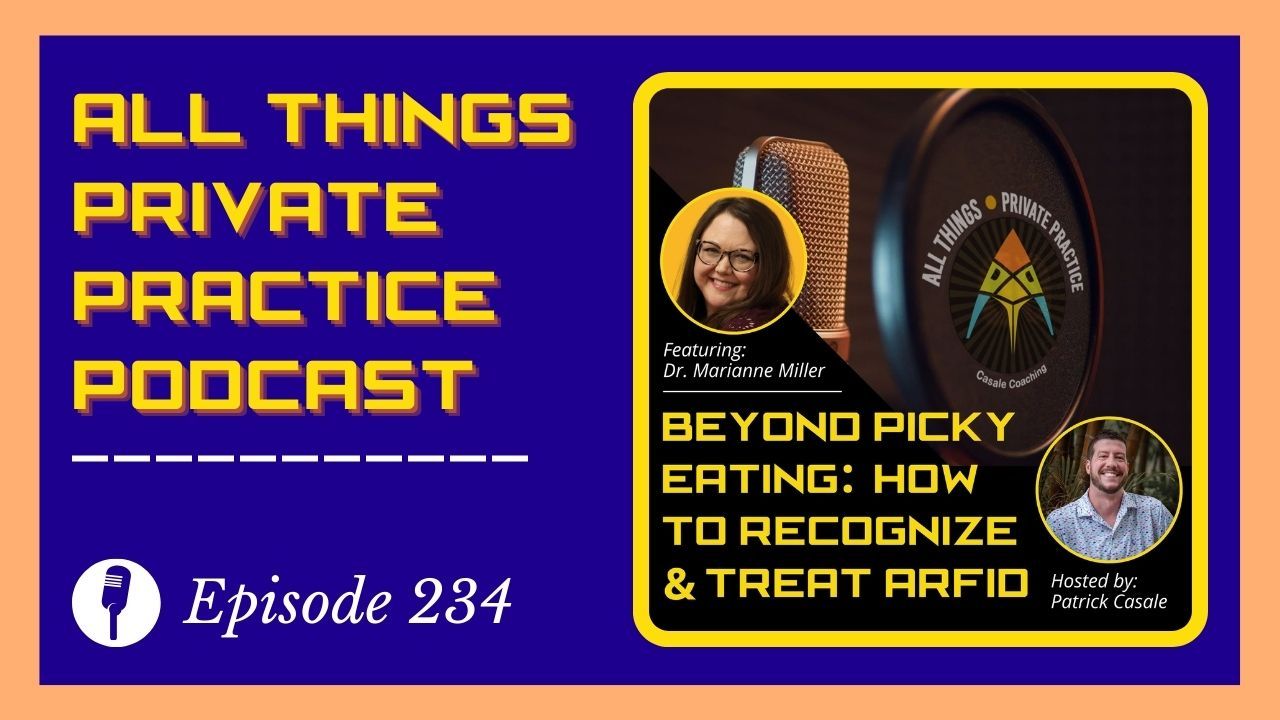
Beyond Picky Eating: How to Recognize and Treat ARFID [featuring Dr. Marianne Miller]

Hosted by: Patrick Casale
All Things Private Practice Podcast for Therapists

Show Notes

In this episode, Patrick Casale and Dr. Marianne Miller break down critical myths about Avoidant/Restrictive Food Intake Disorder (ARFID) and offer practical, compassionate approaches for clinicians, parents, and anyone supporting neurodivergent folks with eating challenges.

Here are 3 key takeaways:

  1. ARFID is not “picky eating”: Labeling someone as a “picky eater” implies willfulness or stubbornness, when ARFID is in fact a complex, involuntary experience often tied to sensory processing and interoceptive cues.
  2. A collaborative, sensory-affirming approach matters: Treating ARFID requires asking nuanced questions about sensory preferences, hunger awareness, and family dynamics. Pressure, shame, and coercion do more harm than good—compassion and understanding are the foundation of effective support.
  3. Education is essential—for providers and families: Ongoing education and unlearning old beliefs is vital. There are fantastic resources and training for therapists, parents, and adults living with ARFID to build understanding and empathy.

More about Dr. Marianne:

Dr. Marianne is a licensed therapist with nearly 30 years in mental health and 13 years specializing in eating disorders. She spent 12 years as a full-time academic before moving into full-time private practice in 2018. She is the host of the Dr. Marianne-Land podcast and creates online education, including her ARFID and Selective Eating course. Her work centers a non-diet, liberation-focused, Health at Every Size (HAES®) approach and supports people of all genders and neurotypes. She is neurodivergent and LGBTQIA+ affirming.


🎙️Listen to more episodes of the All Things Private Practice Podcast here
🎙️Spotify

🎙️Apple

🎙️YouTube Music
▶️ YouTube
✈️ Check out available Retreats
🗨️ Join the free Empowered Escape FB Community
🗨️ Join the free All Things Private Practice FB Community


A Thanks to Our Sponsors: The Receptionist for iPad & Portland, Maine, Summit 2026!

The Receptionist for iPad

I want to thank The Receptionist for iPad for sponsoring this episode.

This podcast is sponsored by The Receptionist for iPad, a digital check-in system that eliminates the need to walk back and forth from your office to the waiting room to see if your next appointment has arrived. Clients can securely check-in for their appointments and you'll be immediately notified by text, email, or your preferred channel. Break free from interruptions and make the most of your time. I've been using them for almost three years now and it saves me hours in my week.

Start a 14-day free trial of The Receptionist for iPad by going to thereceptionist.com/privatepractice. Make sure to start your trial with that link. And you'll also get your first month free if you decide to sign up. 

Portland, Maine, Summit 2026

 The 2026 Doubt Yourself Do It Anyway Summit is happening for the first time in the United States in beautiful Portland, Maine, on September 1st–3rd, 2026. Portland, Maine, is a beautiful coastal city in the Atlantic Ocean. There's a lot of history there, and it's a very funky, creative, safe, walkable, diverse, and progressive city. You will get 9 NBCC CEs. We have ASWB pending—we'll make an announcement when that's finalized—and have 13 prolific industry leaders. This summit has always been about showing that our skills are applicable in so many different ways, and to motivate you to think bigger, grow in this profession, take more risks, work through self-doubt, and really embrace the doubt-yourself-do-it-anyway mentality. Spots are limited. Reserve your spot here: empoweredescapes.com/portland-maine-summit
Doubt yourself. Do it anyway. See you in Maine.


 Free Podcasting Workbook

Get a practical podcasting workbook for therapists considering starting a podcast, created by Patrick Casale, host of the podcasts All Things Private Practice and Divergent Conversations.

You'll get a practical structure for therapists who want to start a podcast but don’t want to rush, perform, or build something they can’t sustain.

Grab your free copy: atppod.com/free-podcasting-workbook


Transcript

PATRICK CASALE: Hey, everyone. Welcome back to the All Things Private Practice podcast. I am joined today by Dr. Marianne, who is a licensed therapist with nearly 30 years in mental health, and 13 of those specializing in eating disorders. 

She spent 12 years as a full-time academic before moving into full-time private practice in 2018. She is the host of the Dr. Marianne-Land podcast and creates online education, including her ARFID and Selective Eating course. Her work centers a non-diet, liberation-focused health at every size approach, and supports people of all genders and neurotypes, just neurodivergent and LGBTQIA+ affirming. 

Really appreciate you coming on. We have not had this conversation on here yet, so looking forward to your thoughts and expertise on a topic that is probably talked about often, or more often than it used to be, but it's certainly still wrong a lot of the time. And I think there's a lot of misconceptions around ARFID in general. So, welcome to the show. And yeah, if you want to take it away with, tell the audience what ARFID is.

MARIANNE MILLER: Sure.

PATRICK CASALE: Because I think that’s important.

MARIANNE MILLER: Thanks. And I appreciate you having me, Patrick. It's definitely an honor to be here.

So, it was about 10 years ago, and I lived in San Diego, California, that I went to a training on ARFID. And like, nobody had heard about it, that was there. And we were like, “What is this?” 

And in like a month afterward, I got a client with ARFID, a young woman or teenager, and her mom that I was working with. And so, I was able to use some of the skills that I learned during the training. And then, I just found myself, like, really falling in love with treating ARFID, because it's so different from anorexia and bulimia. And it's very, very complex. 

So, ARFID stands for avoidant/restrictive food intake disorder. And typically, where you have the other eating disorders, or people are trying to control their weight, lose weight, they're very obsessed about their weight, and body image, and stuff like that. Typically, with ARFID, you don't see that. So, you see people struggling with eating for various reasons. 

And there's three subcategories. The first subcategory is that they're afraid of, like, aversive consequences of eating. Like, maybe they had a choking episode or vomiting episode that makes them fearful to eat. 

And another subcategory is where you're just, like, not interested in eating. It's like they wish they could, you know, take a pill. And, well, some of them can't take pills, but wish they could just, like, have some sort of… Or eat by osmosis, some of my clients say, because it's very hard to get motivated. They're just not interested. They typically don't feel hunger cues. 

And the third type is the sensory type subtype. And that's where people struggle with, like the texture of food, the temperature of food, how food feels in their mouth. Sometimes, like how their saliva mixes with the food, how the texture might change in their mouth, how food looks, and how food smells. 

And those subtypes aren't mutually exclusive. They overlap. And people can have all of them, and often do.

PATRICK CASALE: Yeah, and that makes so much sense, right? Especially, when we're talking a lot about neurodivergent folks who maybe they are going to struggle with interoceptive awareness or cues. And like you mentioned, those hunger cues. And they just don't know when they feel hungry, or they don't know they're hungry until they're ravenously hungry. I know I have that experience a lot. And then, the sensory piece is huge, right? Like, that's where, like, the “stereotypical” autistic person eating bland, familiar, same diet every single day comes in, right?

MARIANNE MILLER: Oh, like, beige foods, yeah.

PATRICK CASALE: Beige foods, yeah. And it's like, there's so much misinformation and misunderstanding there. And maybe those kiddos, or people growing up, or still to this day, are being called, like, picky eaters, or they never want to try anything new, or they're so hard to please. And that stuff really gets ingrained in your head as well when there's really so much more going on behind the scenes. 

MARIANNE MILLER: Yeah. And the term picky eaters indicates, like, this sense of willfulness and stubbornness. And it has nothing to do with that. Like, this is a completely involuntary response to food and eating.

PATRICK CASALE: Yep, yep. And I think that's a huge delineation, and something that's really not as well understood. Even in a lot of disordered eating treatment, I don't see ARFID mentioned in certain programs around here sometimes. I don't see certain therapists even acknowledge that it's a thing, or have a good foundational knowledge or awareness about how to support someone who might come into their office. 

And I know this is a huge topic. I know we only have, like, 25-ish minutes to talk about it. I'm trying to frame how I want to say it. Where should people be starting, in terms of how can we support? Like, what are some foundational, like, building blocks, maybe that people can at least start trying to implement on a daily basis in their practice, or to support their clients?

MARIANNE MILLER: Yeah, well, I think the number one thing is to educate themselves on ARFID and to notice when things might be about ARFID. And I think asking questions based on those three subtypes is really helpful, because that's part of the DSM-5, you know, categories. And just like, you know, what's your experience eating? Like, do you feel uncomfortable when a food is a certain temperature? Or, you know, do you have some foods you have to only eat cold and other foods you only eat hot? And, I mean, it's, it's so like complex and nuanced. You have to ask those really specific questions. 

You know, interoceptive awareness is another big piece is just asking, you know, how do they know when they feel hungry? And a lot of them just say. “I don't.” Or, “I start feeling faint.” Or, “I just know that it's time to eat sometimes.” 

But it depends whether they have, like, other neurodivergent traits, because, like, if you have someone with ARFID and ADHD, they have time blindness. And, you know, they can go hours without eating and feel completely detached from their bodies. And then, like, get up and pass out or something like that. 

PATRICK CASALE: Yeah, I have been there, unfortunately. And it's like that experience where you don't know until you know. And then, all of a sudden, it’s like, “Shit.”

MARIANNE MILLER: Yeah, yeah. 

PATRICK CASALE: And it's real easy to overlook that with that struggle, with interoceptive cue. I think for a lot of people listening, the sensory piece is the one that they probably would most see or relate to in their experiences, a lot of the time, is like, because so many people who listen to this podcast are autistic, really struggling with that sensory component. Like you said, some foods have to be hot, some foods have to be cold. The opposites cannot be true. 

And like you said, it is not about being picky about what you're putting in your body. It is literally something that you can't control and something that is really impactful and detrimental to people's livelihoods, because it impacts how you socialize, it impacts how you participate in certain activities, it impacts how you like, you know, do things behind the scenes as well. So, there's a lot going on here that you have to pay attention to.

MARIANNE MILLER: Right. And then, you know, physical health is also a big reason why people end up coming in my therapy door. They are often, well, I wouldn't say like most of them, but I’d say maybe like 60% are underweight, or they've recently lost weight. You know, their labs aren't looking that great. And so, there's real concern if it gets to a point where they're really at risk for like, cardiac failure. Like, their heart rate’s really low and things like that. They need to get to a hospital, get on an NG tube, which is just like a tube that provides feeding that, like, goes through your nose, I believe. 

And then, unfortunately, like, I've talked to people where just the sensory aspects of having an NG tube is incredibly uncomfortable and like, impossible. And then, so they had to be discharged AMA, which is against medical advice from the hospital, or like, I can't have the energy to, but it's like, not their fault. It's not like they're being willful or stubborn. They just, from a sensory perspective, they can't do it. 

And one thing I wanted to also mention is, I'm late-diagnosed autistic myself. And what really affects how I eat is like, what's going around around me, sensory-wise. So, first, like, we stopped going to restaurants during COVID, and we haven't gone back, we didn't. Like, we preferred not to go. And the restaurants are really overstimulating for me. 

And so, when we were at a crowded restaurant, I found it like a lot more difficult to eat. And I had to use a lot of coping skills to kind of desensitize myself. And then, whether it's lighting or kind of family situations, dinners are often really challenging for families, you know? Because of different, you know, components. Sometimes it's the misunderstanding of parents. And they're like, “Well, if you eat your broccoli, then you get you dessert.” 

And that's the last thing you should do with ARFID, is try to bargain, because the more pressure you put on the child, minor, or adults, the more difficult it is to for them to eat because that creates more anxiety, and their nervous system becomes more hyper-aroused. They become more overstimulated. And then, they're like, “Well, I can't eat it all now.” So, yeah.

PATRICK CASALE: And then, potentially seeing, like, behavioral consequences in those situations that further reinforce, like, eating is not a safe or calming place to be. This is something that I'm going to be thinking about more and more as I go into to mealtime, especially if-

MARIANNE MILLER: Exactly.

PATRICK CASALE: …that messaging of, “If you don't do this there's a consequence.” And then, that certainly does not help when we have PDA profiles involved as well. 

MARIANNE MILLER: Oh, yeah. And, you know, there's a lot of PDA profiles that can come out in with people with ARFID. And I don't blame them, because they've been so misunderstood, and pressured, and ridiculed by peers. And it's just very, very difficult. 

And what I found to be most effective is family therapy with ARFID for teens and children with adults, it depends. It depends, you know, for like people in their 20s, and I would say, like, 30s, if they're still living at home, I would definitely have at least one family member who's kind of the, like, primary feeder, you know? The person who cooks most of the meals. And that is incredibly helpful to educate the family member so they can back off and not pressure them. And it's about providing/creating ease, and really asking the person with ARFID, how can we make this environment situation more safe for you, so it feels safer to eat? 

PATRICK CASALE: Right, yeah, absolutely. Because I imagine in those situations that the person that is cooking most of the meals could feel like frustration, or taken for granted or “My hard work is never appreciated.” Type of thing. And-

MARIANNE MILLER: Or, “Oh, this is so expensive, we’re wasting food, and…”

PATRICK CASALE:  Yeah, and again, like you said, that's not going to be helpful for the dynamic and setting either party up for success. So, I like what you're saying, just trying to set that ground for like, how can we make this a success for you? How can we make this a path of least resistance? What are things that we can pay attention to in the environment, sensory-wise? Paying attention to preferences. And really trying to do away with that, like, shame-inducing mentality and language, because I think that does no one any good. And it just creates further barrier when we're talking about something that is really complex.

MARIANNE MILLER: Yeah, and again, not their fault. It tends to be genetic. It tends to run in families, you know? Even if it was just masked really well by a family member. But when people think about it, it's like, “Oh, yeah. Like, I remember Grandma Mabel. She did this, that, and, you know, the other, you know, with food.” Or, “She didn't like her foods touching.” Something like that. 

And that can also, kind of looking at it from a multi-generational perspective, can also help take off, like, that feeling of blame or internalized ableism, where, like, it's my fault, something's wrong with me, which is just so heartbreaking.

PATRICK CASALE: Absolutely, very heartbreaking, and just allowing this to be an easier process. I know, for me and for a lot of people I know, trying to get calories somehow, acknowledging like I need to get them, but I don't have a lot of interest in eating. I don't have a lot of motivation to eat, or even if I build up that, like, “Okay, I'm going to do it this time.” And then, you're just like, “Oh, I can't do it.” Or, “It just tastes wrong.” Or, “The texture was off.” And then, all of a sudden, that shutdown occurs. 

Smoothies, like liquid diets, for me have been super important as someone who also who, like, has had multiple throat surgeries. So, like, I've learned that it's really a path of least resistance for me. 

And I used to shame myself, or be like, “Why can't I just, like, eat food and eat a meal right now?” Or, “Why is this so hard for me?” But now I'm like, “Smoothies are such a path of least resistance. I know I'm getting veggies, and like fruits, and protein.” And it allows me to, just like, take the pressure off myself of trying to force myself to eat when I'm often not hungry, or I'm often not in the mood to do so. 

MARIANNE MILLER: Yes, absolutely. And smoothies, nutrition shakes, protein shakes, milk shakes, is also a big one, because you can get a lot of calories in there. And you can put a lot in the smoothie that gets you calories. So, it's like you get more bang for your buck when you drink something like that, and yeah. 

And you have to be careful about like the texture, and the things, and stuff like that. If you can find things like using frozen vegetables, and fruit, because they tend to be more consistent, you know, instead of, like, if you put spinach in it, and you get, like, a weird tasting leaf, you know?

PATRICK CASALE: Yeah. 

MARIANNE MILLER: So, yeah, it's really interesting. There is another subtype of ARFID. It's not in the DSM-5, but more ARFID providers have been talking about it. It's called ARFID plus, where, if people have ARFID, and they do have, you know, issues with body image, and kind of wanting to look a certain way. And so, they might actually have ARFID and anorexia, for example. 

What I found is that you really have to treat both at the same time. And instead of saying, “Okay, we're going to treat the anorexia first.” It's like, no, no, that's not going to work. Because, you know, when you have all these sensory issues and interoceptive kind of things going on, and then, just lack of interest in food, and they're like, “Cool, I can lose weight this way.” And, you know, then, like you have to attend to the complexities of the ARFID or the anorexia treatment is not going to work. 

And I provide a neurodivergent-affirming, sensory-attuned, trauma-informed approach to treating ARFID, which is really based on encouraging autonomy and agency, where we're working really collaboratively with the people with ARFID. And that, also, really helps with PDA profiles as well. 

And then, there's another type, which is CBT-AR, which a lot of the treatment centers universities use, which is more of a top-down approach, more coercive. And I was just talking to one of my clients yesterday. And she was thinking back to when she went to one of those programs and she was just saying, like, that was the worst experience ever, because like, a lot of times they say, “Okay, you have to eat all of these foods. And then if you don't, you have to drink this boost.” Or something like that. And which is like the absolute worst thing you can do with someone with ARFID, in my opinion. 

PATRICK CASALE: Yeah, and it's really unfortunate that we're seeing a lot of that in trauma- informed treatment programs. And-

MARIANNE MILLER: Yeah, I know.

PATRICK CASALE: Which just goes to show that there's a hell of a lot to learn and unlearn when we're talking about this topic, and that the education is out there. I think that's what you mentioned before. Like, do the work, seek out the education, do the learning. There's lots of training, there's lots of people to pay attention to. I know you're one of them. And, you know, I think that makes a lot of sense in any topic where we need to do a lot of deconstructing around our beliefs around anything. So…

MARIANNE MILLER: Yes, yes.

PATRICK CASALE: I appreciate that work that you're doing. 

MARIANNE MILLER: Thank you.

PATRICK CASALE: As we are getting ready to wrap, I know this was a very short episode on a very complex topic. Any takeaways that you want to leave the audience with, like, do this, don't do this.

MARIANNE MILLER: I think cultivating compassion both in yourself and cultivating self-compassion within your clients, with the family, you know, that you work with, this is how I explain it sometimes, is I say, you know, it's like you're sitting down to a family meal. And for the person with ARFID, it's like you're putting a bowl of motor oil in front of everyone. 

And every everyone else is like, eating it, and they're like, “Oh, this is so good. Taste it, taste it.” Whatever. And so, the brain of the person with ARFID is, like, screaming, “Warning, warning.” And their nervous system is like, “No, no, danger, danger.” And everyone else is like, “No, this is no big deal.

And so, it's a really, really hard thing to have. And so, just having compassion, building compassionate families, building self-compassion to counter the internalized ableism is really key. 

PATRICK CASALE: That's a great takeaway. I appreciate that very much. Well, we appreciate your coming on. And where can people find you and what you've got going on. And we will also link this in the show notes, so you have access to everything Dr. Marianne is about to say.

MARIANNE MILLER: Yeah, so you can find me at drmariannemiller.com. It's D-R-M-A-R-I-A-N-N-E-M-I-L-L-E-R.com. On Instagram, I'm @drmariannemiller. My podcast is Dr. Marianne-Land. And I have a lot of episodes on ARFID, and being neurodivergent, and eating challenges you can face. 

And then, if you're looking for training on ARFID, I have a self-paced virtual course card called ARFID and Selective Eating. When you buy it, you have unlimited lifetime access. And every year I like add to it, you know? I look at the latest research, and I add information about it. 

I think the most people who buy it are providers. And they find it very helpful. But I also have had, like, parents of kids with ARFID buy it. And of course, like adults with ARFID themselves can buy it. And it's nice and neurodivergent friendly. It has, like, little short videos, and summaries, and stuff like that. So, it's a really passion project for me. I'm very proud of this course.

PATRICK CASALE: That sounds like an incredible resource. And we will make sure that that link is in the show notes for all of you. If you're interested in checking that out, I highly recommend it, as it's a topic that's not often talked about and often misunderstood. So, thank you so much for coming on and making the time. 

MARIANNE MILLER: Oh, I'm so glad I got to come. Thanks, Patrick.

PATRICK CASALE: You're welcome. And to everyone listening to the All Things Private Practice podcast, new episodes are out on Saturdays in all major platforms and YouTube. Like, download, subscribe, share. And we will see you next week.

FREE PRIVATE PRACTICE GUIDE

Join the weekly newsletter for private practice tips, podcast updates, special offers, & your free private practice startup guide!

We will not spam you or share your information. You can unsubscribe at any time.

All Things Private Practice Podcast for Therapists

Episode 234: Beyond Picky Eating: How to Recognize and Treat ARFID [featuring Dr. Marianne Miller]

Show Notes

In this episode, Patrick Casale and Dr. Marianne Miller break down critical myths about Avoidant/Restrictive Food Intake Disorder (ARFID) and offer practical, compassionate approaches for clinicians, parents, and anyone supporting neurodivergent folks with eating challenges.

Here are 3 key takeaways:

  1. ARFID is not “picky eating”: Labeling someone as a “picky eater” implies willfulness or stubbornness, when ARFID is in fact a complex, involuntary experience often tied to sensory processing and interoceptive cues.
  2. A collaborative, sensory-affirming approach matters: Treating ARFID requires asking nuanced questions about sensory preferences, hunger awareness, and family dynamics. Pressure, shame, and coercion do more harm than good—compassion and understanding are the foundation of effective support.
  3. Education is essential—for providers and families: Ongoing education and unlearning old beliefs is vital. There are fantastic resources and training for therapists, parents, and adults living with ARFID to build understanding and empathy.

More about Dr. Marianne:

Dr. Marianne is a licensed therapist with nearly 30 years in mental health and 13 years specializing in eating disorders. She spent 12 years as a full-time academic before moving into full-time private practice in 2018. She is the host of the Dr. Marianne-Land podcast and creates online education, including her ARFID and Selective Eating course. Her work centers a non-diet, liberation-focused, Health at Every Size (HAES®) approach and supports people of all genders and neurotypes. She is neurodivergent and LGBTQIA+ affirming.


🎙️Listen to more episodes of the All Things Private Practice Podcast here
🎙️Spotify

🎙️Apple

🎙️YouTube Music
▶️ YouTube
✈️ Check out available Retreats
🗨️ Join the free Empowered Escape FB Community
🗨️ Join the free All Things Private Practice FB Community


A Thanks to Our Sponsors: The Receptionist for iPad & Portland, Maine, Summit 2026!

The Receptionist for iPad

I want to thank The Receptionist for iPad for sponsoring this episode.

This podcast is sponsored by The Receptionist for iPad, a digital check-in system that eliminates the need to walk back and forth from your office to the waiting room to see if your next appointment has arrived. Clients can securely check-in for their appointments and you'll be immediately notified by text, email, or your preferred channel. Break free from interruptions and make the most of your time. I've been using them for almost three years now and it saves me hours in my week.

Start a 14-day free trial of The Receptionist for iPad by going to thereceptionist.com/privatepractice. Make sure to start your trial with that link. And you'll also get your first month free if you decide to sign up. 

Portland, Maine, Summit 2026

 The 2026 Doubt Yourself Do It Anyway Summit is happening for the first time in the United States in beautiful Portland, Maine, on September 1st–3rd, 2026. Portland, Maine, is a beautiful coastal city in the Atlantic Ocean. There's a lot of history there, and it's a very funky, creative, safe, walkable, diverse, and progressive city. You will get 9 NBCC CEs. We have ASWB pending—we'll make an announcement when that's finalized—and have 13 prolific industry leaders. This summit has always been about showing that our skills are applicable in so many different ways, and to motivate you to think bigger, grow in this profession, take more risks, work through self-doubt, and really embrace the doubt-yourself-do-it-anyway mentality. Spots are limited. Reserve your spot here: empoweredescapes.com/portland-maine-summit
Doubt yourself. Do it anyway. See you in Maine.


 Free Podcasting Workbook

Get a practical podcasting workbook for therapists considering starting a podcast, created by Patrick Casale, host of the podcasts All Things Private Practice and Divergent Conversations.

You'll get a practical structure for therapists who want to start a podcast but don’t want to rush, perform, or build something they can’t sustain.

Grab your free copy: atppod.com/free-podcasting-workbook


Transcript

PATRICK CASALE: Hey, everyone. Welcome back to the All Things Private Practice podcast. I am joined today by Dr. Marianne, who is a licensed therapist with nearly 30 years in mental health, and 13 of those specializing in eating disorders. 

She spent 12 years as a full-time academic before moving into full-time private practice in 2018. She is the host of the Dr. Marianne-Land podcast and creates online education, including her ARFID and Selective Eating course. Her work centers a non-diet, liberation-focused health at every size approach, and supports people of all genders and neurotypes, just neurodivergent and LGBTQIA+ affirming. 

Really appreciate you coming on. We have not had this conversation on here yet, so looking forward to your thoughts and expertise on a topic that is probably talked about often, or more often than it used to be, but it's certainly still wrong a lot of the time. And I think there's a lot of misconceptions around ARFID in general. So, welcome to the show. And yeah, if you want to take it away with, tell the audience what ARFID is.

MARIANNE MILLER: Sure.

PATRICK CASALE: Because I think that’s important.

MARIANNE MILLER: Thanks. And I appreciate you having me, Patrick. It's definitely an honor to be here.

So, it was about 10 years ago, and I lived in San Diego, California, that I went to a training on ARFID. And like, nobody had heard about it, that was there. And we were like, “What is this?” 

And in like a month afterward, I got a client with ARFID, a young woman or teenager, and her mom that I was working with. And so, I was able to use some of the skills that I learned during the training. And then, I just found myself, like, really falling in love with treating ARFID, because it's so different from anorexia and bulimia. And it's very, very complex. 

So, ARFID stands for avoidant/restrictive food intake disorder. And typically, where you have the other eating disorders, or people are trying to control their weight, lose weight, they're very obsessed about their weight, and body image, and stuff like that. Typically, with ARFID, you don't see that. So, you see people struggling with eating for various reasons. 

And there's three subcategories. The first subcategory is that they're afraid of, like, aversive consequences of eating. Like, maybe they had a choking episode or vomiting episode that makes them fearful to eat. 

And another subcategory is where you're just, like, not interested in eating. It's like they wish they could, you know, take a pill. And, well, some of them can't take pills, but wish they could just, like, have some sort of… Or eat by osmosis, some of my clients say, because it's very hard to get motivated. They're just not interested. They typically don't feel hunger cues. 

And the third type is the sensory type subtype. And that's where people struggle with, like the texture of food, the temperature of food, how food feels in their mouth. Sometimes, like how their saliva mixes with the food, how the texture might change in their mouth, how food looks, and how food smells. 

And those subtypes aren't mutually exclusive. They overlap. And people can have all of them, and often do.

PATRICK CASALE: Yeah, and that makes so much sense, right? Especially, when we're talking a lot about neurodivergent folks who maybe they are going to struggle with interoceptive awareness or cues. And like you mentioned, those hunger cues. And they just don't know when they feel hungry, or they don't know they're hungry until they're ravenously hungry. I know I have that experience a lot. And then, the sensory piece is huge, right? Like, that's where, like, the “stereotypical” autistic person eating bland, familiar, same diet every single day comes in, right?

MARIANNE MILLER: Oh, like, beige foods, yeah.

PATRICK CASALE: Beige foods, yeah. And it's like, there's so much misinformation and misunderstanding there. And maybe those kiddos, or people growing up, or still to this day, are being called, like, picky eaters, or they never want to try anything new, or they're so hard to please. And that stuff really gets ingrained in your head as well when there's really so much more going on behind the scenes. 

MARIANNE MILLER: Yeah. And the term picky eaters indicates, like, this sense of willfulness and stubbornness. And it has nothing to do with that. Like, this is a completely involuntary response to food and eating.

PATRICK CASALE: Yep, yep. And I think that's a huge delineation, and something that's really not as well understood. Even in a lot of disordered eating treatment, I don't see ARFID mentioned in certain programs around here sometimes. I don't see certain therapists even acknowledge that it's a thing, or have a good foundational knowledge or awareness about how to support someone who might come into their office. 

And I know this is a huge topic. I know we only have, like, 25-ish minutes to talk about it. I'm trying to frame how I want to say it. Where should people be starting, in terms of how can we support? Like, what are some foundational, like, building blocks, maybe that people can at least start trying to implement on a daily basis in their practice, or to support their clients?

MARIANNE MILLER: Yeah, well, I think the number one thing is to educate themselves on ARFID and to notice when things might be about ARFID. And I think asking questions based on those three subtypes is really helpful, because that's part of the DSM-5, you know, categories. And just like, you know, what's your experience eating? Like, do you feel uncomfortable when a food is a certain temperature? Or, you know, do you have some foods you have to only eat cold and other foods you only eat hot? And, I mean, it's, it's so like complex and nuanced. You have to ask those really specific questions. 

You know, interoceptive awareness is another big piece is just asking, you know, how do they know when they feel hungry? And a lot of them just say. “I don't.” Or, “I start feeling faint.” Or, “I just know that it's time to eat sometimes.” 

But it depends whether they have, like, other neurodivergent traits, because, like, if you have someone with ARFID and ADHD, they have time blindness. And, you know, they can go hours without eating and feel completely detached from their bodies. And then, like, get up and pass out or something like that. 

PATRICK CASALE: Yeah, I have been there, unfortunately. And it's like that experience where you don't know until you know. And then, all of a sudden, it’s like, “Shit.”

MARIANNE MILLER: Yeah, yeah. 

PATRICK CASALE: And it's real easy to overlook that with that struggle, with interoceptive cue. I think for a lot of people listening, the sensory piece is the one that they probably would most see or relate to in their experiences, a lot of the time, is like, because so many people who listen to this podcast are autistic, really struggling with that sensory component. Like you said, some foods have to be hot, some foods have to be cold. The opposites cannot be true. 

And like you said, it is not about being picky about what you're putting in your body. It is literally something that you can't control and something that is really impactful and detrimental to people's livelihoods, because it impacts how you socialize, it impacts how you participate in certain activities, it impacts how you like, you know, do things behind the scenes as well. So, there's a lot going on here that you have to pay attention to.

MARIANNE MILLER: Right. And then, you know, physical health is also a big reason why people end up coming in my therapy door. They are often, well, I wouldn't say like most of them, but I’d say maybe like 60% are underweight, or they've recently lost weight. You know, their labs aren't looking that great. And so, there's real concern if it gets to a point where they're really at risk for like, cardiac failure. Like, their heart rate’s really low and things like that. They need to get to a hospital, get on an NG tube, which is just like a tube that provides feeding that, like, goes through your nose, I believe. 

And then, unfortunately, like, I've talked to people where just the sensory aspects of having an NG tube is incredibly uncomfortable and like, impossible. And then, so they had to be discharged AMA, which is against medical advice from the hospital, or like, I can't have the energy to, but it's like, not their fault. It's not like they're being willful or stubborn. They just, from a sensory perspective, they can't do it. 

And one thing I wanted to also mention is, I'm late-diagnosed autistic myself. And what really affects how I eat is like, what's going around around me, sensory-wise. So, first, like, we stopped going to restaurants during COVID, and we haven't gone back, we didn't. Like, we preferred not to go. And the restaurants are really overstimulating for me. 

And so, when we were at a crowded restaurant, I found it like a lot more difficult to eat. And I had to use a lot of coping skills to kind of desensitize myself. And then, whether it's lighting or kind of family situations, dinners are often really challenging for families, you know? Because of different, you know, components. Sometimes it's the misunderstanding of parents. And they're like, “Well, if you eat your broccoli, then you get you dessert.” 

And that's the last thing you should do with ARFID, is try to bargain, because the more pressure you put on the child, minor, or adults, the more difficult it is to for them to eat because that creates more anxiety, and their nervous system becomes more hyper-aroused. They become more overstimulated. And then, they're like, “Well, I can't eat it all now.” So, yeah.

PATRICK CASALE: And then, potentially seeing, like, behavioral consequences in those situations that further reinforce, like, eating is not a safe or calming place to be. This is something that I'm going to be thinking about more and more as I go into to mealtime, especially if-

MARIANNE MILLER: Exactly.

PATRICK CASALE: …that messaging of, “If you don't do this there's a consequence.” And then, that certainly does not help when we have PDA profiles involved as well. 

MARIANNE MILLER: Oh, yeah. And, you know, there's a lot of PDA profiles that can come out in with people with ARFID. And I don't blame them, because they've been so misunderstood, and pressured, and ridiculed by peers. And it's just very, very difficult. 

And what I found to be most effective is family therapy with ARFID for teens and children with adults, it depends. It depends, you know, for like people in their 20s, and I would say, like, 30s, if they're still living at home, I would definitely have at least one family member who's kind of the, like, primary feeder, you know? The person who cooks most of the meals. And that is incredibly helpful to educate the family member so they can back off and not pressure them. And it's about providing/creating ease, and really asking the person with ARFID, how can we make this environment situation more safe for you, so it feels safer to eat? 

PATRICK CASALE: Right, yeah, absolutely. Because I imagine in those situations that the person that is cooking most of the meals could feel like frustration, or taken for granted or “My hard work is never appreciated.” Type of thing. And-

MARIANNE MILLER: Or, “Oh, this is so expensive, we’re wasting food, and…”

PATRICK CASALE:  Yeah, and again, like you said, that's not going to be helpful for the dynamic and setting either party up for success. So, I like what you're saying, just trying to set that ground for like, how can we make this a success for you? How can we make this a path of least resistance? What are things that we can pay attention to in the environment, sensory-wise? Paying attention to preferences. And really trying to do away with that, like, shame-inducing mentality and language, because I think that does no one any good. And it just creates further barrier when we're talking about something that is really complex.

MARIANNE MILLER: Yeah, and again, not their fault. It tends to be genetic. It tends to run in families, you know? Even if it was just masked really well by a family member. But when people think about it, it's like, “Oh, yeah. Like, I remember Grandma Mabel. She did this, that, and, you know, the other, you know, with food.” Or, “She didn't like her foods touching.” Something like that. 

And that can also, kind of looking at it from a multi-generational perspective, can also help take off, like, that feeling of blame or internalized ableism, where, like, it's my fault, something's wrong with me, which is just so heartbreaking.

PATRICK CASALE: Absolutely, very heartbreaking, and just allowing this to be an easier process. I know, for me and for a lot of people I know, trying to get calories somehow, acknowledging like I need to get them, but I don't have a lot of interest in eating. I don't have a lot of motivation to eat, or even if I build up that, like, “Okay, I'm going to do it this time.” And then, you're just like, “Oh, I can't do it.” Or, “It just tastes wrong.” Or, “The texture was off.” And then, all of a sudden, that shutdown occurs. 

Smoothies, like liquid diets, for me have been super important as someone who also who, like, has had multiple throat surgeries. So, like, I've learned that it's really a path of least resistance for me. 

And I used to shame myself, or be like, “Why can't I just, like, eat food and eat a meal right now?” Or, “Why is this so hard for me?” But now I'm like, “Smoothies are such a path of least resistance. I know I'm getting veggies, and like fruits, and protein.” And it allows me to, just like, take the pressure off myself of trying to force myself to eat when I'm often not hungry, or I'm often not in the mood to do so. 

MARIANNE MILLER: Yes, absolutely. And smoothies, nutrition shakes, protein shakes, milk shakes, is also a big one, because you can get a lot of calories in there. And you can put a lot in the smoothie that gets you calories. So, it's like you get more bang for your buck when you drink something like that, and yeah. 

And you have to be careful about like the texture, and the things, and stuff like that. If you can find things like using frozen vegetables, and fruit, because they tend to be more consistent, you know, instead of, like, if you put spinach in it, and you get, like, a weird tasting leaf, you know?

PATRICK CASALE: Yeah. 

MARIANNE MILLER: So, yeah, it's really interesting. There is another subtype of ARFID. It's not in the DSM-5, but more ARFID providers have been talking about it. It's called ARFID plus, where, if people have ARFID, and they do have, you know, issues with body image, and kind of wanting to look a certain way. And so, they might actually have ARFID and anorexia, for example. 

What I found is that you really have to treat both at the same time. And instead of saying, “Okay, we're going to treat the anorexia first.” It's like, no, no, that's not going to work. Because, you know, when you have all these sensory issues and interoceptive kind of things going on, and then, just lack of interest in food, and they're like, “Cool, I can lose weight this way.” And, you know, then, like you have to attend to the complexities of the ARFID or the anorexia treatment is not going to work. 

And I provide a neurodivergent-affirming, sensory-attuned, trauma-informed approach to treating ARFID, which is really based on encouraging autonomy and agency, where we're working really collaboratively with the people with ARFID. And that, also, really helps with PDA profiles as well. 

And then, there's another type, which is CBT-AR, which a lot of the treatment centers universities use, which is more of a top-down approach, more coercive. And I was just talking to one of my clients yesterday. And she was thinking back to when she went to one of those programs and she was just saying, like, that was the worst experience ever, because like, a lot of times they say, “Okay, you have to eat all of these foods. And then if you don't, you have to drink this boost.” Or something like that. And which is like the absolute worst thing you can do with someone with ARFID, in my opinion. 

PATRICK CASALE: Yeah, and it's really unfortunate that we're seeing a lot of that in trauma- informed treatment programs. And-

MARIANNE MILLER: Yeah, I know.

PATRICK CASALE: Which just goes to show that there's a hell of a lot to learn and unlearn when we're talking about this topic, and that the education is out there. I think that's what you mentioned before. Like, do the work, seek out the education, do the learning. There's lots of training, there's lots of people to pay attention to. I know you're one of them. And, you know, I think that makes a lot of sense in any topic where we need to do a lot of deconstructing around our beliefs around anything. So…

MARIANNE MILLER: Yes, yes.

PATRICK CASALE: I appreciate that work that you're doing. 

MARIANNE MILLER: Thank you.

PATRICK CASALE: As we are getting ready to wrap, I know this was a very short episode on a very complex topic. Any takeaways that you want to leave the audience with, like, do this, don't do this.

MARIANNE MILLER: I think cultivating compassion both in yourself and cultivating self-compassion within your clients, with the family, you know, that you work with, this is how I explain it sometimes, is I say, you know, it's like you're sitting down to a family meal. And for the person with ARFID, it's like you're putting a bowl of motor oil in front of everyone. 

And every everyone else is like, eating it, and they're like, “Oh, this is so good. Taste it, taste it.” Whatever. And so, the brain of the person with ARFID is, like, screaming, “Warning, warning.” And their nervous system is like, “No, no, danger, danger.” And everyone else is like, “No, this is no big deal.

And so, it's a really, really hard thing to have. And so, just having compassion, building compassionate families, building self-compassion to counter the internalized ableism is really key. 

PATRICK CASALE: That's a great takeaway. I appreciate that very much. Well, we appreciate your coming on. And where can people find you and what you've got going on. And we will also link this in the show notes, so you have access to everything Dr. Marianne is about to say.

MARIANNE MILLER: Yeah, so you can find me at drmariannemiller.com. It's D-R-M-A-R-I-A-N-N-E-M-I-L-L-E-R.com. On Instagram, I'm @drmariannemiller. My podcast is Dr. Marianne-Land. And I have a lot of episodes on ARFID, and being neurodivergent, and eating challenges you can face. 

And then, if you're looking for training on ARFID, I have a self-paced virtual course card called ARFID and Selective Eating. When you buy it, you have unlimited lifetime access. And every year I like add to it, you know? I look at the latest research, and I add information about it. 

I think the most people who buy it are providers. And they find it very helpful. But I also have had, like, parents of kids with ARFID buy it. And of course, like adults with ARFID themselves can buy it. And it's nice and neurodivergent friendly. It has, like, little short videos, and summaries, and stuff like that. So, it's a really passion project for me. I'm very proud of this course.

PATRICK CASALE: That sounds like an incredible resource. And we will make sure that that link is in the show notes for all of you. If you're interested in checking that out, I highly recommend it, as it's a topic that's not often talked about and often misunderstood. So, thank you so much for coming on and making the time. 

MARIANNE MILLER: Oh, I'm so glad I got to come. Thanks, Patrick.

PATRICK CASALE: You're welcome. And to everyone listening to the All Things Private Practice podcast, new episodes are out on Saturdays in all major platforms and YouTube. Like, download, subscribe, share. And we will see you next week.

FREE PRIVATE PRACTICE GUIDE

Join the weekly newsletter for private practice tips, podcast updates, special offers, & your free private practice startup guide!

We will not spam you or share your information. You can unsubscribe at any time.

Send Me The Free Private Practice Guide

This guide is full of resources, referral codes, step by step strategies,
retreat & podcast information, and more.

We will not spam you or share your information. You can unsubscribe at any time.