Show Notes
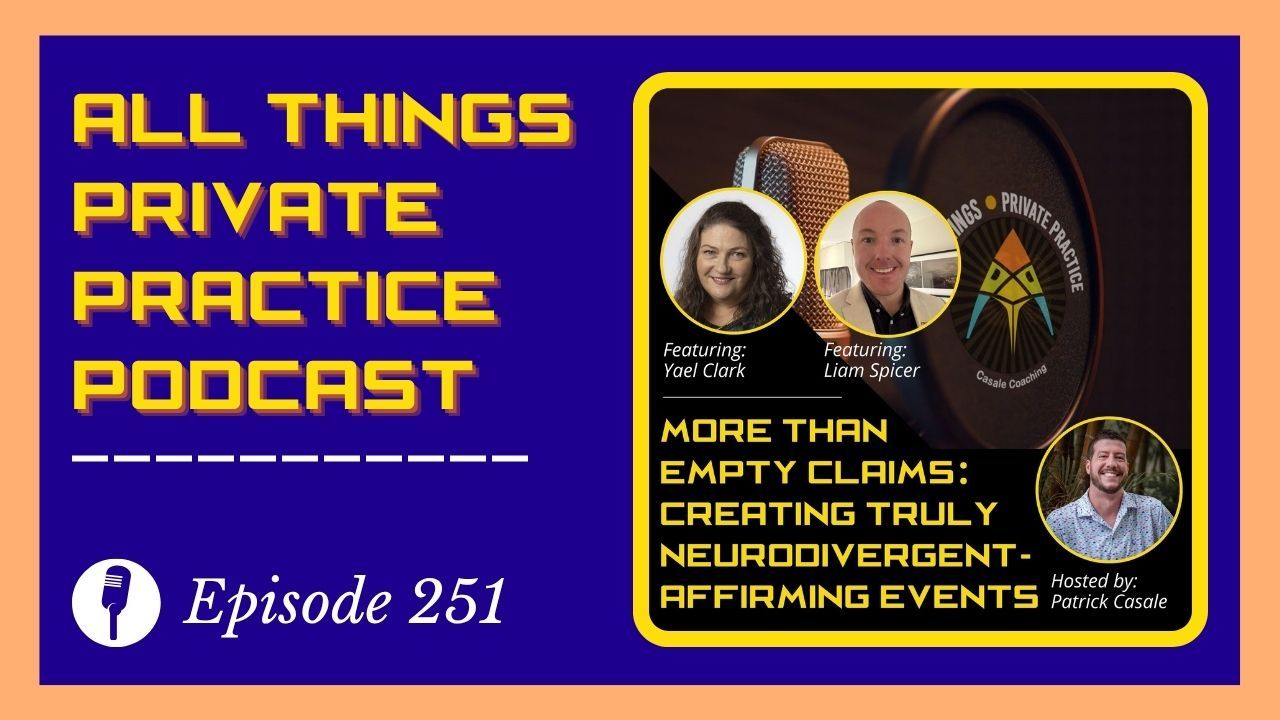
In this episode, Patrick Casale talks with Yael Clark and Liam Spicer about building neurodiversity-affirming mental health spaces and the Neurodiversity Affirming Therapy Conference Australia & LOAPAC Expo.
They discuss how collaboration among neurodivergent professionals can drive change—whether by centering lived experience, innovating inclusive practices, or redefining what “professional” environments look like.
3 Key takeaways:
- Practice What You Preach: Every layer of event planning—from speaker selection to seating arrangements—should be infused with neurodiversity-affirming values, not just the content itself.
- True Accessibility Means Change: Accommodations like sensory-friendly spaces, alternative seating, open movement, and even alternative applause create environments where more people can show up authentically and sustain their energy.
- Community-Led Innovation: Real impact comes from grassroots collaboration and feedback—welcoming new voices, ideas, and continuous adaptation, both onsite and online.
If you’re creating events, building communities, or delivering care: model the values you want to see, because people notice—and they appreciate it.
More about Yael:
Yael Clark is an Educational & Developmental Psychologist and former teacher who established her private practice, Supporting Parents in 2005 after having taught at primary, secondary, and tertiary levels for 15 years. A late-identified AuDHDer herself, her work has increasingly expanded beyond the therapy room into disability rights, advocacy, and systems change.
In 2020, she created an online community for Autistic mental health professionals, from which two larger groups quickly emerged, comprising more than 14,000 lived experience clinicians and allies. In 2024, she founded LOAPAC Australia (the League of Autistic Psychologists and Affirming Colleagues), an organisation dedicated to neurodiversity-affirming mental health care and increasing community access to affirming clinicians with lived experience. LOAPAC maintains a public register of mental health practitioners whose values and practice align with LOAPAC’s non-pathologising framework.
Her work is shaped both by her professional background and by her family’s experiences navigating systems that failed to understand Autistic needs. She is a proud Jewish woman who believes that never again means never again for anyone.
More about Liam:
Liam Spicer (he/him) is a Senior Lecturer in Psychology, Psychologist, EMDR Trainer and Consultant, and Accredited ISST Schema Therapist with lived experience as an Autistic ADHDer. He coordinates Cairnmillar’s Postgraduate Certificate in Trauma-Informed Care and delivers EMDR training for Psychology Training.
His clinical and research work focuses on neurodiversity-affirming trauma therapy, particularly with Autistic and ADHD adults. Liam is Director of the Neurodiversity Affirming Therapy Conference Australia and is involved in several research and training projects in this space.
Free gift from Yael and Liam: We will raffle off one free online registration for the conference. Raffle Instructions to win 1-free virtual or in-person ticket: Mention this episode on social media and tag @Patrick.Casale + @Ndaffirmingtherapyconference, as well as 3 friends who may want to join you at the conference. The winner will be announced shortly after.
- Social media: @Ndaffirmingtherapyconference + @Loapac_psychologists
- Website: ndaffirmingtherapyaus.org
- Website: loapac.org
🎙️Listen to more episodes of The Neurodivergent Entrepreneur Podcast
🎙️Spotify
🎙️Apple
🎙️YouTube Music
▶️ YouTube
✈️ Check out available Retreats
🗨️ Join the free Empowered Escape FB Community
A Thanks to Our Sponsors: The Receptionist for iPad!
I want to thank The Receptionist for iPad for sponsoring this episode.
The Receptionist for iPad is a HIPAA-ready digital check-in system that eliminates the need to walk back and forth from your office to the waiting room to see if your next appointment has arrived. Clients or patients can check in for their appointments, and you'll be immediately notified by text, email, or your preferred channel. Break free from interruptions and make the most of your time, because it is valuable. Start a free 14-day trial of the Receptionist for iPad by going to thereceptionist.com/privatepractice. Make sure to start your trial with that link to get your first month free if you decide to sign up.
Free Gifts for Our Listeners
Get a practical podcasting workbook for therapists considering starting a podcast, created by Patrick Casale, host of the podcasts The Neurodivergent Entrepreneur and Divergent Conversations.
You'll get a practical structure for therapists who want to start a podcast but don’t want to rush, perform, or build something they can’t sustain.
Grab your free copy: ndpod.org/Free-Podcasting-Workbook
✨ Move Beyond Private Practice As A Neurodivergent Entrepreneur
Move Beyond Private Practice As A Neurodivergent Entrepreneur is a FREE 5-part mini-course designed for therapists who want sustainable financial independence beyond one-on-one work.
Access your free mini-course here: ndpod.org/Neurodivergent-Entrepreneur
Transcript
PATRICK CASALE: Hey, everyone. Welcome back to the All Things Private Practice podcast, soon to be The Neurodivergent Entrepreneur podcast. I am joined today by two Australian people coming from the other side of the globe. And I also just realized I didn't ask you if you're both Australian before I even said that. Is that true? Yes. Good.
YAEL CLARK: Not only that, we're both Tasmanian.
PATRICK CASALE: Okay. See, here's a good lesson learned of me being tired and reading a bio that doesn't even have the words that I'm reading.
So, joined today by Yael Clark, who is an educational and developmental psychologist, former teacher who established her private practice supporting parents in 2005 after having taught at primary, secondary, and tertiary levels for 15 years.
A late-identified AuDHDer herself, her work has increasingly expanded beyond the therapy room into disability rights, advocacy, and systems change.
In 2020, she created an online community for autistic mental health professionals, which two larger groups quickly emerged, comprising more of 14,000 lived experience clinicians and allies.
In 2024, she founded LOAPAC Australia, the League of Autistic Psychologists and Affirming Colleagues, an organization dedicated to neurodiversity affirming mental health care, and increasing community access to affirming clinicians with lived experience.
Her work is shaped both by her professional background and her family's experiences navigating systems that fail to understand autistic needs.
She is a proud Jewish woman who believes that never again means never again for anyone.
We are also joined by Liam Spicer, who is a senior lecturer in psychology, psychologist, EMDR trainer, and consultant, an accredited ISST schema therapist with lived experience as an autistic ADHDer.
He coordinates Karen Miller's, I don't know, maybe, hopefully, Karen Miller's postgraduate certificate in trauma-informed care and delivers EMDR training to psychology. His clinical and research focuses on neurodiversity affirming trauma therapy, particularly with autistic and ADHD adults.
Liam is the director of the Neurodiversity Affirming Therapy Conference Australia and is involved in several research and training projects in this space.
Oh my God. Okay, I think I got it, but I think I missed some. But here we are. And you know, to set the stage for those of you at home, Yael reached out to me via Facebook DM, and was like, “Hey, I'm hosting this conference. And we need to get it in front of more eyes.” And I thought, “This is a really great opportunity to meet and actually have a conversation.”
So, I appreciate you both being here and navigating time zones. Now, I want to tee one of you up for whoever wants to go first, but ultimately, tell us a little bit about the conference itself and how you two came to be kind of partners in this.
LIAM SPICER: Yeah.
YAEL CLARK: You start the ball rolling.
YAEL CLARK: Yeah, that sounds good. So, yeah, I guess this sort of idea started a few years back for the conference, and just particularly seeing, I guess, a lack of, I guess, sort of more advanced practice in the neurodiversity affirming therapy space. And also, I guess a sort of critical sort of neurodiversity topics lens, and looking at it through a very trauma-informed intersectional lens.
Like, I, for example, went to many conferences, presented at many conferences, and often it felt like it gets neurodivergence with this sort of small little inclusion. Maybe it's just focused around autism and ADHD in particular.
And over the last five years, and a lot of people have really sort of sunk their teeth in and up-skilled, and have a lot more knowledge, and the neurodiversity affirming therapy space overall, in terms of the key sort of principles. And I guess the basic elements of practice, but really wanted to sort of take that knowledge and learning to the next level, and really educate people and create a space for that in an Australian and international context.
So, that's sort of where the idea for the conference initially started. And upon sort of thinking about and selecting speakers for the first year of the conference, which was last year, Yael was one of the sort of people that came to mind as a key presenter for that. And upon sort of catching up with Yale, having a bit of a conversation discussion, I was aware of a lot of the work that they were doing in the field, particularly, the launch of LOAPAC as well, which was really exciting. And I was a member of that as well, initially. And still a member today.
And yeah, upon having a bit of discussion with Yael, and I guess the overall sort of aims, the values of the conference, what we're sort of looking to achieve overall, had a discussion with Yael, and then we sort of came up with the idea to really have a focus as well as a part of the conference, not just on the education side of things, and not just on, I guess, learning and teaching in terms of presentations, but also, really platforming sort of autistic and other neurodivergent professionals' practices, their resources, et cetera. And that was really one of the big missions of LOAPAC, which I'm sure Yael will talk about. But that's where we came up with the idea for the expo. And that was, I guess, a part of the conference events initially last year.
So, since then, we've been working together and collaborating in terms of having the conference side of things, which is obviously the presentations, but also the expo side of things as well, really platforming people's, professionals' sort of voices, their experience, their businesses as well. And yeah, now we're sort of on to the second year of things, busily planning away again, but that's, I guess, a little bit of the backstory, if you wanted to add anything there as well, Yael?
YAEL CLARK: Absolutely. You know, I know you're changing the name of the podcast, but at the moment I was thinking about private practice and the fact that we can do so much more when we're collaborating, because I couldn't have done this alone, and collaborating with Liam just made it possible, and bigger than, I don't know, if is this an Australian saying to say bigger than Ben-Hur? Is it? Yeah, okay, so it's a very, very thick book.
PATRICK CASALE: I mean, I have [INDISCERNIBLE 00:07:17] so maybe.
YAEL CLARK: I think it is Ben-Hur. I think it's an Australian novel. Anyway, so, I digress, as usual, which is why I wrote notes, because I do digress a lot.
So, Liam, yep, was a LOAPAC member. And LOAPAC, really, the primary aim of LOAPAC is to ensure that the community has affirming mental health care, the wider community, right?
And, as Liam said, when we're talking about mental health care, sorry, neurodivergence, it doesn't just mean autistic ADHD, you know? Neurodivergence, we know, is far more broad than that.
However, in order not to do this whole big "I'm going to save the world" thing, I did make LOAPAC focus on the autistic community, and all that intersects with it. So, that still reaches out to the broader intersectional community.
So, in order to do that, I wanted to make sure that I'm actually supporting the autistic and intersectional lived experience workforce. If we're not okay, we cannot give to the wider community.
And that really informs everything I do, meaning that we affirm each other as professionals, and it starts there. If we don't affirm each other, if we don't recognize and lean into our own ways of processing, of being, of showing up in the world, of relating, first of all, how are we going to be regulated and engaged in order to support the wider community? And second, how can we possibly provide to others what we don't experience ourselves?
So, that would be to me the real excitement that when Liam said, you know, so let's be honest, Liam actually first just said, “Do the expo.” And I went, “Yeah.” And suddenly jumped in on Liam. And just got really excited, “And I'm going to organize this, I’m going to organize that that.” Because I wanted the environment, the actual physiological experience, nervous system experience of being in the space to affirm us in ways that no conference does.
PATRICK CASALE: I love that. And as someone who hosts conferences and summits, and really leaning more towards the entrepreneurial side of things, I know the work that goes into this stuff.
And I also have a business partner. And having someone, like you said, Yael, of like having someone to help you out navigating this, because I definitely could not do the ones I do on my own, it's just a tremendously big, heavy lift. And you need executive functioning for months to be able to go through these things. And I find myself really having a hard time with some of the logistical side of the conference sets, so really glad to have that partnership.
So, for the two of you, it sounds like expo and conference, clinical and lived experience, and also the workforce kind of melding all of these different pieces of the puzzle together of holistic oversight of everything in terms of intersectionality and neurodivergence, in general, business-related workforce, clinical, and educational. That's a big venture, because that's really wonderful to hear that they're blending, because Yael, like you said, if we can't take care of ourselves or our community, how can we be okay? And that's a huge component that I think often gets missed and overlooked.
LIAM SPICER: Yeah, it's really good point to make, and particularly, I guess it's a really good example of what happens when people in the community collaborate, and work together, and bring our strengths. It really is a truly collaborative effort, not just myself and Yael, but so many other people in the community as well, being involved in the event. We have so many amazing sponsors, and businesses, and people working as a part of sort of showcasing their work at the expo. We have amazing people coming and helping us create a really nice sensory space. We have individuals as well, I guess, that are really bringing their different lived and clinical experiences in terms of the presenters.
So, it does really feel like this really sort of grassroots, genuine collaborative effort within the community here, which is really nice to see. It doesn't really feel like, I guess, a traditional sort of clinical conference.
And that was, I guess, one of the goals at the forefront was really trying to shake things up and do things a little bit differently. And particularly, as well, one of the things that I guess we were finding challenging, and increasingly people were speaking more of in the community, was for factors neurodivergent people, we would often want our voices to be heard at conferences, and we would want our messages to be promoted in different ways. But there was often all these sort of significant barriers there.
Many conferences, even if you got selected to present, you would still have to pay $1,000 for a conference registration fee. There would be no payment often for people's time and stuff. So, that's one of the things, particularly, we really wanted to change, is that every presenter at a conference got a complimentary registration, got a small fee towards their time, and lived experience as well.
And that's just one of the ways that we're really trying to change things here and really set the tone for something different in Australia, but also, overseas, because particularly, people having to give their time, and expertise, and have to pay for that. We don't really feel that aligned with being neurodiversity affirming. So, yeah, generally, one of the important things that we're really trying to bring in terms of our conference space.
YAEL CLARK: Can I say, I think that Liam and I have approached this very much as, how can this be organically, actually practicing what we talk about?
PATRICK CASALE: Right.
YAEL CLARK: Actually, every single layer be infused with what we want to be seeing in the world.
PATRICK CASALE: Yeah, I love that.
YAEL CLARK: And one of the beautiful bits of feedback that we got from many, many people was that they usually go to a conference, and by the end of or middle of the first day, they're wiped.
PATRICK CASALE: Yeah.
YAEL CLARK: They're all in the sensory, low-stem sensory space, trying to just cope, or they're going home. And yet after the end of the first day, we had so many people coming up to us, going, "I didn't even need to leave the auditorium.”
They said, "I don't feel like I usually feel.” Okay, I'm just going to list some of the accommodations that we had. I don't even want to call them accommodations, some of the ways of showing up that we facilitated, right? So, there were bean bags, as opposed, and also, nice little banquet tables, bean bags, low chairs that people would sit cross-legged on, or you know, and of all sizes, sit comfortably and be accommodated, or bodies.
There was even one person who brought in a flat chaise lounge to lie on. People were knitting, they brought their knitting, and they’re crocheting. We had coloring in on every table, so people were coloring and knitting. It's okay to have your phone out. You might be scrolling, you might be taking notes, you might be taking a photo of the… We wanted to say that professional does not mean playing this suited-up role.
PATRICK CASALE: Yeah.
YAEL CLARK: Professional means being regulated and engaged. It means learning, it means being able to attend, and be present, and show up, and then to be able to share this with, you know, our client community.
So, you know, even the catering, same food. So, we had chippies, you would call them French fries, and dinosaur nuggets. You know, we wanted it to be that nobody had to drain their executive functioning going, "Oh, what can I eat? What's it going to be? And I might not like this. And then, what do I do with it? Where do I put it?” We just wanted things to be easy.
PATRICK CASALE: Yeah, I love that. Easy is huge when you're thinking of a large group of people and trying to figure out how do we make this a process and experience for people to come away from this and say this feels different, but it feels different because it feels supportive, and it feels accessible.
And so often we'll hear buzzwords get thrown around like neurodiversity affirming, or we have this large neurodivergent audience, but then you end up showing up, and it's like really bright fluorescent lights, really uncomfortable seating packed in like a wedding table, almost, situationally. Like, all sorts of things that just do not feel affirming.
So, I've started to like just say and model similar to what you're saying, Yael, of like, please stim while you're here. We've created like whole corners of the room where people can just be in movement at all times, even on your phones. Like, come and go as you please. Make this what you need it to be, because there's often pressure to, like, mask and performance spaces, right? So, ultimately, saying like I need to be at every event, I need to be at every talk, every presentation, or I'm going to miss out.
And it's like, no, if you're feeling depleted, please remove yourself and just go take care of you. And I find that to be such an important thing to model, even as the host of these events, for myself to say, like, when I'm overstimulated, I've got to get the hell out of here, and I've got to do it fast.
And, I love hearing that you all are doing this. And when I went on your website earlier, I was blown away by the amount of sponsorships that you have. Like, it's absolutely incredible. And that says the community trusts what you're doing.
YAEL CLARK: Yes. Like Liam said, it really is a community event. I mean, even to the point that I'll just shoot out an email or in our little Facebook group and say, “Can you price for me show bag inclusions?”
PATRICK CASALE: Yep.
YAEL CLARK: Things like that, so that everybody's doing their bit, and it's just beautiful. I have a packing day, show bag packing day at my house on the Saturday before the conference. You know, 15 people rock up, and we have such a good time packing the show bags.
PATRICK CASALE: Yeah, yeah, I love that.
LIAM SPICER: Yeah, it's a great example as well. It's like not just sort of the outcome itself, in terms of the conference as being neurodiversity affirming, it's the actual process as well. The process of, I guess, how we actually think about, who's going to speak, and obviously, really trying to create diverse perspectives, but all these little things along the way, in terms of this sort of collaborative and community efforts, and thinking about all the different bits and pieces together over time.
And even as well, I guess, like, as organizing things, as you mentioned before, with ADHD, and the executive functioning side of things. Like, knowing that the part of this process, it is sort of wild and crazy, and sometimes a little bit chaotic. But that's part of, as well, of just embracing and recognizing that's a part of the journey of putting something on like this.
And people seem to understand that as well, in terms of, I guess, maybe take three days to reply to an email here, or maybe need to follow up this person here, etc. But there's this sort of sense of understanding and community involved. It doesn't really feel, I guess, in comparison to other conferences and professional events. So, it's really nice in that sense. It sort of sets a scene of comfort, even before going into the actual space, which is really nice.
YAEL CLARK: I've got to say, he's a shocker, though. Like, you know, last minute. And I'll be like, "But Liam, you haven't done X, Y, and Z.” "Yeah, yeah, it'll get done.” And it gets done.
PATRICK CASALE: Yeah.
LIAM SPICER: [CROSSTALK 00:18:14] as well. I guess it's one of those things with Yael and I. We sort of balance each other quite well out. We joked about that last year. And I guess, yeah, one of us sort of fueling and thriving on that last-minute urgency, and Yael likes to be very much planned out in advance. And we find a nice happy medium, which is great.
PATRICK CASALE: I love that. And then I think that's a really wonderful way to have partnership, because I think a lot of people listening to this may want to go do something together, like a retreat, or an event, or a conference together. And you really do have to have some hard conversations when you're in partnership and putting on an event.
There's a lot of stress, there's a lot of tasks that need to be dispersed and allocated, like, and there's a lot of energy that goes into these things. And you can certainly end up on the wrong end of that, where there's miscommunications, misinterpretations, resentments, and jealousies, and frustrations. And it sounds like you two have really found a nice groove going into year number two, and feeling like very supportive and complimentary of each other's strengths and areas of support.
YAEL CLARK: So, we've had some hiccups and worked through them very well.
LIAM SPICER: That's right, definitely. And then, that's another example, as well as, like, even throughout this process, as well, where there has been hiccups, or challenges, or anything else. Part of that is, I guess, being sort of recognizing, and reflecting, and actually creating repair, and all the things that we talk about as well with our clients and in the community in general, are things that we've had to navigate and embrace as a part of this whole journey in different ways as well.
So, I guess at a sort of wider level, but also, an individual level, it definitely gives us an opportunity to practice what we talk about, which is really nice.
PATRICK CASALE: Yeah, are there things that from year one to this year maybe you thought going into that year, like we've nailed this. This is going to be really great. And then, you got some feedback where you like, "Oh, we may need to change how we do things a little bit going into year number two about whatever.”
LIAM SPICER: So, yeah, I guess after last year, the feedback overall was really overwhelmingly positive, which was really amazing to see. We had a lot of really positive feedback regarding the diversity of presenters. And I guess the presentation topics, really focusing on things that often aren't talked about in the affirming space. We had stuff around disassociation, and death trauma, and really sort of took this sort of intersectional lens, which was really important last year, and particularly, with the expo as well, and the conference space itself. We had really amazing feedback.
But I guess one of the things from last year was that because it was the first year, so all the presenters were sort of individually selected to be as a part of the lineup. And I guess one of the feedbacks that we had, and one of the things that we wanted to incorporate for the second year as well was actually having abstract submissions open for people to be able to give other individuals the opportunity to speak, and showcase their work, and their voice. So, that was definitely one of the parts of the feedback that we had that we've really incorporated into year two. And from doing so, that's been really quite amazing.
We've been able to, yeah, really hear from a lot of different people, not only in Australia, but also, internationally as well. We have really quite a great lineup of different voices. So, that's certainly something that we incorporated after year one, that's definitely going to be an ongoing focus, really sort of keeping it open to hear from different people.
In terms of other bits and pieces, I'm not sure if you can think of anything else, Yael, in terms of changes or anything.
YAEL CLARK: I do have one, but I first want to comment that you know when you're talking about the lineup and the topics that we, I learned, I was at this conference, our conference, and learned, and that's what we wanted. So many of us are past the, you know, “Yeah, we know what we mean by neurodiversity 101 kind of stuff.” Really challenged me and make me think critically, extend me, maybe a little bit uncomfortable, you know, that's what happened, that's the level of learning and challenge that is going on with the lineup that Liam has selected, because there are people there bringing topics that are outside the traditional Eurocentric psychology. I don't know what to call it, whatever, framework. And I loved that.
You know, if you're at the beginning of your neurodiversity affirming journey and anti-oppressive practice, etc. then yes, you'll still get the basic sense of, okay, this is what this is about, but if you're past that, you really get challenged. And I think that was really exciting for our brains to be engaged that way. And then, afterwards to be thinking and unpacking that. I think, that was just the magic of it, of the learning aspect. I will say one of the things that has changed, I also will note that, I think that Liam and I, I shouldn't speak for both of us, but the novelty of the first year really helps an ADHDer.
LIAM SPICER: Yes.
YAEL CLARK: And this year we were kind of like, yeah, yeah, we know what we're doing, we'll get to it. We sort of needed the dopamine to really kick in. You know, “Oh, whoops, okay, let's get this done.” So, I think that is a little bit of an aspect that…
LOAPAC actually is about to announce its first board, and incorporation, and charity, etc. And that I think will help me for next year, because I'll have more people on the ground, you know, at the director level-
PATRICK CASALE: Right.
YAEL CLARK: …really being able to look at committees and etc. That'll help. We're going to announce that at the conference, the new board. But the thing that did change from last year to this year, and I still hope to bring it back again next year. I don't know if you call it in America, we call it the cost of living crisis. Do you call it that there? What's going on in the world at the moment?
PATRICK CASALE: Uh-huh (affirmative).
YAEL CLARK: And we have found that sponsors couldn't give what they gave last year. We can't afford what we could afford last year. And you know, I could go into a whole big conversation about this, and I won't open it down. But when we talk about accommodations for different ways of being, as in not the main neuronormative way of being, it does cost money, because it's not society's default.
PATRICK CASALE: Right.
YAEL CLARK: It isn't there. And we don't call it additional needs, no, but it doesn't really exist, so we have to create it, and that costs.
PATRICK CASALE: Sure.
YAEL CLARK: So, we have had to trim it a couple of corners this year. We don't have the online platform that we did, which would have been lovely, but didn't get the engagement that we wanted out of it last year, so it really didn't feature that high. That was one of my big learnings. We really wanted to facilitate the international community, and as well as the disability community, you know, of people who can't turn up to a physical space.
PATRICK CASALE: Right.
YAEL CLARK: Either for the sensory overload and social overwhelm, etc. What's that for the traveling, leaving, caregiving demands from home? So, there was the expo online, and I thought it was amazing, but it didn't get the uptake that I'd hoped for.
PATRICK CASALE: Right.
YAEL CLARK: So, I didn't put my time and money into it this year, but I do want to re-jig it for next year, because I do think it serves an important purpose, if we can get it right.
PATRICK CASALE: Sure, yeah, that's a-
LIAM SPICER: [CROSSTALK 00:26:52].
PATRICK CASALE: …great point. And I think you're absolutely right with the cost of living crisis, so to speak, globally. Let's say we have a lot to do with that here and where I live. And unfortunately, it does mean that you do have to really make some hard decisions when you're doing things like this. And it sounds like you're trying to be as intentional and as thoughtful as you possibly can in order to include as many people as you can.
And I think that we're always going to be learning, and growing from these experiences as hosts and facilitators of things that work, things that we want more of, things we want less of, and continuously soliciting feedback year after year. It's just an unbelievably valuable way to give back to the community itself. So, I really applaud you both for doing that, because that's not an easy road.
I think a lot of people have this fantasy of I'm going to host these things, they're going to be so easy, exciting, exhilarating, want to make all this money. And the reality is like, well, a lot of those things are probably not going to be true, and you really need to anchor into the why. Like, why do I want to be doing this if I acknowledge that I, as someone with lower capacity, am going to… there's going to be a cost, right? And putting ourselves into this.
LIAM SPICER: Yeah, 100% And I guess, as well, like that sort of why, and even just reflecting on last year and thinking about the feedback that people gave, the sort of sense of inclusion that people felt, and also, as well, like knowing how people translated the learning, and relationships, and connection from that event into their practice, into their life, into who they are as a person and a practitioner, I guess that's always been a nice thing to come back to in moments of stress and challenge, and thinking logistically, how's this going to work, et cetera, et cetera. And really trying to figure out solutions to problems that are coming up, really coming back to that, and thinking about that feeling that was there for everyone, I guess, last year, all connected together, and learning, and growing in the space. It's yeah, definitely important to have that as a sort of anchor guiding things moving forward.
PATRICK CASALE: Well said. Yeah, absolutely.
YAEL CLARK: I have had conversations with Liam about, it’s called the paradox of, you know, making sure we pay everyone, making sure no one's exploited, that lived experience is remunerated, I can never say that word. And you know sometimes I look at me and Liam and go, “Yeah, no, you don't get rich during a conference, and you don't even necessarily break even.” So, you know there is that aspect there of caring for ourselves as well in all of this.
PATRICK CASALE: Absolutely.
YAEL CLARK: And I think I'm not sure, Liam, if you'd agree that I have found that some people in the community would come up to me, I believe you do, Liam, and really express that appreciation, and that they did see how hard it was, and what we did. I think so. I actually think in our community we notice these things because they're usually absent.
PATRICK CASALE: Right, yep, yep.
YAEL CLARK: So, yeah, a lot goes into it, and people can see that.
PATRICK CASALE: I agree with that. I agree with that on my end, too. Like, I've noticed that a lot of people, at least from my perspective, are really appreciative of the small details, of the little touches that go into things that make their experience a little bit more enjoyable, because people are really coming to these things so often for a sense of belonging. They want to find their footing in terms of where can I be around a group of people who I can feel like I can be myself around, or I can at least experience the environment in a way that feels really supportive. And I think that's a really beautiful thing to be able to create, and to offer, and to help facilitate.
YAEL CLARK: It's very validating to know that you're no less a professional because you show up differently.
PATRICK CASALE: Right.
YAEL CLARK: Something we didn't mention before when we were talking about some of the Spoon savers, do you guys say that there too? So that we're not in spoon deficit. And we have that energy accounting aspect, right? We didn't have applause, we had the deaf applause, so there was no big noise on everybody at the end of every talk. I think that was actually a really significant difference for people. And yes, the lights were very low, so yeah, they're two things that can really drain people.
PATRICK CASALE: For sure. That's such a great point, and just a nice, wonderful way to preserve everyone's energy and capacity. So, I love hearing all these intricate little details that came into this. And I think it sounds like round two is going to be pretty fantastic, all things considered. So, well done, you all. Because it's not often that I see people consistently have quality events year after year, at least not here in the States.
LIAM SPICER: Yeah, we're just looking forward to this year as well. I guess one of the things, particularly, like being an online conference, but also, in person as well, we do really want to make it as accessible for people, and to have, I guess, people all across the globe be able to attend and engage with the conference.
We really fortunately had a lot of interest from different presenters from different places this year as well, which has been really exciting. Have people from the US, and UK, and Mexico, and other different countries as well, who’ll be doing online presentations, and also, some other people that will be presenting in person from different places as well.
So, yeah, I really wanted to, I guess, yeah, take it that next level as well, and really expand in terms of getting it out there to different people, in different places all across the world. And yeah, really sort of continue to build that sense of community that really developed after last year.
PATRICK CASALE: That’s beautiful.
YAEL CLARK: I guess, also, if anyone has ideas for how to ensure that the online experience, particularly, for international attendees, is accessible, affirming, also part of a delightful, I think funny word, boredom, experience, shoot us ideas, because showing up in your pajamas is great, and having your dog with you is great, but there might be other aspects also that we can factor into online attendance that makes it really different, really accessible, and enjoyable. I mean, I don't know about you, but I download everything, or I pay for everything, and then never bloody watch it.
PATRICK CASALE: I am also [INDISCERNIBLE 00:33:26] unfortunately. I am like, “Oh my God, my inbox of stuff that I've purchased, thinking I was going to dive into it, and then something else came up.”
YAEL CLARK: Yeah. We don't want this to be like that. We want you to log on this same day, because, oh my God, I need to be a part of this.
PATRICK CASALE: Yeah, I think that it's a challenge, but I don't think it's an impossible one. I think it's just trying to get really creative in terms of how do we keep people interactive and engaged from a distance. I do think it's totally a possible thing to make happen, because people do it. I just think it's like you said, yeah, absolutely. I would think about that for sure.
YAEL CLARK: Yeah.
PATRICK CASALE: If anything comes up for me, I'll let you know.
YAEL CLARK: Thank you.
LIAM SPICER: Yeah, great. Thank you. Yeah, and I guess, as well, that's the good thing about, I guess, it being sort of more of this community grassroots focus event. Like, it's not this sort of big formal sort of organization or anything like that, where, for example, someone makes a suggestion, and it goes through this six-month or one-year process in terms of enacting something. Like, if someone gives us some ideas now, we can automatically put it in place, which is a really nice thing, for example, even as we're talking about that right then, like we could organize a Zoom catch-up for online attendees, where they can talk about their learnings a month after the event, or things like that.
So, this is what I mean, ideas just flow, and things come naturally. And I think that's one of the good things of, I guess, having a sort of neurodivergent led event, in that sense, is that you can actually embrace those strengths of being spontaneous, and creative, and actually leaning into just doing things differently, and not having to be this sort of formalized, structured way, which is often, I guess, the dominant model within sort of our society, unfortunately.
YAEL CLARK: I think also just the verbal processing that we're doing now sparks off so many new ideas-
PATRICK CASALE: Oh, yeah. For sure.
YAEL CLARK: …in and of itself. This is the process. And Liam, we did talk about having, like, I mean, you firstly said WhatsApp group, it could be anything, to send questions throughout the day that we can address the live. So, there'll be ways that we can make it interactive, and yeah. And there'll be digital goodies to download for free, like resources and things like that.
PATRICK CASALE: I love that. What we've started to do, just thinking about this, is doing virtual, like, welcome parties to in advance, like virtual meetups a month before. And then, Liam, like you were saying, doing some follow-ups, not just for, like, ours, are more entrepreneurial, so a lot of it is accountability about, like, what are you working on, creating, et cetera, but ultimately, it's a nice touch point too that we're able to offer people just to have that extra connection and sense of belonging too. So, I do think [INDISCERNIBLE 00:36:36] to make that happen.
YAEL CLARK: I've just got all these ideas coming now, it's great. Thank you.
PATRICK CASALE: As you're starting your day in the future, my brain is slowing down as much as possible while I'm sitting here. So, my brain stops working basically by like 3:00 PM my time. And all of my team are like, “Are you going to answer our messages?” The rest of them are like, “Hell no.” Anyway, this has been a cool conversation, and I'm really excited to see where this goes for you all. I think you mentioned Yael, you may want to raffle off a ticket on here for an event or for the-
YAEL CLARK: Yeah, we’re trying to figure how that works, though. Yes.
LIAM SPICER: Yes, yeah.
PATRICK CASALE: So, let me think about how we could do that. Maybe when this episode comes out, if you share it publicly, and tag three people who want to go to this conference, you get entered into a raffle to win a free ticket.
YAEL CLARK: Yeah, does that work, Liam.
LIAM SPICER: Sounds good. Let’s do it.
YAEL CLARK: Brilliant.
PATRICK CASALE: If that's not the idea, we will edit that out and remove that, so that nobody-
YAEL CLARK: Oh, no. That’s the idea. We love it.
PATRICK CASALE: [CROSSTALK 00:37:11] great getting to meet both of you, and really appreciate us figuring out the time difference here. And tell the audience where they can find information on the conference, so that they can sign up as soon as they hear this, and they can get on that waiting list too.
YAEL CLARK: Liam [CROSSTALK 00:37:30].
LIAM SPICER: [CROSSTALK 00:37:30]. Yeah, you can find us on our website online, ndaffirmingtherapyaus.org. So, that's the website there for the conference. On there, you'll see the lineup and everything else in terms of information, sponsorship opportunities, stuff about the expo, and everything else that's ndaffirmingtherapyaus.org.
You can also find us on Instagram as well. So, if you want to start today with different updates and learn a little bit more about the conference, and some of the speakers and stuff, you can certainly engage with this on Instagram as well, @ndaffirmingtherapyconference. So, you can certainly engage in that as well. And I'm sure we can provide the links for that. But yeah, we're really looking forward to the conference.
And also, as well, on the conference website, you'll be able to get access to the LOAPAC organization website as well, so if you want to learn more about LOAPAC and the work that they're doing, and values, and mission, and membership, and all that sort of stuff, you can also go on the LOAPAC website directly regarding that.
But yeah, certainly still, if people want to be involved in sponsorship opportunities, or expo opportunities and stuff, there's still a few positions in relation to that, and certainly, as well, if you have any questions, feel free to reach out via email, Instagram, or anything else to help you out if you need.
PATRICK CASALE: Great, and we will have all of this in the show notes for you, so it's easy for everyone to access. And we'll have instructions in the show notes as well about how you can enter into the raffle to win a free ticket to the conference. What you got, Yael?
YAEL CLARK: No, you already just spat off thoughts. Sorry, I obviously was showing that on my face.
PATRICK CASALE: Oh, okay. I didn't know if you wanted to jump in.
YAEL CLARK: No, no, sorry.
PATRICK CASALE: No, it's no worries at all. Yeah, so we'll have that all. It'll be easily accessible to all of you listening. And wishing you the best of luck in, what is it about a month and a half?
YAEL CLARK: Yeah, we really, really appreciate the opportunity, Patrick, because you've got a great platform, and your platform is a big place. And Australia, we're a big place geographically, but it’s not that many of us.
PATRICK CASALE: Sure.
YAEL CLARK: So, really lovely to be able to reach more neurokin, more allies, and you know, sort of bring that community together, even internationally.
PATRICK CASALE: Yeah, absolutely. I'm happy to do it. And really nice to meet you both. And-
YAEL CLARK: Thank you.
PATRICK CASALE: I appreciate you making the time to come on.
For everyone listening to the… I don't even know what to call it anymore, All Things Private Practice podcast, that's rebranding on June 26th, to The Neurodivergent Entrepreneur podcast. Doubt yourself, do it anyway, on all of our platforms, YouTube, Instagram, social media, like, download, subscribe, share. See you next week.
FREE PRIVATE PRACTICE GUIDE
Join the weekly newsletter for private practice tips, podcast updates, special offers, & your free private practice startup guide!
We will not spam you or share your information. You can unsubscribe at any time.





![Episode 269: Neurodivergent-Friendly Spaces Aren’t Built by Accident [featuring Trina Haynes]](https://kajabi-storefronts-production.kajabi-cdn.com/kajabi-storefronts-production/file-uploads/sites/2147507511/images/70d8a83-24dd-42e8-cb48-83a524680760_TNDE_YouTube_episode_269.jpg)
![Episode 266: Healing Isn’t Just in Your Head: Rethinking What Therapy Can Be [featuring LeNaya Crawford]](https://kajabi-storefronts-production.kajabi-cdn.com/kajabi-storefronts-production/file-uploads/sites/2147507511/images/a2d5a4-e4bf-63b0-fa7f-6e6f62c466d5_TNDE_YouTube_episode_266.jpg)