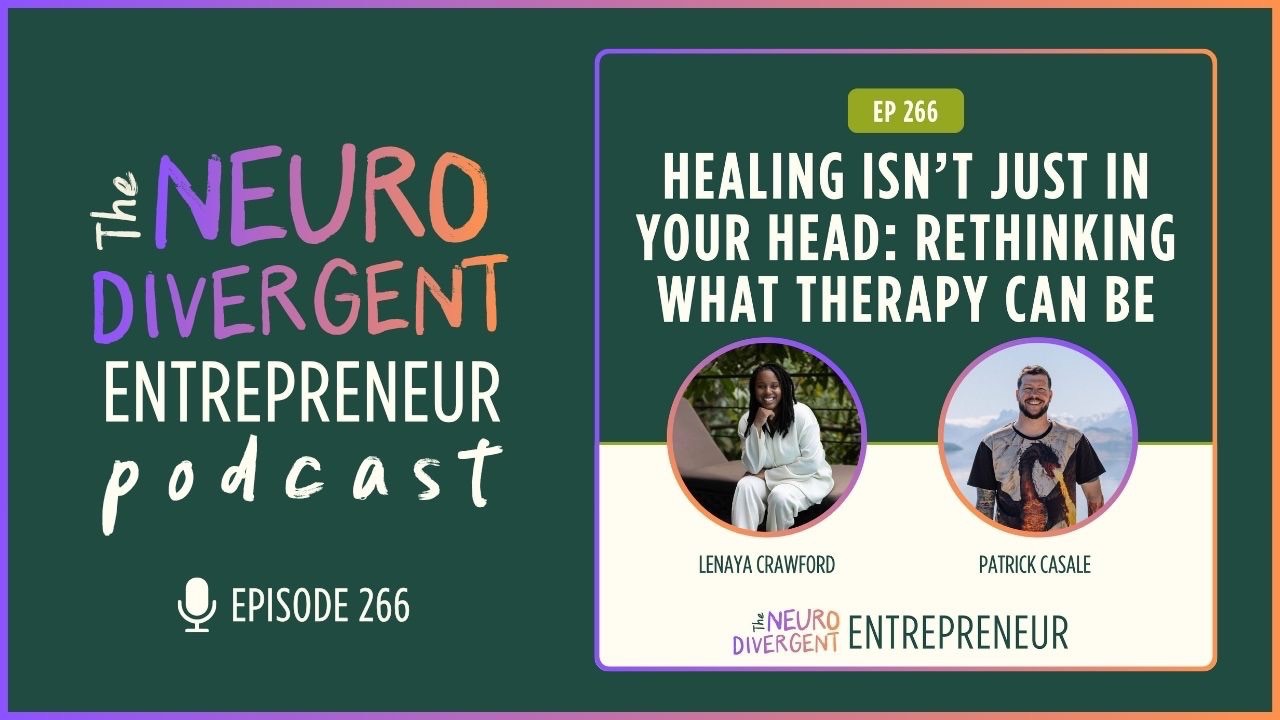
Show Notes
What if caring for your mental health isn’t just about what’s happening in your head?
Patrick Casale sits down with holistic therapist and educator LeNaya Crawford to rethink what therapy can look like when we consider the whole person. They explore how movement, breathwork, mindfulness, spirituality, and other practices can complement traditional talk therapy—and why integrating them responsibly matters.
The conversation also touches on burnout, hustle culture, self-worth, and the importance of finding approaches to healing that actually fit the individual.
3 Key Takeaways:
- Healing can involve more than talking. The body can play an important role in how we process, regulate, and reconnect with ourselves.
- There’s no one-size-fits-all approach to therapy. Different people may need different tools, modalities, and forms of support.
- Holistic therapy still requires responsibility. Expanding the therapeutic toolbox means having the appropriate training and understanding when and how to use different practices.
More about LeNaya:
LeNaya Smith Crawford, The Holistic Therapist™, is a Licensed Therapist, Holistic Mental Health Educator and Expert, Business Mentor, International Teacher, and Wellness CEO on a mission to make holistic mental health and healing accessible, inclusive, and relatable by training and empowering the therapists, healers, and organizations that make this work possible. Her work is rooted in taking a holistic approach to mental health, self-care, and entrepreneurship.
She earned her Bachelor’s in Psychology with honors from Spelman College and holds a Master’s in Marriage and Family Therapy with a specialization in trauma and spiritual integration. She is also an advanced certified yoga, breathwork, and meditation teacher (ERYT-500+) and a sound healer.
With over a decade of experience in the mental health and wellness space, LeNaya is a sought-after mental health expert and space holder. Her work has been featured in The New York Times, Essence, The Huffington Post, Healthline, and on national television, including Bravo.
As a leader in the holistic mental health space, LeNaya created The Holistic Therapist™ Academy, a globally recognized certification and immersion program that trains therapists, healers, and mental health professionals in the ethical and confident integration of holistic trauma-informed modalities.
Through her company, LSC Wellness, LeNaya supports women therapists, healers, leaders, and ambitious women entrepreneurs in prioritizing their self-care, expanding their toolbox, and building impactful, sustainable businesses—without burning out.
In addition to LSC Wellness, she is also the Founder of Kaleidoscope Therapy and Holistic Wellness, a trauma-informed group therapy practice serving clients across Georgia, Florida, and virtually nationwide, and the Co-Founder of Seviin Yoga Studio + Yoga School, a trauma-informed heated yoga studio and community healing space based in Atlanta.
- Free Intro to Holistic Mental Health: lenaya-crawford.mykajabi.com/become-a-holistic-therapist-generator1
- Free Facebook Community: facebook.com/groups/holistictherapycommunity
- Holistic Therapist Academy info page: lenaya-crawford.mykajabi.com/holistictherapistacademy
- Instagram: instagram.com/lenayascrawford
- Facebook: facebook.com/lenaya.smith
- TikTok: tiktok.com/@lenayascrawford
- YouTube: youtube.com/channel/UC0AH5hqOQdS_JRHqlwTO3dQ
🎙️Listen to more episodes of The Neurodivergent Entrepreneur Podcast
🎙️Spotify
🎙️Apple
🎙️YouTube Music
▶️ YouTube
✈️ Check out available Retreats
🗨️ Join The NeuroPreneur Circle Community
🗨️ Join the free Empowered Escape FB Community
A Thanks to Our Sponsors: The Receptionist for iPad!
I want to thank The Receptionist for iPad for sponsoring this episode.
The Receptionist for iPad is a HIPAA-ready digital check-in system that eliminates the need to walk back and forth from your office to the waiting room to see if your next appointment has arrived. Clients or patients can check in for their appointments, and you'll be immediately notified by text, email, or your preferred channel. Break free from interruptions and make the most of your time, because it is valuable. Start a free 14-day trial of the Receptionist for iPad by going to thereceptionist.com/privatepractice. Make sure to start your trial with that link to get your first month free if you decide to sign up.
Free Gifts for Our Listeners
Get a practical podcasting workbook for therapists considering starting a podcast, created by Patrick Casale, host of the podcasts The Neurodivergent Entrepreneur and Divergent Conversations.
You'll get a practical structure for therapists who want to start a podcast but don’t want to rush, perform, or build something they can’t sustain.
Grab your free copy: ndpod.org/Free-Podcasting-Workbook
✨ Move Beyond Private Practice As A Neurodivergent Entrepreneur
Move Beyond Private Practice As A Neurodivergent Entrepreneur is a FREE 5-part mini-course designed for therapists who want sustainable financial independence beyond one-on-one work.
Access your free mini-course here: ndpod.org/Neurodivergent-Entrepreneur
Transcript
PATRICK CASALE: Hey, everyone. Welcome back. I'm joined today by LeNaya Smith Crawford, The Holistic Therapist. She is a licensed therapist, holistic mental health educator, an expert, business mentor, international teacher, and wellness CEO on a mission to make holistic mental health and healing accessible, inclusive, and relatable by training and empowering the therapists, healers, and organizations that make this work possible.
Her work is rooted in taking a holistic approach to mental health, self-care, and entrepreneurship. She got her bachelor's in psychology from Spelman College and holds a master's in marriage and family therapy with a specialization in trauma and spiritual integration.
She's also an advanced certified yoga, breathwork, and meditation teacher, and sound healer with over a decade of experience in the mental health and wellness space. LeNaya is a sought-after mental health expert and space holder. Her work has been featured in the New York Times, Essence, the Huffington Post, Healthline, and on national TV, including Bravo.
As a leader in the holistic mental health space, LeNaya created The Holistic Therapist Academy, a globally recognized certification and immersion program that trains therapists, healers, and mental health professionals in the ethical and confident integration of holistic trauma-informed modalities.
Through her company LSC Wellness, LeNaya supports women therapists, healers, leaders, and ambitious female entrepreneurs in prioritizing their self-care, expanding their toolbox, and building impactful, sustainable businesses without burning out.
In addition to LSC Wellness, she is also the founder of Kaleidoscope Therapy and Holistic Wellness, a trauma-informed group therapy practice serving clients across Georgia, Florida, and virtually nationwide. And the co-founder of, not to say this correctly, Seviin Yoga Studio and Yoga School, a trauma-informed heated yoga studio and community healing space based in Atlanta. Only tripped up twice. I'm happy for the start of my day. Welcome to the show.
LENAYA CRAWFORD: Thank you so much for having me.
PATRICK CASALE: I know we've been working on this for a while. You've had a lot of cool stuff happening in your life behind the scenes, so I'm excited for you to be here.
LENAYA CRAWFORD: Yeah.
PATRICK CASALE: I want to kind of start us off with, like, you know, obviously, as someone who has trademarked The Holistic Therapist, what does that mean to you? Like, for the audience listening who hears that word and almost kind of thinks of it sometimes as, like buzzword-esque, what does that actually mean these days?
LENAYA CRAWFORD: Yes, absolutely. So, holistic therapy, holistic mental health, essentially says that in order for our clients and communities to truly heal, we have to integrate all layers of who they are into the healing work, right?
So, often, we as therapists have focused solely on the mental and emotional aspects of healing. When we become holistic therapists, we're also integrating the physical aspect, the energetic aspect, the spiritual aspects, as well as communal and relational aspects as well.
And so, when you hear the holistic therapist, that's essentially what it means. It's a coming together of all parts of who we are.
PATRICK CASALE: Yeah, I like that. That's a great answer. And looking at it from a parts perspective, I think in the therapy spaces, a lot of the times, like you said, we're focusing on the emotional, we're focusing on the cognitive, the psychological components. And if we lose sight over the fact that people have so many layers and so many parts that add up to make that whole person, but they're not getting that support in the same place, that can feel really fragmented for that person, right? Like, they have to go out and find that other practitioner or those other people. And do I even have the time in the day or the week to piece that all together?
LENAYA CRAWFORD: Exactly, exactly. And it makes it harder for our clients to find deep, meaningful healing. And that's why I'm really passionate about training therapists and mental health professionals in this holistic and integrative approach. Because how beautiful is it for our clients to be able to find healing in all aspects by coming into our spaces?
PATRICK CASALE: Yeah, yeah, absolutely. And it sounds like, you know, with everything you're doing right now, like the academy for training more holistic therapists and coaches, the group practice, the yoga studio, like everything is kind of symbiotic.
LENAYA CRAWFORD: Yes.
PATRICK CASALE: Do you feel like that describes your personality, just being able to flow from one to the next and having a lot of different interests?
LENAYA CRAWFORD: You know, I think that yes, but also, I think being able to, like, integrate these practices in my own life has created spaciousness for me to be able to lean into the different aspects of what I ultimately think is my purpose, right? To help people heal, learn, and grow. And so, I think that it's like a tangible example of all the things that you can hold when you're intentional about integrating this holistic approach, not just for the clients and communities, but also, for yourself. Because, as you know, right? If we're not doing the work on ourselves consistently, it's a lot to hold, right? So, I think it's the both and.
PATRICK CASALE: I love the both and. I talk about nuance all the time.
LENAYA CRAWFORD: Yes.
PATRICK CASALE: And I think nuance gets lost on us sometimes. We think, I think, societally, in a lot of like black-and-white, all-or-nothing statements. I think more so right now than maybe ever.
LENAYA CRAWFORD: Yeah.
PATRICK CASALE: And we need that spaciousness. And we need that ability to have that expansiveness. We can't often find that if we are just so overwhelmed by all of these layers all the time.
And I think it's hard, right? Like, we live in a capitalist society that really rewards hustle culture, and productivity, and just even thinking about stepping back and really taking care of myself in this way.
I know that for a lot of us, there's almost like this reaction of, like, do I even have the capacity to do that work? And can you talk a little bit about, like, what it's like to go on that journey of doing the deeper holistic work comparatively to, like, and talk therapy is fine, you all. I'm not knocking it. Like, I employ 25 therapists. I get it, but there's only so much that talk therapy can offer when we really need more.
LENAYA CRAWFORD: Absolutely right. And I echo your sentiments. Talk therapy is still very powerful and beneficial, but there's still a whole other aspects or aspects that we're missing, right? And to do the deeper work really requires work, right? And I think oftentimes folks forget that, you know, bettering ourselves and healing, like, it takes effort, it takes time, right?
PATRICK CASALE: Yeah.
LENAYA CRAWFORD: But I would say, what would it look like on the other side of taking the time to heal? Right? Is there a sense of joy, authenticity, peace, or what have you that you've been missing? Which, you know, typically is on the other side of doing some sort of healing work, right?
And so, what that can look like tangibly, in addition to talk therapy, is movement, right? Any form of movement. My favorite form is yoga. And on a little like tangent, right? I found the practice of yoga during one of my most stressful hustle periods in my life, grad school. And as you know, grad school, working, trying to make a living while, you know, spending days and days and hours and hours learning a skill, it's very overwhelming, right?
PATRICK CASALE: Yeah.
LENAYA CRAWFORD: And so, finding the practice of yoga allowed me to realize that even in the midst of the chaos, speaking to your point, that we could still, or I could still create some room to find some sense of peace. It doesn't mean that I wasn't stressed out. It doesn't mean I wasn't overwhelmed. But there at least was an additional tool to allow me to work with the overwhelm without burning out or giving out that peace.
PATRICK CASALE: Yeah, yeah, it makes a lot of sense. And I will agree and piggyback on that being a very stressful time in my life, and probably a lot of the listeners' lives, of like, how do I keep this all together? How do I keep all the plates spinning? How do I handle all the responsibilities and the demands of existence?
And being able to just kind of drop into something, and really anchor in, and integrate is so important, regardless of what the healing modality is or the intervention is. So many of us just do not make the time because we're so busy. We're going from thing to thing to thing to really step back and say, like, what is it that I need more of and less of, and how can I work actively to prevent burnout before it happens? Because if I get to burnout, it's hard to do any of this stuff, right? Like, it's hard to do anything besides, like acute burnout recovery measures.
And I think that being intentional really goes into, like, the interweaving fabric of being holistic in general as well.
LENAYA CRAWFORD: Yeah, absolutely. And speaking to that time factor, right? Because that's real, right? I'm a big believer that if you can be consistent, even starting with five minutes a day, five minutes can help you drop in, like you said, and anchor, and just create the space to not think about the to-do list, to not think about, you know, the kids, or the career, or whatever, but solely focusing on you and your time connecting with yourself, with God, with purpose, right? And it's that consistency piece that's really important because five minutes, you know, every two weeks, you're not see a difference, but five minutes each day.
And if you're listening and you're thinking, LeNaya, I don't have five minutes, I would say over the course of the next week, take stock of how you're spending your time, right?
PATRICK CASALE: Yeah.
LENAYA CRAWFORD: Notice the times in your day where maybe you're scrolling, right? Maybe you spend a little extra time in the bathroom. Maybe you took the longer way home, what have you? And I promise, as you scan through your day, there's at least five minutes that you can, you know, add to yourself.
And sometimes it means waking up a little bit earlier, going to bed a little bit later, but really creating the space to pour into yourself is going to be important, especially in the moments of chaos, because you need something in your cup to deal with the clients, to deal with your family, to deal with society, especially today, because it seems like the world has been on fire forever, right?
PATRICK CASALE: Yeah.
LENAYA CRAWFORD: And so, in order to show up fully, not only for yourself but the people who love you or the people that you serve, you've got to be consistent, even with just that five minutes.
PATRICK CASALE: Yeah, I love that. And I think for me, like, my immediate reaction to, like, adding things to my day is always that resistance piece. So, to reframe it, to think, like, how many times am I spending, you know, my day? I start my day off in the worst way. And I talk about this a lot, but, like, my routine, I put my phone away at 6:00 PM every night. I just want to be very clear about that because otherwise, I'd be on it all the fucking time.
But, you know, I start my day. I look at my phone immediately. I scroll through all the demands, all the messages, all the notifications, all the responses that I've missed by putting it away at night and protecting myself.
So, like, I start my day in that way energetically. And there's definitely five minutes in that, right? To, like, really think about how can I be more mindful about the way I start my day. How can I incorporate something that feels like restorative and healing, opposed to something that creates almost instantaneous anxiety and dread?
LENAYA CRAWFORD: Yeah.
PATRICK CASALE: And because that sets your whole day up, right? Like, mentality-wise and energetically. So, there's a lot that can be said for just doing that scan that LeNaya was talking about. Because I know a lot of you are thinking that, but ultimately, I know we have these pockets, and it's really about how can we shift our perspective, build those neural pathways, because that five-minute-a-day exercise, even if it's for yoga, or breathwork, or something that feels healing, can also be applied entrepreneurially to those of you who are like, I want to write that book, but I just never have the time.
I encourage you all to open that doc five minutes a day and just write for five minutes. The odds that you ever stop at five minutes are pretty slim, but it is about retraining your brain to get into that place of like saying, "I deserve to step back and spend this time really intentionally in order to support myself for my best life.”
LENAYA CRAWFORD: Yeah, I love that you said that I deserve this time, right? Because this idea of worthiness comes up a lot, especially as we do our own work as therapists and entrepreneurs.
And it's important for us to start, like, foundationally, you are worthy of the life that you want to live. You are worthy, right, of the time it takes to nourish your mind, body, and soul. You're deserving of that time. So, I love that perspective shift as well.
PATRICK CASALE: Yeah, absolutely. I want to just say that I've only done yoga three times in my life. I'm the least flexible human on planet Earth, perhaps. I always feel like I'm like a two-by-four. And I always do it when I get to this place, right? Of like, oh, back pain is 10 out of 10. Got to do everything in my power to fix, but never in the lead-up to that, and it's always like damage control, emergency yoga, acupuncture, chiropractic, massage, whatever.
LENAYA CRAWFORD: Yeah.
PATRICK CASALE: And I just realized, like, in those moments, also, in those rooms where I'm in like beginner’s yoga, and I'm like, I can't even follow what's going on. And then, I can't even do the poses. So, I will shut down in that. But I realize that there are so many ways to do that where it's not like crisis acute 10 out of 10 pain level, and probably do so with much more openness to, like, the experience. So, that's been my experience so far with yoga. It's been a journey.
LENAYA CRAWFORD: Yeah, yeah. So, when it is the emergency, 911, and you integrate the postures and things, are you finding relief?
PATRICK CASALE: No, I'm finding more pain because I'm, like, typically not probably doing them correctly and getting frustrated with myself. I'm not a good visual learner where I can like watch something done and then do it myself, so I really struggle with that. And so, I've tried to think about creative solutions around that.
LENAYA CRAWFORD: Yeah.
PATRICK CASALE: But that's been really challenging for me.
LENAYA CRAWFORD: Yeah, yeah. And you know, maybe other practices, or actually, too, have you ever been in a class where the teacher is like helping you physically get into the different postures.
PATRICK CASALE: Mm-mm (negates).
LENAYA CRAWFORD: No, okay. I think that would be helpful, like a hands-on teacher, because you're right. People learn in different ways. And that's one of the things we teach in our yoga training, is how can you help people not only through your words and through demonstration, but also, physically getting them into the posture.
And I would say, give yourself grace. And if yoga is not your thing, yoga is not your thing, you know?
PATRICK CASALE: Totally.
LENAYA CRAWFORD: Yeah.
PATRICK CASALE: I'm still looking for that magic solution to alleviate the chronic pain issues. And it's just about being open, I think, for those of you listening, like being open to trying new things that are outside of your comfort zone. I know I've leaned into that more and more with, like, getting more into tarot, getting more into intuitive energy, getting more into the way I perceive and pick up on energy throughout the world. And there are so many different, like, healing modalities and holistic ways to kind of support not only yourself but the work that you do. And just having that openness and that curiosity are super important because it's very easy to default into, like, well, that stuff's not going to work for me.
LENAYA CRAWFORD: Yeah, yeah, yeah. And in that sense of openness and curiosity, like you're saying, it allows us to lean into different practices that we may not have experienced, right? Or different practices that could actually be beneficial and healing.
And in the work that I do with therapists and training them in this integrative approach, that's usually their doorway into being curious about providing this work for their clients. They found healing in, you know, a meditation, a sound bath, movement, breath work, yoga, energy cleanse, whatever. And they were like, "I've never felt this sense of whatever it is.” Peace, joy, so on and so forth. And experiencing the healing power for themselves has opened up their mind to say, “If I experience this in these practices, I wonder what my clients might experience as well.”
So, speaking to openness, right? It's like a domino effect. You are open. You experience, and now you're able to bring that healing to your clients and your communities.
PATRICK CASALE: Yeah, that's really well said. That's a good point. I think a lot of people probably are also thinking like, okay, I'm interested in this, but if I try to support my clients through these strategies, if I get it wrong, if I stumble, if I don't feel confident in the approach, then that can create some disruption.
LENAYA CRAWFORD: Speak to that, okay? And this is why I am a big proponent of training, right? It's not enough to, you know, take a particular class or feel the healing power yourself, or do a weekend CE, or YouTube video, right? Because harm can be done if you're not confident in what you're doing and know different tools to bring into the therapy room, because not every practice is for everybody. And it's important to have an array of tools that you know align well with what the client is bringing to you, right? Because what works for anxiety doesn't necessarily work for depression. What works for trauma doesn't necessarily work for, you know, relational concerns or confidence, right?
And so, it's important that even though we spend the thousands of hours and the many years getting our clinical licenses, that we also take that same time to learn how to ethically and confidently bring these practices into our work as therapists and healers.
PATRICK CASALE: Yeah, exactly. Well said. That's a really important point. Think about so often that this profession is kind of laughable when it comes to, like, post-full licensure accountability, where it's just like you have to do 40 CEs in the next two years unsupervised, and just turn them in, and like that's fine.
And I just think about how many people are just checking the boxes just to check the boxes sometimes. Like, you can do a lot of harm in this profession if you don't continuously seek out supervision and consultation. I think it's such a crucial part of this professional journey.
LENAYA CRAWFORD: Yes, absolutely, right? And it's like always learning and being able to begin or be in that beginner's mind, that student mind, right? And also, understanding that as, you know, society evolves, our toolkit also needs to evolve, right? And so, it's not enough just to be stagnant, like you're saying, and check off the box. But what are you learning? What are you experiencing that could be of service to your clients and your communities, right?
The journey of being a therapist, the privilege of being a therapist and healer, right? The privilege of being able to help a human find a path to joy, to healing, to authenticity, to so on and so forth. It's sacred, right?
PATRICK CASALE: Absolutely.
LENAYA CRAWFORD: And I think especially in this work of being a holistic therapist, that's at the forefront, right? This work is sacred. And if this work is sacred, I'm going to be continuing to evolve and be the best version of myself, not only as a therapist but a human, and that requires learning, and mentorship, and supervision, and openness, and new experiences, like you're saying.
PATRICK CASALE: Couldn't agree with you more. My brain almost starts to diverge down the pathway of, like, people calling out like the ethical word, but the way you just frame that really combats that hypocritical statement that comes from therapists very often when they hear, like, holistic deconstruction, alternative practice, and all of a sudden people feel defensive of the profession. And I'm saying a small pocket of people.
LENAYA CRAWFORD: Yeah.
PATRICK CASALE: Exactly what you just said. Like, this is sacred work. It's not to be taken for granted. And if we want to deconstruct this, like, mental health industrial complex that we find ourselves to be a part of, and to go back to, like, anti-colonial work, it is about doing all parts of this work, and having a holistic vantage point, and acknowledging that one modality does not work for everybody. There's no one-size-fits-all in any of this.
LENAYA CRAWFORD: Yes.
PATRICK CASALE: And I think that's just really important to continuously anchor into.
LENAYA CRAWFORD: Absolutely, like the decolonization of it all, right? You know, the perspective that it's not hierarchical, right? Something is not better than the other, but it's about working together, like all pieces of us coming together, utilizing all of the different modalities to come together. I'm so happy that, you know, you're speaking to that, that deconstruction, moving away from the colonial lens of what therapy has been, and realizing we can expand what it means to hold space in the therapeutic and mental health space.
And I want to touch on the ethics part, again.
PATRICK CASALE: Sure, yeah.
LENAYA CRAWFORD: [CROSSTALK 00:22:07].
PATRICK CASALE: Always happy to do that.
LENAYA CRAWFORD: Yes, and so when we talk about being ethical, at the forefront of ethics is being within your scope of practice, right?
PATRICK CASALE: Yeah.
LENAYA CRAWFORD: Scope of practice. And what does that mean? It means that you have training in the thing that you are doing, right? And so, if you want to make sure you're ethical, you want to make sure that you have training that shows that you know how to integrate these practices, that you have training in these practices, and you have training from a therapeutic lens, right? Or even supervision from that integrative part, right?
PATRICK CASALE: Yeah.
LENAYA CRAWFORD: And from that training, right, that's how you learn how you set up your sessions, how you dictate what type of practice is best for someone based off their diagnosis, how you, you know, align your modality with your clinical modality. And also, how you document, right?
And so, these are all things that you can learn, and all things that are necessary for ethical integration. What's your scope of practice? What is your training? How are you documenting what you're doing? How do you know which practices to bring into the room with you, right? And so, when you have that, that's an ethical framework for you to feel confident in integration.
PATRICK CASALE: Yeah, I couldn't say it better myself. That's really, really well said. And I think that's super important. So, yeah, that was a great transition segue into closing this out. So, really cool conversation. And I appreciate you having it.
You've got a lot of cool stuff going on, so always want to give space for you to kind of share what's up, and we'll put it in the show notes, too. And just thank you so much for making the time.
LENAYA CRAWFORD: Yeah, thank you so much for having me. I really enjoyed having the conversation. And so yeah, if you are on the journey of wanting to become a holistic therapist, wanting to learn more about how yoga, breathwork, and sound healing can be really powerful tools in the therapy room, got several resources for you. I will provide actually a free training on holistic mental health, and what it is, and I'll provide that for you, Patrick.
But also, if you're wanting to be in community with other aspiring and practicing holistic therapists, we have an annual conference called The Holistic Therapist Conference. And this year we are going to be at the Art of Living Retreat Center in Boone, North Carolina. It's a beautiful space that allows us to not only learn during the sessions but have time for integration. And so, that'll be October 1st through fourth at the Art of Living Retreat Center. And so, I'll share some information about that too.
And also, stay connected. You can follow me on all socials @lenayascrawford. And you can join my free Facebook community called The Holistic Therapist Community.
PATRICK CASALE: Cool, love it. Boone is beautiful.
LENAYA CRAWFORD: Yes.
PATRICK CASALE: So, if you all are looking for a conference to go to that isn't the one that I'm doing in Maine in September, I recommend going to Boone because that will be the best time to be in the mountains of Appalachia because it is so freaking beautiful here.
So, that's really cool, and we will link all of that in the show notes so that you have access to everything LeNaya just offered you.
So, thank you so much again for coming on and making the time.
LENAYA CRAWFORD: Yeah, thanks for having me.
PATRICK CASALE: All right, everyone, thanks for listening to the Neurodivergent Entrepreneur Podcast. New episodes are out on Wednesdays on all major platforms and YouTube. You can like, download, subscribe, share. Doubt yourself, do it anyway. We'll see you next week.
FREE PRIVATE PRACTICE GUIDE
Join the weekly newsletter for private practice tips, podcast updates, special offers, & your free private practice startup guide!
We will not spam you or share your information. You can unsubscribe at any time.