Show Notes
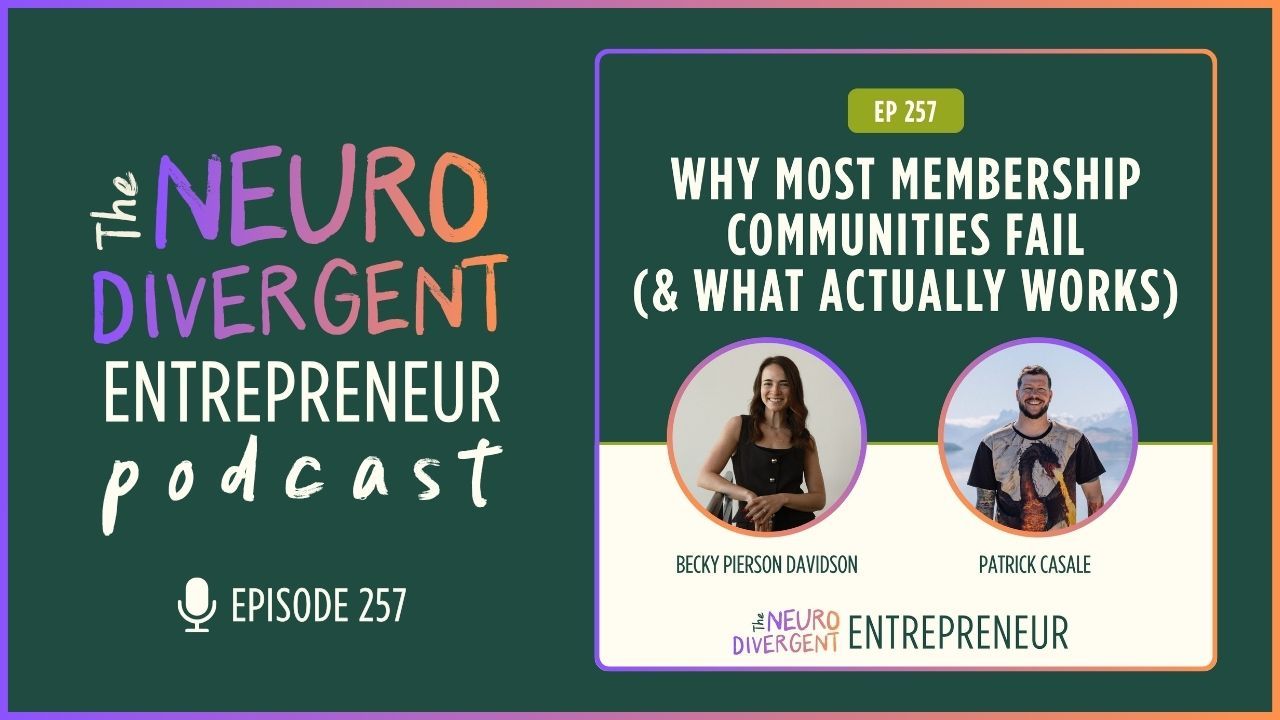
In this episode, Patrick Casale talks with Becky Pierson Davidson, founder of Affinity Collective, about what it really takes to build meaningful, sustainable online communities—including for neurodivergent entrepreneurs.
Becky shares insights from her journey in product strategy, UX, and community design, plus the hard truths about memberships, monetization, and why passion-driven communities thrive.
3 key takeaways:
- Community is the long game: Success doesn’t happen overnight. It’s built on real relationships, consistency, and showing up, not just choosing a platform or chasing quick wins.
- Engagement beats audience size: It’s not about how many follow you, but about the quality of connection and engagement. Even a community of 2,000 can be incredibly powerful if involved and connected.
- Start small and experiment: You can begin with conversations, coffee meetups, or even small group coworking—don’t rush into building giant platforms. Let your members’ needs and energy guide the journey.
If you’re interested in practical strategies for designing authentic, member-centric communities (and how to avoid common pitfalls), definitely check out Becky and the Affinity Collective.
More about Becky:
Becky Pierson Davidson is the founder of Affinity Collective — a digital product agency that builds & scales memberships.
She brings a background in product strategy, user experience, and community design, with a career that spans building software for Fortune 500 brands like Berkshire Hathaway, RE/MAX, and STARZ, and scaling one of the fastest-growing memberships for women entrepreneurs as Head of Product at bossbabe.
Across her work – whether teaching UX and design thinking at General Assembly, volunteering with CreativeMornings, or advising online businesses – community and user experience have always been the throughline.
Today, Becky leads her team at Affinity in designing membership-based communities that grow sustainably through better structure, stronger retention, and deeper connection.
Her work reframes community not as a “nice-to-have,” but as a product – designed intentionally to create real transformation for members and long-term growth for the business behind it.
- LinkedIn: linkedin.com/in/beckypierson
- Instagram: instagram.com/buildwbecky
- Website: affinitycollective.co
🎙️Listen to more episodes of The Neurodivergent Entrepreneur Podcast
🎙️Spotify
🎙️Apple
🎙️YouTube Music
▶️ YouTube
✈️ Check out available Retreats
🗨️ Join the free Empowered Escape FB Community
A Thanks to Our Sponsors: The Receptionist for iPad!
I want to thank The Receptionist for iPad for sponsoring this episode.
The Receptionist for iPad is a HIPAA-ready digital check-in system that eliminates the need to walk back and forth from your office to the waiting room to see if your next appointment has arrived. Clients or patients can check in for their appointments, and you'll be immediately notified by text, email, or your preferred channel. Break free from interruptions and make the most of your time, because it is valuable. Start a free 14-day trial of the Receptionist for iPad by going to thereceptionist.com/privatepractice. Make sure to start your trial with that link to get your first month free if you decide to sign up.
Free Gifts for Our Listeners
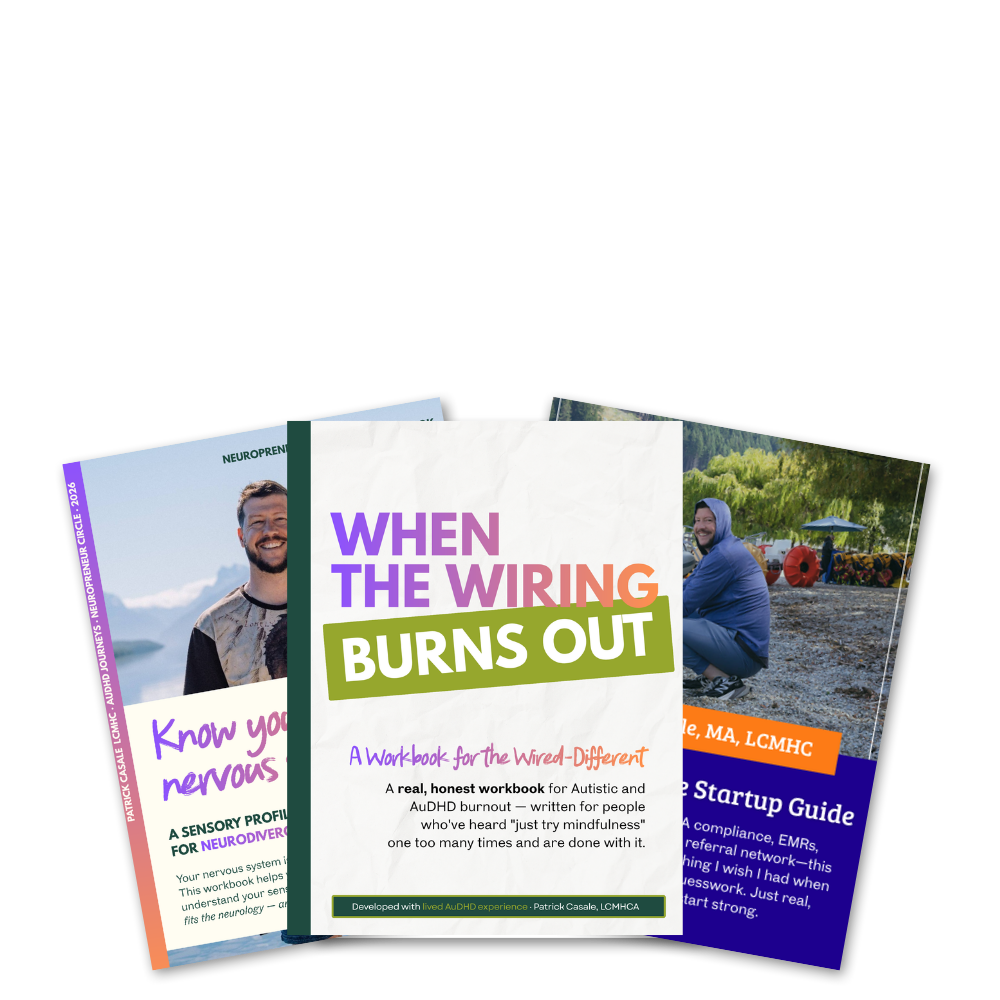
Get a practical podcasting workbook for therapists considering starting a podcast, created by Patrick Casale, host of the podcasts The Neurodivergent Entrepreneur and Divergent Conversations.
You'll get a practical structure for therapists who want to start a podcast but don’t want to rush, perform, or build something they can’t sustain.
Grab your free copy: ndpod.org/Free-Podcasting-Workbook
✨ Move Beyond Private Practice As A Neurodivergent Entrepreneur
Move Beyond Private Practice As A Neurodivergent Entrepreneur is a FREE 5-part mini-course designed for therapists who want sustainable financial independence beyond one-on-one work.
Access your free mini-course here: ndpod.org/Neurodivergent-Entrepreneur
Transcript
PATRICK CASALE: Hey, everyone. This is Patrick. And I wanted to share something really exciting with you. The All Things Private Practice podcast is changing to The Neurodivergent Entrepreneur podcast.
When I discovered that I was autistic ADHD five years ago, everything changed for me. It's wild, because at that point in time my career had just taken off.
Over these last few years, I've done a lot of deconstruction, worked through a lot of internalized ableism, learned as much as I can about neurodiversity, in general. And I really want to start unpacking what it means to be a neurodivergent entrepreneur.
So, in this podcast, I'm going to be interviewing other neurodivergent entrepreneurs of all walks of life, and all different areas of business and creativity, thought leaders, visionaries, creatives, leaders, etc. Real, unfiltered, authentic conversations. No positive psychology, always highlighting both sides of the coin with a lot of nuance, a lot of duality, and a lot of honest conversation, highlighting the strength and the struggle.
Make sure to download, like, subscribe, and share The Neurodivergent Entrepreneur podcast.
Hey, everyone. I'm joined today by Becky Pierson Davidson, who is the founder of Affinity Collective, a digital product agency that builds and scales memberships.
She brings a background in product strategy, user experience, and community design, with a career that spans building software for Fortune 500 brands like Berkshire Hathaway, REMAX, and Stars, and scaling one of the fastest-growing memberships for women entrepreneurs as head of product at Boss Babe.
Across her work, whether teaching design, thinking at General Assembly, I just read that very wrong, across her work, whether teaching UX and design thinking at General Assembly, volunteering with CreativeMornings, or advising online businesses, community and user experiences have always been the through line.
Today, Becky leads her team at Affinity and designing membership-based communities that grow sustainably through better structure, stronger retention, and deeper connection. Her work reframes community not as nice to have, but as a product designed intentionally to create real transformation for members and long-term growth for the business behind it.
Really excited to have you on for a couple reasons because we met yesterday because you're helping design my community for neurodevelopment entrepreneurs. And I think online communities are such a big important player right now in terms of how people want to show up and stay connected, and also for alternative income streams. A lot of people listening to this are always trying to figure out what that next step is going to be.
And admittedly, I think the online community space is one that I've been like sitting on and contemplating for a long time. And oftentimes, how my career goes is like it's sitting there, it's taking up mental space. I don't take action on it. It's like bubbling up beneath the surface, and then, all of a sudden one day, I'm like, “Okay, I've got to make a move.” And that's how I found you. So, really grateful for that. So, thanks for coming on.
BECKY PIERSON DAVIDSON: Yeah, thanks for having me. That's super relatable. I feel like I always have something churning for quite a while, and then it's like one day you wake up, and you got to take the plunge.
PATRICK CASALE: Yep, yeah. I need that, like, pressure to create the action. And it also has to be the right timing. I just haven't had the like time or the capacity to think about projects or ideas with all the travel, and retreat hosting that I've been doing. So, it's kind of like a natural endpoint and transition point.
And we were just talking about career pivots. And you've certainly made quite a few, starting now, like with your own brand and business, where you're helping all of these different entrepreneurs and creators create their own communities.
So, you want to share a little bit about like what that journey has been like for you from working at all these different agencies, and tech, and startups, and now running this amazing membership collective that really supports people on their journeys.
BECKY PIERSON DAVIDSON: Yeah, I think probably like a lot of your listeners, when you're working, and you're just not in it, it feels almost impossible. Like, it's so, so hard to get up in the morning.
Like, I used to show up so late for all my jobs. And like, I'm kind of like super unemployable. I'm a great consultant, but like super unemployable. And it's because like, if I don't wholeheartedly believe in everything I'm doing and working on, I'm totally useless.
And so, a lot of my career path has been trying to find that feeling of, “Oh this is right, and this feels good, and aligned. And I'm excited about it every day.”
I mean, so I actually started my career in architecture. So, I studied architecture. One summer I had an internship where I designed stair details every single day. I was doing stair detail drawings. Design is an extreme word there. I was drawing stair details like red lines, like not fun.
And this was before, I think, like, this is kind of an aside, but I think, like, we need to teach, like, teenagers how to find what they're good at. Like, are they a visionary? Are they detail-oriented? Like, what kind of brain do they have?
Because I didn't know that I am not a detail-oriented, like zoom weigh-in person. I'm a visionary type person. And so, yeah, that was awful. And then I kind of like stumbled my way into user experience design. And when I worked in tech, I worked at a consultancy. I probably worked on 100 different software projects. And I just kept waiting. I was like, as soon as I like work on a project where I'm like, “Oh, I could do this forever, then I'll jump ship, and I'll go in with like in-house and work somewhere at some like large organization.” And it just like never happened for me.
And then, I started teaching on the side at General Assembly. I started joining all of these communities and like kind of getting obsessed with online education because I always loved learning. And that's when I was like, maybe I just sort of like break into this industry somehow. And I did that through my job at Boss Babe. And it worked. And now I love what I'm doing and love building my team. But it’s like a journey, a decade journey to get there, you know?
PATRICK CASALE: Yeah, super relatable. I mean, I think a lot of people listening can relate to that, myself included, and just trying to find your place in the world, right? Of like, there's so much pressure for us to pick a career, pick a job, pick a passion, stick with it from early on. And that was never who I was.
And I thought I was like just doing it wrong, where I just couldn't find the thing that felt like it lit me up, or was exciting, or that I was good at, or it came like naturally to me.
And I think that for a lot of us, you know, it's so hard to tell younger people, like, you've got to figure this out by the time you're like 18, 19, 20, 21. I mean, I don't even think I figured it out until like three, four years ago, if I'm being honest.
And it took a lot of trial and error. Definitely relate to like not feeling employable at all, and just have to have control over my situation, and environment, and scenario because like, otherwise, I really feel like the walls are closing in quite a bit, and I really struggle in those workspaces. So, I get that for sure.
So, now that you're doing what you're doing, tell the audience a little bit about what that looks like for you, and like what your day to day is because I think a lot of people listening have probably flirted with the idea of building an online membership.
I had a pretty large Facebook group for a while, and it got too overwhelming. Just moderation and like, I'm very good at building community and connection, but I knew I wanted to take it off of Meta for a lot of reasons, but I just didn't. My struggles are definitely executive functioning related, especially when it comes to like, like you're mentioning the details.
So, if I saw here's a list of how to build a community, I would look at that list and be like, "Yeah, I'm not fucking doing this.” And I would just delete it or throw it away or whatever. So, finding you and your team who are going to take on all of the things that my brain does not do well was a godsend for me.
So, like, tell us a little bit about why communities? Why are they like really thriving right now? What are you seeing behind the scenes? Like, tell us anything you want about that.
BECKY PIERSON DAVIDSON: Yep, community for me in the beginning, well, it still is. Like, I want to work with people that want to make an impact, and for me, I was like, I could build anything. I just built 100 different types of software like businesses, and it's like, so what do I want to focus on? And community spans so many industries. So, it still scratches that itch for me of like continuous like learning, and changing my mind, and following the thread or whatever. But the underlying like root is the community experience, which for me is all about bringing people together that have a shared goal, shared interest. They're like desiring human connection. We need that more than ever. We need to, like, get off these horrible social platforms and, like, get into spaces that actually fuel our brain and not break it down.
So, a lot of, you know, my intention is around, I have this quote on my computer, like on my background on my screen. It says, "Businesses built on community are the future.” Because I really believe that. And especially right now. Like, with technology evolving and everything that's happening, we need that human connection to survive in a happy way, a good way.
So, my day-to-day, I've also like designed my business, and I wholeheartedly believe we get to like design our lives, which is why I never gave up on, like, just trying to find the right thing for me. And I've designed my business in a way that I get to like zoom out and look at the patterns across all these different communities. Start to see the trends. I make content myself. And then, I do a lot of the sales and marketing. And I help my clients with setting their strategies. But then, my team takes over, and they do all the execution and the details because I'm the same. Like, I can't do the details.
PATRICK CASALE: Yep.
BECKY PIERSON DAVIDSON: So, that's really what we do is like we set strategies, and a lot of people, you know, can set up a community platform, one of these out-of-the-box platforms, like you're building yours on Circle.
But what my team brings is like the thoughtful strategy, not just the execution, because communities, what people get wrong is they think they can just set up a forum, and the reality is you actually need to design a thoughtful member journey, and an experience for people, and customize it.
And we spend a lot of time talking about personalization because that's how your members will be successful is when they feel like, “Oh, this was designed for me.”
PATRICK CASALE: Yep, that's really well said, that last point, for sure, because you're right. I think a lot of people just choose a platform. All of a sudden, they think, “I'm going to create this forum. People are going to instantaneously be engaging. It's going to start to thrive.”
And that's not likely. I mean, you would really have to catch lightning in a bottle for that to be like the perfect storm scenario. You really do have to have, like, kind of a roadmap in terms of how you're going to set it up and structure it, and that's why I really enjoyed working with you all about this because the thoughtfulness is really important, even as someone who's built big communities. Like, I have built big communities by kind of destroying myself, by putting too much of myself into what I've been creating.
And that's been really hard because when you kind of set the precedent or tone that you're just going to be live, and available, and accessible all the time, it starts to kind of consume you in a way energetically that was the exact opposite of what I was looking to do.
And it's funny. After we got off our call yesterday, you know I had a lot going on. So, like, I already told you, I was admittedly not really paying attention. And thank God Jenna, my OBM was there taking notes. But like, I immediately got off of that call, and I went into my Substack, The AuDHD journeys. Make sure to follow that if you're on Substack. And I saw a, like, that was about what do you want to see out of community and I'm building this neurodivergent entrepreneur community, etc.
And I saw someone respond that was like community doesn't work. All it is is just another platform for people to log into. Nobody engages. Nobody tells you this. Nobody ever makes money on these things. And I was like, you know, what weird timing for that that, like, comment to happen.
And I know that is not true because one of my best friends, Maureen Harmon, has the Group Practice Membership Exchange. And she's had it for a decade plus. And it's just been one of the most vibrant communities in the mental health space for a very long time. And it's so robust. Like, there's so much resource in there. It's so supportive. It's so helpful.
And I believe she was doing this way before community really was taking off. And when I look at her stuff, I'm like, “Damn, could I ever make anything as useful as this, and packed full of resource?”
And I think I could, but like she has put blood, sweat, and tears into that thing. And I know it generates revenue from personal convos with her. And I just think that a lot of people are starting to realize, like, I want to take my business off Meta. I'm really good at this. I don't know how to structure and set this up in a way where I know how to support people, or would people even think this was, like, worth purchasing or subscribing to?
And I think you have to work through that and really get clear on what that messaging, that goal is, and who your ideal, like, community and target pop is. Because if you don't have that, it's going to feel really murky, and it's going to feel like, “Yeah, I can't make sense of where to go from here.”
BECKY PIERSON DAVIDSON: Yeah, I think there's also a really important distinction that community is a long game. And I don't mean that in the sense that like it's going to take you a long time to grow your membership. I mean that in the sense that you've been building community for a long time. You are a connector. You've been hosting retreats. You've been building an audience, not just community. So, like, that is part of the long game.
And so, the only time where I'm like, yeah, it's not going to work right out the gate, is when you're really starting from scratch. Because again, it's a long game. And it's just like putting money in the stock market, like it's a compounding effect. And so, like, people really have to commit to wanting to do it.
And there's a lot of fear around starting a community because it feels like a big commitment. Like, if somebody signs up, okay, I have to keep showing up forever. I’m like, and what if I don't get the numbers I want?
And so, there's a lot of fear around doing it, but if it makes sense for your business, like I mean, I think it makes so much sense for where you're at with like, okay, we're not going to host retreats for a while. I'm focusing on these other projects. Like, a perfect moment opportunity. And you also have like frameworks and tools that can really be useful for people and help people.
And so, like, people that are doing any kind of like education, coaching, those kind of aspects to their membership model, or even like community of practice where we're like bringing people together to do a project or do work together, you need to have some level of experience with like facilitation, or you have a framework that you use with your customers. Like, all of this stuff is important for it to work. Like, not anybody off the street can just go and build a community online and have it be a really successful, high-paying membership.
And I'm also really straight with people about whether or not it will work. So, if you're wondering, like, reach out to me. But yeah, like it's important to consider where you're at. Are you willing to play the long game? And also, design it in a way that is going to work for you and how you like to show up?
PATRICK CASALE: That's really important. That's a really good point. And this is why, like, consultants like yourself, myself, who are really transparent about whether or not we think you're going to be successful in what you're pursuing is important to ask those questions when you meet with someone to potentially hire. It's really easy to find people who are like, “Yeah, this is going to be great no matter what.” You don't want those like cheerleader, 100% positivity at all times without telling you the drawbacks, without telling you the potential pitfalls, without like really being straight with you.
And it's the same when I was teaching people how to like start to host retreats, where I was like, you could honestly have the best retreat idea in the world, but if you don't have any audience build up, this is going to take a lot to get this off the ground successfully.
And the obstacle to that would always be like, “Well, I really don't want to be on social media, and I really don't want to like make content.” I would think to myself, and I would say, where do you think you're going to find these paying members? Like, how do you think you're going to do this if you don't have anyone who you've established know, like, and trust with, who are going to potentially be willing to part with X amount of money, large amounts of money, often in those events.
And so, I would always see those people, even if they had the best ideas in the world, it just like would come crumbling down because they were looking for that short-term relief from the day-to-day, without acknowledging, like, it takes a long time to build audience and build know, like, and trust, and to build reputation. And it's through consistency.
And I like that you said, like, we can do this if we're looking at this as the long game. It's not a short-term solution. If you're thinking, I just want to get out of practice, or I just want to get like an alternative income stream going, you do have to think about this long term.
And I think about it not only about the money that can be coming in and the financials gain in that regard. I think about, like, what community means for me as an autistic ADHD person who spends a lot of time in my house. I think about how I want to have people who get it around me? I want to have less people who feel like there's something wrong with me. I don't ever fit in. I don't ever belong. My ideas are always like too outside of the box. Like, I really struggle in traditional workplaces. I really struggle to find my place in the world. And I want to foster that, and just nurture that, and build that.
So, I think you really have to anchor into your why about, like, why is this important to me? Why do I really want this to be created? And a lot of times, I think we're creating something that we ourselves often need, and tapping into that can be really powerful.
BECKY PIERSON DAVIDSON: Yeah, I love that. It's such a good point. It's like I'm thinking about a couple of clients I worked with recently that they definitely didn't have the right why going into it. It was like, “Oh, I want to make recurring revenue because there are people online that do what I do, what I do in.” But their whole strategy is like, “Let me add a recurring revenue model to your business.” And-
PATRICK CASALE: [CROSSTALK 00:19:30].
BECKY PIERSON DAVIDSON: That's what I hear in my head. So, yes.
And so, I'm just like, I watch these people, you know, build their communities, and then they want to shut it down. They're like, “I hate showing up in this. I don't want to talk to people that follow me.” And I'm like, “What are you doing?”
PATRICK CASALE: Yeah.
BECKY PIERSON DAVIDSON: And so, there's also a really big difference. Like, when I say play community build, you know, for the long game. Like, I'll give you an example. I've been writing my newsletter and writing content online for years at this point. Like, at least three, four years. And I mean, I think total audience I have like 2500 people following me. Like, that's not that many people, but it doesn't matter. I've built a successful business. And I've built community. And I have my own community for, like, past clients and stuff. And it's through just, like, actually making connections with those people. Can you imagine 2000 people in a room? That's like a lot of people.
PATRICK CASALE: A ton of people.
BECKY PIERSON DAVIDSON: Yeah.
PATRICK CASALE: Also, I think we also misconstrue, like, numbers of audience with success, right? Because I could look at my audience and say like, okay, if my Insta has 68,000 right now, if I launch something today, how many of those 68,000 are actually engaged and willing to like commit to something?
If the answer is super minimal or a low percentage, it doesn't really matter what the number is. So, engagement is everything for me. And that could mean 2500 total people, that could mean 20. But if you have the engagement and the consistency, I think that's what creates success. We get really caught up in, like, vanity metrics and comparison culture. And social media does a great job of telling you you're not doing enough, or you're not as successful, or someone else has content that you think is not as good, but it's going viral all the time, and you can't figure out why.
And you have to try really hard to, like, zoom out from that and deconstruct the narrative of like, am I only as good as my, you know, social media account or my accomplishments online? Because a lot of that is a facade, and a lot of that is bullshit.
And I like that you said, like, these coaches that are like, “Add recurring revenue.” And like I'm always very weary of coaches, consultants, trainers, etc., my field included, when people are just, like, learn how to build alternative income streams without truly understanding. There's not a lot of “passive income” streams. Like, you do have to put the work in, whether you are putting an enormous amount in on the front end, or you're hiring the right person, parting with that resource to hire the right people. It's not just as simple as saying, like, I'm going to put coaching into my practice. I'm going to put retreat hosting or podcasting into my practice.
Like, podcasting is another one where people start out with the wrong idea of, like, I'm going to start this, and I'm going to make money podcasting. It is so rare for people to actually monetize their podcast. So, like, you just have to, like, really step back and say, am I willing to really do the work to get this to the place where I can be monetized? And if I'm not, it's okay for it to still be a hobby and be enjoyable. But you want to go into it with the right understanding so that you don't set yourself up for failure.
BECKY PIERSON DAVIDSON: Yeah, memberships, you know, can be great, but they're definitely from a revenue perspective. But when we think about, like, they're one of the most active, actually, not passive offers you can have because it's a people product, which means we have to respond. Like, it's co-created with your community. We constantly have to be responding to what people are needing.
We talked about this yesterday because we talked about your programming, and I'm like, let's keep it flexible. Let's experiment. We're going to come up with some ideas for the first couple months. Gather feedback. See what people care about. You know, we'll have onboarding questions when they come in that we can use to inform that programming.
All of that is very iterative. And we want to build in like feedback loops that we're reviewing every single month. But if a membership is your main offer and you're looking at feedback loops and you're supporting people, it's also like a lot less intensive than trying to find new clients constantly because you get to actually work with clients month over month, and they're growing, and they keep paying you every month. And so, I mean, yeah, like plenty of benefit around the recurring revenue aspect of it. But it's a very active product, so like make no mistake.
PATRICK CASALE: Yeah, you have to be involved. And one thing I used to do unknowingly and unintentionally when I had my Facebook group going was I would be asking like engagement-based, open-ended questions in the group all of the time. And I didn't know what I was doing was driving engagement and creating like almost this situation where people were expecting these types of questions at each time of each day.
And you would have hundreds of people responding to things as simple as, like, you know, what's your favorite thing to drink in the morning? What's your favorite place you've ever been for vacation? And none of it even had to do with private practice. But all of a sudden, we had this active Facebook group that was just constantly like full of engagement.
And I was like, "Damn, I'm just doing market research.” I realized. I'm like, I never even understood what I was doing in those moments. So, you have to kind of be willing to be involved in that community as the face of it for a very long time.
And I think you have to think about, do I have the capacity to truly commit to that? If you are thinking about building community. For those listening like at home, what's a good starting point? Like, what are what are a couple of things, like, you need to know this in order to even start actively thinking about building community. Like, do we need the target audience? Do we need the theme? Like, what feels the most important for people?
BECKY PIERSON DAVIDSON: If you're like just getting started, it's all about, I mean, have an idea of who you think an ideal community member is, and then start talking to those people. Like, have one-on-one conversations. Start connecting them to each other. Plan a coffee meetup. Plan a virtual co-working. Like, do something that's, like, bringing people together in some way, and just do like little experiments. We don't have to jump straight to let's build this platformed-out, like fully thought-out product. Like, that comes later.
So, a lot of people come to me where they're like, “Okay, I have this community, and it has like 25 people, and I'm ready to like take it to the next level.” Like, that's where we you know, meet with a lot of people where it's like, “We have this WhatsApp chat, and I'm ready to, like, make this like a thing.”
So, I would say, like, start small, start like very boots on the ground. And then, it comes back to what I shared earlier around you have to have frameworks, tools, processes, ways you help people.
And it's not that you have to have, like they have you know, a certain framework you're taking them through necessarily. If you want to bring people together for more of a practice, like we've talked about your community being like a community of practice where people can come and work together, and you know work through their challenges, and it's more about showing up every month and the consistency of building that out. Like, that's totally valid. And also, like a more of a transformative experience is also totally valid. So, there's kind of like two categories.
But you kind of want to have an idea of what you're building. But all of that comes from having conversations and learning from people what they need, and what their challenges are, and what they care about, and how you can really connect them and create these, like, shared conversations and experiences.
PATRICK CASALE: Yeah, that's great advice for everyone listening. I know that early on when I started All Things Private Practice, I probably could have built an online community for private practice therapists who were doing exactly what we were doing in my Facebook group every single day. And I'm honestly really glad that I didn't. Maybe not so much financially. I feel like would have been beneficial in a lot of ways. But we talked about pivoting and adapting before we started recording, and I know that's not really my target audience anymore in terms of like what I enjoy doing.
BECKY PIERSON DAVIDSON: Yeah.
PATRICK CASALE: So, it's fascinating when you allow yourself to go on that journey in the entrepreneurial sense of like when does the right fit make the most sense? And I think for me, spending a lot of time with more neurodivergent entrepreneurs over the last couple of years, and just getting a better understanding of my own neurodivergence, and being a good community connector and a good leader in a lot of ways, that it just felt like the perfect timing.
And it probably could have generated lots of revenue early on in a different sense, but it wasn't the perfect timing for me.
And I think sometimes we have to pay attention to that as we're on these journeys, not only with community, but really any big project that we're about to take on, and commit our energy, and our capacity, and our time too, because those are the resources that we do not get back. So, I want to be very intentional about how to move forward in all of those ways.
BECKY PIERSON DAVIDSON: Yeah, in your last podcast, well, that I listened to was about your trip to New Zealand, you shared that you loved being around these neurodivergent entrepreneurs, and it really filled your cup, and you had a lot of energy, and your nervous system felt safe.
And I think also just, like, noticing, for those listening, like noticing when you feel that. Like, who are you with? What are you doing?
Like, for me when I'm teaching a group of people that want to build community or they have established communities, and they're trying to grow them, like, they're trying to scale past that 25, 50, 100-member mark, like, that lights me up. I love hanging out with those people, talking about what experiments they're trying, you know what they're learning from their members. Like, different tools they're experimenting with, all of that. Like, I love that. That feels really good. And when I get to help them, that feels really good. And so, I know that that's who I want to serve. So, you have to like pay attention to those signals that your literal body gives you.
PATRICK CASALE: Yeah, 100% agreed with that. Yeah, just pay attention to that stuff, and it's going to ebb and flow throughout your careers. I think it changes as you change. I think as we change personally, we change professionally. Our interests may change if you are an ADHDer and have an interest-based nervous system. Your interests are going to change a lot. So, just really paying attention to when does it feel like the right feeling, or the right energy, or the right group. And that will reveal itself the more that you put yourself in these situations and in these rooms.
So, really cool combo. And I appreciate all of your help on the back end. And I'm excited to get my Neuropreneur Community going in early June. So, if you want to get on the wait list for that, make sure you are on my Insta, or on my Linktree, or on my website. And if you are interested in working with Becky, she can share every place that you can do that.
BECKY PIERSON DAVIDSON: Yeah, so my company is called Affinity Collective. You can go to our website, affinitycollective.co. I also have a podcast all about community. It's like a voice note-style show. It's like five to 10-minute episodes, so definitely bite-sized. It's called Build with Becky, so you can find that anywhere. And then, on Instagram, I'm Build W. Becky, and I'm also on LinkedIn if you hang out there.
PATRICK CASALE: Cool. We'll have all of that in the show notes so you have access to everything Becky listed. And if you are thinking about hiring someone to help you build community, especially Circle builds, Becky is your person. And I can't recommend her enough. So, thank you so much for coming on and for all of your help with my journey as well.
BECKY PIERSON DAVIDSON: Thanks, Patrick. I can't wait for the Neuropreneur Community launch.
PATRICK CASALE: Thank you. And to everyone listening, make sure to follow me on Substack, AuDHD Journeys. You can also come to my summit in Portland, Maine, the third annual Doubt Yourself, Do It Anyway Summit, September 1st to the 3rd. All my links are on my Insta, my socials, and my website. Doubt yourself, do it anyway. We'll see you next week.
All right, everyone. Thanks for listening to The Neurodivergent Entrepreneur podcast. New episodes are out on Wednesdays on all major platforms and YouTube. You can like, download, subscribe, share. Doubt yourself, do it anyway. We'll see you next week.
FREE PRIVATE PRACTICE GUIDE
Join the weekly newsletter for private practice tips, podcast updates, special offers, & your free private practice startup guide!
We will not spam you or share your information. You can unsubscribe at any time.





![Episode 269: Neurodivergent-Friendly Spaces Aren’t Built by Accident [featuring Trina Haynes]](https://kajabi-storefronts-production.kajabi-cdn.com/kajabi-storefronts-production/file-uploads/sites/2147507511/images/70d8a83-24dd-42e8-cb48-83a524680760_TNDE_YouTube_episode_269.jpg)
![Episode 266: Healing Isn’t Just in Your Head: Rethinking What Therapy Can Be [featuring LeNaya Crawford]](https://kajabi-storefronts-production.kajabi-cdn.com/kajabi-storefronts-production/file-uploads/sites/2147507511/images/a2d5a4-e4bf-63b0-fa7f-6e6f62c466d5_TNDE_YouTube_episode_266.jpg)