Show Notes
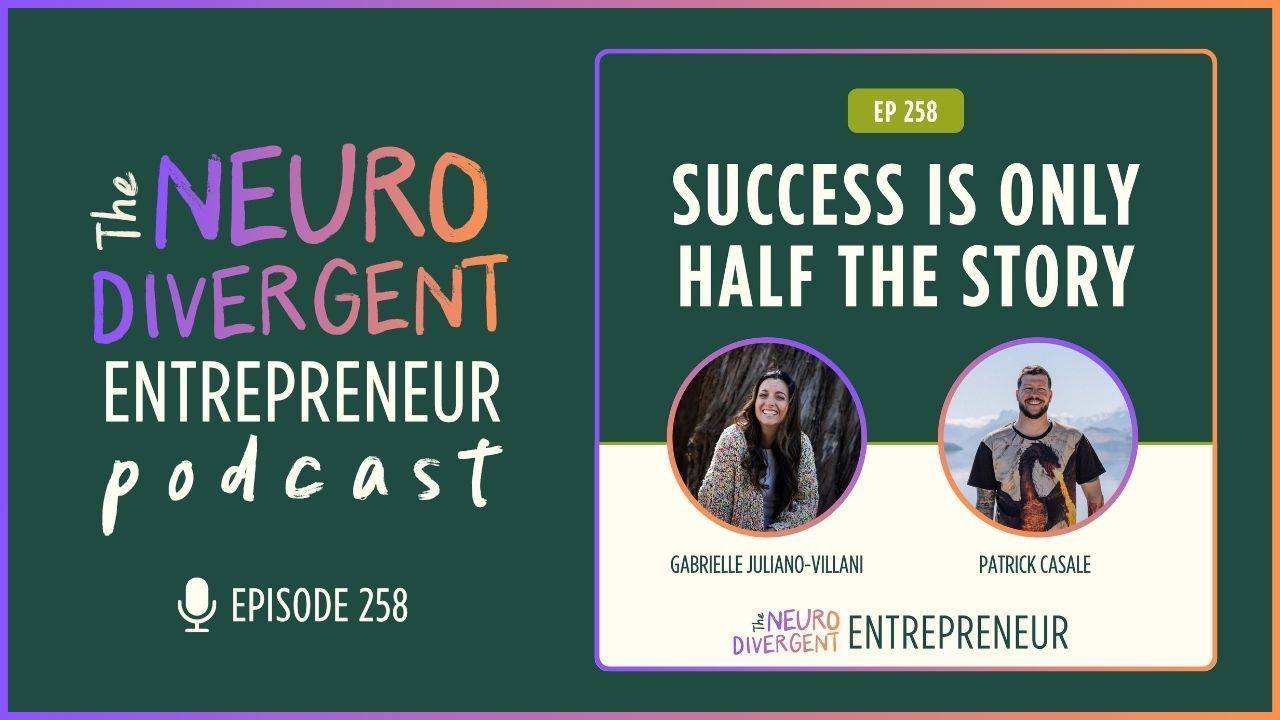
In this episode, Patrick Casale and Gabrielle Juliano-Villani pull back the curtain on what entrepreneurship really looks like when you're neurodivergent.
From burnout and chronic illness to purpose, friendship, travel, and creating businesses that actually fit your brain, this conversation explores the realities that rarely make it onto social media. They also share why they created the free Diverge Summit—a first-of-its-kind event bringing together more than 20 experts to talk about the intersection of neurodivergence, entrepreneurship, nervous system regulation, chronic health, creativity, and sustainable success.
Whether you're autistic, ADHD, living with chronic illness, or simply trying to build a business without losing yourself in the process, this episode is an honest reminder that success doesn't have to come at the expense of your wellbeing.
You'll learn:
- Why traditional definitions of success often lead neurodivergent entrepreneurs to burnout—and how to build a business that actually supports your life.
- How purpose, community, and authentic relationships can create more sustainable motivation than chasing validation or achievement.
- What to expect from the free Diverge Summit, featuring 23 conversations on entrepreneurship, chronic illness, nervous system regulation, creativity, and neurodivergent success.
Sign up for the free Diverge Summit here: allthingspractice.com/diverge
More about Gabrielle:
Gabrielle Juliano-Villani is a licensed clinical social worker, consultant, coach, entrepreneur, and educator based in Sarasota, FL. She has been in the mental health field for over a decade specializing in stress, chronic health conditions, and trauma.
After realizing her own burnout in 2021, she sold her thriving group practice and made it her mission to educate others on the impact stress has on our everyday lives. Gabrielle pulls from her experience as an EMDR and Polyvagal Informed therapist to utilize mind/body approaches to help others implement everyday strategies to manage stress and live their best lives.
Gabrielle is an international speaker, retreat leader, and has been featured in Authority Magazine, The Daily Om, Bustle, and the Everyday Woman TV Network. When she's not working, Gabrielle is teaching Zumba, surfing, or reading a psychological thriller at the beach.
- Website: gabriellejulianovillani.com
🎙️Listen to more episodes of The Neurodivergent Entrepreneur Podcast
🎙️Spotify
🎙️Apple
🎙️YouTube Music
▶️ YouTube
✈️ Check out available Retreats
🗨️ Join the free Empowered Escape FB Community
A Thanks to Our Sponsors: The Receptionist for iPad!
I want to thank The Receptionist for iPad for sponsoring this episode.
The Receptionist for iPad is a HIPAA-ready digital check-in system that eliminates the need to walk back and forth from your office to the waiting room to see if your next appointment has arrived. Clients or patients can check in for their appointments, and you'll be immediately notified by text, email, or your preferred channel. Break free from interruptions and make the most of your time, because it is valuable. Start a free 14-day trial of the Receptionist for iPad by going to thereceptionist.com/privatepractice. Make sure to start your trial with that link to get your first month free if you decide to sign up.
Free Gifts for Our Listeners
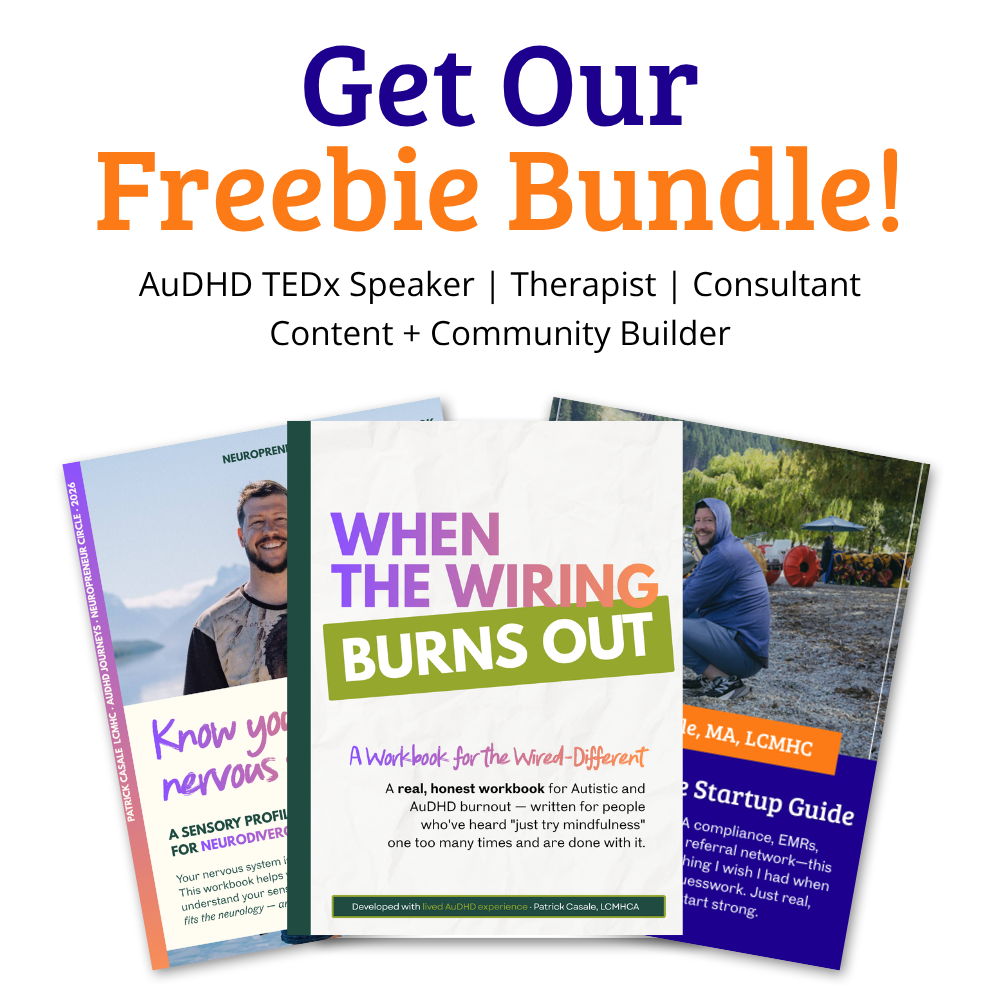
Get a practical podcasting workbook for therapists considering starting a podcast, created by Patrick Casale, host of the podcasts The Neurodivergent Entrepreneur and Divergent Conversations.
You'll get a practical structure for therapists who want to start a podcast but don’t want to rush, perform, or build something they can’t sustain.
Grab your free copy: ndpod.org/Free-Podcasting-Workbook
✨ Move Beyond Private Practice As A Neurodivergent Entrepreneur
Move Beyond Private Practice As A Neurodivergent Entrepreneur is a FREE 5-part mini-course designed for therapists who want sustainable financial independence beyond one-on-one work.
Access your free mini-course here: ndpod.org/Neurodivergent-Entrepreneur
Transcript
PATRICK CASALE: Hey, everyone. Welcome back to The Neurodivergent Entrepreneur podcast, which is the first time I've said that when it's actually a reality, which is super strange. You know the first time you said you were going to come on my podcast five years ago? You said your topic was going to be about twerking. So, appropriate that we're here five years later and now, like, best friends.
You have also broken the record for appearances on this podcast, which I think maybe like Shane and Yunetta might be pissed about. I don't know. We'll see. Anyway, it is what it is.
GABRIELLE JULIANO-VILLANI: She’s also my friend. [CROSSTALK 00:00:42].
PATRICK CASALE: So, today we are talking about this… Yeah, you just need to be okay with it. Like, we're talking about the Diverge Summit that we're co-hosting together, and kind of talking about why we've created it, and inviting you to join us there. A completely free summit for neurodivergent entrepreneurs. And I cannot think of a better person to partner with to do that.
And to give context for all of you, you know, I am autistic ADHD. Gabrielle is ADHD. We have a lot of overlap in terms of chronic health conditions and other struggles, but we're making it. We're making it work. And we just finished wrapping up all 23 interviews of our summit as of five minutes ago, which feels amazing.
GABRIELLE JULIANO-VILLANI: Yeah, and I'm just excited to put this out there. And I was telling Patrick yesterday, my business manager Christina was like, "This is so cool. This was such a good idea. I love that you guys did this.” Because there's nothing… And again, as far as I know, right? Like, I don't know everything, but as far as I know, I haven't seen anything like this, which is why I wanted to create this.
I've seen a lot of summits either, like, more clinical focused for neurodiversity, or like more business focused, but nothing that kind of crosses those things and talks a lot about burnout and like mindset. So, I feel like we kind of melded all the things together.
PATRICK CASALE: Yeah, I completely agree. I think that looking at it from this holistic vantage point of zooming out a bit and saying, okay, we could certainly make this an entrepreneurial summit and talk all about business, or we could anchor into lived experience and talk all about success, creativity, but also highlight struggle.
And I love duality. And I love both sides of the coin when we're talking about entrepreneurship, even if we weren't neurodivergent, I would still be preaching that entrepreneurship is fucking hard. And I think that gets missed a lot in entrepreneurial spaces where it's just, like, glamorizing and highlighting accomplishment and success.
And we should celebrate success. We should try to take it in and feel proud. But we also need to acknowledge that for those of us who are disabled, for those of us with more sensitive nervous systems, with chronic illnesses, with intersecting identities, who are multiply marginalized, this is not an easy road.
GABRIELLE JULIANO-VILLANI: It's not easy at all. And I think, to your point, there is a lot of, is glamorization a word?
PATRICK CASALE: I don't know. When I said it, I was like, I think I meant glamorizing, but I think my brain is fried.
GABRIELLE JULIANO-VILLANI: To me, it sounds like a word.
PATRICK CASALE: It should be a word. It should be a word, glamorizing, aka glamorization. That's what we're using today.
GABRIELLE JULIANO-VILLANI: And I think a lot of people just see that. And a lot of people who come to me and maybe to you too, see that, and they're like, "Oh, I want to do all these things. I want to host retreats, and events, and have income streams, and do all these things.”
And I'm like, "You can have them, but not tomorrow.” This is years of really fucking hard work that has continued to be work, and that has given me a lot. It's also taken a lot from me, and you know, even like with selling my business, the same thing. Even though that was six years ago now, which is crazy.
PATRICK CASALE: Congrats.
GABRIELLE JULIANO-VILLANI: Thank you.
PATRICK CASALE: Finger snaps.
GABRIELLE JULIANO-VILLANI: Thank you.
PATRICK CASALE: Can't do it, so can't coordinate my fingers enough.
GABRIELLE JULIANO-VILLANI: Like same thing, or people are like, "Wow, that's like so amazing that you did that. I want to do that.” And I'm like, “And it almost fucking killed me.”
I mean, I have told this story before, where I was like on the beach with my family, trying to watch the sunset on Christmas Eve, but I was on the phone with my attorney getting charged whatever, $600 an hour, trying to, like, get this deal closed before the end of the year. And it wasn't a fun way to spend a holiday. And that's just one example of all of the things.
PATRICK CASALE: And you know, I think it's this reality check sometimes where you start to think about creation, and accomplishment, and success. And then, I start to connect the dots of like, what did that take from me, and was it worth it?
I think there are some things that I would take back over these last five or six years, and there are some things that I'm glad that I've done, like coaching programs, coaching courses, individual coaching. I wish I never did any of it. Starting a Facebook group, moderating said Facebook group. Wish I never did it. But those things led to things that I am really grateful for. Like, I've now been doing this podcast for five years. I've had so many cool conversations with people and gotten to know them at their most vulnerable states while they talk about life, and business, and everything else in between.
Hosting all the retreats I had, would I do it differently? Absolutely. Yeah. Would I do it differently? Yes. Am I glad that I did it? Yes.
I think, like, having those experiences, you know, especially with like myself and my speakers, or when I'm co-hosting with someone, and you get to spend a lot of time together in a different country or a different location. And you really get to connect, and you really get to bond, and you get to really experience life in that way. And I would never trade those experiences. Like, the month you and I just shared together in New Zealand, I would never ever trade, despite the level of burnout that I've been in, because I think that was so life-changing. And I'm so grateful to have been able to create and do a lot of these things over the years.
But I do wish I had learned to pace. I do wish that I hadn't pushed so hard. I had to work through a lot of core beliefs of only being as good as my creations and my accomplishments that came from, like, early childhood wounds.
And you know, I think I've almost destroyed myself in the process, trying to obtain that, like, level of self-love, and appreciation, and respect, and worth. And that's the stuff that I don't wish I had done. And sometimes you also get caught up in it, right? Like, success is addicting.
GABRIELLE JULIANO-VILLANI: Yeah.
PATRICK CASALE: I have an addictive personality. I had a gambling addiction. Like, there's a lot of dopamine in success. There's a lot of dopamine in creation. There's a lot of dopamine in people liking your stuff, and buying your stuff, and commenting on it. And I've really had to work hard, and I'm still working hard to separate myself from that because I don't want that to be the source of validation. And I don't want that to be the source of contentment.
GABRIELLE JULIANO-VILLANI: And I think I feel that when I'm away from work. Like I'm thinking when we were in New Zealand at our, I call it the crying dinner.
PATRICK CASALE: Oh yeah, that was intense. And they just got a Michelin nod, so shout out to, what was it called, again?
GABRIELLE JULIANO-VILLANI: Aosta.
PATRICK CASALE: Aosta, and my cousin from the same province in Italy. So, if you ever see this, know we're thinking about you.
GABRIELLE JULIANO-VILLANI: We were having this beautiful dinner and at an incredible place. And I think we were all feeling a little existential because we were dealing with the grief of things that were happening with your friend. And Mish and I were just dealing with the weight of the world. I'm just like always feeling a little existential, but I just remember us talking about like, what is our life's purpose? Like, what does this all mean? Like, what are we doing here?
PATRICK CASALE: Yeah.
GABRIELLE JULIANO-VILLANI: What is happiness? What is success?
PATRICK CASALE: Yeah.
GABRIELLE JULIANO-VILLANI: Is it the dopamine hit that I get when people buy my courses? Like, that happened this morning. Like, really? Is that what I want it to be?
PATRICK CASALE: Sure.
GABRIELLE JULIANO-VILLANI: No.
PATRICK CASALE: Well, our good friend Cindy Miller, who was on the summit talking about human design, you know, when she read my human design a few years ago, she was like, "Your life's mission is to use your voice and your message to get it out into the world.”
And I have tried really hard to anchor into that and embrace that, and I believe that to be true because even when I didn't have a platform, or an audience, or a single person following me, minus Terry Fideli, probably, and my grandma, okay, I would talk about the struggles all the time publicly on social media.
And I remember, like, my mom messaging me and being like, "Are you sure you want to be this open? Are you sure you want to be this vulnerable? Like, you're sure you want to be having people know your business?”
And I'm like, "Yes, because I believe that my mission in this life is to make people feel less alone and to make things feel more relatable, and to make things feel more human.” And I stand by that to this day.
And I think that when you anchor into purpose, and things feel aligned within your values, that's when I think I can create, and be in flow, and do some of these projects without the cost, without the extreme fatigue, and exhaustion, and brain fog, and pain that comes with a lot of it. And that's what we experienced together in New Zealand. Because for those of you who don't know, we did two separate seven-night retreats for two separate groups of mental health therapists and entrepreneurs.
I, especially during the first event, and don't kill me if you came to the second event and you hear this, but the first event was all neurodivergent entrepreneurs, and the second group was not. That's not their fault. We had a Neurodivergent Entrepreneur event. We had a Beyond Private Practice Alternative Income Stream event.
So, the Neurodivergent Entrepreneur event, I didn't feel like work to me. It felt like there was a lot of co-regulation happening with everyone in the group and individually, and experiencing, like, all the sensory soothing, and all the beautiful experiences, and the landscapes, and just completely unmasking around 20 other people and being in one of the most beautiful, sensory-friendly, safe places on planet earth. That was so special.
GABRIELLE JULIANO-VILLANI: Speaking of that, and also, human design, something in human design, I forget what it's called, but like it is your purpose. So, it's beyond like what your type is, but it's like your life's meaning. And mine is some weird thing like right angle cross of Eden or some shit. Because everything in human design has weird words.
PATRICK CASALE: Is it your incarnation cross? Because I just looked it up.
GABRIELLE JULIANO-VILLANI: Yes.
PATRICK CASALE: Okay.
GABRIELLE JULIANO-VILLANI: Yes, it is.
PATRICK CASALE: Yeah.
GABRIELLE JULIANO-VILLANI: And so, mine is literally to heal people by, like, helping them and sharing my experiences, but giving them that experience. Like, literally creating an Eden for them.
And so, I think of like New Zealand and that first retreat, there was lots of like, you know, esoteric spirituality shit happening, which I love, and lots of sound healing, which I love to give that experience. And so, that just felt like very fulfilling to me because I was like, "This is like my zone. I feel so good, like, providing this for them.” Also, just like being in that space, being in nature, and I did push myself a little bit, but, you know-
PATRICK CASALE: You did. I’m super proud of you. You went zip lining, and you were afraid of heights. And that zipline's course, in my opinion, wasn't scary, but it was horrible. And like you did it. And maybe it's a memory you don't want to anchor into ever again, but you did it. Like, you know. So, I was very proud of you. I would have not judged you if you decided to walk down. I think the walk down would have been awful.
GABRIELLE JULIANO-VILLANI: The walk down-
PATRICK CASALE: It was like a two-mile hike straight down a mountain with no ability to, like, not destroy your knees, and your calves, and your ankles.
GABRIELLE JULIANO-VILLANI: And they were like, "We're not coming with you, so like you will be figuring it out yourself.” And they're like, "Or you could just do this three-minute thing.” So, I chose the three-minute thing, and now Arielle, Patrick's wife, and I have a trauma bond because of that experience. But it was good. Like, I needed to do that.
We also, like, spent the night in Doubtful Sound, which I get seasick and I'm afraid of throwing up. So, that was a huge deal to me. But like that-
PATRICK CASALE: And that was amazing, too.
GABRIELLE JULIANO-VILLANI: I think about that every day. Like, that was one of the coolest things I've ever done.
PATRICK CASALE: There was no cell phone service, no internet. We're on basically the edge of the world on this tiny boat with 50 other people, most of whom were significantly older than the three of us. No shame, but just a reality check that we acknowledged. Like, we were like, wow, this is our lives, and this is our work. We're watching people struggling with mobility and really having a hard time. I think a lot of people wait until that age to travel and to have experience. And we've had so many experiences so early, but that was so special.
And then, the dolphins swimming next to the boat the next day. And then, we went through that sound of silence where the captain turned the motor off, and everyone was quiet for five minutes while we just drifted through this section of the world that, God, nobody would have even known where we were. You know, we're just out there floating, and it was awesome to just exist that way.
GABRIELLE JULIANO-VILLANI: It was really, really special. There's no electricity sound. There's no other humans. It's just, like, truly being in nature with the animals, and that's all you can hear. And they do that on every cruise that they do. And they've been doing it for like I don't even know what? 70 years or something like that.
PATRICK CASALE: Yeah.
GABRIELLE JULIANO-VILLANI: Yeah.
PATRICK CASALE: It was amazing. It was hard to get to, and you know, those of you who don't know me yet on this podcast, like I am a huge Anthony Bourdain fan. You can see him behind me. I have an Anthony Bourdain tattoo. He's a special interest of mine. And I really believe, like, he said it best. And he was talking about how the hardest places to get to are usually the most special and the most worth it. And I believe that wholeheartedly.
And I've always tried to travel like that. I've always tried to figure out ways to do things that feel different than like, this is what everyone does when they go to New Zealand or this is what everyone does when they go to Ireland. Like, I don't want to do that shit. And I never have.
So, it's been really special. You and I have had a lot of experiences along the way. Like, over the last couple of years, since Italy. Like, since you came and spoke at my first Italy summit in 2024, what have we done? Like, Italy, Ireland.
GABRIELLE JULIANO-VILLANI: Ireland.
PATRICK CASALE: Greece. We co-hosted Belize, a neurodivergent entrepreneur retreat in a nature ecolodge in Belize. You came to Spain, New Zealand twice. We co-hosted. You came to Scotland, Portland, Maine is coming up. It's been pretty cool.
GABRIELLE JULIANO-VILLANI: Yeah, we have [CROSSTALK 00:15:47].
PATRICK CASALE: You know? And this-
GABRIELLE JULIANO-VILLANI: And I think like, even with what you were saying about Anthony Bourdain, because it's so special interest of my husband, and I think it also goes back to just life. Like, even in the hardest places in life is where I learn the most about myself, my capacity, and what I can do.
PATRICK CASALE: Yeah, 100%. I mean, I'm going to look for a Bourdain quote about travel right now, and I'm going to read it because it's so freaking helpful and special to me, and I need to find it. So, I'm going to pivot for a second.
GABRIELLE JULIANO-VILLANI: [CROSSTALK 00:16:22] got it engraved on a frame when we got you the picture, but like he should pick what he wants.
PATRICK CASALE: I know. He was so special. And like you know, I still think that he was neurodivergent. I've said this so many times in my life. And I really believe that to be true. Okay, here it is, “Travel isn't always pretty. It is not always comfortable. Sometimes it hurts. It even breaks your heart, but that's okay. The journey changes you. It should change you. It leaves marks on your memory, on your consciousness, on your heart, and on your body. You take something with you. Hopefully, you leave something good behind.” And that is one of my all-time favorite quotes. I think about that a lot.
GABRIELLE JULIANO-VILLANI: And we did leave things behind. We had our little rocks in Lake Tippu, and we [CROSSTALK 00:17:17].
PATRICK CASALE: Yep. All those memories, you know? Like, you just get to anchor into those things when your nervous system is dysregulated. I think travel for me is so crucial to my survival.
And that brings me to a point. Like, you all might hear me talk about my burnout, my chronic health conditions. You might hear me talk about it constantly on social media, especially chronic health stuff right now, because I'm in that season of life, and you still might see me doing things like traveling and experiencing things. And my philosophy is to live life as long as I can, regardless of the struggle that I'm experiencing. And when I cannot, then I don't know what happens next. But I do know that is what I want out of this life. And I want to be able to do it while I can, even when I'm suffering or even when I'm struggling. Because I often feel the most healthy and alive when I am traveling, and exploring the world, and in movement, and navigating new spaces and having different experiences. Like, it's just the thing that makes me feel the most human, and it makes me feel like I have the most sense of belonging.
GABRIELLE JULIANO-VILLANI: One of my favorite things is when you fly to a new country and get off the plane. You can, like, feel the energy is different. And if it happens to be a red eye, you just, like, pound the pavement because you go to the jet lag, and you find like, a cute coffee shop, and you just start, like, exploring like that the first day and it's my favorite.
PATRICK CASALE: It's exhilarating. I can feel that right now. I'm actually thinking of a moment, like, for the Scotland summit last summer, which was not easy for me. Edinburgh was so busy in July, and it was so hot. Like, that was a really hard event for me, and I had to leave and remove myself from it constantly to, like, sensory soothe and not have meltdowns in the event constantly.
The first thing I did when I arrived was went to a coffee shop, cute coffee shop in my neighborhood. I was sitting there having coffee, had a couple of desserts and cakes because they looked delicious, and I couldn't resist them. And this couple came up to me. And they were from the Netherlands, and they're like, "Hey, man, it's going to sound really weird.” And I was like, "Okay.” And they're like, "We've watched your TED Talk before, and we listen to your podcast. And we're from the Netherlands, and we're neurodivergent, and your TED Talk helped me discover my autism like a couple of years ago.” And blah blah blah blah blah.
And I was like, blown away, you know? And like, “Can we sit and talk to you, and pick your brain?” I was like, “I'm so jet-lagged right now, but sure.” Like, I'm going to use the exhilaration of this experience to like use that adrenaline.
And I've had a lot of cool experiences like that, which are really surreal. You know, like, having two podcasts that like have become globally recognized, you never realize how many people are listening to your voice or are familiar with you.
And I've had that experience like seven or eight times now. When I went to do recon for our New Zealand event with my dad, lucky bastard that came with me for free, we went on a wine tour with Joe, our Maori guide, and he actually was involved in our ceremony. He's really beautiful. And these two women were like giggling during the wine tour. And they were like, "We listen to your podcast. And we think this is going to be a weird day now that we all know we're getting super drunk together.” And I was like, "Okay, like I don't know what to do with that, but thank you for the support.”
And I think those are the things that, like, as neurodivergent people who often feel on the outside, who often feel less than or different or alien-esque, or just like we don't belong in this world, those are the moments that anchor us into humanness. And I think they're so unbelievably beautiful. And I would not have any of that if I wasn't sharing my own experiences so publicly and so intimately.
GABRIELLE JULIANO-VILLANI: And having community, and friends, and support for that is just so hugely important. And this is my love letter to Patrick, which I know you'll love. But I feel like our friendship really helped me with all of that to unmask, and to, like, lean into who I am, and to be okay with being my weird little self, and like, also, just even when I'm not weird, which is not very often, but like when I'm just putting myself out there, and I always remember when I was so freaked out in Italy, which I feel like that was also a really big catalyst for me. But you were like, "Remember who the fuck you are?” And I was like, “Okay, you're right. I've done some shit.”
PATRICK CASALE: You have. Yeah. I appreciate that. You know, it's something I'm trying to get better at embracing, like, because I think what I do for people is bring out the best in them, and help them be their best version, and their most authentic self by being my most authentic, raw, vulnerable self.
And I think we have so many opportunities where we can have that, and a lot of things get in the way, and a lot of us can't always safely unmask and be that weird human that we really are. Because you really embraced the role of wearing the Gollum mask during our Lord of the Rings tour in New Zealand, like with these props. And I think that was your real element right there, like your real self. If Gabriel was like looking in a mirror and it was like a fantasy show, all of a sudden, you'd start to see that mask come out, and like, it would be like, “This is who I really am.”
GABRIELLE JULIANO-VILLANI: Yeah.
PATRICK CASALE: Beneath the smile and like, the cute exterior, this is who I am.
GABRIELLE JULIANO-VILLANI: Yeah, just weird, like busking around for it.
PATRICK CASALE: Crawling around the forest floor.
GABRIELLE JULIANO-VILLANI: Literally. But it's great. And we have great pictures and great [CROSSTALK 00:23:02].
PATRICK CASALE: We really do. We really do. And I think that's what it's about, you all. Like, for those of you listening, like, if you're going to come to the summit that we're putting on, we're talking about this stuff, like neurodiverse business partnerships. How to make that work when you have different processing styles, different neurotypes, different communication styles, different energy levels. How to navigate a complex medical system that is frankly not designed for us. Having conversations about nervous system regulation and rewiring, and how to support yourself. Having conversations about creation and artistry. Using your ADHD spontaneity and creativity to create hobbies that you don't have to monetize, so they don't become too much of a demand. Like, we're talking about it all.
We’re talking about the autistic burnout, and the dream job that I believe I've created that I can't actively participate in. We have physical therapists on there talking about hypermobility EDS, and hypermobility spectrum disorders and how to navigate POTS, and MCAS, and other chronic health conditions. Like, it's a really fucking cool summit. And we put a lot of ourselves into it, and it is completely free.
GABRIELLE JULIANO-VILLANI: And it is full of good shit. Like, truly. And, you know, I'm thinking because we just got off with Doctor Zach Spiritos, and that was very validating for me as a female who has been gaslit in so many areas of my life, but especially, medically, and just to like hear what he was saying and being like, you know, these are real things that people experience, and hugely, it just felt very good to hear that.
PATRICK CASALE: Yeah, agreed, agreed. And he was my doctor for a while. I think that's public knowledge. But having those doctors in your corner right now, especially if you're navigating that, like, what I am going to call the pentacle, which is autism, ADHD, mast cell activation syndrome, hypermobility EDS, or other forms of EDS, and then POTS, or dysautonomia, you need people in your corner who get it. You need people who don't gaslight you, even if they don't have the answers.
And that is something I don't think we speak up about enough in chronic health and illness positions or communities, of like, I don't need toxic positivity. I don't need, “Oh well, my cousin did this to feel better.” Or, “Try these medications.” Or, “Have you tried working out? Have you tried being act?” Shut the fuck up. Do you think I haven't deep-dove to the ends of the earth to find a solution to not feel the way that I feel? But what you do need is people who get it, or are at least willing to just say, “I don't get it. I don't experience it. It sounds awful. And I'm so sorry.” Like that goes so far.
GABRIELLE JULIANO-VILLANI: It makes such a difference because I have shingles right now, and which, again, like I said this before, but like if you're listening to this, and you're a younger person, you apparently can get shingles if you're stressed enough. So, that’s FYI.
And you can also get post shingles neuralgia, which is what I have right now, which is where you have continued nerve pain that can last for months or even years. And I went back to urgent care. And she was like, "That's not a thing. I've never seen that. You should just have pain where the rash is.” And I'm like, “Well, it feels like my skin is like being stripped off, and raw, and on fire. So, I'm pretty sure that there's something happening.”
And then, this week, I went to a new doctor who is cash pay, of course, and more integrative. She's not functional medicine. She's HBA and she's more integrative work PCP. And it was so easy. She was like, "No, I believe you. Here's Gabapentin. I know you're in pain, and I know that it's very uncomfortable, and this will help you.” And I was like, "Thank you. That's like all I fucking wanted.”
PATRICK CASALE: And even if she didn't have a solution for you, like a takeaway, even if she just said, "I believe you.”
GABRIELLE JULIANO-VILLANI: Yeah.
PATRICK CASALE: That would have changed your mental state immensely.
GABRIELLE JULIANO-VILLANI: Yeah.
PATRICK CASALE: And that's the stuff that gets missed so often for all of us who are experiencing these complex, chronic, oftentimes invisible illnesses where the medical system has not caught up.
I went to the hospital a couple of weeks ago and ended up there overnight in anaphylactic shock, out of nowhere, reacting to a medication that had been prescribed. In addition to an enormous amount of stress and mycotoxic poisoning, the histamine levels just dumped. Like, there was just nowhere for it to go. It was overflowing. I went into anaphylactic shock while watching a basketball game with my friend at our favorite pub.
And I was pretty sure I was having either a stroke or a heart attack. Like, my face went numb where I couldn't smile, and I was like, "Okay, I'm having a stroke.” My extremities went completely numb. My neck, throat, everything went numb and started to close up. My heart was beating a million miles a minute. I couldn't breathe.
And when I went to the hospital, they're like, "You're having a panic attack.” I'm like, "I'm not having a fucking panic attack. I am a licensed, like, help mental health therapist.” And that's not saying I can't have a panic attack. I know what a panic attack is and feels like. And this is not that. Just like Jesus Christ. And we just have to be our own best advocates, and it's exhausting. And that's not what this episode is about. So, anyway, back to the summit. No, in all seriousness.
GABRIELLE JULIANO-VILLANI: It is related.
PATRICK CASALE: It's related. It’s all interconnected. And that's the reality here. And in this summit, we talk about all of the interconnectivity, and whether that be how can we increase in our sense of belonging and community with other neurodivergent people? How can we create business models and hire support in a way that works for us and not against us? How can we work on ways to stop fighting our brain and finally succumb and admit to these are the accommodations and supports that I need in order to flourish or in order to survive?
GABRIELLE JULIANO-VILLANI: Yeah.
PATRICK CASALE: How do we deconstruct internalized ableism in our businesses and in our personal lives? So, we have so much jam-packed into this event. We have over 20 speakers, including ourselves. The interviews were fantastic. People gave away parts of themselves. They were so vulnerable, so raw. None of this, like, pop psychology bullshit that you're going to see on social media. We're not going to make any glamorizations. Can't remember the word that Dr. Megan Neff on Divergent Conversations can never say because there's a word that we were using for a while, and people on social media were like, "That's not a word.” And we're like, "We're going to continue using it.” So, [INDISCERNIBLE 00:29:39]. Got to love the trolls on social media, too.
We talk about rejection-sensitive dysphoria, how to handle that, how to handle being perceived, how to build businesses off of social media. Gabrielle Farms came on the other day and talked about that. Getting a book deal completely off social media. So, we have we have a lot of cool stuff in store for you all.
And Gabrielle and I are also co-hosting another neurodivergent retreat in New Zealand. And it's not soon enough, but October 24 to the 30th of 2027. And that link is on my website, and in my bio, and on hers as well. And if there are still spots on there, that means it's still available. But it's going to be amazing.
And we're going to spend time. We rented an entire 15-person, 15 hotel room boutique hotel downtown Queenstown, not in the thick of the wild tourism near Lake Wakatipu. About a 10-minute walk through this beautiful nature trail, all secluded. And we're going to spend six nights there, just connecting, and unmasking, and sensory soothing and special interest immersing. Especially, if you're a Tolkien or Middle Earth fan, and God, it felt like I lived in Middle Earth for 30 days. I think that's why it felt so good to be there too, was like, I was in special interest heaven. And I was just like, "Damn, this is amazing.” Like, I get to just wake up to this every single day.
GABRIELLE JULIANO-VILLANI: That was incredible, and I cannot wait to go back with more folks that we can connect with, and help, and build community. So, I hope you'll join us if you're able to. But either way, the summit is free. So, lots of good stuff in there. We have a VIP bundle for 97 bucks, also, which has lots of freebies.
All of our speakers, or most of our speakers, I should say, contributed a lot of really great things that they put a lot of work into, like courses. Some people are doing, like, short, free consultations, free access to memberships for a month. So, there's a lot of really good stuff in there, too, that hopefully, you know, again, we tried to make it as affordable as we could. But if there's stuff in there that you want, you know reach out to us, and we'll do what we can. But certainly, worth the $100 for the speakers' time.
PATRICK CASALE: Absolutely. And the speakers do make money when they sell spots for the VIP. So, we want to compensate them for their energy and their time as well. And then, there's obviously the free version.
And I just had a thought that we should probably have the free version all accessible all at once, and probably do it for more than five days for those of you who have different processing styles. We'll extend that to make it more accessible. I'm thinking in the moment of something that would have already come up from some of you, so we will make that happen too, and we'll give you a little more time to have access to that stuff before we close it down. So, make sure to register. Link is in this podcast description, in the show notes. It is on both of our websites, on our social media, so it's very accessible. And if you can't find it, reach out to us, and one of our admins will relay the information to you.
Want to end this podcast episode with a fun story about New Zealand. I did a vowel renewal at Hobbiton, and obviously, Lord of the Rings, Middle Earth, Tolkien stuff is my special interest foundation. And did a vow renewal that Gabrielle and her husband Mike came to. But fun fact is that the actor who played Sauron, Sala Baker, who was born in New Zealand, was in New Zealand at the time. We became friends randomly while I was doing retreat recon three years ago in Portugal. We met and hung out all day, which was mind-blowing to me. And I DM'd him, and I said, "Do you want to come to this vow renewal?” And he said, "Yes.”
So, he and his beautiful wife Sakari came the night before. We all ate dinner together. Gabrielle's husband's a former, well, not a former, is a chef, and made a beautiful dinner. We just talked about Lord of the Rings and behind the scenes, and drank wine, and ate food, and then we went to Hobbiton the next day. And it was really, really, really special.
And then, I said, "Do you want to come to our neurodivergent entrepreneur retreat and stay with us the entire time?” And he said, "Yes.” And then, we got to surprise our guests by saying, "Oh, we also have this person who played Sauron in three of the Lord of the Rings movies at this retreat.” So, unbelievably special. We will not guarantee that that will happen next year, but we will do our best.
GABRIELLE JULIANO-VILLANI: And he came to my sound bath, and he fell asleep and was snoring. He was so relaxed. It was like the best of the best.
PATRICK CASALE: It was really beautiful. You know, just nice to have that experience. And we never would have had that stuff if we weren't doing the things that we were doing, and we weren't in alignment with where we're supposed to be.
So, we hope to see you at Diverge. Make sure to sign up. And if you're interested in New Zealand, check out our websites. Check out our socials, or reach out to us directly. We've got 12 and 15-month payment plans on there because we are going all the way to the other side of the world, and it is in 15 months, and we want to make it as accessible and affordable as possible.
So, doubt yourself, do it anyway. And we will see you next Wednesday, which is now when episodes come out. And I know I'm going to forget that, but it is now Wednesday on all platforms and on YouTube. And we will see you next week.
Join the free Neurodivergent Entrepreneur "Diverge" Summit Diverge
FREE PRIVATE PRACTICE GUIDE
Join the weekly newsletter for private practice tips, podcast updates, special offers, & your free private practice startup guide!
We will not spam you or share your information. You can unsubscribe at any time.





![Episode 264: Creating Through the Chaos of a Neurodivergent Life [featuring Bre "BR3"]](https://kajabi-storefronts-production.kajabi-cdn.com/kajabi-storefronts-production/file-uploads/sites/2147507511/images/a14004-cc3d-8aba-5fb8-2442fdfc650_TNDE_YouTube_episode_264.jpg)
![Episode 263: Your Symptoms Are Real—Even When Medicine Doesn’t Have The Answers [featuring Dr. Zachary Spiritos]](https://kajabi-storefronts-production.kajabi-cdn.com/kajabi-storefronts-production/file-uploads/sites/2147507511/images/84bc15-1ce4-1a0b-8f85-f5812bce75_TNDE_YouTube_episode_263.jpg)
![Episode 262: Your Brain Isn’t the Problem. The System Needs Reimagining. [featuring Dr. Mel Houser]](https://kajabi-storefronts-production.kajabi-cdn.com/kajabi-storefronts-production/file-uploads/sites/2147507511/images/42c858d-0b15-7581-e6ac-f636e7a1fa1_TNDE_YouTube_episode_262.jpg)
![Episode 261: Dragons, Dopamine, and Autistic Special Interests [featuring Mandi Dixon]](https://kajabi-storefronts-production.kajabi-cdn.com/kajabi-storefronts-production/file-uploads/sites/2147507511/images/25ae562-4a0a-44e-04f6-4caeaa5c8bd_TNDE_YouTube_episode_261_new_.jpg)