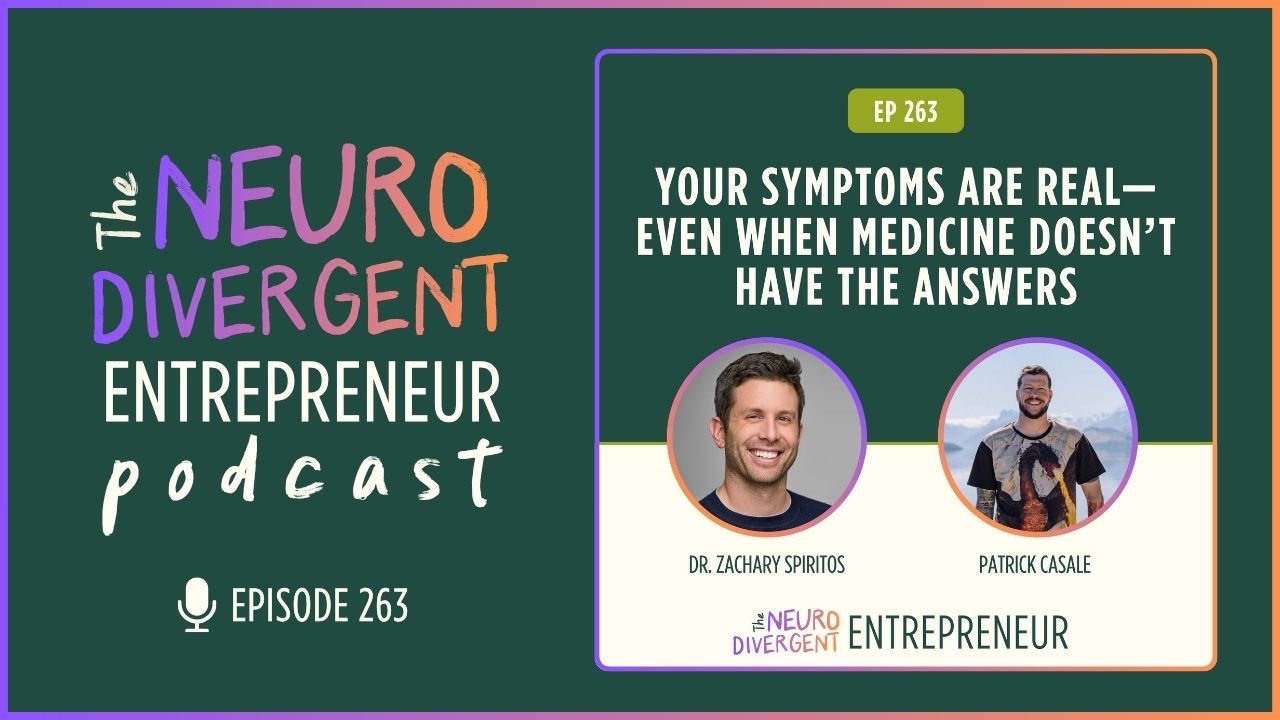
Episode 263
Sep 09, 2026

Your Symptoms Are Real—Even When Medicine Doesn’t Have The Answers [featuring Dr. Zachary Spiritos]

Hosted by: Patrick Casale
The Neurodivergent Entrepreneur Podcast

Show Notes

What happens when neurodivergent burnout, chronic illness, stress, and medical trauma all start colliding?

Patrick Casale sits down with Dr. Zachary Spiritos for an in-depth conversation about complex chronic illness and why conditions like POTS, dysautonomia, ME/CFS, mast cell activation, hypermobility, and unexplained GI symptoms can be so difficult to navigate.

They explore the potential roles of stress, trauma, environmental exposures, illness, and nervous system dysregulation—and why so many Autistic and ADHD people find themselves struggling with both neurological burnout and worsening physical symptoms at the same time.

Dr. Spiritos also shares a more realistic approach to navigating complex illness: stop expecting everything to be solved in one appointment. Instead, identify what is affecting your life most, understand your triggers, find providers who take your experience seriously, and start accumulating small wins.

3 Key Takeaways:

  1. Stress and trauma aren't “just in your head.” Dr. Spiritos explains how stress can interact with neurological and immunological processes, and why trauma and medical PTSD can add another layer of complexity when someone is already chronically ill.
  2. You don't have to solve everything at once. When symptoms include fatigue, pain, brain fog, food intolerances, insomnia, GI problems, and more, trying to tackle everything simultaneously can become overwhelming. Start with what's affecting you most and build from there.
  3. Being believed matters. A provider doesn't need to have every answer to make a difference. Finding someone who listens, understands complex chronic illness, helps you make sense of your symptoms, and works collaboratively with you can be incredibly valuable.

Disclaimer: This episode discusses medical conditions, symptoms, and approaches to care based on the conversation and should not be treated as individualized medical advice.

More about Zachary:

Dr. Zachary Spiritos, MD, MPH, is a neurogastroenterologist who specializes in treating patients with complex and chronic conditions, including disorders of the brain-gut interaction (DBGI), postural orthostatic tachycardia syndrome (POTS), mast cell activation syndrome (MCAS), Ehlers-Danlos syndrome (EDS), and gastrointestinal dysmotility.

He earned both his medical degree and Master of Public Health (MPH) from the University of North Carolina at Chapel Hill, where he developed a passion for addressing the systemic challenges faced by patients with underrecognized illnesses. He completed his residency in Internal Medicine at Emory University and went on to complete his fellowship in Gastroenterology at Duke University, where he focused on neurogastroenterology and disorders of gut-brain interaction.

Dr. Spiritos is particularly dedicated to supporting patients who have been dismissed, misdiagnosed, or lost in the medical system. He takes a whole-person approach to care, combining the best of conventional medicine with targeted interventions aimed at regulating the nervous system, improving sleep and movement patterns, addressing nutritional imbalances, and managing stress physiology.

He works primarily with patients whose symptoms span multiple systems and don’t fit neatly into one diagnosis—individuals who require time, nuance, and interdisciplinary collaboration. Dr. Spiritos partners closely with his patients to build individualized, sustainable care plans that address both symptoms and root causes—helping them reclaim their health and quality of life.


🎙️Listen to more episodes of The Neurodivergent Entrepreneur Podcast
🎙️Spotify

🎙️Apple

🎙️YouTube Music
▶️ YouTube
✈️ Check out available Retreats
🗨️ Join The NeuroPreneur Circle Community
🗨️ Join the free Empowered Escape FB Community


A Thanks to Our Sponsors: The Receptionist for iPad!

✨The Receptionist for iPad

I want to thank The Receptionist for iPad for sponsoring this episode.

The Receptionist for iPad is a HIPAA-ready digital check-in system that eliminates the need to walk back and forth from your office to the waiting room to see if your next appointment has arrived. Clients or patients can check in for their appointments, and you'll be immediately notified by text, email, or your preferred channel. Break free from interruptions and make the most of your time, because it is valuable. Start a free 14-day trial of the Receptionist for iPad by going to thereceptionist.com/privatepractice. Make sure to start your trial with that link to get your first month free if you decide to sign up.


Free Gifts for Our Listeners

✨ Free Podcasting Workbook

Get a practical podcasting workbook for therapists considering starting a podcast, created by Patrick Casale, host of the podcasts The Neurodivergent Entrepreneur and Divergent Conversations.

You'll get a practical structure for therapists who want to start a podcast but don’t want to rush, perform, or build something they can’t sustain.

Grab your free copy: ndpod.org/Free-Podcasting-Workbook

✨ Move Beyond Private Practice As A Neurodivergent Entrepreneur

Move Beyond Private Practice As A Neurodivergent Entrepreneur is a FREE 5-part mini-course designed for therapists who want sustainable financial independence beyond one-on-one work.

Access your free mini-course here: ndpod.org/Neurodivergent-Entrepreneur


Transcript

PATRICK CASALE: All right, everyone. Welcome back to The Neurodivergent Entrepreneur podcast. I am so excited to share today that Dr. Zachary Spiritos, who is an MD, MPH, a neurogastroenterologist who specializes in treating patients with complex and chronic conditions, including disorders of the brain-gut interaction, POTS, mast cell activation syndrome, Ehlers-Danlos syndrome, and gastrointestinal dysmotility. 

He earned both his medical degree and master of public health from the University of North Carolina at Chapel Hill, where he developed a passion for addressing the systemic challenges faced by patients with underrecognized illnesses. 

He completed his residency in internal medicine at Emory University. And went on to complete his fellowship in gastroenterology at Duke University, where he focused on neurogastroenterology and disorders of gut-brain interaction. 

Dr. Spiritos is particularly dedicated to supporting patients who have been dismissed, misdiagnosed, or lost in the medical system. He takes a whole-person approach to care, combining the best of conventional medicine with targeted interventions aimed at regulating the nervous system, improving sleep and movement patterns, addressing nutritional imbalances, and managing stress physiology. 

He works primarily with patients whose symptoms span multiple systems and don't fit neatly into one diagnostic category, individuals will require time, nuance, and interdisciplinary collaboration. 

Dr. Spiritos partners closely with his patients to build individualized, sustainable care plans that address both symptoms and root causes, helping them reclaim their health and quality of life. 

His practice, everbettermedicine.health, sees clients in North Carolina, Illinois, and Florida. Welcome to the show. 

All right, so today we are talking about all of these complex health conditions, these neuroimmune disorders that seem to plague neurodivergent humans, like mast cell activation syndrome, dysautonomia, hypermobility, EDS, and other forms of EDS, chronic fatigue syndrome, etc. And Doc, you see this all the time. You and my mind are becoming like this clear focal point of information in terms of, like, social media content and just a doctor who's talking about this stuff openly. 

So, I want to just give you the floor because so many people listening are experiencing life like myself, exhausted, chronically sick, just not feeling good, and trying to run businesses simultaneously. And it's a lot.

ZACHARY SPIRITOS: Yeah, no, I think you're touching on a really important point of the challenge living with this is that it can be debilitating physically, mentally, emotionally. And there's no biomarkers to substantiate how crappy somebody feels, right? So, when you feel horrible, you get a blood test, and everything is just, like, lighting up red with like the double exclamation points.

PATRICK CASALE:  Yep.

ZACHARY SPIRITOS: Patrick, I knew it. This is why you feel like garbage. And that we don't have it, right? 

PATRICK CASALE: No. 

ZACHARY SPIRITOS: So, you get all these blood markers, and like, this is it. This is the one, and then it's completely normal. You know, and it speaks to not only, again, one of the challenges of living with this, but also the challenges, like, that a lot of providers face is that it's just like, well, the tests that I know how to use, the tools that we have that I was informed were the best way to evaluate whether somebody's feeling good or bad or telling me that it's normal. So, this must be superintendential. Like, this must be psychological, or for people who acknowledge that maybe not everything can be defined by the labs that we have, because we're just maybe not that savvy at detecting the comings and goings of neuroimmune dysfunction, we just don't know. Which is kind of this world that we live in. A lot of this is unknown and unexplored. And we know and learn about it by pouring research into it and money, and we don't have that. And you know, until we until we get that, it's still going to be a little bit grasping at straws and an incomplete answer to really tough questions.

PATRICK CASALE: Yeah, that's really well said. And I think a lot of people, including myself, probably relate to that feeling of, like, I want the tests to show something. I want the tests, or the labs, or the procedures to come back with something because the inconclusive or everything looks normal or within normal range can be really demoralizing when you're chasing something for, you know, decades of your life, acknowledging that you feel pretty shitty, but you can't pinpoint what's going on. And that baffles a lot of medical providers. 

And then, in turn, because of the way our medical system is structured, you're left picking up the pieces as the patient, trying to do all of the research and go down all the rabbit holes with already limited capacity and resource. And then it just ends up in this, like, self-fulfilling prophecy loop of just beating your head against the wall.

ZACHARY SPIRITOS: Yep. No, you're exactly right. And what's one of the most common questions that I get is how do I talk to my provider about this? And my answer is that if you are asking yourself that question, you probably shouldn't be seeing that provider, because I think that if you are going in there convincing them that what you're dealing with is real, you don't want them treating you, right?

So, say at the end of that conversation, they're like, “I believe you, Patrick. This is MCAS or ATDS-related complications. So, what do I do next?” Right? Like, you know, the providers we have these reputable resources, open evidence, up-to-date- that talks about, you know, how you treat stage one prostate cancer, how you treat, you know, congestive heart failure. So, at least if you're not the expert, you can go to that and be like, “You know what? I may not be the thought leader on this, but I can get you started.” It doesn't exist here, right? 

And reliable data or, you know, clinical decision-making tools are not accessible. They don't exist. And so, even if you convince someone that, like, this smorgasbord of conditions are at play, what's next? And so, I think, you know, my answer is that there are some people that have kind of just landed in this space by happy chance, and I would include myself in that. And you want to find someone who kind of speaks this language. 

And even if you find that person, we still have imperfect answers, right? We're using off-label medications. We're using clinical gestalt as opposed to biomarkers to identify why something is happening. And when you rely on those things, you know, there's just there's a lot left to be desired. It's an imperfect system.

PATRICK CASALE: 100%, yeah. And I face it. You know, I counted on my hand today. I had nine doctor's appointments this week and three ultrasounds. And yesterday I spent time trying to convince the internal vascular radiologist, internal radiology, like, medicine to do, what's the word I'm looking for? A venography for pelvic congestion. And he was like, "You don't have it, man. Like, the ultrasound shows everything's normal.”

And I had to provide, like, research after research article after research of like, "Here's what happens in people with POTS and dysautonomia.” And he's like, "Fine, I guess we'll do it.” And that does not make me feel confident, right? To say, like, you're going to be the one doing this procedure now? Like, I don't want to go ahead and schedule that. 

And I think a lot of people without the amount of time and resource, like myself, I'm very privileged to own my business, work from home, have control over my situation, are found getting recycled through the system that is definitely not designed to help them, nor see them, or even listen to them and take them seriously.

ZACHARY SPIRITOS: Yeah, the book was not meant to serve people with hypermobility. And I used that as a crux because, or kind of a focal point of discussing kind of broader issues that affect these folks, because the things that we, like, pelvic venous congestion or intracranial hypertension. There's a way to think about these things that make sense in people that aren't hypermobile.

I think of hypermobility as like the fifth vital sign, because once that comes up, the items that you think about when someone has belly pain, or headaches, or bladder pain are different, right? So, when someone who doesn't have this has pain, or has belly pains, like peptic ulcer disease, Crohn's disease, H.pylori, and certainly those things can affect people with hypermobility, but the menu expands to other conditions as well, you know?

And then, you know, for example, there's a condition called retrograde cricopharyngeal dysfunction where people can't burp because the muscle at the top of the esophagus is too tense. And I was taught that as really, really, really rare. But it's not super rare in those with hypermobility. And just things are different, right? 

And turns out the hypermobility isn't as rare as we thought. We're just bad at picking up on it. And so, it's not like this, like, well, if you work for five years, you may see two people that are hypermobile. It's like, no, I guarantee you see one every month at least without you knowing it. We're just really not picking it up.

Like, look, like I got the stuff a little bit. And I have other things that go along with it. I think it affects some medical stuff that I have going on. And if we had that piece of information going on, my past providers would do things differently for me because there's just a different approach.

PATRICK CASALE: Right, yeah. And I think once you discover this after you go through, like, all the trials and tribulations of getting that diagnosis, then you have to start almost playing catch-up with the providers that you have that are your supports and saying, like, we have to look at this differently, procedures, lab work, all sorts of protocol. And you're left trying to find those people like yourself, and they are few and far between. Like, there are certainly more and more medical providers out there talking about this, but that doesn't mean that we have an immense amount of access to them, especially if you're having to go through the insurance world, right? Like, you're very, very limited because your practice is membership-based. You spend a lot of time with your clients because you have to, to treat a lot of these disorders and conditions. But most people are in situations with insurance where it's like you might get 5, 10 minutes. You know, like you might not even get that.

ZACHARY SPIRITOS: Yeah, and how I've kind of developed my practice over time is we will use our first visit as starting blocks to feel like let's identify all the, like I had one patient this morning who has ME/CFS, and MCAS, and hypermobility-related issues, and POTS, and chronic nausea. Okay, we're never going to be able to get through all these things today. There's just no way. We need 10 hours, right? 

PATRICK CASALE: Yeah. 

ZACHARY SPIRITOS: But today we're going to go over three, two things, okay? Make sense of those. I'm going to call you in like two weeks, and then we're going to make a plan for other things. And I'm going to call you again in two weeks after that. And that's, like, honestly, because I find the best way to do things because even if we made a plan for six things, you can't layer in six plans concurrently. 

One, you know, patient gets overwhelmed. I get overwhelmed, and you put them at risk for like multiple side effects of medications. And so, it's kind of like a slow burn where you just kind of like, you kind of continue to work through things together, and there's going to be backslides, and you kind of pick up the pieces, and you kind of move forward. You want to create slow progress over time.

And I mean, I've thought and thought and thought of a better way to serve this population. I have not yet figured it out. And it's a new way of care, but you know, the traditional way of doing things it's hard because you have a limited amount of time, and then you know when your follow-up is? Six months, right?

PATRICK CASALE: Yeah, yeah.

ZACHARY SPIRITOS: Ain't going to work. 

PATRICK CASALE: Exactly. Yep. Yeah, been there, for sure. So, I want to choose your own adventure question right now that's coming to my mind. This is a neurodivergent podcast, so I'd love for you to talk a little bit about why we're seeing such a prevalence of these things in neurodivergent people, especially autistic ADHDers. 

And I'm also thinking about dynamic disability and how many of us are managing these things, and a lot of our medical providers, and friends, and social groups, and family members feel like maybe we're making this up. It's not really impacting us that much because we're so used to carrying the weight of the pain of the exhaustion. So, you pick whichever direction you want to go.

ZACHARY SPIRITOS: Let me choose the latter. And I want to get back to the first question. So, it is heartbreaking to see how people are overlooked, and they’re suffering, underappreciated by their families. 

And I think that part of my job is to help bring to light the why behind people are suffering, so their family can understand it without kind of judging them on their physical appearance, right? Because they're like, you look fine. You don't have a missing eyeball. You're not maimed. You're not decapitated. Like, you look okay. Like, why can't you just suck it up and push through? 

And that's where identifying biomarkers is so important to really give their family an appreciation of what's going on. Because even a description of what ME/CFS is so abstract, right? There's endothelial dysfunction, mitochondrial inefficiency, microclots. What does that even mean? Like, it's not easy to describe to someone as opposed to, like, I have an ulcer in my stomach or you know, I have a mass in my lungs.

PATRICK CASALE: Right.

ZACHARY SPIRITOS: And I don't think we have perfect answers right now. Besides that, we need to, you know, I think have providers document as much as possible the thought processes when they see patients in clinic, so then they can show their family, “Hey, look, there's a real thing going on here, and it requires a lot of treatment and thought.” 

And then, you know, applying for disability. Like, we spend not an insignificant amount of time working on disability papers because it's really like a pain in the butt, you know, to get paid for working part time or taking some time off, paid leave, because working with these conditions is so incredibly challenging. The brain fog, the fatigue, the palpitations, the exposures at work, the chronic nausea. Like, everything feels terrible. 

And yes, that's one thing that we try to do really well is just document really well and help people with disability because that's, obviously, very important and allows people to at least pay for rent, and also, they're accumulating medical bills, too.

PATRICK CASALE: Yeah, I've seen it from the other side as a mental health professional of helping people fill out disability paperwork, even going to disability hearings. And they try everything in their power to not award disability benefit. Like, they try to look for every loophole imaginable. It's like going through an insurance adjuster. Essentially, it's fucking disgusting. 

And I think I see that in myself sometimes because I will, either it's through internalized ableism or just imposter syndrome, where I'm like, "Am I really disabled? And I'm like, "Do I really need to spend so much time horizontal? Am I really struggling the amount that I'm struggling?”

And the answer is emphatically yes, but it will creep up on me every now and again because I'm like, "I'm 39 years old. I should be able to go do A, B, and C.” And you used to be able to do A, B, and C, and now you can't do anything hardly without becoming depleted, exhausted, fatigued, overwhelmed, etc. 

And it just was like a light bulb, like a light switch for me. It just happened overnight. And it's wild to watch the trajectory there for a lot of us. 

And you talk a lot about immunological events, kind of being a catalyst for a lot of this stuff. Do you want to talk about, like, stressors and immunological events that maybe trigger or create some of these things?

ZACHARY SPIRITOS: Yeah. You know, some people have had issues forever and symptoms the day they're born, you know? And that speaks to neurodivergence as well, right? Is this immunologic too? You know, we're learning, and I think we can maybe make a tangential point and bring it back. 

But there's a lot of things, diagnoses, whatever you want to call it, in this space that coexist with hypermobility and MCAS, endometriosis, PMOS, you know, DMDD, vestibular migraines, but also neurodivergence. I'd say that you know, neurodivergence is a spectrum. Like, I think I have a little bit of it. I think my son does, but it's in a much, I mean, like, I get overstimulated very, very easily with. And my son has it as well. And I'm also a little bit bendy, right? 

And so, like, I think it's just a big spectrum of really bad, you know, biomarkers. So, it's all kind of a clinical diagnosis. But I do wonder if this is all kind of immune dysregulation, because I don't think we know what causes kind of any of this stuff. 

But, you know, there's usually a trigger. And again, some people kind of have it since day one, and kind of unclear what that trigger is, whether it's just the environment. I think there's a growing body of data that suggests that this environment can be quite toxic for people that are vulnerable to this. That this environment, you know, since the advent of chemicals and dyes in the 1950s, the industrial revolution, like everybody's collective immune system has gone bananas. Like, the rate of allergies, eosinophilic disorders, autoimmune conditions are crazy. That's effectively what bogs down kind of PCP offices, right? 

And there's not an insignificant amount of data that suggests that everything from polysorbate and ice cream to pesticides can erode people's what's called epithelial linings, which we have these barriers in our body that separate the inside world from the outside world. And I think when those epithelial linings become compromised, the immune system just gets turned on a bit more. So, just the environment.

But oftentimes it's kind of there's some white noise symptoms in the background. People growing up with food intolerances, some anxiety, the mind-grade, and then puberty, some humongous jump in estrogen that can kind of turn on the immune system. Estrogen is uniquely… Mast cells have a receptor for estrogen. Estrogen seems fairly inflammatory to mast cells. Whether it's COVID, COVID's really put this on the map. COVID has probably been the most inflammatory event that humans have ever come across in the last 100 years. The COVID vaccine, the HPV vaccine, we've seen it, a big stressful event, a big surgery, a long course of antibiotics. Yeah, so all these events have real correlates in our body, you know, that are driven by our immunologic system, our neurologic system.

For example, like when we're really stressed, this hormone called corticotropin-releasing hormone is released. Then mast cells have this unique receptor for it, so stress becomes this kind of immunologic event too. Stress is not just stress. We feel stress because there's something happening in our body, right? And turns out that our immune system picks up on all of it. So, you know, the story that I typically hear is kind of everything is kind of okay, but you know, there's some symptoms growing up, and then boom, something happens, and nothing's quite the same afterwards.

PATRICK CASALE: Right. Yeah, I think I said this to you on the summit that you participated on. But like, for those of us who have had this compounding thing after thing after thing. Like, I know I've been sick all my life. I remember having mana when I was like eight years old, and being out of school for a month, having a hernia when I was about the same age. Like, stressor on the body, stressor on the body, stressor on the body. Add in trauma, add in this, like, and then all of a sudden, you're just-

ZACHARY SPIRITOS: Trauma is key, right? Because…

PATRICK CASALE: Go ahead, yeah.

ZACHARY SPIRITOS: No, no. It's just like it can't be ignored, that and the medical PTSD, right? And one example I have is, you know, we use medications a lot in the space to do a variety of things, but some people in the space are intolerant of all the medications. And part of it's just an inherent intolerance. But part, I believe, is that when you get hurt time after time with medications, your body is going to generate a natural response to it. Like, you're going to subconsciously be stressed by anything you put in your body because everything makes you feel like crap, right? 

PATRICK CASALE: Yeah. 

ZACHARY SPIRITOS: And that stress can also make mast cells more primed. So, there's so much. It's such a layered, complex situation. And I think you pointed that very elegantly. I'm sorry I cut you off, but-

PATRICK CASALE: No, no. It’s a good point.

ZACHARY SPIRITOS: …stress and trauma play an inherent role into all of this.

PATRICK CASALE: It's an inherent role. And it changes neurology. I mean, our nervous systems generating more than what we need to keep us safe, attacking things that, you know, they feel like is a threat when it's really not. So, I mean, I think you need to approach this from a biopsychosocial lens of a holistic lens of healing of like you've got to hit the mental health piece, you've got to hit the physical health piece, you've got to rewire the nervous system. There's so many things that you have to try to do to try to get back to a place where you can feel functional, where you feel like you can actually enjoy going through life. 

And I think that's what breaks my heart from a lot of people I talk to is like, I just want to get back to a place where I feel like I'm participating in my life again. And that's like devastating to hear from a lot of people that I talk to.

ZACHARY SPIRITOS: Yeah, these are young folks and just want to be understood a lot, and want to understand what's going on in the body. And you know, sometimes we don't have perfect answers, but at least we can try to make sense of what's going on. 

And sometimes just naming the beast can be very helpful. Like, oh, I have cramping. I know what that is, or I know what caused it, right? And so, I think the physical trauma of all of this, combined with just, like, what is going on in my system is really yeah, and you're going to kind of supposed, you know, healthcare folks who should be, you know, at least guiding you towards an answer, and oftentimes you're met with dismissal. Like, I'm not sure, you know, maybe you know go see another therapist. And you know, therapy is really helpful. I'm not dismissing therapy. Here's maybe another SSRI. And they're doing the best they can because I think, you know, we weren't taught this in medical training. Like, I probably sunk in 10,000 hours of reading to figure out what I know about this stuff. And so, it's a very tragic situation for a lot of people.

PATRICK CASALE:  It is. And you know, for a lot of people listening who identify either autistic, ADHD, AuDHD, or some other form of neurodiversity and neurodivergent, in general, a lot of you are listening thinking like I'm getting this from both ends. The mental health care system is not identifying the autism or the ADHD until later in life. The physical symptoms are not being identified until later in life. And there seems to be a clash, right? They come together at some point.

And I think what a lot of people start to experience is autistic burnout or AuDHD burnout, massive neurological depletion, exhaustion, sensory fatigue, overwhelm from no longer being able to keep up with all of the demands of life, and simultaneously, as that is happening, all of a sudden, all these illnesses start to compile and compound. And all of a sudden, you're like, not only am I neurologically depleted and exhausted, but I'm also getting sicker and sicker and sicker. And I don't think that's by accident.

ZACHARY SPIRITOS: Yep. And then, you know you got to find one place to kind of interject. Is it finding some physical comfort first? Is finding the right therapist? And you know, it's hard to do this alone. It really is. And the question is, who do you work with? 

PATRICK CASALE: Yeah.

ZACHARY SPIRITOS: You know, and it's really hard. That's really hard. And you know, I think finding someone who can kind of at least help you make sense of what you experience can be helpful. 

And I don’t want to speak for people that are really in it with the MCAS, and the ME/CFS, and the POTS, because I don't have a lot of those issues. But I certainly understand them to the best of my abilities. 

And I find that just being like this is real. This is why you have this. These are potential triggers. This is the why. The best of this is like the edge of what we understand in terms of medicine can be helpful. It's not everything. And we have certainly so far to go in terms of, you know, finding good therapies, good interventions. And you know, I think it speaks to a broader issue of, like, the why behind all of this, and I really think the environment is particularly challenging. And it's like, how do we get out of this?

PATRICK CASALE: I agree with you 100%, all around. I mean, I was in New Zealand for a month last year, and I didn't get sick a single time. And as soon as I got back, I got sick. And I was like, I've now been New Zealand twice, and both times I felt better than I've ever felt in my entire life, physically and mentally. And there's got to be a reason why I feel so sick in the United States. And it's got to be the culture, it's got to be the environment. And I think about that a lot. 

But I want to leave people with some glimmer of hope. And I think what you said is important. You have to start somewhere. You can't tackle it all at once. It is way too overwhelming to think that you're going to figure this all out in one day, or one appointment, or even a handful of them. So, for those listening, starting points, entryways, like what can be helpful in the moment for people who are going through some of these things?

ZACHARY SPIRITOS: Yeah, no. I think identifying someone who knows this space well and talks this language is very helpful, so they can help make sense of the existence and which experience. 

And then, we start somewhere. You start somewhere, whether it’s the chronic fatigue or the pain that's really bothering you? Is it the brain fog? Is it the bloating? Is the food intolerances? Where are we starting? Let's get some wins. Let's pile up some small wins. 

I do agree with you that some people have an expectation that we'll do it all in one visit and like, you'll pull on one thing, and then where it's smooth sailing. It's like it's a constant. It's a tango between provider and patient to kind of understand what buttons to press because we can start some things with the best of intentions, and make people feel worse. And it happens infrequently because mast cells have a mind of their own. And so, it's this constant, like let's all right, we're going to work here. What are we going to do with this? Okay, are we feeling pretty good about this plan? Okay, cool let's deal with thick the insomnia. All right. Let's work through this. 

And you're kind of like you're just piling up these small win where over time, hopefully, we're making some meaningful improvement. And you know, progress in the space, it's not this. It's not a speedboat. It's the [INAUDIBLE 00:26:54]. It's a very slow, let's just kind of, like, let's make sure in two months we're feeling 10% better than we are now. 

And sometimes we have big wins, right? Oh my God, that right there, that makes you feel great. That's cool. And sometimes we hit on that, but sometimes it's very much okay. Let's kind of see how things work because a lot of times we onboard medication. There's an adjustment period where things get worse before they get better. So, it's like I don't even know, you know, what way is up. Am I feeling worse? Am I feeling better? And having someone kind of talk you through this can be helpful.

But if you're kind of working through this on your own, you know, some places to start are nervous system regulation, which is certainly easier said than done, right? It's not eliminating stress, but what do we do with that stress, right? So, how do we not let stress kind of spiral? 

And there's you know, brain retraining programs, limbic retraining programs, Gupta, DNRS, Primal Trust people, you know, have said good things. You know, food, you know, try and identify what your food triggers are. There's not one diet that works for everybody. Some people really deal with a low histamine diet. Some people deal with a gluten-free diet. Some people deal with a low FODMAP diet. You know identifying a dietician to work with, kind of writing down your triggers, not for food, writing down your triggers for life, right? Some people, it's like I hop on a call with my mother-in-law. [INAUDIBLE 00:28:07]. Well, like, hop on the, like, you know my boss calls, or I get bad sleep, or I doom scroll, or the weather changes, or the barometric pressure changes. Not anything you do for that, but you can then plan around it, right? And so, symptom tracking and identifying triggers is really, really smart. And here's what's really important. 

And I want to really emphasize this, is when you do find a provider, organize your thoughts.

PATRICK CASALE: Yes.

ZACHARY SPIRITOS: Right. Because I have people come in and they're like, "Where do I start?” I'm like, "I don't know, man. Where do you want to start?” And then they'd be like, list off a lot of things. But it's you really want to come in as prepared as possible. And the way that I would coach it is identifying the most important thing going on in your world right now, and then what makes it better, what makes it worse, you know, when does it happen, how long's it been there for. And just be as succinct as possible because [INAUDIBLE 00:29:05] doesn't need to know every single detail about it, and then recognize that it's not all going to be covered in one visit. And then you know make sure that it's like a good follow up plan. 

But if you're talking to someone in the space, they usually will kind of be like, I know there's a lot of things going on, let's knock out a few, but it's to be as organized and plan as much as possible for that visit. Because if you come without a plan, you want to make the most out of that time.

PATRICK CASALE: Yeah, that's so, so important, foundationally important for everyone listening. And for those of you who are autistic, who are like, “Oh, I come with a plan, and I've got it all mapped out.” Like, try to make it concise. You know, bullet points are important, timelines are important, things that have worked, things that have not worked like, and don't be afraid to go to mental health therapy appointments or doctor's visits with those notes, with that information, so that you don't feel overwhelmed when you have to respond in real time to questions that are coming up, especially if processing can be a struggle in those situations. So, there are lots of ways to that a little bit more accessible. And I think that's great advice. 

So, there are lights at the end of the tunnel for those of you listening. There are doctors like Dr. Spiritos out there who is constantly out there talking about this stuff. Worth the follow on social media, worth paying attention to. 

And I know you only work right now in Florida, Illinois, and North Carolina, but hey, those are three states at least that can find a provider. And I know that you're working on expanding too. So, tell everybody where they can find you. And we'll add all of this to the show notes so you have access to it at home.

ZACHARY SPIRITOS: Yeah. So, we have licenses in North Carolina, Illinois, and Florida. You don't have to live in those states. You just have to be physically present in that state at the time of the visit. We try to tackle dysautonomia, unexplained chronic, really challenging GI symptoms and conditions, POTS, ME/CFS, and issues related to hypermobile Ehlers-Danlos syndrome. They can find me on Instagram, Dr. Zach Spiritos. I'm on TikTok as well. And yeah, that's it.

PATRICK CASALE: I just want to say every time I watch your videos, not only are they just super relatable, I'm always like, could I get myself to do what he's doing in those videos? And I just cannot do it. I think there's an autistic force field where I'm like, can I do skits? Can I act? Can I do things? Nope, I can just relay information, looking straight at the camera, info-dumping way too much context and then trimming it to make it 90 seconds, never works for me.

ZACHARY SPIRITOS: Yeah, no, I know what you mean. What you're doing is so important, man. And I think you're a voice for, a lot of people don't feel like to have people working on their behalf. And I think what you're doing is incredibly important. Man, I lip-sync TLC while taking a fake poop on [INAUDIBLE 00:31:44]. Like, let's not like, give me too many flowers. Like, it's really like I look at myself like this is so fucking dumb sometimes. 

And like, my wife's watched my video in six months, she's like, this is so ridiculous. But you know, I think it's like trying to normalize people's existences and be like, you know, there's stuff that we learn in medical school, and there's a whole bunch of crap that, like, I've just figured out my own because you just listen to people tell your stories time and time again. People are like, “Whoa, like that happens to me. That's not normal, right?”

And I don't want to say what normal and not normal is, but is it something that's indicative of something that could be intervened upon to make someone feel better, right? I put out a video about, like people's headaches when they cry. And like my daughter through a temper tantrum the other day, and she had a massive headache. Like, so you can have a headache when you cry a lot, but like people who, like, just cry when they watch The Notebook and their head is pounding afterwards, like that may be indicative of something, right? 

PATRICK CASALE: Sure. 

ZACHARY SPIRITOS: And especially, if you're hypermobile, so it's kind of these breadcrumbs of, like, how can you take something, something very silly that you learned on TikTok, and then start to… I wouldn't say I saw this on TikTok. Hey, Doc, can you take me seriously? It's like, “Well, my head hurts when I cry. I have a lot of pressure in my head. Could this be something bigger?” And that's what [CROSSTALK 00:32:56]-

PATRICK CASALE: You know?

ZACHARY SPIRITOS: And I don't do well with kind of talking head videos. I do better when I'm like, I don't know, doing dumb stuff [CROSSTALK 00:33:05].

PATRICK CASALE: Well, I think it's entryway. You know, it's an entryway, and kind of what you've hit on a couple of times, just to further drive this point home, is that someone that listens to you and takes you seriously is worth their weight in gold, and it doesn't happen often. So, that goes for mental health and physical health.

And I think relatability equates to accessibility. So, having the understanding, having the language, not dismissing someone when they bring something up like that, it goes such a long way. So, for everyone thinking out there, there aren't providers for you. I promise you, there are. You just have to do some digging, but they do exist. 

So, I want to just honor your time. I know you're a busy man, so thank you so much for coming on here and making the time. And this has been a great conversation. I know it will help a ton of people at home.

ZACHARY SPIRITOS: It's a pleasure, man. Thank you so much for having me, Patrick.

PATRICK CASALE: You're welcome. And to everyone listening to the Neurodivergent Entrepreneur Podcast, new episodes are out every single Wednesday on all major platforms and YouTube. Like, download, subscribe, share. Doubt yourself, do it anyway. See you next week.

FREE PRIVATE PRACTICE GUIDE

Join the weekly newsletter for private practice tips, podcast updates, special offers, & your free private practice startup guide!

We will not spam you or share your information. You can unsubscribe at any time.

The Neurodivergent Entrepreneur Podcast

Episode 263: Your Symptoms Are Real—Even When Medicine Doesn’t Have The Answers [featuring Dr. Zachary Spiritos]

Show Notes

What happens when neurodivergent burnout, chronic illness, stress, and medical trauma all start colliding?

Patrick Casale sits down with Dr. Zachary Spiritos for an in-depth conversation about complex chronic illness and why conditions like POTS, dysautonomia, ME/CFS, mast cell activation, hypermobility, and unexplained GI symptoms can be so difficult to navigate.

They explore the potential roles of stress, trauma, environmental exposures, illness, and nervous system dysregulation—and why so many Autistic and ADHD people find themselves struggling with both neurological burnout and worsening physical symptoms at the same time.

Dr. Spiritos also shares a more realistic approach to navigating complex illness: stop expecting everything to be solved in one appointment. Instead, identify what is affecting your life most, understand your triggers, find providers who take your experience seriously, and start accumulating small wins.

3 Key Takeaways:

  1. Stress and trauma aren't “just in your head.” Dr. Spiritos explains how stress can interact with neurological and immunological processes, and why trauma and medical PTSD can add another layer of complexity when someone is already chronically ill.
  2. You don't have to solve everything at once. When symptoms include fatigue, pain, brain fog, food intolerances, insomnia, GI problems, and more, trying to tackle everything simultaneously can become overwhelming. Start with what's affecting you most and build from there.
  3. Being believed matters. A provider doesn't need to have every answer to make a difference. Finding someone who listens, understands complex chronic illness, helps you make sense of your symptoms, and works collaboratively with you can be incredibly valuable.

Disclaimer: This episode discusses medical conditions, symptoms, and approaches to care based on the conversation and should not be treated as individualized medical advice.

More about Zachary:

Dr. Zachary Spiritos, MD, MPH, is a neurogastroenterologist who specializes in treating patients with complex and chronic conditions, including disorders of the brain-gut interaction (DBGI), postural orthostatic tachycardia syndrome (POTS), mast cell activation syndrome (MCAS), Ehlers-Danlos syndrome (EDS), and gastrointestinal dysmotility.

He earned both his medical degree and Master of Public Health (MPH) from the University of North Carolina at Chapel Hill, where he developed a passion for addressing the systemic challenges faced by patients with underrecognized illnesses. He completed his residency in Internal Medicine at Emory University and went on to complete his fellowship in Gastroenterology at Duke University, where he focused on neurogastroenterology and disorders of gut-brain interaction.

Dr. Spiritos is particularly dedicated to supporting patients who have been dismissed, misdiagnosed, or lost in the medical system. He takes a whole-person approach to care, combining the best of conventional medicine with targeted interventions aimed at regulating the nervous system, improving sleep and movement patterns, addressing nutritional imbalances, and managing stress physiology.

He works primarily with patients whose symptoms span multiple systems and don’t fit neatly into one diagnosis—individuals who require time, nuance, and interdisciplinary collaboration. Dr. Spiritos partners closely with his patients to build individualized, sustainable care plans that address both symptoms and root causes—helping them reclaim their health and quality of life.


🎙️Listen to more episodes of The Neurodivergent Entrepreneur Podcast
🎙️Spotify

🎙️Apple

🎙️YouTube Music
▶️ YouTube
✈️ Check out available Retreats
🗨️ Join The NeuroPreneur Circle Community
🗨️ Join the free Empowered Escape FB Community


A Thanks to Our Sponsors: The Receptionist for iPad!

✨The Receptionist for iPad

I want to thank The Receptionist for iPad for sponsoring this episode.

The Receptionist for iPad is a HIPAA-ready digital check-in system that eliminates the need to walk back and forth from your office to the waiting room to see if your next appointment has arrived. Clients or patients can check in for their appointments, and you'll be immediately notified by text, email, or your preferred channel. Break free from interruptions and make the most of your time, because it is valuable. Start a free 14-day trial of the Receptionist for iPad by going to thereceptionist.com/privatepractice. Make sure to start your trial with that link to get your first month free if you decide to sign up.


Free Gifts for Our Listeners

✨ Free Podcasting Workbook

Get a practical podcasting workbook for therapists considering starting a podcast, created by Patrick Casale, host of the podcasts The Neurodivergent Entrepreneur and Divergent Conversations.

You'll get a practical structure for therapists who want to start a podcast but don’t want to rush, perform, or build something they can’t sustain.

Grab your free copy: ndpod.org/Free-Podcasting-Workbook

✨ Move Beyond Private Practice As A Neurodivergent Entrepreneur

Move Beyond Private Practice As A Neurodivergent Entrepreneur is a FREE 5-part mini-course designed for therapists who want sustainable financial independence beyond one-on-one work.

Access your free mini-course here: ndpod.org/Neurodivergent-Entrepreneur


Transcript

PATRICK CASALE: All right, everyone. Welcome back to The Neurodivergent Entrepreneur podcast. I am so excited to share today that Dr. Zachary Spiritos, who is an MD, MPH, a neurogastroenterologist who specializes in treating patients with complex and chronic conditions, including disorders of the brain-gut interaction, POTS, mast cell activation syndrome, Ehlers-Danlos syndrome, and gastrointestinal dysmotility. 

He earned both his medical degree and master of public health from the University of North Carolina at Chapel Hill, where he developed a passion for addressing the systemic challenges faced by patients with underrecognized illnesses. 

He completed his residency in internal medicine at Emory University. And went on to complete his fellowship in gastroenterology at Duke University, where he focused on neurogastroenterology and disorders of gut-brain interaction. 

Dr. Spiritos is particularly dedicated to supporting patients who have been dismissed, misdiagnosed, or lost in the medical system. He takes a whole-person approach to care, combining the best of conventional medicine with targeted interventions aimed at regulating the nervous system, improving sleep and movement patterns, addressing nutritional imbalances, and managing stress physiology. 

He works primarily with patients whose symptoms span multiple systems and don't fit neatly into one diagnostic category, individuals will require time, nuance, and interdisciplinary collaboration. 

Dr. Spiritos partners closely with his patients to build individualized, sustainable care plans that address both symptoms and root causes, helping them reclaim their health and quality of life. 

His practice, everbettermedicine.health, sees clients in North Carolina, Illinois, and Florida. Welcome to the show. 

All right, so today we are talking about all of these complex health conditions, these neuroimmune disorders that seem to plague neurodivergent humans, like mast cell activation syndrome, dysautonomia, hypermobility, EDS, and other forms of EDS, chronic fatigue syndrome, etc. And Doc, you see this all the time. You and my mind are becoming like this clear focal point of information in terms of, like, social media content and just a doctor who's talking about this stuff openly. 

So, I want to just give you the floor because so many people listening are experiencing life like myself, exhausted, chronically sick, just not feeling good, and trying to run businesses simultaneously. And it's a lot.

ZACHARY SPIRITOS: Yeah, no, I think you're touching on a really important point of the challenge living with this is that it can be debilitating physically, mentally, emotionally. And there's no biomarkers to substantiate how crappy somebody feels, right? So, when you feel horrible, you get a blood test, and everything is just, like, lighting up red with like the double exclamation points.

PATRICK CASALE:  Yep.

ZACHARY SPIRITOS: Patrick, I knew it. This is why you feel like garbage. And that we don't have it, right? 

PATRICK CASALE: No. 

ZACHARY SPIRITOS: So, you get all these blood markers, and like, this is it. This is the one, and then it's completely normal. You know, and it speaks to not only, again, one of the challenges of living with this, but also the challenges, like, that a lot of providers face is that it's just like, well, the tests that I know how to use, the tools that we have that I was informed were the best way to evaluate whether somebody's feeling good or bad or telling me that it's normal. So, this must be superintendential. Like, this must be psychological, or for people who acknowledge that maybe not everything can be defined by the labs that we have, because we're just maybe not that savvy at detecting the comings and goings of neuroimmune dysfunction, we just don't know. Which is kind of this world that we live in. A lot of this is unknown and unexplored. And we know and learn about it by pouring research into it and money, and we don't have that. And you know, until we until we get that, it's still going to be a little bit grasping at straws and an incomplete answer to really tough questions.

PATRICK CASALE: Yeah, that's really well said. And I think a lot of people, including myself, probably relate to that feeling of, like, I want the tests to show something. I want the tests, or the labs, or the procedures to come back with something because the inconclusive or everything looks normal or within normal range can be really demoralizing when you're chasing something for, you know, decades of your life, acknowledging that you feel pretty shitty, but you can't pinpoint what's going on. And that baffles a lot of medical providers. 

And then, in turn, because of the way our medical system is structured, you're left picking up the pieces as the patient, trying to do all of the research and go down all the rabbit holes with already limited capacity and resource. And then it just ends up in this, like, self-fulfilling prophecy loop of just beating your head against the wall.

ZACHARY SPIRITOS: Yep. No, you're exactly right. And what's one of the most common questions that I get is how do I talk to my provider about this? And my answer is that if you are asking yourself that question, you probably shouldn't be seeing that provider, because I think that if you are going in there convincing them that what you're dealing with is real, you don't want them treating you, right?

So, say at the end of that conversation, they're like, “I believe you, Patrick. This is MCAS or ATDS-related complications. So, what do I do next?” Right? Like, you know, the providers we have these reputable resources, open evidence, up-to-date- that talks about, you know, how you treat stage one prostate cancer, how you treat, you know, congestive heart failure. So, at least if you're not the expert, you can go to that and be like, “You know what? I may not be the thought leader on this, but I can get you started.” It doesn't exist here, right? 

And reliable data or, you know, clinical decision-making tools are not accessible. They don't exist. And so, even if you convince someone that, like, this smorgasbord of conditions are at play, what's next? And so, I think, you know, my answer is that there are some people that have kind of just landed in this space by happy chance, and I would include myself in that. And you want to find someone who kind of speaks this language. 

And even if you find that person, we still have imperfect answers, right? We're using off-label medications. We're using clinical gestalt as opposed to biomarkers to identify why something is happening. And when you rely on those things, you know, there's just there's a lot left to be desired. It's an imperfect system.

PATRICK CASALE: 100%, yeah. And I face it. You know, I counted on my hand today. I had nine doctor's appointments this week and three ultrasounds. And yesterday I spent time trying to convince the internal vascular radiologist, internal radiology, like, medicine to do, what's the word I'm looking for? A venography for pelvic congestion. And he was like, "You don't have it, man. Like, the ultrasound shows everything's normal.”

And I had to provide, like, research after research article after research of like, "Here's what happens in people with POTS and dysautonomia.” And he's like, "Fine, I guess we'll do it.” And that does not make me feel confident, right? To say, like, you're going to be the one doing this procedure now? Like, I don't want to go ahead and schedule that. 

And I think a lot of people without the amount of time and resource, like myself, I'm very privileged to own my business, work from home, have control over my situation, are found getting recycled through the system that is definitely not designed to help them, nor see them, or even listen to them and take them seriously.

ZACHARY SPIRITOS: Yeah, the book was not meant to serve people with hypermobility. And I used that as a crux because, or kind of a focal point of discussing kind of broader issues that affect these folks, because the things that we, like, pelvic venous congestion or intracranial hypertension. There's a way to think about these things that make sense in people that aren't hypermobile.

I think of hypermobility as like the fifth vital sign, because once that comes up, the items that you think about when someone has belly pain, or headaches, or bladder pain are different, right? So, when someone who doesn't have this has pain, or has belly pains, like peptic ulcer disease, Crohn's disease, H.pylori, and certainly those things can affect people with hypermobility, but the menu expands to other conditions as well, you know?

And then, you know, for example, there's a condition called retrograde cricopharyngeal dysfunction where people can't burp because the muscle at the top of the esophagus is too tense. And I was taught that as really, really, really rare. But it's not super rare in those with hypermobility. And just things are different, right? 

And turns out the hypermobility isn't as rare as we thought. We're just bad at picking up on it. And so, it's not like this, like, well, if you work for five years, you may see two people that are hypermobile. It's like, no, I guarantee you see one every month at least without you knowing it. We're just really not picking it up.

Like, look, like I got the stuff a little bit. And I have other things that go along with it. I think it affects some medical stuff that I have going on. And if we had that piece of information going on, my past providers would do things differently for me because there's just a different approach.

PATRICK CASALE: Right, yeah. And I think once you discover this after you go through, like, all the trials and tribulations of getting that diagnosis, then you have to start almost playing catch-up with the providers that you have that are your supports and saying, like, we have to look at this differently, procedures, lab work, all sorts of protocol. And you're left trying to find those people like yourself, and they are few and far between. Like, there are certainly more and more medical providers out there talking about this, but that doesn't mean that we have an immense amount of access to them, especially if you're having to go through the insurance world, right? Like, you're very, very limited because your practice is membership-based. You spend a lot of time with your clients because you have to, to treat a lot of these disorders and conditions. But most people are in situations with insurance where it's like you might get 5, 10 minutes. You know, like you might not even get that.

ZACHARY SPIRITOS: Yeah, and how I've kind of developed my practice over time is we will use our first visit as starting blocks to feel like let's identify all the, like I had one patient this morning who has ME/CFS, and MCAS, and hypermobility-related issues, and POTS, and chronic nausea. Okay, we're never going to be able to get through all these things today. There's just no way. We need 10 hours, right? 

PATRICK CASALE: Yeah. 

ZACHARY SPIRITOS: But today we're going to go over three, two things, okay? Make sense of those. I'm going to call you in like two weeks, and then we're going to make a plan for other things. And I'm going to call you again in two weeks after that. And that's, like, honestly, because I find the best way to do things because even if we made a plan for six things, you can't layer in six plans concurrently. 

One, you know, patient gets overwhelmed. I get overwhelmed, and you put them at risk for like multiple side effects of medications. And so, it's kind of like a slow burn where you just kind of like, you kind of continue to work through things together, and there's going to be backslides, and you kind of pick up the pieces, and you kind of move forward. You want to create slow progress over time.

And I mean, I've thought and thought and thought of a better way to serve this population. I have not yet figured it out. And it's a new way of care, but you know, the traditional way of doing things it's hard because you have a limited amount of time, and then you know when your follow-up is? Six months, right?

PATRICK CASALE: Yeah, yeah.

ZACHARY SPIRITOS: Ain't going to work. 

PATRICK CASALE: Exactly. Yep. Yeah, been there, for sure. So, I want to choose your own adventure question right now that's coming to my mind. This is a neurodivergent podcast, so I'd love for you to talk a little bit about why we're seeing such a prevalence of these things in neurodivergent people, especially autistic ADHDers. 

And I'm also thinking about dynamic disability and how many of us are managing these things, and a lot of our medical providers, and friends, and social groups, and family members feel like maybe we're making this up. It's not really impacting us that much because we're so used to carrying the weight of the pain of the exhaustion. So, you pick whichever direction you want to go.

ZACHARY SPIRITOS: Let me choose the latter. And I want to get back to the first question. So, it is heartbreaking to see how people are overlooked, and they’re suffering, underappreciated by their families. 

And I think that part of my job is to help bring to light the why behind people are suffering, so their family can understand it without kind of judging them on their physical appearance, right? Because they're like, you look fine. You don't have a missing eyeball. You're not maimed. You're not decapitated. Like, you look okay. Like, why can't you just suck it up and push through? 

And that's where identifying biomarkers is so important to really give their family an appreciation of what's going on. Because even a description of what ME/CFS is so abstract, right? There's endothelial dysfunction, mitochondrial inefficiency, microclots. What does that even mean? Like, it's not easy to describe to someone as opposed to, like, I have an ulcer in my stomach or you know, I have a mass in my lungs.

PATRICK CASALE: Right.

ZACHARY SPIRITOS: And I don't think we have perfect answers right now. Besides that, we need to, you know, I think have providers document as much as possible the thought processes when they see patients in clinic, so then they can show their family, “Hey, look, there's a real thing going on here, and it requires a lot of treatment and thought.” 

And then, you know, applying for disability. Like, we spend not an insignificant amount of time working on disability papers because it's really like a pain in the butt, you know, to get paid for working part time or taking some time off, paid leave, because working with these conditions is so incredibly challenging. The brain fog, the fatigue, the palpitations, the exposures at work, the chronic nausea. Like, everything feels terrible. 

And yes, that's one thing that we try to do really well is just document really well and help people with disability because that's, obviously, very important and allows people to at least pay for rent, and also, they're accumulating medical bills, too.

PATRICK CASALE: Yeah, I've seen it from the other side as a mental health professional of helping people fill out disability paperwork, even going to disability hearings. And they try everything in their power to not award disability benefit. Like, they try to look for every loophole imaginable. It's like going through an insurance adjuster. Essentially, it's fucking disgusting. 

And I think I see that in myself sometimes because I will, either it's through internalized ableism or just imposter syndrome, where I'm like, "Am I really disabled? And I'm like, "Do I really need to spend so much time horizontal? Am I really struggling the amount that I'm struggling?”

And the answer is emphatically yes, but it will creep up on me every now and again because I'm like, "I'm 39 years old. I should be able to go do A, B, and C.” And you used to be able to do A, B, and C, and now you can't do anything hardly without becoming depleted, exhausted, fatigued, overwhelmed, etc. 

And it just was like a light bulb, like a light switch for me. It just happened overnight. And it's wild to watch the trajectory there for a lot of us. 

And you talk a lot about immunological events, kind of being a catalyst for a lot of this stuff. Do you want to talk about, like, stressors and immunological events that maybe trigger or create some of these things?

ZACHARY SPIRITOS: Yeah. You know, some people have had issues forever and symptoms the day they're born, you know? And that speaks to neurodivergence as well, right? Is this immunologic too? You know, we're learning, and I think we can maybe make a tangential point and bring it back. 

But there's a lot of things, diagnoses, whatever you want to call it, in this space that coexist with hypermobility and MCAS, endometriosis, PMOS, you know, DMDD, vestibular migraines, but also neurodivergence. I'd say that you know, neurodivergence is a spectrum. Like, I think I have a little bit of it. I think my son does, but it's in a much, I mean, like, I get overstimulated very, very easily with. And my son has it as well. And I'm also a little bit bendy, right? 

And so, like, I think it's just a big spectrum of really bad, you know, biomarkers. So, it's all kind of a clinical diagnosis. But I do wonder if this is all kind of immune dysregulation, because I don't think we know what causes kind of any of this stuff. 

But, you know, there's usually a trigger. And again, some people kind of have it since day one, and kind of unclear what that trigger is, whether it's just the environment. I think there's a growing body of data that suggests that this environment can be quite toxic for people that are vulnerable to this. That this environment, you know, since the advent of chemicals and dyes in the 1950s, the industrial revolution, like everybody's collective immune system has gone bananas. Like, the rate of allergies, eosinophilic disorders, autoimmune conditions are crazy. That's effectively what bogs down kind of PCP offices, right? 

And there's not an insignificant amount of data that suggests that everything from polysorbate and ice cream to pesticides can erode people's what's called epithelial linings, which we have these barriers in our body that separate the inside world from the outside world. And I think when those epithelial linings become compromised, the immune system just gets turned on a bit more. So, just the environment.

But oftentimes it's kind of there's some white noise symptoms in the background. People growing up with food intolerances, some anxiety, the mind-grade, and then puberty, some humongous jump in estrogen that can kind of turn on the immune system. Estrogen is uniquely… Mast cells have a receptor for estrogen. Estrogen seems fairly inflammatory to mast cells. Whether it's COVID, COVID's really put this on the map. COVID has probably been the most inflammatory event that humans have ever come across in the last 100 years. The COVID vaccine, the HPV vaccine, we've seen it, a big stressful event, a big surgery, a long course of antibiotics. Yeah, so all these events have real correlates in our body, you know, that are driven by our immunologic system, our neurologic system.

For example, like when we're really stressed, this hormone called corticotropin-releasing hormone is released. Then mast cells have this unique receptor for it, so stress becomes this kind of immunologic event too. Stress is not just stress. We feel stress because there's something happening in our body, right? And turns out that our immune system picks up on all of it. So, you know, the story that I typically hear is kind of everything is kind of okay, but you know, there's some symptoms growing up, and then boom, something happens, and nothing's quite the same afterwards.

PATRICK CASALE: Right. Yeah, I think I said this to you on the summit that you participated on. But like, for those of us who have had this compounding thing after thing after thing. Like, I know I've been sick all my life. I remember having mana when I was like eight years old, and being out of school for a month, having a hernia when I was about the same age. Like, stressor on the body, stressor on the body, stressor on the body. Add in trauma, add in this, like, and then all of a sudden, you're just-

ZACHARY SPIRITOS: Trauma is key, right? Because…

PATRICK CASALE: Go ahead, yeah.

ZACHARY SPIRITOS: No, no. It's just like it can't be ignored, that and the medical PTSD, right? And one example I have is, you know, we use medications a lot in the space to do a variety of things, but some people in the space are intolerant of all the medications. And part of it's just an inherent intolerance. But part, I believe, is that when you get hurt time after time with medications, your body is going to generate a natural response to it. Like, you're going to subconsciously be stressed by anything you put in your body because everything makes you feel like crap, right? 

PATRICK CASALE: Yeah. 

ZACHARY SPIRITOS: And that stress can also make mast cells more primed. So, there's so much. It's such a layered, complex situation. And I think you pointed that very elegantly. I'm sorry I cut you off, but-

PATRICK CASALE: No, no. It’s a good point.

ZACHARY SPIRITOS: …stress and trauma play an inherent role into all of this.

PATRICK CASALE: It's an inherent role. And it changes neurology. I mean, our nervous systems generating more than what we need to keep us safe, attacking things that, you know, they feel like is a threat when it's really not. So, I mean, I think you need to approach this from a biopsychosocial lens of a holistic lens of healing of like you've got to hit the mental health piece, you've got to hit the physical health piece, you've got to rewire the nervous system. There's so many things that you have to try to do to try to get back to a place where you can feel functional, where you feel like you can actually enjoy going through life. 

And I think that's what breaks my heart from a lot of people I talk to is like, I just want to get back to a place where I feel like I'm participating in my life again. And that's like devastating to hear from a lot of people that I talk to.

ZACHARY SPIRITOS: Yeah, these are young folks and just want to be understood a lot, and want to understand what's going on in the body. And you know, sometimes we don't have perfect answers, but at least we can try to make sense of what's going on. 

And sometimes just naming the beast can be very helpful. Like, oh, I have cramping. I know what that is, or I know what caused it, right? And so, I think the physical trauma of all of this, combined with just, like, what is going on in my system is really yeah, and you're going to kind of supposed, you know, healthcare folks who should be, you know, at least guiding you towards an answer, and oftentimes you're met with dismissal. Like, I'm not sure, you know, maybe you know go see another therapist. And you know, therapy is really helpful. I'm not dismissing therapy. Here's maybe another SSRI. And they're doing the best they can because I think, you know, we weren't taught this in medical training. Like, I probably sunk in 10,000 hours of reading to figure out what I know about this stuff. And so, it's a very tragic situation for a lot of people.

PATRICK CASALE:  It is. And you know, for a lot of people listening who identify either autistic, ADHD, AuDHD, or some other form of neurodiversity and neurodivergent, in general, a lot of you are listening thinking like I'm getting this from both ends. The mental health care system is not identifying the autism or the ADHD until later in life. The physical symptoms are not being identified until later in life. And there seems to be a clash, right? They come together at some point.

And I think what a lot of people start to experience is autistic burnout or AuDHD burnout, massive neurological depletion, exhaustion, sensory fatigue, overwhelm from no longer being able to keep up with all of the demands of life, and simultaneously, as that is happening, all of a sudden, all these illnesses start to compile and compound. And all of a sudden, you're like, not only am I neurologically depleted and exhausted, but I'm also getting sicker and sicker and sicker. And I don't think that's by accident.

ZACHARY SPIRITOS: Yep. And then, you know you got to find one place to kind of interject. Is it finding some physical comfort first? Is finding the right therapist? And you know, it's hard to do this alone. It really is. And the question is, who do you work with? 

PATRICK CASALE: Yeah.

ZACHARY SPIRITOS: You know, and it's really hard. That's really hard. And you know, I think finding someone who can kind of at least help you make sense of what you experience can be helpful. 

And I don’t want to speak for people that are really in it with the MCAS, and the ME/CFS, and the POTS, because I don't have a lot of those issues. But I certainly understand them to the best of my abilities. 

And I find that just being like this is real. This is why you have this. These are potential triggers. This is the why. The best of this is like the edge of what we understand in terms of medicine can be helpful. It's not everything. And we have certainly so far to go in terms of, you know, finding good therapies, good interventions. And you know, I think it speaks to a broader issue of, like, the why behind all of this, and I really think the environment is particularly challenging. And it's like, how do we get out of this?

PATRICK CASALE: I agree with you 100%, all around. I mean, I was in New Zealand for a month last year, and I didn't get sick a single time. And as soon as I got back, I got sick. And I was like, I've now been New Zealand twice, and both times I felt better than I've ever felt in my entire life, physically and mentally. And there's got to be a reason why I feel so sick in the United States. And it's got to be the culture, it's got to be the environment. And I think about that a lot. 

But I want to leave people with some glimmer of hope. And I think what you said is important. You have to start somewhere. You can't tackle it all at once. It is way too overwhelming to think that you're going to figure this all out in one day, or one appointment, or even a handful of them. So, for those listening, starting points, entryways, like what can be helpful in the moment for people who are going through some of these things?

ZACHARY SPIRITOS: Yeah, no. I think identifying someone who knows this space well and talks this language is very helpful, so they can help make sense of the existence and which experience. 

And then, we start somewhere. You start somewhere, whether it’s the chronic fatigue or the pain that's really bothering you? Is it the brain fog? Is it the bloating? Is the food intolerances? Where are we starting? Let's get some wins. Let's pile up some small wins. 

I do agree with you that some people have an expectation that we'll do it all in one visit and like, you'll pull on one thing, and then where it's smooth sailing. It's like it's a constant. It's a tango between provider and patient to kind of understand what buttons to press because we can start some things with the best of intentions, and make people feel worse. And it happens infrequently because mast cells have a mind of their own. And so, it's this constant, like let's all right, we're going to work here. What are we going to do with this? Okay, are we feeling pretty good about this plan? Okay, cool let's deal with thick the insomnia. All right. Let's work through this. 

And you're kind of like you're just piling up these small win where over time, hopefully, we're making some meaningful improvement. And you know, progress in the space, it's not this. It's not a speedboat. It's the [INAUDIBLE 00:26:54]. It's a very slow, let's just kind of, like, let's make sure in two months we're feeling 10% better than we are now. 

And sometimes we have big wins, right? Oh my God, that right there, that makes you feel great. That's cool. And sometimes we hit on that, but sometimes it's very much okay. Let's kind of see how things work because a lot of times we onboard medication. There's an adjustment period where things get worse before they get better. So, it's like I don't even know, you know, what way is up. Am I feeling worse? Am I feeling better? And having someone kind of talk you through this can be helpful.

But if you're kind of working through this on your own, you know, some places to start are nervous system regulation, which is certainly easier said than done, right? It's not eliminating stress, but what do we do with that stress, right? So, how do we not let stress kind of spiral? 

And there's you know, brain retraining programs, limbic retraining programs, Gupta, DNRS, Primal Trust people, you know, have said good things. You know, food, you know, try and identify what your food triggers are. There's not one diet that works for everybody. Some people really deal with a low histamine diet. Some people deal with a gluten-free diet. Some people deal with a low FODMAP diet. You know identifying a dietician to work with, kind of writing down your triggers, not for food, writing down your triggers for life, right? Some people, it's like I hop on a call with my mother-in-law. [INAUDIBLE 00:28:07]. Well, like, hop on the, like, you know my boss calls, or I get bad sleep, or I doom scroll, or the weather changes, or the barometric pressure changes. Not anything you do for that, but you can then plan around it, right? And so, symptom tracking and identifying triggers is really, really smart. And here's what's really important. 

And I want to really emphasize this, is when you do find a provider, organize your thoughts.

PATRICK CASALE: Yes.

ZACHARY SPIRITOS: Right. Because I have people come in and they're like, "Where do I start?” I'm like, "I don't know, man. Where do you want to start?” And then they'd be like, list off a lot of things. But it's you really want to come in as prepared as possible. And the way that I would coach it is identifying the most important thing going on in your world right now, and then what makes it better, what makes it worse, you know, when does it happen, how long's it been there for. And just be as succinct as possible because [INAUDIBLE 00:29:05] doesn't need to know every single detail about it, and then recognize that it's not all going to be covered in one visit. And then you know make sure that it's like a good follow up plan. 

But if you're talking to someone in the space, they usually will kind of be like, I know there's a lot of things going on, let's knock out a few, but it's to be as organized and plan as much as possible for that visit. Because if you come without a plan, you want to make the most out of that time.

PATRICK CASALE: Yeah, that's so, so important, foundationally important for everyone listening. And for those of you who are autistic, who are like, “Oh, I come with a plan, and I've got it all mapped out.” Like, try to make it concise. You know, bullet points are important, timelines are important, things that have worked, things that have not worked like, and don't be afraid to go to mental health therapy appointments or doctor's visits with those notes, with that information, so that you don't feel overwhelmed when you have to respond in real time to questions that are coming up, especially if processing can be a struggle in those situations. So, there are lots of ways to that a little bit more accessible. And I think that's great advice. 

So, there are lights at the end of the tunnel for those of you listening. There are doctors like Dr. Spiritos out there who is constantly out there talking about this stuff. Worth the follow on social media, worth paying attention to. 

And I know you only work right now in Florida, Illinois, and North Carolina, but hey, those are three states at least that can find a provider. And I know that you're working on expanding too. So, tell everybody where they can find you. And we'll add all of this to the show notes so you have access to it at home.

ZACHARY SPIRITOS: Yeah. So, we have licenses in North Carolina, Illinois, and Florida. You don't have to live in those states. You just have to be physically present in that state at the time of the visit. We try to tackle dysautonomia, unexplained chronic, really challenging GI symptoms and conditions, POTS, ME/CFS, and issues related to hypermobile Ehlers-Danlos syndrome. They can find me on Instagram, Dr. Zach Spiritos. I'm on TikTok as well. And yeah, that's it.

PATRICK CASALE: I just want to say every time I watch your videos, not only are they just super relatable, I'm always like, could I get myself to do what he's doing in those videos? And I just cannot do it. I think there's an autistic force field where I'm like, can I do skits? Can I act? Can I do things? Nope, I can just relay information, looking straight at the camera, info-dumping way too much context and then trimming it to make it 90 seconds, never works for me.

ZACHARY SPIRITOS: Yeah, no, I know what you mean. What you're doing is so important, man. And I think you're a voice for, a lot of people don't feel like to have people working on their behalf. And I think what you're doing is incredibly important. Man, I lip-sync TLC while taking a fake poop on [INAUDIBLE 00:31:44]. Like, let's not like, give me too many flowers. Like, it's really like I look at myself like this is so fucking dumb sometimes. 

And like, my wife's watched my video in six months, she's like, this is so ridiculous. But you know, I think it's like trying to normalize people's existences and be like, you know, there's stuff that we learn in medical school, and there's a whole bunch of crap that, like, I've just figured out my own because you just listen to people tell your stories time and time again. People are like, “Whoa, like that happens to me. That's not normal, right?”

And I don't want to say what normal and not normal is, but is it something that's indicative of something that could be intervened upon to make someone feel better, right? I put out a video about, like people's headaches when they cry. And like my daughter through a temper tantrum the other day, and she had a massive headache. Like, so you can have a headache when you cry a lot, but like people who, like, just cry when they watch The Notebook and their head is pounding afterwards, like that may be indicative of something, right? 

PATRICK CASALE: Sure. 

ZACHARY SPIRITOS: And especially, if you're hypermobile, so it's kind of these breadcrumbs of, like, how can you take something, something very silly that you learned on TikTok, and then start to… I wouldn't say I saw this on TikTok. Hey, Doc, can you take me seriously? It's like, “Well, my head hurts when I cry. I have a lot of pressure in my head. Could this be something bigger?” And that's what [CROSSTALK 00:32:56]-

PATRICK CASALE: You know?

ZACHARY SPIRITOS: And I don't do well with kind of talking head videos. I do better when I'm like, I don't know, doing dumb stuff [CROSSTALK 00:33:05].

PATRICK CASALE: Well, I think it's entryway. You know, it's an entryway, and kind of what you've hit on a couple of times, just to further drive this point home, is that someone that listens to you and takes you seriously is worth their weight in gold, and it doesn't happen often. So, that goes for mental health and physical health.

And I think relatability equates to accessibility. So, having the understanding, having the language, not dismissing someone when they bring something up like that, it goes such a long way. So, for everyone thinking out there, there aren't providers for you. I promise you, there are. You just have to do some digging, but they do exist. 

So, I want to just honor your time. I know you're a busy man, so thank you so much for coming on here and making the time. And this has been a great conversation. I know it will help a ton of people at home.

ZACHARY SPIRITOS: It's a pleasure, man. Thank you so much for having me, Patrick.

PATRICK CASALE: You're welcome. And to everyone listening to the Neurodivergent Entrepreneur Podcast, new episodes are out every single Wednesday on all major platforms and YouTube. Like, download, subscribe, share. Doubt yourself, do it anyway. See you next week.

FREE PRIVATE PRACTICE GUIDE

Join the weekly newsletter for private practice tips, podcast updates, special offers, & your free private practice startup guide!

We will not spam you or share your information. You can unsubscribe at any time.

Send Me The Free Private Practice Guide

This guide is full of resources, referral codes, step by step strategies,
retreat & podcast information, and more.

We will not spam you or share your information. You can unsubscribe at any time.