Episode 212
Oct 18, 2025

Teaching Graduate Courses with a Therapy Degree [Featuring Danni Biondini]

Hosted by: Patrick Casale
All Things Private Practice Podcast for Therapists

Show Notes

In this episode, Patrick Casale talks with Danni Biondini, LMFT, adjunct professor, and founder of Gemini Family Therapy, about their experience of utilizing their expertise as a licensed therapist to become an adjunct professor, including practical advice and the realities of teaching at the graduate level.

3 Key Takeaways:

  1. You don’t need a doctorate to get started. Many adjunct positions at the graduate level accept applicants with a master’s degree and clinical experience. Danni emphasizes: “You absolutely can teach with just a master's degree.”
  2. Be specific about what you want to teach. Programs need instructors for a variety of subjects like human development, psychopathology, research methods, multicultural counseling, and more. Highlight relevant clinical expertise and be clear about your subject interests when you reach out.
  3. Teaching is rewarding—but don’t expect to get rich. Adjunct roles can pay between $3,000–$6,000 per class, per semester. The real benefits? Creative fulfillment, connecting with students, and diversifying your work as a therapist.

More about Danni:

Danni Biondini is a licensed Marriage and Family Therapist, born and raised in San Francisco and now living in Brooklyn. They served as core faculty and department chair of a graduate program for MFT students, and as adjunct professor at the University of San Francisco, the San Francisco Center for Psychoanalysis, and Brooklyn College. 

Now, they primarily work as a family therapist in their private practice, Gemini Family Therapy, helping adult families in CA and NY repair from past hurts or estrangement.

They are also launching an online program that teaches theories and tools around how to repair from family estrangement. The program is called Prepare to Repair. Visit: prepareto.repair


๐ŸŽ™๏ธListen to more episodes of the All Things Private Practice Podcast here
๐ŸŽ™๏ธSpotify

๐ŸŽ™๏ธApple

๐ŸŽ™๏ธYouTube Music
โ–ถ๏ธ YouTube
โœˆ๏ธ Check out available Retreats
๐Ÿ—จ๏ธ Join the free Empowered Escape FB Community
๐Ÿ—จ๏ธ Join the free All Things Private Practice FB Community


A Thanks to Our Sponsors: The Receptionist for iPad, Alma, & All Things Private Practice — 2025 & 2026 Retreats!

โœจThe Receptionist for iPad

I want to thank The Receptionist for iPad for sponsoring this episode.

This podcast is sponsored by The Receptionist for iPad, a digital check-in system that eliminates the need to walk back and forth from your office to the waiting room to see if your next appointment has arrived. Clients can securely check-in for their appointments and you'll be immediately notified by text, email, or your preferred channel. Break free from interruptions and make the most of your time. I've been using them for almost three years now and it saves me hours in my week.

Start a 14-day free trial of The Receptionist for iPad by going to thereceptionist.com/privatepractice. Make sure to start your trial with that link. And you'll also get your first month free if you decide to sign up.

โœจAlma

I want to thank Alma for sponsoring this episode.

Building and managing the practice you want can be challenging. That’s why Alma offers tools and resources to help you build not just any practice, but your private practice. They’ll help you navigate insurance, access referrals who are the right fit for you, and efficiently manage administrative tasks — so you can spend less time on the details and more time delivering great care. You support your clients. Alma supports you.

Visit helloalma.com/ATPP to learn more.

โœจ All Things Private Practice — 2025 & 2026 Retreats

All Things Private Practice has some amazing retreat experiences coming up in 2025 and 2026.

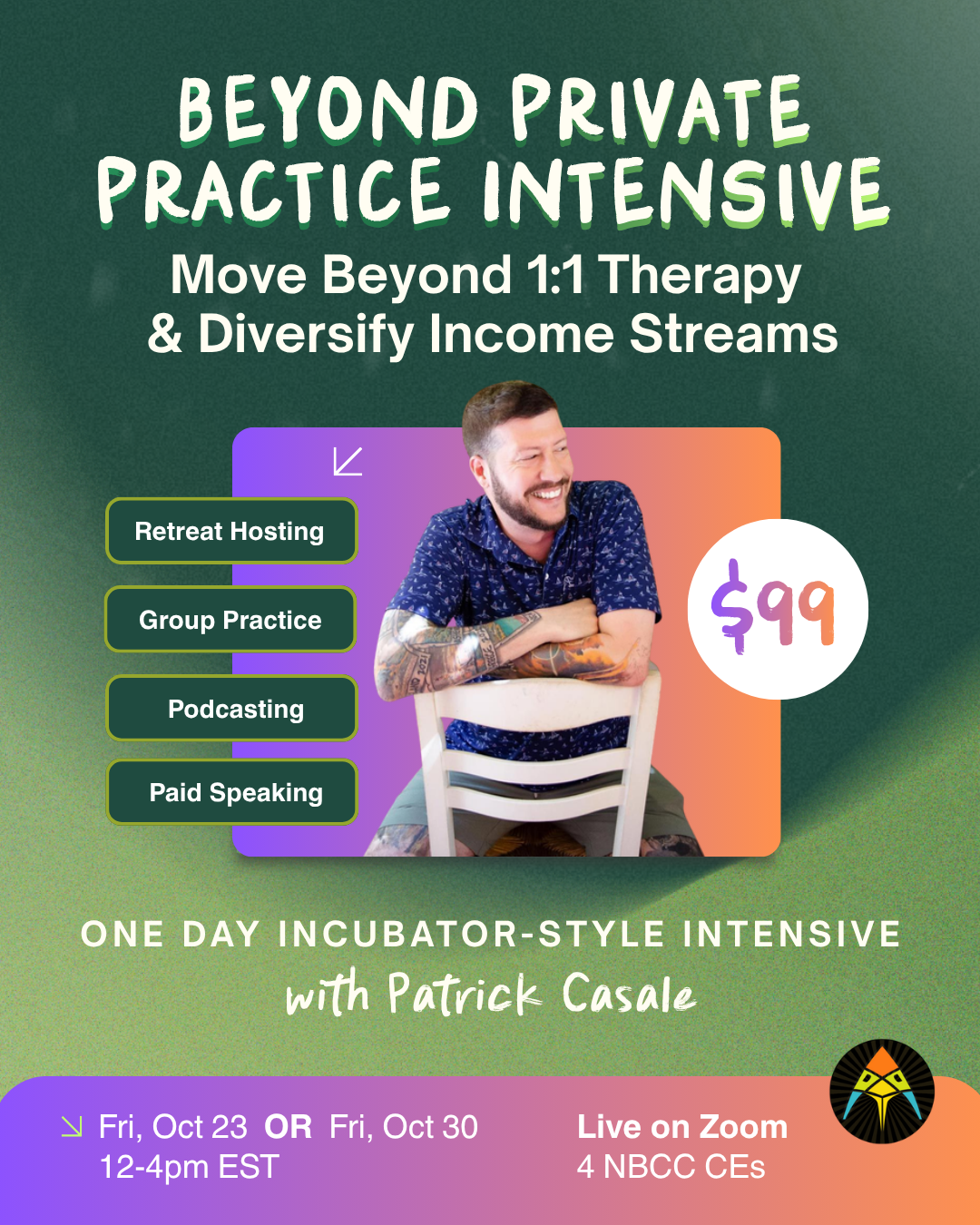
We have two retreats in Queenstown, New Zealand. The first is for Neurodivergent Entrepreneurs from March 1st to 8th, and the second retreat, Beyond Private Practice, focuses on moving beyond one-on-one therapy and creating alternative income streams from March 15th to 22nd.

Spaces are limited, so check the links to sign up today. Doubt yourself, do it anyway!


Transcript

PATRICK CASALE: Hey, everyone. Welcome back to the All Things Private Practice podcast, joined today by Danni Biondini, who is a licensed marriage and family therapist, born and raised in San Francisco. And now, living in Brooklyn. They served as a core faculty and department chair of a graduate program for MFT students and as an adjunct professor at the University of San Francisco, the San Francisco Center for Psychoanalysis, in Brooklyn College. Now, they primarily work as a family therapist in their private practice, Gemini Family Therapy, helping adult families in California and New York repair from past hurts or estrangement.

They are also launching an online program that teaches theories and tools around how to repair from family estrangement. The program is called Prepare to Repair. Danny Biondini, welcome to the show.

DANNI BIONDINI: Hello, Biondini, thank you.

PATRICK CASALE: I still think about that every day of my life. So, Danni was at my Italy summit back in September of last year. And rushed onto the bus the day everyone was leaving at like 5:00 in the morning. And apparently, was like, oh, this is not the story. Go ahead, do tell it.

DANNI BIONDINI: No, that's the story. Yeah. Well, first I slept through it. And someone had to [INDISCERNIBLE 00:02:08] back and roused me from my sleep.

PATRICK CASALE: Yeah. Well, I get it. You know, I was anxious that everyone's getting on the bus and making sure everyone gets out of this village that's four hours from the nearest airport. I say, "Danni's missing. We don't know where Danni is." And then, Shailene messaged me, "Danni's on the bus." They came on and were like, "Hi, bonjour." [CROSSTALK 00:02:31].

DANNI BIONDINI: Apparently, I'm very chipper and cheery at 5:00 AM. I [CROSSTALK 00:02:37]-

PATRICK CASALE: [CROSSTALK 00:02:37].

DANNI BIONDINI: …at all times.

PATRICK CASALE: At all times, yeah. You must be like angrily riding your bike in New York City, and you said, "Get the fuck out of here."

DANNI BIONDINI: Yeah, exactly. Unless somebody steps in front of my bike, then I am a different person.

PATRICK CASALE: Dennis comes out.

DANNI BIONDINI: Yeah.

PATRICK CASALE: Okay, I'm regrouping for you all. So, today we are going to talk about how to move into becoming a professor and how to supplement your income by doing so, because I know a lot of you listening are like, "I do want alternative income streams. I want to do different things with my career."

And I think it's a really wonderful path, and one that you have experience with, and want to share that. So, tell us a little bit about why this feels like an important topic.

DANNI BIONDINI: Yeah, well, you said it. And I'll just reiterate it that I know a lot of therapists are very interested in figuring out if they can and how can they get into teaching as a side gig.

Actually, a few years ago, I'd posted in a Facebook group for therapists. And I asked, "Is anybody in here interested if I was going to do a workshop on how to get into teaching?" And I had like 400 people respond affirmatively. Never put it together. But this is my opportunity. This is for them.

PATRICK CASALE: This is accountability.

DANNI BIONDINI: Yeah, yeah.

PATRICK CASALE: Well, I mean, you know, I think we go through seasons of life as small business owners, and it sounds like, right now, this season of life, you feel really passionate about this. So, you've been a professor as an adjunct professor for different colleges and a part of different programs.

DANNI BIONDINI: Yeah.

PATRICK CASALE: Tell us about, like, what do you really like about that to offset doing family and one-on-one therapy?

DANNI BIONDINI: Well, you know, I've always been, I think, like you and like everyone we know, always been very interested in having my attention scattered in a few different places.

PATRICK CASALE: Sure.

DANNI BIONDINI: And so, I think that teaching is one really awesome way to have a side gig where you're really doing a lot of the same kinds of stuff that all the people we know who are, like therapist entrepreneurs, like all that kind of stuff they're doing, like doing talks and making content, and filming videos, and making funny memes, whatever. But as a professor, you're doing it with more of a safety net, because, yeah, you don't have to find the audience. Like, they will bring the students to you.

PATRICK CASALE: Sure.

DANNI BIONDINI: And there's just more support and more structure already in place. So, I think it's a good like first step.

PATRICK CASALE: Yeah, no, that makes a lot of sense. And I think a lot of people will be interested in that. And I think a lot of people will get hung up on, like, can I be an adjunct professor with just a master's degree?

DANNI BIONDINI: Yes, very common question. So, let's dispel that myth right now. The answer is yes, you absolutely can get hired to teach at the graduate level with a master's degree. I only have a master's degree. And I have been an adjunct at multiple schools. I was also core faculty and the department chair, even, which was weird in retrospect, and a mistake, but I think-

PATRICK CASALE: [CROSSTALK 00:06:03] red flag in some ways, yeah.

DANNI BIONDINI: What?

PATRICK CASALE: Was it a red flag in some ways about-

DANNI BIONDINI: Yeah, yeah, yeah, yeah. We won't go down that path. But, yeah.

PATRICK CASALE: Sure.

DANNI BIONDINI: But you absolutely can teach with just a master's degree, but that is to say, not at every school. Some schools will have a stricter standard and want doctorate level. But there's plenty of programs that are happy to have you with a master's degree and with clinical experience in the field.

PATRICK CASALE: Sure. I mean, I think that makes a lot of sense. And I can remember, like, having professors for sure that did adjunct work, who had master's degrees in my program. And I really enjoyed a lot of them. And I never really thought about, like, doctoral versus masters in that capacity.

DANNI BIONDINI: Yeah.

PATRICK CASALE: With that being said, one thing that's always held me up, right? Because I've been like, "oh, I might be interested in teaching in some capacity," is, like, the executive functioning piece of like the syllabus, all the administrative work that goes into it. So, you are a fellow, I guess, I can say AuDHDer, if you feel comfortable with that. If not, we'll remove it.

DANNI BIONDINI: No, it's okay.

PATRICK CASALE: How do you manage that? Because I don't know if I could. Like, the executive functioning piece, the administration piece, the behind-the-scenes stuff.

DANNI BIONDINI: Okay, you are going there. You are going to the heart of it. I mean, that's the hardest part of it. For me, it was the hardest part of it. And, you know, I'll say I taught for maybe, gosh, five or six years before I even knew I was AuDHD, or before I even got my ADHD diagnosis. And I struggled with all of those pieces that you're talking about.

It's actually funny, after I got my ADHD diagnosis, I was at the school, and I saw one of my former students who also worked in administration there. And I was like, "Oh my gosh, guess what? I just found out I have ADHD." And his response was, "Yeah, we all knew that. Like, you would show up to classes with 100 slides in your PowerPoint for a one-hour lecture, just so you could jump around to whatever you know seemed most interesting at that moment."

PATRICK CASALE: Sure. That makes sense. I actually would love to know what like pre-discovery Danni was like, the masked version of Danni. I find that to be fascinating.

DANNI BIONDINI: Oh, okay, okay.

PATRICK CASALE: You don't have to answer that. But I was just thinking about it.

DANNI BIONDINI: Well, gosh, okay. I'd like to think about it for a moment-

PATRICK CASALE: It's okay.

DANNI BIONDINI: Because, I think I was pretty similar to how I present now. Like, I do have very, very big energy. And I'm enthusiastic about everything. But also, you know, I would get a lot of feedback, though, that I was also, like, very disorganized and, like, sometimes sort of, like, chaotically so.

And as a professor, I mean, definitely, I think that there's the ADHD part of me that's like, I just want to, like, have fun with my lectures, and I'm going to make all kinds of, like, really funny memes and jokes throughout my lectures. And I was really good at that kind of thing.

PATRICK CASALE: Sure.

DANNI BIONDINI: And also, just, like, following somebody's tangent, like to the ends of the earth, which was also feedback I would get. And I learned, okay, I got to reel that in. And on that, like, how I learned to reel it in was like to come to class with a very strong, structured syllabus and a very structured PowerPoint, like slideshow, whatever you want to call it that would keep me on track.

PATRICK CASALE: Sure.

DANNI BIONDINI: Besides the ADHD part of me, I think there's also what I've come to realize is my more autistic side too, which is like, I want to deeply research my special interest and talk about it in depth, or like, the entire three hours.

PATRICK CASALE: Sure.

DANNI BIONDINI: So, like, I'm not going to come and just do like a surface-level lecture. Like, we are going to go as deep as possible into this.

PATRICK CASALE: Hard to do in an hour sometimes, yeah.

DANNI BIONDINI: Yeah, yeah, yeah, I mean, and that's why, like, my classes would often just be so packed with, like, my psychopathology class was like, we are going to examine every diagnosis, every disorder from four different lenses.

PATRICK CASALE: Sure.

DANNI BIONDINI: And we're going to critique the DSM from a historical perspective, and talk about the rise of the biomedical model, and look at alternative frameworks, and look at trauma, and like so on and so on.

PATRICK CASALE: Sure.

DANNI BIONDINI: I think people kind of did come out of my classes, like, in like a swirl. Like, what was that like whirlwind, like tornado that just hit?

PATRICK CASALE: So, I mean, I could see that in some aspects, for sure. And I'm sure some people also really enjoyed, like, the passion that you brought to the classroom.

DANNI BIONDINI: Oh, yeah, yeah, yeah, absolutely. I mean, I would get a lot of positive feedback about my enthusiasm, my passion, like my clear like love for the topics, and my knowledge was really deep. But I'd also get feedback, again, literally, like, I had students that were like, "Danni, like, you're too much." And like, "The way you approach this material, like it's too much, it's too fast, it's too deep." Like, you know?

PATRICK CASALE: So, how do you find the balance in that?

DANNI BIONDINI: Oh, yeah.

PATRICK CASALE: Or is that still searching for?

DANNI BIONDINI: Well, I think so, still the search. You know, I'm still now putting together courses. I'm creating my online course right now, that's separate from any institutions. I have that same balance where I had that same struggle, where I'm like, "I'm teaching about it, repairing family estrangement. But first, I have personally read about, like, every single book on estrangement…" Which is not that many. So, it's not that a lot, but it's like a dozen, let's say, every journal article I could find. "And I am now going to give you the entire history that every theory, every person who has ever said anything on this topic."

And I'm realizing, dude, that's not what people actually want. You just want to come in and have me say, like, there is hope. You can repair. Here are some basic skills and tools.

PATRICK CASALE: Yep, I agree. And I think that there's probably a way to strike that balance between, like, passion and deep interest in research, right? And, like, deep diving it. And maybe that can be, like, an offshoot off the course of like, "Hey, if you want to deep dive deeper and really go into the research and have these deep, analytical, philosophical conversations, like, here's this track. And here's the track where it's like, here's the hope, and the optimism, and the support."

DANNI BIONDINI: Yeah, yeah. And I think, I mean, that's one of the things I really loved about teaching. And like I loved teaching. I adored it because I would get to have those deeper moments with my students when I would read their papers, and respond to their papers, or read their Canvas posts on, you know, their online posts. And like, really be able to track their thinking and respond to their thinking. I would do that hours every day, not that I had to, just because I wanted to. Like, I loved it so much.

PATRICK CASALE: That makes sense. Yeah, you were that passionate about it. And I'm sure the students really, really appreciated that.

So, how does someone get started with this process? If they're like, "Okay, I do want to teach. I do want to do some adjunct I want to supplement my income. I want to do something different with my brain." How do you get started with this?

DANNI BIONDINI: Yes, well. You would be starting out looking for adjunct positions. And they have them in every master's level graduate program in the country. They hire adjuncts to teach, you know, at least some, if not most of their classes.

And what I did and what a lot of people I know to get our foot in the door, just go back to the graduate school you went to. Because you probably still have connections there. There's probably professors who know you. And talk to them. And say, "You know, I'm really interested in teaching."

And like, well, how it worked for me was the former chair of my program said, "Oh, great. You know, we have a human development class. Do you want to teach it?" And I said, "Yeah, of course I do." So, that's a good place to start.

You also can, I mean, if you really were bold, you know, just look up all the grad programs that are in your locale and really quick, just probably reach out. Look them up online. Find out who the chair is. Send an email saying, I really want to teach. Like, here are my interests. Here's my subject. Like, not just like, I'll talk about this in a moment, but it's important to not just have like, vague interest and like, "Oh, I would love to teach." But like, you need to have subject matters you're interested in and capable of teaching.

PATRICK CASALE: For sure, that makes a ton of sense, instead of being vague, and instead of like, if you're going to take that approach, I imagine, don't just, like, throw out the same email to every single person you reach out to. Be really specific about why you want to work at this institution, what you want to teach, what you feel passionate about, and what you feel like you would bring to the table.

DANNI BIONDINI: Yeah. I mean, that would be ideal. Yeah, if you did all that. But also, like, I was in the position of chair, like, hiring adjuncts. And I will tell you, behind the scenes, we were pretty desperate to hire. Like, it's actually very hard to find therapists who want to adjunct. I think in part because a lot of people just feel like, "Oh, that's not for me. I could never do that. I don't know enough."

PATRICK CASALE: Right.

DANNI BIONDINI: And also, in part, because, let's be real, this is another thing we've got to talk about.

PATRICK CASALE: The pay.

DANNI BIONDINI: The pay, yeah, the pay is not good. You don't do this to make a ton of money. You really do it because you love it. And/or, you know, it's interesting to you. You want an opportunity to be creative in this way. I think some people also do it for the status. Like, this is a very neurotypical thing that I don't understand personally, but I think there's like a status associated to being [CROSSTALK 00:19:20]-

PATRICK CASALE: [CROSSTALK 00:19:21] to being a professor.

DANNI BIONDINI: Yeah, yeah.

PATRICK CASALE: Yeah, that probably tracks. I also cannot relate to that. Like [INDISCERNIBLE 00:19:27] that often. I mean, I'm glad you touched on the pay, because I was definitely going to ask you about that.

DANNI BIONDINI: Yeah.

PATRICK CASALE: And I guess another question people might be having is, can an adjunct, and it sounds like it can already, based on you becoming a faculty chair, but can an adjunct lead to, like, a permanent, tenured position or a permanent position?

DANNI BIONDINI: Yeah, yeah, yeah, it can. In my experience at the schools I've been at, that's much more likely going to go to somebody with a doctorate, but it's clearly not always the case. I mean, it depends on the school. I mean, I taught at a school that was very anti-establishment. Like, we don't care about credentials, or accreditation, or any of the… I mean, of course, they had, like, the ones you need to have, okay, don't sue me. But, you know, otherwise, like they didn't care so much about that stuff.

PATRICK CASALE: Yeah, yeah. I think that makes sense, like that not every institution in this country is going to be the same and have the same, like, concerns about maybe bureaucracy, or, like, doing things a certain way.

DANNI BIONDINI: Yeah.

PATRICK CASALE: And I like that you just switched drink types. Very-

DANNI BIONDINI: I was going to tell you at the beginning, I do have three drinks here.

PATRICK CASALE: Good. I'm glad to hear. What do we have in front of us? We have an iced coffee or something. And we have…

DANNI BIONDINI: This is my cold brew from this morning.

PATRICK CASALE: Okay, probably something carbonated somewhere.

DANNI BIONDINI: You know, I don't have any carbonated right now. I really let everybody down in my community. But I do have three. This one is just water. In the cat mug, we have milky oolong tea.

PATRICK CASALE: Love it. I love it. I noticed as soon as you put your water down. So, okay, I think we covered, like, the foundation. What else did you have on your list?

DANNI BIONDINI: Oh, yeah, wait, let me tell you, actually, how much that you do get paid.

PATRICK CASALE: Sure.

DANNI BIONDINI: I want to give the range that I've seen, which is at the low end, maybe 3000, and at the high end-

PATRICK CASALE: Per semester.

DANNI BIONDINI: For one class, per one semester class, yeah. 3000 on the low end and maybe 6000 on the high end.

PATRICK CASALE: Sure. And I know that a lot of adjunct professors sometimes, often, like, piece it together by teaching, like, multiple classes, or once they get established.

DANNI BIONDINI: Yes, oh, absolutely. And, I mean, the thing is, once you get your foot in the door, if you do a good job, and they like you, I promise you, they will offer you more classes. Because, like, I said like, it's actually pretty hard to hire good people.

PATRICK CASALE: Oh, I'm sure. And I'm sure what happens too is like, once you get your foot in the door, you establish yourself, you do a good job, it's like, this is so much less of a path of least resistance, opposed to, like, hiring new people, going through that process trying to figure out if it's a good fit. So, that makes a ton of sense to me.

DANNI BIONDINI: Exactly. Yeah, yeah. So, you can definitely piece it together with, you know, teaching a couple classes at the same school, or, you know, moving it around.

PATRICK CASALE: I like that. And I think flexibility, you know, is what people want. And I know for a lot of us, especially those of us who do identify as neurodivergent, especially probably more the ADHD side, doing the same thing for the rest of our lives in a career seems pretty hellacious.

DANNI BIONDINI: Yeah, yeah. I could never imagine that. And, I mean, that's really why I wanted to teach initially, is, I mean, I already was a therapist. I was already a program director at the agency I worked at. Then I had a private practice. And then, I was like, "Yeah, now add teaching."

But, I mean, to be fair, like, if there are any of my former students who listen to this and they're like, "Yeah, dude, that's part of the problem, though, is that you were doing like five things at once." I understand that now.

PATRICK CASALE: Sure.

DANNI BIONDINI: I did not understand that then.

PATRICK CASALE: I think there's refinement too, though, in that process. Like, I bet if you went back to teaching now, things could look a little bit different in regards to, like, how many things you take on, or how much you have capacity for.

DANNI BIONDINI: Yeah, oh yeah, yeah, yeah, for sure. I would not do it the way I did it before.

PATRICK CASALE: I think that's a good growth lesson. I mean, honestly, and I think for those of you listening, like, probably relatable in a lot of different ways.

DANNI BIONDINI: Yeah, I mean, Patrick, for you, it's a lesson.

PATRICK CASALE: It's a constant lesson, and it's a constant, like, check and balance, unfortunately. But like, just trying to honor, for those of us who have diminished and limited capacity, like, where do we put our energy? How do we pace? How do we, like, protect our spoons? How do we, like, set boundaries? How do we not say yes to every idea and opportunity?

And I've gotten a lot better at it, but it's still a challenge. And I think it's about it just acknowledging that it's a growth point, and not just, like, it's not a finite point either.

DANNI BIONDINI: Yeah, well…

PATRICK CASALE: Anything else that you want to add for those that are listening about any of this?

DANNI BIONDINI: Yeah, yeah. Let me see, how much time do we have?

PATRICK CASALE: A couple of minutes, and we'll probably get wrapped up.

DANNI BIONDINI: So, I'm just go back to my notes to make sure I cover everything.

PATRICK CASALE: Sure.

DANNI BIONDINI: So, I did want to come back to a point we briefly touched on, which is, when I would talk to people who wanted to teach in my program, in our program, a lot of them would, I'd say, like, "Okay, yeah, what are you interested in teaching?" And they would say things like, "Oh, well, I really want to teach the supervision or, like, clinical skills."

And I was kind of like, "That's not really how it works." Like, most programs do have some version of supervision, but that's probably already taken by the core faculty, because it's a really easy gig, and they just want that. They've already claimed it.

PATRICK CASALE: Of course.

DANNI BIONDINI: You have to be prepared to really teach subject matter. And so, what I would recommend is that you look up, you know, what are the common classes taught at the master's level? And it's going to be some version of all the same things like human development, psychopathology, research methods, law and ethics, child therapy, couple's therapy, multicultural counseling. And then, figure out, like, where your interests as a therapist align.

PATRICK CASALE: Right. That makes a lot of sense, instead of just going for, like, the core classes that are obviously going to be taken, being much more specific and probably somewhat flexible in terms of, like, what am I willing to teach and what am I going to be interested in, especially at first?

DANNI BIONDINI: Exactly. And I think it helps a lot if you do that work ahead of time and present yourself to the person hiring as, you know, I am a therapist. I have all this… You know, like, what I did was, like, I have all this experience as a school-based therapist, working in high schools in San Francisco, and I've trained in child psychoanalysis. So, given all of that, I feel qualified to teach a human development class, because I have the clinical experience and the theoretical knowledge to teach about development.

PATRICK CASALE: Sure, that makes great sense. And I think for those of you listening, like, trying to embrace that, if this is something that you want to embark upon, because it does sound like a great income stream. And also, just a great way to use creativity, and connection, and just a different part of the brain, because again, the monotony of session after session to me sounds like absolute tedium. And I don't think I could ever do it again.

DANNI BIONDINI: No, no, no. I mean, this is the first time in my life that I've really only been doing my private practice, but that's just because I burnt out so, so deeply. I've been in recovery from it.

PATRICK CASALE: I love that.

DANNI BIONDINI: Otherwise, like, I'd still be teaching. Because, like I said, I think it's so, so, so rewarding, both, like, as a neurodivergent person, like it just like scratches that itch in my brain for like, I want to constantly be learning and talking about ideas with people.

PATRICK CASALE: That makes so much sense. I'm glad that you named that. If the audience wants to find you, and connect, and take this program that you're creating, how do they do that?

DANNI BIONDINI: Okay, you can find me on Instagram as Gemini Family Therapy. That's it, I mean. Or go to my website, sign up for my email list.

PATRICK CASALE: Yes [CROSSTALK 00:28:10]-

DANNI BIONDINI: geminifamilytherapy.com.

PATRICK CASALE: Perfect. And we'll put that in the show notes so that you have access to it, for those of you who are listening and interested in connecting with Danni.

Danni, it's always a pleasure. I hope, you know, the rest of the day is fun, full of biking, riding, and multiple drinks.

DANNI BIONDINI: Thank you so much. Okay, bye, Patrick.

PATRICK CASALE: Thanks for coming on. And to everyone listening to the All Things Private Practice podcast, new episodes are out on Saturdays on all major platforms. Like, download, subscribe, and share. Doubt yourself, do it anyway. And we'll see you next week.

FREE PRIVATE PRACTICE GUIDE

Join the weekly newsletter for private practice tips, podcast updates, special offers, & your free private practice startup guide!

We will not spam you or share your information. You can unsubscribe at any time.

All Things Private Practice Podcast for Therapists

Episode 212: Teaching Graduate Courses with a Therapy Degree [Featuring Danni Biondini]

Show Notes

In this episode, Patrick Casale talks with Danni Biondini, LMFT, adjunct professor, and founder of Gemini Family Therapy, about their experience of utilizing their expertise as a licensed therapist to become an adjunct professor, including practical advice and the realities of teaching at the graduate level.

3 Key Takeaways:

  1. You don’t need a doctorate to get started. Many adjunct positions at the graduate level accept applicants with a master’s degree and clinical experience. Danni emphasizes: “You absolutely can teach with just a master's degree.”
  2. Be specific about what you want to teach. Programs need instructors for a variety of subjects like human development, psychopathology, research methods, multicultural counseling, and more. Highlight relevant clinical expertise and be clear about your subject interests when you reach out.
  3. Teaching is rewarding—but don’t expect to get rich. Adjunct roles can pay between $3,000–$6,000 per class, per semester. The real benefits? Creative fulfillment, connecting with students, and diversifying your work as a therapist.

More about Danni:

Danni Biondini is a licensed Marriage and Family Therapist, born and raised in San Francisco and now living in Brooklyn. They served as core faculty and department chair of a graduate program for MFT students, and as adjunct professor at the University of San Francisco, the San Francisco Center for Psychoanalysis, and Brooklyn College. 

Now, they primarily work as a family therapist in their private practice, Gemini Family Therapy, helping adult families in CA and NY repair from past hurts or estrangement.

They are also launching an online program that teaches theories and tools around how to repair from family estrangement. The program is called Prepare to Repair. Visit: prepareto.repair


๐ŸŽ™๏ธListen to more episodes of the All Things Private Practice Podcast here
๐ŸŽ™๏ธSpotify

๐ŸŽ™๏ธApple

๐ŸŽ™๏ธYouTube Music
โ–ถ๏ธ YouTube
โœˆ๏ธ Check out available Retreats
๐Ÿ—จ๏ธ Join the free Empowered Escape FB Community
๐Ÿ—จ๏ธ Join the free All Things Private Practice FB Community


A Thanks to Our Sponsors: The Receptionist for iPad, Alma, & All Things Private Practice — 2025 & 2026 Retreats!

โœจThe Receptionist for iPad

I want to thank The Receptionist for iPad for sponsoring this episode.

This podcast is sponsored by The Receptionist for iPad, a digital check-in system that eliminates the need to walk back and forth from your office to the waiting room to see if your next appointment has arrived. Clients can securely check-in for their appointments and you'll be immediately notified by text, email, or your preferred channel. Break free from interruptions and make the most of your time. I've been using them for almost three years now and it saves me hours in my week.

Start a 14-day free trial of The Receptionist for iPad by going to thereceptionist.com/privatepractice. Make sure to start your trial with that link. And you'll also get your first month free if you decide to sign up.

โœจAlma

I want to thank Alma for sponsoring this episode.

Building and managing the practice you want can be challenging. That’s why Alma offers tools and resources to help you build not just any practice, but your private practice. They’ll help you navigate insurance, access referrals who are the right fit for you, and efficiently manage administrative tasks — so you can spend less time on the details and more time delivering great care. You support your clients. Alma supports you.

Visit helloalma.com/ATPP to learn more.

โœจ All Things Private Practice — 2025 & 2026 Retreats

All Things Private Practice has some amazing retreat experiences coming up in 2025 and 2026.

We have two retreats in Queenstown, New Zealand. The first is for Neurodivergent Entrepreneurs from March 1st to 8th, and the second retreat, Beyond Private Practice, focuses on moving beyond one-on-one therapy and creating alternative income streams from March 15th to 22nd.

Spaces are limited, so check the links to sign up today. Doubt yourself, do it anyway!


Transcript

PATRICK CASALE: Hey, everyone. Welcome back to the All Things Private Practice podcast, joined today by Danni Biondini, who is a licensed marriage and family therapist, born and raised in San Francisco. And now, living in Brooklyn. They served as a core faculty and department chair of a graduate program for MFT students and as an adjunct professor at the University of San Francisco, the San Francisco Center for Psychoanalysis, in Brooklyn College. Now, they primarily work as a family therapist in their private practice, Gemini Family Therapy, helping adult families in California and New York repair from past hurts or estrangement.

They are also launching an online program that teaches theories and tools around how to repair from family estrangement. The program is called Prepare to Repair. Danny Biondini, welcome to the show.

DANNI BIONDINI: Hello, Biondini, thank you.

PATRICK CASALE: I still think about that every day of my life. So, Danni was at my Italy summit back in September of last year. And rushed onto the bus the day everyone was leaving at like 5:00 in the morning. And apparently, was like, oh, this is not the story. Go ahead, do tell it.

DANNI BIONDINI: No, that's the story. Yeah. Well, first I slept through it. And someone had to [INDISCERNIBLE 00:02:08] back and roused me from my sleep.

PATRICK CASALE: Yeah. Well, I get it. You know, I was anxious that everyone's getting on the bus and making sure everyone gets out of this village that's four hours from the nearest airport. I say, "Danni's missing. We don't know where Danni is." And then, Shailene messaged me, "Danni's on the bus." They came on and were like, "Hi, bonjour." [CROSSTALK 00:02:31].

DANNI BIONDINI: Apparently, I'm very chipper and cheery at 5:00 AM. I [CROSSTALK 00:02:37]-

PATRICK CASALE: [CROSSTALK 00:02:37].

DANNI BIONDINI: …at all times.

PATRICK CASALE: At all times, yeah. You must be like angrily riding your bike in New York City, and you said, "Get the fuck out of here."

DANNI BIONDINI: Yeah, exactly. Unless somebody steps in front of my bike, then I am a different person.

PATRICK CASALE: Dennis comes out.

DANNI BIONDINI: Yeah.

PATRICK CASALE: Okay, I'm regrouping for you all. So, today we are going to talk about how to move into becoming a professor and how to supplement your income by doing so, because I know a lot of you listening are like, "I do want alternative income streams. I want to do different things with my career."

And I think it's a really wonderful path, and one that you have experience with, and want to share that. So, tell us a little bit about why this feels like an important topic.

DANNI BIONDINI: Yeah, well, you said it. And I'll just reiterate it that I know a lot of therapists are very interested in figuring out if they can and how can they get into teaching as a side gig.

Actually, a few years ago, I'd posted in a Facebook group for therapists. And I asked, "Is anybody in here interested if I was going to do a workshop on how to get into teaching?" And I had like 400 people respond affirmatively. Never put it together. But this is my opportunity. This is for them.

PATRICK CASALE: This is accountability.

DANNI BIONDINI: Yeah, yeah.

PATRICK CASALE: Well, I mean, you know, I think we go through seasons of life as small business owners, and it sounds like, right now, this season of life, you feel really passionate about this. So, you've been a professor as an adjunct professor for different colleges and a part of different programs.

DANNI BIONDINI: Yeah.

PATRICK CASALE: Tell us about, like, what do you really like about that to offset doing family and one-on-one therapy?

DANNI BIONDINI: Well, you know, I've always been, I think, like you and like everyone we know, always been very interested in having my attention scattered in a few different places.

PATRICK CASALE: Sure.

DANNI BIONDINI: And so, I think that teaching is one really awesome way to have a side gig where you're really doing a lot of the same kinds of stuff that all the people we know who are, like therapist entrepreneurs, like all that kind of stuff they're doing, like doing talks and making content, and filming videos, and making funny memes, whatever. But as a professor, you're doing it with more of a safety net, because, yeah, you don't have to find the audience. Like, they will bring the students to you.

PATRICK CASALE: Sure.

DANNI BIONDINI: And there's just more support and more structure already in place. So, I think it's a good like first step.

PATRICK CASALE: Yeah, no, that makes a lot of sense. And I think a lot of people will be interested in that. And I think a lot of people will get hung up on, like, can I be an adjunct professor with just a master's degree?

DANNI BIONDINI: Yes, very common question. So, let's dispel that myth right now. The answer is yes, you absolutely can get hired to teach at the graduate level with a master's degree. I only have a master's degree. And I have been an adjunct at multiple schools. I was also core faculty and the department chair, even, which was weird in retrospect, and a mistake, but I think-

PATRICK CASALE: [CROSSTALK 00:06:03] red flag in some ways, yeah.

DANNI BIONDINI: What?

PATRICK CASALE: Was it a red flag in some ways about-

DANNI BIONDINI: Yeah, yeah, yeah, yeah. We won't go down that path. But, yeah.

PATRICK CASALE: Sure.

DANNI BIONDINI: But you absolutely can teach with just a master's degree, but that is to say, not at every school. Some schools will have a stricter standard and want doctorate level. But there's plenty of programs that are happy to have you with a master's degree and with clinical experience in the field.

PATRICK CASALE: Sure. I mean, I think that makes a lot of sense. And I can remember, like, having professors for sure that did adjunct work, who had master's degrees in my program. And I really enjoyed a lot of them. And I never really thought about, like, doctoral versus masters in that capacity.

DANNI BIONDINI: Yeah.

PATRICK CASALE: With that being said, one thing that's always held me up, right? Because I've been like, "oh, I might be interested in teaching in some capacity," is, like, the executive functioning piece of like the syllabus, all the administrative work that goes into it. So, you are a fellow, I guess, I can say AuDHDer, if you feel comfortable with that. If not, we'll remove it.

DANNI BIONDINI: No, it's okay.

PATRICK CASALE: How do you manage that? Because I don't know if I could. Like, the executive functioning piece, the administration piece, the behind-the-scenes stuff.

DANNI BIONDINI: Okay, you are going there. You are going to the heart of it. I mean, that's the hardest part of it. For me, it was the hardest part of it. And, you know, I'll say I taught for maybe, gosh, five or six years before I even knew I was AuDHD, or before I even got my ADHD diagnosis. And I struggled with all of those pieces that you're talking about.

It's actually funny, after I got my ADHD diagnosis, I was at the school, and I saw one of my former students who also worked in administration there. And I was like, "Oh my gosh, guess what? I just found out I have ADHD." And his response was, "Yeah, we all knew that. Like, you would show up to classes with 100 slides in your PowerPoint for a one-hour lecture, just so you could jump around to whatever you know seemed most interesting at that moment."

PATRICK CASALE: Sure. That makes sense. I actually would love to know what like pre-discovery Danni was like, the masked version of Danni. I find that to be fascinating.

DANNI BIONDINI: Oh, okay, okay.

PATRICK CASALE: You don't have to answer that. But I was just thinking about it.

DANNI BIONDINI: Well, gosh, okay. I'd like to think about it for a moment-

PATRICK CASALE: It's okay.

DANNI BIONDINI: Because, I think I was pretty similar to how I present now. Like, I do have very, very big energy. And I'm enthusiastic about everything. But also, you know, I would get a lot of feedback, though, that I was also, like, very disorganized and, like, sometimes sort of, like, chaotically so.

And as a professor, I mean, definitely, I think that there's the ADHD part of me that's like, I just want to, like, have fun with my lectures, and I'm going to make all kinds of, like, really funny memes and jokes throughout my lectures. And I was really good at that kind of thing.

PATRICK CASALE: Sure.

DANNI BIONDINI: And also, just, like, following somebody's tangent, like to the ends of the earth, which was also feedback I would get. And I learned, okay, I got to reel that in. And on that, like, how I learned to reel it in was like to come to class with a very strong, structured syllabus and a very structured PowerPoint, like slideshow, whatever you want to call it that would keep me on track.

PATRICK CASALE: Sure.

DANNI BIONDINI: Besides the ADHD part of me, I think there's also what I've come to realize is my more autistic side too, which is like, I want to deeply research my special interest and talk about it in depth, or like, the entire three hours.

PATRICK CASALE: Sure.

DANNI BIONDINI: So, like, I'm not going to come and just do like a surface-level lecture. Like, we are going to go as deep as possible into this.

PATRICK CASALE: Hard to do in an hour sometimes, yeah.

DANNI BIONDINI: Yeah, yeah, yeah, I mean, and that's why, like, my classes would often just be so packed with, like, my psychopathology class was like, we are going to examine every diagnosis, every disorder from four different lenses.

PATRICK CASALE: Sure.

DANNI BIONDINI: And we're going to critique the DSM from a historical perspective, and talk about the rise of the biomedical model, and look at alternative frameworks, and look at trauma, and like so on and so on.

PATRICK CASALE: Sure.

DANNI BIONDINI: I think people kind of did come out of my classes, like, in like a swirl. Like, what was that like whirlwind, like tornado that just hit?

PATRICK CASALE: So, I mean, I could see that in some aspects, for sure. And I'm sure some people also really enjoyed, like, the passion that you brought to the classroom.

DANNI BIONDINI: Oh, yeah, yeah, yeah, absolutely. I mean, I would get a lot of positive feedback about my enthusiasm, my passion, like my clear like love for the topics, and my knowledge was really deep. But I'd also get feedback, again, literally, like, I had students that were like, "Danni, like, you're too much." And like, "The way you approach this material, like it's too much, it's too fast, it's too deep." Like, you know?

PATRICK CASALE: So, how do you find the balance in that?

DANNI BIONDINI: Oh, yeah.

PATRICK CASALE: Or is that still searching for?

DANNI BIONDINI: Well, I think so, still the search. You know, I'm still now putting together courses. I'm creating my online course right now, that's separate from any institutions. I have that same balance where I had that same struggle, where I'm like, "I'm teaching about it, repairing family estrangement. But first, I have personally read about, like, every single book on estrangement…" Which is not that many. So, it's not that a lot, but it's like a dozen, let's say, every journal article I could find. "And I am now going to give you the entire history that every theory, every person who has ever said anything on this topic."

And I'm realizing, dude, that's not what people actually want. You just want to come in and have me say, like, there is hope. You can repair. Here are some basic skills and tools.

PATRICK CASALE: Yep, I agree. And I think that there's probably a way to strike that balance between, like, passion and deep interest in research, right? And, like, deep diving it. And maybe that can be, like, an offshoot off the course of like, "Hey, if you want to deep dive deeper and really go into the research and have these deep, analytical, philosophical conversations, like, here's this track. And here's the track where it's like, here's the hope, and the optimism, and the support."

DANNI BIONDINI: Yeah, yeah. And I think, I mean, that's one of the things I really loved about teaching. And like I loved teaching. I adored it because I would get to have those deeper moments with my students when I would read their papers, and respond to their papers, or read their Canvas posts on, you know, their online posts. And like, really be able to track their thinking and respond to their thinking. I would do that hours every day, not that I had to, just because I wanted to. Like, I loved it so much.

PATRICK CASALE: That makes sense. Yeah, you were that passionate about it. And I'm sure the students really, really appreciated that.

So, how does someone get started with this process? If they're like, "Okay, I do want to teach. I do want to do some adjunct I want to supplement my income. I want to do something different with my brain." How do you get started with this?

DANNI BIONDINI: Yes, well. You would be starting out looking for adjunct positions. And they have them in every master's level graduate program in the country. They hire adjuncts to teach, you know, at least some, if not most of their classes.

And what I did and what a lot of people I know to get our foot in the door, just go back to the graduate school you went to. Because you probably still have connections there. There's probably professors who know you. And talk to them. And say, "You know, I'm really interested in teaching."

And like, well, how it worked for me was the former chair of my program said, "Oh, great. You know, we have a human development class. Do you want to teach it?" And I said, "Yeah, of course I do." So, that's a good place to start.

You also can, I mean, if you really were bold, you know, just look up all the grad programs that are in your locale and really quick, just probably reach out. Look them up online. Find out who the chair is. Send an email saying, I really want to teach. Like, here are my interests. Here's my subject. Like, not just like, I'll talk about this in a moment, but it's important to not just have like, vague interest and like, "Oh, I would love to teach." But like, you need to have subject matters you're interested in and capable of teaching.

PATRICK CASALE: For sure, that makes a ton of sense, instead of being vague, and instead of like, if you're going to take that approach, I imagine, don't just, like, throw out the same email to every single person you reach out to. Be really specific about why you want to work at this institution, what you want to teach, what you feel passionate about, and what you feel like you would bring to the table.

DANNI BIONDINI: Yeah. I mean, that would be ideal. Yeah, if you did all that. But also, like, I was in the position of chair, like, hiring adjuncts. And I will tell you, behind the scenes, we were pretty desperate to hire. Like, it's actually very hard to find therapists who want to adjunct. I think in part because a lot of people just feel like, "Oh, that's not for me. I could never do that. I don't know enough."

PATRICK CASALE: Right.

DANNI BIONDINI: And also, in part, because, let's be real, this is another thing we've got to talk about.

PATRICK CASALE: The pay.

DANNI BIONDINI: The pay, yeah, the pay is not good. You don't do this to make a ton of money. You really do it because you love it. And/or, you know, it's interesting to you. You want an opportunity to be creative in this way. I think some people also do it for the status. Like, this is a very neurotypical thing that I don't understand personally, but I think there's like a status associated to being [CROSSTALK 00:19:20]-

PATRICK CASALE: [CROSSTALK 00:19:21] to being a professor.

DANNI BIONDINI: Yeah, yeah.

PATRICK CASALE: Yeah, that probably tracks. I also cannot relate to that. Like [INDISCERNIBLE 00:19:27] that often. I mean, I'm glad you touched on the pay, because I was definitely going to ask you about that.

DANNI BIONDINI: Yeah.

PATRICK CASALE: And I guess another question people might be having is, can an adjunct, and it sounds like it can already, based on you becoming a faculty chair, but can an adjunct lead to, like, a permanent, tenured position or a permanent position?

DANNI BIONDINI: Yeah, yeah, yeah, it can. In my experience at the schools I've been at, that's much more likely going to go to somebody with a doctorate, but it's clearly not always the case. I mean, it depends on the school. I mean, I taught at a school that was very anti-establishment. Like, we don't care about credentials, or accreditation, or any of the… I mean, of course, they had, like, the ones you need to have, okay, don't sue me. But, you know, otherwise, like they didn't care so much about that stuff.

PATRICK CASALE: Yeah, yeah. I think that makes sense, like that not every institution in this country is going to be the same and have the same, like, concerns about maybe bureaucracy, or, like, doing things a certain way.

DANNI BIONDINI: Yeah.

PATRICK CASALE: And I like that you just switched drink types. Very-

DANNI BIONDINI: I was going to tell you at the beginning, I do have three drinks here.

PATRICK CASALE: Good. I'm glad to hear. What do we have in front of us? We have an iced coffee or something. And we have…

DANNI BIONDINI: This is my cold brew from this morning.

PATRICK CASALE: Okay, probably something carbonated somewhere.

DANNI BIONDINI: You know, I don't have any carbonated right now. I really let everybody down in my community. But I do have three. This one is just water. In the cat mug, we have milky oolong tea.

PATRICK CASALE: Love it. I love it. I noticed as soon as you put your water down. So, okay, I think we covered, like, the foundation. What else did you have on your list?

DANNI BIONDINI: Oh, yeah, wait, let me tell you, actually, how much that you do get paid.

PATRICK CASALE: Sure.

DANNI BIONDINI: I want to give the range that I've seen, which is at the low end, maybe 3000, and at the high end-

PATRICK CASALE: Per semester.

DANNI BIONDINI: For one class, per one semester class, yeah. 3000 on the low end and maybe 6000 on the high end.

PATRICK CASALE: Sure. And I know that a lot of adjunct professors sometimes, often, like, piece it together by teaching, like, multiple classes, or once they get established.

DANNI BIONDINI: Yes, oh, absolutely. And, I mean, the thing is, once you get your foot in the door, if you do a good job, and they like you, I promise you, they will offer you more classes. Because, like, I said like, it's actually pretty hard to hire good people.

PATRICK CASALE: Oh, I'm sure. And I'm sure what happens too is like, once you get your foot in the door, you establish yourself, you do a good job, it's like, this is so much less of a path of least resistance, opposed to, like, hiring new people, going through that process trying to figure out if it's a good fit. So, that makes a ton of sense to me.

DANNI BIONDINI: Exactly. Yeah, yeah. So, you can definitely piece it together with, you know, teaching a couple classes at the same school, or, you know, moving it around.

PATRICK CASALE: I like that. And I think flexibility, you know, is what people want. And I know for a lot of us, especially those of us who do identify as neurodivergent, especially probably more the ADHD side, doing the same thing for the rest of our lives in a career seems pretty hellacious.

DANNI BIONDINI: Yeah, yeah. I could never imagine that. And, I mean, that's really why I wanted to teach initially, is, I mean, I already was a therapist. I was already a program director at the agency I worked at. Then I had a private practice. And then, I was like, "Yeah, now add teaching."

But, I mean, to be fair, like, if there are any of my former students who listen to this and they're like, "Yeah, dude, that's part of the problem, though, is that you were doing like five things at once." I understand that now.

PATRICK CASALE: Sure.

DANNI BIONDINI: I did not understand that then.

PATRICK CASALE: I think there's refinement too, though, in that process. Like, I bet if you went back to teaching now, things could look a little bit different in regards to, like, how many things you take on, or how much you have capacity for.

DANNI BIONDINI: Yeah, oh yeah, yeah, yeah, for sure. I would not do it the way I did it before.

PATRICK CASALE: I think that's a good growth lesson. I mean, honestly, and I think for those of you listening, like, probably relatable in a lot of different ways.

DANNI BIONDINI: Yeah, I mean, Patrick, for you, it's a lesson.

PATRICK CASALE: It's a constant lesson, and it's a constant, like, check and balance, unfortunately. But like, just trying to honor, for those of us who have diminished and limited capacity, like, where do we put our energy? How do we pace? How do we, like, protect our spoons? How do we, like, set boundaries? How do we not say yes to every idea and opportunity?

And I've gotten a lot better at it, but it's still a challenge. And I think it's about it just acknowledging that it's a growth point, and not just, like, it's not a finite point either.

DANNI BIONDINI: Yeah, well…

PATRICK CASALE: Anything else that you want to add for those that are listening about any of this?

DANNI BIONDINI: Yeah, yeah. Let me see, how much time do we have?

PATRICK CASALE: A couple of minutes, and we'll probably get wrapped up.

DANNI BIONDINI: So, I'm just go back to my notes to make sure I cover everything.

PATRICK CASALE: Sure.

DANNI BIONDINI: So, I did want to come back to a point we briefly touched on, which is, when I would talk to people who wanted to teach in my program, in our program, a lot of them would, I'd say, like, "Okay, yeah, what are you interested in teaching?" And they would say things like, "Oh, well, I really want to teach the supervision or, like, clinical skills."

And I was kind of like, "That's not really how it works." Like, most programs do have some version of supervision, but that's probably already taken by the core faculty, because it's a really easy gig, and they just want that. They've already claimed it.

PATRICK CASALE: Of course.

DANNI BIONDINI: You have to be prepared to really teach subject matter. And so, what I would recommend is that you look up, you know, what are the common classes taught at the master's level? And it's going to be some version of all the same things like human development, psychopathology, research methods, law and ethics, child therapy, couple's therapy, multicultural counseling. And then, figure out, like, where your interests as a therapist align.

PATRICK CASALE: Right. That makes a lot of sense, instead of just going for, like, the core classes that are obviously going to be taken, being much more specific and probably somewhat flexible in terms of, like, what am I willing to teach and what am I going to be interested in, especially at first?

DANNI BIONDINI: Exactly. And I think it helps a lot if you do that work ahead of time and present yourself to the person hiring as, you know, I am a therapist. I have all this… You know, like, what I did was, like, I have all this experience as a school-based therapist, working in high schools in San Francisco, and I've trained in child psychoanalysis. So, given all of that, I feel qualified to teach a human development class, because I have the clinical experience and the theoretical knowledge to teach about development.

PATRICK CASALE: Sure, that makes great sense. And I think for those of you listening, like, trying to embrace that, if this is something that you want to embark upon, because it does sound like a great income stream. And also, just a great way to use creativity, and connection, and just a different part of the brain, because again, the monotony of session after session to me sounds like absolute tedium. And I don't think I could ever do it again.

DANNI BIONDINI: No, no, no. I mean, this is the first time in my life that I've really only been doing my private practice, but that's just because I burnt out so, so deeply. I've been in recovery from it.

PATRICK CASALE: I love that.

DANNI BIONDINI: Otherwise, like, I'd still be teaching. Because, like I said, I think it's so, so, so rewarding, both, like, as a neurodivergent person, like it just like scratches that itch in my brain for like, I want to constantly be learning and talking about ideas with people.

PATRICK CASALE: That makes so much sense. I'm glad that you named that. If the audience wants to find you, and connect, and take this program that you're creating, how do they do that?

DANNI BIONDINI: Okay, you can find me on Instagram as Gemini Family Therapy. That's it, I mean. Or go to my website, sign up for my email list.

PATRICK CASALE: Yes [CROSSTALK 00:28:10]-

DANNI BIONDINI: geminifamilytherapy.com.

PATRICK CASALE: Perfect. And we'll put that in the show notes so that you have access to it, for those of you who are listening and interested in connecting with Danni.

Danni, it's always a pleasure. I hope, you know, the rest of the day is fun, full of biking, riding, and multiple drinks.

DANNI BIONDINI: Thank you so much. Okay, bye, Patrick.

PATRICK CASALE: Thanks for coming on. And to everyone listening to the All Things Private Practice podcast, new episodes are out on Saturdays on all major platforms. Like, download, subscribe, and share. Doubt yourself, do it anyway. And we'll see you next week.

FREE PRIVATE PRACTICE GUIDE

Join the weekly newsletter for private practice tips, podcast updates, special offers, & your free private practice startup guide!

We will not spam you or share your information. You can unsubscribe at any time.

Send Me The Free Private Practice Guide

This guide is full of resources, referral codes, step by step strategies,
retreat & podcast information, and more.

We will not spam you or share your information. You can unsubscribe at any time.