
Show Notes
In this episode, Patrick Casale and Jennifer Agee openly discuss the realities of running a business together as partners with different neurotypes. They share the unique strengths and challenges that they bring into their business partnership, highlighting Patrick Casale's AuDHDer (Autistic/ADHD) perspective and Jennifer Agee's neurotypical perspective, who self-described “as neurotypical as neurotypicals get.”
Their honest reflections highlight the importance of communication, empathy, and flexibility when collaborating across neurotypes—not just in business, but in all relationships.
Here are 3 key takeaways:
- Self-Awareness and Communication are Critical: Both Patrick Casale and Jennifer Agee emphasize the importance of acknowledging and discussing differences in processing, communication, and strengths. Open, honest conversations can help avoid resentment and frustration in team dynamics.
- Burnout and Capacity Fluctuate—And That’s Okay: Entrepreneurial life is not static. Patrick Casale shares his experience with Autistic burnout and how roles in the partnership shift as capacity changes. Accepting these ebbs and flows is essential for sustainability and growth.
- Adapt Roles, Don’t Force Equality: True partnership isn’t always a 50/50 split. Regularly reevaluating what actually works (instead of sticking to outdated expectations) makes the collaboration healthier for everyone involved. Bringing in extra support when needed can make all the difference.
More about Jennifer:
Jennifer Agee is the founder of Counseling Community, Inc. and Counseling Community KC, and the co-founder of Empowered Escapes. A licensed clinical professional counselor and strategic business coach, Jennifer helps fellow helpers and healers thrive emotionally, professionally, and financially.
Her passion? Creating spaces where therapists and wellness entrepreneurs stop surviving and start living. Through coaching, retreats, and a whole lot of joyful disruption, she empowers others to step away from burnout and into purpose-driven abundance.
From launching a nonprofit mission base in South Africa to building a vibrant, affirming counseling practice in Kansas City, Jennifer’s work spans continents and communities—but her heart stays rooted in service, strategy, and soul.
Whether she’s leading a transformational summit, whipping up a sourdough loaf, or talking you into trying the latest TikTok trend, she does it with vision, humor, and heart.
- Social Media Links: beacons.ai/counselingcommunity
- Aruba Cruise: counselingcomm.kartra.com/page/aruba_cruise
- South Africa Retreat: counselingcomm.kartra.com/page/southafrica2026
🎙️Listen to more episodes of The Neurodivergent Entrepreneur Podcast
🎙️Spotify
🎙️Apple
🎙️YouTube Music
▶️ YouTube
✈️ Check out available Retreats
🗨️ Join the free Empowered Escape FB Community
A Thanks to Our Sponsors: The Receptionist for iPad!
I want to thank The Receptionist for iPad for sponsoring this episode.
The Receptionist for iPad is a HIPAA-ready digital check-in system that eliminates the need to walk back and forth from your office to the waiting room to see if your next appointment has arrived. Clients or patients can check in for their appointments, and you'll be immediately notified by text, email, or your preferred channel. Break free from interruptions and make the most of your time, because it is valuable. Start a free 14-day trial of the Receptionist for iPad by going to thereceptionist.com/privatepractice. Make sure to start your trial with that link to get your first month free if you decide to sign up.
Free Gifts for Our Listeners
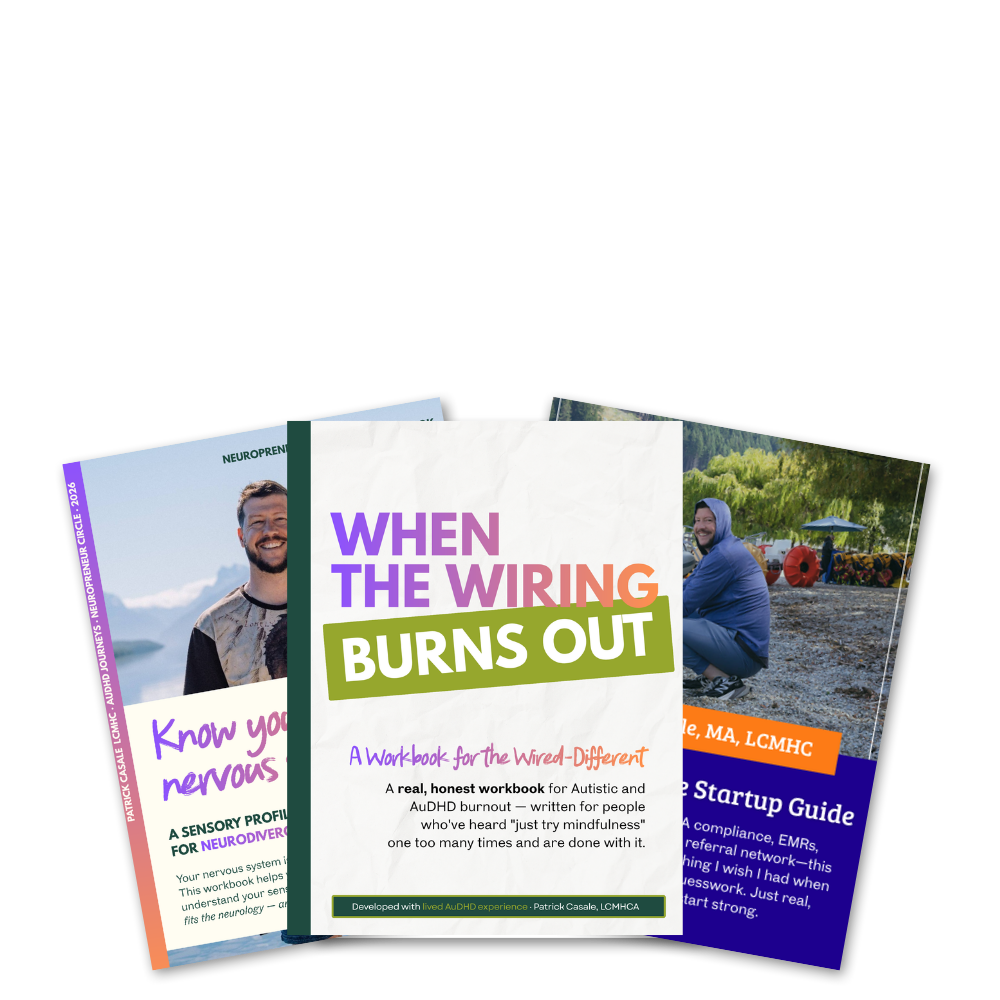
Get a practical podcasting workbook for therapists considering starting a podcast, created by Patrick Casale, host of the podcasts The Neurodivergent Entrepreneur and Divergent Conversations.
You'll get a practical structure for therapists who want to start a podcast but don’t want to rush, perform, or build something they can’t sustain.
Grab your free copy: ndpod.org/Free-Podcasting-Workbook
✨ Move Beyond Private Practice As A Neurodivergent Entrepreneur
Move Beyond Private Practice As A Neurodivergent Entrepreneur is a FREE 5-part mini-course designed for therapists who want sustainable financial independence beyond one-on-one work.
Access your free mini-course here: ndpod.org/Neurodivergent-Entrepreneur
Transcript
PATRICK CASALE: Hey, everyone. Welcome back to All Things Private Practice podcast, joined today, again, by my business partner for Empowered Escapes, Jennifer Agee, who is an LCPC in Kansas, a supervisor, group practice owner, a retreat and summit host, a business coach for therapists, a serial entrepreneur. She has a lot of fun Midwestern Jainism's that we might turn into a book one day. And yeah, all around good human being.
And today, we are going to talk about mixed neurotype business partnerships, because we haven't covered that on this podcast. I think it's quite applicable. Obviously, just because Jen and I, over the last couple of years have become good friends, but also have co-hosted quite a few events together. And I think that the acknowledgement of the differences in processing information, communication style, strengths, areas of support, all really important to cover. So, welcome back onto the show.
JENNIFFER AGEE: Thank you. Glad to be here. And I'm actually glad we're talking about this, because we're not the only business partners that are in this situation. And I think you and I do a pretty good job about being open and talking about things, hopefully in a really honest way. So, hopefully this conversation will help others that find themselves in a similar situation.
PATRICK CASALE: Yeah, so I'm going to put you on the spot right away. What's it like to be the business partner with Patrick Casale? Look at that gasp of [CROSSTALK 00:02:32]-
JENNIFFER AGEE: I would say it can be really freaking great and really freaking hard at the same time.
PATRICK CASALE: Yeah.
JENNIFFER AGEE: And I would say that's probably true of you being a business partner with me, who is about as neurotypical as neurotypicals get, because I can imagine those parts of me can become annoying, too.
So, what actually works really well for me, to be quite honest, is the fact that you are anxious, so anxious. And although I don't wish that upon you, it actually works very well for us in a business side, because you are anticipating all sorts of crap that I'm not even thinking about. I'm just going to assume most things are going to work out. I'll have a plan A and a plan B. But, you know, I figure I'll just go with the flow, whereas by the time I've woken up in the morning, if there's been a twinkle of a conversation, you have come up with three plans, three alternatives. You've texted somebody. And so, in that way, that works great for me.
The other thing that works great for me is because I am the only neurotypical in my entire family, and in my other businesses as well, I am often very much an over-functioner for other people. That's a part of my personality, too. So, I have to acknowledge that.
So, I'm the one usually who is anticipating where we're going, or thinking about where we're going to eat, and how we're going to get there, and all that stuff. And because you don't sleep when I wake up, that stuff's all taken care of. But you know, when we travel together, so that piece of it is nice. Now, do you want to hear what's hard?
PATRICK CASALE: Sure.
JENNIFFER AGEE: There's a couple things that can be really hard. One of them is, I care about you deeply. And the more I have seen you unmask, the more disabled I have seen you become. And you've been really open about that. And as somebody who really cares about you, that's really hard. And I find that I'm having to shift my expectations of what my role is in any given situation a lot without conversation. So, I go into like anticipatory type needs or expectations a lot. So, I would say that part's definitely been harder me.
PATRICK CASALE: Yeah, I mean, I imagine twofold, right? Like, it's like hard as a friend, someone who cares about the other person and their well-being. But then, there becomes this dynamic shift where it's almost like, huh, this is almost like taking care of another human in some areas of their lives, in terms of how they show up, what they can handle, what their capacity is, what their limitations are, what their struggles are, all of the things.
JENNIFFER AGEE: Yeah, and I think where my mind has taken me a lot recently is understanding that every piece is a season, and it's not necessarily forever. So, even though you are in an intense place of burnout right now, and more might be required of me, like, let's say, on the practical side, that probably won't always be true. But for now, it is true. And I'm having to have those conversations with myself like, "Are you good with that?" And I'm like, "Yeah, I am good with that.
But it's making these little adjustments so that I think I'm not disappointed, and hopefully, you're not disappointed in me, or that you don't look at me and feel like you're disappointing me, because I might have expectations that you're not able to meet either.
PATRICK CASALE: Yeah, for sure. And I think for those of you listening, like, that's where communication and trust play a big role, and having harder behind the scenes conversations is important, because I think so many people shy away from these types of things, or are embarrassed to talk about them, or they feel judged, or they feel like one business partner's carrying more of the weight, so to speak, or more of the load. Resentment can build up, irritation can build up, frustration can build up. And that's just a reality.
I think for me, you know, I've made a lot of content about this recently, about creating this dream job that I can't really actively participate in. And there's a lot of grief in that. I think there's a lot of having to step back and do a lot of reflection and introspection about that.
I also think for the last like four years, I've pushed myself so far beyond my limitations and my capacity that burnout and crash was so inevitable that I even joked around about it last year going into the six events that we hosted, saying like, "As soon as the Italy Summit's over, I'm going to be in such bad autistic burnout that I'm going to take the rest of the year off."
And that was really the plan. And I think I was trying to soften the blow for myself by just acknowledging that. And then, immediately, Asheville getting hit by Hurricane Helene. And it was like, "Well, there's no rest. There's no end in sight here."
JENNIFFER AGEE: And also, I do see both your autistic parts and your ADHD parts battle, because I'll hear you say, "I can't do one more thing. I just need to, like, be on the couch in a dark room or whatever." I'm like, "Okay, cool." And then, 15 minutes later, you're like, "Well, I booked this thing, or I'm looking at this, or I just made this deal." And I'm like, "Are you going to sit your ass down or what?" Because I see those parts kind of battling themselves as well.
PATRICK CASALE: Yeah, it's a real fight. I mean, for those of you listening who identify as AuDHD, it's hard. It's a tug of war and constantly won by the ADHD side, because I think that the intellectual under stimulation and the restlessness combined are pretty hellacious. And those two parts are constantly pushing the autistic side to say we need to do more. It's not comfortable to rest. It's not comfortable to be still. It's not comfortable to be creative, because the ADHD side, when bored often that leads to depression. And that side is fighting as hard as humanly possible to avoid that.
Or the other side of the coin is like, dude waving the white flag for years, acknowledging, like, I can't do one more thing. The reality, though, for me, and I'll take some, like, pride in this, to some degree, sense of accomplishment even, is, I have gotten somewhat better at saying no to things.
So, like, I have removed a lot from my life, and my calendar, and my schedule. And it can suck, because in reality, you kind of take a step back and you see your friends and your colleagues doing these things, and you're like, kind of almost become resentful that you're not included in them or being asked to be a part of, but in reality, you're like, they're just honoring what you asked for and what you need.
And I think that it's hard to acknowledge that your life is really smaller than it seemed it needed to be, because I think that I struggle so much in these spaces, that I'm so overwhelmed so often, that I'm constantly over-accommodating for myself. And then, I just am in such like hellacious, deep, dark burnout periods where I can hardly, like, get through my day, or function, or get off the couch, or speak to another human being. And it's not just like one day at a time. It's like weeks, if not months, of that feeling. It's pretty horrible.
JENNIFFER AGEE: And as a friend, it's painful to watch you be in that much pain, because I know that there's nothing that I can really do about that. There are things that I can take off your plate, you know, as the business partner side. But I've seen this last year for you be a lot of grief, and probably grief that you've not let yourself feel, even since your diagnosis, because you've hit the ground running with like diving into learning about it, and teaching about it, and all of the things. And maybe this is the season where you're just kind of allowing yourself to feel all of that. And I would imagine that is pretty freaking painful.
PATRICK CASALE: Yeah, you know, when you start to deconstruct things, and you start to accept things, I think it's where reality clashes with internalized ableism, because you're so conditioned to say, I should be able to push through this. I should be able to do more, but I have done more. I've created A, B, C, D, E, and how come now it feels like so fucking challenging to just start the day.
And I think it's just the more you unmask, the more you experience almost this amplification and intensification of AuDHD traits, and the sensory stuff is the most hellacious. I think that Megan Anna and I were talking about this on Divergent Conversations the other day. We were actually like, if you could trade one of your neurotypes and get rid of it, what would it be?
And I think we both settled on the autistic part because of the sensory component, because sensory overwhelm, for those of us who are hypersensitive to things, opposed to hyposensitive, it's like this constant inability to filter out the world. And I think that is the most painful.
JENNIFFER AGEE: Yeah, and I've seen that. And I've felt that when I've been with you, more so the last six months than I think any other period of time. And it's interesting the parts that it brings up in me, because, as you know, I'm extremely maternal. Like, I have a mom energy, and my mom voice does mom things even when I don't intend to. People think they're in trouble sometimes.
But there are these parts of me sometimes when I see you struggling, where I'm like, okay, has he let himself unmask to the point that his resiliency for being in discomfort is so little that, like, should I say something? Should I not say something? This isn't really my lane, but I care about him. This isn't my lane. Like, kind of knowing what is my own ableism thoughts, versus what is caring about somebody and wanting the best for them. And maybe they do need to be pushed.
I don't always know where that line is, obviously, but I have thought about that a lot over the last six months. Like, is this okay? Is it getting worse? Is it supposed to get worse? Is this what he wants? Does he want somebody to step in and say like, "Hey, what can I help you with?"
But I'm always sensitive to, like, not wanting to be labeled as somebody who's being ableist, that I don't say anything at all. I don't know what do you want in that? Or do you just want people to leave you TF alone?
PATRICK CASALE: Man, I think so often I'd want to be left alone, for sure. But I also think it's a paradox, because, you know, that's what friendships are for, right? Is like the check-in piece and the like, what can I do to support question? I think it's less of an ableist question when you think it comes from genuine concern, opposed to just saying it because you're uncomfortable. So, there's a difference there, for sure.
I don't always know what I need or want right now. I think I'm in this season of my life where I'm reevaluating everything and have to. And even like my own internalized ableism comes up, and is like, "You're not doing shit with your life, besides, like resting and lying around." It's like, "What are you going to do in 2026? You don't have anything on the schedule for the first time in four years, minus, like, going to New Zealand. You don't have anything planned. People are like, where are the events? Where are the retreats? Where are the summits? Where are the courses?" And I'm like, I don't have the capacity to even fucking write my name out loud.
And then, I'm like, but you're getting paid to podcast from your house. You're getting paid for this book that you're writing. And maybe, like, this is your job for 2026 is to try to dig yourself out from this hole. Because what we know about autistic burnout is that these periods can last years. And this is the worst it's ever been for me. And I just like, don't want to lose myself to the place of no return.
And I think that's hard, because I've talked about like having to pivot in your career as an entrepreneur and come to terms with that, of like, is what was once working no longer working for you? And is this still suited for you?
I think there's grief in that of acknowledging like, maybe everything you've done over the last four or five years, that you've worked really hard for has burnt you out so bad, but has also allowed you the space to step back and recover. Because, I mean, I've been quite successful and financially very lucky. And I don't have to work in 2026. So, I'm like, maybe this is just a sign, subconsciously, I worked so damn hard to finally give myself breathing room.
JENNIFFER AGEE: What does that look like, though, for you to actually fight then your ADHD parts, who are not going to want you to take that space? Because that is what I've seen. Like, when we first started this whole thing, listeners, you should know this, we were in Hawaii. We were both burned out. We were having a conversation about what we wanted to do. And one of the whole reasons we decided to do retreats was, okay, we can do four to six events a year. It gives us capacity to do some other things, but then we don't have to work so freaking hard. And what I've seen is I took that message to heart. And I have been, you know, trying to do that. You have added on 452 bazillion things since that conversation took place.
PATRICK CASALE: Yep, it's hard. It's not a balancing act, because it's not balanced. I think that's what a lot of this has come down to, is like, how do you set boundaries with the ADHD side that needs novelty, and stimulation, and excitement, and new experiences? How do you balance that without creating a container that is inescapable, because when you start to create these like black and white parameters, the ADHD side is like, "Fuck, no. This is not going to work." So, allowing some freedom and flexibility while really trying as hard as possible to rein it in. It's a challenge.
I think that's what people don't get from the outside, if you're not ADHD, because it really is two different neurotypes that are constantly at war with one another. And I think that is so challenging because you're experiencing the sensory hell, the executive dysfunction. You're experiencing the social struggle, the processing struggles. You're experiencing the push/pull between the two of what they need. And I think that is so freaking challenging. And I don't have the answer. I wish I did.
But I know for a fact that I've had to say no to so many opportunities over the last year to two years, and going forward, even into 2026, to be like, I just have to keep saying no to things. And I don't know what that means when I have all of that space in my calendar, or how to check myself when I'm restless and thinking, "Wow, look at all this free time, look at what I could do with it." I keep trying to tell myself, you know, writing the book, getting the manuscript in by next May, that's the job. And it has to be honestly, but like, yeah, I'm not good with having free time and open space at my schedule and not filling it with 20 different things. So, it will be determined.
JENNIFFER AGEE: Yeah, and I don't get that from an ADHD part, but I'm a workaholic, as you well know, so I struggle with that in a very different capacity. I'm curious for you, okay, because we're talking about mixed neurotype partnerships. So, what's it like to work with me? So, what do I do that's helpful for you? What do I do that is challenging for you? Or what do you wish I would do or knock it off?
PATRICK CASALE: Jen's like bracing for my response. Helpful, let's start there. Yeah, I think it's like the logistics, right? Behind the scenes stuff, where my executive functioning really struggles with things, because I can respond quickly, because I'm tracking all the things all the time. But like putting a lot of pieces together and having to deal with like forms and responses, and then, using that to, like, create data and spreadsheets and information to give to vendors. And that stuff is really hard for me.
Communication with a lot of the vendors really challenging for me, having to communicate with all the guests behind the scenes about whatever thing is coming up for them in the moment really challenging, because I get really irritated, and I just want to send, like one-word answers to them. And I know that that is not appropriate in a lot of situations. So, honestly, like handling a lot of that is obviously, like, super helpful.
The challenging sides, we just don't see the world the same way, you know? Like, when I walked into the conference room in Scotland and saw the way the tables were organized, I almost had like a meltdown. And I was like, "I've got to create some space and separation here." Because I know what it's like to look at the world through a very different lens and neurology.
So, I'm always thinking about that for other people. And I think you've done a good job of trying harder to like, be like, how can we create sensory soothing spaces? And how can we create like, more neuro-affirming spaces? And then, I'm like, then we have bagpipes at 9:00 in the morning, that is hell. So, it's just like those things, right? It's like, I have to constantly track the world a very different way than a lot of people.
But I also think about that because I draw a lot of neurodivergent humans into my audience and sphere that if I'm experiencing something a certain way, likely that means they will be too. And how do we build in those accommodations and support needs for people who are going to be significantly more sensitive to things? And, you know, it's a constant evolving process, depending on the environment and the location.
For me, being in the middle of, like, the Royal Mile in Edinburgh in July was not optimal, you know? There's just tough. So, I think it's just this trying to see the world through different lenses and perspectives which can make it challenging for any human being, let alone like people who experience things very, very, very differently.
And you know, I always give you a lot of credit because, you know, thinking back to our conversations on Divergent Conversations, and even, like, while we were traveling in Europe together a couple years ago, and you being a verbal processor very early in the morning, and me having to be like, "Can you please tell me the context? Like, is this something that needs to be done now, or are you just talking?"
So, I always watch you, like, hesitate to say something. And I read your facial expressions and everyone's expressions very well. I'm like, "What do you want to say, Jen?" You're like, "Well, I have something I want to talk about, but I don't want to overwhelm you."
And I think what I've appreciated about our friendship honestly, at its core, is you're kind of willing to take a back seat in terms of your preferences or needs to accommodate mine, because mine are so much more impacted.
JENNIFFER AGEE: Yeah, that definitely is an area I think our friendship and our partnership has had me grow in, is continuing to like be aware of things I wasn't aware of, because I do walk through the world as a neurotypical person. And I've said before, I trust that my system just has it.
And when I've been in spaces where I see the way you experience it, I think about when we travel together, it is very clear that your system is taking in something that my system is not. And so, I'm appreciative a lot for the way that this friendship and this partnership has helped me grow just as a person in my capacity, compassion, and understanding of what it's like to actually walk through the world as an AuDHD human.
One thing I don't think that we've done well, that I think we can do better on, is I think we both recognized that, especially as your burnout was coming, or as we started doing the retreats, maybe there were things that you probably needed to step back on. But we kept pretending as though we were doing this true 50/50 division of labor in a very practical sense of the word.
And I think what should have happened, and what I think we need to do moving forward, is just have a very honest conversation. We'll be together in a week, about what the heck actually works now that we've been doing this for a little while, instead of just doubling down and then feeling bad about the parts that we're not showing up for or we wish we were, or whatever.
Just say, what works, what doesn't work, what do we need to adjust so that both of us feel good about it? And I think having a really good, honest conversation about that, because we're thankfully in a position, we could bring people in to help with different pieces or parts, but we've not had that conversation. And I think we could do better about that.
PATRICK CASALE: Yeah, yeah. I'm sure you're right. I think for both of us, we're probably like workaholics in a lot of ways. And we also can be control freaks in a lot of ways, about like, I can just take it and do it. So, I think, you know, that's always a challenge for people.
And I also think, like, both of us probably feel some sort of guilt about not doing enough. I know, for me, like the guilt I often experience is like I acknowledge that I sell a lot of our spots because my audience is large, so I feel this pressure to be around and available, when in reality, that's not my preference, nor is it my strength, and nor is it within my ability, really. So, I think I feel guilt around that of like people are paying to come travel, experience, be a part of. And I'm like, "I don't think I even want to be around the like audience most days or times." And it's no offense to anyone listening. It's just like complete capacity issue, and limitation, and sensory struggle, and overwhelm. So, that's a hard thing for me to grapple with.
JENNIFFER AGEE: Definitely, and no matter how many times I say you don't have to show up to this, it's fine if you're not here or, like, I've got this piece. You know, I know you're in burnout, go take care of yourself. I can see that you keep showing up anyway. So, I know that you have those parts that feel obligated, or, I wouldn't say guilt, but that feel obligated to be there and to show up in a certain way.
PATRICK CASALE: Yeah, yeah. It's tough. You know, you all in my small inner circle, like the joke that I've created a cult.
JENNIFFER AGEE: Yes.
PATRICK CASALE: So, it's this reality of, like, a lot of people are honestly, like, paying to have access to you, which honestly makes me unbelievably uncomfortable. And I want, like, real, authentic, genuine relationships and conversations. And that, for me, is a real struggle. I'm sure some of you listening have maybe come to an event where you're like, "I didn't really get the access to Patrick I wanted." Or, "The conversation and interaction didn't go the way I wanted it to." And then, some of it is probably like, if it feels really forced or really artificial, it's really hard for me to stay around. And I don't do a great job of removing myself tactfully.
JENNIFFER AGEE: No, your eyes dart to the side. And I can tell you are looking for the exit. I love the little Patrick, "I dart left, right, left, right. How can I get out of here?"
PATRICK CASALE: Yep, yep, yep. One thing I'll say, I just want to name, like, what I have done a better job at, in my opinion, is like during events, since, like, probably Portugal, a couple years ago, which in my opinion, was honestly our worst event we've ever had. So, sorry to any of you who listened, who came. I started removing myself when I was really experiencing sensory shutdown and sensory meltdown. And it happened in Lisbon the first time when we went on that walking tour, which was hell, because Lisbon is sensory hell.
And then, when we walked into that restaurant that night to go, like, listen to music and eat dinner, I was like, "Absolutely not. I can't be here. It's too hot, it's too loud. Everything in my being is saying I need to remove myself."
And I got an Uber and went back to the retreat location by myself. And I turned my phone off. And I took a shower. And I was like, "I need to completely sensory soothe if I'm going to be a part of the rest of this experience." And that's something I probably wouldn't have done in the past. And since that time, just being really communicative and open about that, even with our guests, like there is a good strong possibility that I am going to have to remove myself throughout large portions of these events. And I think what that does is it models that behavior for other neurodivergent humans who may not feel like they have permission to do the same.
JENNIFFER AGEE: Absolutely, you do a great job of articulating the felt experience of being AuDHD in the world, which I think that articulation gives people the framework and words to be able to advocate for themselves.
And I've definitely seen that in our audience. I've seen reflective words that I know that you have said come back and come out of their mouths, which I think that's one of the reasons, I think, if we can adjust and figure out a way that this works for both neurotypes, we've created such a unique space for not just therapists who are entrepreneurs, but also the neurodivergent group of therapists who are entrepreneurs, specifically, that, like, there is some guilt in thinking about the potential of taking that space away, because it's such a unique, supportive environment to be in that the world does not always give people.
PATRICK CASALE: Yeah, for sure. You know, and that's why, when I was talking about stepping away from things, like, people kept coming up to me in Scotland, like, "Please don't let this be your last event. Please don't retire from this." And I was like, "I never said forever, but it needs to be for now."
And I think that distinction for me is really important. That's even important for like the ADHD side, because it's like not having finality to something, not saying this chapter is closed forever, but acknowledging that I do need it to be closed semi-permanently, at least for the foreseeable future, or I will destroy myself. That's just the reality here. And I think it's just an important distinction to make, both publicly and for myself.
JENNIFFER AGEE: My hope is that there's enough of us around you that love you that we're not going to let you destroy yourself. I know your wife will at least call you to the carpet if she has to, if she sees you pushing things too awful far.
PATRICK CASALE: That's fair. Yeah, I'm thankful to the to the people in my life that get it, and see it, and understand it, for sure. So, yeah, I think this is a good conversation. And I hope a lot of you listening who have any sort of business partnerships or working relationships, or even personal relationships that are cross-neurotype can understand it. Talk so often about the double empathy problem, about struggling in cross-neurotype interaction, but really excelling in same pairing neurotype interaction. But there are ways to make it work. It just takes a lot of understanding, and communication, and feedback, and honesty. And I think those are all a big part of successful partnerships in general. So, thank you for being one of those people in my life for the last couple of years.
JENNIFFER AGEE: Thank you for the same.
PATRICK CASALE: You were a nerd ass, nerd from the Midwest, who I didn't want to spend time with at first.
JENNIFFER AGEE: And you were an elitist, aloof jerk from the Northeast. So, I mean, hey, what are you going to do?
PATRICK CASALE: Exactly. So, full circle moment for that. Okay, so you have some of your own events coming up. And I want you to just kind of share briefly with the audience what they are, what you have available. And we'll put this in the show notes for everyone that's listening as well, so that you don't have to remember.
JENNIFFER AGEE: Yeah, if you have been thinking about how your inner childhood wounds might be showing up in your business and impacting your bottom line, and your ability to show up in the way that you want to, I have a cruise in January I'm co-hosting with Yunetta Smith, which is literally one of the funniest trainers you will ever meet in your whole life. So, that is going to be in the show notes.
And also, the next month, in February, we're going to South Africa. I lived there for four years. We're going to go back to my second home and spend time with some of the most amazing young entrepreneurs in the country. And we're going to pour into them while our coaches and trainers pour into you. You're going to get to get to safari, see the country, and meet amazing human beings.
PATRICK CASALE: Sounds incredible. If I wasn't leaving for New Zealand the very next month, that's something I might actually have taken you up on. And both of these events have CEUs. Is that correct?
JENNIFFER AGEE: Correct, yeah. For the cruise, we have both NBCC and ASWB. And for South Africa, because it is more business-focused, they don't allow the ASWB, but those are NBCC CE-approved.
PATRICK CASALE: Great, and we'll have that in the show notes. And just for you all listening who are like, "I want to go on one of those." I highly recommend getting to an event, because what's better than traveling, connection, community, building friendships and relationships, getting some CEs in a non-boring location, and getting to write it all off, especially as the new year starts. Like, I'd rather give my money to something like that then wherever else it goes. But thanks for coming on, and I will see you in Maine in a couple of weeks.
JENNIFFER AGEE: Sounds good. Have a good day, Patrick. Bye.
PATRICK CASALE: And to everyone listening to the All Things Private Practice podcast, new episodes are out on Saturdays on all major platforms and YouTube. You can like, download, subscribe, and share. Doubt yourself, do it anyway. And we'll see you next week.
FREE PRIVATE PRACTICE GUIDE
Join the weekly newsletter for private practice tips, podcast updates, special offers, & your free private practice startup guide!
We will not spam you or share your information. You can unsubscribe at any time.





![Episode 266: Healing Isn’t Just in Your Head: Rethinking What Therapy Can Be [featuring LeNaya Crawford]](https://kajabi-storefronts-production.kajabi-cdn.com/kajabi-storefronts-production/file-uploads/sites/2147507511/images/a2d5a4-e4bf-63b0-fa7f-6e6f62c466d5_TNDE_YouTube_episode_266.jpg)
![Episode 264: Creating Through the Chaos of a Neurodivergent Life [featuring Bre "BR3"]](https://kajabi-storefronts-production.kajabi-cdn.com/kajabi-storefronts-production/file-uploads/sites/2147507511/images/a14004-cc3d-8aba-5fb8-2442fdfc650_TNDE_YouTube_episode_264.jpg)