
Show Notes
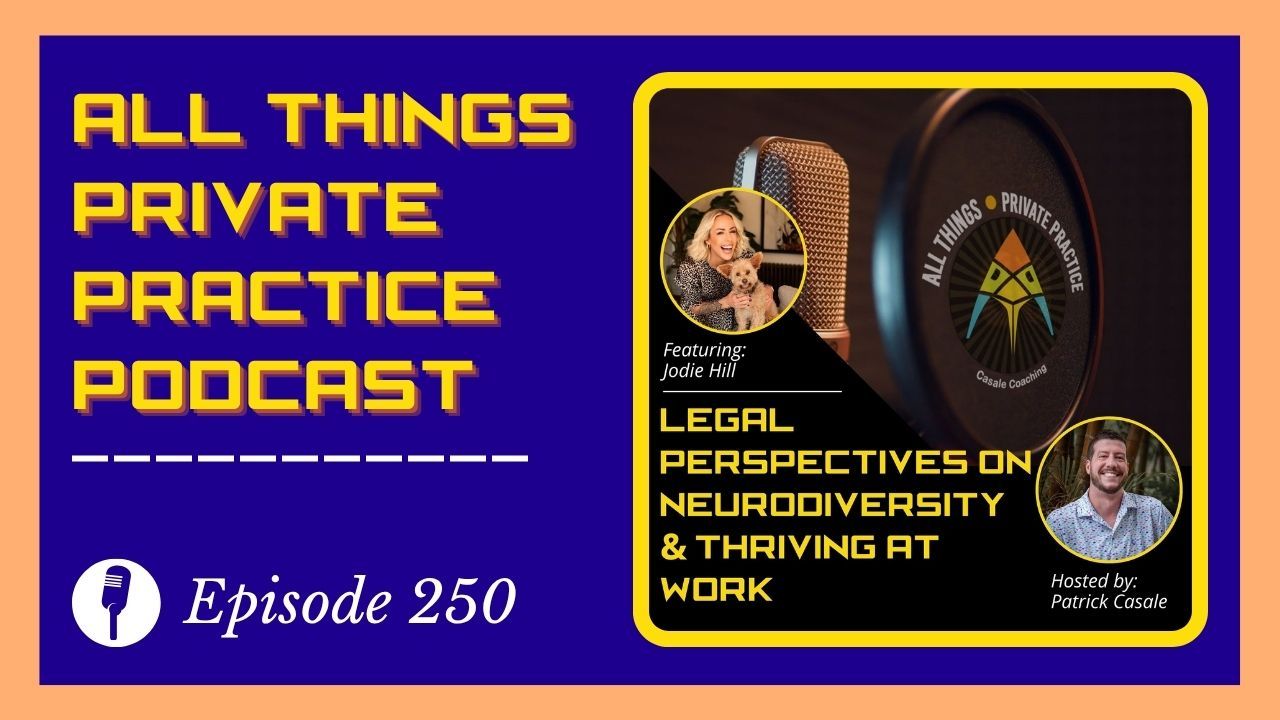
In this episode, Patrick Casale talks with Jodie Hill, who is the founder & managing partner of Thrive Law, a neurodivergent solicitor, and a passionate advocate for mental health, equity, and neuroinclusion in the workplace. Her lived experience and legal expertise shed light on the daily realities—challenges and opportunities—for neurodivergent professionals and their employers.
Here are 3 key takeaways:
- Psychological safety is critical: Many neurodivergent employees hesitate to fully disclose their diagnosis due to concerns about how managers will respond, highlighting the urgent need for organizations to foster safer, more inclusive environments.
- One size DOES NOT fit all: Individual needs must be heard and understood—there is no universal set of accommodations that works for everyone. Truly inclusive workplaces focus on listening and adapting to each person's unique strengths and challenges.
- Leadership accountability and learning matter: Mistakes will happen as organizations strive for inclusion. What’s key is for leaders to listen, take ownership, and keep learning from those they support.
More about Jodie, Founder & Managing Partner of Thrive Law:
Jodie Hill is a neurodivergent solicitor, ED&I consultant, coach and trainer, author and campaigner. She is passionate about employment law, mental health and wellbeing, equality, diversity and inclusion (ED&I), and neurodiversity.
A qualified barrister initially called to the Bar by The Inner Temple in 2010, Jodie then cross-qualified to become a solicitor in 2013. Her mental breakdown in 2017, which Jodie now describes as her “mental breakthrough”, led her to establish Thrive Law in 2018. It was the first law firm in the UK founded with wellbeing and mental health at its heart.
Check out Jodie's Neurodiversity website page with diagnostic and training: thrivelaw.co.uk/neurodiversity.
Jodie’s Social Media:
- Instagram: @Iamjodiehill
- LinkedIn: linkedin.com/in/jodie-hill-lawyer
Thrive Law’s Social Media:
- Instagram: @thrive_law
- LinkedIn: linkedin.com/company/thrive-lawleeds
🎙️Listen to more episodes of The Neurodivergent Entrepreneur Podcast
🎙️Spotify
🎙️Apple
🎙️YouTube Music
▶️ YouTube
✈️ Check out available Retreats
🗨️ Join the free Empowered Escape FB Community
A Thanks to Our Sponsors: The Receptionist for iPad!
I want to thank The Receptionist for iPad for sponsoring this episode.
The Receptionist for iPad is a HIPAA-ready digital check-in system that eliminates the need to walk back and forth from your office to the waiting room to see if your next appointment has arrived. Clients or patients can check in for their appointments, and you'll be immediately notified by text, email, or your preferred channel. Break free from interruptions and make the most of your time, because it is valuable. Start a free 14-day trial of the Receptionist for iPad by going to thereceptionist.com/privatepractice. Make sure to start your trial with that link to get your first month free if you decide to sign up.
Free Gifts for Our Listeners
Get a practical podcasting workbook for therapists considering starting a podcast, created by Patrick Casale, host of the podcasts The Neurodivergent Entrepreneur and Divergent Conversations.
You'll get a practical structure for therapists who want to start a podcast but don’t want to rush, perform, or build something they can’t sustain.
Grab your free copy: ndpod.org/Free-Podcasting-Workbook
✨ Move Beyond Private Practice As A Neurodivergent Entrepreneur
Move Beyond Private Practice As A Neurodivergent Entrepreneur is a FREE 5-part mini-course designed for therapists who want sustainable financial independence beyond one-on-one work.
Access your free mini-course here: ndpod.org/Neurodivergent-Entrepreneur
Transcript
PATRICK CASALE: Hey, everyone. Welcome back to the All Things Private Practice podcast. I'm joined today by Jodie Hill, who is the founder and managing partner of Thrive Law, is a neurodivergent solicitor, ED&I consultant, coach, and trainer, author, and campaigner.
She's passionate about employment law, mental health, and well-being, equity, equality, diversity, and inclusion, and neurodiversity.
A qualified barista, initially called to the bar by the Inner Temple in 2010. Jodie then cross-qualified to become a solicitor in 2013.
Her mental breakdown in 2017, which Jodie now describes as her mental breakthrough led her to establish Thrive Law in 2018. It was the first law firm in the UK founded with well-being and mental health at its heart, which is amazing. And that's really a powerful testament story. So, really grateful to have you here, especially now that I know you've moved across the world to a different location.
JODIE HILL: Thank you so much. And thanks for having me. Yeah, I’m really excited to have a chat today about these really important topics.
PATRICK CASALE: So, I've been following your content for a long time, and I really like it, because it's from that perspective that we don't see a lot of, which is from that person with that legal expertise and counsel experience.
I don't think we see a lot of neurodivergent lawyers out there speaking out publicly about what it's like to support, not only their clients but themselves. And I love that you constantly are tackling like workforce inequities and ways to better support and advocate for yourself. Because I think a lot of people get into that place, right? Where whether they've just discovered their own form of neurodivergence or they've known for a long time that disclosure is one of those topics that often comes up first and foremost, but it has to be done really delicately.
Do you want to start off there with what you're seeing behind the scenes, and how you help people advocate? Because I think when we're disclosing, we should, because we want to feel empowered, we want to embrace our identity, we want to be able to support ourselves, but there are also risks, there are also pitfalls. So, I always like to kind of paint both sides of that picture.
JODIE HILL: Yeah. No, for sure. Certainly, as an employment lawyer, what we see is both sides. So, to give context, I represent individuals and companies. So, from an individual side, what we see is certainly where they want to advocate for themselves, but they're not sure how it will land with the manager. Perhaps don't feel psychologically safe to say what it is that they have been diagnosed with, or that they are going for a diagnosis. They instead perhaps focus on behaviors of things that they're struggling with, or areas of the role that they struggle with, because they don't feel fully comfortable to say what the reason for that is, which is a starting point.
I think, if people are not feeling comfortable to disclose a full diagnosis, or that they're going through a process, or that they've self-identified, it's a starting point to get support. But it doesn't get us all the way there, does it? Because often the manager then doesn't have the full understanding of what's going on. And so, there seems to be this kind of, I suppose, psychological safety gap where employers have an expectation that employees should just tell them, but the employees don't feel fully comfortable to tell them anything, or everything. Sometimes it sits somewhere in between.
And then, from a manager's perspective, I think, often what happens is if somebody does disclose, and whatever that might be, it's knowing well, what am I allowed to do? What does my employer need to authorize? It's like that autonomy piece.
And so, for me, I just don't think managers are equipped to deal with that. And that places a lot of insecurity then on individuals, because they go, “Well, actually, this manager has no clue what they're doing. And so, I'm not going to place my vulnerability in their hands.”
So, there's a whole piece around disclosure. And I think a lot of it sits with employers, actually, and training their managers to have the difficult conversations, but to know what they're allowed to do, and to be encouraged to use the support and the resource that they have. And I just don't think a lot of managers know where to start is the problem.
PATRICK CASALE: True. Yeah, kind of, one, I think the psychological safety piece is huge, and it's hard to build that up from the employer/employee standpoint or manager/employee standpoint when there's a power differential, there's a gap in inequality there in terms of like who has more power and who has more need for advocacy. And I think the psychological safety piece is huge.
But what you just said is really important, because you're right, I think they don't know where to start in terms of what types of accommodations and supports can we offer this person. And on the flip side, what types of supports and accommodations can I ask for as the person who needs them.
And you mentioned before we started recording, like, people almost giving like a one sheet of like a one size fits all, like, “Here you go. Like, welcome to neurodivergence. Here are the things you've heard you might need.”
And you know, I think that really takes away autonomy, but it also kind of puts you in a box of feeling like all people are going to have the same support needs. And that's just not factual.
JODIE HILL: No, it's not. And actually, it really comes down to listening, doesn't it? It's understanding what the person is struggling with and what their needs are, because even the same neurotype in a different organization, a different role, even the same role could be completely different in terms of the needs.
And certainly, lawyers have [INDISCERNIBLE 00:07:02] for this. Lawyers jump straight to solutions. They're like, “Well, how do we fix this? How do we fix this?”
But actually, it's going well, we're not trying to fix this. What we're trying to do is understand how we can level the playing field for this person who is trying to fit into a neurotypical environment. We created this environment without neurodivergence in mind, so it's our role as the managers and the leaders to make accommodations and adjustments, so that it aligns better with their needs, because they are the minority.
And I say that I'm also neurodivergent myself, I speak from lived experience of constantly feeling like you're the problem, or asking questions for asking for support. And, you know, it's exhausting.
And I think as soon as you say I'm neurodivergent, it's like, “Oh, okay. So, now I'm going to have to do all this stuff.” So, I think that also makes it difficult for people to disclose, because they're immediately seen as a problem, when actually, if you can flip it on its head and think about how we can make workplaces neuro-inclusive from a psychological safety perspective, that embracing your difference is seen as normal. And you know, one of the ways we do this is we have a license to thrive, so it's a document that you fill in when you join, and it talks about how you do and don't like to do things, the preferences, communication, everything, mine's huge, I've got loads in there, loads of pet hate.
But actually, what it allows is rather than going, “Hi, I'm Jodie, I'm autistic, I'm ADHD, I need this.” It's just saying, “How does everybody work best?” It's normalizing difference, and preference, and barriers, and the difference between those as well.
So, yeah, I think if employers could take that more inclusive approach, that would bring down some of the barriers to accessing support at work. And then, they would actually, by virtue of that, see a return on investment of spending the time of doing that, because those people would thrive at work, literally.
PATRICK CASALE: Yep, yeah, so much good stuff in that to unpack. And first off, like, I love like that document about thriving at work, because that's true.
And I think that if we are all having conversations around support, and accommodations, and different ways that we work best, without thinking like there's a one-size-fits-all, or everyone has to be here from 9:00 to 5:00, or we do things this way, because we've always done things this way. I hear that statement a lot. It drives me insane. I think that's unbelievably powerful. And it creates that sense of balancing the scales, so to speak.
And then, you mentioned something else that I think about a lot, because I do a lot of training for, like, how do we build more neuro-inclusive workspaces. And sometimes what I hear, and I understand where it's coming from, to some degree, from like managers and administrators, is like, now it's like all of these hoops that I have to jump through in order to support this person. And you know everyone's getting diagnosed these days, and it's making my job harder. And it's like, well, let's pump the breaks there on that, because, like, that's first and foremost not true.
Second of all, like you said, if we are best supporting this person, they're going to thrive at work. You're going to see returns on investment tenfold when you're supporting the person in the way that they need to be supported. And yeah, it might mean that you have to do some learning at first and unlearning.
But in reality, the more diverse a workforce we can build, and create, and sustain, the more likely it is we are going to be more cutting edge in that department or that sector. And it's such an important realization that, I mean, I employ 25 therapists, all of whom are neurodivergent. And it would be really inconsiderate and just misinformed for me to just go about it as if all of them have the same needs in terms of like communication preferences, and styles, and ways of receiving and processing information and ways that they have to be supported or not supported, or like if we just bought certain furniture for the offices, and we had a policy where you had to leave the lights on all the time, or you couldn't sit on the floor.
It's all these little things that I think until you know what you need, you don't know what you need. And I think that can be really challenging, especially for those who are just finally discovering their own form of neurodivergence.
JODIE HILL: Have you ever come across needs assessors where they support so less from a medical perspective, but more like needs-focused? Have you seen how employers use this, and is that something maybe I can just explain a little bit about how that could help here?
PATRICK CASALE: Yeah.
JODIE HILL: So, I think your point is really well made about people don't know what they don't know, and they don't know what they need. And especially, if they're late diagnosed, and they've kind of always worked in a certain way because of heavily masking.
So, actually, for me, what I found is really helpful, and actually the reason, to give you context, that I found this helpful is I was the customer, not the employer, in this situation, because as a founder, nobody's asking me, “What do you need? How can we help you?”
So, I was thinking, like, I know what I need to a degree, but really, I don't know how to describe it. What's like the typical way of approaching an email, for example?
And when I went through this process, it really, I suppose, showed me that because I'd always approached things a certain way. I thought that was the standard way everybody approached writing an email in that way. To give context, I'm also dyslexic, so I approach things kind of a bit back to front and upside down, and then I miss things. And I've just found ways around that, right?
But just having talked through, like somebody saying to me, “Tell me how you actually write an email from start to finish.” And I'm saying, “Oh, well, I write hi, and then I just jump straight to the point. And then, I go back and forget to ask the niceties. And then I go, 'Oh shit, did I cut any.. like, do I need to do grammar?’ Oh my God, everything's underlined. Okay, what was I writing? I don't know, I'm what writing.”
And I have this, like, internal dialog. And it's a two-line email. And it just made me think, oh, actually, well, through the conversations, looking at, like, well, what tools might help with that. Okay, you're really good at articulating verbally. Okay, so let's voice note it.
And then, just little things like that, that actually, you know, when I was previously in a law firm, I had a secretary that I voice-noted, but it was a dictation, old school tapes. But then, technologies come on, you can just voice it in your iPhone now, right? And it will just do the majority of it.
So, I think the needs assessor helps you to, and I went through it as an individual, so I could see how it'd help employers, so that I could use it with my clients. And actually, for me on a personal level, it was really helpful, and I've also used it for my staff to look at all areas of their role.
So, you look at their role, you look at their well-being, how they write, everything that is required for that role, and what they struggle with, how they approach it. And then, they can assess what the need is in that role rather than making assumptions.
And I just found that really powerful as an individual, because I got a report and there was stuff I could do, I didn't have to wait for my employer, so it was quite empowering. And then, there was stuff my employer could obviously have helped with, if I'm employed, so then I'd get my company to pay for it.
PATRICK CASALE: Yeah, yeah, yeah. No, I love that. That's a great, great tool to use, and something to strongly consider, because you're right. For founders, especially, they're like, I don't know what I need if I'm the one that is running the business. How do I best support myself? I think that gets overlooked a lot.
JODIE HILL: Yeah.
PATRICK CASALE: Yeah, no, that's a wonderful tool. So, starting with that. And then, also, I'm curious, and I think about this a lot. How often are you representing or seeing clients who are disclosing their own form of neurodivergence, whether they're saying, like, “Hey, I'm autistic, I'm ADHD, I'm dyslexic, I have OCD.” And then, it being the work environment just changing for the negative?
JODIE HILL: You know what? Really sadly, a lot, and I think disproportionately I do have a lot of neurodivergent clients because of what I talk about. So, obviously, a lot of what I see is in this space, but what I'm really quite shocked at, at the moment, is, and I give a case example, which I was really shocked at recently, is that somebody's really senior, running a legal department, and they are late diagnosed, and they ask for reasonable adjustments. And the employer says go to a portal.
They go on the portal. There's like a one-line thing saying ADHD is this. And there's no support, there's nothing there. And this person is performing in their role, there's no performance issues, they need administrative support, support with the executive functioning issues. And obviously, like lawyers, there's loads of admin, they need a load of support.
And it's refused, it's refused. And then, when he keeps asking for support, they just suspend him for like an indefinite period of time. I think it lasted three months. And he's like the head of the department. So, you can imagine like the guilt, and the shame, and the RSD that comes with that. I mean, obviously, it's unlawful, and we're representing this person now, but I thought, “Wow, just because you don't know what to do as a manager, how do you go from I don't know what to do to I'm going to suspend you? Like, what there’s gap there?”
But there's a human being involved. And so, unfortunately, I have seen where people are quite persistent with it, it can escalate in a way that they don't anticipate, because the managers don't know what to do, they don't know what to do, which is really sad.
PATRICK CASALE: Yeah. That is really sad, because you're right, it turns it around on that person, and then they start to internalize that as if I am the problem. Like, all of these narratives, or all of this feedback that I've heard throughout my life is true.
And it almost makes that person have to feel like I have to continuously mask, because the only way I can show up and be a part of this workforce is if I cannot be myself. And that's really fucking hard, because it's just super painful for people to have to exist in spaces of not only employment, but in general, in life, and feel like I just can't be myself because I'm too much, because I ask too many questions, because I get details confused, because I jump from point to point, and now it's better off if I isolate. And I think that's what you start to see in that way. And it's really unfortunate.
JODIE HILL: Yeah, and I think your point's really well made on the impact that that has, because when I have seen these situations happening, often there's a correlation, then with a decline in mental health. And I personally experienced that in my own breakdown. But I've seen it in the situation where someone's never struggled with their mental health, and then they start advocating for their needs from a neurodivergence perspective. And then, it's like, well, they're just rejected constantly, and then it makes them question everything, and their mental health declines so rapidly that I've seen way too many situations that have resulted in suicidal ideation, you know, going so far because the impact is so profound.
And I think that's what's really misunderstood, with like every action or inaction by an employer has an effect, whether you intended it or not. It has an effect. And I think that's what's often so missing in workplaces is, “Oh, well, this is what the policy says, so we have to do it this way.” Or they're forgetting as a human being, like an actual human, you need help. And it's so hard to ask for help in the first place going right back to the disclosure point. It's hard to ask for help whether you disclose a disability or not. It's hard anyway. But it's even harder when you're constantly being rejected in life, and you're constantly being pushed back because you're so scared that's going to happen again.
PATRICK CASALE: Yep, absolutely. And when it impacts your livelihood, there's such a ripple effect, right? Like, that person getting suspended for three months, and then not having access to the day-to-day, or the culture of the business, or the coworkers, or the even potentially the paychecks. Like, I mean that stuff has a massive ripple effect.
And I almost want to go into most organizations, and take the employee manual, and rip it up, and start from scratch, because the reality is what you just said is like we just have always done things this way, or it says to do it in the manual. We need to zoom out a bit and think about the fact that in order to create a culture of safety and vulnerability where people can be their authentic selves, leadership sometimes has to stumble and make mistakes, but have accountability, right? Like, I think that's what gets overlooked a lot of the time, is people in leadership positions are like, “I'm in leadership, I should have all the answers, I should know how to deal with all the situations that arise.” Without really thinking about the fact, like, if you're not a neurodivergent human.
And let's just use autism and ADHD specifically, because of all of the different ways they present and impact the day-to-day. And you are just going to make blind assumptions to this is what this person's going to need, or this is how this person is going to best present, or this is how they're going to struggle.
I mean, you have to learn and unlearn, right? Like, we have to unlearn ableism, we have to unlearn our own internalized ableism, we have to make mistakes, but be willing to be corrected, and to learn, and to seek out information. And I think that's a piece that is often missing from the top down perspective.
JODIE HILL: Yeah, it's definitely missing. And I think because advantages are so scared of getting it wrong, that's where they default to doing nothing. And that's even worse, you know? It's interesting with the language point as well, because people, when I deliver training on this topic, and I talk about like the language that we should use, and how we should use this is this interchangeably within the organization, but also, how that appears in the policies, the processes. Like, what does that look like.
And people that, “Oh my God. I'm just going to use neurodiversity all the time for everything, instead of like neurotypical neurodivergence.” And it's really interesting, it’s because they're scared, they're scared of getting it wrong.
So, I would say to people, look, I would rather you get it wrong and try than not try at all. And I think that most neurodivergent folk would agree with that, is that you know we don't expect people to be perfect, but what we want is to feel heard and to at least have a level of understanding. And that starts with listening, and it starts, as you say, with accountability. If we do make mistakes, then learn from it, that's all we ask.
PATRICK CASALE: Yeah, exactly. Yeah, I think that's a hugely important piece. And just the acknowledgement of, we're going to make mistakes as we tread into these new unforeseen waters, because I think we're seeing such a boom in terms of neurodiversity advocacy, and we're seeing so many more content creators, and people come out and speak about their own experiences, their struggles, also the strengths. But I think we often forget that this has only been going on in the realm of social media for, like, I don't know, maybe the last three or four years, really, and it's really increased and gotten bigger as the movement has gotten bigger.
But that means that there's a lot to learn and there's a lot to unlearn. And I think it also means, like for leadership, especially thinking about privilege in the workplace, too, there are layers of privilege, and some of us certainly have more than others, and some of us cannot mask any of those privileges or lack thereof in the workplace, too. So, they're already at a disadvantage if we're not being willing to talk about and deconstruct what we consider a “typical workspace.”
And I think for me it's always about like turning it on its head and just saying, like if we have always been told this is how this environment thrives or this is how it's done, how can we deconstruct all of that, because we were not the ones involved in making those decisions or those policies, or that culture, so how can we start from scratch? And then, allowing your staff to kind of buy in as well about how do we build something that feels really supportive here, and really soliciting and opening up for dialog and feedback.
JODIE HILL: And designing with those people in mind, but with them in the process as well, because one of the things, obviously, as lawyers, we draft a lot of policies, and we always err on the side of inclusion. So, like it's interesting, as lawyers, often there's a template, people stick to the template, and they're really, really like structured with it. But actually, we reverse engineer that and go, what is it that you're trying to achieve, what is it that you want to happen, and how can we make this as inclusive as possible? So, do we need visuals, do we need a video, do we need like flow charts. Like, how does this fit in your business?
And rather than just giving people like you say, like a manual that nobody reads or understands, it's actually making it really relevant to the organization, but with that lens of inclusion. And you can't do that without speaking to people who are neurodivergent as part of that process within your organization, because they know it best. Even just because I'm neurodivergent, I don't have all the answers, but what I can do is ask the right questions to help people find the answers that they need.
And I think, you know, moving away from that typical, there's a handbook in the office, and a manual that we just look at once a year to creating systems and processes that work better for everybody, I think, is the future here.
And technology plays a role, but I do think there's like an overwhelm of technology at times. And I just get like, “Oh my God, all these apps pinging at me. Like, it's so distracting.” So-
PATRICK CASALE: [CROSSTALK 00:26:40].
JODIE HILL: Yeah, I just like, “Ah.” So, it's trying to work out like ways of working that doesn't feel overwhelming as well, because often, certainly with neurodivergence, tech is often a big solution that's pushed on employees. But if the tech doesn't work within the system, or the tech means that they have to do an extra task, then certainly, as an ADHDer I know that that's not going to get done. It's not happening.
So, it's like actually seeing, like, even though that's a really nice, kind, thoughtful, helpful thing, and it might work if I could get the task in this over the task initiation piece, it's actually making sure it all works in the flow of the work, not just for a specific task, it's going okay. So, in my day-to-day, how does that work? And that's where the systems are really important, because the systems have to support that.
PATRICK CASALE: Absolutely, that's really well said. I think that tech is huge. I mean, it's important where you know we're in this AI era where we're having lots of discussion about usage or not usage, what do we prefer, but in reality, if you can't get started and it's too much of a complication from an executive functioning standpoint or a demand standpoint, and we just shut it down, it's really easy to default to, like, “See, now I have to do everything on my own, I can't ask for help, I can't use assistance. Like, I can't even get this stuff done because I'm so overwhelmed.”
And you don't want to feel that way either. I think there's so many ways that we already feel othered that we want to just support one another as best we can in these environments. So, glad that there are people like you out there advocating, and training, and really showing up for the people who need that support.
JODIE HILL: Thank you. No, and I absolutely love it, because I think what I enjoy the most is being able to use that legal knowledge mixed with the lived experience, and actually blend that into legal documents and training, so that you know it's robust enough from a legal perspective, it's not too fluffy, is what some of this can be seen as. And so, it's sitting in that space that crosses between lived experience, leadership, and legal. And yeah, I feel like I get to create new stuff all the time. It's so much fun, but you know, you're helping people as well, right?
You know, it's interesting people say to me, "Oh, how can you represent employers as well as employees?” And I say, "Well, with an employee, I can help that one person. Hopefully, they never come back, right? Because I never want them to go through this again.”
But with an employer, I can impact their whole workforce through the redesign of the systems, and the guidance, and the training. So, I think there's benefit in both sides of that. And yeah, thank you so much for having me on. It's been super, super fun to chat.
PATRICK CASALE: Yeah, likewise. I really admire your work. And I'm really grateful that you are able to make the time today. So, we always give people an opportunity at the end where you can promote whatever you've got going on, or share how people can get in touch with you, and we'll have it in the show notes, so that everyone has access to anything that Jodie says.
JODIE HILL: Perfect. So, yeah, on Instagram and TikTok, it's @iamjodiehill, and our website, thrivelaw.co.uk has a neurodiversity page with loads of free resources. There's a reasonable adjustments guide, loads of videos, like whatever platform format you prefer, there's loads of stuff on there. So, yeah, reach out if you have any questions, or you want me to cover any things on videos, things like that. I'm always taking requests, because I think, you know, I want to keep my content as relevant as possible, so yeah, hit me up. Thank you.
PATRICK CASALE: Thank you so much. And to everyone listening to All Things Private Practice podcast, new episodes are out on Saturdays on all major platforms and YouTube. Like, download, subscribe, and share. Doubt yourself, do it anyway.
FREE PRIVATE PRACTICE GUIDE
Join the weekly newsletter for private practice tips, podcast updates, special offers, & your free private practice startup guide!
We will not spam you or share your information. You can unsubscribe at any time.






![Episode 266: Healing Isn’t Just in Your Head: Rethinking What Therapy Can Be [featuring LeNaya Crawford]](https://kajabi-storefronts-production.kajabi-cdn.com/kajabi-storefronts-production/file-uploads/sites/2147507511/images/a2d5a4-e4bf-63b0-fa7f-6e6f62c466d5_TNDE_YouTube_episode_266.jpg)