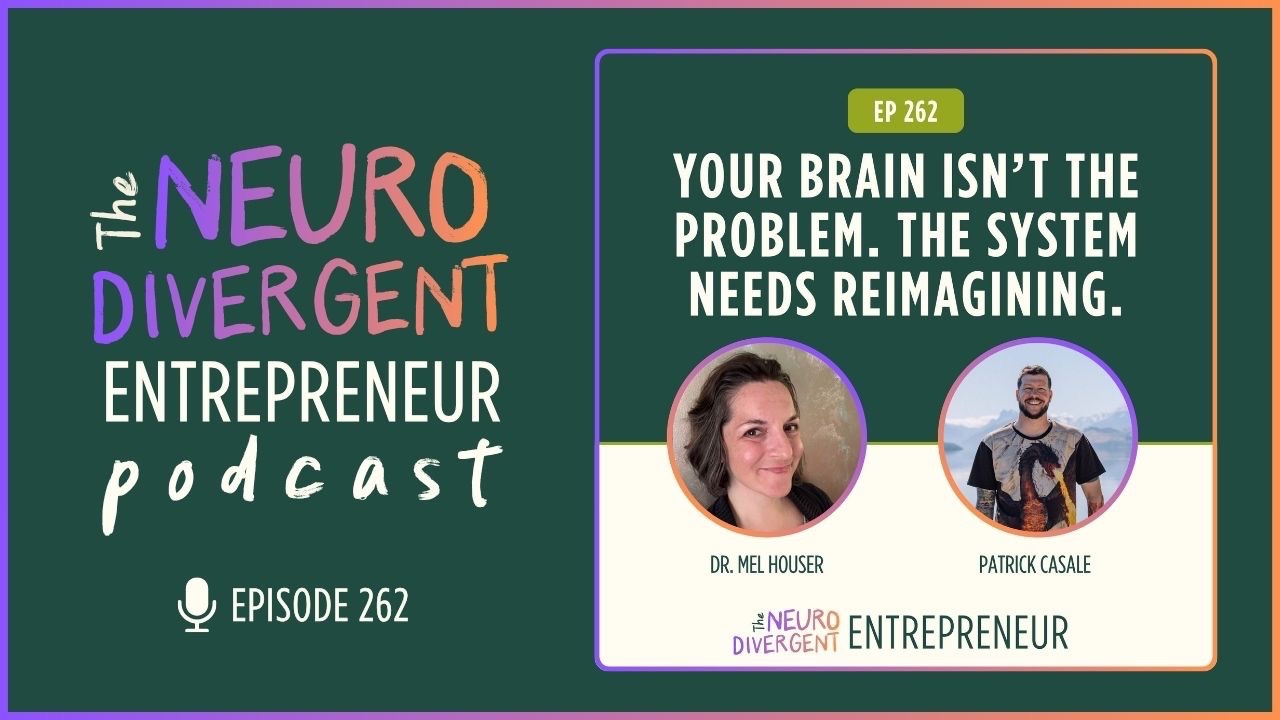
Show Notes
What if neurodivergent people aren't failing the systems around them—what if those systems are failing them?
Patrick Casale sits down with Autistic and ADHD (AuDHD) physician Dr. Mel Houser, founder of All Brains Belong, to explore why navigating healthcare, employment, chronic illness, and burnout can be so exhausting for neurodivergent people—and what it could look like to build something better.
From advocating for yourself in medical appointments to understanding the connections between neurodivergence and complex health conditions, Patrick and Dr. Houser discuss why so many people spend years believing they're the problem. They also explore universal design, workplace accommodations, community, internalized ableism, and why entrepreneurs need to be careful not to recreate the exact working conditions they left behind.
Dr. Houser also shares the ideas behind their upcoming book, The Failure of Imagination: How the Healthcare System Fails Neurodivergent People — And What We're Doing Instead.
3 Key Takeaways:
- You are not a problem waiting to be solved. Difficulties navigating healthcare, work, and everyday life aren't automatically evidence of a personal or moral failing; inaccessible systems can create and amplify those struggles.
- Leaving a broken workplace doesn't help if you recreate it in your business. Entrepreneurship gives neurodivergent people an opportunity to redesign work around their actual access needs, capacity, communication style, and energy.
- Better systems are possible. Universal design, clearer healthcare communication, flexible pathways to participation, and neurodivergent community can move us beyond simply identifying what's broken toward creating environments where more brains can belong.
More about Dr. Houser:
Dr. Mel Houser is a family physician and Founder and Executive Director of All Brains Belong VT, a nonprofit organization in Montpelier, VT, with a mission to support the health and belonging of people with all types of brains. All Brains Belong has pioneered an innovative model that integrates medical care with social connection, employment support, and community education. Dr. Houser provides neurodiversity training to healthcare practices and workplaces around the country about how to create environments where people with all types of brains can get their needs met and thrive.
- Book pre-order link: allbrainsbelong.org/book
- Social media: @allbrainsbelongvt on Instagram, Facebook, YouTube
- LinkedIn: linkedin.com/in/melissa-houser-652505212
🎙️Listen to more episodes of The Neurodivergent Entrepreneur Podcast
🎙️Spotify
🎙️Apple
🎙️YouTube Music
▶️ YouTube
✈️ Check out available Retreats
🗨️ Join The NeuroPreneur Circle Community
🗨️ Join the free Empowered Escape FB Community
A Thanks to Our Sponsors: The Receptionist for iPad!
I want to thank The Receptionist for iPad for sponsoring this episode.
The Receptionist for iPad is a HIPAA-ready digital check-in system that eliminates the need to walk back and forth from your office to the waiting room to see if your next appointment has arrived. Clients or patients can check in for their appointments, and you'll be immediately notified by text, email, or your preferred channel. Break free from interruptions and make the most of your time, because it is valuable. Start a free 14-day trial of the Receptionist for iPad by going to thereceptionist.com/privatepractice. Make sure to start your trial with that link to get your first month free if you decide to sign up.
Free Gifts for Our Listeners
Get a practical podcasting workbook for therapists considering starting a podcast, created by Patrick Casale, host of the podcasts The Neurodivergent Entrepreneur and Divergent Conversations.
You'll get a practical structure for therapists who want to start a podcast but don’t want to rush, perform, or build something they can’t sustain.
Grab your free copy: ndpod.org/Free-Podcasting-Workbook
✨ Move Beyond Private Practice As A Neurodivergent Entrepreneur
Move Beyond Private Practice As A Neurodivergent Entrepreneur is a FREE 5-part mini-course designed for therapists who want sustainable financial independence beyond one-on-one work.
Access your free mini-course here: ndpod.org/Neurodivergent-Entrepreneur
Transcript
PATRICK CASALE: Hey, everyone. Welcome back to the Neurodivergent Entrepreneur Podcast. I am so honored today to be joined by Dr. Mel Houser. They have been on Divergent Conversations, I believe, three times now, and one of my go-to resources for medical knowledge in the neurodiversity-affirming spaces.
Mel is a family physician and the founder and executive director of All Brains Belong VT, a nonprofit organization in Montpelier, Vermont, with a mission to support the health and belonging of people with all types of brains.
All Brains Belong has pioneered an innovative model that integrates medical care with social connection, employment support, and community education.
Dr. Houser provides neurodiversity training to healthcare practices and workplaces around the country about how to create environments where people with all types of brains can get their needs met and thrive.
Mel, welcome to the show. I am super excited to have this conversation with you. You have a book coming out, like, amazing.
MEL HOUSER: It's excellent to be here. And I think that, like, it's a good conversation. I think just, like, modeling that even in a low energy state, like we can have meaningful interactions and we can do meaningful work and all of that.
PATRICK CASALE: 100%. For those of you who don't know Dr. Houser, I really recommend going to check out All Brains Belong VT for All Brains Belong Vermont. Check out their resources on all of the things, how everything is interconnected for neurodivergent people in healthcare and the struggles that we experience.
So, do you want to talk about all of the things? Because you have resources on this and you talk about it a lot. But I think it's important to navigate, for those listening at home who are all entrepreneurs, for the most part, who are like, “I am so freaking tired. And I just don't have the capacity. And what is happening to me? And I can't advocate enough for myself anymore.”
MEL HOUSER: Totally, yeah. So, in our community, All Brains Belongs, our nonprofit supporting neurodivergent people, it's really healthcare, workplaces, community spaces for and by neurodivergent people.
What we found when we started almost five years ago is that the overwhelming majority of our community members suffer from a constellation of intertwined medical conditions. And so, you know, some examples of the constellation, this is not, you know, an exhaustive list, but some examples would be hypermobility, mast cell activation disorder, migraine, endometriosis, myalgic encephalomyelitis, chronic fatigue syndrome, post infectious chronic illness like long COVID, irritable bowel syndrome. Like, the list goes on and on. And so, you know, probably there's listeners being, like, you know, by being a part of [CROSSTALK 00:02:49]-
PATRICK CASALE: [CROSSTALK 00:02:49]
MEL HOUSER: Yeah, so it's the idea, and POTS, a more larger umbrella term, dysautonomia. I should have included that in my short list, but anyway, these are really common. And the thing about these conditions that they are all interacting with the neuroimmune system, so the nervous system and the immune system cross talking, and you know, it's all interwoven.
So, the problem in traditional healthcare is you go in, you get like 10 minutes with your doctor. And, you know, the healthcare system, you know, gets in the way of clinicians really being able to have enough time and bandwidth to zoom out far enough to be like, “Oh, all these conditions are related to each other.”
And why that's important is that sometimes the standard management of some parts of this cluster actually make the other parts worse, you know?
PATRICK CASALE: Right.
MEL HOUSER: So, for example, you know, I don't know if you want me to give examples of like-
PATRICK CASALE: Yeah, go ahead. Yeah, sure. Yeah, yeah.
MEL HOUSER: I'll give two examples of that, maybe. Yeah. So, if someone has chronic pain and they get put on a muscle relaxant, but they actually had an unrecognized connective tissue disorder, actually that muscle pain and tightness was a compensation for the unstable joints. And so, now on the muscle relaxant, those joints get more unstable. Things move more in the wrong places, including in the airway, where their unrecognized sleep apnea now got worse on the muscle relaxant, which made their autonomic nervous system problem, the dysautonomia, worse, which actually makes pain worse. And so, this thing that was supposed to help the pain actually made the pain worse because of, like, all these interconnected things.
So, if you zoom out, you'd be like, "Oh, I need a strategy for pain that actually doesn't collapse connective tissue.” Great.
Or, you know, this one's, I imagine, pretty common also for some people who have connective tissue disorders, the blood vessels are kind of squishy and floppy. So, when they're on a medicine that vasoconstricts the blood vessels, closes them off, they are more susceptible to, like, big closing off. So, stimulant medications, for example.
So, yeah, we need dopamine. We need it for all the things in our lives. You know, starting and stopping activities, starting and stopping ideas, motor planning and coordination, like all the things. And yet, we also need blood flow. So, if this medicine that boosts blood flow actually constricts the blood vessels, I don't know if you have to choose between blood flow and anything, you should choose blood flow.
So, like a lot of our people, not everybody, but like a lot of our people on stimulant medications, they have like worsening headaches, and brain fog, and pain. It's like, “Oh well, I need dopamine, but like not enough to close off my blood flow.”
So, like, that's just examples of why it's important to think about these things as a cluster. And you know, it certainly wasn't part of my medical training. You know, all these conditions are known to be more common in autistic and ADHD people. They're also known to be related to each other. But, like, you got to zoom out and recognize this as all one cluster.
PATRICK CASALE: Right.
MEL HOUSER: So, anyway, we have some resources on our website at allbreedsbelong.org, and including a toolkit for, you know, patients to learn about this, a evidence-based clinician guide that, you know, a patient can print off a letter that's written in language that their primary care clinicians are likely to be receptive to, which brings them to this, like, very kind of academic resource looking thing that tells them, like, how to identify and manage these problems.
And, you know, we've heard that it actually has been effective in, you know, helping patient’s kind of broker these conversations with their primary care clinicians.
PATRICK CASALE: I love that. And you know, the first time you came on Divergent Conversations, probably had to be almost three years ago now, which is wild, my mind was just blown because you were describing symptom after symptom, correlation after correlation, constellation after constellation. And I was just like, "Damn, you are nailing my entire existence to a T.”
And I think so many of us have to do so much of our own advocacy, our own research, our own deep dives. We're, like, trying to cross off things off the list of things that we've tried, trying to remember medications you've tried for things, trying to remember doctors, and specialty visits, and procedures, and labs, and the executive functioning that goes into having a chronic illness, especially as a neurodivergent human who's already marginalized enough as it is. And it's like a full-time fucking job. Like, I spend so much of my life navigating my chronic illness.
MEL HOUSER: Yeah, totally. No, absolutely, totally. And then, you know, like I think about the last time I was on Divergent Conversations, and we talked about the overlap of post-exertional malaise, which is, you know, one of the hallmark symptoms of myalgic encephalomyelitis. You know, the overlap of post-exertional malaise, where your symptoms, you know, your energy crash because your mitochondria don't make and use energy appropriately, and your autonomic nervous system is dysregulated. So, your post-exertional malaise overlapping with autistic burnout, and you just, like, literally don't have energy at the level of your cells.
PATRICK CASALE: Yeah, that's exactly where I've been at for over two and a half years now. Like, just sitting here right now, I'm enthusiastic to talk to you, and I have zero energy. It feels like I'm living in quicksand all of the time.
MEL HOUSER: Yeah.
PATRICK CASALE: It doesn't matter how much I sleep. It doesn't matter how much I rest. It doesn't matter how much time I spend horizontally. And I think a lot of people listening can relate to this reality, where demands continue to pile up, regardless of how you try to combat them. Sensory overwhelm continues to happen.
And we live in capitalism. Like, we have to survive. And our medical system is a for-profit system, for the most part, not doing anyone any favors unless they can make money off of you and your outcome. And so, many of us are just left scrambling for answers, trying to find providers who are even not even savvy or competent, but just willing to listen.
MEL HOUSER: Yeah.
PATRICK CASALE: I think I would take that almost [CROSSTALK 00:08:58].
MEL HOUSER: [CROSSTALK 00:08:58].
PATRICK CASALE: Yeah.
MEL HOUSER: I need a safe person who is open to my experience, who believes me, who doesn't invalidate and dismiss me, who's open to learn.
PATRICK CASALE: Exactly. And few and far between, I've had a good amount of healthcare professionals on here recently who I would add into that small bucket of people who are competent, confident, willing to learn, curious, but that is few and far between.
And the amount, you know, even as a mental health therapist, someone who's trained in advocacy for other people, I know how to advocate for myself in this system. That does not make it any less exhausting and demoralizing. And you hit dead end after dead end, after dead end. And you just throw your hands up. You're like, “What do I do?” You know, like I'm trying to run a business. I can't even get off the fucking couch nine days out of 10.
MEL HOUSER: Yep.
PATRICK CASALE: And it's exhausting.
MEL HOUSER: Yeah, and you know, for my own healthcare, like, fortunately, you know, I'm grateful that I do have a physician who is open and receptive, like, you know, and just, like, safe energetically, which is, you know, that's everything. Also, going in with really clear goals for that encounter. Like, I'm never approaching a visit like, “I have a problem I need help solving.” Like, I don't expect that.
PATRICK CASALE: Yeah.
MEL HOUSER: So, it's really, like, I have a focused question, or you know, this is this quandary. I've been thinking about this versus this, and you know, I want your opinion on this versus this.
PATRICK CASALE: Yeah.
MEL HOUSER: Like, really focused because I think that, you know, a lot of the people that we meet in our community, like they're still on this, you know, I'm a medical mystery. I need solving. Like, you actually don't need solving. If you have all the things, like, mystery solved, this is a known construct, and it's really, like, there's a known set of strategies, and you need access to them once you know what they are, you know, hopefully, you know, using a tool like the clinician guide to sort of broker these conversations. “Hey, I read about this thing. Can we look at it together during an appointment? And you know, what do you think about my trying this thing?”
PATRICK CASALE: I think that's such a good point. And for those of you listening, like, using Doctor Houser's guide on the All Brains Belong website, and bringing it in with you. And I think you're going to know really quickly whether or not you need to find a new doctor, because I think if you… Go ahead.
MEL HOUSER: I was just going to validate what you just said, right? It's the energy you go in and like, somebody looks at you wrong, or just like, energetically, you know, like my PDA, I can feel the energy of other people, and like if you're judging me or thinking about me in an unfavorable light, like I'm going to feel it.
PATRICK CASALE: Absolutely.
MEL HOUSER: And you know, like it's fine, but I'm going to give space from you, and I'm going to opt out of that encounter.
PATRICK CASALE: Absolutely.
MEL HOUSER: I also think what's also important is like, you know, you said that sort of, like, contrast between, you know, I, like, want to talk to you, but I have no energy. Like, it's like a both and. Like, thinking about, you know, first off, there's a lot of unrecognized neurodivergent clinicians out there in the world. And so, you can imagine how you feel in the healthcare system. Like, a lot of clinicians feel that way too. They don't have the bandwidth. They don't have the executive functioning. And like they lose access to, you know, those, like, complex cortical skills, the perspective taking, and the self-monitoring, and like all of it. And like if I don't have enough energy to, you know, do most things, like they don't have enough energy to, like, go learn a new thing. They just don't have bandwidth.
PATRICK CASALE: Yeah. One thing that feels like such a disservice, and I'm sure you agree with this, is like the lack of understanding around connective tissue disorders. I feel like it should be a prominent intake question on every medical and mental health intake you ever fill out for any physician, any specialist, any person who's involved in your care. And yet it feels like this massive chasm of, like, lack of understanding within the medical practice and world.
MEL HOUSER: Yeah, it's not part of medical training. Like, I mean, I did get taught about Ehlers-Danlos syndrome kind of as a first-year medical student. I was told it was a really rare condition, and that I would never see it. I see it all day. I also have it. Like, I had no idea, right? So, it's very difficult.
And there's a ton of research on this, so there's usually this lag between when something's sort of identified as a big deal and you know, a new paradigm shift in it. Maybe there's like a 10-year delay before it makes its way to mainstream medicine, and you know, in medical education. But you know, I do think that people are talking about this. And you know, I think sort of demanding and expecting, you know, what you get out of a healthcare encounter, and if you don't get it, you move on. That resource, the Ehlers-Danlos Society, has a provider directory that's, you know, depending on where you live, you know there may be more or less providers listed in it, but it's a good resource.
PATRICK CASALE: It's a great resource. They have an app as well. And they have a lot of consistent communication on their social media feeds and their newsletters. They do a lot of trainings, a lot of webinars. There are so many people who are talking about it from lived experience perspective, which is great, who have really fought tooth and nail to finally take their place in all of this.
I watch people's eyes glaze over, like when I'm bouncing from specialist to specialist, from lab visit to lab visit, to doctor to doctor right now. I'd say I go to, like, eight to nine appointments a week. And I will always bring it up first and foremost. Like, and I will watch provider’s eyes, like, glaze over when I say it. And they have no understanding of why I'm stressing the importance of acknowledging it, which really greatly reduces my confidence in whatever our next step is going to be together.
And it's really hard. Like, I live in Appalachia in Western North Carolina, and a lot of my friends are in the same boat, but we joke, like, specialty care here is complete shit. Like, it's terrible. You have to drive hours to find someone who really gets it or has the resources. So, you're kind of sometimes left with what you get. And I think that could be really challenging, too.
MEL HOUSER: Definitely, right? And I also think, I mean, maybe this thought I'm about to share is like what makes me feel better about my life as opposed to, like, some kind of objective truth. But if you try on the idea that the person you are interacting with has an autistic brain with a monotropic focus on their particular thing, if you bring up anything outside of their attentional tunnel, they literally can't take it in.
PATRICK CASALE: Yeah.
MEL HOUSER: So, like, you know, if you're seeing a specialist who, you know, like my brain, whose monotropic focus is this, my brain can zoom out and be like, "Oh, there's connective tissue in everybody’s system.” So, any specialist whose body system has connective tissue in it, like might find that to actually be aligned with their attentional tunnel, but they don't know that. So, it can't come into the attentional tunnel. They literally are unable to take in the information.
So, then, if you're seeing a specialist, like when our patients go see folks, like we do a lot of, you know, preparation, scripting, you know, like when we have to make a referral, it's like, all right, so you're going to see, you know, a pulmonologist specialist in lungs. Why am I sending you? All right, so I'm going to be really concrete, you know? My doctor told me this. My question for you is that.
PATRICK CASALE: Yes.
MEL HOUSER: Nothing else. Or I'll even say, you know, like, “Hey, don't talk about your diarrhea and your head. They don't care. Focus on your breathing. Nothing else but your breathing. That's it.” Right?
And like, you might say, well, why would a doctor not want all the information? It's like they literally can't take it in. Remembering that, like, they are in a system, like, where we are, like, our local tertiary care center. They've basically increased the productivity standards of all the specialists, and they've put out, like, the official position statement. We expect 10% of specialists to resign, and we're okay with that. Like, they're in a toxic environment that doesn't really value them. And so, let's make it like a little bit easier for you. Because what I really care about is you getting what you want, and so be really focused, really narrow. I'm telling you just this slice that is in your attentional tunnel, and I have this focused question.
PATRICK CASALE: Right, that's such a great perspective reframe, or reframe in perspective, like to really acknowledge, like, our medical professionals are under strain and stress all the time, right? We know the burnout rates are so high. We know the resources are non-existent to some degree. Like, they're doing almost often doing the best with what they've got, right?
And the reality is, like you do have to be hyper focused and super specific when you're in those appointments because all of those ancillary symptoms, which are still important that you just mentioned, they might take that professional down a different rabbit hole or take attention off of the main thing that they really specialize in and understand. And all of a sudden, you leave feeling like, "Wow, that was a waste of time.” So, I think that's a great point. Having your resources available.
Now, you're writing a book right now. It's going to be published soon. Tell us about the book. Why people need to have it? Because in my mind, what you're writing and putting into the world really needs to not only be in every medical practice, every mental health practice, but anyone who's going to come in contact with a neurodivergent human in general. Like, that's how important I think that this is.
MEL HOUSER: Thank you. Yeah. So, the concept is, like, we know that all the broken systems are broken and they're thwarting neurodivergent people left and right. But to assume that it's always going to be this way and that it has to be this way, that's a failure of imagination. So, that's what the books call the Failure of Imagination: How the Healthcare System Fails Neurodivergent People and What We're Doing Instead. It basically walks you through. I mean, it starts off with systems critique of healthcare, of workplaces, of community spaces, but it goes further than that. It's the idea of describing at a granular level what we've been doing the last five years, and so that you could replicate it.
Or if you're not in, you know, a place to be able to replicate, you know, all or part of it, like at least have some ideas to have some conversations with decision makers around you know hey this little tweak and it's got like a full toolkit of all the things that you would need to replicate, you know, all the things we're doing. And when you think about, you know, universal design using multiple flexible pathways to participation, you can do that anywhere, so you have universal design for healthcare.
Like, all of our patients, we offer a menu. You know, you pick from your furniture, your lighting, your executive functioning, communication, sensory supports. And we have the menu in the book. And you can have it., universal design for workplaces.
And even if you are an entrepreneur doing your own thing, like maybe you want to be thinking about, like, how do you plan your own life around some things that might actually be helpful to you? That's the thing about a menu, right? If you ask someone, "What do you need?” Most people can't answer that question. Like, ideating in response to an open-ended question, like, most words, just can't do that, especially when you're in burnout, right? And you're a chronic illness. You have no energy.
So, like, you scan through and be like, "Huh, when I start my own business, I don't need to just be reproducing the conditions that ruined my life that I fled.” Right? And that's like what a lot of us do because it's habitual ways, you know, over-rehearsed neural pathways. This is how I do the thing, as opposed to like, actually, I can redesign anything based on my access needs, my capacity, my energy, all of it.
PATRICK CASALE: Yeah, yeah, exactly. Yeah, that's a huge point. I think I say this a lot, you know, I think a lot of my listeners leave their job and then recreate their job.
MEL HOUSER: Yeah.
PATRICK CASALE: And it's because it's like what we know is what we know. And it takes so long to deconstruct, and it takes so much energy, and it also takes a lot of situations that bring it into to attention.
Like, before I hit major autistic burnout, was I struggling with all the things? Yes. Was I masking heavily through them? Yes. Was I as aware of them as I am sitting here right now in present day? Hell no. Do they now take up 90% of my life? Yes. So, like, it is an awareness thing as well.
And I want for all of you listening is to figure this out, build this awareness before it's too late, before you hit this place of burnout, where it feels like you're just trudging along and just existing.
MEL HOUSER: Yes.
PATRICK CASALE: And I don't want that on my worst enemy, honestly.
MEL HOUSER: Totally, totally. And I think that, like, when we think about when you are deep in autistic burnout, you actually may lose access to the executive functioning skills required to zoom out and reimagine your life, like all you can do is survive. You're treading water, and that's all you can do.
So, you know, in the book, you know, certainly there's a lot of attention on all the things, and how we manage it, and like all of that. It's also around how do you partner with a community to figure out what the community needs are.
Like, the reason we spend so much time talking about neuroinclusive workplaces and reimagining workplaces, is that what our patients told us to do? They were like, "Work is ruining my life.” And so, you know, describes programs where we're helping people start their own businesses. And you know, how do you learn your employment-related access needs? How do you build out your inventory? What you actually need? Because it's just so hard when you're in the trenches.
PATRICK CASALE: Yeah, absolutely. I'm sure a lot of people listening are nodding emphatically right now because I think so many of us have experienced such major workplace burnout, and then it becomes like this almost reflection of self or character, or like, I'm just not motivated enough, or I can't be productive enough, or there's something wrong with me. Instead of thinking like, how can we revamp, and reorganize, and recon, and deconstruct these systems that are so oppressive. And we can do that… Go ahead.
MEL HOUSER: No, go ahead.
PATRICK CASALE: I love watching your emotion take over because I can see it in my peripheral. So, go for it.
MEL HOUSER: I'm using my impulse control of my mute button.
PATRICK CASALE: Yeah.
MEL HOUSER: Yeah, go ahead.
PATRICK CASALE: No, I just think it's important to recognize, like, it makes sense why we end up where we end up. And it's not a reflection of a character flaw, or like a moral failing. We are kind of set up to fail from the get-go based on the society that we live in. So, I just want everyone to hear that and not to take it personally, because I know how hard it can be to kind of unravel the thing that feels really interwoven throughout identity, too.
MEL HOUSER: Absolutely. And I think that, like, for me, you know, I started All Brains Belong very shortly after receiving my ADHD and then autism diagnosis. Like, I didn't have much time to, like, deconstruct identity on my own. I wouldn't even know how to do that. So, it's the idea of a community coming together to do this unlearning together, right? Because if you know that you're not alone, and you hear your own stories reflected back to you through the stories of other people, not only do you feel less alone, but it's, like, I mean, it's certainly not a fast track, but it's a faster track to unlearning the internalized ableism that, like, digs you deeper and deeper.
And so, when you have this full group of people being like, “Hell no. This this was not built for me, and it's not my fault. And I'm being thwarted when you shift that narrative.” Like, everything follows from that.
PATRICK CASALE: Well said. Couldn't say it better myself. I agree 100%. I think community and connection is so, so important. And I know you have like a pretty cool community-based component of All Brains Belong, too. And I think it's so healing, you know, to be in proximity and to have a sense of belonging for a lot of us who have gone through life feeling on the outside like there's a force field. Why can't I access this? Why can't I feel like I connect to it?
MEL HOUSER: Totally, yes. And so, you know, in addition to medical care, and then, like, you know, beyond actual medical care, like, medical appointments, medical management, all that stuff, like our patients are connecting with each other in peer groups. But we also have community programs that are open to the general public. So, we have a weekly free community education program called Brain Club. And so, you know, it's virtual, anyone can join. And so, you know, you hear from community panels like neurodivergent people going through stuff, including like, “Hey, how did I start my small business and how am I doing this? How am I reimagining things? Why did I do this? How do I deal with burnout?” Like all of these things that you know, just knowing that you're not alone. And even if you don't come synchronously, you can watch the recording, or you can listen to the podcast so that, you know, there's, you know, you're not alone. You're not the only one dealing with all this stuff.
PATRICK CASALE: It's so important. It's so powerful too. And I think there's so many people that feel that way. So, what you're doing is incredible. I am a constant cheerleader and supporter, and I just really appreciate what you're putting into the world. And I know it takes energy to give it too, and I don't take that for granted either.
So, I want to give you kind of the spotlight, so to speak, to just tell people where they can find what you've got going on. We'll make sure there are links in the show notes for all of you who want to pre-order Dr. Houser's book. And we will make sure that that's widely accessible as well.
MEL HOUSER: Thank you so much. And you know, over the past five years, we've been so grateful for your ambassadorship and connecting people to us. Thank you.
PATRICK CASALE: Has it been that long? Like, I can't believe we've stayed… It's wild, you know?
MEL HOUSER: It’s wild.
PATRICK CASALE: The internet is wild, you all.
MEL HOUSER: It is wild. So, we'd love for folks to connect. So, at allbrainsbelong.org, you can connect with all of our free community programs and educational resources, including the All the Things Project. Everything's connected to everything improving the healthcare of autistic and ADHD adults.
And if you want to check out the book, it's allbrainsbelong.org/book, and it'll be released later this fall. But pre-orders are ready now. And it'll be in print, e-book, and audiobook.
PATRICK CASALE: Congratulations. I know how much energy goes into that. And it's a huge undertaking and a major accomplishment. And it's going to help a ton of people. So, we will have that on the show notes for you with the links, so you all have access to that. Pre-order the book, get it now. Thank you so much for coming on and making the time.
MEL HOUSER: Thank you so much.
PATRICK CASALE: And to everyone listening to the Neurodivergent Entrepreneur Podcast, episodes are out on Wednesdays on all major platforms and YouTube. You can like, download, subscribe, share. Doubt yourself, do it anyway. See you next week.
FREE PRIVATE PRACTICE GUIDE
Join the weekly newsletter for private practice tips, podcast updates, special offers, & your free private practice startup guide!
We will not spam you or share your information. You can unsubscribe at any time.





![Episode 266: Healing Isn’t Just in Your Head: Rethinking What Therapy Can Be [featuring LeNaya Crawford]](https://kajabi-storefronts-production.kajabi-cdn.com/kajabi-storefronts-production/file-uploads/sites/2147507511/images/a2d5a4-e4bf-63b0-fa7f-6e6f62c466d5_TNDE_YouTube_episode_266.jpg)