Show Notes
Feeling the turbulence in our economy and the mental health industry?
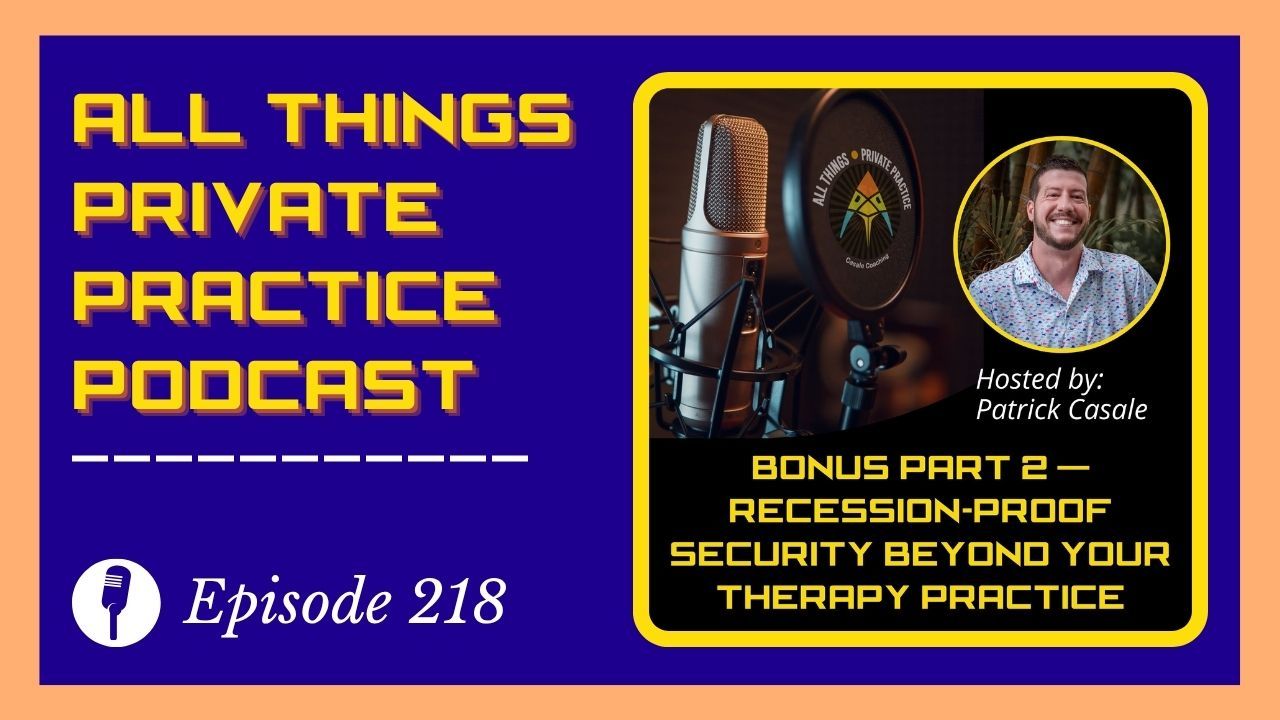
In this episode, Patrick Casale shares hard-won lessons from running a group practice and launching multiple ventures—all while navigating burnout and uncertainty. Whether you’re a clinician, small business owner, or entrepreneur, his insights are timely and actionable.
Here are 3 key takeaways:
- Diversify Your Income Streams: Don’t put all your eggs in one basket. In uncertain times, it’s crucial to build additional revenue channels beyond 1:1 therapy—think coaching, courses, podcasting, writing, or retreat hosting.
- Fortify Your Foundation Before Expanding: Before leaping into new projects, make sure your primary source of income is secure. Build around what’s working rather than abandoning it out of excitement or impulse.
- Mindset Matters: Self-doubt, perfectionism, and imposter syndrome hold many back from launching new initiatives. Patrick Casale encourages us to “doubt yourself, do it anyway”—a reminder that starting imperfectly beats waiting for the perfect moment.
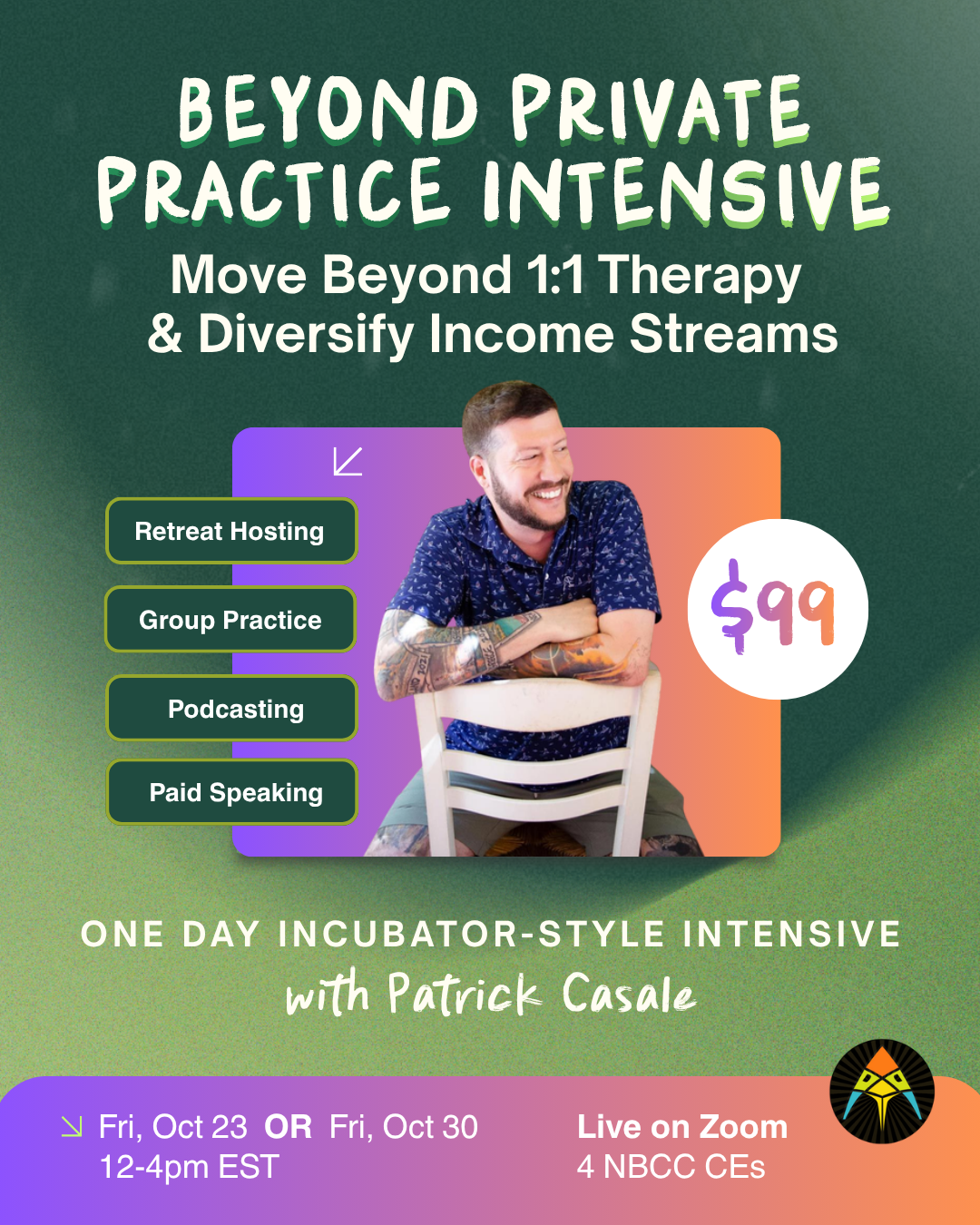
If you’re looking to step beyond traditional therapy, recession-proof your business, and want to learn more about diversifying income through retreat hosting, podcasting, and writing books, check out the Beyond Private Practice: Recession Proofing Intensive on December 12, 2025. Learn more: allthingspractice.com/beyond-recession-intensive
Let’s support one another and keep moving forward during these challenging times!
🎙️Listen to more episodes of The Neurodivergent Entrepreneur Podcast
🎙️Spotify
🎙️Apple
🎙️YouTube Music
▶️ YouTube
✈️ Check out available Retreats
🗨️ Join the free Empowered Escape FB Community
A Thanks to Our Sponsors: The Receptionist for iPad!
I want to thank The Receptionist for iPad for sponsoring this episode.
The Receptionist for iPad is a HIPAA-ready digital check-in system that eliminates the need to walk back and forth from your office to the waiting room to see if your next appointment has arrived. Clients or patients can check in for their appointments, and you'll be immediately notified by text, email, or your preferred channel. Break free from interruptions and make the most of your time, because it is valuable. Start a free 14-day trial of the Receptionist for iPad by going to thereceptionist.com/privatepractice. Make sure to start your trial with that link to get your first month free if you decide to sign up.
Free Gifts for Our Listeners
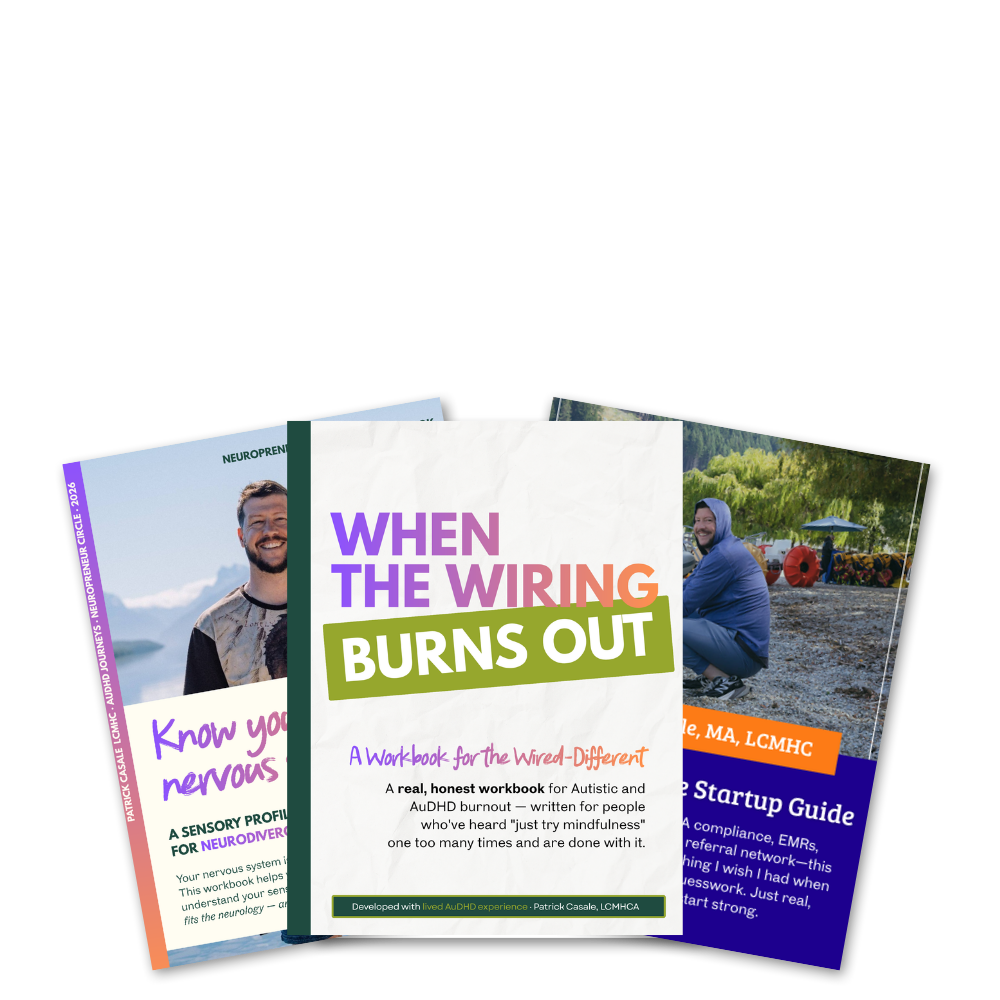
Get a practical podcasting workbook for therapists considering starting a podcast, created by Patrick Casale, host of the podcasts The Neurodivergent Entrepreneur and Divergent Conversations.
You'll get a practical structure for therapists who want to start a podcast but don’t want to rush, perform, or build something they can’t sustain.
Grab your free copy: ndpod.org/Free-Podcasting-Workbook
✨ Move Beyond Private Practice As A Neurodivergent Entrepreneur
Move Beyond Private Practice As A Neurodivergent Entrepreneur is a FREE 5-part mini-course designed for therapists who want sustainable financial independence beyond one-on-one work.
Access your free mini-course here: ndpod.org/Neurodivergent-Entrepreneur
Transcript
PATRICK CASALE: Hey, everyone. Welcome back to All Things Private Practice. I am going to embark on a solo series, which is quite rare on this podcast. Though this was meant to be more interview style, I think, after I got going and found my rhythm. But I really enjoy interviewing. But I want to talk about some really important topics that are happening in our industry.
So, today, as I sit here recording, it is the middle of November 2025. We are probably in an economic place, financially, where things feel really uncertain. There's a lot of anxiety, uncertainty, fearfulness, scarcity, insecurity, and understandably so. I mean, I can't predict the future. I'm not an economist, but I do forecast quite well, and pattern recognition is definitely a strength of mine.
So, that is kind of why I started the Beyond Private Practice: Recession… Words are hard today, you all. Beyond Private Practice: Recession Proofing Intensive is because I kind of read the writing on the wall. I don't know where the future of private practice goes, but I do think that as we move into 2026, things get dicey.
What do I mean by that? Okay, let me set the stage. So, what I think is going to happen, and my good friend Morgan Herman of The Group Practice Exchange, is expertly forecasting this. And has been talking about the future of mental health care for a long time. But as we see more VC or venture capital-based group practices expand, including conglomerates like Headway, Alma, and other group practices that are owned by very large, wealthy organizations who are going to start taking over smaller practices, and expanding, and using their vast amount of resources for marketing, SEO, controlling a large portion of the online real estate, so to speak.
And I also think what's going to happen as we are moving into the era of ACA health care uncertainty, increases in premiums, removals of subsidies and tax credits, and insecurity, and people who will go back to not having health care, we're going to see a lot more uninsured human beings. And I think that's going to mean that a lot of people are going to go with the health care plan that they can afford, right? And that might be simply catastrophic coverage only, which is really fucking unfortunate in this country, where we are a for-profit healthcare system, for-profit everything, really, right?
And ultimately, what I think is going to happen is that we're going to start to see reductions in client inquiries and calls. Some of you may already be experiencing this right now.
My group practice that I run, Resilient Mind Counseling, hit the first like lull that we've ever had in all four-year span over the last month. I'm constantly trying to create ways to bring more calls in, so that our clinicians can maintain their lifestyle and have a steady paycheck, and so that everyone stays full to their best of their ability.
And that includes like revamping SEO, Google Ad strategies, creative marketing, trying to figure out ways to get in front of people, because we want to be who you think about when you start looking for a therapist. But the reality is, as we and so many group practices, and private practices are struggling with call reduction. It's a weird paradox, because we know that stress, and anxiety, and dread right now are exponentially up in this country. And we also know that people are in survival mode financially. And they are having to cut back on decisions about where their money goes and where they spend it. Even if therapy is the best usage of their resources, people are going to choose to use their limited funding for things that are more immediate and that might just be simple survival, paying the bills, paying the mortgage, paying the rent, getting another week or month of groceries, you know? And that's kind of where we're heading.
So, my brain, unfortunately, is a blessing and a curse for myself, because I'm constantly in this mode of, like, what could go wrong and how do I prevent it? How do I get out in front of it? And that's not just in small business ownership. That's like, all facets and areas of life. That's another conversation for a different day. But that is where my brain goes, of like, okay, if we're moving into this time of uncertainty, how do we protect ourselves as mental health clinicians? Like, how do we protect ourselves as small business owners?
In my opinion, for those of you who are probably more entrepreneurial, listening to this podcast, I think that we have to start diversifying income streams. We need to make sure that all of our eggs are not in one basket, so to speak. High-priced dozens of eggs in the grocery stores. I thought grocery prices were going down, by the way.
Anyway, we have to protect ourselves, and we have to fortify the foundation. And what I think that means is like not being as reckless or impulsive in terms of where do I go from here, and how do I monetize? How do I diversify? How do I spread myself thin?
If one-on-one therapy feels strong, secure, and stable, build around that, right? Like, don't let go of that, to pursue other ventures that have been calling your name or exciting to you, because, you know, if you're an ADHDer like myself, a lot of things feel exciting. And sometimes I do them impulsively or recklessly and without always thinking about, like, longer-term consequence.
So, I think it's about thinking right now, how do I guarantee that I am bringing revenue in and paying my bills and my basic human needs? Okay? That's first and foremost for everybody.
Number two is like, if that feels secure, how do we build off of that without relinquishing that income? Because I think we need to rely on certain levels of income, right? Like, for me, I'm really grateful for our group practice and having that ownership, because I've burnt myself out to no end. A lot of you maybe acknowledge this or know this by listening to my other podcast, Divergent Conversations, or following me on Instagram, where I talk about autistic burnout a lot. I am beyond burnt out. Okay?
My plan for the rest of the year was not to work. It was to rest and recover, because I have pushed myself so far beyond my limits, as you heard in my last episode, Beyond Burnout. And what happened, unfortunately, is that my wife is a federal employee, but a essential one. And with everything going on in this country, all of a sudden, we went from a two-income household to a one-income household. And I was like, "Shit, I do not have the energy, or the creativity, or the capacity to do anything." Right?
Like, I've launched courses in the past and two-day jump starts, and create content creations, and take the leap programs, etc. I don't have that in me right now. I really don't.
And I started to think, like, what do I have in me that is high value that I can give back to the therapist community, because we're all in this together. How can I support all of you who have supported all of my ventures over the last four years? I wouldn't be here and have this podcast or anything else that I've done in this sphere without your support.
And I thought, okay, I don't have a lot of energy. I don't have a lot of capacity. What can I do? And then, I thought, okay, I'll do a two-day intensive, and then in order to, like, get people excited, and interested, and signed up, I'll do a free webinar that funnels into the intensive. And then, I thought, do you really have the energy for a webinar and a two full day intensive? And the answer was, like, "You really don't."
And I thought, what if I did a half-day intensive and just scrapped everything else? Five hours of business, coaching, and advice, and support, but specifically, focusing on podcasting, book writing, retreat hosting, three things that I have done fairly well at and with, in the last four years. And I thought, "Okay, that I can do. I love talking about those things with people. I love talking about that with therapists who are moving beyond one-on-one therapy or beyond private practice."
My goal, actually coming into 2025, was to launch a six-month beyond private practice cohort. I lost steam, I went into burnout, I scrapped it all and shut it all down, because I just don't have it, you know? I can't commit to things that I know I can't do with 100% of myself. That's just my personality. And I thought I can't commit to six months, like if I'm going to charge people a decent amount of money, I can't do it if I can't fully show up for them.
So, my goal was always to create beyond private practice, because I love working with people who are looking to move beyond therapy and who are interested in doing the things that I've done over the last four years. So, some of the things that I've done right coaching programs, courses, building a group practice, hosting 20-plus retreats all over the world, which is why I'm probably so fucking burnt out, keynote speaking engagements at multiple conferences, a TEDx, and now a six-figure book deal. All of that has been very symbiotic. Oh, and the podcasts, All Things Private Practice and Divergent Conversations, all of which has been really successful, all of which I have monetized so that I make money doing all of these things. And I want to give it back to you all.
And All Things Private Practice is an NBCC CE provider. So, I thought, how can I mix value so that you guys are not breaking the bank? Give away all of that knowledge, experience, and information, because what I don't want you to do is get caught up in that, like, self-doubt, imposter syndrome, perfectionism, place that we, all you know, have been in, including myself. You know, my motto is doubt yourself, do it anyway. And how can I help you work through those mindset blockages to get started? Because I think that's such a struggle is, how do I get started? Or I don't know how to, right? And then, work through that mentality of, do I even have anything meaningful to say? Is anyone really going to listen to me, etc.
I believe you all have a story to tell. The struggle area is like, how do we get that story out? Where do we put it? If that means you've been interested in writing a book, if that means you are interested in starting or growing a podcast, if that means you are interested in hosting retreats, that is what this intensive will be for. We are going to focus on those three things specifically. We'll interweave a little bit of speaking opportunity and engagement, too, because I think that all four of those things are really cohesive. They all build on each other. And they all create that know, like, and trust factor that we need if we're going to do any of these things successfully.
So, I decided five hours of breakout like group coaching and training, four NBCC CEs, templates, roadmaps, a follow up body double accountability virtual event, so that we can check in and continue the momentum. And then, working through that mindset stuff that's the stuff that really holds us back, the stuff that tells us that idea is good, but it's better for someone else, or someone else is already doing that. Or why would anyone listen to me? We're going to work through that. That's been a big part of my evolution as a small business owner. And then I'm going to price it at $299.
Typically, if I had to be conservative in my pricing, I think a five-day intensive like or five-hour intensive like that would cost at least 2500 if not more. But I want to ensure that I can help a lot of you. And I also need to take care of my own household financially, because things are a fucking mess out there. So, that's what this is about. And that's what I want you to focus on. Even if you don't join the intensive thinking about what is my foundation? What do I know I can do consistently and securely that I feel really confident about going into 2026. Then, are there other things that I have been interested in, and how do I start building them in?
But what I don't want you to do is dive in headfirst. What I don't want you to do is give up like your steady income that's coming in right now. I'm going to teach you how to do this with clarity and confidence, because otherwise it will feel reckless without a plan, without direction, you'll spread yourself thin, and then you'll be really overwhelmed and frustrated, and potentially have spent an enormous amount of resources trying to navigate that. And that is not what we want.
So, make sure that if you're interested, you're signing up for that Beyond Private Practice: Recession Proofing Intensive. Make sure to listen, and follow, and subscribe to this podcast. Share it with your friends and your colleagues right now. I think we need support more than ever. And I'm really looking forward to it.
As of right now, already, 35 of you have signed up for that event. And we still have a month to go. So, I am really, truly excited to spend that day with you, picking my brain, offering advice, offering support, because I want you to avoid the pitfalls, and the mistakes, and the stumbling blocks that I have experienced. There's no reason to do that. If I can help you avoid those things, you know, and get you hours of your time back and save you money, then that's my goal. Doubt yourself, do it anyway.
And I will see you on the next episode, and hopefully I will see you on Friday, December 12, for that Beyond Private Practice intensive. And that will be in the show notes and on my website.
FREE PRIVATE PRACTICE GUIDE
Join the weekly newsletter for private practice tips, podcast updates, special offers, & your free private practice startup guide!
We will not spam you or share your information. You can unsubscribe at any time.





![Episode 266: Healing Isn’t Just in Your Head: Rethinking What Therapy Can Be [featuring LeNaya Crawford]](https://kajabi-storefronts-production.kajabi-cdn.com/kajabi-storefronts-production/file-uploads/sites/2147507511/images/a2d5a4-e4bf-63b0-fa7f-6e6f62c466d5_TNDE_YouTube_episode_266.jpg)
![Episode 264: Creating Through the Chaos of a Neurodivergent Life [featuring Bre "BR3"]](https://kajabi-storefronts-production.kajabi-cdn.com/kajabi-storefronts-production/file-uploads/sites/2147507511/images/a14004-cc3d-8aba-5fb8-2442fdfc650_TNDE_YouTube_episode_264.jpg)
![Episode 263: Your Symptoms Are Real—Even When Medicine Doesn’t Have The Answers [featuring Dr. Zachary Spiritos]](https://kajabi-storefronts-production.kajabi-cdn.com/kajabi-storefronts-production/file-uploads/sites/2147507511/images/84bc15-1ce4-1a0b-8f85-f5812bce75_TNDE_YouTube_episode_263.jpg)