
Show Notes
The therapy landscape has been changing as people navigate these challenging times: slower call volumes, increased conglomerates, and uncertainty in the air.
In this episode, Patrick Casale and Michael Fulwiler, marketing advisor, strategist, copywriter, creative director, and digital marketer for mental health professionals, discuss actionable strategies for therapists and private practice owners to sustain and grow their practice without burning out or falling into scarcity traps.
Here are 3 key takeaways:
- Go Back to Basics with Networking: Now more than ever, investing in genuine, reciprocal relationships with fellow clinicians and referral sources makes a big difference. Networking isn’t about being salesy—it’s about building trust and being clear on your niche so others know who to send your way.
- Resist Panic Marketing and Spending: When clients slow down, so does income anxiety. Avoid “panic spending” on quick-fix courses or expensive ads. Instead, be deliberate: review what’s really needed in your business and where your time (or hiring help) can have the most impact.
- Clarity on Your Niche Is Essential: If you want more referrals, get specific about who you serve. The clearer you are, the easier it is for others to keep you top of mind and send the right clients your way—even if it feels counterintuitive during slowdowns.
If you’re feeling the pressure, know you’re not alone—and with a strategic approach, your caseload can grow.
More about Michael:
Michael is a sought-after advisor, strategist, copywriter, creative director, and digital marketer with over a decade of professional marketing experience in mental health. He's the creator of Therapy Marketer, a popular newsletter for therapists, and founder of Fulwiler Media, a content marketing consultancy for mental health companies. Most recently, he was the Director of Brand at Heard, and before that was the Chief Marketing Officer of The Gottman Institute.
He offers marketing consulting calls for therapists as well as longer-term engagements. More info and rates here: michaelfulwiler.com/consulting
- LinkedIn: linkedin.com/in/michaelfulwiler
🎙️Listen to more episodes of The Neurodivergent Entrepreneur Podcast
🎙️Spotify
🎙️Apple
🎙️YouTube Music
▶️ YouTube
✈️ Check out available Retreats
🗨️ Join the free Empowered Escape FB Community
A Thanks to Our Sponsors: The Receptionist for iPad!
I want to thank The Receptionist for iPad for sponsoring this episode.
The Receptionist for iPad is a HIPAA-ready digital check-in system that eliminates the need to walk back and forth from your office to the waiting room to see if your next appointment has arrived. Clients or patients can check in for their appointments, and you'll be immediately notified by text, email, or your preferred channel. Break free from interruptions and make the most of your time, because it is valuable. Start a free 14-day trial of the Receptionist for iPad by going to thereceptionist.com/privatepractice. Make sure to start your trial with that link to get your first month free if you decide to sign up.
Free Gifts for Our Listeners
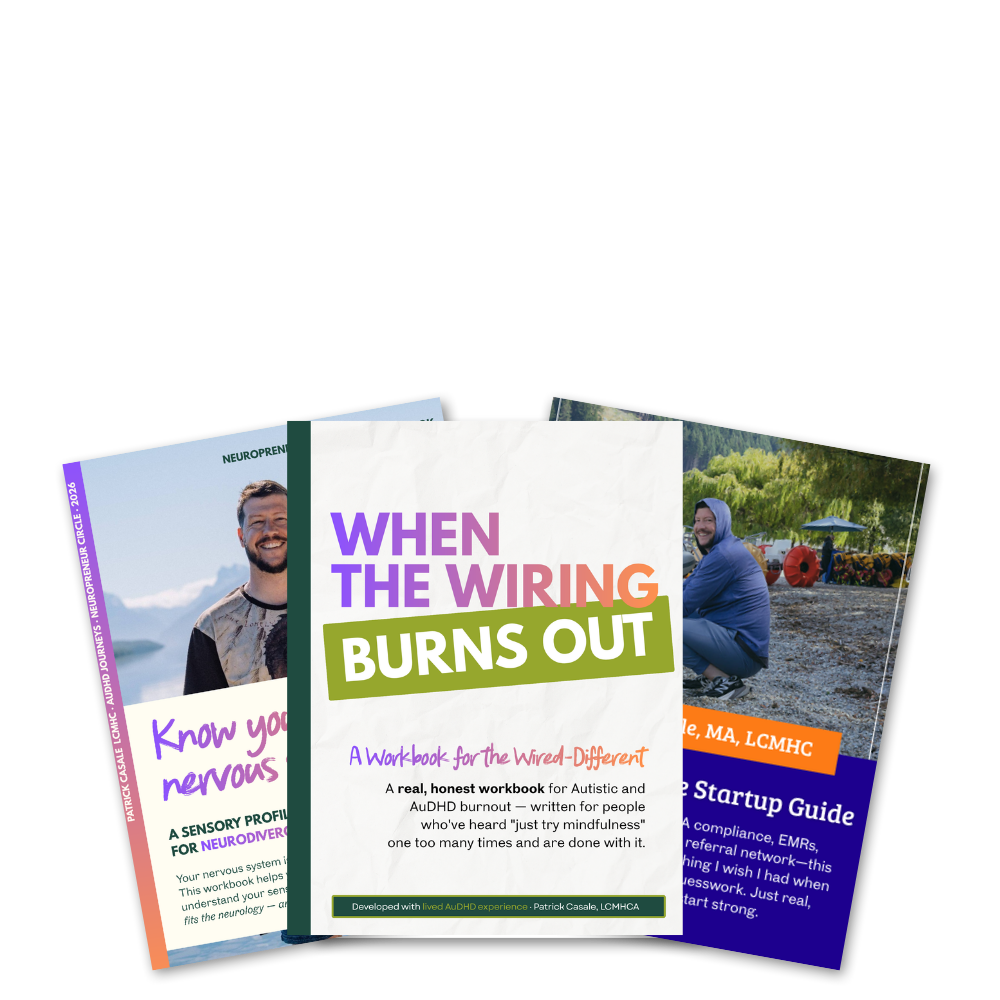
Get a practical podcasting workbook for therapists considering starting a podcast, created by Patrick Casale, host of the podcasts The Neurodivergent Entrepreneur and Divergent Conversations.
You'll get a practical structure for therapists who want to start a podcast but don’t want to rush, perform, or build something they can’t sustain.
Grab your free copy: ndpod.org/Free-Podcasting-Workbook
✨ Move Beyond Private Practice As A Neurodivergent Entrepreneur
Move Beyond Private Practice As A Neurodivergent Entrepreneur is a FREE 5-part mini-course designed for therapists who want sustainable financial independence beyond one-on-one work.
Access your free mini-course here: ndpod.org/Neurodivergent-Entrepreneur
Transcript
PATRICK CASALE: Hey, everyone. Welcome back to the All Things Private Practice podcast, joined today by a repeat guest and friend, Michael Fulwiler. He is a sought-after advisor, strategist, copywriter, creative director, and digital marketer with over a decade of professional marketing experience in mental health.
He's the creator of Therapy Marketer, a popular newsletter for therapists, and the founder of Fulwiler Media, a content marketing consultancy for mental health companies. Most recently, he was the Director of Brand at Heard, and before that, he was the Chief Marketing Officer at the Gottman Institute. Welcome back.
MICHAEL FULWILER: Thanks for having me back on. I think it's my third time on the show, so you must be running out of guests by this point.
PATRICK CASALE: You know, it's actually fascinating, because I have probably about 10 people out of the 250 episodes who have come on more than once. And then, everyone's been new. And I just went through a big recording batch and queue of meeting, so many new people who I was like, "I didn't even know these people existed in the space."
But always good to have you on. And I think marketing is a good conversation right now because you and I were talking off-air about how the landscape of private practices and group practices are changing. I think a lot of you who are listening are probably feeling that in your call volume, in the inquiries that are coming in or not coming in, the acknowledgement that more VC or venture capitalist-backed firms are buying up large group practices and creating conglomerates, which means they have more resources out in this space. People are a little scared. And I think with the economy and the uncertainty, people are really feeling that anxiety.
MICHAEL FULWILER: Absolutely, yeah. And so, if you're seeing that, you're not alone. I have talked to multiple group practice owners recently who hired a bunch of clinicians during the pandemic, when, you know, referrals were through the roof, and it's really slowed down.
And so, you know, I think it's just, yeah, the state of the market right now. And so, it's a good opportunity to invest in marketing.
I would also say, don't panic. Like, you know, business has ups and downs. And I think the best thing that you can do as a business owner is not to get too high, not to get too low. I think ride this out. And I think, like, you know, it will get better right now. I think it's just a tough time, you know, as of November 2025 when this is being recorded.
PATRICK CASALE: Yeah, I agree. I think try not to panic. I know that can feel hard in the moment. I know it can really feel hard, especially if you're experiencing one of these situations where, like, four or five openings become available on your schedule simultaneously. Because that always seems to happen in like bunches, where a client ages out of therapy or graduates, a client disappears, a client moves out of state.
All of a sudden, you go from feeling really certain and secure about your caseload to thinking like, "Oh shit, what should I be doing?"
And that's where panic marketing kicks in. I think that's where you see, like someone throwing their name into every single referral post, even if it's not a good fit. Someone like feeling really desperate to answer that phone call, because if you don't answer it, it never rings again. Like that mentality, you know?
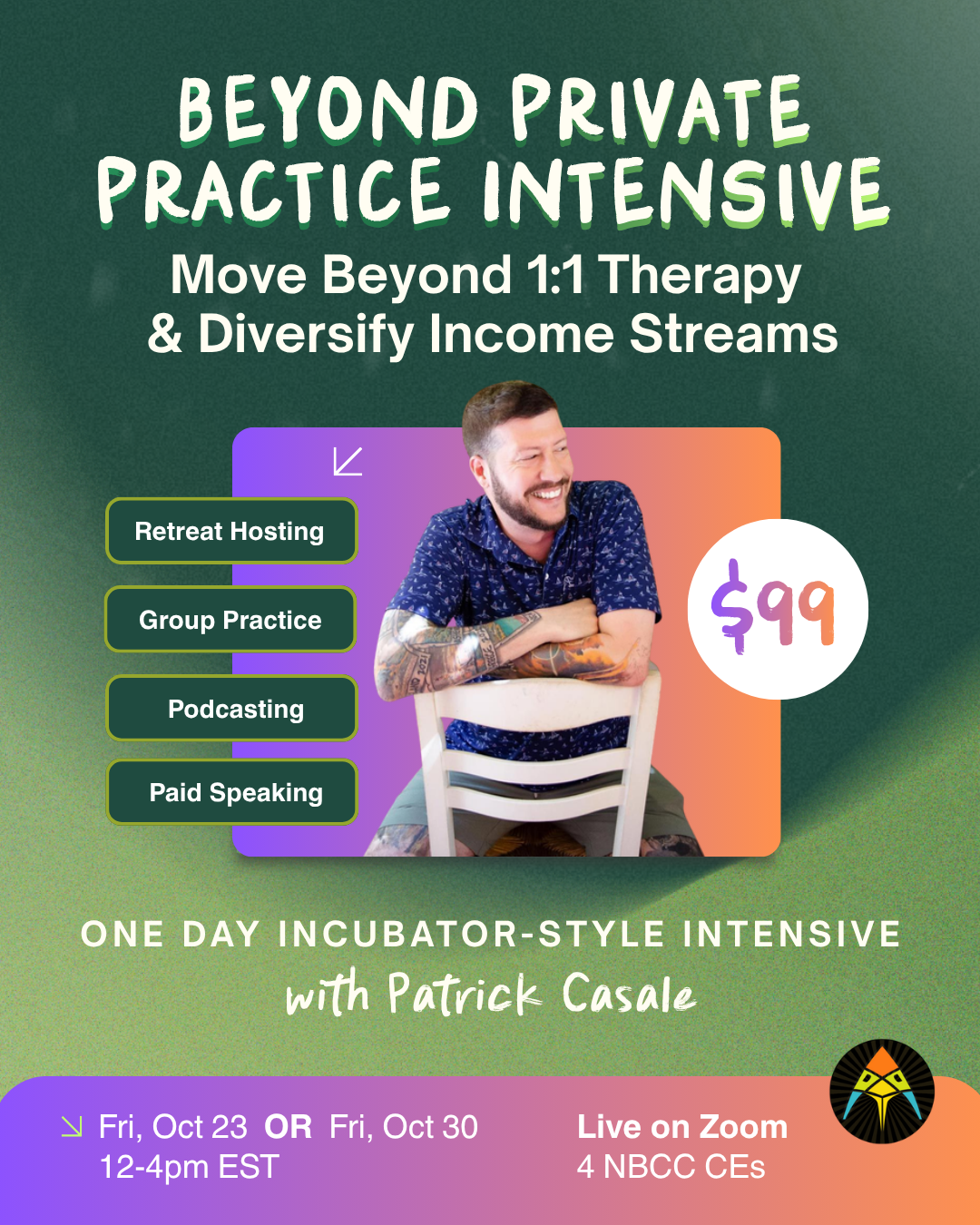
MICHAEL FULWILER: Yeah. Well, yeah, that scarcity mindset starts to come up, which is normal. I mean, totally understandable. I think it's also, you know, a good time to explore other income streams as well, which is, I know something that you talk about, and you're offering an intensive one as well. Like, if you have some availability right now in your caseload, and you know, that could be a good thing. Like, maybe you're feeling a little burnt out, and you can, you know, take a little bit of a break. Like, if you need the money, of course, like, you know, there's an opportunity maybe to invest in, you know, courses, or, you know, speaking, or something like that.
PATRICK CASALE: Yeah, I think you can certainly diversify right now, if you have the energy, and the capacity, and the desire. If you're one of those therapists, though, that's like, "I don't really want to be entrepreneurial. I just want to see clients." I think that's where it gets a little challenging to say, like, now what?
And here's what I think needs to be done, because I've been thinking about this for my group practice that I own, because I've noticed over the last two months, calls have been lower than they ever have been in the last three and a half years.
And we do everything. I mean, I'm talking about like we do Google ads, we do tweaks and edits to SEO. We do blog posting. I have a large social media presence. I've inserted ads into both of my pod… Like, I am trying to get as creative as possible.
And I want to acknowledge, for most of you listening, that you maybe don't have the resources to do all of those things or the platform. And this is when I think going back to basics makes a lot of sense. Like, this is where I think relationship building and networking is huge. Like, I know so many of you cringe at that word, but in my mind, networking is simply relationship building and building reciprocal relationships where it's a win-win for both people. And it doesn't have to feel gross, or sleazy, or car salesperson-esque, like a lot of people say.
MICHAEL FULWILER: Yeah, absolutely. And I think the key to getting referrals from other therapists, from doctors, from other sources, is just being super clear about the population that you serve, right? Like, who is your niche? Who is your ideal client?
And when I talk to therapists who they're not getting referrals, or their referrals have slowed down, that's where I always go, is, well, who do you work with? And if they don't have clarity on their, like, ideal client, then, of course, people aren't going to know who to refer to them, right? Because they're not going to be top of mind. So, that's my recommendation as well. Like, if things are slow, getting back to the basics, totally agree with. And is there an opportunity, maybe even to niche down further? Like, that can be counterintuitive, like, why would I reduce my addressable market by getting more specific about who I work with?
But actually, I think when things are slow, it's a good opportunity to do that, to re-engage with your professional network, referral sources say, "Hey, you know, like I'm working with this particular type of client. I have, you know, availability. If there's, you know, anyone that you know you know who could benefit from services like this."
PATRICK CASALE: Yeah. I agree 100%. I think what happens, right, when we're talking about like scarcity mindset, is you start to panic. If you've already established a niche, you start to think, "Oh, I need to become more generalized. I need to take everybody.
MICHAEL FULWILER: Yes.
PATRICK CASALE: In doing so, you kind of become misaligned with your business and your brand, which therefore means that less people are going to refer to you because they're like, "I don't know who Michael works with." And he says he works with everybody. And we all know, you know, you can certainly be a generalist. I think that's fine in like more rural or smaller areas with less providers. I think the need for generalists are higher in less populated places. However, if you live in a saturated market, let's say like I do in Asheville, or you do in like the Seattle area, also sorry for your [PH 00:08:21] Mariners' loss.
MICHAEL FULWILER: That's all right, I'm still recovering.
PATRICK CASALE: I mean, I think that you have to really get granular. And like you said, if you have time in your schedule, narrowing down more, narrowing down more, getting more specific about who you support, so that when you make posts, when you make social media posts, when you make blog posts, when you put yourself out on video, however you're marketing, you know who you're speaking to, and you can do it with confidence and clarity, so that when that person receives that message, they know that you're talking to them, instead of them saying like, "I don't know if this is really my therapist or the person that I want to reach out to."
MICHAEL FULWILER: Absolutely, yeah. I totally agree. I would also add here that there's not, like, one easy fix or one solution when it comes to getting more clients, right? I talk to therapists who asked me, "Hey, should I, like, be on Instagram? Will that fill my caseload? Or should I, you know, start blogging? Will that fill my caseload?"
And so, when things are slow, like they are now, like recognizing that it's not just one channel, or one tactic, or one activity that's going to make the difference. I think marketing is really about the combination of those things, like you said at your group practice, like you're doing all of the things.
I think, to me, I'm curious your perspective on this. Like, the highest impact marketing activity that you can do when things are slow is to invest in your referral network and professional relationships. And, like, I would focus there, because that's where you're going to get, I think, the most return versus, you know, spending time kind of in the short term, at least creating content for social media, or, you know, trying to improve your SEO.
PATRICK CASALE: Yeah, unless you have a large social media following with a lot of engagement, I think that, like, putting content on social media, great. You might be spinning your wheels a bit if you're just like regurgitating the same therapist content that circulates all throughout the internet, like, if you're not really narrowed down. So, I would be reinvesting in those relationships. I think that's important.
And I think as we move into economic uncertainty and people are feeling more financially anxious, and being more conscientious about where their money goes, the reality is relationships matter. And you are going to get significantly more investment from people who know, like, and trust you. And I think that it's a really important piece right now to spend your mind or money, resources, and energy, doubling, tripling, quadrupling down on that. Because I do think as people feel like the walls close in a bit, they start to become a little bit more fearful, they're going to only like, interact and connect with the people who they believe in and that they trust. That's important.
MICHAEL FULWILER: Yeah, yeah. I think the other thing that happens when things slow down, and that kind of panic sets in is therapists feel like they need to spend more money actually to acquire clients. And so, when you get an ad for that coaching program, or that mastermind program, or that course, like, "Oh, if I just spend, you know, $5,000 to redo my website, like, maybe that'll fill my caseload, right?"
And so, I think that's important as well, that we're not like, panic spending in order to fill our caseload, and we're, you know, focusing on things that are actually going to make an impact on our business.
PATRICK CASALE: That's a great point. And I know a lot of you can probably relate, thinking like, "Oh, I just threw, like, 1000s of dollars into Google ads, or I threw 1000s of dollars in SEO, or I joined one of those coaching programs who promised me 20 clients in 30 days." Or whatever.
So, I just want to be clear, if any coaching program ever promises you specific results like that, you probably want to be a little bit weary and, like, stay away from the things that have 100% assurance, because I don't think we can 100% guarantee anything in this when we're talking about human behavior.
Okay, so if that's the case, if people are sitting here on the other end of this saying, like, what are things I can invest in? Because you're a marketing expert, you can speak to that really clearly, where should people be spending their money right now? Where should they be allocating their resources?
MICHAEL FULWILER: I think it depends on the stage of your practice. Like, the way that I think about it is that if you're just getting started in private practice, you probably should be doing everything yourself, right? Just to conserve expenses and reduce expenses. I think, like nowadays, having a like, good website is super important. That feels like table stakes. And so, I think some therapists feel like, "Oh, I need to go out and I need to spend 5000 or $10,000 to have this professionally designed website created for my practice."
I would say, initially, I wouldn't recommend that. I would say, get like, a Squarespace website. You can do it yourself. I would say, find someone like me who could come in just like, and consult with you just for an hour on like, "Yes, this is what I would tweak. This messaging looks good." Even like sharing in Facebook groups. I know you don't have your Facebook group active anymore, but I would see therapists sharing like, "Here's my website, here's my Psychology Today." Just like getting peer feedback as well, I think can be super valuable.
So, I think like consulting with someone like myself who can just advise you in the beginning, I think can be helpful, and then as your kind of practice grows, I think that's when it makes sense to start investing, you know, in Google ads, if you're a group practice, for example, you know, in, you know, SEO and content to kind of optimize your website.
But I think at this point right now, like, if you are looking to get more clients, I would say like invest in your referral network, and that's actually like low to no cost.
PATRICK CASALE: That's true. I remember when I was starting out. I kind of laugh about it. Now I don't have the energy or the capacity or the desire, but I feel like I met everybody in Nashville during that time when I was building my practice, like reaching out to people asking if they want to get coffee, get lunch, meet online, whatever, just to, like, connect.
And I was very intentional about it. Like, I wanted to build relationships. But I also think if you think about your capacity, and a lot of you are listening now are probably neurodivergent, low energy, low capacity, really intentional about where that energy goes. I think it's important to think about who you're connecting with and why.
So, for example, I always thought about like at the time, I specialized in working with young adult men struggling with addiction. I made it a point to connect with therapists who are working with young adult women who are struggling with addiction, who might be referring their boyfriends or their husbands to me, because they only worked with women, and vice versa. So, again, win-win. Psychiatrists and psychiatric providers who have caseloads 20 times the size of a therapist who don't want to go on Facebook and make post after post looking for referrals, they just want to have some trusted referral sources that they can just know that they give your name and your number and you're going to get an ROI, you're going to keep them in the loop, and that is a wonderful referral source. And they know that you are going to refer people to them for medication management, because you can't do that.
So, I was always thinking about that type of strategy when I was networking with people. And I think that was really helpful. And then, you start to establish and build this name of like, "Ooh, Patrick's the person to send this type of client to." And then, all of a sudden, your phone is ringing off the hook.
Now, that is not a short-term solution or strategy. That takes time and investment. And relationship building, but I think it's important to put yourself in those situations and to put yourself out there. I hear from a lot of therapists who are like, "That feels really scary to just ask random people to, like, connect. That makes me feel really vulnerable." It is. Some people are not going to answer you. Some people are going to say, "No." Some people are going to meet you, and you're going to be like, "I will never refer to that person." Right? That's just a part of it, and I think it's important to be really intentional about what you're doing, instead of, like, casting a wider net, cast a taller net, or a deeper net.
MICHAEL FULWILER: I love that. Yeah, and I think using social media to connect with, like, other therapists and professionals, that's something that I've had a lot of success with. I'm someone who, like, doesn't enjoy going to a networking event. Like, I don't walk into a room and, you know, like, I'm not super comfortable walking up to people to introduce myself, right? But if I'm connecting with someone through social media, and then we, you know, set up a call like this and just have like a casual conversation that feels like way better.
PATRICK CASALE: Oh, yeah, [CROSSTALK 00:19:39].
MICHAEL FULWILER: And so, yeah [CROSSTALK 00:19:40].
PATRICK CASALE: [CROSSTALK 00:19:40] conversation, you know what I mean?
MICHAEL FULWILER: Definitely. And it's not just, "Hey, I'm Patrick, and I'm looking for referrals." Right?
PATRICK CASALE: [CROSSTALK 00:19:48].
MICHAEL FULWILER: How can I support your practice? Like, what do you need right now? How can I be helpful? And I think if we take that approach right of, like, you know, we're not asking for anything. We're just actually offering our help, then people are going to want to help us.
PATRICK CASALE: That's exactly right. And I think that's so important. And I just want to be clear, when you're networking or connecting with other providers, it's implied that you also need referrals. You don't have to explicitly come out and say like, "I need referrals. Please send me people."
Like, get to know the other person. I always liked the meetups that I went to one-on-one, where I actually got to learn about the person as a human, without even ever talking about, like, "Where'd you go to grad school? What do you specialize in? What trainings have you done?" It felt those types of interactions felt like job interviews. I always left those feeling like, "Oh, I don't think I'm going to refer to that person." I felt really uncomfortable.
MICHAEL FULWILER: Yeah.
PATRICK CASALE: Some of the people I met back in 2017 are still some of my closest friends today. And those are the people, like, when I was really struggling, when my caseload hit a slump, I would reach out to them explicitly and say like, "Hey, I've got one or two openings. If you have anyone that meets, you know, who I work with." And all of a sudden, I'd be full again in like, a week. And trusting in that was really important for me early on, because I had a lot of imposter syndrome about like, what I was doing. But I think a lot of you do. So, I love what you said.
And also, like, I also believe in the if you build it, they will come approach. So, like, if you live in an area and there's not a social media group. Like, there's not a Facebook group explicitly for referrals in your area, or the one that exists is really not your vibe, or there's not a lot of interaction and engagement, start your own. Become the face of that community. Become someone who's recognizable. It's a low-energy endeavor early on. When your group gets large, then you might rethink that, because I will never reopen mine again, despite what you saying. Like, that's a really missed opportunity.
MICHAEL FULWILER: Yeah. Well, yeah, it's opportunity cost, right? Of like, the energy that you're kind of putting into manage it. I also think too, going back to what I said about initially, when you're kind of getting your practice off the ground, kind of doing everything yourself, I think you get to a certain stage of growth where it makes sense to bring in someone that could be an like an outreach coordinator, or someone who's actually reaching out to other practices, or hospitals or, you know, depending on your, like, population that you work with, someone who's kind of helping to do that outreach in the community, even like an executive assistant, someone helping you to manage your schedule, things like that. I'm curious for you, like, at what point did you start to hire and bring people in to help with specifically, kind of, the marketing side of your practice?
PATRICK CASALE: Yeah, that's a great question. You know, I was really fortunate to never really need to have to. As a solo provider, I think most of my referrals were just word of mouth, building relationship. But then, when I started to grow into hiring people as a group practice, I mean, it became very apparent I can't do all of the functions of being a group practice owner, especially networking, referral building, the outreach, some of the administrative tasks. So, then I started to hire.
And the same goes for my coaching business. I mean, I started to hire pretty early on in that. And I know it's scary to hire people, and I think my feedback and my advice would be very clear about what you are looking for, because far too often I see people saying, like, I just need to hire a VA. That's like, "Great, to do what?" And it's like, "I don't know. I just need help." And it's like, "Yeah, but you are going to be so disappointed, and it's going to be so unfair to the person you hire. You're probably going to build resentment because they're not doing things that you want them to do, or the way that you want them to do it."
So, I really think being very clear about who you're hiring, why you're hiring them, and what their role and expectation is, because if you don't have that in your mind, it is going to lead to a loss of financial resource and stress.
And, you know, I always think about hiring and delegating, right? And how in the short term, sure, do you have to spend money?
MICHAEL FULWILER: Yes.
PATRICK CASALE: In the long term, will that make you money? And I think the answer is yes, because it frees you up as the person who is either the visionary in the practice or the person who's bringing in primarily, like most of the income to spend your time and energy doing what you do best, and allocating the tasks that take you time and energy, frustration, resource, whatever, and buying back your time and your time is so valuable. It's the most valuable like resource that we have because you can't replenish it.
MICHAEL FULWILER: Yeah, and this is a really interesting point, because when you think about hiring for marketing, like, I need more clients, who should I hire? You probably think about, I need to hire like an SEO person or a social media person, but you might actually need to hire a VA. You might need to hire someone to take some of the admin off of your plate. You might need to hire a bookkeeper. Like, look at where you're spending your time, because if you're feeling like, yeah, this sounds great, I'd love to network with other therapists and just take calls all day, but, like, I don't have time to do that. Where are you spending your time?
PATRICK CASALE: Exactly.
MICHAEL FULWILER: And can you bring in help to get some of that off of your plate?
PATRICK CASALE: Yeah, exactly. So, you might have to, like, step back a bit and get a sense of how much of my time am I spending on which tasks, and get really clear about where is that energy going. And if I can offload some of that to someone else and pay them to do so I can then spend my time, and my resources, and my energy doing what I want to be doing. And I think that really frees you up. And it starts to create expansion. So, that would be my two cents.
As we get ready to wrap, what do you want to leave people with? And definitely, how do people find you if they do want to hire you for consulting? And this is a shameless plug, not asked to say this, but Michael's been on the podcast multiple times. We've become friends over the years and colleagues. And if you do need someone for marketing consulting, even if you want someone to come and talk to you for an hour about things that you could tweak, or thoughts, or things that you could be doing differently, I highly, highly, highly recommend him.
MICHAEL FULWILER: Thank you, man, appreciate that. I would just reiterate what we've talked about. You know, don't panic. Things are, things are going to, you know, pick back up. I think right now is just a difficult time across the board. If you do want advice or just like someone to bounce ideas off of, or you know if you want feedback on your social media content or your website, that's something that I do and love to do. I offer free discovery calls with therapists that you can book with me. And then, if you want to book more time, I offer longer hour consulting calls as well. And that's really just your time to ask any questions that you have, kind of about marketing and things that we're talking about today.
And, you know, I also work with therapists in kind of longer-term engagements as well, where we meet once a month or twice a month and just talk about their practice. We work on a marketing plan together, things like that.
So, I think just having someone external to your business can be really valuable, because when you're in it, like, you're not seeing everything, right? I'm sure that you can relate to that. And just having that external perspective to ask, like, why are you doing this? Or why did you write this in this way? And you might be like, "Oh, I didn't even think about that?" Or, "You know, I didn't realize that." Or, "Oh, yeah, it's a good question." So, I think having that external perspective can be super helpful.
PATRICK CASALE: Yeah, I agree. And where can people find you if they want to reach out and work with you? And we'll add this to the show notes so everyone has access to it as well.
MICHAEL FULWILER: Yeah. So, my website is just my name, michaelfulwiler.com. And there's a link on there under there's a consulting tab on my website. I also write a newsletter as well. It's called Therapy Marketer. If you just put that into Google, hopefully, my SEO is good enough that it'll show up.
So, that goes out every week. I just share, like, marketing, you know, advice, and things that I'm learning as a marketer specifically for therapists. And so, that goes out every Tuesday. So, that's something also that you can sign up for free.
But, yeah, I would say, if you're interested in just chatting, you know, happy to set up a free call, and we can go from there.
PATRICK CASALE: Solid. And again, we'll have that information in the show notes, so you have access to everything Michael listed. Thanks again for coming on, Man. I know it's like 7:30 AM your time, so…
MICHAEL FULWILER: Yeah, no worries, man. Thanks for having me back on.
PATRICK CASALE: And to everyone listening to All Things Private Practice, new episodes are out on Saturdays and all major platforms and YouTube. Like, download, subscribe, share. Doubt yourself, do it anyway. See you next week.
FREE PRIVATE PRACTICE GUIDE
Join the weekly newsletter for private practice tips, podcast updates, special offers, & your free private practice startup guide!
We will not spam you or share your information. You can unsubscribe at any time.







![Episode 266: Healing Isn’t Just in Your Head: Rethinking What Therapy Can Be [featuring LeNaya Crawford]](https://kajabi-storefronts-production.kajabi-cdn.com/kajabi-storefronts-production/file-uploads/sites/2147507511/images/a2d5a4-e4bf-63b0-fa7f-6e6f62c466d5_TNDE_YouTube_episode_266.jpg)

![Episode 264: Creating Through the Chaos of a Neurodivergent Life [featuring Bre "BR3"]](https://kajabi-storefronts-production.kajabi-cdn.com/kajabi-storefronts-production/file-uploads/sites/2147507511/images/a14004-cc3d-8aba-5fb8-2442fdfc650_TNDE_YouTube_episode_264.jpg)
![Episode 263: Your Symptoms Are Real—Even When Medicine Doesn’t Have The Answers [featuring Dr. Zachary Spiritos]](https://kajabi-storefronts-production.kajabi-cdn.com/kajabi-storefronts-production/file-uploads/sites/2147507511/images/84bc15-1ce4-1a0b-8f85-f5812bce75_TNDE_YouTube_episode_263.jpg)