
Show Notes
If you have been thinking about launching a podcast, it's normal to feel stuck on the details (like finding that “perfect” name). In this episode, I share my honest journey from private practice owner to podcast host—complete with all the overthinking, imperfect starts, and hard-won lessons along the way.
Here are 3 key takeaways:
- Progress Over Perfection: Don’t let analysis paralysis (like obsessing over the “perfect” name) hold you back. Get clarity on your target audience and focus on taking imperfect action.
- Plan for Consistency: Create a master Google Doc of at least 20 episode ideas to avoid getting stuck. Consistency—in planning and publishing—trains your audience to show up for you.
- Batch Your Efforts and Work With Your Energy: Batch record episodes to match your energy levels, rather than pushing through every day. Find systems and support (like affordable editors or helpful tools) that make the process sustainable.
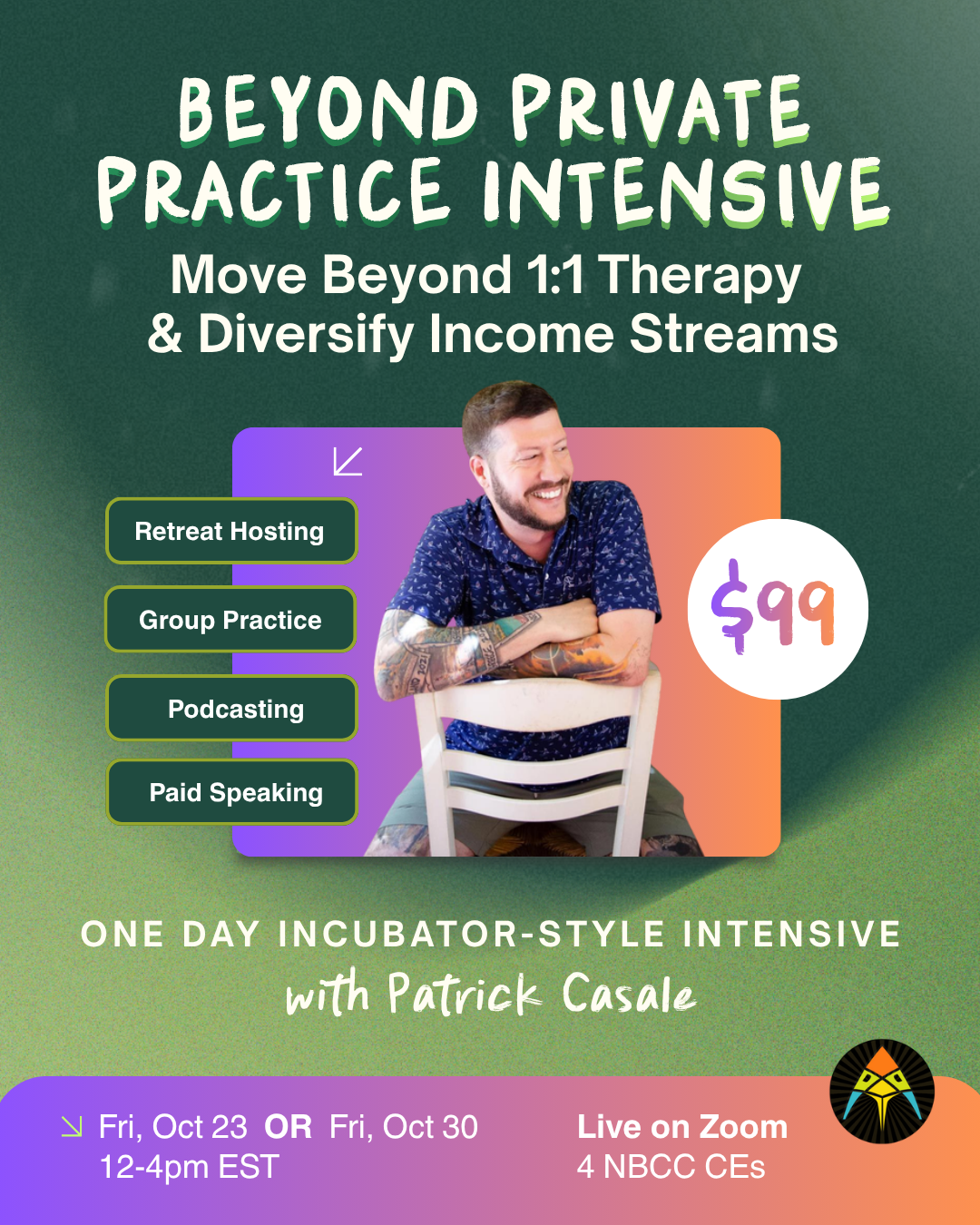
If you’re looking to step beyond traditional therapy, recession-proof your business, and want to learn more about diversifying income through retreat hosting, podcasting, and writing books, check out the Beyond Private Practice: Recession Proofing Intensive on December 12, 2025. Learn more: allthingspractice.com/beyond-recession-intensive
🎙️Listen to more episodes of The Neurodivergent Entrepreneur Podcast
🎙️Spotify
🎙️Apple
🎙️YouTube Music
▶️ YouTube
✈️ Check out available Retreats
🗨️ Join the free Empowered Escape FB Community
A Thanks to Our Sponsors: The Receptionist for iPad!
I want to thank The Receptionist for iPad for sponsoring this episode.
The Receptionist for iPad is a HIPAA-ready digital check-in system that eliminates the need to walk back and forth from your office to the waiting room to see if your next appointment has arrived. Clients or patients can check in for their appointments, and you'll be immediately notified by text, email, or your preferred channel. Break free from interruptions and make the most of your time, because it is valuable. Start a free 14-day trial of the Receptionist for iPad by going to thereceptionist.com/privatepractice. Make sure to start your trial with that link to get your first month free if you decide to sign up.
Free Gifts for Our Listeners
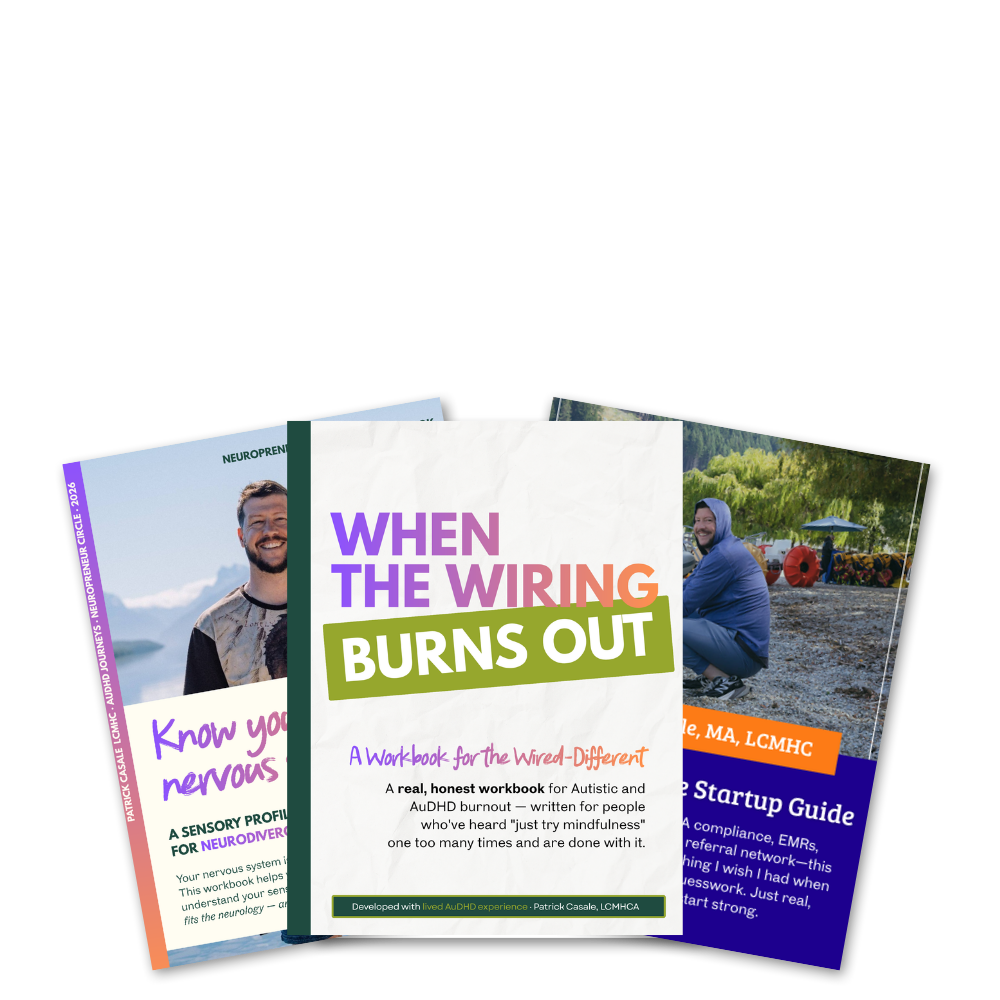
Get a practical podcasting workbook for therapists considering starting a podcast, created by Patrick Casale, host of the podcasts The Neurodivergent Entrepreneur and Divergent Conversations.
You'll get a practical structure for therapists who want to start a podcast but don’t want to rush, perform, or build something they can’t sustain.
Grab your free copy: ndpod.org/Free-Podcasting-Workbook
✨ Move Beyond Private Practice As A Neurodivergent Entrepreneur
Move Beyond Private Practice As A Neurodivergent Entrepreneur is a FREE 5-part mini-course designed for therapists who want sustainable financial independence beyond one-on-one work.
Access your free mini-course here: ndpod.org/Neurodivergent-Entrepreneur
Transcript
PATRICK CASALE: Hey, everyone. Welcome back to All Things Private Practice. Today is a continuation of last week's conversation, Moving Beyond Private Practice: Recession Proofing. We're going to talk about podcasting today.
So, as we're sitting here, I don't know what episode this is of All Things Private Practice. It's like 225, and I know we have like another 25 episodes in queue. So, we're at like 250 all said and done.
I didn't expect this to happen. I had started the Facebook group, All Things Private Practice, back in I think it was September or October of 2020. I had just started doing six-week, six-person take the leap coaching program. So, it was just like a beta test where I was trying to figure out, like, is this valuable to people, taking people from agency work into private practice, and going over core themes that I thought were important.
It was kind of a perfect storm and perfect timing, because my idea came, like, six months after COVID started. And a lot of you wanted to get the hell out of your agency jobs to work for yourself, where you could control the environment. And that was, you know, synchronistic and not planned for, but it certainly launched my career. And I am so grateful for all of you. And I will never, ever forget that, because I couldn't do that without your support.
And I started the Facebook group, and the Facebook group was growing, and people kept saying, like, "You have a podcast voice." And I was like, "I don't know what that means." "And you have so many interesting takes, and you the way you articulate things."
And I thought nobody wants to listen to anything that I have to say. And also, like so many of us, I despise hearing my voice, if I'm being honest.
So, I say, okay, if I'm going to launch this podcast, I got hung up on names for like months, like almost a year, because I didn't launch All Things Private Practice podcast till November of 2021, so that was a full year after the Facebook group, and the coaching programs, and courses, and some of that stuff took off.
And I kept getting stuck in my head about, like, the name of the podcast, which I know you all can relate to, similar for your therapy practice names and whatever other names we struggle with. And I thought, "Oh, I have the All Things Private Practice Facebook group. I should probably make a continuation of that and just do the All Things Private Practice podcast."
So, lo and behold, three years later, yeah, actually, it's November 2025, so three, four years later. Yeah, this podcast has been on for four years. Wow, that adds up, I guess, if there's 250 episodes.
Yeah, this has all been a wonderful journey. And I have had no idea what I've been doing 99% of the time. Like, I've admitted this on Divergent Conversations and in other circles, but to this day, I have never listened to a single podcast in my life. And that includes my own. I have never. I struggle with auditorial processing, attention. Like, I'm sure a lot of you have so many valuable podcasts you'd love to share. And I just haven't ever listened to one. And I don't really ever plan on it.
My co-host for Divergent Conversations, Dr. Megan Neff, she is a absolute genius, and if you ever listen to this, I just have loved that journey, going on that journey with you. But she is an avid podcast listener. And she'll always be like, "Hey, check this out. Hey, we could do things like this." And I'm like, "I'm not going to do that." But she knows that at this point it has just become a running joke.
So, the name thing is a big hang-up. And we're going to go over that when you come and do the Beyond Private Practice Intensive. We're going to get through the naming stress. Because I do think naming is important, especially if it has some association like All Things Private Practice. It makes sense to name this the All Things Private Practice podcast. It didn't make sense to get hung up on it, though. And then, you have to search to make sure it's available.
Once it's available, just do it. Like, book the domain. Okay, if you want to start a podcast, I want you to start with a couple of things. We're going to go over this during the intensive, but I think these are important. Find the domain and buy it. Purchase the domain. I couldn't start the Beyond Private Practice podcast because I couldn't buy the domain, and somebody had already beat me to it. So, book the domain. Purchase it if you have one that stands out. If you have a couple that stand out, there's no harm in purchasing them. So, do that first and foremost.
Two, although the name is somewhat important in the long run, it's not in the short term when you're launching unless you are launching something unbelievably specific that you want people to know this podcast is about.
So, I want you to skip over the name for now, if you don't have one in your mind. I want you to think about who are the listeners going to be, who's your target audience. You need to know that. What sector of podcasting? Is it health and wellness? Is it entrepreneurialship? Is it science? Is it education, etc? Figure that out. Who's the target audience?
And then, what I want you to do is open up a Google Doc or your notebook, or wherever your ADHD is going to forget your ideas like myself. I have so many notepads, and apps, and all the things. But anyway, so open that Google Doc up. And I want you to just create like a checklist, and you just start typing out things that you know you could talk about for 20 minutes, 20 to 30 minutes. My podcasts tend to be like around 30 minutes. Divergent Conversations tends to be closer to an hour, but there's two of us, and that's much more depth-oriented.
But think about how long your episodes are going to be. And also, remember that people's attention spans are short. That's just the reality. So, create a list of 20 topics, 20 things that you can talk about. And I want you to not be intimidated by this, because I know it feels scary to say, how the hell do I know 20 topic ideas?
Let's take example, starting a private practice, that's not really a topic idea, that's more of like an overarching theme, because inside of that, right? We could talk about naming, getting your business structure, how to market, content creation, copywriting, networking, working through impostor syndrome, rate setting. Like, every single one of those could be a topic in itself. So, I want you to think about it like that. Think about the overarching theme, then break it apart and create topic ideas. That way you don't have to stress yourself out, because if we can get a lot of this done, once you figure out the name and choose a hosting platform, that stuff becomes really easy.
Think about starting your private practice, right? I bet you either looked at my checklist or maybe Allison Puryear's from Abundance, or someone's list of like, how to start a private practice. How many times did you look at that and close the doc or put the paper away? Or, like, convince yourself this is too overwhelming.
I know I did that. I actually had Allison's checklist. Shout out to Allison for that, back in like 2017. And I kept looking at it, and I was like, get an MPI, get an EIN, start an PLLC. I was like, "I don't know what any of this means." So, I kept telling myself, I can't do it. And I would file it away for a rainy day.
Fast forward, eight years later, and that stuff is like, you could do it in your sleep, mindlessly. And I think that's the same with starting a podcast, is like, once you get the logistics down, those stuff that feels like really scary in reality, it's not that overwhelming. The stuff that's overwhelming is like making sure that you create enough content to host consistently. And we're going to talk about this in the intensive that I'm hosting.
That's one thing I see people fail at. They have this wonderful idea, podcasting, coaching program, retreat, whatever, doesn't matter, but there's no consistency. You need to be able to get your audience, almost like trained, to understand and learn how often your episodes are coming out and when they're coming out. They need to know that. There needs to be an expectation. You can't post an episode today and then not post another one for six weeks. We have to find a groove. We have to find a rhythm. And we have to find consistency.
One thing that I do is I batch. So, you'll see me wearing this like Basque whale shirt today. And I love it because it just represents probably something that I think I feel like a lot of the time as an autistic ADHDer. Anyway, you're going to see this shirt in like five episodes, right? Because I'm batching. I'm not doing recording every single day. I set aside certain amounts of my time and my schedule to record episodes, and I batch them, because I don't always have energy. So, I have to record when I have it, knowing that, as a neurodivergent human who is often in autistic burnout, that my energy spikes, and it crashes. And there comes bursts when the ADHD is like, "Hello, I'm back." And all of a sudden, I'm like, "Oh, I got to get some recording done."
So, I want you to think about what works best for your energetic cycle. And podcasting is a low-risk, high-reward situation, because, as we're talking about this intensive, this recession-proofing intensive, if you followed the last couple episodes, knowing my thoughts on the upcoming future of the economy and private practice landscape, you can maintain your clinical caseload, and you can podcast at night. You can podcast in the morning. You can podcast in between clients. You can do it on the weekends. You get to decide when you want to record.
And you're going to find a new energy in this new creative project. So, I want you to think about, again, who is my target audience? Who is this podcast for? What like spectrum of the internet? What is the category? Then let's create the episode ideas. Let's get really granular. Let's, like, throw everything and anything on that dock. There's no wrong answers. Then we will start recording. Start getting on camera. Start getting comfortable, because I believe in imperfect action, building the plane as you fly it. I would rather have you start recording episodes on Zoom, on Riverside, something like that, pretty commonly used, easy to use, Riverside. If those of you are less tech savvy. Riverside, you can record on it will chop up your recording into social media clips, so you kill two birds with one stone.
I still record on Zoom. I probably should switch to Riverside. But like creature of habit, you know? So, it just is what it is. But I would just start recording episodes and download them into folders.
I have a Google Drive with both of our podcasts, All Things Private Practice, Divergent Conversations, Episode folder, the video, the audio, everything goes into that folder, bios, headshots, offers, links, et cetera. The person who edits my podcasts goes in. She gets the files, she edits them, she replaces them, and it's really easy.
Now, there is resource that is involved. If you don't know how to edit audio or video, you're going to have to pay someone to do that. You can find people who are pretty affordable. I mean, I am lucky enough that my previous VA just happens to specialize in audio and video editing. But you can go on Fiverr. You can certainly learn it yourself, if you have the time and energy. I certainly do not. You can ask around. There are services that do this, but don't let that hold you up. I would rather have you focus on episode ideas, record some episodes, get comfortable being on camera, comfortable speaking, comfortable with how your voice sounds. I don't know if I ever will be. And I want you to work on that. Okay?
And then, you can figure out which platform you want to use to host the podcast. There's so many. I use Captivate. I've used Buzzsprout in the past. I've used Podbean in the past. Like, they're all basically the same. Look for one that you feel comfortable with. They're like $39 a month. You host it on there. You get it all linked to Apple and Google or whatever platforms, and it will disseminate that audio feed every single time you post an episode and publish an episode once you get everything connected. And I'm going to walk you through that stuff.
So, if you are interested in podcasting, and that's something that you've wanted to do, that is going to be 1/3 of the Diversifying Income Recession Proofing Intensive that I'm doing. So, again, Beyond Private Practice: Recession Proofing Intensive, Friday, December 12, 11:00 AM to 4:00 PM Eastern Time. Going to go over podcasting, getting your book started, and also hosting your retreat.
Make sure to sign up. The link will be in my bio. The link will be in the show notes. Link will be on my website. It is $299. It includes four NBCC CES. We're going to work through mindset shifts, perfectionism, imposter syndrome, self-doubt. How do I get started? And then we're going to work through those things. And we're going to build some community, and connection, and have a follow up body doubling virtual event. So, click that link. Happy and excited to see already 35 people signed up. Excited to see you all on Friday, December 12, doubt yourself, do it anyway. Next episode, we'll be talking about retreats.
FREE PRIVATE PRACTICE GUIDE
Join the weekly newsletter for private practice tips, podcast updates, special offers, & your free private practice startup guide!
We will not spam you or share your information. You can unsubscribe at any time.





![Episode 266: Healing Isn’t Just in Your Head: Rethinking What Therapy Can Be [featuring LeNaya Crawford]](https://kajabi-storefronts-production.kajabi-cdn.com/kajabi-storefronts-production/file-uploads/sites/2147507511/images/a2d5a4-e4bf-63b0-fa7f-6e6f62c466d5_TNDE_YouTube_episode_266.jpg)
![Episode 264: Creating Through the Chaos of a Neurodivergent Life [featuring Bre "BR3"]](https://kajabi-storefronts-production.kajabi-cdn.com/kajabi-storefronts-production/file-uploads/sites/2147507511/images/a14004-cc3d-8aba-5fb8-2442fdfc650_TNDE_YouTube_episode_264.jpg)