Episode 227
Dec 27, 2025

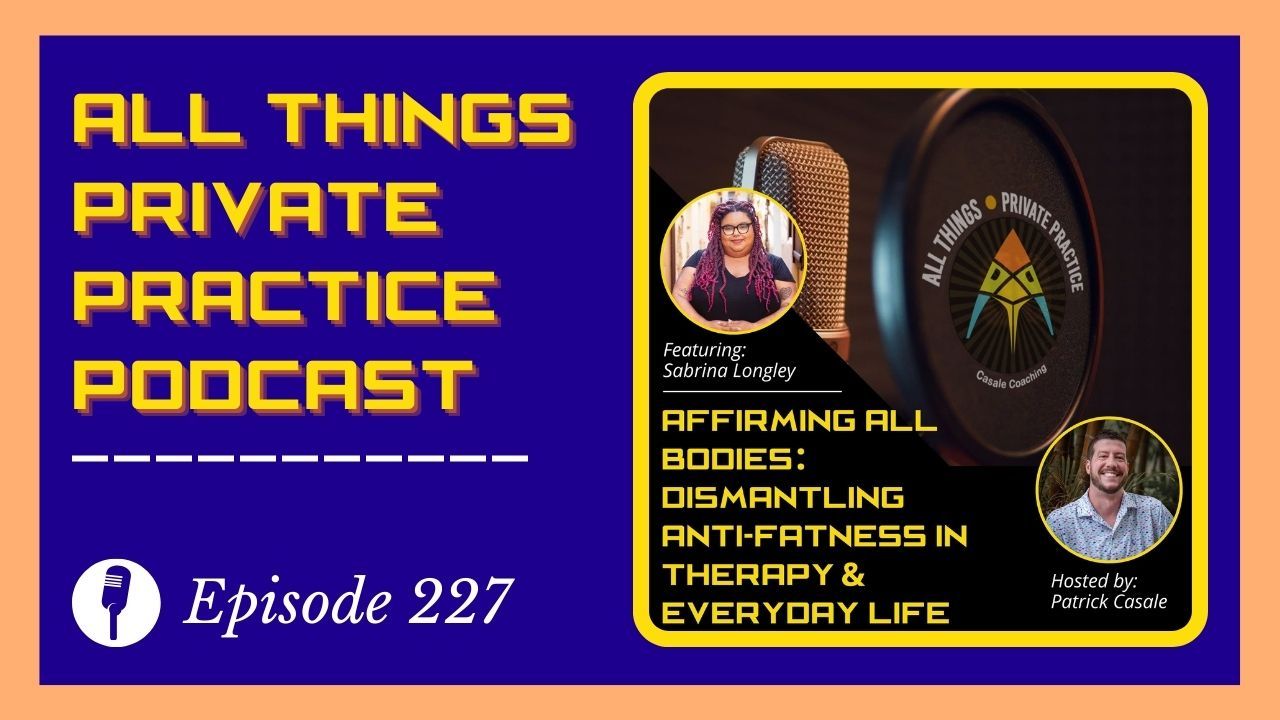
Affirming All Bodies: Dismantling Anti-Fatness in Therapy and Everyday Life [featuring Sabrina Longley]

Hosted by: Patrick Casale
All Things Private Practice Podcast for Therapists

Show Notes

In this episode, Patrick Casale talks with Sabrina Longley about what it means to truly build a fat-affirming therapy practice. This topic is especially important as we head into the new year, and toxic resolution/fitness culture starts ramping up.

Here are 3 key takeaways:

  1. Assume Less, Listen More: Approaching clients from a place of curiosity rather than assumption is crucial. Don’t make judgments about health, habits, or desires based on body size.
  2. Representation Matters: The resources, images, and stories we use in our practices should reflect the identities and lived experiences of all bodies—including larger bodies. Take the time to diversify your media, office environment, and marketing materials.
  3. Challenge Industry Narratives: The weight loss industry cashes in on insecurity and shame—often with little focus on actual health. As providers, let's not become agents of these narratives. Instead, support every client’s autonomy, dignity, and humanity.

More about Sabrina:

Sabrina is passionate about offering lived and clinical experience support to both clients and other mental health providers related to topics including racial justice, neurodivergence, fat liberation, teen mental health, and DBT. She works to honor her own lived experience and the lived experiences of other marginalized folks to promote ethical and just mental health care.


🎙️Listen to more episodes of the All Things Private Practice Podcast here
🎙️Spotify

🎙️Apple

🎙️YouTube Music
▶️ YouTube
✈️ Check out available Retreats
🗨️ Join the free Empowered Escape FB Community
🗨️ Join the free All Things Private Practice FB Community


A Thanks to Our Sponsors: The Receptionist for iPad, Alma, & Portland, Maine, Summit 2026!

The Receptionist for iPad

I want to thank The Receptionist for iPad for sponsoring this episode.

This podcast is sponsored by The Receptionist for iPad, a digital check-in system that eliminates the need to walk back and forth from your office to the waiting room to see if your next appointment has arrived. Clients can securely check-in for their appointments and you'll be immediately notified by text, email, or your preferred channel. Break free from interruptions and make the most of your time. I've been using them for almost three years now and it saves me hours in my week.

Start a 14-day free trial of The Receptionist for iPad by going to thereceptionist.com/privatepractice. Make sure to start your trial with that link. And you'll also get your first month free if you decide to sign up.

Alma

I want to thank Alma for sponsoring this episode.

Building and managing the practice you want can be challenging. That’s why Alma offers tools and resources to help you build not just any practice, but your private practice. They’ll help you navigate insurance, access referrals who are the right fit for you, and efficiently manage administrative tasks — so you can spend less time on the details and more time delivering great care. You support your clients. Alma supports you.

Visit helloalma.com/ATPP to learn more.

Portland, Maine, Summit 2026

 The 2026 Doubt Yourself Do It Anyway Summit is happening for the first time in the United States in beautiful Portland, Maine, on September 1st–3rd, 2026. Portland, Maine, is a beautiful coastal city in the Atlantic Ocean. There's a lot of history there, and it's a very funky, creative, safe, walkable, diverse, and progressive city. You will get 9 NBCC CEs. We have ASWB pending—we'll make an announcement when that's finalized—and have 13 prolific industry leaders. This summit has always been about showing that our skills are applicable in so many different ways, and to motivate you to think bigger, grow in this profession, take more risks, work through self-doubt, and really embrace the doubt-yourself-do-it-anyway mentality. Spots are limited. Reserve your spot here: empoweredescapes.com/portland-maine-summit
Doubt yourself. Do it anyway. See you in Maine.


Transcript

PATRICK CASALE: Hey, everyone. Welcome back to the All Things Private Practice podcast. I'm joined today by a repeat guest, friend, colleague, co-worker, Sabrina Longley, who is a passionate… I just fucked up your bio that I was just giving you credit on because I said it wrong. Sabrina is passionate-

SABRINA LONGLEY: That’s okay.

PATRICK CASALE: …about offering lived and clinical experience to support both clients and other mental health providers related to topics including racial justice, neurodivergence, fat liberation, teen mental health, and DBT. 

She works to honor her own lived experience and the lived experiences of other marginalized folks, to promote ethical and just mental health care. 

And I was just giving Sabrina credit off-air about giving me a better bio this time than the first time she was on, which, I think, the bio was like, “I'm Sabrina, I'm a social worker.” And-

SABRINA LONGLEY: Okay, I think it was, “I'm Sabrina, I'm from North Carolina. I'm a social worker.”

PATRICK CASALE: Yeah, it was probably that iteration. So, better. We're moving in the right direction. 

Today, you want to talk about building a fat-affirming practice. And I know you kind of mentioned we're heading into the holidays. Right now, when we're recording. It's the end of October. When this comes out, it'll probably be the end of December-ish, early January, which, you know, is all of a sudden resolution time. And I'm going to get my shit together time, right?

And you mentioned something off-air, which made me laugh, which was like, “I hate my body and help me make money off of it.” So, here we are.

SABRINA LONGLEY: I really like what your burned-out brain does.

PATRICK CASALE: My working memory is trash, okay? I just had Bobby Joe Malkin on. And I was talking about working memory. And how there's a painting to the left on my wall that is uneven. And it was bothering me, two podcast recordings ago. And I meant to straighten it out. And then, I told her about it 20 minutes ago. And-

SABRINA LONGLEY: And [CROSSTALK 00:02:54]-

PATRICK CASALE: You know? And I'm now looking at it again. So, my working memory is trash. It's just trash.

SABRINA LONGLEY: I will try to remind you as we wrap this one up, to go back to it. I sometimes will do that at the end of session, like, just remind my mind. I'm like, “This was the thing that you did right, right? At the start of session.”

PATRICK CASALE: Yeah, you know, when I'm in that seat, I'm like, “I'm great at that.” And then, when I take my own advice, it's always so hard. Okay, what was the phrase that you said that made me-

SABRINA LONGLEY: Like, weight loss industrial complex. The goal of it, right, is to say, “Hey, we hate your body, and we want to make a lot of money off of how much we think that it's bad.”

PATRICK CASALE: Sure, that's way more articulate and accurate than what I said. So, yeah, and that's very, very true. And, you know, I think the holiday season in general has to be hard, right? Like, if you are someone who's going to be spending any amount of time, whether it be through Thanksgiving, through Christmas, Kwanzaa, Hanukkah, New Year's, anything, where it's communal-based, and you're around a bunch of people, people do like to comment on your physique. They like to comment on your weight or lack of weight. Like, I know when I am skinnier in my life, people are like, “Oh, you look so healthy.”

SABRINA LONGLEY: Yeah.

PATRICK CASALE: And I'm like, “Wait, what? I just lost like 10 pounds because I haven't been sleeping for long.”

SABRINA LONGLEY: Right? Yeah? No, there's some kind of really strong confidence that people have in making body comments, right? Whether because they think that it's like a kindness, or because they think that they have a right to like be the health police in some way. I will often be like, “Oh my God, Dr. Bean? Is that you? Like my doctor? You're all of a sudden here and making comments on my body that you've never made before as my healthcare provider, right?”

But somehow, we're very emboldened to make body comments. And I think a big part of it is that like, anti-fatness is a really, really big part of most systems. It's one of the last things that the right and the left politically agree on, is that fat people suck, and they're lazy, and they're bad, and they deserve nothing but like, shame and pain.

And so, you know, when that's kind of like, it's coming from everywhere you do, you get a lot of people who feel very confident. Like, making comments that, like, I will sometimes share things that people have said to me or to my friends. And people's jaws hit the ground at like, how bold it is to say that to someone you don't fucking know, especially when it's like, there's all that old trope of like, oh, you know, you ask someone when they're due, and they're not actually pregnant. It's like, I don't think that we pay enough attention to how harmful that can actually be, right? In a lot of different ways.

PATRICK CASALE: I've watched it unfold many times, like people coming up to my wife in stores and like touching her stomach, which is a whole nother conversation of how people feel, like they should just have access to people's bodies, especially people who have uteruses bodies. And-

SABRINA LONGLEY: Especially, black people who have uterus bodies, or people that they perceive to have uteruses, right? Like, there is this, like, “Oh.” And it always harkens back to me of like, black people used to literally be put in petting zoos. And I'm like, you don't see how this is actually an echo of that same pattern happening again. But you think it's okay because of how we stand socially, both from a racial perspective, but also, because my body is something that you are perceiving, you know? That, like, there are comments of like, “Oh, you know, I'm so glad that you're getting healthy.” 

And it's like you don't actually know anything about the state of my health unless I have shared it with you. And that, like none of the things that are part of the state of my health have to do with anything about my weight. 

I was in a car accident, and I broke my back. I use a cane, and it's not because I'm fat, it's because I broke my back. I would have broken it if I was skinny too. Like, that isn't something that would have changed, but I think a lot of people are really in that. And unfortunately, like in mental health, it is one of the first things that we go to. Is like, “Oh, our clients need to be moving. And like that is actually how they'll feel better emotionally.” 

And yes, I think that movement can be really helpful and important, but to assume that your fat clients are not moving already is a really big problem. 

Reagan Chastain is a fat athlete, and statistician, and like activist. And I went to a talk of hers recently. She was down here in Durham. And she's a marathon runner. And she went to the doctor, and the doctor was like, “You know, even if you just walked, like, 10 minutes a day, it could do wonders for your health.” And she was like, “Well, I ran five miles yesterday.” And he was like, “Well, you don't have to lie.”

PATRICK CASALE: Oh.

SABRINA LONGLEY: First of all, why would I make up that? Like, why would that be the lie I would go to? But like, there is this automatic assumption that we know the activity level, the food intake, all of these different things, even, like, I know people with diabetes, where their doctors will be like, “You need to change what you're eating.” Without ever asking what they're eating. 

PATRICK CASALE: Yeah, there's a lot of implicit bias. And there's a lot of assumptions. And that automatic equation of like fat equals lazy, fat equals less than. Fat is a bad word. And you mentioned this in your talk in Greece, about like traveling while fat, and how concerned about losing a suitcase in an area where they may not have clothing that would fit your body.

SABRINA LONGLEY: Yeah. 

PATRICK CASALE: And I think that was eye-opening for a lot of people in that room, because they were like, “Oh, I've never thought about sizing that way. I've never thought about, like, discriminatory practice in terms of, like, the fashion industry in that way.”

SABRINA LONGLEY: Yeah, there's actually a really cool, like, little graphic made by The Fat Lip. Like, thefatlip.com. And it kind of goes through the way that we in the fat liberation community talk about, like, the different levels of fat, right? And so, because fat isn't a feeling, right? Fat is an access issue, right? 

And so, I don't feel fat. I literally cannot buy clothes in certain stores. They do not make my size. I go to specialty stores, right? So, I'm about a Torrid size four. And I became a Torrid size four like during lockdown. So, I was a Torrid size three before that. And let me tell you, like the amount of access that I had to close shrank drastically. And we use Torrid because that's a really big, famous, like, popular plus-size brand, and retailer in the United States. And so, they're a little bit standardized. But women's clothes are always kind of bullshit in terms of standardization. 

But, like, I need a seatbelt extender. Actually, I asked for one on my flight from Canada to Athens. And they forgot to bring me one. I spent that entire flight with no seatbelt on because, like, A, like, I was all the way in the window. They couldn't really see if I, like, you know, they come by and check if you have it. But, like, I'm fat, they didn't know, is it under, I don't know. And they just forgot to bring me one, you know? I don't care that much because, like, if the plane goes down, I don't know what this little tiny seatbelt’s going to do for me. But you know, like, it's not even something that they're really paying that much attention to, right? 

And so, you know, like, there's all of these things that I keep a track of in my head that other people don't have to. And so, this, chart, kind of goes through, like there's small fats and like there are ways in which, you know, maybe you sometimes have to shop in a plus-size store, but a lot of times a straight-size store will carry clothes that you have. You fit in most seats that are publicly available, you know, in these different places. You don't need a seatbelt extender, all these things. 

And then, there's mid-fat, right, which is a little bit, like, you need a little bit more of that, like specialty sizing, you don't fit in all the things. Sometimes you have to shop online. And then, there's super fat and infinite fat. And that's when you start getting into, like, four or five, six plus, like sizing. And like, sometimes even online. Like, even plus-size stores in person do not have my bra size. And sometimes they don't even have it online, right? Because of the way that bras are made.

And it's annoying, and it sucks. And so, then you know when a lot of, like, even dietetics, right? So, like, dietitians, and nutrition therapists, and things like that. Like, a lot of them are thin, and a lot of them are, like, straight-sized, or at most, like, small fat. There aren't a lot of fat providers in that space. And so, it ends up being that, like, okay, like, how is this person going to respond to me? Are they going to understand that I'm not just saying I feel fat and it's a cognitive distortion that I need to fix? Are they going to understand that I literally do not have access? And that I was so panicked before my flight to Scotland because I was like, I fit every single piece of clothing that I wore in Scotland. I fit in my carry-on. And then, my little backpack that I carried as well, which we were not sure it was going to get my there. My personal item, which is supposed to be like, tiny, was the same size as my carry-on. I sent Patrick a picture. And he was like, “I have concerns.”

PATRICK CASALE: You know, I did have concerns, you know, more for the reason of like, what are they going to tell you? Or, like, what are they going to say? But you know, it was eye-opening for me, because you were like, “Well, I have to have this. Like, I can't not have this. And I'm not going to check a bag, because I'm so concerned that if the bag is lost…” Which is so fucking common these days. “…then what am I going to do in this other country? Like, if I don't have access to clothing, if I don't have access to, like, clean underwear, and bras, because, like, I just can't find them.”

And no, for me, I really appreciated you sharing that information, because that was not at the top of my mind. And I think as someone who I have, like, body dysmorphia, and I constantly think that I'm fat, I also have access to all of the things that you just listed that you may not.

SABRINA LONGLEY: Yeah. And I think that that's an important thing too, right? Is like that still matters, right? That like that is the way that the anti-fatness in the culture shows up for you, in the same way that you as a white, cis male, are still affected by the patriarchy, right? You are still affected by anti-fatness, just not in the same ways, right? And so, like, we have to be aware of those differences in order to actually serve both parts of the population.

PATRICK CASALE: Yep, that's a huge, important distinction. So, with that being said, moving into affirming practices, tell us about what that means?

SABRINA LONGLEY: So, like anything, it means a little bit different to everybody. But I think that one really important part is to start from a, especially if you're not active in the fat liberation space, right? Start from the I do not know space, right? I don't know what my client eats. I don't know if they are what I would consider healthy or unhealthy. I don't know if they care about being healthy. We don't owe health to anyone, right? 

PATRICK CASALE: True.

SABRINA LONGLEY: And so, like, really starting from a curious spot, as much as you can before trying to say, like, “Oh, but like, you need to move your body.” Don't presume that you know, how much they do or don't do that, or how much they can or cannot, which is a whole more disability focused thing, right?

PATRICK CASALE: For sure.

SABRINA LONGLEY: You know, have, like, I remember, so I've got an office in Raleigh. And you messaged one day and were like, “Do you have, like, couches and chair? Like, “Do you have everything you need in the office in Raleigh?” And I was, you know, “Like, a better couch would be nice.” It was actually this one that was in our office. I got it for free. It's bad. And you were like, “Here's a budget. Find a new couch.” And I was like, “Okay.” 

And I immediately went and, like, went to the weight ratings on Wayfair, because I want the highest weight-rated couch, partially because, like, I work with teens. You know, we have folks who work with couples. We have folks who work with who work with multiple people in a family. If multiple people in our family are in the office, and need to sit down, and are fat, we need a couch that is weight-rated to support everybody who needs to sit on that, right? And I never want it to be that a client comes in and is like, “Ooh, is that going to hold my weight?” Because I've definitely had that happen. And it's scary. And it feels bad to have to think about that as the first thing that you think about in the beginning of your therapy session.

PATRICK CASALE: Right. Yeah, when you're already self-conscious enough, as it is, about whatever else is going on. And how am I going to be perceived? Now, how am I going to be perceived because of my body.

SABRINA LONGLEY: Exactly.

PATRICK CASALE: And having to almost go into some of those sessions, if you are not explicitly stating that you practice from a fat liberation, health at every size, affirming practice that maybe my therapist is judging me because of how I look.

SABRINA LONGLEY: Yeah, exactly.

PATRICK CASALE: [CROSSTALK 00:19:01] judging me because of how I look, yeah.

SABRINA LONGLEY: Right. And that can make it even harder, too, for clients to come forward and let us know what they're struggling with, right? So, like, you know, are they struggling with telling you about their dating life or, like, their romantic goals, because they're worried that you're going to say, “Well, if you lost weight, more people would be interested.” You know? Are they struggling to tell you when they're not eating because they don't think that you'll believe them?

PATRICK CASALE: Right.

SABRINA LONGLEY: Right? Making them more at risk for, you know, complications that might be medical or mental health-wise, with like disordered eating patterns.

PATRICK CASALE: Right. Or shaming based on perception, or what I think you should be doing or not be doing. I know, just shout out to Cindy Miller, who, anytime I am like, “I'm going to eat cake for breakfast. I'm going to text Cindy.” And she's going to be like, “Fuck yeah, you should do that.” Because I can get real judgmental about my own experiences very quickly. Because again, being in a headspace of dysmorphia. I'm like, “You should not do these things, and this is what's leading you to feel this way.”

But in reality, there's so many factors, right? That we do not know for our clients about their chronic health, their disabilities, their chronic pain, their immune systems. Like, genetics. There's so much behind the scenes. And if we just completely make assumption, if I was to go into my therapist's office or doctor's office and be like, “Yeah, I've been eating cake for breakfast every day.” They would be like, “Do you want to see the nutritionist?” And I'm, “No, I want to do this. Like, this is what I want to fucking do.”

SABRINA LONGLEY: And like, they don't actually know if that's having… I mean, like asking that question before you've seen blood work, before you’ve seen like anything that is indicating that you are in poor health in any way is like wild to me. Like, we don't do that for other things, right? 

And so, like, if you were, you know, whatever the version of healthy that they are thinking of looks like, and you said, I'm eating cake every day for breakfast, the assumption that they might make is, “Oh, but you're going to the gym, and you're working it off.” Or, “Oh, you're doing whatever else you need to do to be healthy. And so, we're okay with that.”

You know, there's a post that I saw. It was essentially, like, when you're fat, what you get prescribed from the doctor is what other people call anorexia, right? Since childhood, I've been fat since I was a kid, right? Like fat and tall since I was a kid, the whole time, right? And I have been literally prescribed the eating patterns that are in line with anorexia, except that anorexia also has a weight limit.

PATRICK CASALE: Right, right.

SABRINA LONGLEY: Right.

PATRICK CASALE: Which creates even more damage, right? And mental, like, manipulation from the medical systems and the mental health systems. And it can really lead to some significant disordered eating patterns. It can be so negatively impactful and so damaging. And also, like, if we're taking medical advice at like, from people who say they know what they're talking about, the person in charge of the Department of Health and Human Services, it's fucking wild. So, like-

SABRINA LONGLEY: Yeah. Well, but even before that, so when, like, the term OVC was starting to, like, kind of come forward. And basically, the weight loss industry asked the World Health Organization, WHO, to come together in order to, like, set the standards. And the WHO were like, “We don't have the time or money for that.” And the weight loss industry funded fully the meaning of the WHO that set those standards. 

PATRICK CASALE: Oh, yeah. 

SABRINA LONGLEY: So, like, the entire thing that, what we think of as health is completely funded by and organized by the weight loss industry.

PATRICK CASALE: Right. And there's billions of dollars in that. And think about how many people join the gym to start the new year off, how many people go to the gym more than once after they sign up that membership, that whole mechanism is contingent on people signing up because they're like, “I'm going to make New Year, new me.” And then, falling off. And there's so much money in the portrayal of what is fit, what is healthy, what's desirable, and pushed in front of you all the time on media.

SABRINA LONGLEY: Yeah, what's interesting to me is that, like, it never is actually about health, right? 

PATRICK CASALE: Right.

PATRICK CASALE: Like they say it is. But realistically, there are healthy people at every weight in the world. And there are “unhealthy” people at every weight in the world. 

And like, at the end of the day, A, I don't really know why my health is your business if you're not my doctor. And even then, like, it needs to be my business first. Like, I have to decide that that's what I'm invested in. And what my measures of that are. Like, this is kind of the same thing as, like, there are ways in which I will never be healthy to certain degrees because I am disabled, right? That's just not, you know what my body isn't. Like, these systems are also entwined in that way. But, yeah, there's like, all of this money to be made. And that is something to keep in mind when you're seeing weight loss ads when you're seeing you know all these things. And then, when you have a client sitting in front of you, don't be part of the system that is making money off of people hating themselves. 

PATRICK CASALE: Absolutely.

SABRINA LONGLEY: That's really well said. And I like what you said about being curious, just being open-minded, and curious, and not judgmental. I’m really thinking of Ted Lasso right now. And ultimately, just thinking like I don't know anything about this person. How am I to make assumptions based on body type?

SABRINA LONGLEY: Yeah, exactly. And where did that urge come from? Right? Who empowered me to feel that way? Do I trust them? Do I think that they have my best interests at heart? Do I think that they have other people's best interest at heart? I think the answer that is usually no.

PATRICK CASALE: Yeah. And I think that sucks in a lot of ways when we're talking about, like, therapists, medical professionals, people who work in the “health industry.” But it's a complex in itself, right? So, like that's a whole nother fucking pathway, but it's a complex in itself when we're deciding who's healthy, who's not, who's functioning optimally, who's struggling. 

I mean, hell, we're in a time period right now, societally, where a bunch of, well, not a bunch, millions of people are about to lose access to food security, and a lot of narrative is going to be like, “Those people are fucking lazy. Those people don't fucking care. If those parents cared about those kids, they would work harder.”

SABRINA LONGLEY: It's interesting, too, because I'm seeing a lot of similar things that happen when the autism, like, list was coming out of, like, “Oh, but like autistic people can pay taxes.” And, like, trying to almost justify why we should care about people. 

And that's kind of the same thing that happens, right? Is like, there are good fatties who want to be thin, and who want to do all these things, and who starve themselves and all this shit. And then, there are bad fatties who, like, don't do any of that or play into that. And at the end of the day, right? Like, even those types of things is like, I don't give a fuck if they're lazy. I don't really believe in laziness, but if I did, I don't give a fuck if they're lazy, they still deserve to eat. Like, that is at the end of the day, how it works. You're a person with a body who needs food. That's the end of it.

PATRICK CASALE: It's humanity, right? Like, I always think about who wins when groups of communities are divided like that, about like, if you want to say good fatties, bad fatties, autistic people who maybe are lower support needs versus higher support needs, who is fucking winning when these groups are at each other's throats about who's good and who's bad?

SABRINA LONGLEY: Yep, class consciousness, baby.

PATRICK CASALE: Yeah. And it's a weird time to, like, be alive in terms of, like, what a meta experience to constantly be examining this stuff in real time, and to be seeing it on social media, and in front of your face at all time in all sorts of different media, and to almost be conditioned to believe and react a certain way based on what's put in front of your face.

SABRINA LONGLEY: Yeah, exactly. Yeah. I think that that's another part is like, really making sure that you have diversified media consumption. Because we all consume media, whether it's social media, whether it's books, whether it's podcasts, whether whatever it is. Like, make sure that you're listening to fat people, that you're watching how they live their lives with the ones who have shared it with you. 

Like, I got a comment on an Instagram post the other day that was like, “People always tell me, like, it's not my job to educate you.” Yeah, because the education exists. There are tons of fat people who have written books. There are fat people with podcasts. I have one myself. There are fat people who are on TV, and in movies, and who are making TV, and movies. Like, the narratives are out there. Go and find them, right? And then, engage with them. And then, that way, you also have more resources to share with your clients.

PATRICK CASALE: Yeah, that's a really good point. One thing that's coming to my mind is, you know, we've kind of been creating some new web pages and services pages on our website for Resilient Mind Counseling, and how you were mentioning to our person who's helping us with web design, like it's really hard to find images of fat people because we want to, obviously, create and model representation. And if all the Canva images are like the same fucking image, or there are basically none to be found, that's problematic.

SABRINA LONGLEY: Yeah, well, and it's not even like none to be found. It was, I can't find any pictures of happy fat people who aren't at the gym, of large fat people, of fat people smiling. Like, it's a very specific type and narrative that that is really hard. I actually ended up using, like, Unsplash, which did have some, which was really nice. But like, it is actually one of those things where you'll see an image that's like, “Oh my God, we love diversity.” And it's all thin people. It's people of every shade of even, like, there's different disability status, but it is all thin people. And like, that's the kind of stuff that, like, really gets me. And even when it is fat people, it'll be, you know, thin waist, like, hourglass shape, like a particular type of fat person, right? There's like, hierarchy in all of this. And it is possible [CROSSTALK 00:29:45]-

PATRICK CASALE: [CROSSTALK 00:29:45] miserable, and depressed, and, like, my [CROSSTALK 00:29:49]-

SABRINA LONGLEY: [CROSSTALK 00:29:49] wearing gym clothes.

PATRICK CASALE: Yeah.

SABRINA LONGLEY: Yeah.

PATRICK CASALE: Yeah, yeah. And I'm glad that you know that's something that you brought up in those meetings, too, because, again, needing the voices of people with lived experience to be able to say, like, hey, this is not representation, right? Like, we need to do better. So, if you're listening and you're like, “I support health at every size, and I offer fat-affirming therapy.” And your website is all skinny people, it may not send the right message.

SABRINA LONGLEY: I have a story about that for you.

PATRICK CASALE: [CROSSTALK 00:30:26] story, okay.

SABRINA LONGLEY: It's an all fair story. It's not like bad. I can tell part of it on air. I was meeting with my dietician. And she was like, “Oh, like, there are these really cool, like, cards that kind of go through these different words about body affirmation. And they're made by this person with this practice.”

And I was like, I don't have the cards in front of me. We meet virtually, but I was looking them up online. And I was like, “Are any of the cards fat people?” Like, the whole point of this is like, to build, like, body confidence, and there are no fat people. 

And so, you know, she was like, “Oh. Oh, no.” It's like, yeah. Like, I think it's really easy, again, when you are not exposed to a particular thing, like, it's really easy to default to what you see all the time. And so, if you're not seeing fat people, because you're not actively looking for them, even if you are fat yourself, like, that's the other part, right? Is like, I see myself more than other people do. Like, average folks who aren't on Zoom meetings all day or things like that in therapy. 

But like, there are actually a lot of ways in which, if I don't specifically curate my environment, my friend group, my work colleagues, I mean, like, you know, I do hire anyway, ADHD, you know, my social media, like the movies that I watch, fuck the porn you engage with. Like, there are tons of ways in which you need to make sure that those are all diverse in lots of different ways, or you are going to start normalizing one thing over another.

PATRICK CASALE: Yeah, that's a great point. Very good point. Yeah, I think that's a great transition point and final perspective for everyone listening. Yeah, I always appreciate your takes. And I always appreciate learning from you. So, I think just keep doing what you're doing and getting your voice into the world. And I know you have some ways that you are doing that for people who might be interested. So, please share that.

SABRINA LONGLEY: Yeah. So-

PATRICK CASALE: [CROSSTALK 00:32:33].

PATRICK CASALE: First of all, I'm doing a lot of things. And so, I feel lots of ways about that. But yeah, so since the last time I was on, I started a business. So, I offer a consultation, training, speaking on all the things Patrick listed earlier, and more. And you can find those things at my website is radicalinsightsconsulting.com. I'm also Radical Insights Consulting on Facebook and Instagram. I also host a podcast with my friend Kade, where we are two a-spec autistic kinky therapists who talk about relational stuff for a-spec autistic kinky folks. And so, you can find that at Aces Up Your Sleeve, wherever you listen to podcasts. 

We also have a Patreon for some bonus content. We actually have an episode coming out soon with Patrick and I's friend, Jamie, where she talks about, like, how to make a dating profile and how to like use the apps. Oh, it's such a good episode, and the bonus content with her will be on our Patreon. So, that's really fun. And you can also find us at Aces Up Your Sleeve on Facebook and Instagram as well. So, yeah.

PATRICK CASALE: Sweet. We'll have those links in the show notes for all of you, so you have access to everything Sabrina just listed. Thanks again for coming on. And I'm sure I'll talk to you in a lot of different ways over the next couple of hours.

SABRINA LONGLEY: That seems highly likely, given our track record.

PATRICK CASALE: That’s highly likely. And to everyone listening to the All Things Private Practice podcast, new episodes are out on Saturdays and all major platforms and YouTube. Like, download, subscribe, and share. Doubt yourself, do it anyway. See you next week.

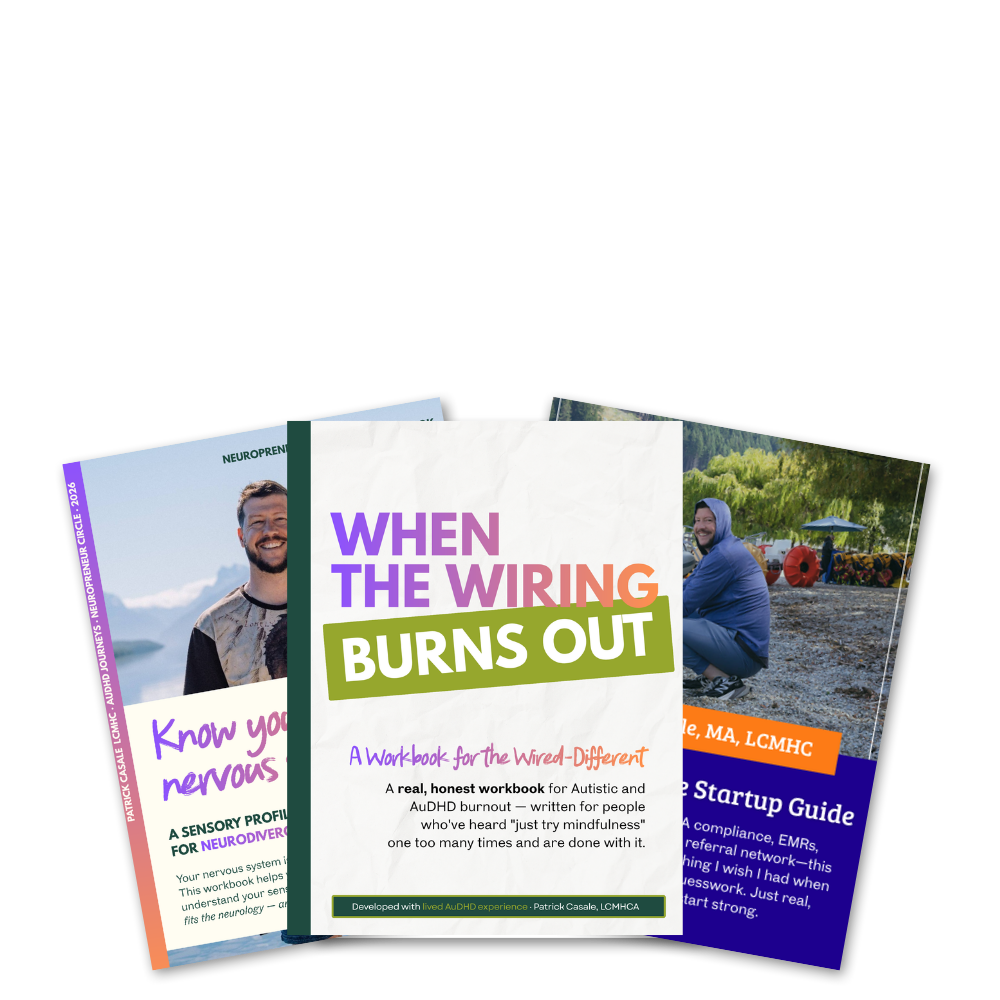
FREE PRIVATE PRACTICE GUIDE

Join the weekly newsletter for private practice tips, podcast updates, special offers, & your free private practice startup guide!

We will not spam you or share your information. You can unsubscribe at any time.

All Things Private Practice Podcast for Therapists

Episode 227: Affirming All Bodies: Dismantling Anti-Fatness in Therapy and Everyday Life [featuring Sabrina Longley]

Show Notes

In this episode, Patrick Casale talks with Sabrina Longley about what it means to truly build a fat-affirming therapy practice. This topic is especially important as we head into the new year, and toxic resolution/fitness culture starts ramping up.

Here are 3 key takeaways:

  1. Assume Less, Listen More: Approaching clients from a place of curiosity rather than assumption is crucial. Don’t make judgments about health, habits, or desires based on body size.
  2. Representation Matters: The resources, images, and stories we use in our practices should reflect the identities and lived experiences of all bodies—including larger bodies. Take the time to diversify your media, office environment, and marketing materials.
  3. Challenge Industry Narratives: The weight loss industry cashes in on insecurity and shame—often with little focus on actual health. As providers, let's not become agents of these narratives. Instead, support every client’s autonomy, dignity, and humanity.

More about Sabrina:

Sabrina is passionate about offering lived and clinical experience support to both clients and other mental health providers related to topics including racial justice, neurodivergence, fat liberation, teen mental health, and DBT. She works to honor her own lived experience and the lived experiences of other marginalized folks to promote ethical and just mental health care.


🎙️Listen to more episodes of the All Things Private Practice Podcast here
🎙️Spotify

🎙️Apple

🎙️YouTube Music
▶️ YouTube
✈️ Check out available Retreats
🗨️ Join the free Empowered Escape FB Community
🗨️ Join the free All Things Private Practice FB Community


A Thanks to Our Sponsors: The Receptionist for iPad, Alma, & Portland, Maine, Summit 2026!

The Receptionist for iPad

I want to thank The Receptionist for iPad for sponsoring this episode.

This podcast is sponsored by The Receptionist for iPad, a digital check-in system that eliminates the need to walk back and forth from your office to the waiting room to see if your next appointment has arrived. Clients can securely check-in for their appointments and you'll be immediately notified by text, email, or your preferred channel. Break free from interruptions and make the most of your time. I've been using them for almost three years now and it saves me hours in my week.

Start a 14-day free trial of The Receptionist for iPad by going to thereceptionist.com/privatepractice. Make sure to start your trial with that link. And you'll also get your first month free if you decide to sign up.

Alma

I want to thank Alma for sponsoring this episode.

Building and managing the practice you want can be challenging. That’s why Alma offers tools and resources to help you build not just any practice, but your private practice. They’ll help you navigate insurance, access referrals who are the right fit for you, and efficiently manage administrative tasks — so you can spend less time on the details and more time delivering great care. You support your clients. Alma supports you.

Visit helloalma.com/ATPP to learn more.

Portland, Maine, Summit 2026

 The 2026 Doubt Yourself Do It Anyway Summit is happening for the first time in the United States in beautiful Portland, Maine, on September 1st–3rd, 2026. Portland, Maine, is a beautiful coastal city in the Atlantic Ocean. There's a lot of history there, and it's a very funky, creative, safe, walkable, diverse, and progressive city. You will get 9 NBCC CEs. We have ASWB pending—we'll make an announcement when that's finalized—and have 13 prolific industry leaders. This summit has always been about showing that our skills are applicable in so many different ways, and to motivate you to think bigger, grow in this profession, take more risks, work through self-doubt, and really embrace the doubt-yourself-do-it-anyway mentality. Spots are limited. Reserve your spot here: empoweredescapes.com/portland-maine-summit
Doubt yourself. Do it anyway. See you in Maine.


Transcript

PATRICK CASALE: Hey, everyone. Welcome back to the All Things Private Practice podcast. I'm joined today by a repeat guest, friend, colleague, co-worker, Sabrina Longley, who is a passionate… I just fucked up your bio that I was just giving you credit on because I said it wrong. Sabrina is passionate-

SABRINA LONGLEY: That’s okay.

PATRICK CASALE: …about offering lived and clinical experience to support both clients and other mental health providers related to topics including racial justice, neurodivergence, fat liberation, teen mental health, and DBT. 

She works to honor her own lived experience and the lived experiences of other marginalized folks, to promote ethical and just mental health care. 

And I was just giving Sabrina credit off-air about giving me a better bio this time than the first time she was on, which, I think, the bio was like, “I'm Sabrina, I'm a social worker.” And-

SABRINA LONGLEY: Okay, I think it was, “I'm Sabrina, I'm from North Carolina. I'm a social worker.”

PATRICK CASALE: Yeah, it was probably that iteration. So, better. We're moving in the right direction. 

Today, you want to talk about building a fat-affirming practice. And I know you kind of mentioned we're heading into the holidays. Right now, when we're recording. It's the end of October. When this comes out, it'll probably be the end of December-ish, early January, which, you know, is all of a sudden resolution time. And I'm going to get my shit together time, right?

And you mentioned something off-air, which made me laugh, which was like, “I hate my body and help me make money off of it.” So, here we are.

SABRINA LONGLEY: I really like what your burned-out brain does.

PATRICK CASALE: My working memory is trash, okay? I just had Bobby Joe Malkin on. And I was talking about working memory. And how there's a painting to the left on my wall that is uneven. And it was bothering me, two podcast recordings ago. And I meant to straighten it out. And then, I told her about it 20 minutes ago. And-

SABRINA LONGLEY: And [CROSSTALK 00:02:54]-

PATRICK CASALE: You know? And I'm now looking at it again. So, my working memory is trash. It's just trash.

SABRINA LONGLEY: I will try to remind you as we wrap this one up, to go back to it. I sometimes will do that at the end of session, like, just remind my mind. I'm like, “This was the thing that you did right, right? At the start of session.”

PATRICK CASALE: Yeah, you know, when I'm in that seat, I'm like, “I'm great at that.” And then, when I take my own advice, it's always so hard. Okay, what was the phrase that you said that made me-

SABRINA LONGLEY: Like, weight loss industrial complex. The goal of it, right, is to say, “Hey, we hate your body, and we want to make a lot of money off of how much we think that it's bad.”

PATRICK CASALE: Sure, that's way more articulate and accurate than what I said. So, yeah, and that's very, very true. And, you know, I think the holiday season in general has to be hard, right? Like, if you are someone who's going to be spending any amount of time, whether it be through Thanksgiving, through Christmas, Kwanzaa, Hanukkah, New Year's, anything, where it's communal-based, and you're around a bunch of people, people do like to comment on your physique. They like to comment on your weight or lack of weight. Like, I know when I am skinnier in my life, people are like, “Oh, you look so healthy.”

SABRINA LONGLEY: Yeah.

PATRICK CASALE: And I'm like, “Wait, what? I just lost like 10 pounds because I haven't been sleeping for long.”

SABRINA LONGLEY: Right? Yeah? No, there's some kind of really strong confidence that people have in making body comments, right? Whether because they think that it's like a kindness, or because they think that they have a right to like be the health police in some way. I will often be like, “Oh my God, Dr. Bean? Is that you? Like my doctor? You're all of a sudden here and making comments on my body that you've never made before as my healthcare provider, right?”

But somehow, we're very emboldened to make body comments. And I think a big part of it is that like, anti-fatness is a really, really big part of most systems. It's one of the last things that the right and the left politically agree on, is that fat people suck, and they're lazy, and they're bad, and they deserve nothing but like, shame and pain.

And so, you know, when that's kind of like, it's coming from everywhere you do, you get a lot of people who feel very confident. Like, making comments that, like, I will sometimes share things that people have said to me or to my friends. And people's jaws hit the ground at like, how bold it is to say that to someone you don't fucking know, especially when it's like, there's all that old trope of like, oh, you know, you ask someone when they're due, and they're not actually pregnant. It's like, I don't think that we pay enough attention to how harmful that can actually be, right? In a lot of different ways.

PATRICK CASALE: I've watched it unfold many times, like people coming up to my wife in stores and like touching her stomach, which is a whole nother conversation of how people feel, like they should just have access to people's bodies, especially people who have uteruses bodies. And-

SABRINA LONGLEY: Especially, black people who have uterus bodies, or people that they perceive to have uteruses, right? Like, there is this, like, “Oh.” And it always harkens back to me of like, black people used to literally be put in petting zoos. And I'm like, you don't see how this is actually an echo of that same pattern happening again. But you think it's okay because of how we stand socially, both from a racial perspective, but also, because my body is something that you are perceiving, you know? That, like, there are comments of like, “Oh, you know, I'm so glad that you're getting healthy.” 

And it's like you don't actually know anything about the state of my health unless I have shared it with you. And that, like none of the things that are part of the state of my health have to do with anything about my weight. 

I was in a car accident, and I broke my back. I use a cane, and it's not because I'm fat, it's because I broke my back. I would have broken it if I was skinny too. Like, that isn't something that would have changed, but I think a lot of people are really in that. And unfortunately, like in mental health, it is one of the first things that we go to. Is like, “Oh, our clients need to be moving. And like that is actually how they'll feel better emotionally.” 

And yes, I think that movement can be really helpful and important, but to assume that your fat clients are not moving already is a really big problem. 

Reagan Chastain is a fat athlete, and statistician, and like activist. And I went to a talk of hers recently. She was down here in Durham. And she's a marathon runner. And she went to the doctor, and the doctor was like, “You know, even if you just walked, like, 10 minutes a day, it could do wonders for your health.” And she was like, “Well, I ran five miles yesterday.” And he was like, “Well, you don't have to lie.”

PATRICK CASALE: Oh.

SABRINA LONGLEY: First of all, why would I make up that? Like, why would that be the lie I would go to? But like, there is this automatic assumption that we know the activity level, the food intake, all of these different things, even, like, I know people with diabetes, where their doctors will be like, “You need to change what you're eating.” Without ever asking what they're eating. 

PATRICK CASALE: Yeah, there's a lot of implicit bias. And there's a lot of assumptions. And that automatic equation of like fat equals lazy, fat equals less than. Fat is a bad word. And you mentioned this in your talk in Greece, about like traveling while fat, and how concerned about losing a suitcase in an area where they may not have clothing that would fit your body.

SABRINA LONGLEY: Yeah. 

PATRICK CASALE: And I think that was eye-opening for a lot of people in that room, because they were like, “Oh, I've never thought about sizing that way. I've never thought about, like, discriminatory practice in terms of, like, the fashion industry in that way.”

SABRINA LONGLEY: Yeah, there's actually a really cool, like, little graphic made by The Fat Lip. Like, thefatlip.com. And it kind of goes through the way that we in the fat liberation community talk about, like, the different levels of fat, right? And so, because fat isn't a feeling, right? Fat is an access issue, right? 

And so, I don't feel fat. I literally cannot buy clothes in certain stores. They do not make my size. I go to specialty stores, right? So, I'm about a Torrid size four. And I became a Torrid size four like during lockdown. So, I was a Torrid size three before that. And let me tell you, like the amount of access that I had to close shrank drastically. And we use Torrid because that's a really big, famous, like, popular plus-size brand, and retailer in the United States. And so, they're a little bit standardized. But women's clothes are always kind of bullshit in terms of standardization. 

But, like, I need a seatbelt extender. Actually, I asked for one on my flight from Canada to Athens. And they forgot to bring me one. I spent that entire flight with no seatbelt on because, like, A, like, I was all the way in the window. They couldn't really see if I, like, you know, they come by and check if you have it. But, like, I'm fat, they didn't know, is it under, I don't know. And they just forgot to bring me one, you know? I don't care that much because, like, if the plane goes down, I don't know what this little tiny seatbelt’s going to do for me. But you know, like, it's not even something that they're really paying that much attention to, right? 

And so, you know, like, there's all of these things that I keep a track of in my head that other people don't have to. And so, this, chart, kind of goes through, like there's small fats and like there are ways in which, you know, maybe you sometimes have to shop in a plus-size store, but a lot of times a straight-size store will carry clothes that you have. You fit in most seats that are publicly available, you know, in these different places. You don't need a seatbelt extender, all these things. 

And then, there's mid-fat, right, which is a little bit, like, you need a little bit more of that, like specialty sizing, you don't fit in all the things. Sometimes you have to shop online. And then, there's super fat and infinite fat. And that's when you start getting into, like, four or five, six plus, like sizing. And like, sometimes even online. Like, even plus-size stores in person do not have my bra size. And sometimes they don't even have it online, right? Because of the way that bras are made.

And it's annoying, and it sucks. And so, then you know when a lot of, like, even dietetics, right? So, like, dietitians, and nutrition therapists, and things like that. Like, a lot of them are thin, and a lot of them are, like, straight-sized, or at most, like, small fat. There aren't a lot of fat providers in that space. And so, it ends up being that, like, okay, like, how is this person going to respond to me? Are they going to understand that I'm not just saying I feel fat and it's a cognitive distortion that I need to fix? Are they going to understand that I literally do not have access? And that I was so panicked before my flight to Scotland because I was like, I fit every single piece of clothing that I wore in Scotland. I fit in my carry-on. And then, my little backpack that I carried as well, which we were not sure it was going to get my there. My personal item, which is supposed to be like, tiny, was the same size as my carry-on. I sent Patrick a picture. And he was like, “I have concerns.”

PATRICK CASALE: You know, I did have concerns, you know, more for the reason of like, what are they going to tell you? Or, like, what are they going to say? But you know, it was eye-opening for me, because you were like, “Well, I have to have this. Like, I can't not have this. And I'm not going to check a bag, because I'm so concerned that if the bag is lost…” Which is so fucking common these days. “…then what am I going to do in this other country? Like, if I don't have access to clothing, if I don't have access to, like, clean underwear, and bras, because, like, I just can't find them.”

And no, for me, I really appreciated you sharing that information, because that was not at the top of my mind. And I think as someone who I have, like, body dysmorphia, and I constantly think that I'm fat, I also have access to all of the things that you just listed that you may not.

SABRINA LONGLEY: Yeah. And I think that that's an important thing too, right? Is like that still matters, right? That like that is the way that the anti-fatness in the culture shows up for you, in the same way that you as a white, cis male, are still affected by the patriarchy, right? You are still affected by anti-fatness, just not in the same ways, right? And so, like, we have to be aware of those differences in order to actually serve both parts of the population.

PATRICK CASALE: Yep, that's a huge, important distinction. So, with that being said, moving into affirming practices, tell us about what that means?

SABRINA LONGLEY: So, like anything, it means a little bit different to everybody. But I think that one really important part is to start from a, especially if you're not active in the fat liberation space, right? Start from the I do not know space, right? I don't know what my client eats. I don't know if they are what I would consider healthy or unhealthy. I don't know if they care about being healthy. We don't owe health to anyone, right? 

PATRICK CASALE: True.

SABRINA LONGLEY: And so, like, really starting from a curious spot, as much as you can before trying to say, like, “Oh, but like, you need to move your body.” Don't presume that you know, how much they do or don't do that, or how much they can or cannot, which is a whole more disability focused thing, right?

PATRICK CASALE: For sure.

SABRINA LONGLEY: You know, have, like, I remember, so I've got an office in Raleigh. And you messaged one day and were like, “Do you have, like, couches and chair? Like, “Do you have everything you need in the office in Raleigh?” And I was, you know, “Like, a better couch would be nice.” It was actually this one that was in our office. I got it for free. It's bad. And you were like, “Here's a budget. Find a new couch.” And I was like, “Okay.” 

And I immediately went and, like, went to the weight ratings on Wayfair, because I want the highest weight-rated couch, partially because, like, I work with teens. You know, we have folks who work with couples. We have folks who work with who work with multiple people in a family. If multiple people in our family are in the office, and need to sit down, and are fat, we need a couch that is weight-rated to support everybody who needs to sit on that, right? And I never want it to be that a client comes in and is like, “Ooh, is that going to hold my weight?” Because I've definitely had that happen. And it's scary. And it feels bad to have to think about that as the first thing that you think about in the beginning of your therapy session.

PATRICK CASALE: Right. Yeah, when you're already self-conscious enough, as it is, about whatever else is going on. And how am I going to be perceived? Now, how am I going to be perceived because of my body.

SABRINA LONGLEY: Exactly.

PATRICK CASALE: And having to almost go into some of those sessions, if you are not explicitly stating that you practice from a fat liberation, health at every size, affirming practice that maybe my therapist is judging me because of how I look.

SABRINA LONGLEY: Yeah, exactly.

PATRICK CASALE: [CROSSTALK 00:19:01] judging me because of how I look, yeah.

SABRINA LONGLEY: Right. And that can make it even harder, too, for clients to come forward and let us know what they're struggling with, right? So, like, you know, are they struggling with telling you about their dating life or, like, their romantic goals, because they're worried that you're going to say, “Well, if you lost weight, more people would be interested.” You know? Are they struggling to tell you when they're not eating because they don't think that you'll believe them?

PATRICK CASALE: Right.

SABRINA LONGLEY: Right? Making them more at risk for, you know, complications that might be medical or mental health-wise, with like disordered eating patterns.

PATRICK CASALE: Right. Or shaming based on perception, or what I think you should be doing or not be doing. I know, just shout out to Cindy Miller, who, anytime I am like, “I'm going to eat cake for breakfast. I'm going to text Cindy.” And she's going to be like, “Fuck yeah, you should do that.” Because I can get real judgmental about my own experiences very quickly. Because again, being in a headspace of dysmorphia. I'm like, “You should not do these things, and this is what's leading you to feel this way.”

But in reality, there's so many factors, right? That we do not know for our clients about their chronic health, their disabilities, their chronic pain, their immune systems. Like, genetics. There's so much behind the scenes. And if we just completely make assumption, if I was to go into my therapist's office or doctor's office and be like, “Yeah, I've been eating cake for breakfast every day.” They would be like, “Do you want to see the nutritionist?” And I'm, “No, I want to do this. Like, this is what I want to fucking do.”

SABRINA LONGLEY: And like, they don't actually know if that's having… I mean, like asking that question before you've seen blood work, before you’ve seen like anything that is indicating that you are in poor health in any way is like wild to me. Like, we don't do that for other things, right? 

And so, like, if you were, you know, whatever the version of healthy that they are thinking of looks like, and you said, I'm eating cake every day for breakfast, the assumption that they might make is, “Oh, but you're going to the gym, and you're working it off.” Or, “Oh, you're doing whatever else you need to do to be healthy. And so, we're okay with that.”

You know, there's a post that I saw. It was essentially, like, when you're fat, what you get prescribed from the doctor is what other people call anorexia, right? Since childhood, I've been fat since I was a kid, right? Like fat and tall since I was a kid, the whole time, right? And I have been literally prescribed the eating patterns that are in line with anorexia, except that anorexia also has a weight limit.

PATRICK CASALE: Right, right.

SABRINA LONGLEY: Right.

PATRICK CASALE: Which creates even more damage, right? And mental, like, manipulation from the medical systems and the mental health systems. And it can really lead to some significant disordered eating patterns. It can be so negatively impactful and so damaging. And also, like, if we're taking medical advice at like, from people who say they know what they're talking about, the person in charge of the Department of Health and Human Services, it's fucking wild. So, like-

SABRINA LONGLEY: Yeah. Well, but even before that, so when, like, the term OVC was starting to, like, kind of come forward. And basically, the weight loss industry asked the World Health Organization, WHO, to come together in order to, like, set the standards. And the WHO were like, “We don't have the time or money for that.” And the weight loss industry funded fully the meaning of the WHO that set those standards. 

PATRICK CASALE: Oh, yeah. 

SABRINA LONGLEY: So, like, the entire thing that, what we think of as health is completely funded by and organized by the weight loss industry.

PATRICK CASALE: Right. And there's billions of dollars in that. And think about how many people join the gym to start the new year off, how many people go to the gym more than once after they sign up that membership, that whole mechanism is contingent on people signing up because they're like, “I'm going to make New Year, new me.” And then, falling off. And there's so much money in the portrayal of what is fit, what is healthy, what's desirable, and pushed in front of you all the time on media.

SABRINA LONGLEY: Yeah, what's interesting to me is that, like, it never is actually about health, right? 

PATRICK CASALE: Right.

PATRICK CASALE: Like they say it is. But realistically, there are healthy people at every weight in the world. And there are “unhealthy” people at every weight in the world. 

And like, at the end of the day, A, I don't really know why my health is your business if you're not my doctor. And even then, like, it needs to be my business first. Like, I have to decide that that's what I'm invested in. And what my measures of that are. Like, this is kind of the same thing as, like, there are ways in which I will never be healthy to certain degrees because I am disabled, right? That's just not, you know what my body isn't. Like, these systems are also entwined in that way. But, yeah, there's like, all of this money to be made. And that is something to keep in mind when you're seeing weight loss ads when you're seeing you know all these things. And then, when you have a client sitting in front of you, don't be part of the system that is making money off of people hating themselves. 

PATRICK CASALE: Absolutely.

SABRINA LONGLEY: That's really well said. And I like what you said about being curious, just being open-minded, and curious, and not judgmental. I’m really thinking of Ted Lasso right now. And ultimately, just thinking like I don't know anything about this person. How am I to make assumptions based on body type?

SABRINA LONGLEY: Yeah, exactly. And where did that urge come from? Right? Who empowered me to feel that way? Do I trust them? Do I think that they have my best interests at heart? Do I think that they have other people's best interest at heart? I think the answer that is usually no.

PATRICK CASALE: Yeah. And I think that sucks in a lot of ways when we're talking about, like, therapists, medical professionals, people who work in the “health industry.” But it's a complex in itself, right? So, like that's a whole nother fucking pathway, but it's a complex in itself when we're deciding who's healthy, who's not, who's functioning optimally, who's struggling. 

I mean, hell, we're in a time period right now, societally, where a bunch of, well, not a bunch, millions of people are about to lose access to food security, and a lot of narrative is going to be like, “Those people are fucking lazy. Those people don't fucking care. If those parents cared about those kids, they would work harder.”

SABRINA LONGLEY: It's interesting, too, because I'm seeing a lot of similar things that happen when the autism, like, list was coming out of, like, “Oh, but like autistic people can pay taxes.” And, like, trying to almost justify why we should care about people. 

And that's kind of the same thing that happens, right? Is like, there are good fatties who want to be thin, and who want to do all these things, and who starve themselves and all this shit. And then, there are bad fatties who, like, don't do any of that or play into that. And at the end of the day, right? Like, even those types of things is like, I don't give a fuck if they're lazy. I don't really believe in laziness, but if I did, I don't give a fuck if they're lazy, they still deserve to eat. Like, that is at the end of the day, how it works. You're a person with a body who needs food. That's the end of it.

PATRICK CASALE: It's humanity, right? Like, I always think about who wins when groups of communities are divided like that, about like, if you want to say good fatties, bad fatties, autistic people who maybe are lower support needs versus higher support needs, who is fucking winning when these groups are at each other's throats about who's good and who's bad?

SABRINA LONGLEY: Yep, class consciousness, baby.

PATRICK CASALE: Yeah. And it's a weird time to, like, be alive in terms of, like, what a meta experience to constantly be examining this stuff in real time, and to be seeing it on social media, and in front of your face at all time in all sorts of different media, and to almost be conditioned to believe and react a certain way based on what's put in front of your face.

SABRINA LONGLEY: Yeah, exactly. Yeah. I think that that's another part is like, really making sure that you have diversified media consumption. Because we all consume media, whether it's social media, whether it's books, whether it's podcasts, whether whatever it is. Like, make sure that you're listening to fat people, that you're watching how they live their lives with the ones who have shared it with you. 

Like, I got a comment on an Instagram post the other day that was like, “People always tell me, like, it's not my job to educate you.” Yeah, because the education exists. There are tons of fat people who have written books. There are fat people with podcasts. I have one myself. There are fat people who are on TV, and in movies, and who are making TV, and movies. Like, the narratives are out there. Go and find them, right? And then, engage with them. And then, that way, you also have more resources to share with your clients.

PATRICK CASALE: Yeah, that's a really good point. One thing that's coming to my mind is, you know, we've kind of been creating some new web pages and services pages on our website for Resilient Mind Counseling, and how you were mentioning to our person who's helping us with web design, like it's really hard to find images of fat people because we want to, obviously, create and model representation. And if all the Canva images are like the same fucking image, or there are basically none to be found, that's problematic.

SABRINA LONGLEY: Yeah, well, and it's not even like none to be found. It was, I can't find any pictures of happy fat people who aren't at the gym, of large fat people, of fat people smiling. Like, it's a very specific type and narrative that that is really hard. I actually ended up using, like, Unsplash, which did have some, which was really nice. But like, it is actually one of those things where you'll see an image that's like, “Oh my God, we love diversity.” And it's all thin people. It's people of every shade of even, like, there's different disability status, but it is all thin people. And like, that's the kind of stuff that, like, really gets me. And even when it is fat people, it'll be, you know, thin waist, like, hourglass shape, like a particular type of fat person, right? There's like, hierarchy in all of this. And it is possible [CROSSTALK 00:29:45]-

PATRICK CASALE: [CROSSTALK 00:29:45] miserable, and depressed, and, like, my [CROSSTALK 00:29:49]-

SABRINA LONGLEY: [CROSSTALK 00:29:49] wearing gym clothes.

PATRICK CASALE: Yeah.

SABRINA LONGLEY: Yeah.

PATRICK CASALE: Yeah, yeah. And I'm glad that you know that's something that you brought up in those meetings, too, because, again, needing the voices of people with lived experience to be able to say, like, hey, this is not representation, right? Like, we need to do better. So, if you're listening and you're like, “I support health at every size, and I offer fat-affirming therapy.” And your website is all skinny people, it may not send the right message.

SABRINA LONGLEY: I have a story about that for you.

PATRICK CASALE: [CROSSTALK 00:30:26] story, okay.

SABRINA LONGLEY: It's an all fair story. It's not like bad. I can tell part of it on air. I was meeting with my dietician. And she was like, “Oh, like, there are these really cool, like, cards that kind of go through these different words about body affirmation. And they're made by this person with this practice.”

And I was like, I don't have the cards in front of me. We meet virtually, but I was looking them up online. And I was like, “Are any of the cards fat people?” Like, the whole point of this is like, to build, like, body confidence, and there are no fat people. 

And so, you know, she was like, “Oh. Oh, no.” It's like, yeah. Like, I think it's really easy, again, when you are not exposed to a particular thing, like, it's really easy to default to what you see all the time. And so, if you're not seeing fat people, because you're not actively looking for them, even if you are fat yourself, like, that's the other part, right? Is like, I see myself more than other people do. Like, average folks who aren't on Zoom meetings all day or things like that in therapy. 

But like, there are actually a lot of ways in which, if I don't specifically curate my environment, my friend group, my work colleagues, I mean, like, you know, I do hire anyway, ADHD, you know, my social media, like the movies that I watch, fuck the porn you engage with. Like, there are tons of ways in which you need to make sure that those are all diverse in lots of different ways, or you are going to start normalizing one thing over another.

PATRICK CASALE: Yeah, that's a great point. Very good point. Yeah, I think that's a great transition point and final perspective for everyone listening. Yeah, I always appreciate your takes. And I always appreciate learning from you. So, I think just keep doing what you're doing and getting your voice into the world. And I know you have some ways that you are doing that for people who might be interested. So, please share that.

SABRINA LONGLEY: Yeah. So-

PATRICK CASALE: [CROSSTALK 00:32:33].

PATRICK CASALE: First of all, I'm doing a lot of things. And so, I feel lots of ways about that. But yeah, so since the last time I was on, I started a business. So, I offer a consultation, training, speaking on all the things Patrick listed earlier, and more. And you can find those things at my website is radicalinsightsconsulting.com. I'm also Radical Insights Consulting on Facebook and Instagram. I also host a podcast with my friend Kade, where we are two a-spec autistic kinky therapists who talk about relational stuff for a-spec autistic kinky folks. And so, you can find that at Aces Up Your Sleeve, wherever you listen to podcasts. 

We also have a Patreon for some bonus content. We actually have an episode coming out soon with Patrick and I's friend, Jamie, where she talks about, like, how to make a dating profile and how to like use the apps. Oh, it's such a good episode, and the bonus content with her will be on our Patreon. So, that's really fun. And you can also find us at Aces Up Your Sleeve on Facebook and Instagram as well. So, yeah.

PATRICK CASALE: Sweet. We'll have those links in the show notes for all of you, so you have access to everything Sabrina just listed. Thanks again for coming on. And I'm sure I'll talk to you in a lot of different ways over the next couple of hours.

SABRINA LONGLEY: That seems highly likely, given our track record.

PATRICK CASALE: That’s highly likely. And to everyone listening to the All Things Private Practice podcast, new episodes are out on Saturdays and all major platforms and YouTube. Like, download, subscribe, and share. Doubt yourself, do it anyway. See you next week.

FREE PRIVATE PRACTICE GUIDE

Join the weekly newsletter for private practice tips, podcast updates, special offers, & your free private practice startup guide!

We will not spam you or share your information. You can unsubscribe at any time.

Send Me The Free Private Practice Guide

This guide is full of resources, referral codes, step by step strategies,
retreat & podcast information, and more.

We will not spam you or share your information. You can unsubscribe at any time.