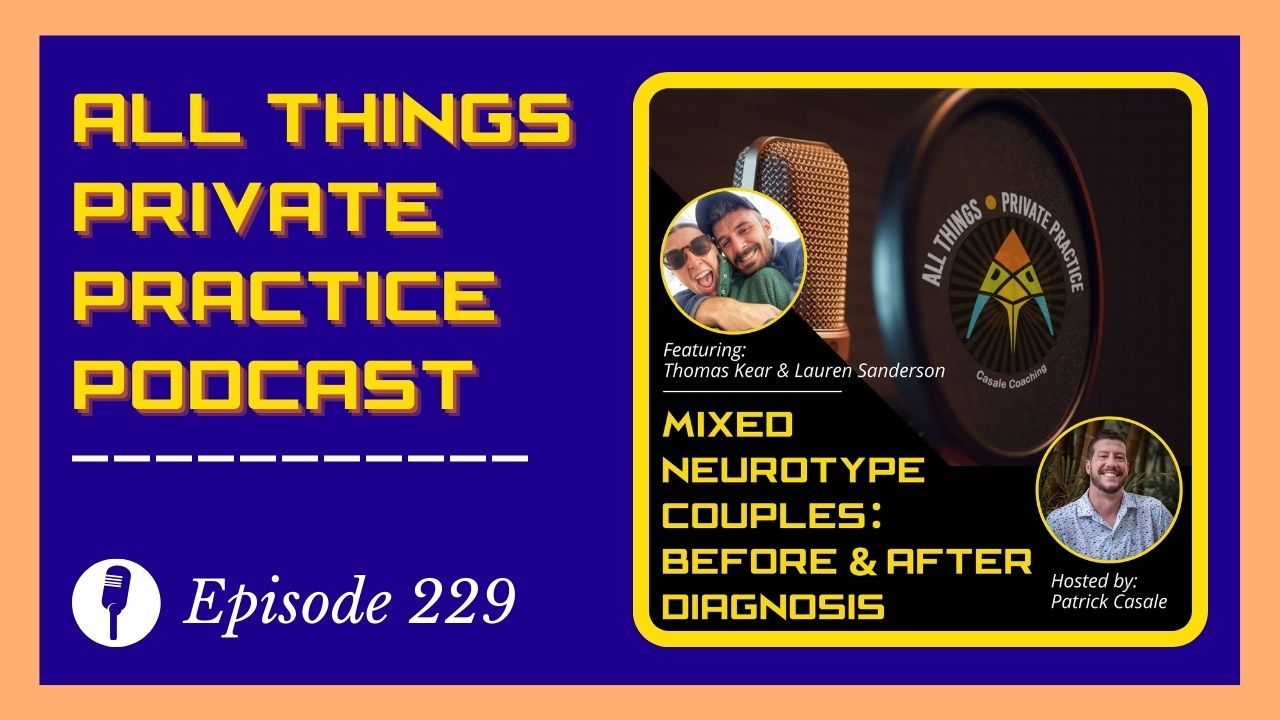
Episode 229
Jan 10, 2026

Mixed Neurotype Couples: Before and After Diagnosis [featuring Thomas Kear and Lauren Sanderson]

Hosted by: Patrick Casale
All Things Private Practice Podcast for Therapists

Show Notes

In this episode, Patrick Casale talks with Thomas Kear and Lauren Sanderson, founders of neuroduo, about being in a mixed neurotype relationship, navigating ADHD and Autism, whether diagnosed or not. This conversation is packed with real-life reflections on neurodiversity, partnership, and communication.

Here are 3 key takeaways:

  1. Understanding Yourself First is Crucial: Before you can support your partner, you need to understand and learn about your own neurodivergence—only then can you communicate your needs and work together.
  2. Communication Styles Can Be Wildly Different: The “Thunderstorm and Turtle” analogy for mixed neurotype partnerships (ADHD and Autistic) is a powerful reminder that urgency and withdrawal can clash, but knowledge and compassion make repair possible.
  3. Diagnosis Brings Validation, Not Instant Solutions: Getting an Autism or ADHD diagnosis doesn’t change who you are overnight, but it does give you the language and understanding you need to stop blaming yourself—and to ask for what you need.

More about Thomas and Lauren:

We’re Lauren and Tom, a neurodivergent couple living in Queenstown, New Zealand. After both receiving ADHD diagnoses as adults (Tom also with Autism and OCD a year prior), we launched neuroduo – a platform to share our lived experiences with ADHD and Autism. Through storytelling, humour, and real talk, we help others feel seen, understood, and empowered.

Our aim is to educate, empower, and advocate for neurodivergent people by sharing real, lived experiences and building more inclusive spaces — one conversation at a time.


🎙️Listen to more episodes of the All Things Private Practice Podcast here
🎙️Spotify

🎙️Apple

🎙️YouTube Music
▶️ YouTube
✈️ Check out available Retreats
🗨️ Join the free Empowered Escape FB Community
🗨️ Join the free All Things Private Practice FB Community


A Thanks to Our Sponsors: The Receptionist for iPad & Portland, Maine, Summit 2026!

The Receptionist for iPad

I want to thank The Receptionist for iPad for sponsoring this episode.

This podcast is sponsored by The Receptionist for iPad, a digital check-in system that eliminates the need to walk back and forth from your office to the waiting room to see if your next appointment has arrived. Clients can securely check-in for their appointments and you'll be immediately notified by text, email, or your preferred channel. Break free from interruptions and make the most of your time. I've been using them for almost three years now and it saves me hours in my week.

Start a 14-day free trial of The Receptionist for iPad by going to thereceptionist.com/privatepractice. Make sure to start your trial with that link. And you'll also get your first month free if you decide to sign up. 

Portland, Maine, Summit 2026

 The 2026 Doubt Yourself Do It Anyway Summit is happening for the first time in the United States in beautiful Portland, Maine, on September 1st–3rd, 2026. Portland, Maine, is a beautiful coastal city in the Atlantic Ocean. There's a lot of history there, and it's a very funky, creative, safe, walkable, diverse, and progressive city. You will get 9 NBCC CEs. We have ASWB pending—we'll make an announcement when that's finalized—and have 13 prolific industry leaders. This summit has always been about showing that our skills are applicable in so many different ways, and to motivate you to think bigger, grow in this profession, take more risks, work through self-doubt, and really embrace the doubt-yourself-do-it-anyway mentality. Spots are limited. Reserve your spot here: empoweredescapes.com/portland-maine-summit
Doubt yourself. Do it anyway. See you in Maine.


Transcript

PATRICK CASALE: Hi, everyone. Welcome back to the All Things Private Practice podcast. I'm joined today by Thomas Kear and Lauren Sanderson. I hope I said your last name right, Tom? 

THOMAS KEAR: Yes.4

PATRICK CASALE: A neurodivergent couple living in Queenstown, New Zealand, after both receiving ADHD diagnosis as adults. Tom also discovered an autism and OCD diagnosis a year prior. They launched neuroduo, a platform to share lived experiences with autism and ADHD through storytelling, humor, and real talk. They help others feel seen, understood, and empowered. 

Really excited to have you on here, because, you know, I found your stuff on social media. It seems like we mutually follow each other and some of each other's content. And I'm always excited about mixed neurotype relationships and partnerships. So, thank you for coming on. 

And I also want to name to everyone watching, it is currently 7:25am, a day later, where they are, hence the very similarly matching pajama set. And I really love it. So, thank you for making the time and coming on so early.

THOMAS KEAR: No worries [CROSSTALK 00:02:05].

LAUREN SANDERON: [CROSSTALK 00:02:05] Thanks for having us. We really love your podcast. So, this is all [CROSSTALK 00:02:09]-

THOMAS KEAR: Yeah [CROSSTALK 00:02:09].

LAUREN SANDERON: Yeah, thank you.

PATRICK CASALE: We might actually get to meet when I'm in Queenstown in the end of February and early March. So, I'm hosting two events there in March. And I'm really looking forward to being back there, because, wow, what a beautiful, beautiful part of the world.

THOMAS KEAR: Yeah.

LAUREN SANDERON: It's absolutely stunning. We lived in Auckland before, and moved to Queenstown about two years ago. And we were like, “Why didn’t we not do that sooner?” [CROSSTALK 00:02:36].

PATRICK CASALE: I spent two and a half days in Auckland, and that was enough for me. I don't think I ever need to go back. I used it as a base for Hobbiton, which, for me is a dream come true, but otherwise, I wouldn’t go back.

THOMAS KEAR: Yeah. 

LAUREN SANDERON: Are you a big fan of Lord of the Ring?

PATRICK CASALE: Oh, yeah. Big time special interest, probably my biggest special interest. I think I've probably seen the movies collectively, I would guesstimate 200, 300 times, read the books at least 100 plus times. Like, yeah, it's been a journey, for sure. 

THOMAS KEAR: [CROSSTALK 00:03:08] a dream come true.

LAUREN SANDERON: A dream come true, exactly. 

PATRICK CASALE: It was very, very cool. So, love your country. Love it very much. Are you both from the UK?

LAUREN SANDERON: Yeah, we're both from the UK, but we met in New Zealand. We came over separately and met in Auckland [CROSSTALK 00:03:23]-

LAUREN SANDERON: Yeah.

THOMAS KEAR: Yeah. When we met, we weren't both neurotypical, but we both were not diagnosed as neurodivergent, and didn't know anything about it. And that's kind of a big story and journey itself. But again, diagnosed three/four years into the relationship, working through that, and luckily, coming out the other side. But yeah, a lot of learning.

LAUREN SANDERON: A lot has happened. 

THOMAS KEAR: A lot has happened, yeah.

PATRICK CASALE: Oh, I'm sure. So, how long have you two been together as of right now?

LAUREN SANDERON: About five years. 

THOMAS KEAR: Yeah, just over five years.

PATRICK CASALE: So, more than halfway through the partnership, you both think, “What's going on here?” Like, what leads us to pursue ADHD diagnosis at that time? 

THOMAS KEAR: Yeah, I think it started off initially with me around autism, initially. I think my mental health probably two or three years in the relationship started taking a big dive. And there were certain things happening that would just become harder and harder to explain in myself and Lauren. 

And I was diagnosed with anxiety, which is kind of common for late-diagnosed neurodivergent, but yeah, that happened to me. I thought that was it. And then, started seeing a therapist. And he suggested to do an online screen test as he sort of had seen some autistic traits, mainly being the black and white thought process, which, when you're in your own head, you just assume that's how everyone else thinks, because that's all you know. 

PATRICK CASALE: Sure. 

THOMAS KEAR: So, I did the test, and the score was like super high. And at the time, I was like, “Well, that's brilliant, because I can't see any other way of answering the questions.” Which, looking back now, is exactly a good sign of autism. And yeah, then I asked Lauren to do the test. And she'd scored, like, super, super low. And I was like, “Hmmm.” So, that process kind of just, yeah, got kick-started pretty quickly. I think Lauren's brother is autistic as well.

LAUREN SANDERON: Yeah, my brother is autistic and has ADHD. And when I could see Tom was really struggling, I could see that there was kind of, not the same, but like similar things happening, especially with like sensory things and things like that. So, I said to Tom, “I think he potentially could be autistic.” And his therapist obviously said something similar. So, that kind of pursued him on that path of we really wanted answers for things. 

And it's not that a diagnosis is like an answer, then it's like the be-all and end-all. It's more like having that understanding. And we didn't have the understanding of why things were happening, especially for Tom, when you're in a kind of bad headspace, having that understanding is extremely helpful.

THOMAS KEAR: Yeah, and I struggled a lot to make friends in New Zealand. And it kind of happened during a similar time as COVID. So, there was a lot of moving parts, which kind of made me a little confused. 

But I think growing up, a lot of things had been masked. I was kind of a sporty, outgoing person. But looking back, that was one of the ADHD masking my autism [INDISCERNIBLE 00:06:36] yeah.

PATRICK CASALE: Sure, absolutely, okay. 

THOMAS KEAR: And then, it kind of all moved on very quickly. And then, the therapist said to me at the time of the autumn assessment that I present some ADHD traits. And that very quickly became my special interests. And like, just zoned in on that. And then, it is all [INDISCERNIBLE 00:06:56] yeah.

LAUREN SANDERON: So, then he saw that I was struggling and stuff as well. So, it's kind of like there came a time where I was kind of like helping Tom, and then I'd got to a point. I'd started a new job, I'd been made redundant. All this stuff had kind of happened. And I always struggled with like time perception and time agnosia, decision paralysis. But I just thought that was me, that is me. But I just thought it was, like, my personality.

And it just got to a point where it kind of came to a halt, and I kind of couldn't really continue with, like, living life as normal again. And Tom could see I was really struggling. And he already had his ADHD assessment appointment before me. And he kindly swapped out his appointment so I could have mine.

PATRICK CASALE: Wow.

LAUREN SANDERON: [CROSSTALK 00:07:48] could see how much I was struggling.

PATRICK CASALE: That is some Romeo Juliet type shit right there. What an act of service. But in all seriousness, that's nice to have a partnership where he was picking up on that and like, had that understanding, “Oh, I can sense this is what's going on.”

THOMAS KEAR: Yeah.

PATRICK CASALE: Question for you, in New Zealand, how long does it take to get an autism or ADHD assessment?

THOMAS KEAR: Yeah, so I think both times I probably got insanely lucky, and it was probably autism assessments, put a two or three months wait. But I know the next point after that was like nine months. So, it was cancellations. ADHD was very similar. Once you get one, and then the next one after that for Lauren was months on.

LAUREN SANDERON: But also, everyone is in this position, and we know that it can be really, really, really tricky. But we went privately for our diagnosis.

THOMAS KEAR: Yeah.

LAUREN SANDERON: So, we kind of [INDISCERNIBLE 00:08:46] on.

THOMAS KEAR: The public service.

LAUREN SANDERON: And the public service, I do think it would be better than some other countries, where there could be, like, years wait. But yeah, we ended up going privately just because we'd got to the point where we really needed…

THOMAS KEAR: Something [INDISCERNIBLE 00:09:03]-

LAUREN SANDERON: We needed something by that point.

THOMAS KEAR: [INDISCERNIBLE 00:09:06] New Zealand from 2026. I'm pretty confident this is going to be law, that GPs can actually now diagnose you with ADHD, rather than just psychiatrists.

PATRICK CASALE: Right. 

THOMAS KEAR: Because there was always this disconnect. I mean, I'm not a medical professional, but it sounds like there's a big disconnect between being able to get an ADHD diagnosis, which is really expensive to do, that to then you can't get medication until you have that. And it's always like this, yeah.

LAUREN SANDERON: Then you get your diagnosis, and then it kind of feels like, “Okay, well, what now?” And then, you don't want to have to pay another $300 to see your psychiatrist again to just go over like next steps. So, it's kind of like, if it is handed over GP, it makes it, one, a bit more affordable for everybody, until it allows GPs to actually be trained and understand, so that if we had [INDISCERNIBLE 00:09:59] right now, we don't have to try and find an appointment with a psychiatrist. We can go to the GP and have an actual conversation where somebody understands what you're talking about.

PATRICK CASALE: I think that's huge, you know? Having the accessibility, especially opposed to those long wait times, those really expensive appointments, where it's like, you know, I just need answers, or I just need support. 

And you know, for us here in the States, I mean, if you're going privately, yeah, you can probably get a quicker turnaround. But I mean, health insurance, if you're using it, it could take 12 to 18 months here to get in with a provider. And it could be really a substantial waiting process and experience, and really frustrating, because I think for a lot of us, you know, if we're not seeking out ADHD medication, which so many of us are, because we need it, and we are strictly, like, really looking for answers about, like, what the hell is going on for me? Because I feel so overwhelmed. And I feel so different. And I feel so much struggle in so many areas? Like, just having that frame of reference and the language and the understanding.

And it is that epiphany moment, but it also doesn't immediately change anything. It just gives you validation, right? And it gives you this final understanding of probably answers you've been seeking out for most of your life.

THOMAS KEAR: Yeah, and you're right there [INDISCERNIBLE 00:11:23] probably more to the autism diagnosis, because that was kind of the starting point for me, it is strange. You get this life-changing moment, and you get [INDISCERNIBLE 00:11:31]. And they give you a [INDISCERNIBLE 00:11:33]. And then, get sent on your way, which is pretty crazy. 

But there's no medication for autism, It's not something you cure. But understanding that, okay, actually, this is something that relates to me, and you can look back into your past and look at your present, and there's a lot of trauma to be dealt with, but it allows you to put things in place going forward and understand that trauma bit better.

PATRICK CASALE: Absolutely.

LAUREN SANDERON: [CROSSTALK 00:12:01] things as well, I think. Like, especially in a relationship. Tom also struggles with… what's it called?

THOMAS KEAR: Alexithymia.

LAUREN SANDERON:  Alexithymia.

THOMAS KEAR: I struggle with that.

LAUREN SANDERON: So, like understanding his emotions. And we didn't know that before, so, especially like communication styles and things like that are very, very different. And it could lead to a lot of like frustration and kind of anger on both parts. But Tom not able to explain then how he was feeling, or even the fact that he didn't know how he was feeling, well, it could be really difficult. But now that he has that level of understanding, it's so much better. And even though he still struggles with identifying his emotions, he's able to express that and be comfortable expressing that and have no shame around it [CROSSTALK 00:12:53]-

THOMAS KEAR: Yeah. The big thing is, I think, nothing changes when you get the autism diagnosis, really, because you're still the same person. You're taking medication, whatever, but being able to communicate and not be judged in a way is the change you need to allow yourself to grow into a of version yourself that you've been trying to be your whole life. 

Because, I mean, it took me a while, but it was a lot of embarrassment, I guess, the shame, guilt, of the, I can't communicate in what seems such a simple way that you've known, or you liked, because everyone else does it. 

And I mean, I've talked about it, so like I can go out and do ultra-marathons and things like that, but things I can push myself to the furthest point. And I get through all that. But then, you put me in a room where I was going to speak to other people about something, or speak to Lauren about something about emotion, and I get overwhelmed, and I break down. And it's like I just couldn't connect the two. Like, it's so different. And, yeah, understanding that was huge for me. 

PATRICK CASALE: Absolutely. I think so many of us have like spiky profiles, where there are things that we might really excel at, or things that might come really easily or naturally. And then, other things that a lot of people would say, “How come you can do this very complex thing, but this thing that we view as like very simplistic or very easy to do is almost impossible?”

And I think that is really challenging, in general, to understand about ourselves, let alone understand about other people who we care about, and that language to just be like, I still don't know how to fully explain this, but here's the language of what I'm experiencing can be so helpful on both sides. 

So, Lauren, for you, you know, as an ADHDer in a cross neurotype partnership with an AuDHDer, what's that like in terms of, like, what was it like pre-discovery versus post-discovery in terms of like, communication styles for you or just [CROSSTALK 00:14:59]-

LAUREN SANDERON: Yeah, I think, I think before Tom received his diagnosis, of what I did, it was, the word would probably be chaos. I mean, my ADHD brain, it's a chaotic brain, it is. But I didn't know that then. 

But yeah, we would describe, we actually went to see a therapist, because our communication is so different. And how she described it is, actually, yeah, it kind of hit the nail on the head. So, she said that we're a thunderstorm and a turtle. So, I don't know if you can kind of guess who is who? And she basically was saying, this was more in kind of where your communication is broken down, and you end up having arguments and things like that. And I’m the thunderstorm, because I want to get things sorted. You have a disagreement. I want to get it out of my head. 

And I didn't know then, but the reason it was like this urgency to kind of get things just solved, have the conversation, you move on from it, and it's done, was because of anxiety. It was the anxiety around, like, I don't like conflict, but from the outside it could look as if maybe I did, and it's all like anxiety-inducing. 

So, again, Tom didn't know that because I didn't communicate it, because I didn't actually know it myself. And also, the fact that kind of RSD was coming into mix. And again, I didn't really know that. So, any disagreement, any change to tone of voice could just change like an atmosphere very, very quickly, could lead to an argument. 

And then, on the flip side, Tom is somebody that needs time and space in order to understand how he feels in that moment, and kind of process what has just happened. And we didn't have anything in place then to kind of give him that time and space. It was like me coming at him, him kind of as a turtle or tortoise does, goes back into their shell, and then it would just be that vicious cycle. 

And I think then post diagnosis, now that we've learned this, it's got 100 times better. So, like, I'm able to kind of give Tom the space that he needs. Also, Tom is then able to kind of communicate with me to say, can we come back to this in… I don't know, maybe 24 hours? Or give me a time so that it's not just left floating. 

And I think that all helped from, I generally think that came from having our diagnosis, or even if you're self-diagnosed, but finding like that understanding. And like knowledge is power. We didn't know any of this before. And we would go round in circles, so…

THOMAS KEAR: But it comes back to that judgment, having no judgment, because, probably, like looking back now, I was embarrassed that I would need time to understand emotion. I would need time to write something down, like just to read to Lauren, because in that moment when emotion gets over me, the overwhelm just is too much, and whatever's in my head becomes a big fog, and I've lost whatever thought is. And I just assumed that I was being a shit person. Like, I wasn't matured in this area, and I needed to do better to forge yourself in this situation. Nine times out of 10, it would end up in turmoil.

LAUREN SANDERON: But then, it's interesting, because I would feel like I was a really bad person. I felt like I was mean because I was angry. And I felt like, why doesn't he love me? Like, this is the RSD coming in? Like, why is he not wanting to fix this? Like, he doesn't want to be in this relationship. 

And when you don't understand where that's coming from, you kind of feel a bit like psychotic. You kind of feel like, what are these thoughts? Like, does everyone think like this? Like, it shouldn't be like, you have an argument.

And then, because I think, as well, I'm big on communication. And for me, an argument is still a form of communication. It's just broken down communication. So, I think, like, not all arguments are bad. Yes, they rise and like, there's a feeling inside of you, but it's because you're trying to communicate with one another, and maybe it's clashing, or there's a difference of opinion, or, again, yeah, like, tone of voice, but it's still an element of communication. So, if you have those tools in place to be able to pick that conversation back up in a less kind of hostile environment, I think that is probably what's really helped.

THOMAS KEAR: Yeah.

PATRICK CASALE: Rupture and repair is a part of relationship, right? So, being able to repair rupture and understand where the communication breakdowns occur is so huge. 

Like, early on in my marriage, you know, my wife would give me gifts that I don't know if I liked them or not at the time, if I'm being honest, I don't even really remember. I just know that I didn't react the way she wanted me or expected me to react. 

And I had no idea that I was AuDHD when we first met. And I would just vacantly stare at her, or, like, not show a level of enthusiasm that she was expecting for the amount of effort and energy. And that would make her feel so hurt. And I would be so ashamed because I'm like, I don't understand what I'm doing wrong. I'm just reacting the way I always react. And so, that's something that has really shifted for us post-discovery. 

And then, also, I really struggle with auditory processing. So, if she's talking to me, but I'm doing something else, or my focus is elsewhere, I might be kind of responding, but I'm not actually able to absorb, right? And then, I've gotten the habit of being like, “Wait, what did you say?” And she would get so frustrated because she would be like, “You've been talking to me this entire time.” And I'm like, “I'm so sorry. Like, I have no idea what you've been talking about for the last however long.”

And that would lead to, like, immediate frustration on her part, and understandably so. But now, she'll like, get my attention by either snapping or, like, using some sort of, like, very direct language over and over to make sure I'm paying attention. Then she'll be like, “Are you paying attention? Like, can we focus on this right now?” And I'm like, “Oh, yes, let me put this down.” Because otherwise I might say yes. And then five days later, she's like, “So, we're going to go do that thing Friday, right?” I'm like, “What the fuck are you talking about?” 

THOMAS KEAR: Yeah, but gifts and even not in, like, intimate moments and stuff in the relationship, and again, previously, there's, I guess, things that Lauren might find intimate and me not understanding my own emotions and stuff. So, I would have a blank face and just not present in the way that she would expect, and that would probably make her feel not loved, I guess.

LAUREN SANDERON: I think as well this can sound really harsh, but I think, and I don't mean it in a harsh way, but learning to not have expectations of each other, like, not in a like you can't lean on that person, because we definitely can lean on each other. But just expectation is huge. And if you expect, say, the presence, I'm used to feel that as well. Like, I love birthdays and celebrating things, and Tom like-

PATRICK CASALE: Me too.

LAUREN SANDERON: …hates that. I now understand why, but before I didn't. And I would be like staring at him as he's opening his presents, I'd be like making lots of noise like, “Whoa.”

PATRICK CASALE: It's like my personal hell.

THOMAS KEAR: Yeah, like [INDISCERNIBLE 00:24:35] shut the door [INDISCERNIBLE 00:24:37].

LAUREN SANDERON: [CROSSTALK 00:24:37] and I can't feel hurt because it has nothing to do with me. It's not because I'm the person giving the present, and he's like, “Oh, God [INDISCERNIBLE 00:24:45].”

PATRICK CASALE: Exactly.

LAUREN SANDERON: [CROSSTALK 00:24:45] to do with how he feels and how comfortable he is, and sensory things, and the whole heap of other things. So, if my expectation isn't to the fact that he's going to be like, “Whoa. This is amazing.” Then I don't feel hurt because I don't have like that expectation in my mind. I think that helped me as well.

PATRICK CASALE: That's actually a great point. And I think that gets missed a lot. And Dr. Megan Neff always talks about, on our other podcast, Divergent Conversations, about how you can't be everything for your partner, right? You cannot be the entire village. And you need your partner to have their own interests, their own friend groups, their own ability to self soothe when they're alone at times. 

Because I know for my wife, at first, like she has a huge family. I love them very much. But it's very loud, it's very overwhelming, and I was always trying to figure out ways to get out of like, birthdays, holidays, etc., just to be at home alone. And she would interpret that as I didn't like her family. And I'm like, “It really has nothing to do with that. I can't explain why, but when I leave your family's house, I am so exhausted for a week that I can hardly function.” Now, to better understand, like, my sensory system and the way that I experience sensory input, I'm like, “Oh.”

And now they all talk about it openly. Like, where they're like, “Patrick's not coming. He gets way too overwhelmed in this space or in this environment.” And whatever. And it's really wonderful to be able to have supportive partnership, and it sounds like that's what you two have. 

And I know for a lot of you listening like that's not often the case. Like, we either end up breaking up with people or ending relationships because of these communication struggles, especially if we don't know what's happening, internalizing it, displacing the blame on the other person, and around and around we go. And that sucks to have those relationships end that way, because a lot of the time it’s just simple misunderstanding and just missing each other, because the neurotypes, and the neurology, and the communication styles, and processing styles are just so different, as are the attention spans and the executive functioning. 

So, I know that it makes a huge difference if you can figure this out together and support one another. And it sounds like you two have really figured out a way to do that, because I watch your content. You make incredible content together. And on the outside looking in, that could be like, “That's just social media, like everything looks so glamorous or so connected all the time.” But it really is about how we understand each other's differences, and struggles, and challenges, and how we support one another through those things, while also, like you said, Lauren, not internalizing everything as if it's my expectation or my issue to fix or my problem to solve, because that is just unrealistic.

THOMAS KEAR: Yeah.

LAUREN SANDERON: Yeah, definitely. I think realistic goals or expectations are definitely a downfall. And I think, also, you mentioned something then about your wife's family and her maybe interpreting that, or them interpreting that as kind of blame. I think blame is also a big one in that, because we've had the same thing, whereas maybe Tom's left a social situation, and I'm like, “Well, why don't you want to get to know my friends?”

But in that situation, I wasn't thinking about Tom, and that's because I was unaware of what was happening for him. I was thinking more of like, “Oh, what are my friends going to think?” Like, all that stuff, the outside things that are just out of my control. But now it's kind of-

THOMAS KEAR: I think, yep, you know, especially early on in relationships, and this is probably pretty common for most people, like, when you do meet initially with somebody, and you start dating you, you have a different persona, maybe push yourself to do things that you might not normally do, and you go to these tough situations. And you-

PATRICK CASALE: For sure.

THOMAS KEAR: [CROSSTALK 00:28:50] in this way, which is this version of you, which you thought was great and funny, whatever. But then, you come home, and you like, crash and burn. And you do end up getting away with that for a while when you’re dating, because you're not in that space every day. You might see the person you’re dating two to three times a week, and you escape and burn out in silence. But, yeah, I mean, it's easy to say for us now, but that all happened when we didn't have the diagnosis. We didn't have that understanding.

LAUREN SANDERON: I think, like, yeah, before the diagnosis, as Tom was just saying, then he would present in certain ways, when we were kind of, like, we love going to festivals as well. Like, we love music festivals. And obviously, I've met his friends, and things like that. But I remember thinking, why does he act this way with friends? And he's like, this outgoing, probably, like, quite funny, loud character. But then he comes back to me, and this is when we were first kind of dating, so I had no idea what was happening. And he would just be, like, totally opposite. 

And I didn't know that then, but now I know that that is actually like him coming back, and unmasking, and just being like so exhausted from the social situation. But beforehand, again, because of that expectation, and I was probably quite selfishly thinking about myself in that moment, to be like, “Well, hang on a minute. Why is he not comfortable enough to be himself?” Because I thought himself was this loud, bubbly, like…

PATRICK CASALE: This really outgoing version of him, this really social version of him, really communicative, yeah.

THOMAS KEAR: I mean, it's terribly horrible in relationship that happens because expectations, yeah, they don't line up. But the one thing I probably struggled with well is personally, I thought this was this version of me. I thought I was this outgoing person. And then, trying to understand, and when I learned what masking was, I was like, life-changing for me. I mean, I didn't believe it related to me for a while, but when I finally had some piece of it, I was, like, a big moment, because, yeah.

PATRICK CASALE: Yeah. And I'm just being mindful of time, we just have a couple minutes left, but it can also create an unfortunate dynamic where it's like, post-discovery, if you're not understanding, and supportive, and curious about being supportive of one another's journeys, it can create this dynamic where it's like, how come post-discovery you're like a completely different person now? Like, you're not maybe able to push yourself to do the things that you were doing pre-discovery. And then, it's like, wow, we really have to unpack, like, what masking looks like, the toll it takes, autistic burnout, all of the things. 

And I think just giving ourselves more grace, more compassion, more acceptance, and having more curiosity with each other about just like, how can we best support each other, acknowledging that there are going to be these, like, misses at times, but we are not doing this intentionally, and it is always about coming back to the neurology behind the scenes and the way that our brains work and operate.

LAUREN SANDERON: Yeah, no, definitely. I think, quickly, and because I know we've only got a bit of time. I completely agree with that, but I think as well, in order for a relationship to work, it's that understanding of self, first, as well. Because especially when you've got two people that have been diagnosed, and you're trying to navigate things yourself, if you don't try and understand or have the knowledge behind your own diagnosis, you're not able to kind of communicate with your partner or your friend about, kind of, your needs. So, understanding self is actually probably the first step. And then, starting to understand then that other person's needs and how they kind of correlate, how they might clash, what those types of things. 

THOMAS KEAR: And we had a question today, and we're talking to neurodivergent relationships. So, I think relationships as a whole, if you're neurodivergent, neurotypical, whatever it may be, and if you get together undiagnosed, and both get diagnosed, one gets diagnosed, whatever it is, it's more about if the person is willing to learn and understand, then that is the sign of something that hopefully you can learn to grow with together. 

So, we obviously talk about neurodivergent a lot, because that's the field we're in. But if one of you gets diagnosed, that's not the end of it. Like, it's something that you hopefully went through together.

LAUREN SANDERON: It's like any relationship, isn't it? Like, communication is key, but everyone has such communication styles, but having that willingness to be able to learn and be open to learning more about each other, this isn't going to change. Like, we're going to continuously adapt.

PATRICK CASALE: Absolutely. Really well said. I agree. Where can people find you on Instagram or whatever else you're doing, because your content is great. Again, your content and ADHD Love who are some of my favorite content creators. I don't know if you follow them, but they are so good.

THOMAS KEAR: So good.

PATRICK CASALE: Having cross-neurotype relationship content is super important, I think, and I think it's just really well done. And also, you'll all get to do it from the beautiful backdrop of New Zealand, which, hell, even better.

THOMAS KEAR: Yeah, thank you. I’d say Instagram's the best thing to find us on. It is @neuroduo. [INDISCERNIBLE 00:34:32].

LAUREN SANDERON: N-E-U-R-O-D-U-O. Although I do love how you say it, Patrick.

PATRICK CASALE: neuroduo.

LAUREN SANDERON: neuroduo, yeah. We are on Instagram and we are on TikTok, but not fully yet. We kind of wanted to just dedicate ourselves to maybe one platform and kind of one community and avoid the overwhelm.

PATRICK CASALE: Yep, I appreciate that. Well, your content is great. Your follower count has been rapidly rising. For those of you who are interested in their content, definitely check it out. We'll include the link in the show notes so you have easy access. And really want to say thank you both so much for joining us from the future, and hopefully, get to meet you all in person, potentially, in the spring of next year.

THOMAS KEAR: Yeah.

LAUREN SANDERON: Thank you so much, thank you. 

THOMAS KEAR: Thank you, Patrick. Awesome. 

LAUREN SANDERON: Love what you're doing as well. Like, these discussions and all your social posts are amazing. And obviously, your TED Talk and stuff as well, they’re inspirational. So, thank you for that. 

THOMAS KEAR: Thank you for that.

PATRICK CASALE: Thank you. I appreciate that. To everyone listening to the All Things Private Practice podcast, episodes are out on Saturdays on all major platforms and YouTube. Like, download, subscribe, share. Doubt yourself, do it anyway. And we'll see you next week.

FREE PRIVATE PRACTICE GUIDE

Join the weekly newsletter for private practice tips, podcast updates, special offers, & your free private practice startup guide!

We will not spam you or share your information. You can unsubscribe at any time.

All Things Private Practice Podcast for Therapists

Episode 229: Mixed Neurotype Couples: Before and After Diagnosis [featuring Thomas Kear and Lauren Sanderson]

Show Notes

In this episode, Patrick Casale talks with Thomas Kear and Lauren Sanderson, founders of neuroduo, about being in a mixed neurotype relationship, navigating ADHD and Autism, whether diagnosed or not. This conversation is packed with real-life reflections on neurodiversity, partnership, and communication.

Here are 3 key takeaways:

  1. Understanding Yourself First is Crucial: Before you can support your partner, you need to understand and learn about your own neurodivergence—only then can you communicate your needs and work together.
  2. Communication Styles Can Be Wildly Different: The “Thunderstorm and Turtle” analogy for mixed neurotype partnerships (ADHD and Autistic) is a powerful reminder that urgency and withdrawal can clash, but knowledge and compassion make repair possible.
  3. Diagnosis Brings Validation, Not Instant Solutions: Getting an Autism or ADHD diagnosis doesn’t change who you are overnight, but it does give you the language and understanding you need to stop blaming yourself—and to ask for what you need.

More about Thomas and Lauren:

We’re Lauren and Tom, a neurodivergent couple living in Queenstown, New Zealand. After both receiving ADHD diagnoses as adults (Tom also with Autism and OCD a year prior), we launched neuroduo – a platform to share our lived experiences with ADHD and Autism. Through storytelling, humour, and real talk, we help others feel seen, understood, and empowered.

Our aim is to educate, empower, and advocate for neurodivergent people by sharing real, lived experiences and building more inclusive spaces — one conversation at a time.


🎙️Listen to more episodes of the All Things Private Practice Podcast here
🎙️Spotify

🎙️Apple

🎙️YouTube Music
▶️ YouTube
✈️ Check out available Retreats
🗨️ Join the free Empowered Escape FB Community
🗨️ Join the free All Things Private Practice FB Community


A Thanks to Our Sponsors: The Receptionist for iPad & Portland, Maine, Summit 2026!

The Receptionist for iPad

I want to thank The Receptionist for iPad for sponsoring this episode.

This podcast is sponsored by The Receptionist for iPad, a digital check-in system that eliminates the need to walk back and forth from your office to the waiting room to see if your next appointment has arrived. Clients can securely check-in for their appointments and you'll be immediately notified by text, email, or your preferred channel. Break free from interruptions and make the most of your time. I've been using them for almost three years now and it saves me hours in my week.

Start a 14-day free trial of The Receptionist for iPad by going to thereceptionist.com/privatepractice. Make sure to start your trial with that link. And you'll also get your first month free if you decide to sign up. 

Portland, Maine, Summit 2026

 The 2026 Doubt Yourself Do It Anyway Summit is happening for the first time in the United States in beautiful Portland, Maine, on September 1st–3rd, 2026. Portland, Maine, is a beautiful coastal city in the Atlantic Ocean. There's a lot of history there, and it's a very funky, creative, safe, walkable, diverse, and progressive city. You will get 9 NBCC CEs. We have ASWB pending—we'll make an announcement when that's finalized—and have 13 prolific industry leaders. This summit has always been about showing that our skills are applicable in so many different ways, and to motivate you to think bigger, grow in this profession, take more risks, work through self-doubt, and really embrace the doubt-yourself-do-it-anyway mentality. Spots are limited. Reserve your spot here: empoweredescapes.com/portland-maine-summit
Doubt yourself. Do it anyway. See you in Maine.


Transcript

PATRICK CASALE: Hi, everyone. Welcome back to the All Things Private Practice podcast. I'm joined today by Thomas Kear and Lauren Sanderson. I hope I said your last name right, Tom? 

THOMAS KEAR: Yes.4

PATRICK CASALE: A neurodivergent couple living in Queenstown, New Zealand, after both receiving ADHD diagnosis as adults. Tom also discovered an autism and OCD diagnosis a year prior. They launched neuroduo, a platform to share lived experiences with autism and ADHD through storytelling, humor, and real talk. They help others feel seen, understood, and empowered. 

Really excited to have you on here, because, you know, I found your stuff on social media. It seems like we mutually follow each other and some of each other's content. And I'm always excited about mixed neurotype relationships and partnerships. So, thank you for coming on. 

And I also want to name to everyone watching, it is currently 7:25am, a day later, where they are, hence the very similarly matching pajama set. And I really love it. So, thank you for making the time and coming on so early.

THOMAS KEAR: No worries [CROSSTALK 00:02:05].

LAUREN SANDERON: [CROSSTALK 00:02:05] Thanks for having us. We really love your podcast. So, this is all [CROSSTALK 00:02:09]-

THOMAS KEAR: Yeah [CROSSTALK 00:02:09].

LAUREN SANDERON: Yeah, thank you.

PATRICK CASALE: We might actually get to meet when I'm in Queenstown in the end of February and early March. So, I'm hosting two events there in March. And I'm really looking forward to being back there, because, wow, what a beautiful, beautiful part of the world.

THOMAS KEAR: Yeah.

LAUREN SANDERON: It's absolutely stunning. We lived in Auckland before, and moved to Queenstown about two years ago. And we were like, “Why didn’t we not do that sooner?” [CROSSTALK 00:02:36].

PATRICK CASALE: I spent two and a half days in Auckland, and that was enough for me. I don't think I ever need to go back. I used it as a base for Hobbiton, which, for me is a dream come true, but otherwise, I wouldn’t go back.

THOMAS KEAR: Yeah. 

LAUREN SANDERON: Are you a big fan of Lord of the Ring?

PATRICK CASALE: Oh, yeah. Big time special interest, probably my biggest special interest. I think I've probably seen the movies collectively, I would guesstimate 200, 300 times, read the books at least 100 plus times. Like, yeah, it's been a journey, for sure. 

THOMAS KEAR: [CROSSTALK 00:03:08] a dream come true.

LAUREN SANDERON: A dream come true, exactly. 

PATRICK CASALE: It was very, very cool. So, love your country. Love it very much. Are you both from the UK?

LAUREN SANDERON: Yeah, we're both from the UK, but we met in New Zealand. We came over separately and met in Auckland [CROSSTALK 00:03:23]-

LAUREN SANDERON: Yeah.

THOMAS KEAR: Yeah. When we met, we weren't both neurotypical, but we both were not diagnosed as neurodivergent, and didn't know anything about it. And that's kind of a big story and journey itself. But again, diagnosed three/four years into the relationship, working through that, and luckily, coming out the other side. But yeah, a lot of learning.

LAUREN SANDERON: A lot has happened. 

THOMAS KEAR: A lot has happened, yeah.

PATRICK CASALE: Oh, I'm sure. So, how long have you two been together as of right now?

LAUREN SANDERON: About five years. 

THOMAS KEAR: Yeah, just over five years.

PATRICK CASALE: So, more than halfway through the partnership, you both think, “What's going on here?” Like, what leads us to pursue ADHD diagnosis at that time? 

THOMAS KEAR: Yeah, I think it started off initially with me around autism, initially. I think my mental health probably two or three years in the relationship started taking a big dive. And there were certain things happening that would just become harder and harder to explain in myself and Lauren. 

And I was diagnosed with anxiety, which is kind of common for late-diagnosed neurodivergent, but yeah, that happened to me. I thought that was it. And then, started seeing a therapist. And he suggested to do an online screen test as he sort of had seen some autistic traits, mainly being the black and white thought process, which, when you're in your own head, you just assume that's how everyone else thinks, because that's all you know. 

PATRICK CASALE: Sure. 

THOMAS KEAR: So, I did the test, and the score was like super high. And at the time, I was like, “Well, that's brilliant, because I can't see any other way of answering the questions.” Which, looking back now, is exactly a good sign of autism. And yeah, then I asked Lauren to do the test. And she'd scored, like, super, super low. And I was like, “Hmmm.” So, that process kind of just, yeah, got kick-started pretty quickly. I think Lauren's brother is autistic as well.

LAUREN SANDERON: Yeah, my brother is autistic and has ADHD. And when I could see Tom was really struggling, I could see that there was kind of, not the same, but like similar things happening, especially with like sensory things and things like that. So, I said to Tom, “I think he potentially could be autistic.” And his therapist obviously said something similar. So, that kind of pursued him on that path of we really wanted answers for things. 

And it's not that a diagnosis is like an answer, then it's like the be-all and end-all. It's more like having that understanding. And we didn't have the understanding of why things were happening, especially for Tom, when you're in a kind of bad headspace, having that understanding is extremely helpful.

THOMAS KEAR: Yeah, and I struggled a lot to make friends in New Zealand. And it kind of happened during a similar time as COVID. So, there was a lot of moving parts, which kind of made me a little confused. 

But I think growing up, a lot of things had been masked. I was kind of a sporty, outgoing person. But looking back, that was one of the ADHD masking my autism [INDISCERNIBLE 00:06:36] yeah.

PATRICK CASALE: Sure, absolutely, okay. 

THOMAS KEAR: And then, it kind of all moved on very quickly. And then, the therapist said to me at the time of the autumn assessment that I present some ADHD traits. And that very quickly became my special interests. And like, just zoned in on that. And then, it is all [INDISCERNIBLE 00:06:56] yeah.

LAUREN SANDERON: So, then he saw that I was struggling and stuff as well. So, it's kind of like there came a time where I was kind of like helping Tom, and then I'd got to a point. I'd started a new job, I'd been made redundant. All this stuff had kind of happened. And I always struggled with like time perception and time agnosia, decision paralysis. But I just thought that was me, that is me. But I just thought it was, like, my personality.

And it just got to a point where it kind of came to a halt, and I kind of couldn't really continue with, like, living life as normal again. And Tom could see I was really struggling. And he already had his ADHD assessment appointment before me. And he kindly swapped out his appointment so I could have mine.

PATRICK CASALE: Wow.

LAUREN SANDERON: [CROSSTALK 00:07:48] could see how much I was struggling.

PATRICK CASALE: That is some Romeo Juliet type shit right there. What an act of service. But in all seriousness, that's nice to have a partnership where he was picking up on that and like, had that understanding, “Oh, I can sense this is what's going on.”

THOMAS KEAR: Yeah.

PATRICK CASALE: Question for you, in New Zealand, how long does it take to get an autism or ADHD assessment?

THOMAS KEAR: Yeah, so I think both times I probably got insanely lucky, and it was probably autism assessments, put a two or three months wait. But I know the next point after that was like nine months. So, it was cancellations. ADHD was very similar. Once you get one, and then the next one after that for Lauren was months on.

LAUREN SANDERON: But also, everyone is in this position, and we know that it can be really, really, really tricky. But we went privately for our diagnosis.

THOMAS KEAR: Yeah.

LAUREN SANDERON: So, we kind of [INDISCERNIBLE 00:08:46] on.

THOMAS KEAR: The public service.

LAUREN SANDERON: And the public service, I do think it would be better than some other countries, where there could be, like, years wait. But yeah, we ended up going privately just because we'd got to the point where we really needed…

THOMAS KEAR: Something [INDISCERNIBLE 00:09:03]-

LAUREN SANDERON: We needed something by that point.

THOMAS KEAR: [INDISCERNIBLE 00:09:06] New Zealand from 2026. I'm pretty confident this is going to be law, that GPs can actually now diagnose you with ADHD, rather than just psychiatrists.

PATRICK CASALE: Right. 

THOMAS KEAR: Because there was always this disconnect. I mean, I'm not a medical professional, but it sounds like there's a big disconnect between being able to get an ADHD diagnosis, which is really expensive to do, that to then you can't get medication until you have that. And it's always like this, yeah.

LAUREN SANDERON: Then you get your diagnosis, and then it kind of feels like, “Okay, well, what now?” And then, you don't want to have to pay another $300 to see your psychiatrist again to just go over like next steps. So, it's kind of like, if it is handed over GP, it makes it, one, a bit more affordable for everybody, until it allows GPs to actually be trained and understand, so that if we had [INDISCERNIBLE 00:09:59] right now, we don't have to try and find an appointment with a psychiatrist. We can go to the GP and have an actual conversation where somebody understands what you're talking about.

PATRICK CASALE: I think that's huge, you know? Having the accessibility, especially opposed to those long wait times, those really expensive appointments, where it's like, you know, I just need answers, or I just need support. 

And you know, for us here in the States, I mean, if you're going privately, yeah, you can probably get a quicker turnaround. But I mean, health insurance, if you're using it, it could take 12 to 18 months here to get in with a provider. And it could be really a substantial waiting process and experience, and really frustrating, because I think for a lot of us, you know, if we're not seeking out ADHD medication, which so many of us are, because we need it, and we are strictly, like, really looking for answers about, like, what the hell is going on for me? Because I feel so overwhelmed. And I feel so different. And I feel so much struggle in so many areas? Like, just having that frame of reference and the language and the understanding.

And it is that epiphany moment, but it also doesn't immediately change anything. It just gives you validation, right? And it gives you this final understanding of probably answers you've been seeking out for most of your life.

THOMAS KEAR: Yeah, and you're right there [INDISCERNIBLE 00:11:23] probably more to the autism diagnosis, because that was kind of the starting point for me, it is strange. You get this life-changing moment, and you get [INDISCERNIBLE 00:11:31]. And they give you a [INDISCERNIBLE 00:11:33]. And then, get sent on your way, which is pretty crazy. 

But there's no medication for autism, It's not something you cure. But understanding that, okay, actually, this is something that relates to me, and you can look back into your past and look at your present, and there's a lot of trauma to be dealt with, but it allows you to put things in place going forward and understand that trauma bit better.

PATRICK CASALE: Absolutely.

LAUREN SANDERON: [CROSSTALK 00:12:01] things as well, I think. Like, especially in a relationship. Tom also struggles with… what's it called?

THOMAS KEAR: Alexithymia.

LAUREN SANDERON:  Alexithymia.

THOMAS KEAR: I struggle with that.

LAUREN SANDERON: So, like understanding his emotions. And we didn't know that before, so, especially like communication styles and things like that are very, very different. And it could lead to a lot of like frustration and kind of anger on both parts. But Tom not able to explain then how he was feeling, or even the fact that he didn't know how he was feeling, well, it could be really difficult. But now that he has that level of understanding, it's so much better. And even though he still struggles with identifying his emotions, he's able to express that and be comfortable expressing that and have no shame around it [CROSSTALK 00:12:53]-

THOMAS KEAR: Yeah. The big thing is, I think, nothing changes when you get the autism diagnosis, really, because you're still the same person. You're taking medication, whatever, but being able to communicate and not be judged in a way is the change you need to allow yourself to grow into a of version yourself that you've been trying to be your whole life. 

Because, I mean, it took me a while, but it was a lot of embarrassment, I guess, the shame, guilt, of the, I can't communicate in what seems such a simple way that you've known, or you liked, because everyone else does it. 

And I mean, I've talked about it, so like I can go out and do ultra-marathons and things like that, but things I can push myself to the furthest point. And I get through all that. But then, you put me in a room where I was going to speak to other people about something, or speak to Lauren about something about emotion, and I get overwhelmed, and I break down. And it's like I just couldn't connect the two. Like, it's so different. And, yeah, understanding that was huge for me. 

PATRICK CASALE: Absolutely. I think so many of us have like spiky profiles, where there are things that we might really excel at, or things that might come really easily or naturally. And then, other things that a lot of people would say, “How come you can do this very complex thing, but this thing that we view as like very simplistic or very easy to do is almost impossible?”

And I think that is really challenging, in general, to understand about ourselves, let alone understand about other people who we care about, and that language to just be like, I still don't know how to fully explain this, but here's the language of what I'm experiencing can be so helpful on both sides. 

So, Lauren, for you, you know, as an ADHDer in a cross neurotype partnership with an AuDHDer, what's that like in terms of, like, what was it like pre-discovery versus post-discovery in terms of like, communication styles for you or just [CROSSTALK 00:14:59]-

LAUREN SANDERON: Yeah, I think, I think before Tom received his diagnosis, of what I did, it was, the word would probably be chaos. I mean, my ADHD brain, it's a chaotic brain, it is. But I didn't know that then. 

But yeah, we would describe, we actually went to see a therapist, because our communication is so different. And how she described it is, actually, yeah, it kind of hit the nail on the head. So, she said that we're a thunderstorm and a turtle. So, I don't know if you can kind of guess who is who? And she basically was saying, this was more in kind of where your communication is broken down, and you end up having arguments and things like that. And I’m the thunderstorm, because I want to get things sorted. You have a disagreement. I want to get it out of my head. 

And I didn't know then, but the reason it was like this urgency to kind of get things just solved, have the conversation, you move on from it, and it's done, was because of anxiety. It was the anxiety around, like, I don't like conflict, but from the outside it could look as if maybe I did, and it's all like anxiety-inducing. 

So, again, Tom didn't know that because I didn't communicate it, because I didn't actually know it myself. And also, the fact that kind of RSD was coming into mix. And again, I didn't really know that. So, any disagreement, any change to tone of voice could just change like an atmosphere very, very quickly, could lead to an argument. 

And then, on the flip side, Tom is somebody that needs time and space in order to understand how he feels in that moment, and kind of process what has just happened. And we didn't have anything in place then to kind of give him that time and space. It was like me coming at him, him kind of as a turtle or tortoise does, goes back into their shell, and then it would just be that vicious cycle. 

And I think then post diagnosis, now that we've learned this, it's got 100 times better. So, like, I'm able to kind of give Tom the space that he needs. Also, Tom is then able to kind of communicate with me to say, can we come back to this in… I don't know, maybe 24 hours? Or give me a time so that it's not just left floating. 

And I think that all helped from, I generally think that came from having our diagnosis, or even if you're self-diagnosed, but finding like that understanding. And like knowledge is power. We didn't know any of this before. And we would go round in circles, so…

THOMAS KEAR: But it comes back to that judgment, having no judgment, because, probably, like looking back now, I was embarrassed that I would need time to understand emotion. I would need time to write something down, like just to read to Lauren, because in that moment when emotion gets over me, the overwhelm just is too much, and whatever's in my head becomes a big fog, and I've lost whatever thought is. And I just assumed that I was being a shit person. Like, I wasn't matured in this area, and I needed to do better to forge yourself in this situation. Nine times out of 10, it would end up in turmoil.

LAUREN SANDERON: But then, it's interesting, because I would feel like I was a really bad person. I felt like I was mean because I was angry. And I felt like, why doesn't he love me? Like, this is the RSD coming in? Like, why is he not wanting to fix this? Like, he doesn't want to be in this relationship. 

And when you don't understand where that's coming from, you kind of feel a bit like psychotic. You kind of feel like, what are these thoughts? Like, does everyone think like this? Like, it shouldn't be like, you have an argument.

And then, because I think, as well, I'm big on communication. And for me, an argument is still a form of communication. It's just broken down communication. So, I think, like, not all arguments are bad. Yes, they rise and like, there's a feeling inside of you, but it's because you're trying to communicate with one another, and maybe it's clashing, or there's a difference of opinion, or, again, yeah, like, tone of voice, but it's still an element of communication. So, if you have those tools in place to be able to pick that conversation back up in a less kind of hostile environment, I think that is probably what's really helped.

THOMAS KEAR: Yeah.

PATRICK CASALE: Rupture and repair is a part of relationship, right? So, being able to repair rupture and understand where the communication breakdowns occur is so huge. 

Like, early on in my marriage, you know, my wife would give me gifts that I don't know if I liked them or not at the time, if I'm being honest, I don't even really remember. I just know that I didn't react the way she wanted me or expected me to react. 

And I had no idea that I was AuDHD when we first met. And I would just vacantly stare at her, or, like, not show a level of enthusiasm that she was expecting for the amount of effort and energy. And that would make her feel so hurt. And I would be so ashamed because I'm like, I don't understand what I'm doing wrong. I'm just reacting the way I always react. And so, that's something that has really shifted for us post-discovery. 

And then, also, I really struggle with auditory processing. So, if she's talking to me, but I'm doing something else, or my focus is elsewhere, I might be kind of responding, but I'm not actually able to absorb, right? And then, I've gotten the habit of being like, “Wait, what did you say?” And she would get so frustrated because she would be like, “You've been talking to me this entire time.” And I'm like, “I'm so sorry. Like, I have no idea what you've been talking about for the last however long.”

And that would lead to, like, immediate frustration on her part, and understandably so. But now, she'll like, get my attention by either snapping or, like, using some sort of, like, very direct language over and over to make sure I'm paying attention. Then she'll be like, “Are you paying attention? Like, can we focus on this right now?” And I'm like, “Oh, yes, let me put this down.” Because otherwise I might say yes. And then five days later, she's like, “So, we're going to go do that thing Friday, right?” I'm like, “What the fuck are you talking about?” 

THOMAS KEAR: Yeah, but gifts and even not in, like, intimate moments and stuff in the relationship, and again, previously, there's, I guess, things that Lauren might find intimate and me not understanding my own emotions and stuff. So, I would have a blank face and just not present in the way that she would expect, and that would probably make her feel not loved, I guess.

LAUREN SANDERON: I think as well this can sound really harsh, but I think, and I don't mean it in a harsh way, but learning to not have expectations of each other, like, not in a like you can't lean on that person, because we definitely can lean on each other. But just expectation is huge. And if you expect, say, the presence, I'm used to feel that as well. Like, I love birthdays and celebrating things, and Tom like-

PATRICK CASALE: Me too.

LAUREN SANDERON: …hates that. I now understand why, but before I didn't. And I would be like staring at him as he's opening his presents, I'd be like making lots of noise like, “Whoa.”

PATRICK CASALE: It's like my personal hell.

THOMAS KEAR: Yeah, like [INDISCERNIBLE 00:24:35] shut the door [INDISCERNIBLE 00:24:37].

LAUREN SANDERON: [CROSSTALK 00:24:37] and I can't feel hurt because it has nothing to do with me. It's not because I'm the person giving the present, and he's like, “Oh, God [INDISCERNIBLE 00:24:45].”

PATRICK CASALE: Exactly.

LAUREN SANDERON: [CROSSTALK 00:24:45] to do with how he feels and how comfortable he is, and sensory things, and the whole heap of other things. So, if my expectation isn't to the fact that he's going to be like, “Whoa. This is amazing.” Then I don't feel hurt because I don't have like that expectation in my mind. I think that helped me as well.

PATRICK CASALE: That's actually a great point. And I think that gets missed a lot. And Dr. Megan Neff always talks about, on our other podcast, Divergent Conversations, about how you can't be everything for your partner, right? You cannot be the entire village. And you need your partner to have their own interests, their own friend groups, their own ability to self soothe when they're alone at times. 

Because I know for my wife, at first, like she has a huge family. I love them very much. But it's very loud, it's very overwhelming, and I was always trying to figure out ways to get out of like, birthdays, holidays, etc., just to be at home alone. And she would interpret that as I didn't like her family. And I'm like, “It really has nothing to do with that. I can't explain why, but when I leave your family's house, I am so exhausted for a week that I can hardly function.” Now, to better understand, like, my sensory system and the way that I experience sensory input, I'm like, “Oh.”

And now they all talk about it openly. Like, where they're like, “Patrick's not coming. He gets way too overwhelmed in this space or in this environment.” And whatever. And it's really wonderful to be able to have supportive partnership, and it sounds like that's what you two have. 

And I know for a lot of you listening like that's not often the case. Like, we either end up breaking up with people or ending relationships because of these communication struggles, especially if we don't know what's happening, internalizing it, displacing the blame on the other person, and around and around we go. And that sucks to have those relationships end that way, because a lot of the time it’s just simple misunderstanding and just missing each other, because the neurotypes, and the neurology, and the communication styles, and processing styles are just so different, as are the attention spans and the executive functioning. 

So, I know that it makes a huge difference if you can figure this out together and support one another. And it sounds like you two have really figured out a way to do that, because I watch your content. You make incredible content together. And on the outside looking in, that could be like, “That's just social media, like everything looks so glamorous or so connected all the time.” But it really is about how we understand each other's differences, and struggles, and challenges, and how we support one another through those things, while also, like you said, Lauren, not internalizing everything as if it's my expectation or my issue to fix or my problem to solve, because that is just unrealistic.

THOMAS KEAR: Yeah.

LAUREN SANDERON: Yeah, definitely. I think realistic goals or expectations are definitely a downfall. And I think, also, you mentioned something then about your wife's family and her maybe interpreting that, or them interpreting that as kind of blame. I think blame is also a big one in that, because we've had the same thing, whereas maybe Tom's left a social situation, and I'm like, “Well, why don't you want to get to know my friends?”

But in that situation, I wasn't thinking about Tom, and that's because I was unaware of what was happening for him. I was thinking more of like, “Oh, what are my friends going to think?” Like, all that stuff, the outside things that are just out of my control. But now it's kind of-

THOMAS KEAR: I think, yep, you know, especially early on in relationships, and this is probably pretty common for most people, like, when you do meet initially with somebody, and you start dating you, you have a different persona, maybe push yourself to do things that you might not normally do, and you go to these tough situations. And you-

PATRICK CASALE: For sure.

THOMAS KEAR: [CROSSTALK 00:28:50] in this way, which is this version of you, which you thought was great and funny, whatever. But then, you come home, and you like, crash and burn. And you do end up getting away with that for a while when you’re dating, because you're not in that space every day. You might see the person you’re dating two to three times a week, and you escape and burn out in silence. But, yeah, I mean, it's easy to say for us now, but that all happened when we didn't have the diagnosis. We didn't have that understanding.

LAUREN SANDERON: I think, like, yeah, before the diagnosis, as Tom was just saying, then he would present in certain ways, when we were kind of, like, we love going to festivals as well. Like, we love music festivals. And obviously, I've met his friends, and things like that. But I remember thinking, why does he act this way with friends? And he's like, this outgoing, probably, like, quite funny, loud character. But then he comes back to me, and this is when we were first kind of dating, so I had no idea what was happening. And he would just be, like, totally opposite. 

And I didn't know that then, but now I know that that is actually like him coming back, and unmasking, and just being like so exhausted from the social situation. But beforehand, again, because of that expectation, and I was probably quite selfishly thinking about myself in that moment, to be like, “Well, hang on a minute. Why is he not comfortable enough to be himself?” Because I thought himself was this loud, bubbly, like…

PATRICK CASALE: This really outgoing version of him, this really social version of him, really communicative, yeah.

THOMAS KEAR: I mean, it's terribly horrible in relationship that happens because expectations, yeah, they don't line up. But the one thing I probably struggled with well is personally, I thought this was this version of me. I thought I was this outgoing person. And then, trying to understand, and when I learned what masking was, I was like, life-changing for me. I mean, I didn't believe it related to me for a while, but when I finally had some piece of it, I was, like, a big moment, because, yeah.

PATRICK CASALE: Yeah. And I'm just being mindful of time, we just have a couple minutes left, but it can also create an unfortunate dynamic where it's like, post-discovery, if you're not understanding, and supportive, and curious about being supportive of one another's journeys, it can create this dynamic where it's like, how come post-discovery you're like a completely different person now? Like, you're not maybe able to push yourself to do the things that you were doing pre-discovery. And then, it's like, wow, we really have to unpack, like, what masking looks like, the toll it takes, autistic burnout, all of the things. 

And I think just giving ourselves more grace, more compassion, more acceptance, and having more curiosity with each other about just like, how can we best support each other, acknowledging that there are going to be these, like, misses at times, but we are not doing this intentionally, and it is always about coming back to the neurology behind the scenes and the way that our brains work and operate.

LAUREN SANDERON: Yeah, no, definitely. I think, quickly, and because I know we've only got a bit of time. I completely agree with that, but I think as well, in order for a relationship to work, it's that understanding of self, first, as well. Because especially when you've got two people that have been diagnosed, and you're trying to navigate things yourself, if you don't try and understand or have the knowledge behind your own diagnosis, you're not able to kind of communicate with your partner or your friend about, kind of, your needs. So, understanding self is actually probably the first step. And then, starting to understand then that other person's needs and how they kind of correlate, how they might clash, what those types of things. 

THOMAS KEAR: And we had a question today, and we're talking to neurodivergent relationships. So, I think relationships as a whole, if you're neurodivergent, neurotypical, whatever it may be, and if you get together undiagnosed, and both get diagnosed, one gets diagnosed, whatever it is, it's more about if the person is willing to learn and understand, then that is the sign of something that hopefully you can learn to grow with together. 

So, we obviously talk about neurodivergent a lot, because that's the field we're in. But if one of you gets diagnosed, that's not the end of it. Like, it's something that you hopefully went through together.

LAUREN SANDERON: It's like any relationship, isn't it? Like, communication is key, but everyone has such communication styles, but having that willingness to be able to learn and be open to learning more about each other, this isn't going to change. Like, we're going to continuously adapt.

PATRICK CASALE: Absolutely. Really well said. I agree. Where can people find you on Instagram or whatever else you're doing, because your content is great. Again, your content and ADHD Love who are some of my favorite content creators. I don't know if you follow them, but they are so good.

THOMAS KEAR: So good.

PATRICK CASALE: Having cross-neurotype relationship content is super important, I think, and I think it's just really well done. And also, you'll all get to do it from the beautiful backdrop of New Zealand, which, hell, even better.

THOMAS KEAR: Yeah, thank you. I’d say Instagram's the best thing to find us on. It is @neuroduo. [INDISCERNIBLE 00:34:32].

LAUREN SANDERON: N-E-U-R-O-D-U-O. Although I do love how you say it, Patrick.

PATRICK CASALE: neuroduo.

LAUREN SANDERON: neuroduo, yeah. We are on Instagram and we are on TikTok, but not fully yet. We kind of wanted to just dedicate ourselves to maybe one platform and kind of one community and avoid the overwhelm.

PATRICK CASALE: Yep, I appreciate that. Well, your content is great. Your follower count has been rapidly rising. For those of you who are interested in their content, definitely check it out. We'll include the link in the show notes so you have easy access. And really want to say thank you both so much for joining us from the future, and hopefully, get to meet you all in person, potentially, in the spring of next year.

THOMAS KEAR: Yeah.

LAUREN SANDERON: Thank you so much, thank you. 

THOMAS KEAR: Thank you, Patrick. Awesome. 

LAUREN SANDERON: Love what you're doing as well. Like, these discussions and all your social posts are amazing. And obviously, your TED Talk and stuff as well, they’re inspirational. So, thank you for that. 

THOMAS KEAR: Thank you for that.

PATRICK CASALE: Thank you. I appreciate that. To everyone listening to the All Things Private Practice podcast, episodes are out on Saturdays on all major platforms and YouTube. Like, download, subscribe, share. Doubt yourself, do it anyway. And we'll see you next week.

FREE PRIVATE PRACTICE GUIDE

Join the weekly newsletter for private practice tips, podcast updates, special offers, & your free private practice startup guide!

We will not spam you or share your information. You can unsubscribe at any time.

Send Me The Free Private Practice Guide

This guide is full of resources, referral codes, step by step strategies,
retreat & podcast information, and more.

We will not spam you or share your information. You can unsubscribe at any time.