Show Notes
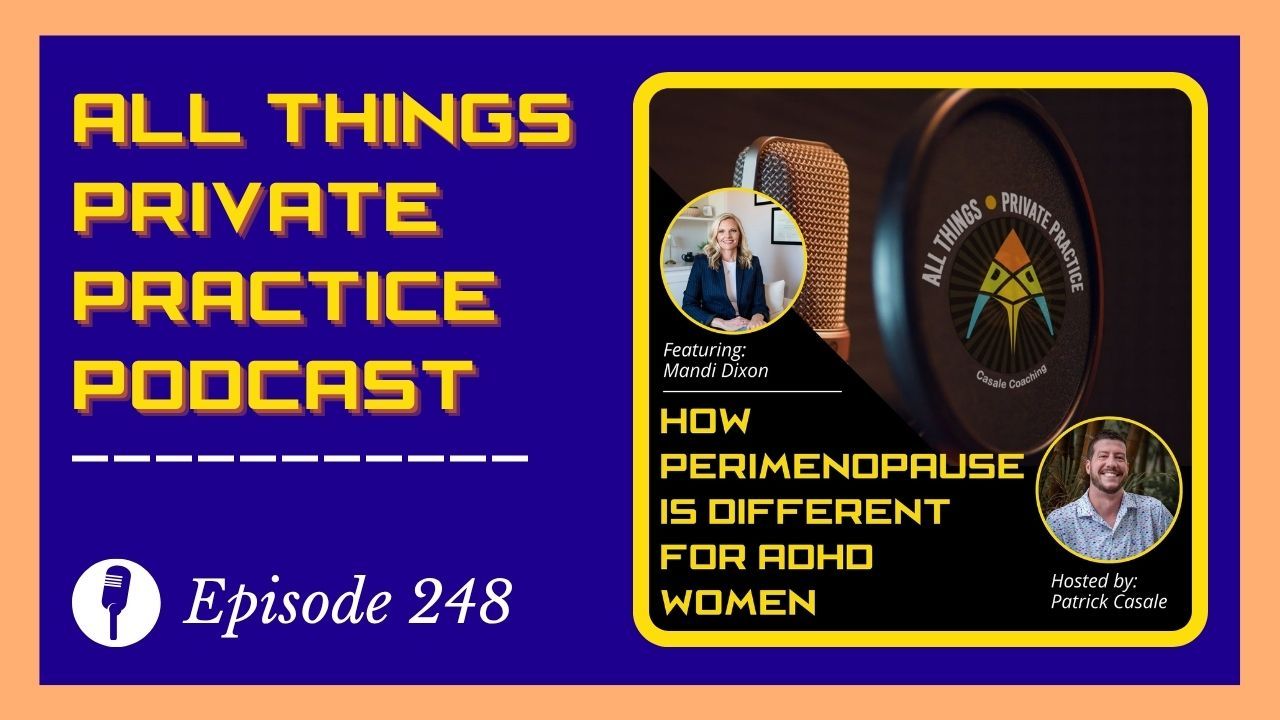
In this episode, Patrick Casale talks with Mandi Dixon, LPC, EMDR therapist, and ADHD executive functioning coach, about the intersection of ADHD and perimenopause, an area with far too little research and awareness—despite how profoundly it impacts so many lives. Mandi shares both expertise and lived experience, highlighting the real challenges faced by neurodivergent individuals navigating this transition.
3 Key Takeaways:
- Perimenopause and Neurodiversity: The intersection of ADHD (and often autism) with perimenopause leads to increased and earlier symptom onset, more intense sensory sensitivity, sleep disruption, and overwhelming emotional changes.
- It’s Not All in Your Head: Many women (and people of all genders with similar physiology) are misdiagnosed or dismissed by healthcare providers. Recognize that these symptoms are hormonal and neurological—not character flaws or mental health failures.
- There Is Help Available: Specialized menopause practitioners (often accessible via telehealth) and resources like symptom trackers can empower individuals to advocate effectively for the care they deserve.
More about Mandi:
Mandi Dixon is a Licensed Professional Counselor, EMDR therapist, and ADHD Executive Function Coach specializing in the intersection of ADHD and perimenopause in women. She’s a member of The Menopause Society and the International Society for the Study of Women’s Sexual Health, and her work has been featured in USA Today and Good Morning America. Mandi is based in Allen, Texas, where she sees clients and is currently writing her first book on ADHD and midlife hormonal health.
- Instagram: @Adhdmenopausetherapist
- mandidixonco.com
- mymenopauserx.com
🎙️Listen to more episodes of The Neurodivergent Entrepreneur Podcast
🎙️Spotify
🎙️Apple
🎙️YouTube Music
▶️ YouTube
✈️ Check out available Retreats
🗨️ Join the free Empowered Escape FB Community
A Thanks to Our Sponsors: The Receptionist for iPad!
I want to thank The Receptionist for iPad for sponsoring this episode.
The Receptionist for iPad is a HIPAA-ready digital check-in system that eliminates the need to walk back and forth from your office to the waiting room to see if your next appointment has arrived. Clients or patients can check in for their appointments, and you'll be immediately notified by text, email, or your preferred channel. Break free from interruptions and make the most of your time, because it is valuable. Start a free 14-day trial of the Receptionist for iPad by going to thereceptionist.com/privatepractice. Make sure to start your trial with that link to get your first month free if you decide to sign up.
Free Gifts for Our Listeners
Get a practical podcasting workbook for therapists considering starting a podcast, created by Patrick Casale, host of the podcasts The Neurodivergent Entrepreneur and Divergent Conversations.
You'll get a practical structure for therapists who want to start a podcast but don’t want to rush, perform, or build something they can’t sustain.
Grab your free copy: ndpod.org/Free-Podcasting-Workbook
✨ Move Beyond Private Practice As A Neurodivergent Entrepreneur
Move Beyond Private Practice As A Neurodivergent Entrepreneur is a FREE 5-part mini-course designed for therapists who want sustainable financial independence beyond one-on-one work.
Access your free mini-course here: ndpod.org/Neurodivergent-Entrepreneur
Transcript
PATRICK CASALE: Hey, everyone. Welcome back to the All Things Private Practice podcast, soon to be the Neurodivergent Entrepreneur podcast. Joined today by Mandi Dixon, who is a licensed professional counselor, EMDR therapist, and ADHD executive functioning coach specializing in the intersection of ADHD and perimenopause in women.
She's a member of the Menopause Society and the International Society for the Study of Women's Sexual Health, and her work has been featured in USA Today and Good Morning America.
Mandi is based in Allen, Texas, where she sees clients and is currently writing her first book on ADHD and midlife hormonal health. Congrats on that.
MANDI DIXON: Thank you.
PATRICK CASALE: Welcome to the show. I'm really excited to have you, and kind of like I told you off air, selfishly, because my wife is an ADHDer with perimenopause. And it's a journey.
MANDI DIXON: It really is. And it's such an area, you know, how ADHD and women, it just hasn't been studied or talked about a lot. And then, perimenopause in women hasn't been studied a lot. And then, when these two intersect, there's almost no research out there at all, nobody has really been talking about it. Thankfully, some people are now. And the women are really speaking up.
PATRICK CASALE: Yep, we're seeing a lot of lived experiences. Your account and your voice definitely front of line in my mind. I see a lot of women, though, who are just talking about, like what the hell is happening to me, and it came on like that.
MANDI DIXON: Yeah, definitely. Because-
PATRICK CASALE: Yeah.
MANDI DIXON: Go ahead.
PATRICK CASALE: I was going to say, can you set the stage for our listeners who maybe continue to hear perimenopause on social media, in news, but have no idea what that means.
MANDI DIXON: So, perimenopause, it's a natural transition that our bodies go through as women. So, there is perimenopause, there's menopause, and post menopause.
So, menopause, technically, the definition is going one year without a menstrual cycle. So, you know, the time leading up to that transition is perimenopause, and then everything after is post menopause. But that's a hard timeline because a lot of women don't have a regular cycle, they may have hysterectomy, they may have an IUD. It's just very hard to measure exactly one year, but we do know that the transition starts roughly seven to 10 years. And I've been saying this for a long time, that I think it's longer than that. And we just got some new research out that shows ADHD women, in particular, experience perimenopause symptoms sooner.
So, they report the highest around age 35 to 39. So, that would be, if you do the math, the average age of menopause is 50, 51. So, we're talking 15 years, possibly, of experiencing symptoms.
And it's the natural transition from when your body goes from being in a reproductive state to gradually transitioning not to produce eggs anymore, not to produce hormones. And so, for some women that transition is slow and gradual, they don't experience a lot of symptoms, you know, maybe some. But for other women, it can feel really dramatic, really terrible, physically debilitating, mentally debilitating.
And we've seen with this population of ADHD women and autistic women too, I haven't seen the research specifically on the autistic women, but I think it overlaps a lot with what we have on ADHD, that, you know, we're more sensitive, we're more sensitive to a lot of things, and hormones are one of those. And it's just not talked about.
PATRICK CASALE: Yeah, and I think it seems like it catches a lot of women off guard, especially, when it comes on pretty dramatically and suddenly, of all of a sudden. Like, why am I experiencing insomnia, and like some almost like white hot seething rage out of nowhere, and irritability, and overwhelm. And it's in sensory sensitivity and everything else in the mix. And I think that can be such a confusing experience, especially, when you're like, where are the resources for me? What do I do? What is happening to me?
MANDI DIXON: It is. And it's very easy to blame yourself, because a lot of us have been told you're too dramatic, you're too sensitive, you're too much of this, or you're not enough this. So, it can be a ton just psychologically, where a lot of those negative thoughts come back because you don't have an answer.
And a lot of people experience, you know, the mental symptoms before the physical symptoms. So, like you said, the insomnia, where you're waking up at three in the morning, and you can't go back to sleep. Well, we know that affects our ADHD or autism negatively, which can make those symptoms worse. So, that's often one of the first things women notice, is the sleep gets messed up.
PATRICK CASALE: Yeah, my wife is really struggling with that, like in those cycles where it's like a week long, and she's like up all night, or waking up throughout the night, hot all the time, sweating all the time, and just like fighting a war inside of her body constantly, and just becoming, like you said, overwhelmingly almost frustrated with herself, as if, like, I'm the problem.
But in reality, it's like, well, no, we're seeing all these hormonal shifts, we're seeing all of these different hormones, like progesterone and estrogen, and everything changing, right? So, can you talk about, especially that overlap in terms of ADHD and perimenopause with hormonal shift?
MANDI DIXON: Yeah, so we know what happens. So, a normal cycle, during your reproductive years, we have fluctuating hormones, and they typically will do this. And that can be symptomatic for sensitive people, but that's normal.
But in perimenopause, it gets dramatic, or it's erratic. It's a roller coaster. Your estrogen can be way up one month, way down the next. The progesterone is kind of slowly declining. And those wild shifts can just be, one, they're unpredictable, which is difficult, and two, extreme. So, for somebody that is sensitive to those, you just have it at every level.
PATRICK CASALE: Yeah. And there's a linkage, right? Between estrogen, progesterone, and progesterone and dopamine. So, you're seeing that dopamine crash and spike a lot of the time, too, that we're seeing in these ADHDers. And then, you add it in the hormonal shifts as well, and then it's like, what in the hell is happening?
MANDI DIXON: So, a lot of ADHD women, younger women, will report that maybe they have worse ADHD symptoms right before their period starts, or their stimulant medication doesn't work as well.
And so, the research shows that estrogen supports dopamine. So, when your estrogen is at a therapeutic level, I don't know if it is the therapeutic level, but at a good level, then your dopamine is being supported, less ADHD symptoms, your medications working. So, then, when you enter into perimenopause, you get those wild, erratic fluctuations, which tanks your estrogen, which then directly impacts your dopamine. And that can feel just brain fog that you just don't have an answer for, or yeah, the rage, the intense mood swings going from zero to 10 like that, that emotional regulation.
PATRICK CASALE: Yeah.
MANDI DIXON: And the sensory sensitivities, I mean, I hear that so much, it's the competing sounds just can become so overwhelming textures, and of course, you're hot. It's just a sensory overwhelm and a cognitive mental overwhelm for some people.
PATRICK CASALE: Yeah, yeah, yeah. And I think that everything you're saying makes so much sense in regards to how that is impactful for someone with a more sensitive nervous system who is going to have more drastic shifts in terms of aging, in terms of developing, in terms of, like, some of the co-occurring struggles that start to manifest and appear.
MANDI DIXON: Yeah.
PATRICK CASALE: I have to imagine that there are also linkages in terms of like PMDD and then, perimenopause, kind of being a correlation of both being increasingly more challenging for ADHD women.
MANDI DIXON: Yes, I have this theory that PMDD turns into ugly perimenopause. And I talk about ugly perimenopause a little bit on social media, because when I was experiencing it, I didn't have a word for it. And I will see my friends, we knew we were in perimenopause, and you know, they were not feeling what I was feeling. And I remember thinking, why do I have this ugly version? Like, mine is so much more dramatic. And it was debilitating. And they didn't seem to have that.
And so, I've found that PMDD, we know what that is. And that's, you know, severe form of PMS. That can be debilitating, and it happens the days before your period.
PATRICK CASALE: Right.
MANDI DIXON: So, we know what happens with our cycles when we start to get in perimenopause, the cycles get wonky. They can get shorter, they can get longer, they can get heavier, they can get lighter. And it's all normal. And it becomes unpredictable.
So, you take PMDD, and then you add in more intense and more unpredictable, and yeah, it's terrible.
PATRICK CASALE: I feel for all of you listening who are experiencing this, because I know it's really, really overwhelming. And yeah. So, when you talk about like ugly symptoms or ugly perimenopause, tell me what that means.
MANDI DIXON: Well, it doesn't have anything to do with physically the way that you look. A lot of people think that it does, but it's not. It's just, you know, you say a symptom of sensory overload, and that can mean, you know, maybe a woman that's not neurodivergent doesn't wear certain shirts anymore because she's extra sensitive. But we have this ugly version where we're crying in our closet because absolutely nothing feels good. And we're overwhelmed, and we're late. And it just can completely take you down.
So, it's this just this ugly version of every single symptom, it seems like, or that's how I experienced when I didn't have words for it, and I just started talking about it, and a lot of people said, "Me too.”
PATRICK CASALE: I think it makes perfect sense, because when you add in that heightened sensory sensitivity that maybe was there beforehand, but now it feels like it's intensified. As an autistic ADHDer, I can speak firsthand about how overwhelming sensory experiences are for me. So, if that comes out of nowhere, and almost blindsides you, it is very uncomfortable to go through the world feeling like an exposed nerve ending that's like constantly being shocked unexpectedly.
MANDI DIXON: [CROSSTALK 00:13:11].
PATRICK CASALE: And you're almost bracing for it, right? Like, you're like everything is bothering you, sounds, noises, textures, smells, etc. And then, they compound. And then, all of a sudden, it's like I don't even feel comfortable in my own body or my own skin, and I don't know how to stop this.
And I watch, you know, my wife when she's in this like week of, I'll say, ugly perimenopause, and I think she would agree. She’s going through this and would be like, she'll have to like remove herself constantly from things, go for like intense walks to try to like get some of that sensory overwhelm regulated, or just be completely left alone, because she's like, I don't want to say the wrong thing or react the wrong way, and I have to remove myself constantly.
And I imagine that has to feel so lonely and isolating in moments where you're like, I really want to be a part of things, but I cannot because my body's not allowing me to be.
MANDI DIXON: Absolutely, and that's where a lot of the mental health comes in, because it can feel isolating, it can feel lonely. You blame yourself.
And one of the things that I hear a lot is the things that we used to do, because you know we're sensitive people, so we know how to cope with issues. The things are go-to methods of coping skills. They don't work anymore. And we're trying, and we're wondering, what's wrong with me? Why is this not working, you know?
And it can feel like falling apart. And your sense of identity is tied to a lot of things, like being a wife, being a mother, you know, having so and so career for a lot of people, and those things, they start to get jeopardized. And there’s shame and loneliness, and just there's so much, and it can just be a really, really hard time for a lot of people when you feel alone, and all that.
PATRICK CASALE: Yeah, yeah, absolutely. I can't imagine that at all. I just see so many of my friends who are going through this at this time, and they're just like, “It's so intense.”
And I imagine there's a lot of misdiagnosis in this, right? Like, you're going to see people get diagnosed bipolar, you're going to see people get diagnosed with personality disorder, you're going to see people get diagnosed with, like, really intense PTSD. And the reality is like a lot of this is hormonal and neurological.
MANDI DIXON: Yep. And that's really what led me on this journey, is, I was seeing women come into my practice being referred by their doctor, they would go in saying, “I'm just not feeling like myself.” They would put them on antidepressants and say, “See a therapist.”
PATRICK CASALE: Sure.
MANDI DIXON: Yeah. And the reason it stuck out to me is because I was feeling the same way. I was going to doctor to doctor to doctor, “I'm just not feeling like myself. I don't know what's going on. It's something with my hormones, I know.” And you know they'd be like, “Well, here's some antidepressants, you're anxious.” So, I noticed that with the women. And then, when I found out just the link that hormones had to mental health, well, then the hyper focus was locked in, and you know, the justice sensitivity, “Why did nobody teach me this?”
PATRICK CASALE: Yeah.
MANDI DIXON: So, I went on a mission, and…
PATRICK CASALE: You’re writing your first book because of this mission.
MANDI DIXON: I am, yeah. And I'm thankful for that opportunity. It took a lot of confusion, and outrage, and you know, there's still people that don't know about it, or don't know that.
And even on that mission of just learning about perimenopause, again, I felt alone because I didn't know why mine felt so much worse. I have trained on ADHD as a coach, mostly worked with young boys, so it's like I never put the two together, but once I did, it was like, “Oh my gosh, this explains everything.” That's hopefully the title of my book.
PATRICK CASALE: I love that.
MANDI DIXON: I don't know, but yeah, roughly.
PATRICK CASALE: And that's what people want, right? Is like to feel less alone, or to feel like my experiences are not just unique to me, because I think when you start to have any sort of shift in personality, or bodily sensation, or mental health, you start to think like I'm the only one who's going through this, and I can't find a reason to say otherwise.
So, when you start to see a combo of lived experience, in addition to education and/or clinical expertise, and saying, like, you're not alone in this. I think it offers a light at the end of the tunnel of maybe this isn't any less shitty and overwhelming, but at least I know I'm not the only one who's experiencing this. And I think that really does help normalize the human condition.
MANDI DIXON: And to know that it's not your fault.
PATRICK CASALE: Exactly.
MANDI DIXON: The one thing I say to the women I work with is when you start to feel that overwhelm, you noticed something isn't working, don't automatically say what's wrong with me, what's wrong, but ask yourself what's changed?
PATRICK CASALE: Yes.
MANDI DIXON: Is it your sleep? You know, is it my hormones? Am I at that, you know, luteal phase? Ask yourself, what's changed, not what's wrong with me.
PATRICK CASALE: I love that reframe.
MANDI DIXON: Yes.
PATRICK CASALE: Because shame that comes with what's wrong with me is really intense, and that can wreak such havoc on someone in general. There's just so much stigma, even though we're in 2026 and like Mental Health Awareness month. And there's just so much stigma and unknown, right? Especially, as we start to talk about neurodiversity and the impacts of late-in-life diagnoses, and coming to understand experiences, and then starting to say, like, “Oh, okay, ADHD foundational, autism foundational, here's all this other fun stuff that gets thrown in the mix that causes chaos and frustration and overwhelm.”
I want to circle back to something you said that stood out to me, that was like going to your doctor, advocating for yourself is exhausting, especially when you're being minimized or dismissed, or just like, “Here's this simple solution, go try this out.” That happens a lot to a lot of us.
MANDI DIXON: Yes.
PATRICK CASALE: But I have to add in, like, the factor of racial disparity in healthcare. And then, I imagine a lot of black and brown women are going to their doctors, saying, like, “What is happening to me.” And it's probably being put back on them as if this is a character flaw, or defect at certain times, or like it's just all in your head.
MANDI DIXON: Oh, absolutely. There's research that shows that black women, brown women, women of color of any sort are not taken as seriously. And women in general are not taking as seriously as a man. And then, you also have people that, you know, I may have to pause here, so I get the right word.
PATRICK CASALE: That’s okay.
MANDI DIXON: I want to say, like, gender fluid. What am I thinking?
PATRICK CASALE: Yeah, like any sort of gender fluidity or expansiveness. So, like, someone who's non-binary or someone who's trans.
MANDI DIXON: We need more gender-affirming care in the menopause space.
PATRICK CASALE: Yeah, yeah, absolutely.
MANDI DIXON: Yeah, I say women a lot because it's so drilled in my head, and I'm trying to be more mindful and say people, because there are a lot of trans men going through this too, and they were certainly never told about this.
PATRICK CASALE: Right. And they're certainly, especially in this iteration of history, in this country, are not maybe even able to access affirming health care at all, for fear of retribution or repercussion, and then having to suffer in silence as an already stigmatized and marginalized group of people thinking, like, what the hell is wrong with me? Like, why is this happening to me?
MANDI DIXON: Absolutely. And yeah, you take the black and brown people, people of color, the people that need gender-affirming care. There is a huge group of people that are marginalized in terms of menopause care in general. And then, you add neurodivergent on top of that. I mean, we have to be there for each other during this time, because it can be isolating. And I always say, you can sit with us-
PATRICK CASALE: Yes.
MANDI DIXON: …no matter what it is, you can sit with us.
PATRICK CASALE: Yeah, that's really, really importantly powerful. I think community and connection is crucial in all of this. You know, like my wife is a black woman. We live in the South, not as far south as you, but like when she goes to healthcare appointments and gets like these simplistic answers, I get so angry for her.
And she's like, “I can advocate for myself, stop. Like, take the therapist's hat off.” But I'm like, “This is so frustrating to hear this is how you were treated.” And she's like, "Yeah, this is every day of my life.”
MANDI DIXON: Yeah.
PATRICK CASALE: It's always a very stark reminder of disparity, and privilege in the country, and in the world. But okay, we've talked a lot about the struggle area. What are things that people can do? Like, what are some even minor adjustments or shifts that people can start incorporating if they're noticing that this is happening.
MANDI DIXON: So, one thing to know is that there is treatment for perimenopause symptoms. You don't need a blood test to diagnose perimenopause. A lot of people say they go to their doctor, they say, "I think I'm in perimenopause.” They do a blood test and say, “Well, your blood is normal, your levels are normal.”
And that does not make sense as far as hormones, because normal hormone levels in perimenopause is chaotic. One day it's this, one day it's that. So, there's no adequate way to measure that. They will do blood work to rule out other causes.
PATRICK CASALE: Sure.
MANDI DIXON: Yeah, diabetes, thyroid, things like that. So, blood work is good, but not in terms of measuring hormonal levels.
So, what a good menopause doctor, a menopause specialist, there are some doctors that have gone and done a little extra training to know about menopause and treatment options. A lot of people think the myth is, they think, if I go to a menopause doctor, that means hormone therapy, but it doesn't. That's only one option. Their job is to talk to you about a whole range of treatment for your perimenopause symptoms. And they can pick through, because every person's symptoms are different.
You know, people experience it in a different way, but they can say, you know, oh, you're having anxiety, night sweats, and tough emotions. Let's look at those symptoms and what treatment would be the best for that. And you could say, “Well, I don't want to do hormone therapy.” “Okay, well, let's look at the other options.” Hormone therapy is one of them, and it's really effective.
PATRICK CASALE: Yeah, and I think what you're saying, too, for those of you listening, is like there is hope out there that there is like relief and alleviation of the struggle and the symptom that's happening. And you do have to find the right providers, I mean.
And I think that becomes such a struggle sometimes when people have more and more health condition or complex cases, where you might feel like you really have to go to bat for yourself, you really have to advocate and almost educate the provider at times. And that is an unfortunate part of our medical system. And that can be really frustrating, and just not to give up hope on that, because there are lots of resources out there and lots of people starting to speak out about their experiences, which is certainly a much more forming, cohesive way to create community and normalize experience, too.
MANDI DIXON: Absolutely. There are some reputable online menopause society-certified practitioners, and they are, you know, paneled with insurance companies. They are online and licensed in almost all 50 states. And I refer women there a lot, because, again, people think that you have to go in person, but you don't. You can still see your gynecologist, you can still see your primary doctor, and then, you see a menopause specialist for the symptoms.
PATRICK CASALE: Right.
MANDI DIXON: And the accessibility of the online platforms with reputable providers is really beneficial, especially, for those people that live in areas where they don't have access to that.
PATRICK CASALE: Yeah, absolutely, that's a great resource. What was that again? We'll add that to the show notes.
MANDI DIXON: So, the two that I recommend is mymenopauserx.com. Those girls are wonderful there. And the other one is Gennev, so I always misspell this, I'll have to look.
PATRICK CASALE: It’s okay.
MANDI DIXON: I misspell it every time.
PATRICK CASALE: This is a good starting point, for sure. So, we'll add that to the show notes as a resource for those who are listening, because I think that's a wonderful thing to have available, especially when you have telehealth and virtual availability, especially for those of you in areas that don't have that many providers, who just have to say, like, well, there's only, like, one GP in my area, and that's who I have to see for everything. And I think that is the beauty of telehealth, sometimes, it's just that accessibility in all of these different ways.
MANDI DIXON: It is. It allows you to be in front of an expert when normally you couldn't.
PATRICK CASALE: Yeah. And also, I think it just creates so much more affirming, relatable lived experience accessibility for those of you who are in more marginalized groups, where you're like, “I want to see someone who identifies like me, or looks like me, or experiences life like me. All I have is this handful of therapists or doctors or providers in my area.” So, yeah, it's a, it's a wonderful, wonderful resource.
As we're getting ready to wrap up, I want to just touch upon, you have a new coaching program coming out that we're going to highlight and add to the show notes. And one thing I want to just say before we get into that while we were not on air, was like you were saying, I didn't want to hire someone to build this website because I knew I could do it, and then it took me nine months, and then I did it in two days.” Which feels like the ADHD creative experience in a nutshell, for all you who also experience that, needing that like I need that momentum, right? Of like that pressure in that deadline to be like I can't do it until the last second, otherwise it's just never going to get done.
MANDI DIXON: Yeah, and I have people reach out almost every day, whether it's, you know, wanting coaching or wanting just more clinicians, even reaching out, wanting more information about how to work with women in this population, or people in this population. And I don't have that availability through therapy. And so, since I am trained as an ADHD coach, I thought, well, I need to make a separate business and offer that for the education, but it was like, I can't create a whole different website. That's just too hard. It was hard, but I did it.
PATRICK CASALE: I can so relate to that with all these ideas that just sit and simmer, and they-
MANDI DIXON: Yeah.
PATRICK CASALE: … take up space. And I'm like, I want to do it. Maybe I'm being stubborn sometimes, where I'm like, I'm not going to hire someone to do something I can do. And then, all of a sudden, the pressure builds so much that I do it in two days. And the results are always really good, and kind of reinforces that that is my process, and that I just have to stick to it and trust my gut on that.
MANDI DIXON: I know. You know, it's a lot of stress, it's a lot of stress. And I like to do, like, a cost-benefit ratio. Like, okay, well, I'm going to build this stress, but also, you know, I don't have to sit there and worry for months, I know that.
PATRICK CASALE: Exactly. Yeah, that's exactly it. So, well, I want to just thank you for coming on, and making the time, and sharing a lot of this wisdom, because this is going to help a lot of people. And yeah, please let the audience know where they can find you and what you've got coming up, and we'll have everything Mandi talks about in our show notes.
MANDI DIXON: Yeah, so you can find me, mostly I'm on Instagram, adhdmenopausetherapist. Also have a TikTok with the same handle.
If you look on my Instagram, I need to make this a little more accessible, but I have a link with free resources, and I created a symptom tracker that is for perimenopause, and it blends ADHD. And it's really simple and easy to use.
And then, the second page is scripts, or kind of a reflection page, and it asks the questions, and ideally you bring these two sheets to your provider, helps you be able to communicate what you're feeling in a clear way where you can get the help that you need. And it's a great download, yeah.
PATRICK CASALE: Perfect. And we'll have that in the show notes as well, so that you all have easy access to everything Mandi just listed. Her account is phenomenal, it's very informative. So, if you're looking for information or education, I highly recommend checking it out, and then checking out her new coaching program or business that's coming out as well. And that's mandidixonco.com, is that correct?
MANDI DIXON: Yes.
PATRICK CASALE: And we'll have that in the show notes for all of you as well, so that you have access to that as soon as that gets promoted, and is out and live and to the public. Just really want to thank you again for coming on and just sharing some of this. It's super, super helpful.
MANDI DIXON: Thank you for having me. And hopefully, there'll be a book in a couple of years that [CROSSTALK 00:33:57].
PATRICK CASALE: I think there will be.
MANDI DIXON: …a long time.
PATRICK CASALE: It's going to be one of those things where all of a sudden you write, you know, 150 pages in two days. And you're like, “Oh yeah, why didn't I do that sooner?”
MANDI DIXON: Absolutely, I know that's what’s going to happen.
PATRICK CASALE: I will be honest, like I wrote my book first draft in that way. I watched all three extended versions of The Lord of the Rings one weekend that my wife was gone. And I wrote like 50,000 words in two days. And I was like, “Whoa, where has this come from, and why didn't I do it sooner?” So, totally relate.
MANDI DIXON: Those little bursts remind us who we actually are, in a good way.
PATRICK CASALE: Exactly, I love those. And I think I try to hold on to those as much as I can, knowing that they're fleeting, you know? But-
MANDI DIXON: Exactly.
PATRICK CASALE: Yeah, it’s super, super good. So, thank you again. And to everyone listening to All Things Private Practice, new episodes are out on Saturdays on all major platforms and YouTube. You can like, download, subscribe, and share.
There's still less than 15 spots left for the third annual Doubt Yourself, Do It Anyway summit in Portland, Maine, September 1st to the third. Link is in the show notes. Doubt yourself, do it anyway. We'll see you next week.
FREE PRIVATE PRACTICE GUIDE
Join the weekly newsletter for private practice tips, podcast updates, special offers, & your free private practice startup guide!
We will not spam you or share your information. You can unsubscribe at any time.






![Episode 266: Healing Isn’t Just in Your Head: Rethinking What Therapy Can Be [featuring LeNaya Crawford]](https://kajabi-storefronts-production.kajabi-cdn.com/kajabi-storefronts-production/file-uploads/sites/2147507511/images/a2d5a4-e4bf-63b0-fa7f-6e6f62c466d5_TNDE_YouTube_episode_266.jpg)
![Episode 264: Creating Through the Chaos of a Neurodivergent Life [featuring Bre "BR3"]](https://kajabi-storefronts-production.kajabi-cdn.com/kajabi-storefronts-production/file-uploads/sites/2147507511/images/a14004-cc3d-8aba-5fb8-2442fdfc650_TNDE_YouTube_episode_264.jpg)
![Episode 263: Your Symptoms Are Real—Even When Medicine Doesn’t Have The Answers [featuring Dr. Zachary Spiritos]](https://kajabi-storefronts-production.kajabi-cdn.com/kajabi-storefronts-production/file-uploads/sites/2147507511/images/84bc15-1ce4-1a0b-8f85-f5812bce75_TNDE_YouTube_episode_263.jpg)