Show Notes
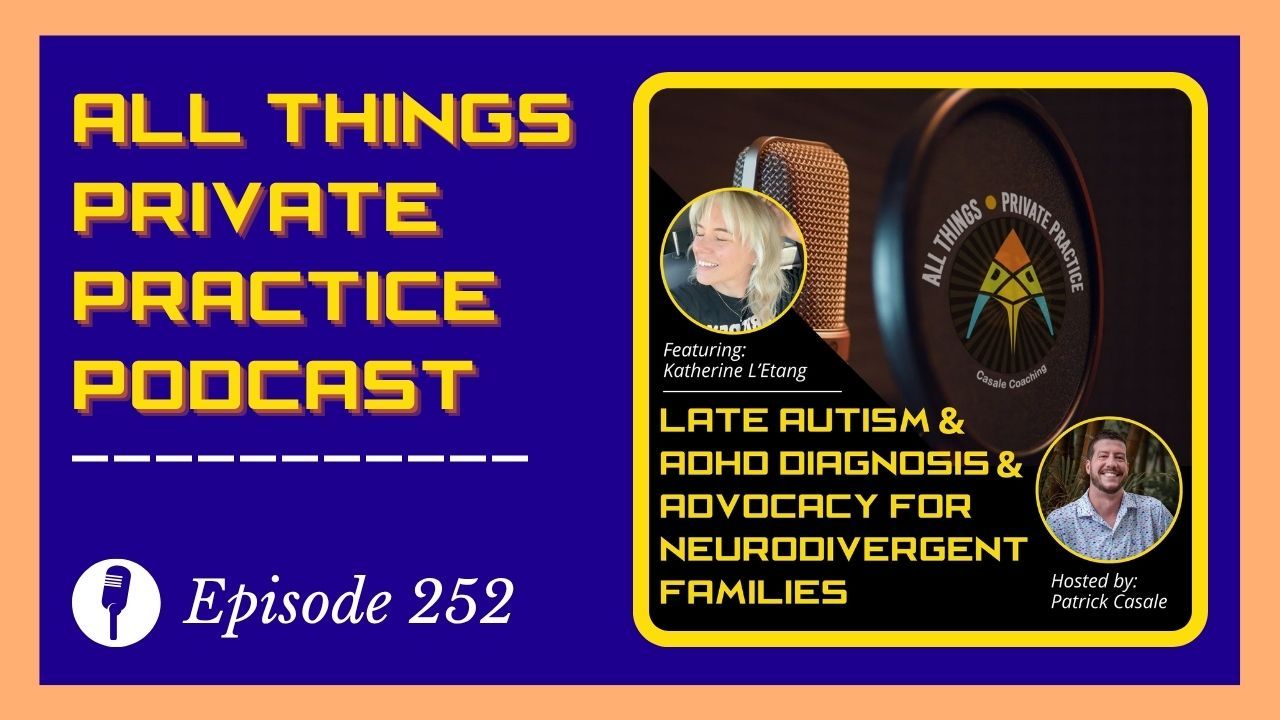
In this episode, Patrick Casale talks with Katherine L’Etang (A.K.A. @TheNeurodiversityMom) about her journey as a late-diagnosed Autistic and ADHD adult, which is both powerful and relatable, especially for advocates, parents, and neurodiverse professionals.
Here are 3 key takeaways:
- Self-advocacy is essential: It's important to seek validating, knowledgeable professionals—and not settle for invalidating experiences, especially when it comes to late diagnosis and mental health support. Doing your homework on assessors and trusting your self-knowledge is crucial.
- Diagnosis is just the beginning: Receiving an autism or ADHD diagnosis in adulthood can trigger a profound shift in self-understanding and acceptance, but it may also lead to a period of intensified traits and burnout before healing begins. Giving yourself grace and time is vital.
- Vulnerability builds community: Whether sharing her own journey or making decisions about what to share as a parent, Katherine models how public vulnerability can foster collective healing and support—while continually wrestling with questions of privacy and consent, especially for her kids.
More about Katherine:
Katherine L’Etang, also known as @TheNeurodiversityMom, is a late-diagnosed autistic and ADHD content creator who has made it her mission to provide community, inclusion, and acceptance to anyone who is autistic or raising autistic kids. She lives in British Columbia, Canada, with her husband and two kids.
- Instagram: instagram.com/theneurodiversitymom
🎙️Listen to more episodes of The Neurodivergent Entrepreneur Podcast
🎙️Spotify
🎙️Apple
🎙️YouTube Music
▶️ YouTube
✈️ Check out available Retreats
🗨️ Join the free Empowered Escape FB Community
A Thanks to Our Sponsors: The Receptionist for iPad!
I want to thank The Receptionist for iPad for sponsoring this episode.
The Receptionist for iPad is a HIPAA-ready digital check-in system that eliminates the need to walk back and forth from your office to the waiting room to see if your next appointment has arrived. Clients or patients can check in for their appointments, and you'll be immediately notified by text, email, or your preferred channel. Break free from interruptions and make the most of your time, because it is valuable. Start a free 14-day trial of the Receptionist for iPad by going to thereceptionist.com/privatepractice. Make sure to start your trial with that link to get your first month free if you decide to sign up.
Free Gifts for Our Listeners
Get a practical podcasting workbook for therapists considering starting a podcast, created by Patrick Casale, host of the podcasts The Neurodivergent Entrepreneur and Divergent Conversations.
You'll get a practical structure for therapists who want to start a podcast but don’t want to rush, perform, or build something they can’t sustain.
Grab your free copy: ndpod.org/Free-Podcasting-Workbook
✨ Move Beyond Private Practice As A Neurodivergent Entrepreneur
Move Beyond Private Practice As A Neurodivergent Entrepreneur is a FREE 5-part mini-course designed for therapists who want sustainable financial independence beyond one-on-one work.
Access your free mini-course here: ndpod.org/Neurodivergent-Entrepreneur
Transcript
PATRICK CASALE: Hey, everyone. Welcome back to All Things Private Practice. I'm joined today by Katherine L’Etang, who is also known as The Neurodiversity Mom, a late-diagnosed autistic ADHD content creator who has made it her mission to provide community, inclusion, and acceptance to anyone who's autistic or raising autistic kids. She lives in British Columbia, Canada, with her husband and her two kids. And welcome to the show.
KATHERINE L’ETANG: Thank you so much, Patrick. Appreciate it to be here.
PATRICK CASALE: Yeah. I love your content on social media. So, I was up late at night one night, a couple weeks ago. And I was like DMing all of the content creators that I really like asking them if they wanted to come on here. So, I appreciate you taking the time to accept that invite.
KATHERINE L’ETANG: Of course, and yeah, likewise. I feel like a lot of your content I really, like, relate to. So, I feel like our AuDHD experience, at least from what I see on content, is like pretty similar. So, yeah, it's great to be here. Great to chat.
PATRICK CASALE: I love the awkwardness that we often have with introductions, and like, as my friend Megan Anna would call it, social ligamenting of like trying to navigate what to say, when to say it. And I am that way when we're doing intros, and bios, and farewells.
So, I want to talk to you about your journey with this, because it sounds like you discovered autism and ADHD later in life. How old were you when that happened? Like, what's going on in your world when that's happening?
KATHERINE L’ETANG: For sure. So, I was diagnosed with ADHD first, which I've actually come to realize, as like a lot of women, kind of a similar thing, saw a lot of ADHD content on social media. And then, I went to my doctor and asked about an assessment. And the doctor referred me on to a psychiatrist. And I was kind of met with, like, “Oh, this is like such a trend at the moment on social media.” Blah, blah, blah.
And then, he started kind of doing the questions and things. And then, he was like, “Actually, I do think you may have ADHD.” And I was like, “Uh-huh (affirmative) yeah.”
So, anyway, I was diagnosed with ADHD. I think I went on stimulants then. And like a lot of autistic or late-diagnosed autistic people, once I started the stimulants, I definitely had a lot more like autistic traits. And it's actually my husband who always, like, he is ADHD, like, diagnosed in childhood. And he would often be like, because my ADHD presentation is very different to him, so he would be like, “I don't know if you have ADHD, but I think you do have autism.”
So, I think he was often suggesting that, but I feel like I was often just like, “Me? No?” And eventually, after about a year later, after my ADHD diagnosis, I got more comfortable with the idea that I was also autistic. And I sought an evaluation. And yeah, I was diagnosed with autism at 32, yeah.
PATRICK CASALE: Okay, so yeah, similar trajectory, I guess, because ADHD for me came first when I was about 31. And then, autism was around 35.
And the ADHD thing for me, you know, I didn't really think much of it. I just kind of was like, “Yeah, that makes sense for me. I checked the boxes.” It never answered the questions, though, that I had about why I was experiencing life the way I was experiencing it. I always just felt, you know, we hear so often people say, “I feel like an alien. I feel like I don't have a manual on how to do life. I feel like everyone else knows the rules except for me.” And I definitely resonated with that. It sounds like you did as well.
KATHERINE L’ETANG: Yeah, exactly, 100%. And that's the thing. It was funny because people brought up the alien thing. And I was like, “I don't feel like an alien.” You know? But that's because my literal brain is like an alien, you know?
PATRICK CASALE: Yes, exactly.
KATHERINE L’ETANG: But that is actually a perfect description of, like, almost like you crash landed on the planet, and everyone else had this manual of how to be human. And you kind of are watching and making the manual yourself, you know? Like, that's my autistic experience, is like, okay, that's what we do then, and everyone else just had that manual, like, downloaded and auto-populated in their brains.
PATRICK CASALE: Yeah, for sure. And I think, it's interesting, I want to go back to what your psychiatrist said, because it sounds like in that moment, and correct me if I'm wrong, that could have gone from a very invalidating experience to a maybe somewhat validating experience. I don't know how the rest of that assessment went, but like when we hear the word this is a trend, or everyone is a little bit autistic, or everyone is a little bit ADHD, that stuff is really minimizing of the actual lived experiences that we're having, right?
And it's unfortunate that we still have so many medical, and psychiatric, and mental health providers who just opt into that philosophy of, like, this is more of a trend, we're just seeing an epidemic. These words are harmful. And they do cause impact. They do cause a ripple effect, for sure.
KATHERINE L’ETANG: Yeah, 100% And so, actually, because of after that experience for my autism evaluation, I was like, “I'm not going to my doctor. I don't want to be referred into the Canadian public health care system.” Which is great, we love it, but it has its challenges, especially with like mental health and that kind of stuff. So, I was like, “No, I'm going privately, I'm going to research my assessor. Like, you know, I'm going to do my homework, because I cannot...”
I think that's the thing with a lot of late-diagnosed people, we're already invalidating ourselves. So, by going to a professional, that's potentially also going to invalidate you. It's like that is just not what I'm looking for, that's going to be super harmful. Like, ADHD, like you said, was kind of one of those things that's like, “Yeah, it makes sense.” Autism, I knew for me was going to be like fundamentally, like, totally life-changing and life-altering in understanding myself in that way. So, I was like, “I need to do this properly.”
PATRICK CASALE: Sure, that's really well said. And I think it's also a very common experience, you know? I just actually had a psychologist on two episodes ago in the UK, and she was talking about how she's offering assessments, and their public health care system, and some people are waiting upwards of four years to get an assessment, potentially more. You just mentioned the Canadian healthcare system.
And I would say that both UK and Canadian healthcare systems are light years better than the American healthcare system, where everything is privatized, and everything is for profit. But I like that you also did the very autistic thing of like, “I'm going to deep dive the assessor. I am going to go down every rabbit hole.”
KATHERINE L’ETANG: Yeah.
PATRICK CASALE: Because when it has so much to do with identity, it's like everything feels like it's at stake. And you almost start even questioning yourself as you're doing all this autistic research, which should be a green flag for us anyway, of like I'm going to deep dive the hell out of this to make sure I get the right fit, and I know who this person is and what their credentials are and all the things.
And then, we can still have these moments of invalidation throughout of like, “But you're not autistic enough, you didn't really meet the criteria, it's just a trend.” That stuff can really become overwhelming and unbelievably dismissive of our experiences.
KATHERINE L’ETANG: Yeah, exactly. Like, that's what's so funny about me. It's like I have, like, my ADHD domains or my autism domain, so sometimes I'm incredibly impulsive, and I'm just like, “I just need to get this done.” Or whatever.
And then, other things, I’m in a rabbit hole. Like, we need to, like, know everything about everything. And you really don't know what you're going to get and what domain is covering which when, but I'm glad, at least for my autism diagnosis, I wasn't just like, “Let's do this thing.” Because, yeah, I really did need to make sure that it was like handled with a lot of care. And I wanted the most robust, like…
And that's the thing, I mean, I believe self-diagnosis is valid. I believe if you do online assessment, that's valid. It's whatever suits you and works for you, and whatever you can do.
But for me, I knew I wanted an in-person assessment. Even though the ADOS is questionable, I still wanted an ADOS. Like, you know, there were so many things that I felt I needed in order to believe that I was actually autistic, and to give myself the grace and the accommodations that I really needed, which is wrong. I mean, you shouldn't have to. You know, I shouldn't have had to have needed someone else's confirmation in order to give that to myself, but that's the way my people-pleasing brain works. And yeah, that's how we did things.
PATRICK CASALE: Okay, so then that happens, you go through that entire process, you get the results, and then what? How does that, like, look? I thought it was like this aha epiphany moment for myself, but then I quickly realized that I started to experience such an intensification of all of my autistic traits all at once. And it felt very flooding in terms of like sensory sensitivity started to feel like unbearable, burnout felt so intensified and magnified, everything started to culminate. And I was like, “Wait, I thought things were supposed to get easier.”
And in reality, I think that's a common misconception for people, but it was definitely unbelievably illuminating. And it kind of started to answer questions for me from this different lens that I had been searching for my entire life.
KATHERINE L’ETANG: Yeah, my autism diagnosis blew up my entire life, but for the better, you know? I had constructed the most perfect mask. I was a suburban mom of two. I worked my corporate job remotely. I'm married, you know? Like, everything is just like on the outside life is great. Like, why I'm even going for this assessment, you know?
But really, I had actually been going through these burnout cycles for my whole life of essentially, like, every three years-ish just suddenly being like I can't function, and I need to like lie in bed for an extended period. And then, slowly rebuild.
So, really, my autism diagnosis did throw me into that place. Actually, like triggered almost that burnout, but at the same time, it's where I needed to go in order to truly accept myself and recover as an autistic person, instead of like putting the mask back on.
PATRICK CASALE: Absolutely.
KATHERINE L’ETANG: Yeah, so it was basically like once I got my diagnosis, same thing. I suddenly couldn't wear makeup anymore. Like, suddenly makeup felt so uncomfortable. Certain clothes I couldn't wear. Like, literally, it just was like a forced, like exposure therapy, and being autistic, almost.
And yeah, basically, then kind of from there I quit my job because I had to take like a medical leave from work. And they would only give me three weeks. Like, I just couldn't go back to working a corporate job and being in like meetings where, you know, there's those social pleasantries and all of that, which always felt so foreign to me, and so hard, but suddenly once I was diagnosed it was like impossible. It wasn't just hard. It was like something I could no longer play or do or mask.
PATRICK CASALE: Absolutely.
KATHERINE L’ETANG: So, yeah, I quit my job and already had started the journey on social media of like kind of sharing my journey, but it was at a point where I was starting to get brand deals and all of that. And I was like, I'm going to quit, and we're just going to see where life goes. So, I think ADHD domain kicked in then with the quitting, but also, I didn't really have a choice with my autistic experience. But, but, yeah, kind of never looked back, I suppose.
PATRICK CASALE: Yeah, I mean, I love hearing that, and you know, I think that happens to a lot of people in these spaces, especially those of us who are maybe entrepreneurial, or content creators, or sharing our lives and our stories online.
So, that brings me to a next question. So, a lot of what you talk about online is like the parenting component. And you mentioned having two kids, and trying really hard to advocate for them and their needs as well. What's that like to be in this space now, and sharing a lot of this, like, very intimate public information with the world, and trying to really help people feel less alone?
KATHERINE L’ETANG: Yeah, so, fuck, I'm glad you asked that, because that's actually something I've been like, seriously, like wrestling with too. Because I feel like it's one thing for me, like I share a lot of my own public stuff, because I feel like my public healing is almost like collective healing. So, I feel like that's the way I look at it, but yeah, when it comes to my kids, I feel like I've actually reigned in a lot of the information I share, because yeah.
So, I'm a mom of two autistic kids, well, AuDHD kids as well. And my account started as more of like this parenting thing. And then, it was somewhere when I started my account, I had my own realization, and you know, I pivoted a lot to sharing a lot about me.
But, you know, my kids are so obsessed with, like, YouTube, wanting to be YouTubers, blah blah, blah. They love that I have Instagram, but I really do question it. I’m always toeing this line of, like, how much I'm sharing about them and what they're okay with? And what they can consent to? Which is honestly nothing, they're little, they're seven and [CROSSTALK 00:17:22].
PATRICK CASALE: Right.
KATHERINE L’ETANG: I don't share their faces at… Well, I do sometimes from the side. I don't share their names, but at the same time, it's very hard to wrestle with like what's okay to share and like what isn't.
But then, at the same time when I feel like the stuff I do share from parenting is really helpful for a lot of people and makes people feel so validated and seen, and also helps me in a way of processing and dealing with this, because in so many ways I feel like our society has failed disabled people, parents of disabled children, because that help isn't really there. And so, so many of us do turn to social media for this kind of support or community, or to be seen, and all of that.
So, I feel like, yeah, I'm in this place where I'm just constantly wrestling, like, what is appropriate? What isn't appropriate? Like, is this too much? You know, it's probably that autistic, like rabbit hole. But I think it's valid questions that need to be asked more, you know? Like, what is okay, and what is the point of, like, this is too much? And you know what is helpful? I don't think I have the answers clearly, but it is something I'm always, at least, I guess, asking myself.
PATRICK CASALE: Yeah, yeah. No, I think that's a great response. And I think for a lot of us who are sharing our lives with the hopes that our experiences help other people.
KATHERINE L’ETANG: Yeah.
PATRICK CASALE: There's a layer of vulnerability and exposure in that, and also just being perceived is messy at times, so it's a great thing to just be always thinking about, but I think it also has such a ripple effect and an impact, so a lot of us are wrestling with that. Like, how much impact is this having in terms of helping, and how much is this hurting? And I think that's something to constantly be thinking about, especially as we are more and more open on social media. So, you are also writing a book, right? Is that right?
KATHERINE L’ETANG: Yeah. So, it's actually done. So, I just submitted my manuscript like two weeks ago. Yeah, so it's with an imprint of Penguin, which is like really cool. It's like it's a thing. Like, it's crazy. So, yeah, this year is going to be nuts. It's going to be like recording the audiobook, all of that.
But at least this book is about late diagnosis. So, it is about my experience. I was also very conscious of that, of what I'm putting in the book. For me, I mean, I have almost zero shame personally. So, there's definitely a lot of personal like stories that I'm just kind of like, you know, throwing it out there. Yeah, the ADHD domain covers my shame sharing, apparently, because I'm just like, whatever.
But yeah, there's one chapter on parenting, and talking about parenting, and advocacy, and all of that. But yeah, it's been a wild ride. All of last year was writing the book, as well as a cross-country move, which is like, I don't understand how I'm not like severely burnt out, but apparently, we're just doing it. And yeah, I’m just rolling with life.
And I think a lot of it has to do with this entrepreneurial journey that I'm on, which I'm sure you can relate to, of like, you know, there's something about when you're your own boss. It's like not just about being in control of your schedule, it's literally also just about not having that person that you're needing to please or answer to, that it's been like that, is probably been one of the most disabling factors of working for other people, or whatever. It's been like this idea of having this like boss, that how am I doing a good job? Do they like me? I’m, you know, falling behind because I think we struggle so much to read people's cues that we’re constantly guessing, and that, for me is what I think often catapulted my burnout, was just the constant needing to figure out what everyone is thinking, or what they think of me, or how I'm doing, how I'm being perceived, you know? Like, all of that was one of the hardest parts, so taking that away is just huge.
PATRICK CASALE: Yeah, yeah, that's very well said. And I agree with that. I mean, it's exhausting to constantly be like trying to figure out how to belong, and fit in, and do a good job, and read all the cues. So, very well said.
As we're getting ready to wrap up, can you tell us a little bit more about, like, when the book might come out? What's it called? Any of that stuff, if people want to pre-order or any of that information?
KATHERINE L’ETANG: Yeah, so the book is called Actually I'm Autistic. So, yeah. And it's coming out actually, only in the fall, so still a little while. I'm not sure when pre-orders are coming out, but yeah, it's super exciting. But yeah, for now I'm still just, you know, sharing on social media, and that's where the journey is still kind of at. And yeah, just seeing where life takes me. It feels like every single week there's some kind of new thing going on.
PATRICK CASALE: Well, that's cool. I mean, it sounds like what you're putting into the world is feeling really helpful and really useful for people, and that's incredible. I mean, I'm in a position as well right now where I'm writing a book. And I say it's the hardest thing I've ever done in my entire life, if I'm being very honest. Like, I question myself every single day. And I just have to keep anchoring into, like, trying to be helpful to people, make things relatable, having people normalize experiences that they might feel really alone in.
KATHERINE L’ETANG: Yeah.
PATRICK CASALE: So, my book is also called So You're Autistic, Now What?
KATHERINE L’ETANG: Awesome, there we go.
PATRICK CASALE: Yes. Coming out March of 27 I'm with Imprint of Hachette. So, I know we’ve rhymed big time, so congrats on that. And keep us posted as it gets closer. And we'll happily share on our platform. And I'll absolutely read your book and support you that way, because I think that's what this is all about, right? Is like supporting each other through the journey and through the creation, and yeah, hugely [CROSSTALK 00:23:44].
KATHERINE L’ETANG: And likewise. Yeah, that's how I feel too, honestly. Like, I feel like, in terms of our community, like, I know there can be like a lot of division and stuff in the autism community, that's a whole other podcast episode, but I really feel like I personally find like there's so much good in all of us, like understanding each other, and being seen by each other, and you know, supporting each other. And that's truly like what I think my place is in the community is, you know, like I want us all to support each other, and yeah, I think it's just awesome. So, yeah-
PATRICK CASALE: Well said.
KATHERINE L’ETANG: Reach out any time for anything.
PATRICK CASALE: Yeah, likewise. Well, thank you so much for coming on and making the time and spending a little bit of your week with us. And really, really appreciate it. And if people want to find you and connect with you, what's the best way to do that?
KATHERINE L’ETANG: Yep, probably still just Instagram. So, it's instagram.com/theneurodiversitymom.
PATRICK CASALE: Cool, and we'll have that in the show notes for all of you, so you have access to everything Katherine talked about today, and so you can keep an eye on when that book comes out as well. Thanks again for coming on and making the time. It's been a pleasure.
KATHERINE L’ETANG: Awesome, thanks so much, Patrick. It was great.
PATRICK CASALE: And to everyone listening to All Things Private Practice, new episodes are out on Saturdays on all major platforms and YouTube. Like, download, subscribe, share. Doubt yourself, do it anyway. We'll see you next week.
FREE PRIVATE PRACTICE GUIDE
Join the weekly newsletter for private practice tips, podcast updates, special offers, & your free private practice startup guide!
We will not spam you or share your information. You can unsubscribe at any time.





![Episode 264: Creating Through the Chaos of a Neurodivergent Life [featuring Bre "BR3"]](https://kajabi-storefronts-production.kajabi-cdn.com/kajabi-storefronts-production/file-uploads/sites/2147507511/images/a14004-cc3d-8aba-5fb8-2442fdfc650_TNDE_YouTube_episode_264.jpg)
![Episode 263: Your Symptoms Are Real—Even When Medicine Doesn’t Have The Answers [featuring Dr. Zachary Spiritos]](https://kajabi-storefronts-production.kajabi-cdn.com/kajabi-storefronts-production/file-uploads/sites/2147507511/images/84bc15-1ce4-1a0b-8f85-f5812bce75_TNDE_YouTube_episode_263.jpg)
![Episode 262: Your Brain Isn’t the Problem. The System Needs Reimagining. [featuring Dr. Mel Houser]](https://kajabi-storefronts-production.kajabi-cdn.com/kajabi-storefronts-production/file-uploads/sites/2147507511/images/42c858d-0b15-7581-e6ac-f636e7a1fa1_TNDE_YouTube_episode_262.jpg)
![Episode 261: Dragons, Dopamine, and Autistic Special Interests [featuring Mandi Dixon]](https://kajabi-storefronts-production.kajabi-cdn.com/kajabi-storefronts-production/file-uploads/sites/2147507511/images/25ae562-4a0a-44e-04f6-4caeaa5c8bd_TNDE_YouTube_episode_261_new_.jpg)