Show Notes
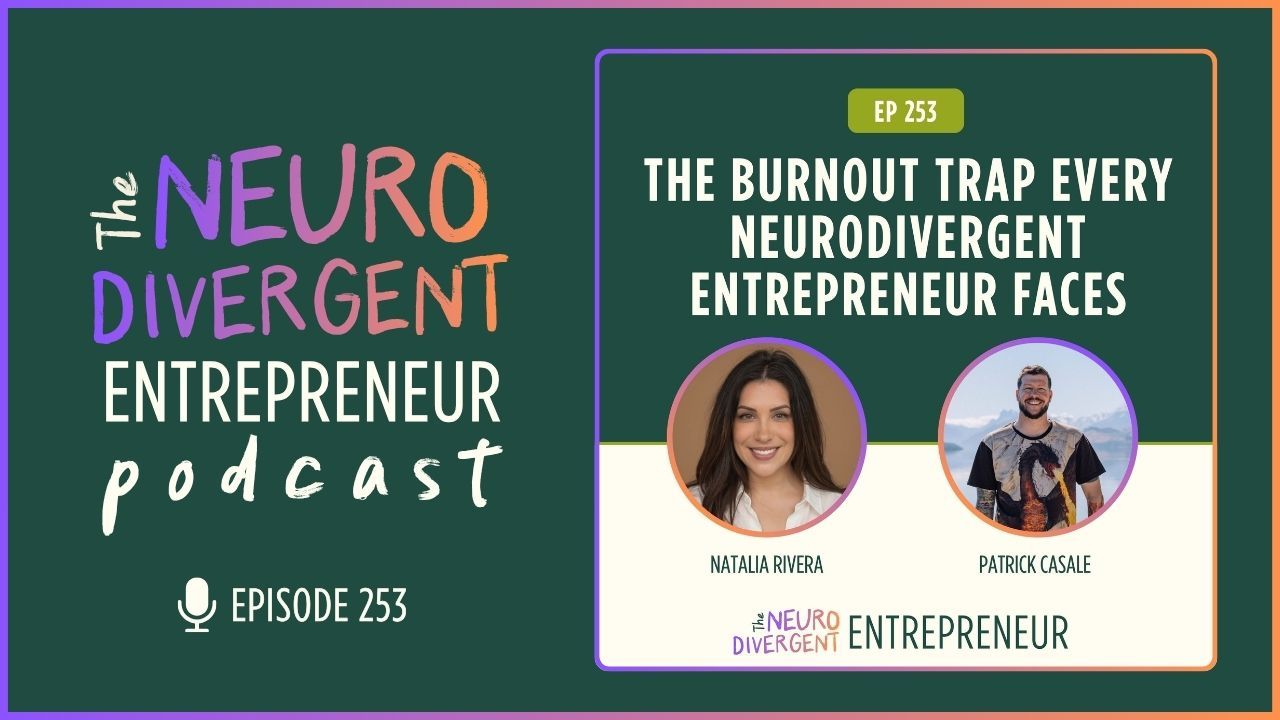
Navigating business ownership as a neurodivergent entrepreneur can be both challenging and empowering, offering independence and autonomy in work life while also requiring constant self-assessment of needs and capacity. In this episode, Patrick Casale talks with Natalia Rivera, a trauma-informed therapist specializing in high-masking Autistic adults, about how late-in-life neurodivergence discovery impacts entrepreneurship and the importance of honoring authentic capacity.
Here are 3 key takeaways:
- Capacity isn't fixed: Burnout plays a role in how our energy and cognitive capacity change over time, and it's critical to continually assess and honor those limits as we grow professionally.
- Rest is a critical business strategy: Building in downtime, taking restorative breaks, and pausing to reflect are essential, not only for wellbeing but also to create and produce meaningful work sustainably.
- Embrace adaptation and outsourcing: Entrepreneurship allows for adaptability. This can look like slowing down, delegating tasks, and shifting business models to align with evolving needs and spiky neurodivergent profiles.
More about Natalia:
Natalia Rivera is a neurodivergent, trauma-informed therapist and clinical psychology intern who specializes in working with high-masking autistic adults. She is EMDR-trained and passionate about helping clients unlearn survival-based identities and reconnect with their authentic selves.
Her doctoral research explores the identity development of high-masking autistic women, and her background as a former English educator informs her love of storytelling, depth, and meaning-making in the therapeutic process. Natalia believes healing is holistic—integrating mind, body, and spirit—and that faith can be a powerful component of psychological growth. She enjoys nature, literature, and time with the people and animals she loves.
- Instagram: instagram.com/awakentherapysf
- Website: awakentherapy.org
🎙️Listen to more episodes of The Neurodivergent Entrepreneur Podcast
🎙️Spotify
🎙️Apple
🎙️YouTube Music
▶️ YouTube
✈️ Check out available Retreats
🗨️ Join the free Empowered Escape FB Community
A Thanks to Our Sponsors: The Receptionist for iPad!
I want to thank The Receptionist for iPad for sponsoring this episode.
The Receptionist for iPad is a HIPAA-ready digital check-in system that eliminates the need to walk back and forth from your office to the waiting room to see if your next appointment has arrived. Clients or patients can check in for their appointments, and you'll be immediately notified by text, email, or your preferred channel. Break free from interruptions and make the most of your time, because it is valuable. Start a free 14-day trial of the Receptionist for iPad by going to thereceptionist.com/privatepractice. Make sure to start your trial with that link to get your first month free if you decide to sign up.
Free Gifts for Our Listeners
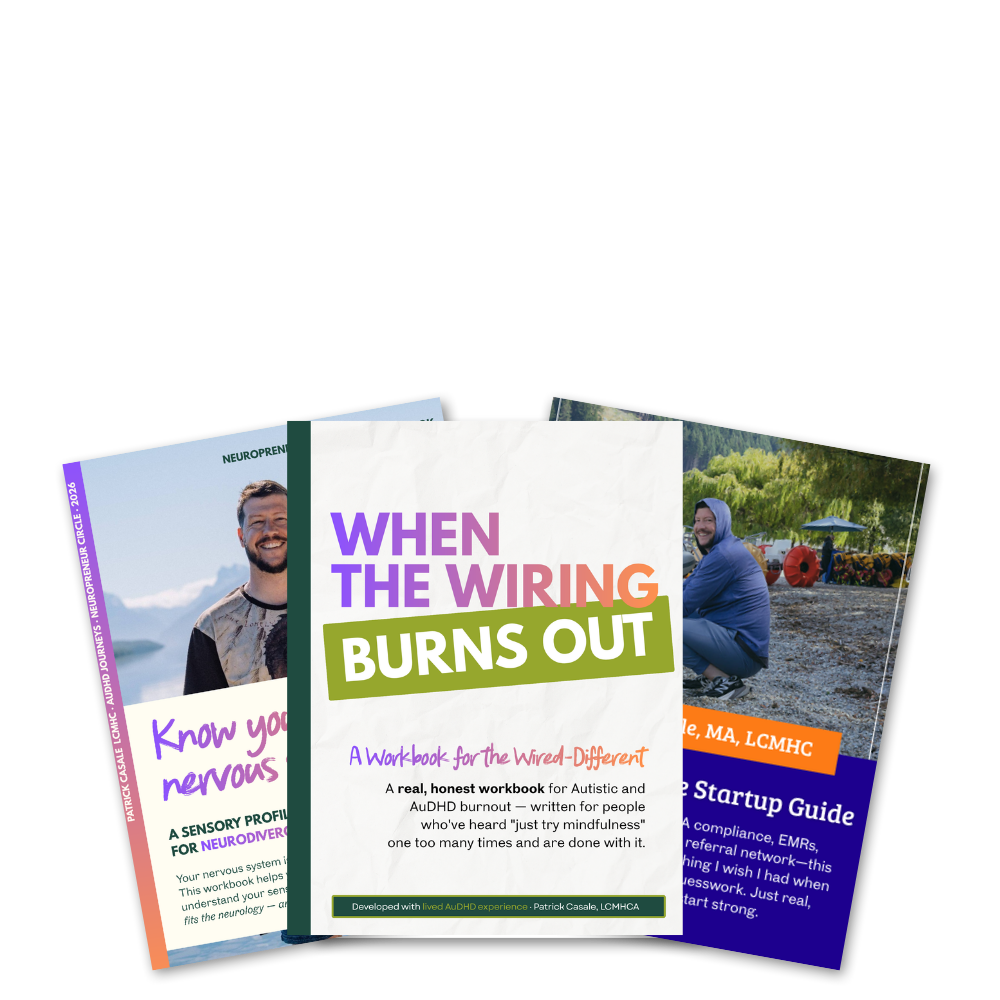
Get a practical podcasting workbook for therapists considering starting a podcast, created by Patrick Casale, host of the podcasts The Neurodivergent Entrepreneur and Divergent Conversations.
You'll get a practical structure for therapists who want to start a podcast but don’t want to rush, perform, or build something they can’t sustain.
Grab your free copy: ndpod.org/Free-Podcasting-Workbook
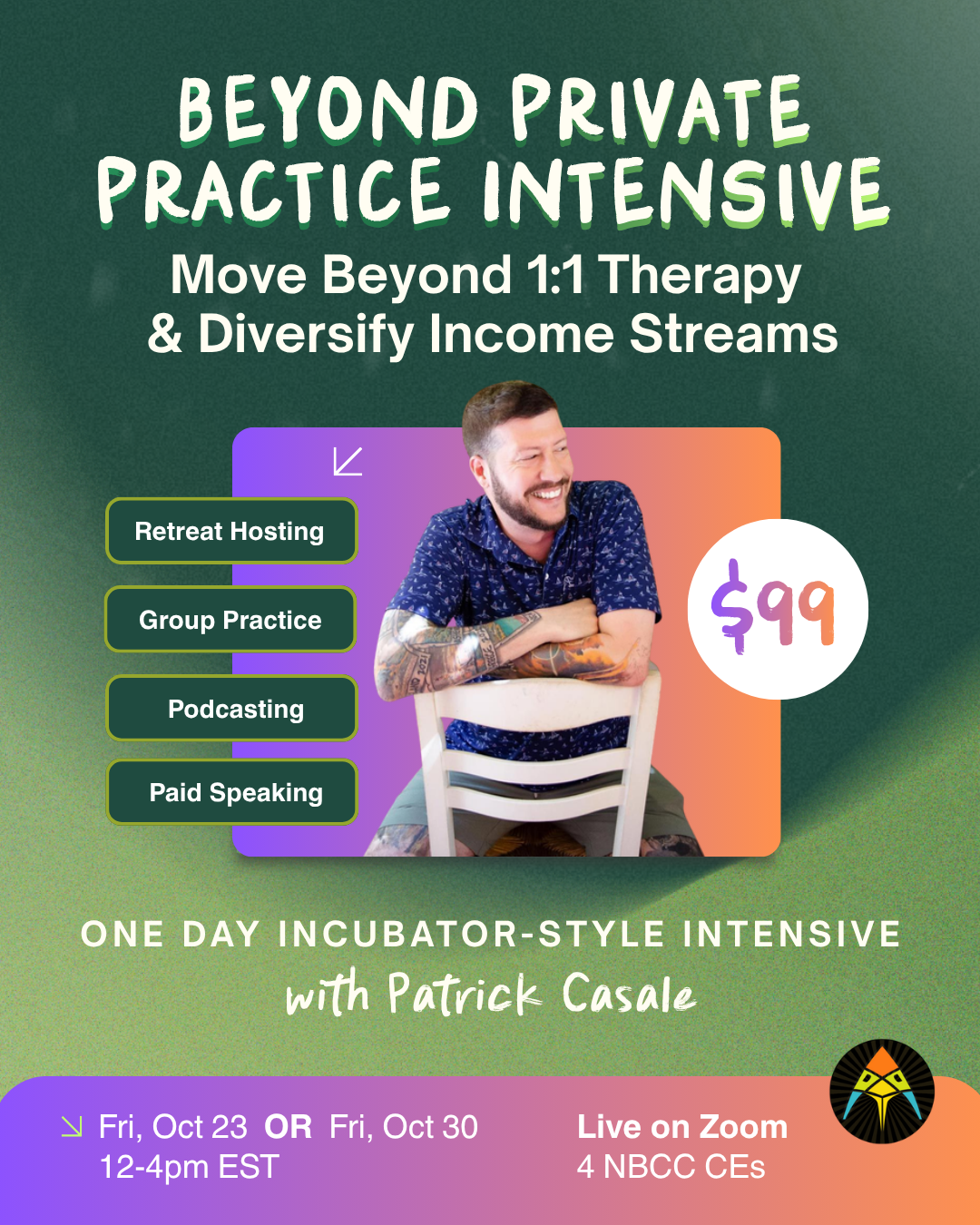
✨ Move Beyond Private Practice As A Neurodivergent Entrepreneur
Move Beyond Private Practice As A Neurodivergent Entrepreneur is a FREE 5-part mini-course designed for therapists who want sustainable financial independence beyond one-on-one work.
Access your free mini-course here: ndpod.org/Neurodivergent-Entrepreneur
Transcript
PATRICK CASALE: Hey, everyone. This is Patrick. And I wanted to share something really exciting with you. The All Things Private Practice podcast is changing to The Neurodivergent Entrepreneur podcast.
When I discovered that I was autistic ADHD five years ago, everything changed for me. It's wild, because at that point in time, my career had just taken off.
Over these last few years, I've done a lot of deconstruction, worked through a lot of internalized ableism, learned as much as I can about neurodiversity, in general. And I really want to start unpacking what it means to be a neurodivergent entrepreneur.
So, in this podcast, I'm going to be interviewing other neurodivergent entrepreneurs of all walks of life, and all different areas of business and creativity, thought leaders, visionaries, creatives, leaders, etc. Real, unfiltered, authentic conversations. No positive psychology, always highlighting both sides of the coin with a lot of nuance, a lot of duality, and a lot of honest conversation, highlighting the strength and the struggle.
Make sure to download, like, subscribe, and share The Neurodivergent Entrepreneur podcast.
Hey, everyone. Welcome back. I'm joined today by Natalia Rivera, who is a neurodivergent trauma-informed therapist and clinical psychology intern who specializes in working with high-masking autistic adults.
She is EMDR-trained and passionate about helping clients unlearn survival-based identities and reconnect with their authentic selves. Her doctoral research explores the identity development of high-masking autistic women. And her background as a former English educator informs her love of storytelling, depth, and meaning-making in the therapeutic process.
Natalia believes healing is holistic, integrating mind, body, and spirit. And that faith can be a powerful component of psychological growth.
She enjoys nature, literature, and time with people and animals she loves.
Yeah, I love that. What favorite animals, to put you on the spot, like, right now, types of animals, I should say?
NATALIA RIVERA: Well, I've always owned dogs and cats. So, I'm not one or the other, I’m both. I also have a red-tailed boa that's about six or seven feet long now. It’s so [CROSSTALK 00:03:35].
PATRICK CASALE: Okay. We only do exposure therapy on here, because I am so scared of snakes.
NATALIA RIVERA: Yeah.
PATRICK CASALE: That is my one of my biggest phobias in life. And living here in the mountains of North Carolina, we have copperheads, rattlesnakes. If I go hiking, I don't even get to, like, look at the surroundings and enjoy them. I just look at my feet the whole time. It's horrifying.
NATALIA RIVERA: Yep. Similar in NorCal, we have rattlesnakes out here in the summer. So, you have to watch where you step.
PATRICK CASALE: Okay, so now we get that out of the way. So, you are someone who is an AuDHD business owner, like myself. And I know you wanted to talk about what it's like to be a neurodivergent entrepreneur. And I would love to know a little bit more about, kind of, your journey here in terms of late-in-life discovery, being a business owner, some of those things. So, where do you want to start?
NATALIA RIVERA: Excuse me. We can start it like late-in-life discovery. That was an interesting process. And still is an interesting process.
So, I only recognized that I was neurodivergent a few years ago. And then, through my doctoral program was essentially pushed into getting an official diagnosis.
So, I have an MFT already, so I'm a marriage and family therapist, and then decided to continue on to get my doctorate.
And as most late-in-life people was realizing how I'm aging, it's becoming more and more apparent that I'm different from my peers. And I've always known that, but the older you get, the more apparent it becomes.
And so, I did a lot of trauma therapy, like years and years of trauma therapy. I felt like I overcame that. And yet there were still things.
And so, that catapulted my deep dive into, you know, sensory sensitivities and the highly sensitive person. And after researching the highly sensitive person for a while, realized this is just code for autistic.
And once I started looking into… because I'm a therapist, I have access to these things, looking into what that means as far as the diagnoses, what the criteria are, I started reading about female diagnosis and female presentations. And I was like, “Oh yeah.” It dates all the way back to when I was a child. You could see, like, pictures when I was three, I had dinosaur arms, you know? All the photos, I'm like this. And amongst many, many other things, but that's how I discovered. And then, I had obviously peers that are therapists, too, that were integral to me processing this.
PATRICK CASALE: How long ago was this?
NATALIA RIVERA: I want to say four years now, so-
PATRICK CASALE: Pretty recent. Kind of on the same trajectory then. So, I like that you said that you're still processing this. I think that a lot of people listening, and just in general, think, “Okay, I'm going to figure this out finally. I'm going to unlock this, like, mystery to my life, because I felt so different and disconnected and alien-esque, and just never felt like I could fit in, but couldn't find the why.”
I found the why. Life has not gotten easier. Life has gotten harder. And you mentioned kind of getting to this point, right, where you can no longer mask anymore, where your ability to mask is no longer able to keep up with the stressors in life.
And I think that's what we see, right, a lot of times later in life, for those of us diagnosed as autistic, of like all of the things we were suppressing, all of our traits that we were masking come to a head, and all of a sudden, we're like, “What the fuck is happening?”
NATALIA RIVERA: Yeah, so that inability to mask was coming out in, you know, for some people, it's their job. And at the time, I was a corporate employee, again. And quickly realized this cannot last for me.
And I was also in school. And so, the only way for me I found that I was going to finish my program is if I got an official diagnosis, and so I did. And I just paid the money, because sometimes it is worth paying the money to get the official diagnosis, to have the accommodations on record, and that's essentially what is now getting me through my dissertation process so I can actually graduate.
PATRICK CASALE: Right, okay. So, when you say, “I had to get the diagnosis to finish school.” Are you saying that you were told that needed to happen, or you realized, like, “I need the accommodations, and the only way I can do that is through this diagnosis?”
NATALIA RIVERA: I needed the accommodations.
PATRICK CASALE: Okay.
NATALIA RIVERA: Yeah, yeah. So, I mentioned earlier, when we weren't recording, that I'm moving. And that has been a very challenging thing for me, because I'm in a beautiful area of Oakland. A lot of people don't realize that Oakland has beautiful areas. And I'm up in the hills. I love being up here. And for the past two years, I've been processing and integrating the fact that it's still not enough and I'm not a city person. So, that was the biggest thing.
My campus is in San Francisco. And even though I'm right across the bridge from San Francisco, I don't like cities. So, I was getting super overwhelmed just driving into San Francisco, having to walk through the city streets, all the noise. The building that my campus is in has like paper thin walls. It was a sensory nightmare.
And I was like, “I can't do this.” And so, that was part of the reason why I decided, like, hey, I'm not going to get through this, because people are looking at me. I'm dysregulated. I'm trying so hard to hold it all together that I'm not even like present mentally at all, yeah.
PATRICK CASALE: Yeah, I can really empathize with that and relate. And just the realization for those of us who are more hypersensitive, who are so impacted, I always look at it as like, sorry, my Shih Tzu is jumping up here [INDISCERNIBLE 00:10:24] by the way [CROSSTALK 00:10:27]-
NATALIA RIVERA: Hi.
PATRICK CASALE: Like, the sensory overwhelm for me is so, so palpable. And it feels like this like electrical shock that is happening constantly. And it's from like all of the input all at once, so that would be very hard for me as well.
And honestly, just driving from Oakland to San Fran, across the bridge, like in general, then add in like all the other factors, right? Or taking the bar, that would also be quite overwhelming for me.
So, like, I am realizing as this happens, the accommodations that I need to put in place to create some sort of accessibility in my life, and be able to function in my life in some capacity with how overwhelmed I get.
So, you're making this move. Like, all of this is going on. And you also own a business, is that correct?
NATALIA RIVERA: I do, yeah.
PATRICK CASALE: Yeah, so tell us about your business, and like how has that changed from pre-discovery to post-discovery?
NATALIA RIVERA: So, I started the business post-discovery. And it's really interesting being AuDHD. And I know you've talked about this too, where we have these bursts of energy where we can get so much done in a short amount of time, and then have to just completely stop or slow down extremely.
And so, I'm learning, you know? And I'm still learning. I started this business gung ho. It just kind of exploded and got a lot of clients. I have a teaching background, so I decided, like, I'm going to make a whole training program, which super passionate about, still doing it, just at a much slower pace. And I'm going to, you know, teach trainees how to work with neurodivergent people, because that's really desperately needed in the therapeutic field, and kind of went too fast, as most ADHDers do. Moved extraordinarily too fast, became really overwhelmed, burned out, reassessed capacity. And then, so that's what I, what I mean when I'm saying, like, I'm still learning how to function with myself.
I've reassessed capacity in terms of employment, but now I'm reassessing capacity in terms of being an entrepreneur. And so, now, I've slowed way down. I've paused with the training program until it's just completely done.
I've begun outsourcing things that I feel like, yes, outsourcing just to, you know, get things done, and also maintain capacity, so I can be in relationship with my partner, so I can have downtime, so I can really take care of myself, because for a couple years there I was just nonstop, you know? 12- to 14-hour days to get this going.
PATRICK CASALE: Absolutely. I think you said so many valuable things. And for those of you listening who are neurodivergent entrepreneurs, especially AuDHDers, I mean, I just can't say enough about this internal push-pull overstimulation versus under stimulation, because I talk about this a lot. And my good friend and colleague Dr. Neff talks about this a lot, where, like, when autism gets so overwhelmed and overstimulated, and you need to shut down however you do, but ADHD is mentally and intellectually under stimulated, it feels like such a hellacious place to be.
And that's where I see so many of us, like, “I have all these idea burst, I've got to do all the things I've got to create while I have the energy, because I don't know when it'll come back.”
For me, autism has been like waving the white flag for years now, from pushing myself far beyond capacity. And I would love to know your thoughts, but did you experience any sort of grief while confronting capacity and limitation, because for me it's been a really paramount moment in my life, both personally and professionally, but there's also been grief with naming and confronting limitation, as someone who's been so used to going like a million miles an hour for so long to now think like, “I've really got to rethink and restructure everything.”
NATALIA RIVERA: Yeah, a lot of grief and also acceptance. So, I've burned out twice really badly. This is prior to my diagnosis or even thinking about the fact that I could be neurodivergent.
I am a person, this doesn't scream autism. I have a lot of degrees, so my doctorate is my fifth graduate degree. I have three master's degrees and a bachelor's degree, and simply because I love doing it. I just really like to be in school. I had the ability to be in school, so I was in school, but I also worked because I don't have, you know, a ton of parental support, so I've always been the person who's working and in school, working and in school.
And I burned out twice because of that. And so, being an entrepreneur, I think just as healing does, it happens in layers. Now, I'm at the point where when I shut down, I know what's happening. And I think about, okay, I did it again. I start reassessing how can I make this work for myself so I can continue?
And that's what this year has honestly been about. I've kept my staff pretty small and manageable. I slowed down on classes again with my program. And I've just been trying to find a way to make it all work.
The grief is still there, especially when you think about what you could be doing. You know, I could be done with all my doctoral classes by May, but what is that going to do to my capacity and to my mental health?
PATRICK CASALE: Exactly. And that's really a profound revelation and really insightful. And I think for so many of us who think in almost like black and white, it feels all or nothing-ish of like if I slow everything down I'll never accomplish all of these things I want to set out to do, or I will accomplish none, or whatever.
And it really is complete bullshit for the most part, because I think when we step back, and reassess, and become really accepting of energy, and capacity, and limitation, and set better boundaries, and start to do some inner child healing, especially from the perspective of the lens of late-in-life discovery, this is a marathon, it is not a sprint.
And for me, one thing that has been a blessing and curse is being an entrepreneur who works from home, primarily, if I'm not hosting events, I can really get into that mindfuck of like, I'm not doing anything, I'm not doing enough, I'm not creating, I feel still, I feel stagnant, I feel like the walls are closing in.
And then, also, like trying to sensory soothe simultaneously and heal through the worst bout of burnout I've ever experienced in my life has been almost ongoing for two years now. And I just keep telling myself, like, if you do not listen to your body and honor what you need, you may not make it to be 45, man. You're 39 and a half right now, you cannot continue to push yourself this way.
NATALIA RIVERA: Yeah.
PATRICK CASALE: And there's grief in that. I think there's internalized ableism to continue to deconstruct living in an ableist world, and a world that is contingent on capitalism, and hustle, and grind that is not designed for our nervous systems. And to also have acceptance of, like, I wrote this post the other day, I was, do you watch Shrinking at all?
NATALIA RIVERA: I do, yeah.
PATRICK CASALE: Okay. I was watching the newest season of episode one for the fourth time. And it's just such a beautiful episode. And I was experiencing such waves of intense emotion.
And I just thought I really wouldn't trade existence like this for the world, because I feel so deeply. And that can certainly be so overwhelmingly torturous and painful, but it can be so overwhelmingly beautiful. And I'm just trying to really embrace the dichotomy of that, and the reality of, like, it is not an either or, it is a both-and. And it's hard, though, it's not easy.
NATALIA RIVERA: No, it isn't. And one of the things that I find really interesting, and it's a repeated, sorry, my brain just shut down. It's a repeated theme in my work with clients is the concept, you know, ADHDers want to move so fast, they want to do it now. They want to have things done, you know. “I want to work through trauma right now. I want to be productive right now. I want to, you know, do everything right now, fast, fast, fast. Like, tell me how to do it, show me how to do it.”
And then my answer is, “We got to slow you down.” And they're like, “What? What do you mean?”
And it's really interesting that when you do slow down, you know, when I finally taught myself to slow down, when I finally taught myself, like, you have to factor in breaks, you have to go on vacation. I'm realizing after burning out last year, again, I have to vacation like every three months or so. It doesn't have to be anything extravagant, but like I have to take a break, maybe go up to, you know, a waterfall or something. I have to do something.
I have to stretch every day. I have to meditate every day. And in those pauses, in those regroupings, you find the capacity. And you, you know, make your window of tolerance wider in order to continue to produce, because you know, one of the things that I see on Instagram all the time from neurodivergent content creators is that capitalism talk. And we live here.
PATRICK CASALE: Yeah, yeah.
NATALIA RIVERA: And you know the radical acceptance is that this isn't going to change no matter how much we rail against it, so how are we going to make it work for us? The way that I made it work for me, and what I would love to eventually help other people do is, you know, build their own business, if that's what's going to work for them, because I feel like that is the only thing that is going to work for me.
PATRICK CASALE: I, well, couldn't say it better myself. I started this business, well, I started in 2017 but COVID forcing me to work from home and transition everything into an environment that I could control. I had no idea how helpful that was going to be on so many layers. And I don't think I could work anywhere else, because I need to control so many things to support my system.
And one thing that has become unbelievably apparent, I started hosting these retreats back in 2022. I think I had just learned I was autistic. I really hadn't made sense of that yet, and that part of my business took off in a way I never expected it to.
And what I realized very quickly was that I was having these like bucket list, once in a lifetime experiences that people dream of as a part of my work, but I wasn't really able to actively participate in it, because of how much it took from me in terms of burnout, and sensory overwhelm, and just the fatigue, and the illnesses that would ramp up, and like absorbing the energy of 20 other people for however many days, and like the travel. Like, all of the compounding layers of stress that led me to such a complete and utter collapse earlier this year, where I ended up in the hospital when I knew that my two upcoming events coming up in New Zealand are going to be it for me.
And that was so painful to admit at first out loud, where I was like, “Is this failure? Is this my career has no meaning anymore? Like, I don't know where to go from this existential crossroads of, like, professionally, what do I do with my life? Because this will be event number 21 and 22.”
And I thought, “Who gets to really say that?” You know, like, pivoting and adapting and evolving as entrepreneurs is a part of the journey, and being able to step back and say what you really need is rest, and what comes from this, I'm not entirely sure, and that can sometimes feel horrifying, but also, trusting that as an entrepreneur, I have to trust that the creative energy will come back to me when it's ready to do so, and that I cannot force it.
I don't even remember the last time, you mentioned going on vacation and needing to do that, where I haven't been like a working vacation. And like just the realization of I don't know how to really be still, and restful, and restorative, because my nervous system all the time needs to be on the go.
And I just know that once I get back from New Zealand, that is the goal, and that is where all of my energy is going, is to slow down, to completely re-shift and restructure my professional life, but more importantly, my personal life, because I think as AuDHD entrepreneurs and those of us who experience these deep bouts of autistic burnout, eventually, there is no coming back if you continue to dig that hole deeper and deeper and deeper.
And I think that that scares the hell out of a lot of us, who the ADHD side is so restless and bored when things slow down. So, that is my goal for the rest of 2026.
NATALIA RIVERA: Yeah, it's a good goal to have, and just to validate that it does come back. And honoring your system, your nervous system in the way that you maybe have performed in the past isn't going to work moving forward. Again, as we age, as we get older, our capacity shifts and changes. And it also doesn't mean that you can't create. So, maybe you're not traveling as much, but something else, you'll have a different idea. And you'll be able to create in a different way.
I'm also in a similar boat, where I'm realizing I'm not there yet, but I also have accepted the fact that I'm not going to be able to do face-to-face for the rest of my life. There's going to come a time where it's going to have to stop, because that is where my autism is spiky, is with socialization, and it really drains me. So, like, when I see you traveling and doing TED Talks, I'm like, “Whoo, like, that would wipe me out.”
PATRICK CASALE: Yeah.
NATALIA RIVERA: Completely wipe me out. And, you know, I'm already thinking about what that transition is going to look like. It won't be for a few years, but I know it's coming, that at some point it's going to have to end, yeah.
PATRICK CASALE: Yeah, absolutely. That's a great point as well, just having those spiky profiles of things that are really struggle areas for us versus the areas that we really excel at.
And I think, for me, I'm in the same boat. And that's why I try so hard when I'm posting content about, like, doing a TEDx, and these events, and whatever else. Like, to always honor the shadow side, because I think social media does such a great job of convincing us that we're not doing enough and putting us in comparison mode.
And any entrepreneurial community feels that way to me. And in order to like model what's really going on, I want to also talk about the struggle, the areas that feel really heavy, that can feel like failure or feel like complete lacks of just growth in general. So, trying to honor both of those things.
And for those of you listening, I think we can easily get caught up in comparison on social media. Who has more likes, follows, downloads, engagement? Who's doing what? And we lose track and sight of the fact that, like, individually, what do we need in order to feel okay?
I know I am a great connector and community builder. And I know that's where I'm putting my energy after retreats come to an end, is into online neurodivergent entrepreneurial community. And I think that will be much more useful for my energy and my capacity. And I think we all have to find that.
And that takes soul searching. And it takes a lot of honesty with ourselves about capacity, and what we need more of, and what we need less of. So, I hope that all of you can do that, who are listening. And I think it's a journey. I love The Hobbit and Lord of the Rings, so I kind of associate everything with being some sort of journey.
NATALIA RIVERA: Yeah. As a true neurodivergent person, yes, I'm obsessed with Lord of the Rings.
PATRICK CASALE: Are you really?
NATALIA RIVERA: Yeah, I really am.
PATRICK CASALE: [CROSSTALK 00:29:18] whole episode on that. [CROSSTALK 00:29:20] strictly about who's your favorite character?
NATALIA RIVERA: My favorite character, someone asked me this before, it has to be, and I'm going to forget her name now, of course, because that's how my brain's going to [CROSSTALK 00:29:35]-
PATRICK CASALE: I got you. Don’t worry.
NATALIA RIVERA: The elf. The queen elf.
PATRICK CASALE: Galadriel is your favorite, like…
NATALIA RIVERA: That's actually my favorite scene, where she looks in the cauldron, and she says, “Instead of a dark lord, you shall have a queen.” I love that scene. But it's Liv Tyler in the movie. That’s actually-
PATRICK CASALE: Oh, okay.
NATALIA RIVERA: Yeah. Thank you.
PATRICK CASALE: Okay. Are you watching… As we completely diverge out of entrepreneurship, did you watch Rings of Power on Amazon?
NATALIA RIVERA: I had it on in the background, so I’ve like half watched it, yeah.
PATRICK CASALE: Okay, I encourage you and everyone else who might be haters that are on the other side of this to re-watch. The first few episodes are very slow-building. Season two is incredible. And the actress who plays Galadriel in that show is phenomenal. Really like that.
I actually met the actor who played Sauron in the original Lord of the Rings series in Portugal a couple of years ago. And we spent the entire day together day drinking, and we-
NATALIA RIVERA: Oh, nice.
PATRICK CASALE: [CROSSTALK 00:30:45]. And it's amazing, you know, like what special interests can do for us as neurodivergent entrepreneurs, because when I talk about this stuff, I can sense, like, getting activated and excited.
I've re-watched the new Game of Thrones show, like, four times now, just to see if I can get into it, and then my brain started going, like, “Oh, here are all these Targaryen dynasties, and lords, and heirs, and family trees.” And I wanted to wake my wife up to talk about it. And I was like, so excited, she's like, "Can you shut the fuck up? Like, I don't want to talk about this ever, let alone now.” Anyway.
NATALIA RIVERA: Yeah, it's really interesting having a partner who's neurodivergent. We're not married, but my boyfriend, whom I'm moving in with, so this is a really exciting time. He's just full of fun facts. We'll just be talking about something random, and he'll be like, "Did you know that…?” And I'm like, "Great, amazing.”
PATRICK CASALE: I have so many of those “did you know” Lord of the Rings facts that I want to share right now, and I'm going to like refrain from it, I'm going to share one, because you said you like Arwen.
NATALIA RIVERA: Yeah.
PATRICK CASALE: So, Viggo Mortensen, who played Aragorn, was a real method actor, sleeping in the woods, using real props, like real swords, going to the grocery store barefoot with his sword, for some reason, getting the New Zealand cops called on him during this time. Anyway, really nice guy. And Arwen’s stunt double fell in love with the horse that she was riding in the movie, but could not afford it. Viggo actually bought her that horse as a gift, and he was a hell of a guy. So, I learned all of that while I was in New Zealand last year.
NATALIA RIVERA: That's so fun. Yeah, I love that story.
PATRICK CASALE: Anyway, after completely diverging, to anyone who's still listening, surplus pack, so I really appreciate you coming on and sharing some of this story and your journey with this. And it's really wonderful to hear from other neurodivergent entrepreneurs who are rearranging and restructuring their lives to make it work for them.
And it sounds like you are really honoring exactly what you need in terms of all of these changes, and I think that is exactly what some of us really, really need to do. So, thank you for sharing that with the audience and with me.
NATALIA RIVERA: Yeah, absolutely. Thanks for having me on.
PATRICK CASALE: Yeah, of course. And as we wrap, where can people find you if they want to follow you on socials or work with you? Where's that? And we'll add that to the show notes for everyone listening.
NATALIA RIVERA: Yeah, so my handle is @awakentherapysf on every social media channel, and then the website is awakentherapy.org.
PATRICK CASALE: Perfect, we will have that in the show notes so you all have access to everything Natalia just referenced. Good luck with the move. And thank you so much for coming on and just sharing some of your story.
NATALIA RIVERA: Yeah, thank you.
PATRICK CASALE: And to everyone listening, you can like, download, subscribe, share. Doubt yourself, do it anyway. And we will see you next week.
FREE PRIVATE PRACTICE GUIDE
Join the weekly newsletter for private practice tips, podcast updates, special offers, & your free private practice startup guide!
We will not spam you or share your information. You can unsubscribe at any time.





![Episode 264: Creating Through the Chaos of a Neurodivergent Life [featuring Bre "BR3"]](https://kajabi-storefronts-production.kajabi-cdn.com/kajabi-storefronts-production/file-uploads/sites/2147507511/images/a14004-cc3d-8aba-5fb8-2442fdfc650_TNDE_YouTube_episode_264.jpg)
![Episode 263: Your Symptoms Are Real—Even When Medicine Doesn’t Have The Answers [featuring Dr. Zachary Spiritos]](https://kajabi-storefronts-production.kajabi-cdn.com/kajabi-storefronts-production/file-uploads/sites/2147507511/images/84bc15-1ce4-1a0b-8f85-f5812bce75_TNDE_YouTube_episode_263.jpg)
![Episode 262: Your Brain Isn’t the Problem. The System Needs Reimagining. [featuring Dr. Mel Houser]](https://kajabi-storefronts-production.kajabi-cdn.com/kajabi-storefronts-production/file-uploads/sites/2147507511/images/42c858d-0b15-7581-e6ac-f636e7a1fa1_TNDE_YouTube_episode_262.jpg)