Show Notes
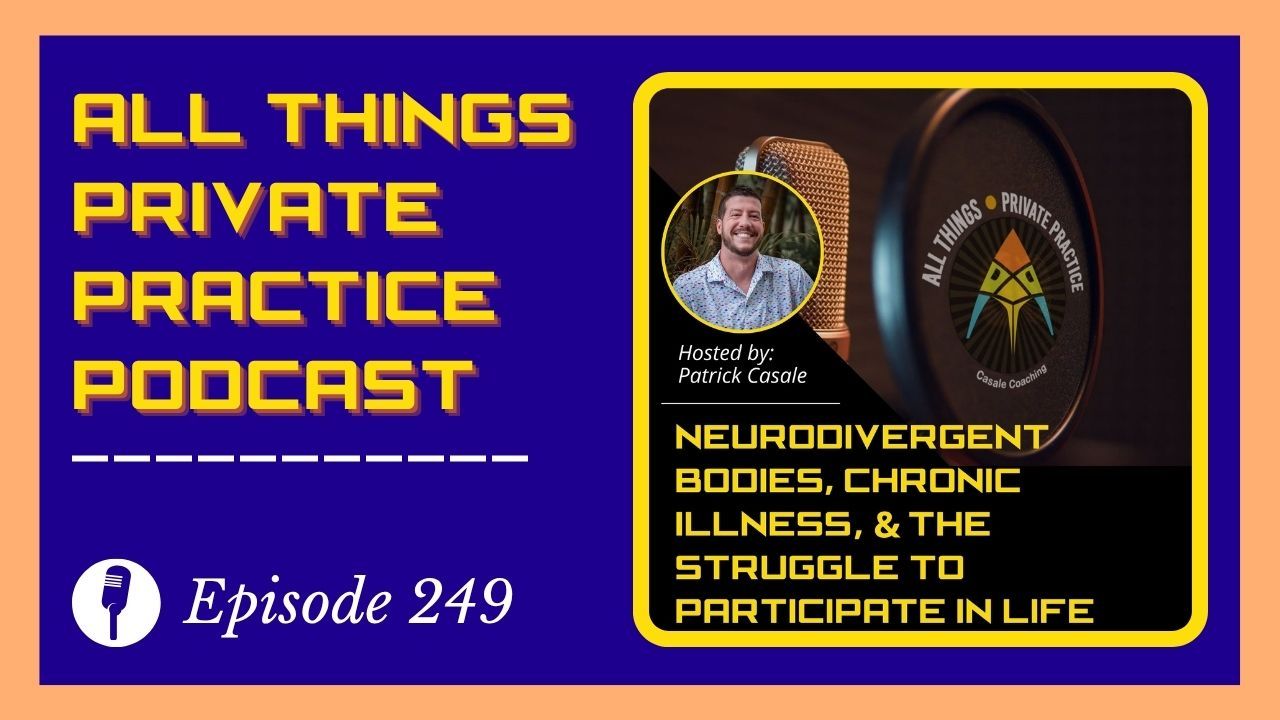
In this episode, Patrick Casale shares a brutally honest look at living with chronic neuroimmune conditions while trying to keep up with plans, business, and even just daily life. If you’ve ever felt like your body is working against you and struggled to keep up with the demands of life, you’re not alone.
Patrick opens up about the exhausting intersection of autism, ADHD, POTS, MCAS, Ehlers-Danlos, chronic pain, burnout, and more. The challenges are real: unpredictable energy, inconsistent capacity, medical gaslighting, and the constant guilt of letting others down.
Here are 3 key takeaways:
- Pace Yourself Relentlessly: Learn to recognize energy “spoons” and avoid going into deficit mode—overexertion leads to longer recovery and deeper burnout.
- Build Accommodations Into Your Work Life: Remote work, flexible schedules, and chunking tasks are vital. Leverage low-energy tasks and batch work when possible to maximize good days and safeguard your health.
- Seek Community and Share Strategies: Isolation compounds pain. Normalize your experience by connecting with others, sharing pacing strategies, and being honest about capacity.
If you’re navigating similar waters, know this: your experience is valid, and there are ways to adapt your life to support your unique needs.
🎙️Listen to more episodes of The Neurodivergent Entrepreneur Podcast
🎙️Spotify
🎙️Apple
🎙️YouTube Music
▶️ YouTube
✈️ Check out available Retreats
🗨️ Join the free Empowered Escape FB Community
A Thanks to Our Sponsors: The Receptionist for iPad!
I want to thank The Receptionist for iPad for sponsoring this episode.
The Receptionist for iPad is a HIPAA-ready digital check-in system that eliminates the need to walk back and forth from your office to the waiting room to see if your next appointment has arrived. Clients or patients can check in for their appointments, and you'll be immediately notified by text, email, or your preferred channel. Break free from interruptions and make the most of your time, because it is valuable. Start a free 14-day trial of the Receptionist for iPad by going to thereceptionist.com/privatepractice. Make sure to start your trial with that link to get your first month free if you decide to sign up.
Free Gifts for Our Listeners
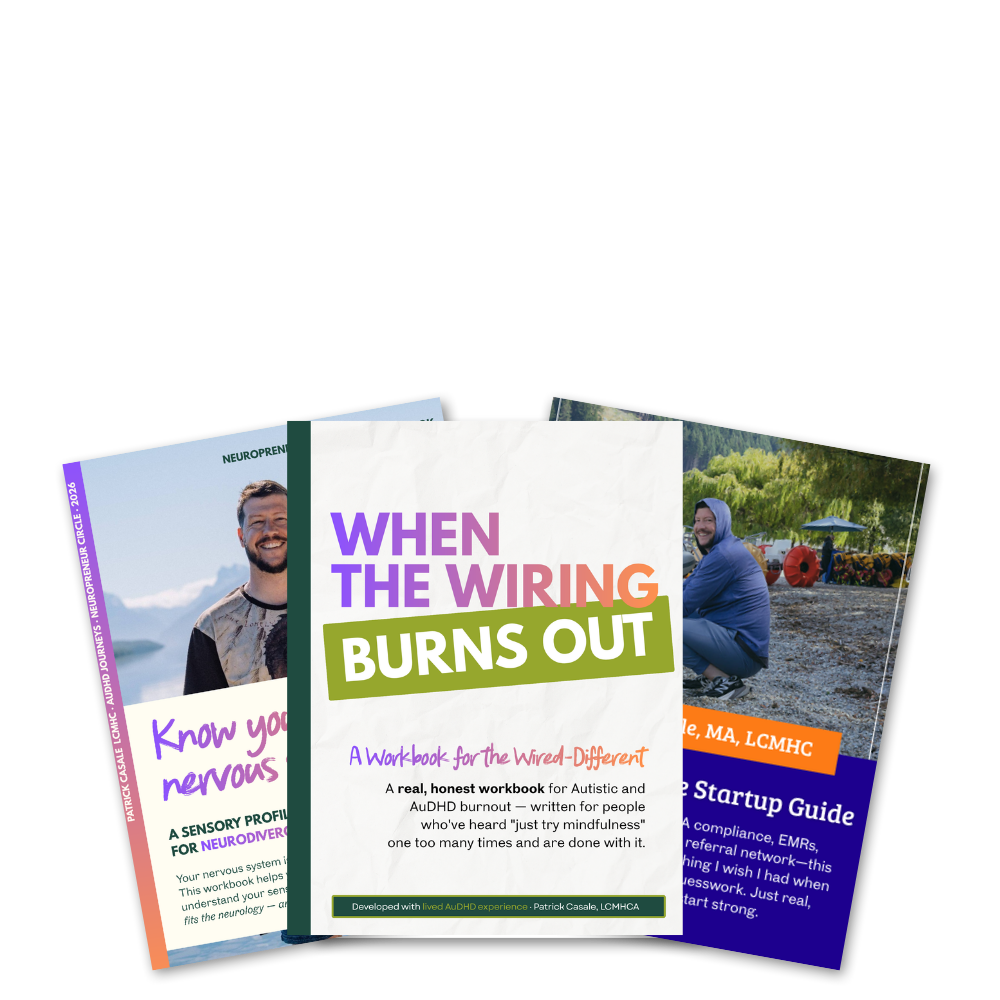
Get a practical podcasting workbook for therapists considering starting a podcast, created by Patrick Casale, host of the podcasts The Neurodivergent Entrepreneur and Divergent Conversations.
You'll get a practical structure for therapists who want to start a podcast but don’t want to rush, perform, or build something they can’t sustain.
Grab your free copy: ndpod.org/Free-Podcasting-Workbook
✨ Move Beyond Private Practice As A Neurodivergent Entrepreneur
Move Beyond Private Practice As A Neurodivergent Entrepreneur is a FREE 5-part mini-course designed for therapists who want sustainable financial independence beyond one-on-one work.
Access your free mini-course here: ndpod.org/Neurodivergent-Entrepreneur
Transcript
PATRICK CASALE: Hey, everyone. It's Patrick. I don't know if you're watching this on my Substack, AuDHD Journeys, or on my podcast, All Things Private Practice, which is going to be turning into the Neurodivergent Entrepreneur podcast. So, wherever you're listening, I appreciate it.
And this is a painful thing that I'm recording. And I think a lot of you are going to relate to it, unfortunately. It's about 9 o'clock at night, where I am. I am exhausted, as you can probably tell out of my face.
Okay, where to start? It's all about health stuff. It's all about health stuff, which is the story of my life right now. It's like everything that's going on all the time is about something that I'm dealing with.
And I know a lot of you are dealing with similar things. And that's kind of the impetus of recording this is the connection between all of these neuroimmune disorders, like POTS or postural orthostatic tachycardia, MCAS, mass cell activation syndrome, hypermobility EDS, Ehlers-Danlos, and then autism and ADHD. And here we are, the unholy pendant, so to speak. And it's all connected.
A lot of people are starting to think that there's a lot of research that a lot of these genes are connected and that there's an association here. We don't have anything definitive, but there's certainly a much higher prevalency of autistic and ADHD people experiencing what I'm experiencing. And maybe it's because our nervous systems are so sensitive and dysregulated, and maybe we were stuck in fight or flight more. And ultimately, our autonomic nervous system, the behind-the-scenes, all the things that are supposed to be just happening naturally, without you thinking about them, your digestion, your heart rate, your temperature control, your urinary system, etc., were all supposed to be working seamlessly, but mine is really not.
I have been saying as a joke for a long time that I am 39 going on 90. And I used to say I was 10 years old going on 90 when I was a kid. And I was always joking halfway, but I really wasn't. I just knew something was off. Like, something was really wrong, that the doctors couldn't figure out, and I didn't know I was autistic ADHD as a child. I didn't know that until I was 35.
But if autism and ADHD, or AuDHD, is the foundation of everything for me, like that's my neurology and neurotype. And then, you sprinkle in these neuroimmune disorders, you know, like POTS, MCAS, hypermobility Ehlers-Danlos, chronic fatigue syndrome.
I had long COVID, was really impacted by that, like so many of you were, too. I just feel unbelievably disabled physically and mentally. The brain fog, the chronic pain issues, the pain that's so bad that I can't even sleep or get out of bed. And the summertime now with heat intolerance and not being able to really, like, participate in my life if it's not between like 7:00 and 8:00 AM or 8:00 PM. And it's really a hard, lonely, isolating experience in existence. And I feel like my body is destroying itself, and attacking itself, and deteriorating rapidly.
And, you know, I was just talking to a few good friends about this, and it just prompted me to make this solo episode about, you know, when you're a small business owner, and you have all this stuff going on, it's so fucking hard. And it's just so fucking hard as any human who has this stuff going on.
But then, when you add on like the responsibilities of running your businesses, and because you're self-employed, you have to work to make money. And you have to give in to fucking capitalism hellscape that we exist in to survive, and pay your bills, and pay for all these specialist visits, and all these medications, and all these appointments, and all of these, like, specialty opportunity procedures, and specialty appointments. And it adds up very, very quickly.
And I am grateful that I work from home, and work remotely, and have autonomy in my schedule, but you know, I've been shutting down my life and my schedule for the last couple of years, because I've been in such bad autistic burnout. It's felt like there's been no way out.
And autistic burnout did not cause all of these health conditions, but a nervous system that is constantly under stress and strain certainly did not help, and certainly contributed. And all of the ways that when you're in autistic burnout, when you're so far beyond your capacity, and you're so depleted, and you're so drained. And you don't have the energy or capacity to fight, and your immune system starts to get impacted, especially in a heightened sense of stress and dysregulation.
And when you're in sympathetic overdrive, when you're constantly in fight or flight, and you're releasing hormones throughout your body, because your body's saying you're not safe or you're in danger, and everything starts to get fucked up, everything starts to become really, really dysregulated.
Like, I don't sleep well, first and foremost. And I probably get three or four hours a night, and this has been since I was a kid. And even as a kid, I was very worried about my lack of sleep, because I kept thinking like, seems like this is going to make me die sooner than I should. Like, I'm not going to live as long as I should, because I don't sleep. We know how important sleep is, and we know how much neurodivergent people, especially autistic, ADHD humans, suffer from a lack of sleep or poor sleep in general.
So, when I'm not getting restorative sleep, it's broken, it's fractured. There are some nights, at least two or three a month, where I do not sleep one single fucking second. And I've gotten so used to that throughout my life that I still am able to just somehow get through my days.
And I started to convince myself, like, “Okay, you're just built differently. You don't need as much sleep. You don't need as much whatever. This is just who you are. It's just like a quirky system.”
But you know, after I started closing my life down from like hosting retreats every other month, and coaching programs, and speaking opportunities, and collaborations, and partnerships, and really just started only doing the bare necessities, and like what I have to do to survive, and I started to just get sicker and sicker as this was happening, getting sick on these retreats that I've been hosting, and like ending up in the hospital, or needing more and more time in between to recover, or just not ever feeling good in your body or your brain.
And it's so hard as a chronically ill human who also experiences chronic pain issues to be a reliable human in any sense of the work. And socially, it's really hard because I could commit to things today, six months from now, looking at my calendar, and all the blank space and saying to myself, like, “I'll probably feel okay to go do whatever, or go to that soccer game, or go to that, you know, foreign country for a vacation, or commit to going on someone's podcast. I'll probably feel okay.” That's a long enough runway, and it never is, because things happen in between that time and life continues to life, and stressors continue to increase, and demands don't ever cease to exist. No matter how hard I've worked to remove as many as I can, the demand of existence still exists. The demands of getting through your day still exists, brushing my teeth, figuring out what to eat, responding to calls or texts or messages that I have to respond to, just participating in my life is a demand.
And then, you start to add in like the hypermobility shit. I've had this chronic pain in my joints, and my knees, and my ankles, and my chest, and my neck, and my head, and my arms, and my elbows for so long. I've torn my hip labrums, my calf muscles. I've had abdominal hernias. I've had hiatal hernias. I have poor, like, gut motility. I have poor esophageal motility, I have a rare throat condition called Zenker’s diverticulum, that only impacts like point 0.001% of the population, most of whom are over 65.
And I have no doubt that it has to do with hypermobility and poor, faulty connective tissue, because what ended up happening is my esophagus structure and foundation was not strong enough, it ruptured, pouch developed behind it. When I would eat or drink or take medicine, it would all end up in that pouch, so it would not go down my esophagus, into my stomach. I would choke, and aspirate, and asphyxiate while sleeping.
I've had two surgeries since then. It's chronic, it's lifelong. It will recur. I am fucking fearful every time I eat that I'm going to feel that feeling again. I look at my scar on my throat all the time.
One of my vocal cords got paralyzed in the process. It's just heavy. And it's so, so exhausting, you all. It's so fucking tiring. And I know for those of you who know, you know. And it's so hard to explain to people. Like, I might have to bail on these plans. I might have to cancel late on the next thing that I've committed to. I might not be able to go on the vacation that I've been excitedly waiting for for months. I may not be able to go, you know, down the street to grab a drink with a friend because it's too hot out, and I just simply cannot walk down the street at that time.
I have bailed and flaked out more in the last year and a half than I have in my entire life, thinking that this is what I needed to finally get back to baseline, but at this stage, I believe that baseline is what I'm talking about. I believe that baseline is going to be managing all of these things for the rest of my life in a chronic way, and that really sucks.
And you know, you can go one or two ways with your brain. Like, I could go down the pathway of, like, okay, but other people have it worse, right? Like, I've talked about my very good friend Chris on here, who has brain cancer, that fucking sucks, right? Like, that is inevitably worse. And then, it's horrible. It feels bad. Like, he should not have to be dealing with that.
You could go down that pathway, for sure. You can go down the pathway of acceptance. You could go down the pathway of being really frustrated and rage-filled some days, and experiencing grief and loss about being disabled, and all of these ways, and acknowledging that it's probably not going to get better in time. It's most likely going to continue to get worse. So, you start to have these thoughts, like mentally, of like when do you want to make certain decisions, right? Like, I only want to live with dignity and autonomy, that's all I want.
I have lived a very good life through 39 years. Like, I've done cool things. I've created amazing things. I've put things into the world that I'm proud of. I've traveled the world. I've built wonderful relationships with people who I love dearly. And, you know, I just think that I've been very lucky in a lot of ways and very unlucky in a lot of ways.
And I try to be grateful for this stuff that feels like once in a lifetime for a lot of people, which has been my life and my career, and I've been very, very fortunate, I've been very, very grateful, and very, very blessed, and very, very privileged in a lot of ways too.
And again, going back to being a small business owner, while struggling with chronic health, you know, your energy is not consistent, your capacity is not consistent. You try to pace yourself. You try to learn how to manage your spoons, you know? For those of you listening, like Spoon Theory is like, if you all have 10 spoons every day and they replenish equally every single day. And for some of us who have a lot of these things going on, maybe I start tomorrow with seven, and maybe certain tasks take almost nine, and then I'm in the negative starting the next day already at a five instead of a seven.
And every single day feels that way, feels like, if you play video games like a life force bar, it just feels like it's like in the red constantly without being able to get back to the green. If you're reading Dungeon Crawler Carl, right now, like so many of us are. You know what I'm talking about in terms of life force. Great book, by the way. Highly recommend. Super weird, super nerdy, very good. My friend Flint recommended it to me, and very, very good.
You know, and so, like, the capacity thing is hard. The limitation thing is hard. You work through your own internalized ableism when you come to terms with disability. You try to stop pushing yourself beyond your limits, telling yourself that you should, or that you used to be able to. You start to really rearrange, and reorganize, and restructure your life in a way that makes sense. And you start to really shrink your world a bit, which is what I've had to do.
I've had to watch a lot of my good friends go off and have all these wonderful adventures together and build these beautiful memories and friendships while I'm lying on my couch or my bed. And they're sending photos from a retreat that they're co-hosting, or an event they're at together, or just simply traveling for fun. And I'm like, “Cool, I haven't been able to get out of the house for five days.”
And I used to shame the shit out of myself for being young, for being “healthy”, for being a former athlete who now can hardly, like, walk out of the house. And a lot of this happened after COVID, like so many of you experienced this long COVID that has really fucked our worlds up in terms of how it's impacted us internally.
And I think a lot of us who were impacted are probably those people who are the autistic ADHDers who have these connective tissue disorders, who have these strange medical conditions that can never be explained by one person, because the tests, and the labs, and the x-rays, and the MRIs, and the screenings are always normal, within normal limits and ranges, but you know something's wrong. And you can sense it. And you advocate like hell. You go to every single doctor that you can, you make as many appointments as possible, you do all of the research. And then, you finally find a couple of people who finally don't gaslight you, who understand, but then, they send you for more tests, and more labs, and more procedures, and more specialty visits, and it's just exhausting.
I'm just fucking tired. I'm so fucking tired. And that's what just keeps coming to my mind, is like the stuff is compounding, it's like layering and getting heavier.
And again, going back to what I was saying before, when I started this episode, like I joke about how I'm almost 40, and people are like, “Oh yeah, you're at like middle age.” I'm like, “I think middle age for me was 10 years ago, you know, maybe 15.”
I have never really felt like I was going to make it past 50 or 55. And that wasn't because I wanted to commit suicide or die by suicide. I just know that I have all this stuff going on, and the research and the data doesn't lie, like life expectancies for autistic people are much lower. Life expectancies for people with all the things I'm listing are much lower, manageable to some extent, sure. Are some people going to have better life qualities and experiences? Sure. And there are going to be some who unfortunately things compound, and get worse, and become more debilitating. And I think that's where I'm finding myself, you know?
I was listing out all these acronyms before, POTS, hEDS, like hypermobility EDS, MCAS, Autism, AuDHD, all the things. Like, chronic fatigue syndrome, and listing everything, I was like, "Fucking hell, this is a lot. It's a lot.”
And then, if you're a woman, or you were assigned female at birth, or you have a uterus, or you have, like, maybe endometriosis, or you know, anything that is impacted by the hormonal changes and fluctuations, menopause, perimenopause, etc. Add that into the list. Quite commonly found in all of these things that I'm listing right now.
And I keep going back to like owning two separate businesses, and like not being able to participate in a dream job that I've created for myself. I can't even actively go to the retreats that I want to go to, that I was hosting.
Towards the end of the last two years, I got sick at every single retreat, regardless of how relaxed or regulated I felt. I got sick every single time, typically during the retreat. And I had to take a whole day away by like sleeping, and taking meds, and trying to recover, and masking, and taking as much, like, downtime as I could, while the people who paid to be there are like, you know, having a good time, but it does make you feel guilty.
And there's a shame component to all this. There's a guilt component to all this. And I think a lot of that can be like core beliefs. I think a lot of that can be deeply embedded. I think a lot of that can also be, you know, capitalist, ableist messaging. Who the hell knows where one starts and one begins and one ends?
But you know, the reality is, for those of you who are in similar boats, I don't want this to sound like such a doom and gloom episode, but I hope it's cathartic for us to have this shared communal experience, to know that you're not alone. I know the medical gaslighting really sucks. And I know how painful it is to know that something's wrong, to be told that everything is fine, or that you're just stressed, or like you're just going through something, life experience, or a change, a transition, overwhelm, panic, etc.
I've known something's been wrong here for years. And I've preached this relentlessly to my PCP and to any other specialty care doctor I can find. And you know 99.9% of the time, I end up back at the same place, or referred to the next person, or you get that blank stare while you explain all of your symptoms and struggles.
And then, they ask you, like, “How are you managing stress? Have you been on under any stress right now?” And you're like, “It's 2026 what the fuck are you talking about? Everybody is stressed. And yes, like, if I'm describing all these symptoms and struggles, do you think that I'm having a good time with it?” It's fucking wild. The medical system sucks ass.
As a mental health provider, it's amazing what we can't get away with that medical professionals can. A mental health therapist, you could never have a patient waiting in your office for an hour before you finally came and saw them. You could never run later than like five minutes for an appointment before something like happened, whether the patient got angry with you, or upset, or reported you, or something bad happened because of their mental health. It's just wild, the difference in terms of how people are treated.
Our healthcare system is not designed to help you with all these complex conditions, because there are not a lot of people who understand the interconnectedness of everything. There's a specialist for this, there's a specialist for this, there's a specialist for this, for this, all different systems of the body. So, then you have to wait, then you have to make these appointments, you have to go through the referral processes, you have to verify the insurance if you have it, deal with the copay or deductible, or pay out of pocket because they're out of network, drive potentially four plus hours or longer, or fly for quality treatment.
I live in Appalachia. Our specialty care is fucking horrible here. I often have to drive to Winston-Salem, to Wake Forest, or to Duke. I've considered traveling out of the country for healthcare at this stage. When you get to this stage of all of these things, all of these issues compounding, desperation does sit in, because you just so badly want to just feel better.
And I used to trick myself and say, like, I want to feel like I used to feel, but that's a lie. I will never get back to baseline of what I felt like when I was in optimal health, with all of the damage that has been done internally and cognitively, too, and all the sleep deprivation. It's just not realistic. And I know that. I'm not like trying to convince myself otherwise.
But I do think what so many of us want is to feel understood, to feel affirmed, to feel validated, to feel just a little bit better. A doctor asked me the other day, like, “What do you really want out of this? What would the ideal result be?” And I was like, “I would like to be able to participate in my life. And I don't even care for how long that is anymore.”
I just don't want to have this life where, like, I can't do anything, or when I do get to do something, I immediately get sick for whatever reason. It's like you are almost bracing for it, expecting it to happen.
You know I've got some like actual vacation coming up to go to Ireland, and then, a couple months later, to go to Spain, Ireland to work on writing my book, and relaxing, and getting off the grid. Spain with my wife to visit some friends. I can't even excitedly like look at those plans and think that's going to work out, that's going to go well, it's going to be a good time, because I get sick everywhere I go.
And some of you are probably like, “Well, don't go then if you're always sick. And that's going to help get you sick again.” Sorry, words are hard right now, as you can tell. But the reality is, for me, I think I have this thought process that all of this stuff is happening to me, a lot of it is not going to really get better, some of it will be managed, and maybe there will be some quality of life, but like it's not going to ultimately get significantly better.
So, ultimately, I'd rather live for the time that I have left. I would rather experience things acknowledging that I'm probably going to get sick, that I'm going to pay the price, because ultimately, what else do I have to look forward to? The alternative is just like laying on my couch, laying on my bed, existing. And I don't really want to live that way. I just want to have the experiences that I can have while I can have them.
And you know it's funny how that all this stuff impacts you as a business owner, too, because I employ lots of people. I'm always concerned about their livelihoods. I'm always texting members of our leadership to, like, make sure we have a will in place, and whenever I'm traveling, because I get sick so often, like always jokingly making one of them the new owner of the business. I think they think it's funny I'm kind of being serious.
But it sucks, you know? Because my capacity is so low, I can't actively participate in that role of like the culture creator, and making sure that people are held accountable, and supporting leadership, as well as supporting our employees. I can hardly participate in that.
I can pop in here and there, but, like, I can't do it the way I would like to, because I am one of those people who needs to be all in on things, because that's just my personality type. So, that's the struggle.
I try to model the behavior of, like, needing to take care of self and prioritizing self-care to the best of my ability for them, and encourage them to do the same. The same goes for my other business, you know, speaking and podcasting, and the retreats, and summits, and writing this book, and whatever else, creating content. I mean, it all comes with a price attached to it. Like, everything takes energy, everything creates fatigue and exhaustion, everything creates more overwhelm, and some of you might be sitting there saying, like, “So, don't do it.”
And the reality is, like, that's not really an option, going back to the capitalism hellscape statement. And, you know, it's been challenging to shut my world down for the most part. Like, I just finished my final two retreats in New Zealand in March, didn't get sick a single time while I was there for 30 days, wild. First time I think my nervous system has ever been truly regulated for an extended period of time.
Came back here immediately, got sick. But I knew that those were going to be my last two retreats of all time, because of this, you know? And there was grief in that, there was gratitude, there was reflection, there was appreciation, there was a lot of great moments out of the last five years of doing that. Met a lot of cool people, met a lot of cool friendships, made a lot of cool friendships. I should say had bucket list experiences all over the world that I was getting paid to do. It was amazing.
And then, like podcasting, content creation, and some of the speaking that I do is the only way I feel connected to things right now. And a lot of people would say shut it all down in the state that you're in. And you might have all gotten some of the similar advice, but for those of us who are AuDHD, or even those of you who are ADHD, shutting everything down feels scary, right? Like, to our nervous systems and our neurology. It's beyond like shutting things down for out of boredom, or like shutting things down, because you need a break.
Like, your neurology, your neurotype is actively saying, like restlessness will kill me. I need to be doing something. I need to have something to be creating or actively participating in, because I think the opposite of the creation for ADHD is depression, deep dark depression. And for autism, although autism is saying, like, "Hell yeah, let's shut everything down.” ADHD is like, "We really need to be actively doing something.”
So, I'm doing low-energy tasks, like podcasting, doesn't take a lot of energy for me. I can sit in this office. I don't have to go anywhere. I like podcasting, so it fills me up a little bit. I like talking with people and interviewing them.
I was just on Vibe with Kai podcast a couple days ago. And I was amazed at how many deep dive questions he asked me about myself. And it was a really fun conversation. He's coming on my podcast soon. And really great guy. So, that was really cool.
I had a really cool conversation with Bri, who is a hiphop artist and a, like, tech engineer mogul out of Macon, Georgia, the other day. Really fucking cool guy. Really enjoyed that conversation. So, like, those things are the things that feel really connective and really fulfilling.
And then, you know, writing this book on late-in-life autism discovery, I would not say is enjoyable, because it's caused me more overwhelm, self-doubt, grief, frustration, impostor syndrome over these last two and a half years than I've ever experienced in my entire life combined, but I am going to push through and make it happen. And I'm making progress on it. And I hope it's going to be good. And I want to get it out there for people, so they feel a little bit less alone in that experience. So, that's been good.
Speaking engagements. I really love doing. I really enjoy speaking. I love, like, getting in front of crowds. I love being able to feed off of energy of the audience and being able to give them the talk that they need to hear, and helping them, you know, experience what they need to experience, and model all of the stuff I'm talking about. So, I really do enjoy that.
The travel piece is the hard part right now, to like go through the motions and the anxiety of travel, and then potential illness from travel, and then, like, transitioning to a new place as an autistic person and really struggling with environmental change and then not sleeping. So, that part's stressful. So, I'm doing a lot more virtual, which is a good accommodation and adaptation. And I think a lot of you can start thinking about, like, adaptations and accommodations that you can use for yourself.
And then, ultimately, like, what else am I doing? Content creation. I mean, I have a really good online business manager who also handles my social media management, so, like, she and her partner are so good about taking things I've said, or done, or written, and I've done so much of that over the years that it's pretty a low lift at this point. You might see my face every day, but I am in no means making content every day. I'm probably making content like once a month or once every two months, and just batching it, because I know that energy is finite, and it's not indefinite, and it's going to run out. So, I have to use it when I have it.
And I think that's a struggle for a lot of us in this chronic illness space, and in these creation spaces, is like when we have those bursts of energy, we want to take advantage of them, because we know they are fleeting. And a lot of us will overextend and overexert in those moments, because we'll like forget about our self-care, we'll forget to eat, we'll forget to sleep, because our mind is just going with ideas and flow. And you'll forget to even get up to go to the bathroom when you need to, until it's urgent.
And you'll do so much in such a short period of time, and you might say, like, “Oh, look at how much I can create in bursts that most people can't create in a month or a year.” But there is a cost. There is a tax, especially if we are not pacing ourselves, especially if we are not taking breaks, stepping away, taking care of ourselves, going to do a different activity, decompressing.
If you're in that hyper-focused state, and it's really taking over, and it's not always enjoyable, you know, there's going to be consequences. And I experienced that last week, you know? I was having a good energy day, both physically and mentally. So, I went to the coffee shop, I got a lot done. I got a lot done in my book. I got a lot done at my group practice, I got a lot done in content creation, I got a lot done in a lot of areas, and probably two or three hours. I probably was able to give myself breathing room for like two or three months.
But when I hit that wall around 3:00 PM and I was like, “Holy shit.” And I had just text my wife, like, “Hey, I'm feeling pretty good, do you want to walk to dinner tonight?” Because those days are fleeting and few and far between now. And then, by 3:00 o'clock I was like, "Oh my God, I need to go lay down and go to sleep.”
And then, I spent the rest of the day in bed. We didn't go to dinner. And that stuff is what happens to us when we are in those experiences where we want to use the limited energy that we have, because we know that we don't feel good so often, and we so desperately want to just experience living that we overexert ourselves. And then, ultimately, we pay the price, especially if you deal with PEM, post-exertional malaise, which is common with chronic fatigue syndrome, ME.
So, if you are experiencing those bursts of energy, you really need to figure out a way to pace, you really need to figure out a way to create a system for yourself to step away, to sensory soothe, to decompress, to, you know, regulate your nervous system, go eat something, go have a drink, go connect with friends, go for a walk outside, get into nature, go lay down on your bed and watch your favorite special interest show, go walk your dog. Like, you have to break it up.
And I know how hard it feels, because it feels like a fucking force field, like drawing you in. Like, you can't break from that laser focus, monotropic, like, hyper focus. It is intense. I get it. I love it. I love when I'm in that state. I love when I get into that flow state. I feel so good. I feel so creative. I feel so alive. It's often why we get misdiagnosed as bipolar, by the way, and with manic episodes, or hypomanic episodes. But the flow states are great.
And I try so desperately to get back to those places, but they are getting harder and harder to access. So, when they come over me, you almost forget that you're supposed to be pacing, and regulating, and moderating, so that you can conserve the energy for the next day, and the next day, instead of depleting yourself completely and entirely. And then, instead of the next day starting like energetic, you're already starting in the negative, and that happens so fucking often.
And I try to be aware of it, but it's hard to practice what I preach sometimes, because if you feel this badly all the time, you really want that one day a month where you don't. And you want to do everything you can with that time. And you know, you really do end up ultimately paying the fucking price.
I don't know why I wanted to record this episode, but I think I just realized that a lot of you are experiencing similar things, and it's really hard. I can't, like, fake that. I never could. You know me too well to try to bullshit you guys.
So, all I can say for you all is, please, like, if you're approaching this place that I am in, do everything in your power to prevent yourself from going down this hole. I would not wish this on my worst enemy. So, please think about that. Think about pacing strategies, okay? You can find them online easily enough. They're very common in the chronic illness community and the autistic ADHD community. So, look some up that you can use, and that feel good for you.
It's again building in the right accommodations into your life, especially into your work-life balance. Like, if you're an entrepreneur, having those breaks, having those checks and balances, having time to step away and decompress, really actively working with your nervous system and not against it, supporting the way your neurotype and your neurology experiences sensory fatigue and overwhelm, masking fatigue, burnout, the demands that come up and pile up, all of the things. So, try to start thinking of little things that you can change and alter to support yourself.
And I think, again, it's about not pushing yourself so far beyond your capacity that you are so depleted that you don't have reserves in the tank to come back from it, like I do, because you don't want to be in this space that I'm in. I promise you that. It's definitely getting harder and harder to feel optimistic about just longevity and quality of life going forward.
And I think when that stuff is on your mind a lot, that's an extra layer of exhaustion from the anxiety, and the thoughts, and all the processing, and all the constant like hyper awareness. So, I just encourage you all to figure out a way, anything possible to do to take care of yourself. For those of you dealing with a lot of these neuroimmune disorders, like I'm talking about dysautonomia, mast cell activation, hypermobility Ehlers-Danlos, or other forms of Ehlers-Danlos. It's not just the hypermobility species. There's lots of other genetic parts too that are significantly more concerning and serious in a medical sense.
It's actually dysautonomia and Ehlers-Danlos awareness, or has been over these last few months and it's just about getting more knowledge, right? Like, in the medical system, we need more support. We can't do all the research and all the advocacy all the time, but that's where we're at.
There's lots of community forums on Reddit, on Facebook, on all of these different platforms. There's lots of forums for all of the conditions that I'm mentioning. I've joined so many recently. I'm kind of a wallflower, just watching people share things, because I can get into the mindset of trying to convince myself, like imposter syndrome style, that I don't have any of these conditions, that my stuff is not as significant, or I'm just like making it up. And then, something will happen, and I'm like, yeah, sprained my ankle walking through my house. Or dislocated my shoulder sleeping. Or yeah, couldn't get up from sitting down because I got so dizzy from the POTS that I almost passed out, couldn't eat the thing that used to bring me joy, because I'll start to have an MCAS attack, and all of a sudden, you're just like, “Yeah, okay, I'm not making it up.”
But I just hope you all take care of yourselves. I know this was a depressing episode, but I want to just keep it real, because if you all see me disappear from a lot of this, then I don't want it to just feel abrupt, you know? I'll always try to give you notice that I'm stepping away if I need to, and it may come to that, but at this stage, I'm just trying to balance what I can balance and do what I can do, because I need something in my life to look forward to, and to take my mind off of things too.
So, I'm wishing you all a lot of recovery and sodium for all my POTS fans, and healthy diets for all the MCAS people out there, and lots of histamine support, and for my hypermobile friends, lots and lots of supportive bedding, and pillows, and braces, and whatever you can to be comfortable. I know it's a lot. I know it's a fucking lot. And I really appreciate you all listening to this long, kind of babbling divergent episode. So, thanks for listening.
And if you, you know, relate to any of this, make sure to come over to my social media or my Substack AuDHD Journeys on Substack and @patrick.casale on Instagram and elsewhere, and just leave some comments. Let me know what you're experiencing.
And if you have any support strategies, share them, because other people will see them. They'll always be helpful for others, and myself included. And it just helps normalize the human experience, because otherwise it can feel really fucking lonely. So, I will see you next week. Can't even speak, doubt yourself, do it anyway. See you next week.
FREE PRIVATE PRACTICE GUIDE
Join the weekly newsletter for private practice tips, podcast updates, special offers, & your free private practice startup guide!
We will not spam you or share your information. You can unsubscribe at any time.





![Episode 266: Healing Isn’t Just in Your Head: Rethinking What Therapy Can Be [featuring LeNaya Crawford]](https://kajabi-storefronts-production.kajabi-cdn.com/kajabi-storefronts-production/file-uploads/sites/2147507511/images/a2d5a4-e4bf-63b0-fa7f-6e6f62c466d5_TNDE_YouTube_episode_266.jpg)
![Episode 264: Creating Through the Chaos of a Neurodivergent Life [featuring Bre "BR3"]](https://kajabi-storefronts-production.kajabi-cdn.com/kajabi-storefronts-production/file-uploads/sites/2147507511/images/a14004-cc3d-8aba-5fb8-2442fdfc650_TNDE_YouTube_episode_264.jpg)