Show Notes
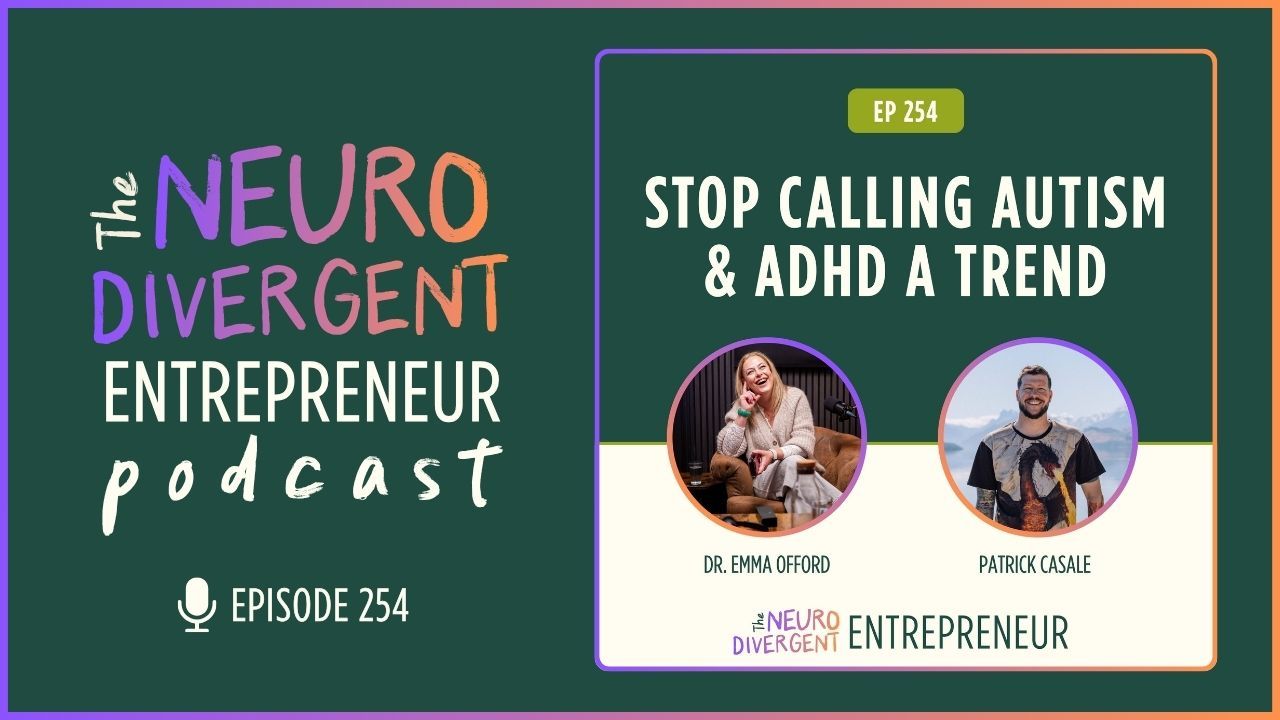
In this episode, Patrick Casale talks with Dr. Emma Offord, a UK-based clinical psychologist and founder of Divergent Life, about the landscape of autism and ADHD assessment, both in the U.K. and U.S., and the urgent need to move past deficit-based models to truly affirming, accessible care.
3 Key Takeaways:
- Systemic barriers to diagnosis are everywhere: Whether it’s a years-long wait for a free assessment in the U.K. or gatekeeping and prohibitive insurance premiums in the U.S., neurodivergent individuals face enormous hurdles in accessing meaningful support. The current system often invalidates lived experience and leaves people without essential accommodations.
- Language matters—and can harm: The use of terms like “trend” or “epidemic” to describe rising awareness of autism and ADHD is not just inaccurate; it’s deeply invalidating. This deficit-driven, medicalized language reinforces stigma and undermines the legitimacy of neurodivergent identities, contributing to trauma and exclusion.
- Lived experience is a key form of expertise: Social media and community voices are finally creating space for marginalized, diverse neurodivergent experiences—well beyond the narrow medical model. Supporting individuals to find agency and safety, inside or outside the system, makes a lasting difference.
We need voices, courage, and systemic change to build a world where neurodivergence is understood and embraced.
More about Emma:
Dr. Emma Offord is a U.K.-based clinical psychologist, speaker, and founder of Divergent Life, a neuroaffirming psychology practice working across the U.K. She specialises in autism and ADHD assessments, therapy, and consultation for late-identified adults, children, and families, with a particular focus on high-masking profiles, burnout, and systems-based trauma.
Emma’s work moves beyond deficit-based and medicalised models, supporting people to understand their nervous systems, histories, and strengths in context. Her approach integrates neurodivergence-affirming practice, developmental trauma frameworks, and deep respect for lived experience, including her own late-identified neurodivergence and parenting while neurodivergent.
She is the host of This Voice Is Mine: The Unquiet Podcast, where she explores identity, voice, safety, and what it means to build lives and practices that genuinely fit. Emma also delivers training and mentorship for psychologists and therapists seeking to build ethical, sustainable, neuroaffirming private practices.
You can find her on Instagram at @divergentlives, and learn more about her work, group programmes at www.divergentlife.co.uk
- Instagram Accounts: @divergentlives and @thiesvoiceisminepodcast
- Website: www.divergentlife.co.uk
🎙️Listen to more episodes of The Neurodivergent Entrepreneur Podcast
🎙️Spotify
🎙️Apple
🎙️YouTube Music
▶️ YouTube
✈️ Check out available Retreats
🗨️ Join the free Empowered Escape FB Community
A Thanks to Our Sponsors: The Receptionist for iPad!
I want to thank The Receptionist for iPad for sponsoring this episode.
The Receptionist for iPad is a HIPAA-ready digital check-in system that eliminates the need to walk back and forth from your office to the waiting room to see if your next appointment has arrived. Clients or patients can check in for their appointments, and you'll be immediately notified by text, email, or your preferred channel. Break free from interruptions and make the most of your time, because it is valuable. Start a free 14-day trial of the Receptionist for iPad by going to thereceptionist.com/privatepractice. Make sure to start your trial with that link to get your first month free if you decide to sign up.
Free Gifts for Our Listeners
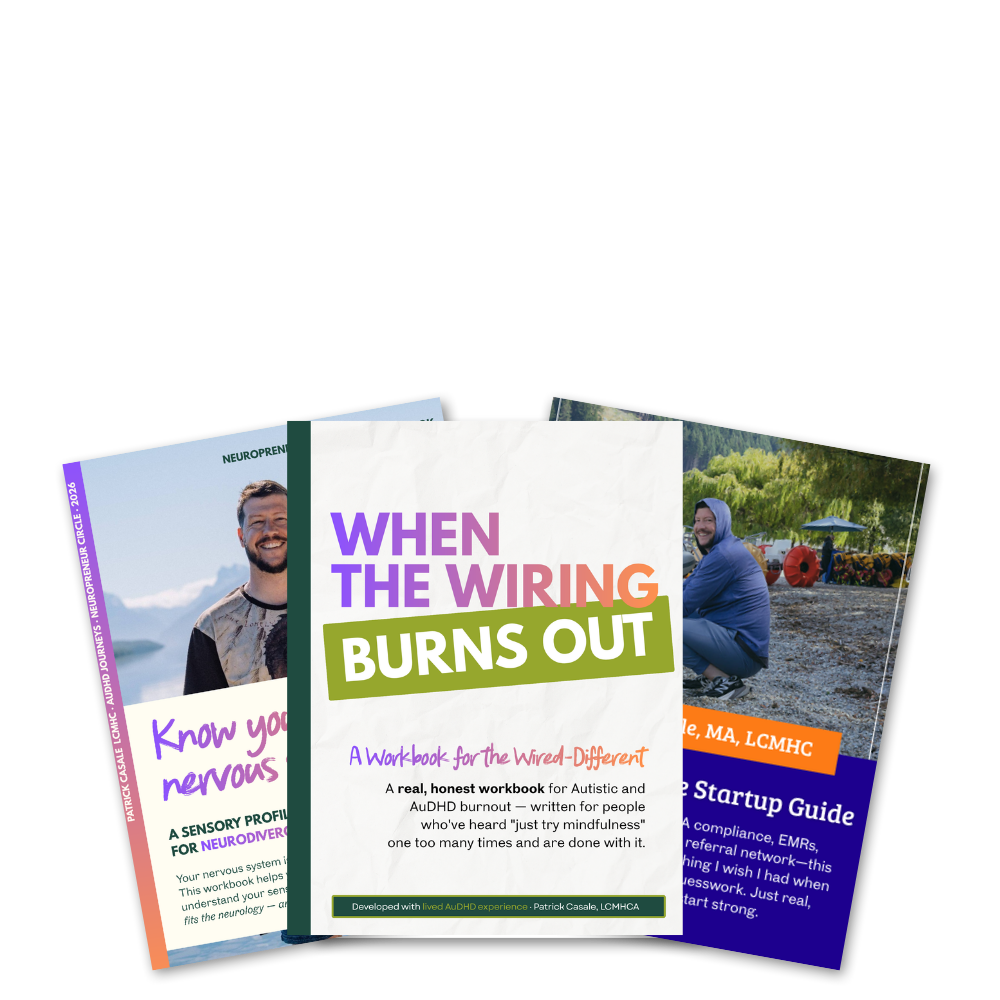
Get a practical podcasting workbook for therapists considering starting a podcast, created by Patrick Casale, host of the podcasts The Neurodivergent Entrepreneur and Divergent Conversations.
You'll get a practical structure for therapists who want to start a podcast but don’t want to rush, perform, or build something they can’t sustain.
Grab your free copy: ndpod.org/Free-Podcasting-Workbook
✨ Move Beyond Private Practice As A Neurodivergent Entrepreneur
Move Beyond Private Practice As A Neurodivergent Entrepreneur is a FREE 5-part mini-course designed for therapists who want sustainable financial independence beyond one-on-one work.
Access your free mini-course here: ndpod.org/Neurodivergent-Entrepreneur
Transcript
PATRICK CASALE: Hey, everyone. This is Patrick. And I wanted to share something really exciting with you. The All Things Private Practice podcast is changing to The Neurodivergent Entrepreneur podcast.
When I discovered that I was autistic ADHD five years ago, everything changed for me. It's wild, because at that point in time, my career had just taken off.
Over these last few years, I've done a lot of deconstruction, worked through a lot of internalized ableism, and learned as much as I can about neurodiversity, in general. And I really want to start unpacking what it means to be a neurodivergent entrepreneur.
So, in this podcast, I'm going to be interviewing other neurodivergent entrepreneurs of all walks of life, and all different areas of business and creativity, thought leaders, visionaries, creatives, leaders, etc. Real, unfiltered, authentic conversations. No positive psychology, always highlighting both sides of the coin with a lot of nuance, a lot of duality, and a lot of honest conversation, highlighting the strength and the struggle.
Make sure to download, like, subscribe, and share The Neurodivergent Entrepreneur podcast.
Hey, everyone. Welcome back. I am joined today by Dr. Emma Offord. I want to make sure I said that right. Did I say that correctly?
EMMA OFFORD: You did, you did.
PATRICK CASALE: Okay. Dr. Emma Offord is a UK-based clinical psychologist, speaker, and the founder of Divergent Life, a neuro-affirming psychology practice working across the UK.
She specializes in autism and ADHD assessments, therapy, and consultation for late-identified adults, children, and families with a particular focus on high masking profiles, burnouts, and systems-based trauma.
Damn, I need you to become my psychologist or therapist, it sounds like.
Emma's work moves beyond deficit-based and medicalized models, supporting people to understand their nervous systems, histories, and strengths in context.
Her approach integrates neurodivergence, affirming therapy, developmental trauma frameworks, and a deep respect for lived experience, including her own late-identified neurodivergence and parenting while neurodivergent.
She is the host of This Voice is Mine: The Unquiet Podcast, where she explores identity, voice safety, and what it means to build lives and practices that genuinely fit.
She also delivers training and mentorship for psychologists and therapists seeking to build ethical, sustainable, and neuro-affirming private practices.
You're lucky you're number one in rotation, because I will start botching bios like for the next person I record with today. So, I just want to thank you for coming on and making the time. I know you're in the UK. And that's an impressive bio. I always cringe when I hear my own being read, so I don't know how you feel about yours.
EMMA OFFORD: Yeah, I also cringe as well. But yeah, no, I can hold a lot of space for being very proud of the collective work that we are all doing right now. And I feel very proud to be a part of that collective.
PATRICK CASALE: Yeah, absolutely. I love that you offer both autism and ADHD assessments. And I'm curious about the process in the UK, because here in the United States, I mean, you could be waiting upwards of 18 months to get an assessment if you're trying to use your health insurance. And then, if you're also trying to find someone neuro-affirming, especially who is either autistic, ADHD, or AuDHD, it could be sometimes impossible. And I'm wondering about what it's like over there.
EMMA OFFORD: It depends, because our health service, the majority of it should be free or is free. So, I'm hearing from colleagues and from clients that depending on where you are in our country, it's anywhere from, I would say, two to four years at the best.
PATRICK CASALE: Wow.
EMMA OFFORD: One area was saying 15. [INDISCERNIBLE 00:04:09] was like 15 years. I don't even know how they calculated that. I'm just going by what people have told me, but it's a very hostile and uncomfortable climate in the UK at the moment, in terms of getting an assessment. There's a lot of pushback, and a lot of gatekeeping about people getting access to services, so a lot of people are going private because they need to protect themselves, their children. And in order to do that, to request accommodation, they need to have that diagnosis, because that's how the world works right now. You can't simply self-identify and then ask for accommodations. You should be able to, but you can't.
So, it feels like a very unsafe situation right now, because there's this rise in awareness, which is wonderful. And then, the systems are not catching up, they're doing the opposite, they're going in the other direction, pushing back. And so, you have more people wanting, needing, and seeing the safety in this understanding, but the system can't support it. And in fact, it’s rejecting it and criticizing it.
PATRICK CASALE: Yeah, and it breaks my heart, you know, because we have a lot of similarities here in the United States, but obviously, we don't have free healthcare, because why not profit off of everything here in this country?
And that creates complication, right? Because insurance premiums are unsustainable for people. I mean, we're talking thousands of dollars a month now. And that's just to potentially even have, like, catastrophic healthcare, which covers nothing unless you're in a complete emergency situation.
And here we are seeing a lot of, you mentioned gatekeeping. We are seeing a lot of mental health therapists start to come out of the woodwork and offer some form of either ADHD autism assessment in their practice. And you are absolutely within your licensure rights in a lot of states. But we have a big, like, psychologist, mental health therapist collision, where it's like psychologists are saying, “Well, we have the experience, we have the training, you should not be offering assessments.”
And I would argue, if you are trained in a way that is affirming and you truly understand what you're offering, why not reduce that barrier, why not reduce the two-to-four-year wait that people might be running into when they desperately need the accommodations now?
Because you're right. Like, we're in a situation here where the pushback isn't so much that we're not covering assessment, it's more like the pushback is we, because we're a for-profit healthcare country, don't want to pay for these things. We want to figure out ways to make it seem like there's too many, there's no justification for service. You don't need this assessment. Like, we want to do as much work as we humanly can to ensure that we are saying autism and ADHD are epidemics. You've seen the RFK stuff, probably, and the-
EMMA OFFORD: Mm-hmm (affirmative).
PATRICK CASALE: …like, the panel that he's created of all these anti-vaxxing, anti-autistic humans who are going to be making decisions for a large amount of people here in this country. And it's fucking scary if I'm being honest. It's not a good situation here.
EMMA OFFORD: There's a sense of threat, isn't there, around all of this? And this is maybe a broad-brushed statement, but many neurodivergent people are very highly attuned with their nervous system and their experience of constant trauma and threat. And I think we really feel this. And you know what's kind of coming into my head is there's this pushback, this constant reframing a narrative around this being a trend.
PATRICK CASALE: Yeah.
EMMA OFFORD: And I just cannot comprehend it. I'm trying to formulate it as a psychologist, as a human. Like, why this? So many other life experiences, human experiences, physical health, mental health awareness developments have happened, and I've never seen a pushback like this about neurodivergence, autism, ADHD, other neurodivergent profiles. It feels like the neurodivergent experience, you know, it's on a bigger scale. It's not just the one-to-one or your legal system, it's now worldwide, where we're having that invalidation all over again. What you say doesn't exist, what you say needs to be changed. It's just like on a much bigger scale. So, you know there's this getting an assessment or working with the system that exists, the ablest systems that exist.
When you're trying to find another route, another way that's criticized, you're criticized in the UK as a private psychologist. Well, people should get it for free. Well, if they're waiting two to four to 15 years, the trauma that's going to happen in that means you know, and you know?
So, people are trying to stay safe. That is what I see. They're not riding a trend. They're taking agency, and they’re trying to stay safe. And I think it's an incredibly important time in the world right now.
PATRICK CASALE: Yeah, that's really well said. And you keep mentioning safety. And I think that's a huge component of this, right? Because here in the States, an autism diagnosis could potentially have ramifications, depending on where we head in this country with everything going on right now. And that's why a lot of people are opting for private assessment and diagnosis, because then it can at least stay out of your record, and maybe people don't have access to it.
But the other side of the coin is like maybe then you don't get the accommodations that you might need in school or in the workplace, because they want to have very specific assessments and evaluations. And they want to have those done through your insurance company or from providers who take your insurance. It's a mess.
And I think that when we say trend, it so invalidates the experience, right? It minimizes the experience.
And you mentioned you've discovered your own neurodivergence later in life, like I have, and so many of us have. And when we hear the words epidemic, I start to go down the etymology of, like, what does that word mean, right? And if you look it up in the definitions, like we're seeing, an epidemic is something that needs to be cured, eradicated, fixed, and solved, which is essentially saying that autistic and ADHD people are broken, defective, something's wrong. We need to get to the core of this. And that feels horrific, you know, like to the core identity of day-to-day existence for most of us.
EMMA OFFORD: Completely, I couldn't agree more. And to me, in my view, this is the language of the medical model. We are dominated by the medical model. The foundations of understanding human disordered or ordered being. Like, if you're out of the order, you're disordered, and you're part of this medical model. And the language is all about deficit. It's all about, as we said, disorder, it's all about fixing, and like returning that person to some sense of order and normality. And this whole neurodiversity movement is all about challenging.
So, it's more than understanding your neurobiology, it is completely about challenging the systems that uphold our society right now, that forcibly medicate people, that, you know, invalidate people's experience, that tell them to mask in order to be accepted, you know? It's such an abusive situation.
And so, when I hear the word trend, I think, God, that to me is ridiculous, you know? This is such a political situation right now, a systemic, a political uprising of people's voices. And that bit's being missed, you know? To say epidemic, I mean, it just doesn't add up. Like, my whole nervous system just cannot stand hearing that. Like, I don't understand the human beings who are saying that. Like, I don't want to be unkind about them. Maybe they don't have the education, the knowledge, but it's so dangerous. Like, the threat in my nervous system just explodes when I hear words like epidemic, and disorder, and deficit. Yeah, I can't even…
PATRICK CASALE: Yeah, honestly, like, I can see it in your body as you're like kind of bracing for what wants to come, and just experiencing that word very viscerally. And yeah, I think a lot of people are in that position right now, whether they are mental health professionals, or clients, or human beings who are just trying to figure this out on a daily basis.
And you're so right that almost all of this is political and politically driven, because words matter. The language that is being used around autism and ADHD, it matters. Trend epidemic disorder, I mean, all of this stuff plays a role in how we view ourselves. And if we are constantly looking at it through this medical pathologizing lens and deficit-based language, you almost think that there's this life sentence that gets passed when you hear the words autism or ADHD, as if we are just going to be struggling for the rest of our lives.
And there's reality where there are people with higher support needs who are going to be struggling very significantly, but it doesn't allow you to take a step back and see the entire spectrum of neurodiversity to acknowledge like everyone has these brains that are just developing a little bit differently, or variations of what we consider to be neurotypical, or neuronormative. And we look at it as if it's like this negative instead of this beautiful experience that exists for all of these different ways to move through the world.
EMMA OFFORD: Everything that you've said there. And I mean, there's no safety in that language for those people who are neurodivergent, is there? There's no context, there's no system, there's no environment, there's no land, there's no territory to be a part of in that language and in that system and that structure. And there should be. There should be equality.
There can be those systems for people who suit those systems and ways of living, but equally, there should be ways of living and ways of accepting and understanding difference, and environments and territory that allow you to flourish, and so you're not as challenged.
Yes, there are challenges that exist, but they could be less challenging in certain environments. We know that. And the research says that, and the lived experience says that.
So, to keep going back to this default of, like, disorder, you know, it's very gaslighting, it's just completely blind to the lived experience, the grassroots of people's, what they're doing, what the neurodivergent neurodiversity community movement are doing, they're finding their own ways, and those ways of working.
PATRICK CASALE: Yeah, yeah.
EMMA OFFORD: You know, whether it’s assessment or whether it's, you know, homeschooling, or whether it's just wear joggers every flipping day in your flip-flops, you know? Whether it's working online, because you can do that and wear a nice top, and you know everyone's happy. People are finding new ways, and it's totally acceptable, it's not harming anybody. It's helping a lot of other people. It might be pissing off some other people who think it has to be a certain way, I don't know why they think it has to be a certain way for every human.
I mean, I've never heard anything more ridiculous, Patrick, that everybody has to go to school and everybody should work nine to five, except for people who have certain, you know? These rules for living are absurd. And I can't even believe that it hasn't been called out sooner, to be honest.
PATRICK CASALE: Yeah, no. Well said. I mean, it's this constant mentality of, like, well, this is how it's always been done, right? Like, that could be in the workplace, or in the school environment, or in day-to-day. And it's so archaic and doesn't account for the fact that people process information differently, people move through the world differently, people experience life differently, so we have to kind of get out of this black-and-white binary. And we are more into the gray and the nuance of like, if we support people and set people up for success with the types of supports and accommodations that they need and deserve, people can flourish. And it's just this mentality of like we don't have to do things the way we've always done them. And that goes for everything.
And I'm glad we are seeing more people speak up and speak out. And I'm glad we are seeing more people talk about their unlived experiences. And also, glad to see that research is catching up to say that lived experience is certainly a valid way to kind of assess things in general and make a stance, so I am happy to see that.
But I agree that the medical system has certainly not caught up to that movement, in general, and feels like it's like light years behind. And I think that's where you just get really creative in terms of how can we make this work, right? Like you said, all of the different ways people build accommodations in their life to make life more accessible and more enjoyable, even.
And it's great to know that people like yourself are out there doing these assessments in different parts of the world, because I get that question a lot, especially about the UK, of like, “Where can I find an affirming assessment.” And it seems like it's a very challenging experience in that way. And I'm glad to know that psychologists like yourself exist out there that are really trying to make this easier and more affirming for people who are trying to figure out their own existence. I think this makes so much sense when we start thinking about it from like an identity perspective, but also, acknowledging that the accommodations are necessary.
EMMA OFFORD: It makes so much sense from an identity perspective and from a trauma perspective, because I think to be really truly neuro-affirming, you must come from a trauma perspective. So, people will say to me all the time, school's not traumatizing. Yeah, it is. School trauma exists.
PATRICK CASALE: Yeah.
EMMA OFFORD: And I can see on people's faces, they just don't get it. They're like, but that's a safe place. It's for education, it's all positive, it's about learning and socializing. Well, not for a lot of people, it isn't, actually. For a lot of people, they're completely on their own, they're masking, they're completely exploding and melting down when they get home. So, you know, no, you know, that is absolutely not the case for a lot of people.
So, you know, I think this idea of looking for safety, building safety in different ways is so important. And you have to think trauma.
And I really don't believe that our evidence base is built with a trauma perspective. I think was very biased evidence-based. And there's lots of books, and lots of writing, and lots of people speaking out about what are the foundations of the medical model? Who were first researched as autistic, ADHD, Asperger's? Like, the names change. Labels didn't exist in the DSM or in the OCD, you know, the way that we diagnose people until you know recently.
And so, if it can come and go and not exist, can people not see the sense that it's constructed? This is all constructed. And so, who's doing the constructing? That is a really important question to ask.
And I think people ask that question. If you look back in history, some of the people who were constructing were white, middle-class, privileged men. And they had a select few people that they were, you know, constructing this idea of autism, and ADHD, and other neurodivergences, and other mental health disorders around. And why are they not being questioned? Why are we being questioned when we are questioning them and the foundations of a heavily biased, apparently evidence-based?
You'd never get away with that evidence these days. You would never get away with running research and spreading, you know, evidence as fact and truth now. And even now, I'd still question how we do it. We're ever evolving. So, sorry, I get a bit passionate about this, because it-
PATRICK CASALE: I love it.
EMMA OFFORD: …really pisses me off. And that everyone's like, “Evidence-based, evidence-based.” And, like, you know, the grassroots, the lived experience. I'm like, that evidence-based is where you all now just need to start looking.
PATRICK CASALE: Yes.
EMMA OFFORD: It's biased, and it's false.
PATRICK CASALE: 100% agree. I mean, think about how many people fall through the cracks because what we consider to be evidence-based, like you mentioned, was focused specifically on young white middle to upper-class, predominantly boys and men. You're leaving out the global majority. And you are kind of saying, like, “Take this at face value, this is how this is experienced, this is what we look for, this is how these struggles manifest, this is how these presentations are.” And it's like, no, I mean.
And again, that's why I love the fact that, you know, people can knock social media, and I really do think there are so many faults with it, including how divisive it makes us become. But the reality is social media has also allowed for so many voices, right? Like, we are seeing black and brown people speak up, we are seeing trans and queer people speak up, we are seeing people who are assigned female at birth speak up about, like, “Hey, these are the experiences that I go through on a daily basis.” And it just keeps flipping things on its head.
And I think that's what we need. We need more voices, we need more context, we need more of a diversity of experience when we are thinking about assigning labels to things. And I think that there's so much deconstruction that needs to be done. And I believe we're just at the forefront of it. Like, I think so much will change over the next couple of years to decade. Like, thinking about the time that the DSM-4 came out in the early 90s fast forwarding till 2026. And I just think that there's so much learning and unlearning that needs to be done. And it's nice to see that it is starting. I just think that, like you mentioned, it needs to catch up to present day.
EMMA OFFORD: Yeah, like I really feel like we're in this positive disintegration. Like, here is this huge unlearning, and relearning, and rebuilding. And I want to be part of the rebuilding. And also, the demolition. Like, the demolishing. I'm up for that.
And like, I've got teens, teen children. And like they've got the language of like so much diversity, like even beyond neurodivergence, about sexuality, about culture, about ranks, about all kinds of things. And maybe it's not always, I don't know, you know? Completely well-informed, maybe it's just somebody's opinion. But their openness and their awareness, I think, is incredible. And they are so accepting. And to me, that is part of that social media influence. And I agree with you, it's not perfect, but there's nothing that is perfect, there's nothing in this world that is ever perfect, so we can't aim for perfection.
And there are some things that, you know, it's not for today that are you know challenging and worrying about social media, but there's always that in life, in every human interaction. But I do think it has given voice to people, which is something I would never want to take away ever, because it's never happened before in this global electric, loud, influential way.
PATRICK CASALE: It's very well said. That's a great way to kind of wrap up our conversation. And I think that's a very powerful statement. And I just appreciate you naming that and having this conversation in general.
So, I do want to offer you a space to talk about your podcast, The Voice is Mine: The Unquiet Podcast. So, tell us a little bit about what that looks like, and where people find that, and everything that we've talked about today.
EMMA OFFORD: Thank you, Patrick. I mean, it's just a seed that's been planted in the ground right now. And I'm still watering it.
So, I really wanted to create a space for marginalized voices that didn't get to be heard, and didn't get the safe space to be heard either. And so, you know, people who come on are talking about… They're very vulnerable. I mean, it's very vulnerable podcasting, isn't it? I mean, especially if you're going to start talking about yourself and your opinions. So, I wanted it to be a safe space for people who have a lot to say and who other people really need to hear. And it's hard to get that voice out.
And so, you know, it's quietly growing. And we're not here to be inclined to anybody. We're not here to say my opinion is better than yours. It's accepting diversity, and difference, and upholding, and honoring that difference. We'll see how it goes, but that's where it is right now.
PATRICK CASALE: I love that. And, you know, we all have to get started somewhere, right? Like, something has to start from that seedling to grow into something. So, really cultivating that early on. And there's a lot of vulnerability in this. There's a lot of being open for criticism, and being perceived, and all the things that come with more sensitive nervous systems. And I think it's scary anytime we put ourselves out there, whether it be podcasting, social media, in general. So, a lot of applause to everyone who is doing that, including yourself. And are you still doing assessments, or can people find you to do that type of work as well in the UK?
EMMA OFFORD: Yeah, so on Instagram I'm @divergentlives, because life was taken, I think, by the film, which is great, which is such a representation of all that we talk about. And yeah, I've got a website. And then, there's the podcast as well, so easy to find.
PATRICK CASALE: Great. Well, we will have everything that Dr. Offord just mentioned in the show notes, so you have easy access, especially if you're in the UK and you're looking for a more affirming autism ADHD assessment, especially from someone with lived experience.
So, Emma, thank you so much for coming on, and making the time, and being a part of this journey.
EMMA OFFORD: Thank you for having me, Patrick. I've really enjoyed talking with you.
PATRICK CASALE: You are very welcome. All right, everyone. Thanks for listening to the Neurodivergent Entrepreneur podcast. New episodes are out on Wednesdays on all major platforms and YouTube. You can like, download, subscribe, share. Doubt yourself, do it anyway. We'll see you next week.
FREE PRIVATE PRACTICE GUIDE
Join the weekly newsletter for private practice tips, podcast updates, special offers, & your free private practice startup guide!
We will not spam you or share your information. You can unsubscribe at any time.





![Episode 266: Healing Isn’t Just in Your Head: Rethinking What Therapy Can Be [featuring LeNaya Crawford]](https://kajabi-storefronts-production.kajabi-cdn.com/kajabi-storefronts-production/file-uploads/sites/2147507511/images/a2d5a4-e4bf-63b0-fa7f-6e6f62c466d5_TNDE_YouTube_episode_266.jpg)
![Episode 264: Creating Through the Chaos of a Neurodivergent Life [featuring Bre "BR3"]](https://kajabi-storefronts-production.kajabi-cdn.com/kajabi-storefronts-production/file-uploads/sites/2147507511/images/a14004-cc3d-8aba-5fb8-2442fdfc650_TNDE_YouTube_episode_264.jpg)