Show Notes
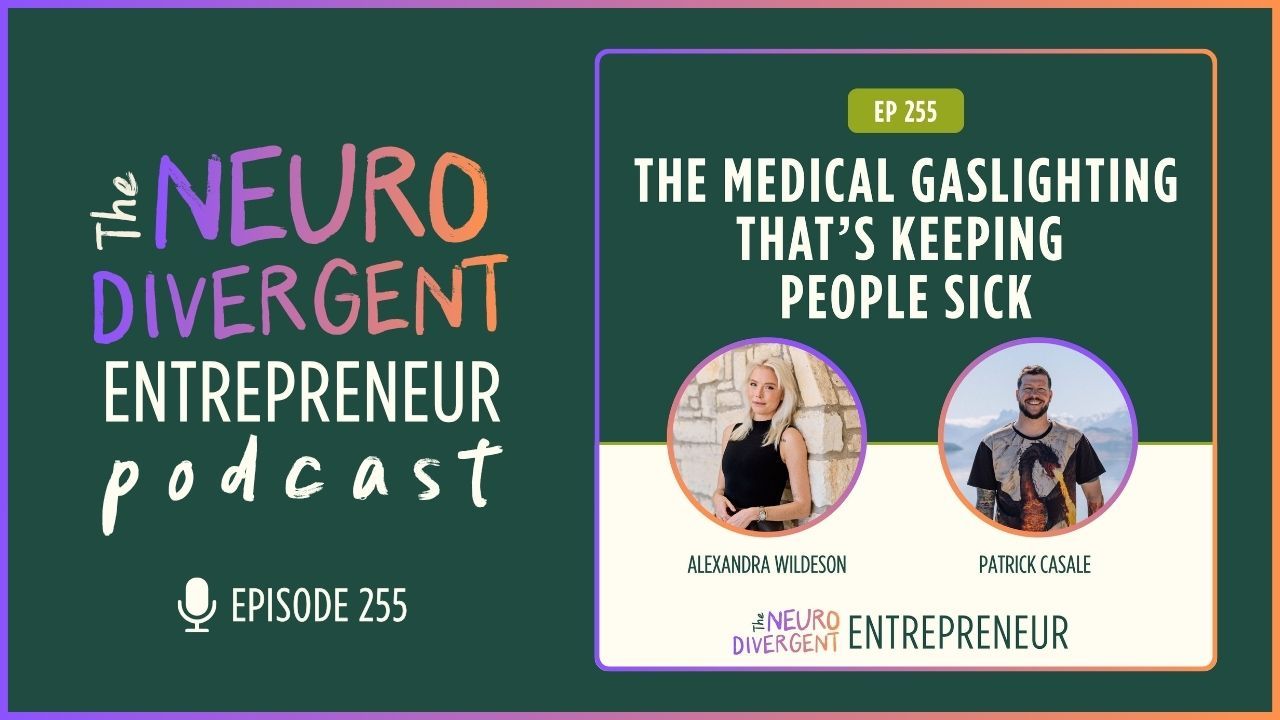
In this episode, Patrick Casale talks with Alexandra (Alex) Wildeson, online content creator and host of the "Calling in Sick" podcast, about the realities of living with invisible and chronic health conditions, from gaslighting in the medical system to redefining success outside of capitalism's narrow achievement lens.
Here are 3 key takeaways:
- Community is Essential: Connecting with others who understand your experience is a game-changer in battling loneliness and advocating for yourself.
- Redefine Success and Identity: Chronic illness often forces a personal reckoning with what truly matters. Prioritizing health, authenticity, and relationships can bring unexpected fulfillment, even after loss or drastic change.
- Be Your Own Advocate: The healthcare system isn’t built for complexity, and preparing for appointments with goals, resources, and support can make a critical difference in outcomes.
More about Alex:
Alexandra (Alex) Wildeson is a content creator and host of Calling in Sick, a podcast on the Just Media Network that centers honest, nuanced conversations around chronic illness, women’s health, and modern wellness.
Drawing from her lived experience navigating multiple autoimmune and chronic conditions — including Polyarteritis Nodosa (PAN) Vasculitis, Mixed Connective Tissue Disease/Lupus, Endometriosis, Small Fiber Neuropathy, and Complex Regional Pain Syndrome — Alex blends storytelling, education, and lifestyle content to build community, challenge misconceptions, and expand how we define health, identity, and productivity.
Before pivoting into media and advocacy, Alex built her career in finance and capital allocation, working across investment banking, private equity, and venture capital, including roles at large institutional platforms. She continues this work today as a Venture Partner at HotStart, an early-stage venture fund focused on celebrity-founded brands.
Following a major spinal injury in 2023, Alex shifted her focus toward advocacy, content creation, and podcasting. Through Calling in Sick and her broader lifestyle platform, she explores what it means to build a meaningful, sustainable life while living with chronic illness — blending lived experience, practical tools, and healing modalities. She is also currently preparing to launch a digital platform aimed at expanding access to education, tools, and community for chronically ill individuals.
- Instagram: instagram.com/alexandrawildeson & instagram.com/callinginsickpod
- YouTube: youtube.com/@CallingInSickPodcast
🎙️Listen to more episodes of The Neurodivergent Entrepreneur Podcast
🎙️Spotify
🎙️Apple
🎙️YouTube Music
▶️ YouTube
✈️ Check out available Retreats
🗨️ Join the free Empowered Escape FB Community
A Thanks to Our Sponsors: The Receptionist for iPad!
I want to thank The Receptionist for iPad for sponsoring this episode.
The Receptionist for iPad is a HIPAA-ready digital check-in system that eliminates the need to walk back and forth from your office to the waiting room to see if your next appointment has arrived. Clients or patients can check in for their appointments, and you'll be immediately notified by text, email, or your preferred channel. Break free from interruptions and make the most of your time, because it is valuable. Start a free 14-day trial of the Receptionist for iPad by going to thereceptionist.com/privatepractice. Make sure to start your trial with that link to get your first month free if you decide to sign up.
Free Gifts for Our Listeners
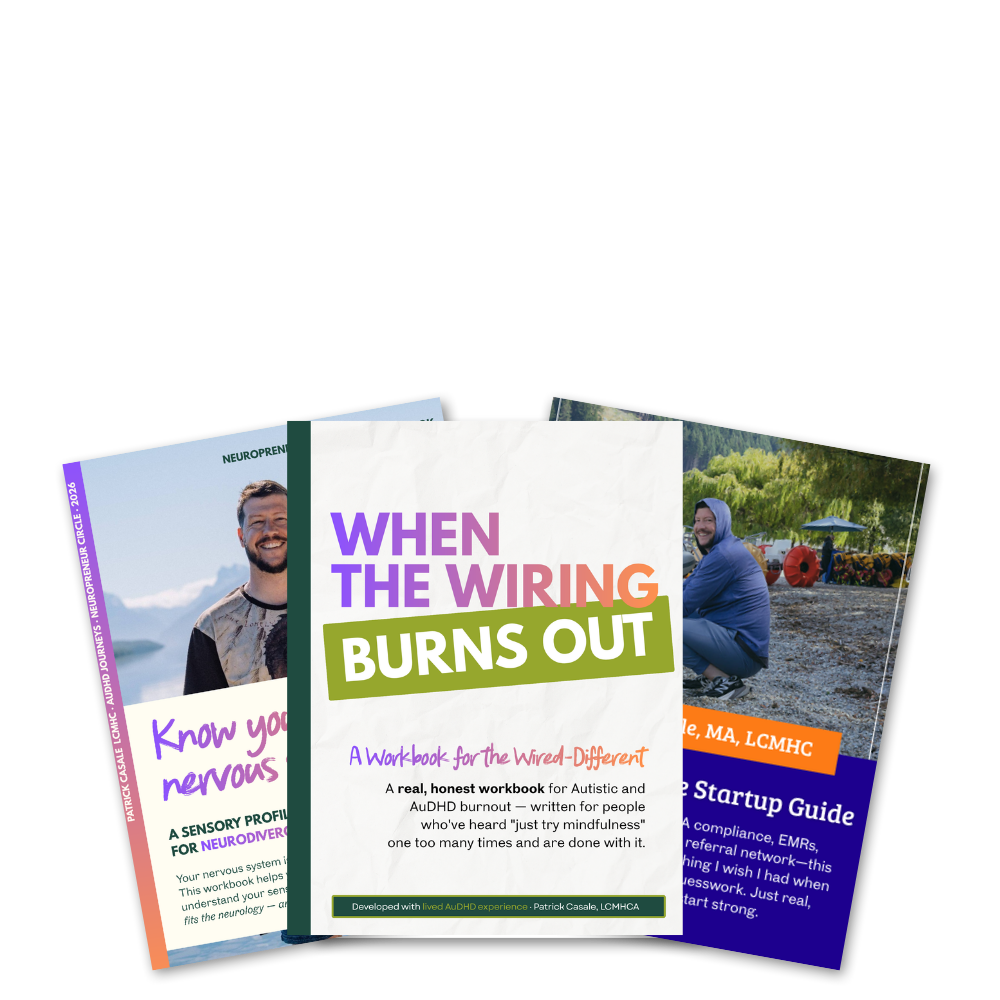
Get a practical podcasting workbook for therapists considering starting a podcast, created by Patrick Casale, host of the podcasts The Neurodivergent Entrepreneur and Divergent Conversations.
You'll get a practical structure for therapists who want to start a podcast but don’t want to rush, perform, or build something they can’t sustain.
Grab your free copy: ndpod.org/Free-Podcasting-Workbook
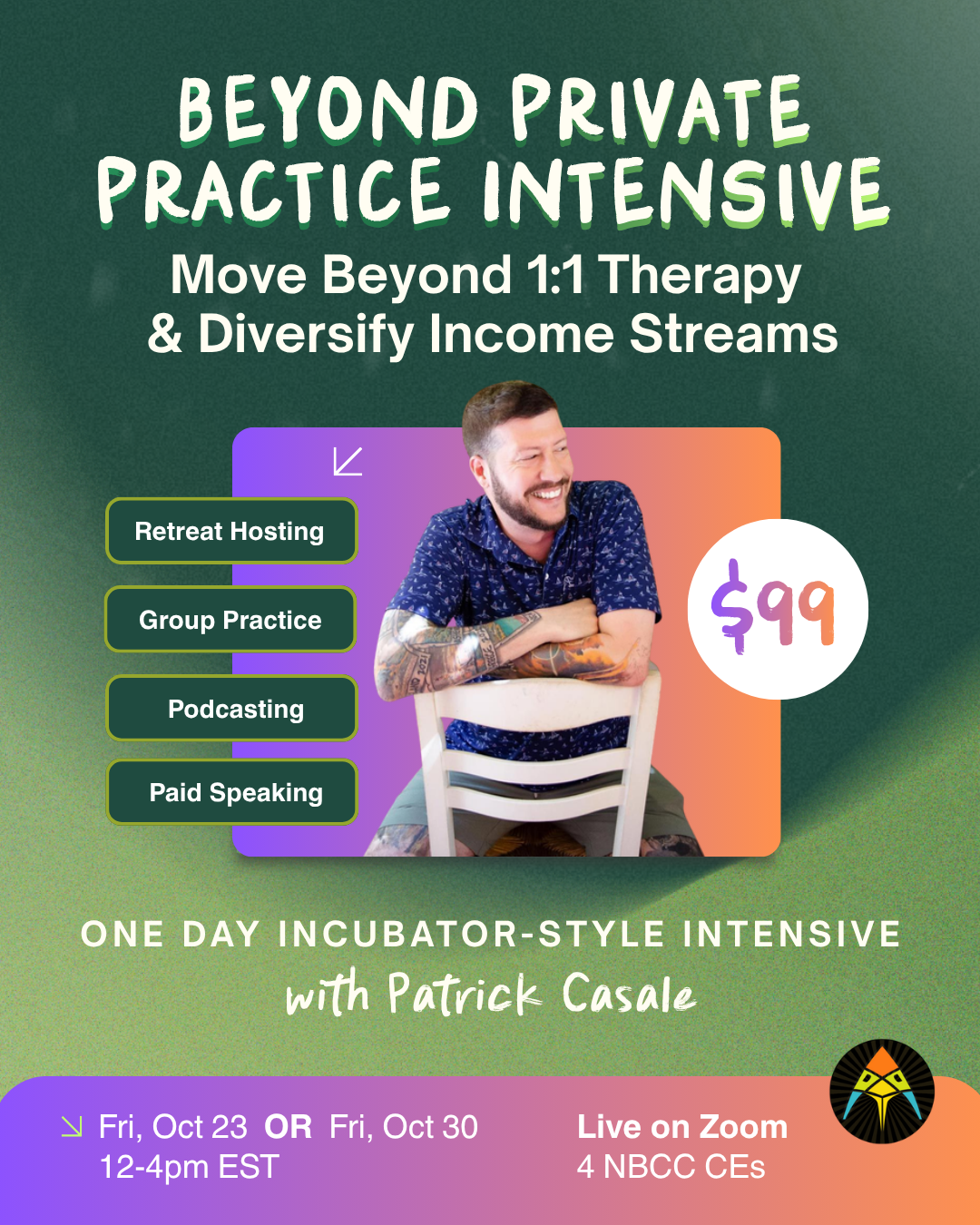
✨ Move Beyond Private Practice As A Neurodivergent Entrepreneur
Move Beyond Private Practice As A Neurodivergent Entrepreneur is a FREE 5-part mini-course designed for therapists who want sustainable financial independence beyond one-on-one work.
Access your free mini-course here: ndpod.org/Neurodivergent-Entrepreneur
Transcript
PATRICK CASALE: Hey, everyone. This is Patrick. And I wanted to share something really exciting with you. The All Things Private Practice podcast is changing to The Neurodivergent Entrepreneur podcast.
When I discovered that I was autistic ADHD five years ago, everything changed for me. It's wild because at that point in time, my career had just taken off.
Over these last few years, I've done a lot of deconstruction, worked through a lot of internalized ableism, learned as much as I can about neurodiversity, in general. And I really want to start unpacking what it means to be a neurodivergent entrepreneur.
So, in this podcast, I'm going to be interviewing other neurodivergent entrepreneurs of all walks of life, and all different areas of business and creativity, thought leaders, visionaries, creatives, leaders, etc. Real, unfiltered, authentic conversations. No positive psychology, always highlighting both sides of the coin with a lot of nuance, a lot of duality, and a lot of honest conversation, highlighting the strength and the struggle.
Make sure to download, like, subscribe, and share The Neurodivergent Entrepreneur podcast.
Hey, everyone. I'm joined today by Alex Wildeson. She is a content creator and the host of the Calling In Sick, a podcast on the Just Media Network that centers honest, nuanced conversations around chronic illness, women's health, and modern wellness, drawing from her lived experience navigating multiple autoimmune and chronic conditions, including polyarteritis nodosa or panvasculitis, mixed connective tissue disease, and lupus, endometriosis, small fiber neuropathy, and complex regional pain syndrome.
Alex blends storytelling, education, and lifestyle content to build community challenges, misconceptions, and expands how we define health, identity, and productivity.
Before pivoting into media and advocacy, Alex built her career in finance and capital allocation, working across investment banking, private equity, and venture capital, including large roles in institutional platforms.
She continues this work today as a venture partner at HotStart, an early-stage venture fund focused on celebrity-founded brands. That's cool.
Following a major spinal injury in 2023, Alex shifted her focus towards advocacy, content creation, and podcasting. Through Calling In Sick and her broader lifestyle platform, she explores what it means to build a meaningful, sustainable life while living with chronic illness, blending lived experience, practical tools, and healing modalities.
She is also currently preparing to launch a digital platform aimed at expanding access to education, tools, and community for chronically ill individuals.
Man, one, I'm happy to have you here. Two, I'm surprised I got through most of that without stumbling. That's a rarity, especially [CROSSTALK 00:02:48]-
ALEXANDRA WILDESON: That’s impressive.
PATRICK CASALE: So, I have so many questions because you and I have been talking offline. And I follow your content. It’s great.
ALEXANDRA WILDESON: Thank you.
PATRICK CASALE: I think a lot of the people listening, especially those who are more identifying as neurodivergent, especially autistic ADHDers, are experiencing a lot of the things we just listed out, or may be thinking about those things, in general, but having no answers.
So, I just want to like say thank you for spending your time here because I know energy and capacity is limited, and man, navigating the medical system is a fucking minefield. It sucks so much.
ALEXANDRA WILDESON: It truly does. And I have to say, even after 20-five years, it's just as hard today as it was back then. But the only thing that's made it, I think, better is just having a voice online and connecting with other people that are navigating it too. I think misery with friends is better than misery alone.
PATRICK CASALE: That's a good point. I think that's maybe the podcast title for this. Yeah, I agree 100%. I think it can feel really demoralizing to go down pathway after pathway and continue to come up with dead ends or doctors who are looking at you kind of like confused or overwhelmed by what you're telling them, or sending you off to the next referral because they don't know how to handle it.
And, you know, I think it's even harder, I realize, as a therapist who navigates a lot of complex systems, and advocacy is a huge part of that. For people who don't have that knowledge, experience, expertise, privilege, financial security, like, it's just not designed to support you.
ALEXANDRA WILDESON: It really isn't. It's the most broken system. And it feeds you down. And I think if you don't have any semblance of a support network, of a financial network, just that cushion, it's hard to keep going every single day and find hope.
PATRICK CASALE: Yeah, yeah, it is. And I don't want to make this episode all doom and gloom for those of you listening. But I know a lot of you who are navigating chronic illness, chronic health conditions, any autoimmune deficiency or disorder, something that feels unexplainable that is causing you distress, it impacts your day-to-day, not only your livelihood, not only your personal life, but it certainly impacts your business and your professional life as well.
And I know, for me, like having to zoom out now and be so much more intentional about how I spend my time, and my energy, and my capacity, knowing that it's unbelievably diminished, that there are certain environments where I cannot be the person I would like to be, and how much of my life is confined to these walls in my home, it can really start to feel lonely. And having people like yourself and other content creators out there who are speaking about their experiences really does help normalize for a lot of people listening.
ALEXANDRA WILDESON: I hope so. That was the goal when I started posting online was to just let people know that if they're sitting in it, then they're not alone in sitting in it.
And I spent, you know, the better half of the first two decades of my life silently battling mixed connective tissue disease, and lupus, and endo, and none of my friends or extended family really knew what was going on with my health, and it was just this almost embarrassment to have to talk about my health and be so vulnerable about it.
But you know, after enough tough experiences, I think you hit a breaking point where you just want answers. And that can come in any shape or form, like connecting online and seeing if somebody recognizes something. So, that's really ultimately why I started talking online. And it helps tenfold.
PATRICK CASALE: Yeah, I think when you're suffering in silence, and you don't even want to bring it up, because I imagine for you, and for me, and many people listening, when you bring these things up consistently, it's like, “Alex is sick again. Oh, there's always something wrong with her. Like, are you just making this up?”
And that is one of the most painful ones. Like, are you malingering? And I've had doctors say that to me. Like, “Are you just here because you like the attention?” Was the last thing the neurologist who I just fired said to me in our last appointment. And I'm just sitting there, like…
ALEXANDRA WILDESON: Yeah, totally, dude.
PATRICK CASALE: Yeah, the gaslighting that exists within our medical infrastructure is so fucking broken, and it's so, like, dehumanizing. And you finally make it to that doctor or specialist that you've waited so long to see, and maybe you've jumped through hoop after hoop and procedure after procedure. And finally, you get onto their calendar and you either wait several hours just to get through the waiting room, despite having an appointment, or you are told you are just there for the attention. And it's just so infuriating to me.
ALEXANDRA WILDESON: It's unfair, and it's unfathomable that it happens to everyone in this community. I don't know a single person who has navigated this unscathed.
PATRICK CASALE: Yeah.
ALEXANDRA WILDESON: With medical gaslighting and just the condescension that happens around living with an invisible or chronic illness.
PATRICK CASALE: Yeah.
ALEXANDRA WILDESON: And that does a number to your mental health to sit there thinking, "Gosh, if no one believes me, am I making it up? Like, is this all in my head?”
PATRICK CASALE: Yeah.
ALEXANDRA WILDESON: And sitting in that without community is a really dark place. I've gone through periods of deep depression, panic attacks, anxiety with that being, I think, the driving force.
PATRICK CASALE: Yeah, same. I've been there myself quite a bit, especially over the last few years.
ALEXANDRA WILDESON: Yeah.
PATRICK CASALE: As I've discovered more and more of these, like, struggles. It's almost laughable sometimes. I think about my body and how it's constantly fighting against itself. And anything and everything can be a trigger for MCAS, for mast cell activation syndrome, for POTS, for hypermobility. And my body just feels like it hates itself. And I'm like, “You have to get everything just right to feel ‘okay’ enough go get through the day.”
And I got diagnosed with this really rare throat condition maybe four or five years ago, called Zenkers diverticulitum, and it impacts like 0.001% of the population, most of whom are all over 65 years old. So, getting this diagnosis was a challenge in itself, right? Like, continuously showing up to a doctor saying like, "No, there's still something wrong. Like something is going on here. And then, being referred to specialists who still couldn't figure out the issue. They go with like, “What's the most treatable symptom in front of me? We'll do that, and we'll cross it off the list.”
And then, to continue to advocate and finally, getting the right nurse practitioner on a virtual call, who was like, "Dude, I think this is what you're describing. And it would be really weird if it is, but go get an esophagram.” And then, lo and behold, it's like, of course, that's what it is because that's how my body works.
ALEXANDRA WILDESON: Of course.
PATRICK CASALE: And it's just that struggle, right, of constantly advocating for yourself when you do not have the energy to do so. And that's the deep dark depression for me, is like, “Oh my God! It's another set of demands and energy that I don't have to just try to feel like 1% better.” And that sucks.
ALEXANDRA WILDESON: It's demoralizing to continue to try to advocate for yourself and be told no, or you're crazy, or whatever. And medical providers are trained to look for horses in a field and not the zebra that is what all of us are.
PATRICK CASALE: Right.
ALEXANDRA WILDESON: And it takes a very special kind of provider that's curious, that is willing to turn over every single rock and really take us to where we need to get. But the crazy part is, even when we get to that diagnosis, sometimes it’s still there’s nothing we can do here. That this is just something you have to learn to live with. And that is really hard. That's really, really hard.
PATRICK CASALE: It is because you work so hard to get to that place, right? Where you can finally figure out the why. But figuring out the why and having that clarity does not mean that life gets easier. In fact, it often gets more challenging as you start to figure out how to incorporate some of these things into your life or restructure your life in a way that needs to work for your body and your immune system.
And that is not that easy, especially for those of you listening who don't have the privilege of owning your own business, working from home, having control over your environment. Like, if COVID doesn't happen, right? In 2020. And I don't pull out of my in-person private practice into virtual, I don't know what happens because that also led me to autism discovery. It led to so much when you are able to control the environment. And being chronically ill. I have to control almost everything in my life. And it just makes everything else feel so challenging.
ALEXANDRA WILDESON: That resonates deeply with me in two different places, the control aspect of feeling like this heavy, heavy pressure that we have to get it right. We have to walk this narrow, narrow, tiny, tiny, whatever it's called, rope, in order to keep ourselves sane and healthy in some regard. And that's a ton of pressure to put on ourselves. And that makes you beat yourself up and have guilt when you flare, thinking it's your fault that you did that. It buys into that public thinking that we made ourselves sick.
PATRICK CASALE: Right.
ALEXANDRA WILDESON: And that's hard, but having to do that in parallel with still forcing yourself in a box that you don't fit in, in relationships, in work environments, and goals and aspirations becomes even harder.
And interesting, you brought up COVID because I do think that was a really big shifting point that has had some unpredicted benefits for our community, where you can start to think maybe society doesn't have to look the way that we're told it is supposed to look or life.
PATRICK CASALE: That's a huge, huge point what you just said. And I think about that so often. And I've had the luxury of traveling a lot for my job over the course of the last five years, all over the world.
And when you go to other countries and you realize that they are not experiencing the same struggles that we are experiencing physically or mentally, and they don't put the chemicals, and the products, and the additives into our food and everything else that goes on here, you almost start to think like we are designed to stay sick and unhealthy in this country because people benefit off of that happening.
ALEXANDRA WILDESON: Yes.
PATRICK CASALE: I just spent 30 days in New Zealand, and I always get sick when traveling. It's just inevitable. I mentally prepare for it every single time. And in that 30-day period, I did not get sick a single time. And I just realized, like, “Oh, this is what it's like to have a regulated nervous system. This is what it's like to feel like you can be healthy and actually access your life.”
And that creates so much grief in acknowledging, like, we do not have to live this way. One of my best friends, while I was in New Zealand, got diagnosed with a stage four, like, terminal brain cancer that's inoperable and-
ALEXANDRA WILDESON: Sorry.
PATRICK CASALE: Thank you. It's fucking hard.
ALEXANDRA WILDESON: Yeah.
PATRICK CASALE: And I started a GoFundMe for him because that's what we do in this country when people get sick. It's like-
ALEXANDRA WILDESON: Yeah.
PATRICK CASALE: Community and mutual aid to keep people alive or protected. And people in New Zealand could not fathom that. They were like, "Why is his health insurance or the government not helping?”
I was like, "He's going to go into hundreds of thousands of dollars of medical debt to try to stay alive as long as possible. And inevitably, the inevitable will happen. And his partner will be left to pick up the pieces. And that doesn't have to fucking happen.” But we live in for-profit healthcare. And it really does create a lot of barriers in trying to navigate chronic health conditions and illnesses.
ALEXANDRA WILDESON: It really does. And you're right. Like, it's shocking when you look around and you see these other cultures, and other countries, and how they've navigated health. And God, capitalism makes us sick in so many different ways, not just physically sick, but mentally. It exacerbates challenges that might have erupted later on in life when we all hit, you know, our own tsunami of whatever it is that's hard, difficult, but earlier and earlier and earlier. And then, there's people just making money off of us being sick. It's sickening. You go down a rabbit hole. You start bleeping into all types of different theories about how the world works. And unfortunately, I can think a lot of it really has some validity to it.
PATRICK CASALE: Yeah. No, I think so too. And I think it's just one of those things that you start to make sense of, or not make sense of, but deconstruct the way that we've been brought up to live. Right?
Like, I imagine you and I are probably close to the same age. I have no idea. You might be younger than me. But like, I'm about to be 40 this year. And I just think growing up in a country where you're constantly told like we're the best and brightest, and we do everything in, like, this nationalistic, extreme way.
And once you start to step outside of that and see things for what they are, it's like, “Oh fuck, we have been brainwashed so badly.”
And unfortunately, a lot of people never get to have the experiences that I have had over the last four or five years, where, like, I think I've had numerous bucket list experiences, and I did it for work. And it was just like when you're in Spain, when you're in Italy, when you're in Greece, when you're in Portugal, when you're in New Zealand, when you're in Ireland, when you're in other countries, and they're all looking at us like, "What are you doing to yourselves? You do not care about yourselves collectively or as a community.”
And that is by design, and that means it is a lot harder to create communal advocacy in terms of how do we change this healthcare system that is so beyond broken.
ALEXANDRA WILDESON: It's so true. And it starts in ways that we don't even think about. Like in Norway, they do not have winners or losers in games until the end of high school. When I learned that, I was shocked. Like, my family's from Norway. And I thought, “Where's the competitiveness?” They just play to play.
PATRICK CASALE: Right.
ALEXANDRA WILDESON: And learn to enjoy something and hone a skill without having this pressure of you have to be the best, you have to do it this way, that Americans internalize so deeply. And stress just carries on tenfold.
And when we look at how we live our lives here, it really is we're just getting sick and sicker and sicker because of these pressures. And we don't have to live this way. But I do think the system itself has to almost implode in order for change to happen.
PATRICK CASALE: Yeah, 100%. Not just the medical system, like everything needs to crumbling down. And you're absolutely right about the pressure of living like this because capitalism makes us feel like we are only as good as our next achievement, our next productive burst, our next thing that we create.
And if we try to rest, then you're deemed lazy or unmotivated, or you don't care about A, B, and C, or you just don't have it in you to be successful.
And I've had to like really, really fight that narrative of, like, achievement equals worthiness because it is killing me. And the way I have created a “successful business” has led to just feeling like I can't even get through my day most of the time, or that I am in such like agony and distress. And it is not worth it.
ALEXANDRA WILDESON: No, it's really not. But it's the identity that we're raised to believe in that we have to do these things. That success is the only thing that means your life is worth living.
And honestly, I'm sad to admit it, but it took having a botched spinal surgery to stop working. I was doing chemotherapy and working in investment banking. I was up at the hospital until three in the morning, turning comments in a PowerPoint. All of my friends outside of the U.S. were like, "What the fuck are you doing, Alex? You don't have to do that.” And it was shocking to them when I said, "I do. I have to do this in order to keep my job, to keep my livelihood.”
But when I had this accident happen, I was forced to stop for the first time, really. And it made me really redefine how I view identity, how I define success. And when you hit that break, it's not like, “Oh, I see everything differently now.” There's a period of soul-sucking depression that happens when you realize everything you've constructed yourself to be is for others and not for yourself.
PATRICK CASALE: Yeah.
ALEXANDRA WILDESON: It takes time to get through that.
PATRICK CASALE: That shit hits hard because that's so true. And I relate to that story so much because, like, I've had two major throat operations over the last four years with this condition. And one paralyzed my vocal cord permanently. And I was in the hospital bed answering emails and with zero voice, trying to pick up or like direct calls for my group therapy practice, or like communicate with staff about how to handle A, B, and C.
And the same thing had to… I was in this deep, deep dark depression after the second surgery because that's the one that impacted my vocal cord. And you go through these cycles, right? Like, with chronic illness and chronic health condition of grief, rage, infuriation, trying to make meaning out of it. Like, I kept thinking, “Why the fuck is this happening to me?” I was 36 at the time. This is supposed to be impacting people who are in their 70s.
ALEXANDRA WILDESON: And end of life.
PATRICK CASALE: Right. And it's chronic, so I know it will recur, especially getting caught so young. And now I'm starting to realize there's a linkage to hypermobility and MCAS in all of this.
ALEXANDRA WILDESON: Yeah.
PATRICK CASALE: And then like, it's just you go through these cycles of infuriation, grief, rage, sadness, despondence, like depression. And in all of that, you have to come to terms with like how do I continue to survive, and pay bills, and make sense of like how to live a life that is worth living. And it's quite a mind fuck.
ALEXANDRA WILDESON: It is. And the crazy part is that you get through those periods, and there is sometimes that light out of the end of the tunnel if you just keep going, and keep your head down and grit through those tough days, and try to figure out tools to help yourself get better.
But when you get to the end of the tunnel, it doesn't mean you're done, and it's all better. One, healing's not linear for mental or physical health, but Lord knows you're going to have many a time when you're going backwards, and that has a whole mental fuckery too of what the hell? I just was better.
PATRICK CASALE: Yep.
ALEXANDRA WILDESON: But over time, and I say this with 25 years of privilege, of understanding how this looks.
PATRICK CASALE: Right.
ALEXANDRA WILDESON: Over time, it gets a little bit easier, and not in a way that's like a switch turns and all of a sudden you're like, “Okay, I'm in a depression, and I just have to get through this.” No, that still sucks.
PATRICK CASALE: Yeah.
ALEXANDRA WILDESON: But you know that there is a light. You just have to keep going forward.
PATRICK CASALE: Yeah, and that's a good transition point away from, like, this is just a death sentence, right? Because it is really hard. And it's not the end.
And there are a lot of accessible and even free resources out there. Like, content creation is a blessing and curse. Like, what you do and what a lot of other medical advocacy workers do. Like, I know we have a common person in our lives of Doctor [PH 00:22:39] Syrados. And he's so great. Like, having a doctor out there talking about some of the things that we're talking about, and trying to approach them so differently.
We're starting to see more people like him out there in the world who are medical professionals, who are willing to completely deconstruct what they know to be the pathology paradigm of like, here's the diagnosis, here's how we treat it, and that's it. And starting to zoom out of like, let's just get, like, really curious, and experiment, and try to have a better understanding, especially of all things dysautonomia-related, where we're just talking about like, you know, digestion and GI stuff, and urinary, and blood pressure, and all of the things that your body is doing without you consciously knowing. And it's impacting so many people right now.
So, having a lot of resources out there like yourself, like him. I mean, he's my doctor, so I'm very grateful for him, and my PCP here in town is not exactly that person, but at least is willing to listen to me. And she, at this point, like during our last exam, she spends like an hour and a half, and I love having that access. It's like it's a collective, so I get to have a lot of access to her. It's much more useful than like a traditional medical model.
And at the end of our last appointment, we went through all these things. And she's like, she gave me like an unprompted hug. I think she needed it more than I did. And she's like, “I just don't know what to say. Like, I don't know what to do for you.” And I'm like, “Honestly, just having that statement is more than enough because so often you're just like 15 minutes, get through this list, push to the side, move on to the next. And you know we need people who are willing to listen, even if they don't have the answers.
ALEXANDRA WILDESON: I think the biggest green flag in a provider is one that doesn't go, “All right, this pill will fix you.” It's the one that says I don't know if this is going to help you or not, but let's try it and let's figure this out together. And they're just next to you for your journey to go forward.
PATRICK CASALE: Yeah, it's huge. It's huge. And those providers do exist. And I want you all to hear that because I know it can feel really demoralizing to think like there is no answer. And you do have to, unfortunately, sometimes do your own research, ask the questions. Like, go into appointments with the things that you need to get out of your mouth and communicate on a index card or a piece of paper, like because when you're in a traditional system, and you have 15 to 20 minutes with a provider, like they are literally just trying to figure out what's in front of them. How do I fix this immediately? Here's the pill. Move on to the next person.
So, if you're in those systems, you do need to have, even if you need someone to go with you for access, and support, and advocacy. And if you can do some digging, there are a lot of holistic providers out there in the mental and physical spaces who are really trying to do things differently and turn the medical model on its head. Ask people in your community. Go online and go find, you know, the people making social media content. There's enormous amounts of podcasts out there, including Alex's. I mean, there are so many free, accessible resources for you to advocate for yourself, and to better understand yourself. And it's unbelievably important.
ALEXANDRA WILDESON: It's interesting because I do think it's overwhelming, right? To prep for our health.
PATRICK CASALE: Yep.
ALEXANDRA WILDESON: But we do things for other areas of our life that we go full in, like our lives depend on it. If you see the Amazon Prime Day sale, people get so excited and start building their cart in advance. And you know that's what they're spending hours on. Why don't we pull that same kind of energy towards our health because our lives depend on it?
So, if you go into an appointment like I'm just going to browse, and see what's on Amazon Prime, and just add whatever to my cart, you're going to miss out on the deal. So, use that appointment to your advantage so that you get what you want and need out of it.
And if people want resources for it, I have a little printout that I'll be happy to share with you, so you can share to your community about having this primary goal out of every appointment. And that's what you're using that time for. Not every doctor is going to be the right one to ask every question for. So, knowing where there's alignment, so you can get what you need out of it.
PATRICK CASALE: Yeah, absolutely. That's really well said. I had a good thought while you were talking, and I've lost it already. But-
ALEXANDRA WILDESON: That happens to me all the time.
PATRICK CASALE: [CROSSTALK 00:27:04]. You are much closer than you think you are to becoming disabled.
ALEXANDRA WILDESON: Yes.
PATRICK CASALE: You are much closer than you think you are to experiencing some sort of chronic health condition. And we need to start thinking about it that way instead of thinking like this can never happen to me. I think it's a real nice fantasy to, like, bury your head in the sand and say like this will never happen to me.
But the way our nervous systems are designed to protect us, and the amount of stress and overwhelm that we absorb, those two do not sync up. And it's really easy to end up in a place where you went from feeling really healthy to all of a sudden needing to accommodate all of these different needs. And that can happen in the blink of an eye.
I think I had COVID before COVID was a thing because I remember early February of 2020, coming out of a really good restaurant here in Asheville with my wife and saying like, “Food wasn't really good tonight. It didn't taste like anything.” And she was like, "What are you talking about?”
And then the next day, I was sitting in my office, had to cancel all my therapy clients, started getting feverish, couldn't breathe, ended up going to the PCP, and they're like, "We did a chest X-ray. We test for the flu. We see that some sort of virus is trying to attack your lungs and is like making you really sick.”
And I think, you know, a lot of us experienced long COVID in those moments, and ultimately, our immune systems were drastically changed forever. And you just never know when something like that is going to happen to you.
And I just think that we need to be proactive, and prepared, and create as much knowledge and advocacy as we possibly can because we need each other as community. That's the only way we can dismantle a system.
ALEXANDRA WILDESON: Very much so. I mean, one in three people in their life will develop a chronic illness. And that stat should scare people, I think.
And you're right, we are one thing away from that developing autoimmune diseases themselves. We think about five key components, which is perhaps a genetic predisposition, some kind of environmental impact like toxins, heavy metals, some kind of infection, fungal, bacterial, viral, elevated stress for a long, long time, or some kind of genetic mutation that can happen, which many a thing can do that. Medications can do that. Lifestyle choices can do that.
And if you get a perfect little storm of those moments, the next day you wake up, and you never feel the same again. And so, it's not always avoidable, unfortunately. But I think you're right. The more you can do before, the better off you can be down the road. You can catch it earlier, which saves you from debilitating symptoms getting actually disabling.
PATRICK CASALE: Right.
ALEXANDRA WILDESON: And can change your lifestyle to mitigate maybe that turning on down the road. And there's great platforms and resources out now, since COVID, that have just spun up that we can do these things. There's health next. There's function health. There's a dime a dozen vagus nerve and sympathetic nervous system projects that you can join. And not all of them are cost-prohibitive. I think there's a lot that introduce you to these ideas even on social media, to integrate these changes into your life and really get yourselves to a place where perhaps and hopefully, you'll be able to avoid or prolong any kind of disabling or chronic illness igniting event.
PATRICK CASALE: Yeah, it's a beautifully put positive note to end this on because I think there are a lot of resources out there. So, you just have to do some digging.
ALEXANDRA WILDESON: Yeah.
PATRICK CASALE: We'll link some in these show notes. And Alex's account is a great one to follow because then you'll have a better understanding and just more access to the things that she's created over time.
And there is hope. There is there is a light at the end of the tunnel for all of you listening. But that doesn't mean it's an easy journey. It just means that there's a lot of reroutes along that journey, and a lot of ways that you have to step back and kind of say, like, how do I restructure? How do I reorganize? How do I reprioritize? Because we get one shot at all of this, you all. Like this goes in the blink of an eye, and you want to do it in the best way possible that supports you and your mental and physical health. So, Alex, I appreciate you. Oh, go ahead.
ALEXANDRA WILDESON: And when you have those deconstructions happen, and I think honestly, I think there's a lot of us that look back and say, "God, I like myself a whole hell of a lot more than I did before I got sick.” I was an investment banker. That was my number one priority in life was my career and making money. And so relieved that I'm not an asshole like that anymore. That I prioritize my loved ones, my health, chasing my dreams and aspirations, and not putting on this facade for other people. I just am really happy to live my own authentic self and my own authentic life. And so, however hard these things are, there are these really unexpected, beautiful things that come out of chronic illness.
PATRICK CASALE: Wow! Yeah, I couldn't say better myself. So, we'll leave that there for you guys. And I just really appreciate you coming on and making the time. And I'm looking forward to coming down to hot ass Texas in June and being on your podcast in person.
ALEXANDRA WILDESON: I'm so excited! Thank you so much for having me on your show. It's always such a pleasure chatting with you and just getting to dissect what our lives are like together. So, thank you for having me on. And I can't wait to have you down here in Austin soon.
PATRICK CASALE: Thank you. And just let the audience know where they can find you because we'll add that to the show notes so you have access to everything Alex lists and says.
ALEXANDRA WILDESON: I have a personal Instagram and TikTok account @alexandrawildeson. And then, my podcast account at @callinginsickpod. And that is the same across all platforms: Insta, TikTok, YouTube, Substack, all the things. And my app, Calling In, should be launching in our beta testing group if you guys want to join later this summer.
PATRICK CASALE: Congratulations on that. That's awesome. I will definitely be joining that as well. Did not know you had a Substack, so I'm about to go follow you right now.
ALEXANDRA WILDESON: We have a really fun group chat there where we all kind of problem-solve together. And if you need to shit talk or you want solutions, you want camaraderie, whatever you need, there's a sub thread for that exact topic, as well as caregivers at the thread. So, people can connect and find some camaraderie at least.
PATRICK CASALE: I love that. That's awesome. Congrats on everything that you're working on, and really, really cool stuff. So, thanks, Alex.
All right, everyone. Thanks for listening to The Neurodivergent Entrepreneur podcast. New episodes are out on Wednesdays on all major platforms and YouTube. You can like, download, subscribe, share. Doubt yourself, do it anyway. We'll see you next week.
FREE PRIVATE PRACTICE GUIDE
Join the weekly newsletter for private practice tips, podcast updates, special offers, & your free private practice startup guide!
We will not spam you or share your information. You can unsubscribe at any time.





![Episode 266: Healing Isn’t Just in Your Head: Rethinking What Therapy Can Be [featuring LeNaya Crawford]](https://kajabi-storefronts-production.kajabi-cdn.com/kajabi-storefronts-production/file-uploads/sites/2147507511/images/a2d5a4-e4bf-63b0-fa7f-6e6f62c466d5_TNDE_YouTube_episode_266.jpg)
![Episode 264: Creating Through the Chaos of a Neurodivergent Life [featuring Bre "BR3"]](https://kajabi-storefronts-production.kajabi-cdn.com/kajabi-storefronts-production/file-uploads/sites/2147507511/images/a14004-cc3d-8aba-5fb8-2442fdfc650_TNDE_YouTube_episode_264.jpg)