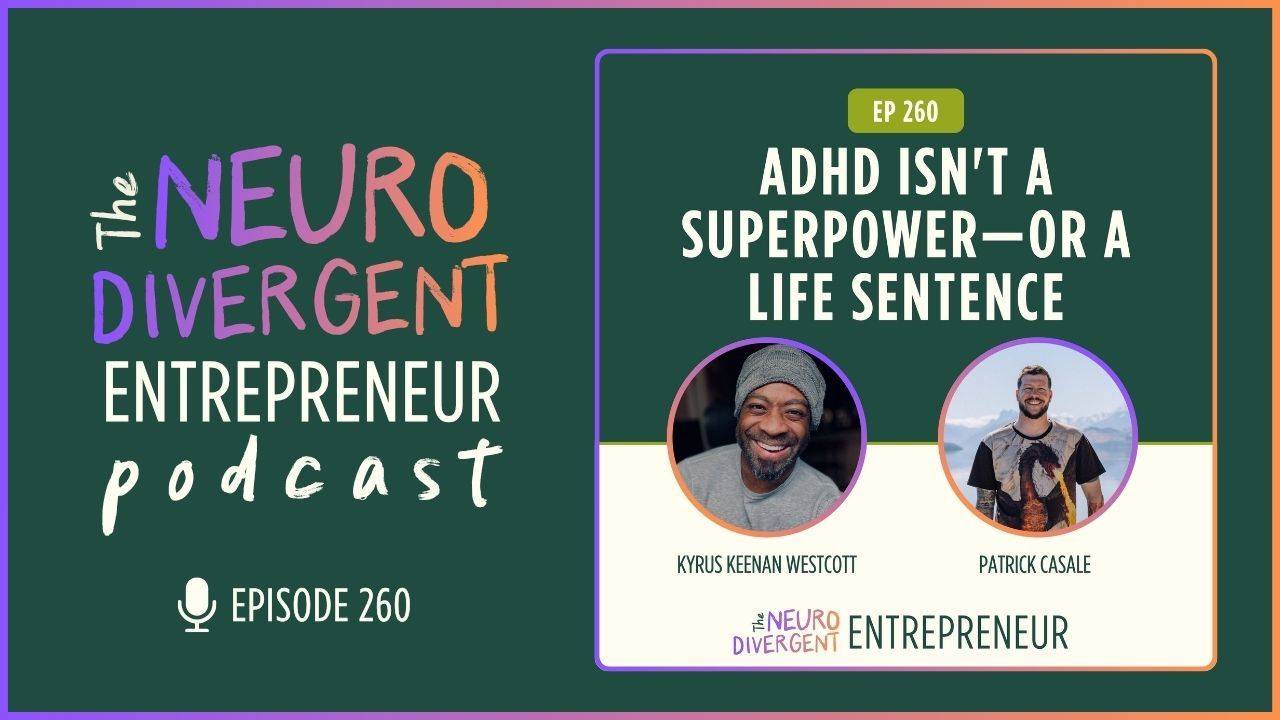
Show Notes
What if the goal isn't to "fix" your ADHD—but to finally stop fighting yourself?
In this episode, Patrick Casale sits down with mental health advocate, content creator, and digital strategist Kyrus Keenan Westcott, whose honest, anti-toxic positivity approach has resonated with nearly 3 million followers. Together, they explore the realities of living with ADHD, executive dysfunction, burnout, perfectionism, and the lifelong process of self-acceptance.
From navigating corporate life and social media to unpacking internalized ableism and learning to work with your brain instead of against it, this conversation is a grounded reminder that progress isn't about becoming someone else—it's about building a life that fits who you already are.
You'll learn:
- Why self-acceptance—not perfection—is one of the most powerful tools for navigating ADHD and neurodivergent life.
- How internalized ableism, unrealistic expectations, and toxic productivity can fuel burnout, shame, and self-criticism.
- What it really takes to create an authentic life and career, including balancing mental health, content creation, and meaningful work without pretending to have it all figured out.
More about Kyrus:
Kyrus Keenan Westcott, who simply goes by Ky, is a social media content creator, mental health advocate, and digital strategist based in the Greater Philadelphia Area. Diagnosed with ADHD (Inattentive Type) at age 34, alongside Major Depressive Disorder, Generalized Anxiety Disorder, and Existential OCD, Ky has dedicated his platform to making conversations about mental health, burnout, and executive dysfunction highly approachable.
Known for his realistic, optimistic, and anti-toxic positivity approach, he adds a much-needed sense of levity to mental health content, validating the very real struggles of neurodivergence while encouraging personal accountability. When he is not speaking on stages or building his content empire of nearly 3 million followers, Ky is quietly balancing a second full-time career as a Senior Paid Media Strategist, giving him a deep, personal understanding of corporate burnout and the demands of modern professional life. He lives with his two cats and is a massive fan of theme parks, professional wrestling, and musical theater.
Social Media:
- Facebook: facebook.com/thevibewithky
- Instagram: instagram.com/thevibewithky
- TikTok: tiktok.com/@thevibewithky
- Threads: threads.net/@thevibewithky
- YouTube: youtube.com/thevibewithky
- LinkedIn: linkedin.com/in/kyruskeenanwestcott
- Website: thevibewithky.com
🎙️Listen to more episodes of The Neurodivergent Entrepreneur Podcast
🎙️Spotify
🎙️Apple
🎙️YouTube Music
▶️ YouTube
✈️ Check out available Retreats
🗨️ Join The NeuroPreneur Circle Community
🗨️ Join the free Empowered Escape FB Community
A Thanks to Our Sponsors: The Receptionist for iPad!
I want to thank The Receptionist for iPad for sponsoring this episode.
The Receptionist for iPad is a HIPAA-ready digital check-in system that eliminates the need to walk back and forth from your office to the waiting room to see if your next appointment has arrived. Clients or patients can check in for their appointments, and you'll be immediately notified by text, email, or your preferred channel. Break free from interruptions and make the most of your time, because it is valuable. Start a free 14-day trial of the Receptionist for iPad by going to thereceptionist.com/privatepractice. Make sure to start your trial with that link to get your first month free if you decide to sign up.
Free Gifts for Our Listeners
Get a practical podcasting workbook for therapists considering starting a podcast, created by Patrick Casale, host of the podcasts The Neurodivergent Entrepreneur and Divergent Conversations.
You'll get a practical structure for therapists who want to start a podcast but don’t want to rush, perform, or build something they can’t sustain.
Grab your free copy: ndpod.org/Free-Podcasting-Workbook
✨ Move Beyond Private Practice As A Neurodivergent Entrepreneur
Move Beyond Private Practice As A Neurodivergent Entrepreneur is a FREE 5-part mini-course designed for therapists who want sustainable financial independence beyond one-on-one work.
Access your free mini-course here: ndpod.org/Neurodivergent-Entrepreneur
Transcript
PATRICK CASALE: Hey, everyone. Welcome back to the Neurodivergent Entrepreneur podcast. Joined today by Kyrus Keenan Westcott, who simply goes by Ky, who is a social media content creator, mental health advocate, and digital strategist based in the Greater Philadelphia area. Diagnosed with ADHD and attentive type at 34, alongside major depressive disorder, generalized anxiety disorder, and existential OCD, I can hard relate to all of that. Ky has dedicated his platform to making conversations around mental health, burnout, and executive dysfunction highly approachable.
Known for his very realistic, optimistic, and anti-toxic positivity approach, he adds a much-needed sense of levity to the mental health content, validating the very real struggles of neurodivergence while encouraging personal accountability.
When he is not speaking on stages or building his content empire of nearly 3 million followers, holy shit! Ky is quietly balancing his second full-time career as a senior paid media strategist, giving him a deep personal understanding of corporate burnout and the demands of modern professional life. He lives with his two cats and is a massive fan of theme parks, professional wrestling, and musical theater. Whoo!
KYRUS KEENAN WESTCOTT: I know.
PATRICK CASALE: You are an impressive human, man. I was on your podcast a couple weeks ago. And, I mean, I love following you and your career because you're so real, you're so authentic, you're so raw. And it sounds like that's what the brand has really been built on.
KYRUS KEENAN WESTCOTT: Yeah, yeah, absolutely. I think people can see through the nonsense sometimes, and I try to avoid that as much as I can. I just want to be me.
PATRICK CASALE: Yeah.
KYRUS KEENAN WESTCOTT: And hopefully, people will vibe with that, man.
PATRICK CASALE: So, you call yourself a content creator and not an influencer. That's kind of an important distinction.
KYRUS KEENAN WESTCOTT: Yeah.
PATRICK CASALE: When you started all of this, you know, three plus million followers is huge. I know I joked with you last time I was on your podcast, my friend asked why you don't have more TikTok followers, and it's an amazing accomplishment because I, having a baby following comparatively, know what goes into constantly creating content, showing up, being authentic, going through the highs and lows of being a human and a neurodivergent human. And at that, when you first started out, did you ever think like this is where this is going to take me?
KYRUS KEENAN WESTCOTT: No, absolutely not. At no point. I mean, I've always loved social media, just in general. I've always loved it. It's always been a part of my life. At no point did I ever think that it would become as big part of my life as it has been. And I'm incredibly thankful and grateful for what it has become and my audience.
PATRICK CASALE: Yeah, yeah, it's impressive. And I don't think we can ever foresee stuff like this happening to us. And you shared some really cool stories, like getting to go to the White House as a content creator summit, and like, meeting Joe Biden, and…
KYRUS KEENAN WESTCOTT: Yeah.
PATRICK CASALE: It is really, really fucking cool, and…
KYRUS KEENAN WESTCOTT: It's awesome.
PATRICK CASALE: It is, yeah. I hope you can sit in that, man, because, like [CROSSTALK 00:03:02]-
KYRUS KEENAN WESTCOTT: Yeah, I'm very grateful.
PATRICK CASALE: Yeah,
KYRUS KEENAN WESTCOTT: Yeah, you know, like, I stay grounded, but I think it's important for people to be proud of the progress they make, especially if you work hard at something. You know, I think it's important to celebrate those wins and to give yourself grace, and be like, “Yeah, I worked really hard on this.” You know?
PATRICK CASALE: Yeah. Absolutely, especially when you're discovering that you're ADHD at 34, and you're struggling with the inattentive piece more so than the hyperactivity piece. How has that played a role in just kind of that discovery? What does that unlock for you?
KYRUS KEENAN WESTCOTT: It's like putting on glasses for the first time, after spending, you know, 34 years of my life with blurry vision. And when you're able to funnily see clearly, and put a name to things, and everything starts to make sense, your life just naturally gets better because you're able to put tools and things in place to make your life better, and in turn, that makes the lives of the people around you better.
And so, it's been incredibly life-changing. And I'm so thankful for all of it because I don't know where I would have been if I didn't. I have no idea what kind of person I would be, or what kind of situation I would be in, or if you and I would even be talking today. I have no idea. And I don't want to know. I'm so thankful that I'm here. I'm very thankful for that.
PATRICK CASALE: We talked about this when I was on your podcast, but as a black man struggling with mental health and ADHD, how has that been breaking into just being a public persona in the eye of like so much of the content creation world and just in general.
KYRUS KEENAN WESTCOTT: Yeah. It's one of the reasons why I take this so seriously. There aren't many male content creators that talk about mental health, let alone black males. And so, I do feel as though I have a responsibility to spread as much information and education as possible. I have the platform to do it. And I do feel the responsibility to use my platform to do that.
And I didn't have any of this growing up. And so, if I could change, like, one person's life because of all of this, it makes everything worth it. It makes all the late nights working on content, all the writer's blocks, and all the struggles, and all of the ups and downs that you were talking about before, it makes all of it worth it, man. Because like, I feel like I have the ability to save a life.
PATRICK CASALE: Yeah.
KYRUS KEENAN WESTCOTT: Like, I don't take that lightly. I don't take that lightly. I have the ability to do that. And I didn't have that growing up. And so, to hopefully be that for somebody in today's world, I mean, that's why I take it so seriously. And I will continue to do so.
PATRICK CASALE: Yeah, I really respect that. And I think it's such an important acknowledgement. Like, the platform equates to some privilege, and just being able to show up and hopefully alter lives.
But I imagine you get a lot of DMs and messages just thanking you for what you're putting out into the world and helping kind of combat this narrative that men can't talk about mental health openly, or…
KYRUS KEENAN WESTCOTT: Yes.
PATRICK CASALE: …openly talk about the struggle, right? Because a lot of content feels like a facade to me. Like, it feels like you're only seeing the shiny object component opposed to like the hardship. And the hardship is what is really humanizing, making that relatable.
KYRUS KEENAN WESTCOTT: Yes, yes. You and I talked about this. I don't romanticize my ADHD. I don't. I'm very real about it because I truly, truly believe that in order for something to be managed, you have to acknowledge all of it, not parts of it.
PATRICK CASALE: For sure,
KYRUS KEENAN WESTCOTT: I understand why people call things like ADHD a superpower. I get it. I'm never going to knock somebody for using that. It's just not me.
PATRICK CASALE: Right.
KYRUS KEENAN WESTCOTT: And it's a controversial opinion that I have. I don't view ADHD as a superpower. It is a disability, and it sucks. And it's okay to have the mindset that, “Yeah, this sucks.”
Now, you don't want to live there, but now that you can name it and you understand the good, the bad, the ugly of all of it, now you can truly put the things in place to manage it because you're not beating around the bush. You're not just looking at the good parts and not the bad parts. You're acknowledging the whole thing. And now you can actually take appropriate actions to manage it in a healthy way. And so, that's why I talk so real about it, and I don't romanticize it. It is what it is. It's a disability.
PATRICK CASALE: Yeah, yeah. Well said. I agree, 100% with you, you know. And as an autistic ADHDer, I live in the world a lot of the time of like feeling like I'm being pulled in two separate directions constantly by my own mind, by my own body. And it's a mind fuck to be honest with you. Like, the autistic need for like sameness, and stillness, and repetition, and familiarity, and rest, and ADHD’s need in myself, at least, for stimulation and sensation seeking, and sometimes impulsivity, and sometimes some recklessness thrown in the mix, and it feels very much like a tug of war. And-
KYRUS KEENAN WESTCOTT: It's exhausting.
PATRICK CASALE: It is exhausting, yeah.
KYRUS KEENAN WESTCOTT: It’s exhausting.
PATRICK CASALE: I was actually just writing a Substack article about the exhaustion piece, especially combining it with, like, chronic health conditions that I experience, is like you may see our faces online frequently, but I know the behind-the-scenes is so hard sometimes.
KYRUS KEENAN WESTCOTT: Bro, you nailed it on the head because some of the messages that I get sometimes, people are like, "You always look so happy. You know, always look so happy.” And I'm like, "Well, you don't see me when I'm crouched in a corner in my kitchen, exhausted, crying because I had a bad day. I had a bad ADHD day, and my ADHD won. It won that day.”
PATRICK CASALE: Yep.
KYRUS KEENAN WESTCOTT: No, and like you don't see that. I'm not the kind of content creator that films that. There are people that do that, and that's fine. That's the way that they want to make content. But like, you know, I don't want to put that out there. But I do acknowledge that happens. But like, it sucks, man. It really sucks. And people, like, they don't see that part of it, but it's there. It happens.
PATRICK CASALE: 100%. You know, I'll have my executive functioning struggling, my working memory starts to really dissipate completely, and that actually kind of has to do with your sponsor, Sucreabeille, Why Did I Walk Into This Room?
KYRUS KEENAN WESTCOTT: Yeah.
PATRICK CASALE: Fragrance named after this ADHD experience.
KYRUS KEENAN WESTCOTT: Yeah, yeah.
PATRICK CASALE: Which is amazing. How did that come to be, man? Because like…
KYRUS KEENAN WESTCOTT: It's so funny, bro. I had a relationship with Sucreabeille for a while because I had signed on. They were one of the first brands that I had partnered up with for the long term, like a while ago. And they're very neurodivergent friendly.
And so, they found that any time that I was talking about any of their other products, like that product would tend to sell pretty well. And so, shout out to Andrea Fender, who is the CEO and manager over there, approached me and was like, “Hey, what are your thoughts on creating your own fragrance?” And I'm like, “Go on.” Right?
And so yeah, what happened was she said, “Well, what kind of fragrances do you wear?” And I'm like, “Well, I like wearing things that are light, that aren't too, like, overstimulating because I get very overstimulated with smells. I don't want anything overstimulating.” And so, they actually sent me over about 20 vials of smells.
PATRICK CASALE: Wow.
KYRUS KEENAN WESTCOTT: And so, I picked the vial that I really liked, and turned out that vial was a mixture of cherry pie and cinnamon.
PATRICK CASALE: Okay.
KYRUS KEENAN WESTCOTT: And it was nice and light. It's not overwhelming. It's not overpowering, and you can just kind of put it on, and like, if I were to walk by it, you would get a faint smell of it.
PATRICK CASALE: Sure.
KYRUS KEENAN WESTCOTT: And it wouldn't be too much. And I'm like, “I like this one a lot.” And they're like, “Okay.” And then they started to produce it. And now, it's become one of their top five-selling fragrances of the year, which is insane to even think. I'm like, I have a popular fragrance. This is insane.
But I named it Why Did I Walk Into This Room? as a love letter and an acknowledgement to the ADHD community, Because like, I don't need to explain to everybody listening. Like, that's a common thing that we struggle with. And so, I wanted to let it be a love letter to the ADHD community.
PATRICK CASALE: I love that. I really do. I mean, that's such a cool thing to be able to say and also just show that appreciation, like you said, for the community by…
KYRUS KEENAN WESTCOTT: Yeah
PATRICK CASALE: …going up and explaining something that a lot of people don't get. When I'm in that space, why did I just walk into this room? I will often be putting things down and forgetting what I'm doing with them, right? Like, putting my phone in the bathroom, for example, and being like, "Where is my phone?”
KYRUS KEENAN WESTCOTT: Where is my phone? Yeah.
PATRICK CASALE: Or like, why is the light on in this closet? Like, I don't even remember going in there.
KYRUS KEENAN WESTCOTT: Yep.
PATRICK CASALE: And it's almost as if, like out of sight, out of mind, right?
KYRUS KEENAN WESTCOTT: Oh, man, yeah.
PATRICK CASALE: So, that is a telltale sign for me that I am way past my limit for the week, and that I have to shut it down.
KYRUS KEENAN WESTCOTT: Yes.
PATRICK CASALE: Is that similar for you?
KYRUS KEENAN WESTCOTT: You have to listen to your body. You have to work with your brain, not against it.
PATRICK CASALE: Yeah.
KYRUS KEENAN WESTCOTT: If you fight your brain, you're always going to lose, always, every time. So, you got to work with your brain. Don't fight it.
There's plenty of times that, like for example, I'll want to get like a whole list of things done, but you know, my executive dysfunction has just taken over. And I just have to allow that to happen. Like, I can't fight it. I have things in place to help me in those cases, but it's the exhausting part that we were talking about before comes from when you are constantly trying to fight some of these things. And so, you have to just put things in place for things that for times that you know this is going to happen, you know it's going to happen, and it's not going to go away. You can't cure any of this. It's with you. It's who you are. So, now you put a structure in place for when it does happen, and it helps you manage that ADHD guilt that we get, because, like, if we don't have that stimulation, if we don't reach, if we don't get that dopamine, like, we beat ourselves up. We’re like, “Oh, why didn't I do this, this, and that?” You know?
PATRICK CASALE: 100%. Yeah, the ADHD tax is real.
KYRUS KEENAN WESTCOTT: Oh, yeah.
PATRICK CASALE: And I'm glad that you named that. Like, you can't fight against your brain. We're not going to change the way our neurotypes are. We're not going to change the way our brains process information. We can certainly build in accommodations and support.
KYRUS KEENAN WESTCOTT: Yes.
PATRICK CASALE: I just wrote an article, again, about like you can't outrun or outthink autistic burnout because I think so many people are trying so hard to desperately outthink this thing.
KYRUS KEENAN WESTCOTT: You're going to lose.
PATRICK CASALE: You're going to lose 100 times out of 100 times. And I think there's almost some power in admitting, I don't want to say defeat, but maybe it is defeat in a way. In those moments where you are so overwhelmed that you have to shut it down.
KYRUS KEENAN WESTCOTT: Yes. The word that comes to mind, Patrick, is the word failure, right? And obviously, words like failure have a negative connotation to it, understandably so. But to me, failure is a lesson that you learn, and then you can take that information and either be better the next time or have something in place to help you not get to that point. I feel like you learn more when you fail than what you than what you learn when you succeed.
PATRICK CASALE: Right. [CROSSTALK 00:15:25].
KYRUS KEENAN WESTCOTT: So, like, own that. It's okay. It's totally okay to fail, or to not have the best day. Like, acknowledge it. And then, let's do what we need to do to move forward.
PATRICK CASALE: Yeah, I think you're spot on. Failure to me has always been like a data point.
KYRUS KEENAN WESTCOTT: Yes.
PATRICK CASALE: And I used to beat the hell out of myself for, like, feeling like a failure, or like I wasn't doing enough, or everything was just feeling more like a struggle than it should.
KYRUS KEENAN WESTCOTT: Yep.
PATRICK CASALE: And the reality for me was like embracing that as humanness, especially acknowledging, like you said, that ADHD and autism are disabilities, having to build an acceptance and deconstruct a lot of internalized ableism about what it means to be disabled, what it means to have this neurotype that is neurodevelopmental. It's not going anywhere. There are days where I fucking hate my autistic part, or my ADHD side, right? But there are so many days that I love the way that I move through the world with the intensity that I experience when I'm really invested in something. It feels like an out-of-body experience in a good way.
KYRUS KEENAN WESTCOTT: I agree 100%.
PATRICK CASALE: And I wouldn't change that.
KYRUS KEENAN WESTCOTT: It's what makes you who you are today. Like, these are the people that are having a conversation right now. You know, we're not faking it. We're acknowledging it, and as a result, we're able to have these real conversations. And like, we mask all the time. That's exhausting. The minute that you feel comfortable enough to just drop the mask, that kind of stuff, it becomes easier to talk about, and it becomes easier to manage.
PATRICK CASALE: 100%.
KYRUS KEENAN WESTCOTT: As simple as that.
PATRICK CASALE: And that's a part of the restoration process that we're talking about when you get so overwhelmed and beyond your capacity that you do end up in that shutdown experience or that meltdown experience, where you're like, “I've got to go lay on the couch in the dark and watch Lord of the Rings for an hour. I got to do something that is mindless.” Like, completely turning it off.
KYRUS KEENAN WESTCOTT: And not feel guilty about it, and not feel guilty about it.
PATRICK CASALE: That.
KYRUS KEENAN WESTCOTT: You know?
PATRICK CASALE: Yeah.
KYRUS KEENAN WESTCOTT: That, because like a lot of us, and I know you know this feeling as well. Like, we'll start doing something like that. Like, we'll sit on our couch, and we'll start watching, you know, a movie or whatever. And then, what do we do when we're sitting there? Oh man, if I was at my computer, you know, I'd be doing this, or I should be doing this, blah blah blah. And we take ourselves out in the moment, and we start beating ourselves up because we're not being “productive.”
PATRICK CASALE: Right.
KYRUS KEENAN WESTCOTT: Like, no, no, this is being productive. One of my talks that I do, I do a talk called It's Okay to Hate Your Brain. And in that talk, I have a thing called Scheduled Incompetence, where, like, you have to like schedule in time for you to just do absolutely nothing. And the key part there is to not feel guilty about it.
PATRICK CASALE: 100%.
KYRUS KEENAN WESTCOTT: At all. Whatever you decide, if you want to stare at a wall for 20 minutes, then guess what? You are staring at a wall for 20 minutes, and there is no regret.
PATRICK CASALE: Yep. And it's not easy. It's not easy.
KYRUS KEENAN WESTCOTT: It’s not.
PATRICK CASALE: Even when you build that into your schedule, if you are a overachiever, like a lot of us are, especially those of us who are higher masking who discovered a lot of our neurodivergence later in life.
KYRUS KEENAN WESTCOTT: Oh yeah.
PATRICK CASALE: It's really hard to say, like I'm going to build this in. I'm going to be really intentional about it. And then, like you said, you're sitting there staring at a wall or doing whatever activity, and your brain starts to say, "But there's so many to-do lists. I could be working on this.” And I will tell you all that will never end. The demands never stop piling up.
KYRUS KEENAN WESTCOTT: Never, ever, ever.
PATRICK CASALE: The checklists never stop existing. We try to convince ourselves otherwise. I have this brain hack for myself. I'm OCD, and I really hate notifications, and I have to clear everything.
KYRUS KEENAN WESTCOTT: Yeah, yeah.
PATRICK CASALE: I convince myself if I check all the platforms and my email in the morning, and I get through everything, that will be it for the day. And guess how many times that fucking happens? Never. It never ever.
KYRUS KEENAN WESTCOTT: Never ever. I can't tell you one time I got through my entire to-do list ever.
PATRICK CASALE: No.
KYRUS KEENAN WESTCOTT: Ever.
PATRICK CASALE: So, like working with your brain, not against your brain. Super, super important here. And I think that's a really helpful tip, you know, for those of you listening, I think because we live in capitalism and ableism, there's such a ingrained, embedded narrative and core beliefs for a lot of us that we are only as good, or as worthy, or as valuable as our next achievement, our next creation, our next collaboration.
KYRUS KEENAN WESTCOTT: Yeah.
PATRICK CASALE: And if we are not doing, then we are worthless, lazy. We are not motivated. Whatever you buy into, it's really toxic.
KYRUS KEENAN WESTCOTT: It's very toxic. And I might have mentioned this to you before, I still have my checklist, right? I still have my to-do list, but I don't judge the success of my day based off of how many boxes I check.
PATRICK CASALE: Right.
KYRUS KEENAN WESTCOTT: I do the best I can.
PATRICK CASALE: Yep.
KYRUS KEENAN WESTCOTT: And that might be one box, that might be 25 boxes. I might get in hyper focus heaven, and then next thing you know, I did 10 weeks' worth of work in one hour, right?
PATRICK CASALE: Yep, yep.
KYRUS KEENAN WESTCOTT: Either way, at the end of the day, I ask myself, did I give it everything that I had today?
PATRICK CASALE: Yeah.
KYRUS KEENAN WESTCOTT: If the answer is yes, that's all that matters.
PATRICK CASALE: Yeah.
KYRUS KEENAN WESTCOTT: I gave it everything I had. Sometimes it's only one checkbox. Maybe it is only checking my email. Did I give it everything that I had today? I did. Okay. That's a win.
PATRICK CASALE: Especially for those of us who are starting a lot of our days beyond, like, behind already in terms of capacity.
KYRUS KEENAN WESTCOTT: Yes, yes.
PATRICK CASALE: So, like our 100% based off our 60% capacity, right, is really just destroying us in that way, and we never play catch-up.
KYRUS KEENAN WESTCOTT: Yeah.
PATRICK CASALE: So, I can think of multiple examples of this, right? Like, I'm writing this book on late-in-life autism discovery. I was trying to force myself into this, like, neurotypical mold of like this is how I write. You structure it, you plan it, you like put it in your calendar. Once I started allowing myself to only write in bursts of creative focus and energy, things felt much more natural, much more engaged, much more like my voice, and just giving myself permission instead of saying like I didn't get a chapter done this week and I'm not feeling well. I'm not sleeping well. I don't have the capacity or the energy. That's okay. Like…
KYRUS KEENAN WESTCOTT: And I'm sure it felt more genuine, too. Like, you probably felt the writing was more genuine and organic, and it wasn't forced.
PATRICK CASALE: 100%. So, just learning these things as we go, right? Like, and that's just super important. So, for everyone listening, especially if you've figured this out later in your life into adulthood, you're going to have to do some work to get to a place where you can really work with your brain, heal that inner child wounding, instead of trying to fight it, instead of trying to outthink it, instead of trying to outrun it.
KYRUS KEENAN WESTCOTT: Yeah.
PATRICK CASALE: I think we're both living proof of the fact that you cannot do that.
KYRUS KEENAN WESTCOTT: Amen. No, you can't.
PATRICK CASALE: All right. So, my podcast is a little bit shorter than yours, but I do have a couple of quotes from you that I want to bring up before we wrap this out. So, West Coast heart, East Coast life. Tell me about that.
KYRUS KEENAN WESTCOTT: So, a lot of my family lives in Arizona. I spend a lot of time out west. The West Coast is a lot more laid back with a lot of things, especially mindset. But I grew up in the Northeast, so Philly, New York, Baltimore, Boston, DC, all these places where it's like boom, boom, boom, boom, boom, boom, boom.
I embrace the San Diego, you know, like suburban L.A. mindset, the Phoenix, Seattle, Portland. I embrace that mindset. That's where my heart is. If I could live out west, I mean, I definitely could if I wanted to.
PATRICK CASALE: Sure.
KYRUS KEENAN WESTCOTT: I probably would. I came very close to moving out west, but I also love the hustle and bustle of the of the East Coast. So, like, it's kind of like a marriage of the two. So, like, my heart is like an empath for that West Coast life. But I'll always be a Northeast boy. Like, I'll always have that northeast mindset, which is a different mindset, man.
PATRICK CASALE: It is.
KYRUS KEENAN WESTCOTT: It's different.
PATRICK CASALE: I’m from New York, and when I moved to North Carolina, people were always like, "You work so much harder than us.” I'm like, "I don't think I am. That’s just how I'm wired. Right? Like, I can't turn it off.”
KYRUS KEENAN WESTCOTT: We talk faster. Like, it's just boom, boom, boom, boom, boom. Yep.
PATRICK CASALE: I had friends come down for my wedding in my bachelor party, and a bunch of them are from like the Bronx, or that I met in college. And they're like, we're at the grocery store. We're at everything slow pace, and they're like, "How the fuck do you live like this?” I was like, "You all should try it. Like, I imagine it would do a world of good.”
KYRUS KEENAN WESTCOTT: Yeah, yeah, yeah. It's definitely a lot more fast-paced, especially like walking down the street. You know, I'm just like, "Let's go. Come on, let's go.”
PATRICK CASALE: Even based on like, are you saying hi to people, or are you just like looking straight ahead, like out of sight, out of mind? Don't even acknowledge, you know?
KYRUS KEENAN WESTCOTT: I'm not here. Just keep walking.
PATRICK CASALE: Right, just look the fuck up.
KYRUS KEENAN WESTCOTT: Yes.
PATRICK CASALE: All right. So, another thing I saw you say that resonated for me, your frustration exit plan, born from a spilled iced coffee. Tell us a little bit about that because I am in that headspace a lot of the time.
KYRUS KEENAN WESTCOTT: I don't know how to describe it. I feel like I'm special. I just sound weird. Like, I feel like I'm just special. Like, I feel like I'm a hot mess.
PATRICK CASALE: Yep, sure.
KYRUS KEENAN WESTCOTT: But I'm proud of my hot messedness.
PATRICK CASALE: Absolutely.
KYRUS KEENAN WESTCOTT: You know, I just kind of embrace the fact that I'm a hot mess. I used to beat myself up about that stuff. And I think I pride myself on how patient I am with the chaos that comes with life, and I just embrace it, and I'm okay with it. Like, I just don't beat myself up about it anymore. I used to, but there's so much that's just out of your control. Things are just going to happen.
PATRICK CASALE: 100%.
KYRUS KEENAN WESTCOTT: And I pride myself on my patience and staying calm. And it might be the medicine that helps. It might be the Wellbutrin that plays a role there.
PATRICK CASALE: Shout out to Wellbutrin.
KYRUS KEENAN WESTCOTT: Yes. But, like, like things happen, and I just have to like accept it. And like okay, it happened. What now?
PATRICK CASALE: Yeah.
KYRUS KEENAN WESTCOTT: And I just don't like to live in a place where I just beat myself up over shit that I can't control, bro. Bro, like I can't.
PATRICK CASALE: I love this because, like, what you're saying to me says you've done a lot of work on healing some of these, like, narratives.
KYRUS KEENAN WESTCOTT: It's still going. It's still work. There's still work happening.
PATRICK CASALE: Yeah, it never ends, right? Like, it's lifelong, you all. Like-
KYRUS KEENAN WESTCOTT: Yes.
PATRICK CASALE: The work is lifelong, but it sounds to me like you have done a lot of work of working through that, like really intense inner criticism, self-talk.
KYRUS KEENAN WESTCOTT: Yes.
PATRICK CASALE: Probably healed a significant amount of inner child wounds along the way.
KYRUS KEENAN WESTCOTT: Yeah.
PATRICK CASALE: And it's still hard. It's still hard.
KYRUS KEENAN WESTCOTT: It’s still hard.
PATRICK CASALE: And messy.
KYRUS KEENAN WESTCOTT: But it’s hard, but becomes easier to process that shit.
PATRICK CASALE: Yeah, yep.
KYRUS KEENAN WESTCOTT: You know, once you acknowledge it, and you're able to process, like when you learn how to process bullshit, and nonsense in a healthy way, things won't bother you nearly as much as they used to.
PATRICK CASALE: You are 100% correct on that, 100 fucking percent. So, I just really want to thank you for coming on here. I mean, I came on yours last week. You're coming to our summit next week. I know how busy you are. I don't take this for granted at all that you were like, “Yeah, I'll do that.”
KYRUS KEENAN WESTCOTT: Yeah, man.
PATRICK CASALE: I think that speaks volumes of like who you are as a human. I think a lot of people who get really big in content creation worlds or in general become really distant to people. I'm like, no, I'm too good for that. I wouldn't even consider that.
KYRUS KEENAN WESTCOTT: I'm nothing without my audience. I'm nothing without these conversations. Like, it's not the Kyrus' show, by any means. I'm nothing without the people that make all of this happen.
PATRICK CASALE: I love the humility. I also love the like other side of the coin of like, “Look at all this cool shit that I've done.” I think both need to exist, right? Like, both need to exist.
KYRUS KEENAN WESTCOTT: Yes, yeah, stay humble but be proud.
PATRICK CASALE: I love that. Ooh, that might be the name of the episode. We'll see.
KYRUS KEENAN WESTCOTT: Yeah, man.
PATRICK CASALE: I feel like walk into this room or be humble, stay proud. We'll see what happens. My team always picks it, and then I'm like, "All right, let's see what happens.”
KYRUS KEENAN WESTCOTT: There you go. There you go dropping that nugget. You have a hard choice to pick, team.
PATRICK CASALE: Exactly.
KYRUS KEENAN WESTCOTT: You know?
PATRICK CASALE: Yeah. I mean, everyone listening, if you don't follow Ky, like, share where you're at. You're everywhere, but like it's definitely someone that you need to be following, subscribing to, paying attention to. Just someone who is just a fucking gift to this world in terms of mental health care, toxic positivity, toxic masculinity, embracing neurodiversity. I'm really, like, grateful that we've connected.
KYRUS KEENAN WESTCOTT: Yeah, man. Yeah, man. Absolutely. Thank you for having me on. And thank you for the work that you do because this is important. It's important to have these conversations, and for you to offer a place for people to have this type of talk. It's important stuff. So, I thank you for the work that you're doing both here online and out in the world, for sure.
PATRICK CASALE: Thanks. Where can people find you if they want to check you out, like podcast-wise, social media, anything else that going on?
KYRUS KEENAN WESTCOTT: The easiest way you can visit my website, thevibewithky.com, or you can just type in The Vibe with Ky on any platform, @thevibewithky is my username on every platform. So, just type that in, and you'll find me. I'll be there with my nonsense.
PATRICK CASALE: I'm just curious. I didn't get to ask the question. How many podcasts are you recording a week at this point?
KYRUS KEENAN WESTCOTT: Oh, so I release two episodes a week.
PATRICK CASALE: Okay.
KYRUS KEENAN WESTCOTT: I record sometimes up to four a week. Sometimes it's like two a day. You know, it's kind of crazy. But I like having the conversations. Yeah, it's fun, man. I love it.
PATRICK CASALE: You're probably like me. I mean, you consider yourself to be an introvert. Maybe we're ambiverts, we like the smaller, depth-oriented conversations overwhelmed by bigger groups, and then we also need a lot of time to recharge.
KYRUS KEENAN WESTCOTT: Yeah, I definitely need time to recharge. And like, I still consider myself an introvert because it’s just about how you disperse your energy, you know?
PATRICK CASALE: Yeah, totally.
KYRUS KEENAN WESTCOTT: So, like, my energy is with these smaller types of conversations.
PATRICK CASALE: Yeah.
KYRUS KEENAN WESTCOTT: I like being among people, what drains my energy is being with people. That’s what truly drains my energy.
PATRICK CASALE: Yes, I couldn’t say that better myself. Well, thank you so much for coming on here and-
KYRUS KEENAN WESTCOTT: Yeah, man.
PATRICK CASALE: …the show. And I’m looking forward to just continuing to connect.
KYRUS KEENAN WESTCOTT: Absolutely.
PATRICK CASALE: And we’ll have everything Ky listed in our show notes. You have access to where he’s at. I mean, it’s pretty easy to find, and maybe you pick up some fragrance along the way like-
KYRUS KEENAN WESTCOTT: Yeah, man.
PATRICK CASALE: Why Did I Walk Into This Room?
KYRUS KEENAN WESTCOTT: You’ll smell pretty good, I’ll tell you that.
PATRICK CASALE: Well, and I think that is amazingly hilarious, so something that will be on the back of my mind, for sure.
KYRUS KEENAN WESTCOTT: Yeah.
PATRICK CASALE: To everyone listening to the Neurodivergent Entrepreneur podcast, episodes are out every single week. All major platforms, YouTube. Like, download, subscribe, share. Doubt yourself, do it anyway. We’ll see you next week.
FREE PRIVATE PRACTICE GUIDE
Join the weekly newsletter for private practice tips, podcast updates, special offers, & your free private practice startup guide!
We will not spam you or share your information. You can unsubscribe at any time.





![Episode 266: Healing Isn’t Just in Your Head: Rethinking What Therapy Can Be [featuring LeNaya Crawford]](https://kajabi-storefronts-production.kajabi-cdn.com/kajabi-storefronts-production/file-uploads/sites/2147507511/images/a2d5a4-e4bf-63b0-fa7f-6e6f62c466d5_TNDE_YouTube_episode_266.jpg)
![Episode 264: Creating Through the Chaos of a Neurodivergent Life [featuring Bre "BR3"]](https://kajabi-storefronts-production.kajabi-cdn.com/kajabi-storefronts-production/file-uploads/sites/2147507511/images/a14004-cc3d-8aba-5fb8-2442fdfc650_TNDE_YouTube_episode_264.jpg)
![Episode 263: Your Symptoms Are Real—Even When Medicine Doesn’t Have The Answers [featuring Dr. Zachary Spiritos]](https://kajabi-storefronts-production.kajabi-cdn.com/kajabi-storefronts-production/file-uploads/sites/2147507511/images/84bc15-1ce4-1a0b-8f85-f5812bce75_TNDE_YouTube_episode_263.jpg)