
Episode 261
Aug 26, 2026

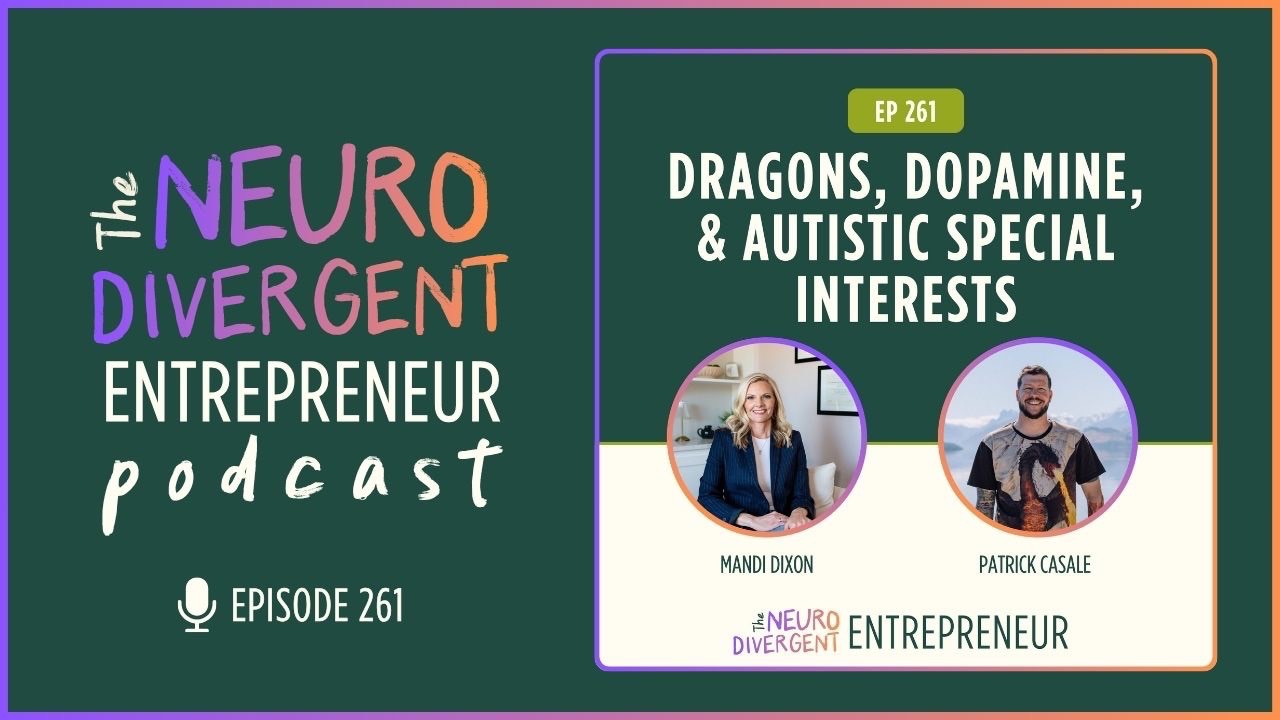
Dragons, Dopamine, and Autistic Special Interests [featuring Mandi Dixon]

Hosted by: Patrick Casale
The Neurodivergent Entrepreneur

Show Notes

What happens when a TV show, book series, fictional universe, or character becomes so much more than entertainment?

Patrick Casale is joined by returning guest and ADHD Executive Function Coach Mandi Dixon for a deep dive into Game of Thrones, House of the Dragon, and the powerful role special interests can play in neurodivergent lives.

From favorite characters and dragons to Autistic-coded characters, PDA, hyperfixation, and the emotional devastation of a terrible series finale, Patrick and Mandi explore why fictional worlds can become sources of joy, nervous system regulation, connection, belonging, and escape. They also unpack something that isn't discussed nearly enough: the genuine grief that can happen when a special interest ends or suddenly stops providing the comfort it once did.

And yes—there are major Game of Thrones and House of the Dragon spoilers, so consider yourself warned.

3 Key Takeaways:

  1. Special interests can be much more than hobbies. For neurodivergent people, they can provide regulation, connection, belonging, predictability, and a place to experience genuine unmasked joy.
  2. Losing a special interest can create real grief. Finishing a beloved series, losing connection with an interest, or watching a fictional world come to an end can leave a surprisingly significant emotional void.
  3. Shared interests can transform neurodivergent connection. When people are given space to enthusiastically discuss what they love without masking or judgment, perceived "social deficits" can look very different—revealing connection, depth, and genuine enthusiasm instead.

More about Mandi:

Mandi Dixon is a Licensed Professional Counselor, EMDR therapist, and ADHD Executive Function Coach specializing in the intersection of ADHD and perimenopause in women. She’s a member of The Menopause Society and the International Society for the Study of Women’s Sexual Health, and her work has been featured in USA Today and Good Morning America. Mandi is based in Allen, Texas, where she sees clients and is currently writing her first book on ADHD and midlife hormonal health.


🎙️Listen to more episodes of The Neurodivergent Entrepreneur Podcast
🎙️Spotify

🎙️Apple

🎙️YouTube Music
▶️ YouTube
✈️ Check out available Retreats
🗨️ Join The NeuroPreneur Circle Community
🗨️ Join the free Empowered Escape FB Community


A Thanks to Our Sponsors: The Receptionist for iPad!

The Receptionist for iPad

I want to thank The Receptionist for iPad for sponsoring this episode.

The Receptionist for iPad is a HIPAA-ready digital check-in system that eliminates the need to walk back and forth from your office to the waiting room to see if your next appointment has arrived. Clients or patients can check in for their appointments, and you'll be immediately notified by text, email, or your preferred channel. Break free from interruptions and make the most of your time, because it is valuable. Start a free 14-day trial of the Receptionist for iPad by going to thereceptionist.com/privatepractice. Make sure to start your trial with that link to get your first month free if you decide to sign up.


Free Gifts for Our Listeners

 Free Podcasting Workbook

Get a practical podcasting workbook for therapists considering starting a podcast, created by Patrick Casale, host of the podcasts The Neurodivergent Entrepreneur and Divergent Conversations.

You'll get a practical structure for therapists who want to start a podcast but don’t want to rush, perform, or build something they can’t sustain.

Grab your free copy: ndpod.org/Free-Podcasting-Workbook

 Move Beyond Private Practice As A Neurodivergent Entrepreneur

Move Beyond Private Practice As A Neurodivergent Entrepreneur is a FREE 5-part mini-course designed for therapists who want sustainable financial independence beyond one-on-one work.

Access your free mini-course here: ndpod.org/Neurodivergent-Entrepreneur


Transcript

PATRICK CASALE: Hey, everyone. Welcome back to the Neurodivergent Entrepreneur Podcast. I am joined today by a repeat guest, Mandi Dixon, who's a licensed professional counselor, EMDR therapist, and ADHD executive functioning coach, specializing in the intersection of ADHD and perimenopause in women. 

She's a member of The Menopause Society and the International Society for the Study of Women's Sexual Health. Her work has been featured in USA Today, Good Morning America. 

Mandi is based in Allen, Texas, where she sees clients and is currently writing her first book on ADHD and midlife hormonal health. 

Welcome back to the show. I am excited to have you on because today, what we are going to talk about, for all of you listening, is special interests, but especially within the realm of Game of Thrones, House of the Dragon, and all those fantasy worlds and realms. 

And last night, for context, was the finale of the season three House of the Dragon series. And I know we're going to really dive into that and just the importance of having these things in our lives. I think that is really foundationally a big part of this. 

And as I sit in my office, I think about the fact that I am surrounded by stuff like memorabilia, posters, pictures, photos, stuffed animals, books, images of my special interests. Like, Anthony Bourdain is behind me. I'm staring at enormous amounts of Lord of the Rings, Ted Lasso, Red Panda, House of the Dragon, Travel. Like, it's just all around me.

And I think as an autistic person, special interests are often gateways into the autistic soul. And when we start to find these things that we connect with on such a cellular level, we can kind of build like entire worlds around it, relationships, senses of connection, and regulation, and belonging. So, okay, House of the Dragon.

MANDI DIXON: Yes.

PATRICK CASALE: Finished last night, controversial probably for a lot of you watching, and there are going to be spoilers. So, if you haven't watched, you know, you may not want to listen to this episode. 

Take it away, Mandi. Like, what is this world doing for you right now? Because when I mention it on Instagram, you were immediately like, "Oh, I would love to talk about this.”

MANDI DIXON: Well, I'll say I was never a Game of Thrones fan. And I just want to say that I have not read the books.

PATRICK CASALE: Yeah, that’s okay.

MANDI DIXON: So, I would see it on HBO, and you know, I'd find myself, like, lost in it. But you know, it would be just a random episode or whatever, when it was, you know, live, coming out. But I knew this is the ADHD in me, that it was so big, you know. It was so much, so many seasons, and the fans were hardcore. And I thought, I just don't have the capacity to consume that, so I stayed away from it. But I always was very intrigued by it. 

And, you know, just one day, I was like, you know what? I'm going to go in, and I'm going to watch it. You know what I think happened is House of Dragon came out. I watched a couple episodes of that, and that was the trigger, was like, “Okay, now I'm going to go watch all of the Game of Thrones, the whole series.” Yeah. 

PATRICK CASALE: How long did it take you to, like, once you hit that point where you were like, “Oh, I got to go back, and now I got to watch eight seasons of Game of Thrones?”

MANDI DIXON: Few months, maybe. 

PATRICK CASALE: Yeah.

MANDI DIXON: Yeah, not long. I mean, and I have children too.

PATRICK CASALE: Sure.

MANDI DIXON: So, I've had to only do it when they weren't around. 

PATRICK CASALE: Have you re-watched it, or was it a one-and-done? 

MANDI DIXON: It was only once, but I very much want to go re-watch it. But I'll tell you what happened. Have you binged it like that? 

PATRICK CASALE: Yes. So, for you listening at home, I have PDA, or you know, what people would call pervasive drive for autonomy, or pathological demand avoidance. So, when everybody's saying to do something, my nervous system immediately shuts it down. 

And the first couple of years that Game of Thrones was out, and it was this massive hit, and everybody's telling you, “You got to go watch this show. You're going to love it. Like, you love Lord of the Rings. You would really enjoy this.” And blah blah blah blah blah. My wife is like, “Come on, join me on this adventure every Sunday night.” I'm like, “No, I want nothing to do with this world.”

And then I started watching, like, season seven while she was watching it out of my peripheral. I was like, "Oh man, this is fascinating.” And then, finally, I decided I should binge-watch all of it before season eight came out a couple of years ago. So, I watched seven seasons in a matter of like two weeks.

MANDI DIXON: Oh my gosh.

PATRICK CASALE: And like just episode after episode after episode. And now, I hate to say this, but I have probably watched the whole series, oftentimes turning it off at season eight because it was an atrocity, 50-plus times total. 

MANDI DIXON: Wow.

PATRICK CASALE: It's a problem. 

MANDI DIXON: It's intense. I know for myself when I benched it like that, I was dreaming about it. And of course, you know, in the dreams. But then, in reality, I noticed when, it’s so funny, when you say something that was upsetting or take a tone with, my instinct was just like, “Draw a sword.” Like, my feet felt like I was going to draw my sword. It was so funny. And I definitely caught myself doing that. Just you get so consumed into it. 

Yeah, and I think that may be why I haven't gone back and re-watched it because I know how consumed I get with it.

PATRICK CASALE: For sure, totally. I actually, like, over my shoulder, I'm going to, right here, you guys can't see it probably. My favorite character, and I'll ask you yours in a second, in Game of Thrones is the Hound. And I think he's such a complex character where, like, in the beginning, so full of hate, and anger, and violence. And as the seasons go on, and he and Arya develop a relationship, and he becomes almost this, like, protector for her, such a beautiful, like, representation of, like, vulnerability-

MANDI DIXON: He died for her.

PATRICK CASALE: And toxic masculinity. He died for her.

MANDI DIXON: Yeah. 

PATRICK CASALE: And he was willing to put himself in harm's way for her. And it was just, you know, a really beautiful character arc, which they ruined a lot of them in Game of Thrones, if I'm being honest. 

So, my wife got me this painting, which is a painting of the Hound and Arya in a field, and her face on Arya and my face on the Hound, so it's one of my favorite things in my office. 

MANDI DIXON: I love that. [CROSSTALK 00:06:46].

PATRICK CASALE: Might be a tattoo that I get, actually now that I say that out loud. That might be a next tattoo. 

MANDI DIXON: There you go. 

PATRICK CASALE: Okay, so favorite character in Game of Thrones for me, the Hound. I could go into a list of people I hated for a lot of reasons. There's a lot of dislikeable characters, but the acting is so good that it makes it intriguing. So, curious for you, like, did you have a favorite, least favorite? 

MANDI DIXON: I was always drawn to Bronn, not Bran, but Bronn. And what is it, Bronn of the Black? 

PATRICK CASALE: Yeah, so Bronn of the Blackwater, yep.

MANDI DIXON: Yeah, Blackwater, that's it. And I've tried to think about what it is about him, and it's hard to really nail down. I think it's, he was never really fake with anyone. He was always just very open and honest about what and who he was, and didn't try to deceive anyone. It was kind of like this is me, and take it or leave it. And became a lord, I guess, at the end.

PATRICK CASALE: Yeah, yeah. I liked Bronn a lot. He was actually on my top five. It was like Bronn, the Hound, Arya, Tyrion, and probably Tormund, the big red-bearded wildling guy. 

MANDI DIXON: I liked him too.

PATRICK CASALE: But I like the characters that are very direct and straightforward. Like, what you see is what you get. And Bronn was definitely that, right? He was always, like, telling Tyrion, like, “You pay me to kill people, you pay me to protect you. That's my job. I don't have any relational, like, sense of justice or duty here. I'm doing it for money because this is what I'm good at.”

MANDI DIXON: Yeah, there was no reading between the lines with him. 

PATRICK CASALE: Right, there is no, like, ulterior motive or sneakiness, which there's a lot of in this series. And those are the characters, and not just in this series, in any series that I often have a hard time with. Like, do you watch Ted Lasso at all? 

MANDI DIXON: No. 

PATRICK CASALE: Okay, Nate, for those of you listening at home, another character that I have such a hard time with. It's the sneaky ulterior motive, always scheming, plotting. And there's a lot of that in Game of Thrones. And you know, I think it's very well done. What about least favorite characters? 

MANDI DIXON: Least favorite, well, Cersei. She was one of those that was also very sneaky, very cunning. 

PATRICK CASALE: Yeah. 

MANDI DIXON: Yeah. Just not even though that she necessarily did a lot of the things herself. It's that she was, you know, the manipulator that stacked all the dominoes up. 

PATRICK CASALE: Yeah. 

MANDI DIXON: Yeah. 

PATRICK CASALE: I didn't like Cersei. 

MANDI DIXON: Yeah.

PATRICK CASALE: Did not like Ramsay Bolton. 

MANDI DIXON: No.

PATRICK CASALE: Was the epitome of a psychopath, like serial killer, almost-esque. Hated Joffrey, but I don't know a single person on planet Earth who liked him. People took it a little too far, where they were, like, sending the actor lots of hate mail and death threats, and like, verbally assaulting him at comic cons and stuff like people. This is a fake character, you all. This is not a real-world event or experience. The kid seems like a very nice guy. He quit acting after that for a while because of it. He was like, “Fans are hardcore.” 

MANDI DIXON: And he did a great job. 

PATRICK CASALE: He did. I always think about that. Like, when characters are that dislikeable, the acting is top tier. So, let's fast forward into this series that just ended. Dislikeable characters, probably across the board for House of the Dragon, if you've watched it. Ser Criston Cole is the top of the list for a lot of you out there because of, like, toxic masculinity. Because he got, you know, dumped by Rhaenyra, and all of a sudden, he's on this vengeance tour. He's constantly, like, trying to fight for honor, but in reality, is just constantly self-absorbed and image-obsessed. Did you like that character?

MANDI DIXON: I did like him at first, but I will say personally, I do get swindled by that sometimes. 

PATRICK CASALE: Yeah, yeah, yeah. 

MANDI DIXON: That's a blind spot personally. But, yeah, no, then I did see how he turned, and I liked that he was so, or a lot of people were able to see his true, you know, I guess, loyalty, which was to himself and how high he could get in things. 

PATRICK CASALE: He's one of those guys, you know. Like, it was just a great acting job because he was so universally hated. Every single week after episodes, people are posting reels and gifs of like, “Please, Criston Cole, just die today. We just want this to be over.”

And of course, he gets killed by a woman in, like, anticlimactic fashion. He thinks he's going to go out as this epic warrior, and people are going to sing songs about him, and he's getting ready to battle, and all of a sudden, he just gets shot by some, I can't remember her name right now, Black Aly, and just gets shot, killed. And it's like, “All right, we're moving on from this.” And I thought that was phenomenal. 

MANDI DIXON: I loved how he got shot first in his chest, so that he, like, could realize it, and then boom, right in the cheek-

PATRICK CASALE: Yeah.

MANDI DIXON: [INDISCERNIBLE 00:12:00].

PATRICK CASALE: And then, it was just over. And it was like, all right, this guy's forgotten about instantaneously, and you know, had so much influence in what happened in this series, and so much harm done from his actions, all because he got spurned by a one-night stand with Rhaenyra while she was a teenager, you know? It's like, how much narcissism can we have to think, like, she's going to have sex with you, and then, all of a sudden, she's just going to choose to leave the Iron Throne and the descendancy because you had a one-night stand. And now that sets you on a course of, like, destruction, and plotting, and scheming, and trying to be her downfall.

MANDI DIXON: That fractured ego. 

PATRICK CASALE: Yeah, yeah, all in the blink of an eye. It was like, you know, she made him feel important, and all of a sudden, he wasn't. And he just couldn't handle that. 

MANDI DIXON: Yeah. 

PATRICK CASALE: So, there's a lot of controversy around the characters in the show, Rhaenyra being like probably in the center of the controversy. For those of you who are watching at home or don't know much, you know, she's the one who was promised to be the heir to the Iron Throne. It gets swept out from under her once her dad dies. Her brother becomes king instead. He's a dislikeable, pretty horrible human being. And she ends up trying to take the throne back and ends up succeeding this season, temporarily. 

People do not like her. People around her start to dislike her. And you had some thoughts about this when we were messaging before.

MANDI DIXON: Yeah.

PATRICK CASALE: You were saying like you were seeing eldest daughters’ stuff. You were seeing, like, perimenopause stuff. Tell us about that. 

MANDI DIXON: Well, I see everything through perimenopause lens sometimes, but no. As this season was going on, I witnessed a lot of, like, people-pleasing tendencies. She wanted to be good. I guess is a pretty good way to say it. And you know, most eldest daughters, do they want to do the right thing? They want to take care of everyone. 

And I could see that she was desperately trying to do that, but you can't make everybody happy. You know, she had to put herself last in a whole lot of situations. And as a queen, you can't do that. And it was just a lot of conflict I could see with her. And I could just see those people-pleasing tendencies coming out. 

And then, it's like with women that I see in my practice who have been people pleasers their whole life, a lot of them eldest daughters, you get to a point where you just snap. And it's almost, you know, unmasking. And people see you as being cruel. And does she get named Rhaenyra the Cruel? 

PATRICK CASALE: Yeah.

MANDI DIXON: Yeah.

PATRICK CASALE: Yeah. In the books they 

MANDI DIXON: So, I just wonder-

PATRICK CASALE: …paint her very poorly. 

MANDI DIXON: Okay. 

PATRICK CASALE: In the books, she's despised by basically everybody. Her reign is very short. But I agree with you. So, all this people pleasing, all that pressure to be the perfect daughter, to honor the legacy, to do exactly what your father wants you to do. And then, it all comes crumbling down because nothing goes to plan. 

MANDI DIXON: Yeah, and you could see she genuinely cared about the people. She was trying to hear their struggles, but like, there wasn't an answer. There wasn't a good answer for everyone. And that can really take a toll on you, you know, in life when you are an eldest daughter, often holding up the family, and your family and everything, and there's just no way to make everyone happy.

PATRICK CASALE: Right, yeah. And I think, you know, a big protagonist in this story, her husband and uncle, a lot of incestuous stuff in the series. 

MANDI DIXON: Oh yeah.

PATRICK CASALE: Is constantly asking her like, “Take your power, use your dragons, burn it all down.” And she's constantly saying, "No, that's not who I want to be. It's not the kind of leader I want to be.”

Which echoes a lot of what you see with Daenerys in Game of Thrones towards the end, where it's like, "I don't want to be the leader and the Queen of the Ashes.” But then, inevitably, all of these people are out against you, right? Like, the whole issue with House of Dragon is that a lot of the people who “bent the knee and swore fealty” really don't want a woman in power. They would rather have a horrible man who is horrific, has no care for the people he serves because he's a man. So, there's a lot of patriarchy in this going on. 

MANDI DIXON: Yeah, that's what I noticed, too. And that's something that Daenerys went through all of Game of Thrones, she was constantly having to fight not only just for her right to the throne, but it was mostly because she was a woman and kept being denied. So, saw a lot of that parallel. 

And I know that there's been instances where there's a mad king, but mostly that image becomes the mad queen. The woman goes mad, the woman goes crazy. 

PATRICK CASALE: Yeah.

MANDI DIXON: And in our world, too, you know, a woman can't just have a moment. No, she has to snap and become crazy. 

PATRICK CASALE: Yep. Yeah, yeah. We're not looking at the outside influences, or factors, or how she wasn't set up for success from the start. She was really never set up for success from the moment she ascends and takes the throne. She's already dealing with a situation where all of the gold is out of the city, they have no resources. Everyone is conspiring against her. And she's meant to, like, keep it all together, and be mature, and be respectful, and be judicious, and be loyal. 

MANDI DIXON: And kind.

PATRICK CASALE: But yeah, yeah, be kind and be gentle while also being required to be vicious, and aggressive, and dominant. And it just doesn't mix in this very, very violent world of Game of Thrones lore. 

MANDI DIXON: Exactly. Like I said, I haven't read the books, so I'm kind of interested to see what plays out. I typically try and go look for spoilers just because I'll get so curious, but I'm going to try really hard not to. 

PATRICK CASALE: I mean, I do know what's coming. And I think we're in for a treat. Hopefully, season four lives up to that hype. I felt like, aside from the finale last night, the last couple of episodes have been really slow and really drawn out. And I thought, “Man, this means they're going to have to rush, you know, whatever happens next.” Because they were going over things that really are inconsequential. 

There's a lot of betrayal in these stories. There is a lot of backstabbing. There is a lot of power-grabbing for people. It really does mirror a lot of what's happening in our country and just worldwide in politics and throughout history. It's often time about who you know and who you have alliances with, and not necessarily if you're the best candidate for the job. 

MANDI DIXON: Exactly. Last night, my son, he's nine, he decided to watch the finale with me. And, you know, he's not into it. He doesn't really know what's going on. But he was sitting there with me, and so he would ask a question, and I would have to pause it and answer the question, trying to explain what was going on. 

You know, one thing he asked is, "Who's the bad guy? Is he a bad guy? I'm like, “Well, you know, you have to look at what perspective you're looking at. Everybody in there thinks they're the good guy. They think the other guy's the bad guy.”

PATRICK CASALE: Yeah.

MANDI DIXON: And he said, you know, whenever Daemon was kind of storming the castle and you know Caraxes is there behind him, he said, why doesn't he just take his dragon and burn everything? He said, "Well, you know, it's kind of like in our world, like a dragon is almost like a nuclear weapon. Like, you can drop it, but everyone gets destroyed, and then everyone else sends their dragon, and then we have no world.”

So, it's kind of very similar to that. And you know, in the end, you saw what happened whenever what is it, Ulf? 

PATRICK CASALE: Yeah, the ultimate betrayal, right? 

MANDI DIXON: And that's when the power gets into the absolute wrong hands. 

PATRICK CASALE: Yep.

MANDI DIXON: Stupid hands. 

PATRICK CASALE: Yep, yep, yep. Exactly. So, lot to unpack with that. I agree 100% Daemon is trying so hard to exhibit restraint, right? Because Ormund, in this episode, is taking children and placing them at the front of the lines of the castle to try to influence the assault from happening, so that they won't burn the castle because the kids are there. 

And Daemon is trying really hard not to do that, to his credit. And then he just loses it. And he's just so desperate to end this. And Daemon always has that, like, glimmer of hope or spark in his eye when he can be violent and when he can cause chaos. That's kind of his character in a nutshell. 

And I've really loved him. His transformation of, like, being very self-centered to now being very loyal to his queen, who really doesn't want anything to do with him other than boss him around or give him a task when she feels like she is vulnerable. And he's my favorite character by far. I think Matt Smith, phenomenal casting for Daemon, just like really, really good. 

I really liked Roddy the Ruin, the guy from the North who's like, “I'm down here to die for the Dragon Queen. That is my mission. I'm going to be excited to go out in a blaze of glory.” And we got to see that happen. And that was pretty cool as well. 

A lot of bad things happened last night, but through the series, like you see a lot of things happening within the family systems. Alicent, right? Lying to Helena constantly and manipulating her, and trying to influence her to make certain decisions that are more beneficial for Alicent than Helena in the long run. And Helena even says to her like, "How come you didn't marry me to anyone else other than my brother? Was it just so that you could keep power over me?” 

And Helena was a wonderful character. I'm so happy she got so much airtime this season. Absolutely autistic coded, like knitting, playing with insects, like having these deep dive knowledges about beetles and caterpillars. And like, I just love her character so much. 

MANDI DIXON: I mean, even Alicent described her as being sensitive. You know, she's sensitive. She has to go outside. And yeah, those sensitivities [CROSSTALK 00:22:58].

PATRICK CASALE: It makes me sad when she's like, “I just want to go out and see the moon. I just want to go out. I want to just raise chickens. Like, that's what I want out of life.” And gets caught up in the wrong family. 

MANDI DIXON: I know. She was beyond any of them. 

PATRICK CASALE: Yeah, yeah. Wisdom, and dreamer, and foresight into what could happen. A lot of, like, pattern recognition skills. Definitely, just a very introverted human who wanted to spend time away from the chaos, and even called Rhaenyra on it last night in the final series of like, “You're ugly. This place is ugly. Everything you're doing is ugly. I don't want anything to do with this. I do not want to be a part of this.” And it's a sad ending for her, for sure. 

MANDI DIXON: It is. And yeah, I felt like Rhaenyra did a good job of, I mean, I think she genuinely cared for Helena, but I think once she learned that Helena had visions and that she could see things, that's whenever she started using her. And that's, you know, force-feeding her to keep her alive. Not only, you know, for the baby as a pawn, but also, just for her visions. And that was cruel. 

PATRICK CASALE: It was tough to watch. 

MANDI DIXON: It was.

PATRICK CASALE: And you could see, like, Rhaenyra has changed, right? They did this thing this season where Rhaenyra, you're rooting for her. You're like, I want her to become the queen. She deserves it. She's fought so hard. She's been cast aside and disrespected. You almost, at the end of this season, start rooting for Aegon over Rhaenyra. There's almost, like, humor in all of the Aegon scenes now. There's almost comedic relief, and just, like, him having to grapple with the fact that he's not a good guy. 

And Larys is a scumbag and a disgusting human being, but he gave it to him straight when he was like, "You are not a good king. You had every opportunity and privilege to be, you know, a good leader. You're even worse human being and man.”

And I was just like, "Damn, what an impressive scene.” And the two of them together were actually kind of enjoyable to watch this season. 

MANDI DIXON: It was. And I wonder if Aegon, if anybody had ever confronted him in that way. My guess is no, nobody ever, you know, held a mirror up to him. 

And there's two things, you know, that can happen when you get a mirror held up to you. You can look at it and actually see what's in there, or you can, you know, look the other way and, you know, call it a lie. And it seems like he was really able to have some reflection inside. And that, to me, shows growth and all of that. 

PATRICK CASALE: Yeah, totally. I mean-

MANDI DIXON: On the opposite side, Aemon has done the complete opposite, where he's almost become more gentle, and more humble, and less arrogant, which I wanted to get your thoughts. What do you think changed him? 

PATRICK CASALE: Oh man, so I think for both of them, right? Like, Aegon getting burned by Aemon, Aemon trying to kill Aegon on their dragons in season two, to take the throne, Aegon has to go through it, right? Like, he is destroyed physically and mentally. He has lost everything. He is now disabled. He is now struggling to even get through the day. He thinks his dragon is dead. He's lost his kingship. And now, he has to flee the kingdom as a commoner. And he's placed in the shoes of people, like, having to deal with latrine pits and, you know, all of these things that are unbelievably humbling. 

Aemond, on the other hand, who I think, in my opinion, is my one of my least favorite characters of the show, Aemond, Criston Cole, Rhaenyra, unfortunately, Ormund, I hated Ormund so much. R.I.P. Good riddance. Aemond was wounded in battle. He's vulnerable as hell, trying to take Harrenhal by himself. Alice Rivers saves him. He has to come to terms with like he is not a mortal, because Aemond has lived his entire life trying to get the attention and affection of his mother. Right? It's very unhealthy Oedipus complex style. Aemond is in love with his mother. He wants her intention so badly, and to a fault, in a lot of ways, he doesn't know how to express himself in a healthy way. In season two, he-

MANDI DIXON: Classic middle child. 

PATRICK CASALE: Yeah, yeah, exactly. He tries to get Helena to come fly off with him and fight. And she's like, “You?” She predicts his death in that moment and tells him how he's going to die. He so desperately wants to be his uncle. Every season he wants to be Daemon. 

And then, finally, he loses his dragon. He gets injured, and he admits very vulnerably to Alice Rivers, "I am nothing without my dragon.” And I think that was the breaking point for him in that realization epiphany of like, “Oh, I'm not this formidable, strong leader warrior that my uncle is because Daemon's out there, you know, kicking ass in every situation with or without Caraxes.”

MANDI DIXON: Yeah.

PATRICK CASALE: And Aemond is not that guy. He's just not that guy. And he's had to present this very tough exterior most of his life because, like you said, middle child. He's not going to be the king. He doesn't really have a role. He's not getting the attention. And he's not being prepped to become a leader. He’s kind of forgotten about. He's kind of cast to the side. 

MANDI DIXON: And Vhagar's, is the biggest dragon, right? The most powerful, I think. And so, where is Vhagar? 

PATRICK CASALE: There's so many thoughts about that this season. Some people thought, like, maybe Alys casts some sort of magic over Harrenhal, where Aemon just couldn't see her. But then, I see, like, now that doesn't seem like that's the case after the finale yesterday. No telling. I know how it ends for him. It'll be great in season four, but like that was not in the book, so I don't know. They've taken a lot of creative liberties in terms of, like, not following the book. Like, Corlys never gets kidnapped. He never gets his finger cut off. He never gets, like, you know, none of that stuff happens. 

So, it's interesting when you have these special interests, right? And you're so connected to the story, when there's deviance to the storyline, or it's a big change, especially for autistic people, it could be so disruptive for me to be like, wait, this is not what's supposed to be happening. Like, they're not following the rules. Like, this isn't how this was supposed to go down. And a lot of people have that similar experience for the Lord of the Rings: The Rings of Power TV show, where it's like, whoa, you know. But so yeah, I don't know. 

I think another interesting character is Alicent. Probably could have been a very good ruler. Probably could have been a better queen than Rhaenyra. Was prepped to do so because her husband looked like a walking corpse 90% of the show. 

MANDI DIXON: Yeah.

PATRICK CASALE: But she's so manipulative, and she's so conniving all the time to try to get to where she wants to go without ever saying it out loud, and being called on it a lot this season, and being really humbled, almost basically becoming a hostage. 

MANDI DIXON: And one thing I can say for Rhaenyra is that she is a good mother. She has that mothering instinct, whereas Alicent does not. 

PATRICK CASALE: Yeah.

MANDI DIXON: Her children are her property. 

PATRICK CASALE: Yeah.

MANDI DIXON: You can see that.

PATRICK CASALE: 100%, I agree with that. The scene where Rhaenyra is grieving Jace’s death is, I hope that Emma D’Arcy wins all the awards. They deserve it all because that was so intense and it was so emotional. 

And even the first episode of this series or season, when Jace has her locked in her room, and she basically starts to have a meltdown in there, you know, tearing things apart, and screaming, and slamming herself against the door. And her protectors are all kind of looking around like, "What is happening to this woman?” But then you can see like she has zero control, despite the fact that she's supposed to be the queen and this leader. Everyone else is kind of pulling the strings. 

MANDI DIXON: Absolutely, I think that was just a really good moment to see just the human in her and that instinct of being a mother, and wanting to protect, and that you can't. That's something you either have or you don't, and you can't get rid of it when you have it. And we never see that with Alicent, never.

PATRICK CASALE: Never ever. Rhaenyra has experienced an enormous amount of grief throughout this show. 

MANDI DIXON: Yeah.

PATRICK CASALE: Her eldest son, dead. Her second eldest son, dead. Her father, dead. Passed up for the throne by having it really pulled out from under her by the high towers. Like, there's a lot of grief, and there's a lot of unresolved trauma happening while also trying to ascend and become, like, this person that she's always dreamed and envisioned that she's supposed to be. 

MANDI DIXON: Yeah, betrayed by her best friend. 

PATRICK CASALE: Yeah, yep, betrayed by her best friend and her best friend, you know, marrying her dad and not telling her until it happens. She's like, "Oh, by the way, I'm marrying your dad.” And it's like, you know, there's so much betrayal happening. So, you know, it's such a complex character, but starting to fracture based on all the trauma, based on all the grief, can no longer hold it together. Can no longer make good, rational, logic-based decision. Everything is based on emotion and impulse now.

MANDI DIXON: Yeah, I don't know that anyone could necessarily be logical during-

PATRICK CASALE: No.

MANDI DIXON: …having undergone all that. 

PATRICK CASALE: No, no, no, no, definitely not. Another storyline that I've really enjoyed is the Velaryon, like, sons that go from being illegitimate, like hidden away, shameful characters for Corlys and his infidelities to now having a lot of airtime, working through a lot of their own, you know, family trauma and trying to navigate, like, I've experienced all this trauma, but he's still my dad. And I still need to protect him. And I still need to, like, figure out a way to save him, despite the fact that he's kind of, like, wanted nothing to do with me my entire life. 

MANDI DIXON: Yeah, I'm sure that brings up a lot of things. Do you think that Corlys, like, genuinely cares about them as sons, or is he just needing them, too?

PATRICK CASALE: I think he does care about them. I think he does. I think he's lost so much so quickly. You know, between losing his son, who is not actually dead, who just faked his own death to get away from their family, right?

MANDI DIXON: I totally forgot about that. 

PATRICK CASALE: Yeah, so he lost his heir and son. He thinks he was murdered. He lost his daughter by dragon fire when she has that pregnancy loss. 

MANDI DIXON: Yeah. 

PATRICK CASALE: Then his wife and his best friend dying in the war. He's got nothing left, and I think that unfortunately, sometimes for people, it takes catastrophe to finally put things in perspective, of like, these two were here this entire time, and I never even gave them a moment's notice because I was so ashamed by my actions. And now, I have to rely on them because I have nothing else. 

MANDI DIXON: Yeah, it's interesting how with Rhaenyra, with her children, that shame and you know, being the bastard children, and all of that. Isn't there a scene where he brings that up to her? Yeah, because she won't anoint his sons, but she will her own. 

PATRICK CASALE: Yeah, he's asking her to legitimize them so that they can have his last name and-

MANDI DIXON: And [CROSSTALK 00:35:32].

PATRICK CASALE: …be a part of the family, and become lords, and get inheritances. And she refuses. 

MANDI DIXON: Yeah.

PATRICK CASALE: And she said that will be a bad look on me. People are already questioning the legitimacy of my children. And he calls her out on it. But then, there's a lot of people out there who would say like Corlys is a deadbeat dad who wanted nothing to do with his kids. And now because he needs something, he wants them to be legitimized. Although, for 30 years he didn't even pay attention to the fact that they were alive. So, it's an interesting storyline, for sure. 

MANDI DIXON: It is. And it's hard to know. It's hard to know because yeah, he had to lose everything before he needed them or before he wanted any kind of contact with them. So, it's interesting. 

PATRICK CASALE: Yeah, I think the whole universe is very cool. I think when you are really immersed in it, like you were mentioning, wanting to pull out a sword when you're frustrated. I've had those fantasies, you know, throughout a lot of life, where I'm like, damn, if I could just get swept away into Middle-earth, like, and not have to deal with the demands of existence and live in this fake fantasy world. I think it's very appealing to us, especially neurodivergent human beings. 

MANDI DIXON: Absolutely. You know, I would say, you know, yesterday, it was just a difficult day for me, just in general, with life. And I couldn't wait for the season finale to come on. And you know, I was watching it, and even having to pause and like, explain a bit to my son, you know, but when it was over, you know, it's almost just, like, this snap back to reality, like the heaviness of reality. And you know, you just want to go back and watch another episode, but it's over, and that can be hard for a lot of people. It was hard for me. 

PATRICK CASALE: It's really hard. I'm glad you brought that up, actually. I wrote an article on my Substack last week on the AuDHD Journeys about special interest loss, like the grief of a special interest coming to an end. 

MANDI DIXON: Yeah. 

PATRICK CASALE: How a lot of times for a lot of people, special interests are not only sources of regulation, but connection, and belonging, and even dissociation when necessary. And I just finished reading the Dungeon Crawler Carl series. Do you know that series at all? 

MANDI DIXON: I've heard of it. 

PATRICK CASALE: It's really a popular phenomenon right now. And there's eight current books, two more to come. I’ve read all eight books in one month. And I was just inhaling them. 

And when I was driving around Ireland a few weeks ago, I was just listening to the audiobook, and I was like, "Cool, I can just zone out, and you know, immerse myself into this world.” And then it comes to a crashing halt and an end. And I'm like, the grief that you start to experience of something like that ending, like a show, a character, a book, a series, like something that is just abruptly taken away from you, that you've like looked forward to, spent time around, connected with other people on, people don't always get the grief that comes with that, but it's really real. 

MANDI DIXON: Yeah, it is absolutely real. And I have a habit, and I've always done this, and I didn't realize that it was really connected to much of anything until recently. But when I read a book, nonfiction, it's, I don't read the last chapter. You know, I will save it until I'm ready for that ending, and sometimes I'm never ready, so I have a whole wall of just, you know, almost finished books.

PATRICK CASALE: I love that. That's kind of beautiful, though. It's like you're savoring it, right? Like, it means so much that you just can't allow yourself for it to be finished because the simple act of, like, completion means that you have to then think about, like, what comes next? You know, I'm trying to replace the Dungeon Crawler Carl series. I've been trying all these different books just to get a set. I'm like, I can't connect. I can't access it. I can't get into it. And I'm like, “Damn! I just lost that ability to like find that joy or that spark.”

So, you had mentioned you had some questions that you wrote down that you might want to talk about. 

MANDI DIXON: Yeah. It's just a silly one. 

PATRICK CASALE: Go on.

MANDI DIXON: So, if you were back then, what house would you belong to? 

PATRICK CASALE: Oh man, okay. I'll show everybody who's watching what this chair looks like. But this is a Targaryen chair, and I don't think I would want to be a part of the Targaryen house, though. I think I only bought this chair because I like the red and black, like dragon outline. I think I would want to be a part of House Stark. I just feel like the unrelenting loyalty to saying what you're going to do and doing what you say, even though it costs them an enormous amount throughout the series, and the books, and all the things. I think I would be how stark. I just think I resonate the most with that. 

They also live in the north where it's colder. And I love being cold, and I hate being hot. So, like, they're also like on this spread-out land out there with, like, dire wolves, and animals, and all these old witchy, like, beliefs and they're kind of forgotten about in a lot of ways. And I think that would be really nice, that would be really appealing. 

MANDI DIXON: Yeah. 

PATRICK CASALE: What about you? 

MANDI DIXON: So, yeah, I think, also, I would definitely be a House Stark. However, if I could pick, I would definitely like to be House Tyrell. You know…

PATRICK CASALE: Really?

MANDI DIXON: Where it's all peace, and it's in a beautiful garden, and everything is pretty, and nobody fights, I mean, at the end, of course, but you know, you just live in this beautiful land of la la. So, that's where I would definitely like to be. But I think if I was, like, really there, I would definitely be a Stark. 

PATRICK CASALE: I like that. Tyrell's an interesting answer, you know. Definitely not known to be warriors, just known to be, like, wine merchants and merchants in general. Olenna Tyrell, the older matriarch of the family, is such a fantastic character. What is the actress's name? Do you know off the top of your head? 

MANDI DIXON: I cannot remember. 

PATRICK CASALE: She's no longer alive, but her name was, who was she played by? Diana Rigg, R.I.P. What a what a legend. Always constantly calling Cersei out on things, always calling, like, dumb idiot men out on things. Yeah, she was great. Loved her so much. 

MANDI DIXON: And she had so much money that everyone needed her, and everybody needed, you know, to be nice to her or whatever. And she could see right through it. But she, you know, would give them money if she, you know, what were they going to do for her? 

PATRICK CASALE: Yeah.

MANDI DIXON: But yeah, I loved her. And who was it? Marjorie was her granddaughter. 

PATRICK CASALE: Yep, that storyline, I don't love that house. I loved, like, the Stark storyline. I like the Targaryen storyline. There's a story there that they need to make a show, and I'm sure they will because the Game of Thrones universe is just exploding right now. But they need to make the story of Ned Stark and Robert Baratheon rebelling against the Mad King, and how the Targaryen dynasty comes to an end in that war. And how Jon Snow is born, and really the cause of everything that gets destroyed. 

And it's interesting because in the House of the Dragon, they're constantly going back to that prophecy of the Song of Ice and Fire. The White Walkers are going to come. They're going to destroy the world. The prince who was promised needs to be the one who saves it. And every Targaryen thinks they are the prince who was promised. It's like Rhaenyra is calling herself the princess that was promised. Daenerys calls herself the princess that was promised. Several of the other Targaryens, but it ends up being Jon Snow, someone who ends up being, you know, bastard born, and illegitimized, and cast aside, and disrespected, and like, humbled and inevitably becomes that person. So, I like that storyline a lot.

And I like seeing the little guys become heroes. I know you don't really like the Lord of the Ring… Or aren't as familiar with the Lord of the Rings universe, but Gandalf is always, like, pushing the hobbits out the door to go on adventures, and people always ask him like, "Why are you choosing these small creatures that don't have any special abilities to carry such a burden? And he'll always say that he thinks that power comes from smaller everyday people just trying to do what's right instead of like the hero saving the world. So, I've always loved that mentality. 

MANDI DIXON: Yeah, I love that too. And I love that Jon Snow did everything that he did without the name Targaryen attached to him. 

PATRICK CASALE: Yeah.

MANDI DIXON: I mean, even he didn't know it. He was just genuinely being who he was, or who he was, a good person, and doing what's right, and all of that. And that led him down that. 

PATRICK CASALE: And then the writers destroyed the entire season eight, and everyone who waited years to see it unfold. And then Jon Snow, basically just said, I don't want it 100 times, and nothing happened. 

That's another thing that people don't talk about, though, is like when people are looking forward to these things, and they don't turn out the way you want them to, there can be such an enormous amount of collective community grief, frustration, anger, sadness. I can think of a lot of shows that have ended really poorly that people were really invested in. 

Dexter, do you ever watch Dexter?

MANDI DIXON: I don't think I've watched it from start to finish, but seen episodes. 

PATRICK CASALE: Awful finale. Like, another situation where like people are like, “That could be the worst moment in television history.” I would argue that Bran becoming king after all is said and done, is one of the worst moments in television history. 

MANDI DIXON: Yeah. 

PATRICK CASALE: And it's all of that built-up anticipation and all of those-

MANDI DIXON: Sopranos. I don't know if you watched that horrible ending. 

PATRICK CASALE: Yeah, horrible.

MANDI DIXON: Seinfeld, another horrible ending, also.

PATRICK CASALE: Yep.

MANDI DIXON: It's a ton of them. 

PATRICK CASALE: It's really hard when it means that much to you, and then it comes crashing down because then you're left to pick up the pieces, and like, figure out okay, how do I get back into a place where I can feel that way again? And I think for a lot of neurodivergent humans that can be a lot of life of like how do I get back into a place where I feel connected to something, excited for something? Like, it brings me a sense of community, belonging. And it just sensory soothes. It regulates my nervous system. And then once it's gone, it's really sad. 

MANDI DIXON: Yeah, and I think a lot of people, when they experience that, they're more reluctant to indulge into a special interest, or a community, or something because knowing that it may not last forever can be really hard to just immerse yourself into it. 

PATRICK CASALE: Well said. Yeah, it's almost like, why try? Like, why participate? And then, if you throw into the mix for those of you who might also have PDA, like I was talking about, it can be really hard to enter into something that other people are excited for you to enter into. It's almost like your nervous system puts up this force field and is like, "Nope, not today.”

MANDI DIXON: A lot of expectation. 

PATRICK CASALE: Yeah, yeah. So, you have to really creatively get into those things. Like, I'm so grateful that I found the Game of Thrones universe. I love the books. I love the shows. I love talking about it. And it took me seven years longer than it probably should have because I just could not let myself do it. 

MANDI DIXON: Yeah.

PATRICK CASALE: And that's the story of my life for a lot of things. 

MANDI DIXON: You have to decide when the time's right. 

PATRICK CASALE: Exactly, exactly. 

MANDI DIXON: But I have a question. 

PATRICK CASALE: Yeah, go for it. 

MANDI DIXON: What is your favorite dragon or most beautiful dragon? 

PATRICK CASALE: That's a great question because I was actually… See, this is how I associate everything. Everything has to live in association. So, like, I was actually just talking to a tattoo artist about getting another tattoo. And I was like, “I really want to get one of the dragons from House of the Dragon.” I'm wearing a dragon T-shirt right now, but it's also Smaug from The Hobbit. 

So, I was trying to think, like, because she asked me, she's like, "Okay, that's fine. What do you want it to look like? Who do you want it to be?” And I'm like, "Oh shit, I don't know.”

MANDI DIXON: They're all so different.

PATRICK CASALE: They're all so different. I think I like Caraxes the most because he gets the most airtime. He's the most important besides Vhagar in the show. But I don't love the look of, like, the really long neck situation. Love Moon Dancer, like Helena's dragon. You only see it one time. Super cool looking. I also really like Daeron's dragon, Tessarion, the little blue one that's chained up right now. 

MANDI DIXON: That was my favorite. And yeah, I was really blown away whenever I saw him. I mean, I saw somebody online said he's an indoor dragon. He's a little house dragon. 

PATRICK CASALE: I love like they put a lot of thought, and intention, and detail into the dragons this season, where they were, like, some of them that were coupled were, like, showing affection towards one another, or like when one of them is, like, drinking water out of the pond. It makes it feel like there's so much connection, and it's unfortunate, you know, for those of you watching because the end doesn't end well, right? Like, everything gets wiped off the map, and it's really hard when you know that that's coming. Like, it's almost anticipatory grief. 

MANDI DIXON: Yeah, I think when the dragons fight each other is one of the hardest things for me to watch, just you feel so connected to them, and you know, even Sheepstealer being just a very wild, mean dragon, and so ugly, so ugly. 

PATRICK CASALE: Yeah.

MANDI DIXON: Like, you don't even like looking at him, but seeing him get hurt, you know, and abandoned, abandoned by his rider that, what was like, 80?

PATRICK CASALE: Yeah.

MANDI DIXON: 80 years to find a writer and just abandon him? Yeah.

PATRICK CASALE: Yeah, you're right. You know, it brings up a lot of emotion. That like dragon fight that happened last episode, like, it was a pretty emotionally charged event, and it's so fascinating because, like, when you watch the actors and actresses, all they're doing is sitting on, like, this mechanical saddle, and you know, they're having to act out like being on this dragon. 

And I just think it's cool because they've started to put details into it. Like, Daemon's dragon when he's on Caraxes, they have his sword attached to the saddle next to him, like as a permanent fixture, so it always looks like it's there. 

And the details have been really cool this season, and the cinematography has been really well done. I will say, like, I wish they handled certain storylines differently. I'm excited for next season being the finale. I know what's going to happen. A lot of you are going to be really sad. I recommend reading the books, or you're going to have a lot of heartbreak when season four comes out. 

But, you know, I think there's going to be a lot of awesome endings for a lot of these characters who we've grown to either really like or really despise. 

MANDI DIXON: Yeah. So, it gets four seasons?

PATRICK CASALE: Four seasons, yep. It'll come to an end next season. They said they're already halfway done filming.

MANDI DIXON: Oh, really.

PATRICK CASALE: So, we might get it sooner than two years, which would be great. And that's another thing is like when we know it's happening a year, two years down the road, you're like, “Oh my God, how am I going to hold myself over till then?”

And for me, it'll be like re-watching Game of Thrones, re-watching Knights of the Seven Kingdom, re-watching House of the Dragon, and then rereading the books, and listening to the audiobooks. And that will be a way to constantly stay connected to this thing that just helps me in a lot of different ways in my life. 

MANDI DIXON: Yeah, absolutely, I love that. This is going to be hard, what was the saddest death? Game of Thrones and House of Dragons. So, all of it. 

PATRICK CASALE: Oh man, okay.

MANDI DIXON: It's a tough one. 

PATRICK CASALE: That is so tough. Okay, I think for me, the saddest death, there's so much death in Game of Thrones, where you're, like, every character you like is dead within four seasons. You're just like, I've seen gifs or memes before of like, “Just started watching Game of Thrones. I love Ned Stark. Can't wait to see what he does for eight seasons.” And you're like, “Yeah.”

I think the saddest death for me was the Hound. Like he protects Arya. They march into the city. Daenerys is burning everything down. And he says, “You know, if you come with me, you will die. You do not want to live like this. Like, get out of here.” 

And she's just like, Sandor. Thank you so much.” And she runs off. And then he dies, you know, fighting his brother, which seemed like the inevitable ending for him the whole time.  So, I think that was the saddest one for me. What about you? 

MANDI DIXON: Yeah, I think that's definitely one of the saddest ones for me, too. I want to say, just maybe because it's fresh, it was Helena's death. 

PATRICK CASALE: Yeah, Helena's is sad, for sure. 

MANDI DIXON: It was sad, yeah. And maybe that's just because it's fresh. I think if I went back and watched Game of Thrones, there would be a whole lot that would come up. There were so many.

PATRICK CASALE: Rhaenys’ death is really sad, actually, you know what? That's might be second for me, is Rhaenys season two, when she's like, she goes off to war. She fights Vhagar and Sunfire. Aemon burns Aegon and Sunfire. Meleys and Rhaenys are like fighting. And there's this moment in that scene where they could get away. And Rhaenys looks at Meleys the dragon, and she's like, “You know, continue fighting.” And the dragon looks at her like knowing that they're about to die. And then they show her like just falling backwards off the dragon and dying that way as Vhagar kills yet another person, and character, and dragon. And that was super sad because she was an awesome, awesome character. 

MANDI DIXON: Yeah, I really liked her. And she, like Rhaenyra, could have been queen if she had, you know, fought for it. But she didn't. And she stayed loyal. 

PATRICK CASALE: She stayed loyal. She always had Rhaenyra's back, despite a lot of conflict. And she was the epitome for them of like a very strong dragon rider warrior. So, she was a hell of a character, and that was a death actually, where I did shed some tears, where I was like, “Damn, that was really emotional.” And then you know Corlys loses his shit and just disappears off the grid forever. 

MANDI DIXON: Yeah, yeah, I like that one. What was the hardest, this kind of maybe goes into that, but the hardest scene to watch?

PATRICK CASALE: There's a lot of scenes in Game of Thrones that are hard to watch. Like…

MANDI DIXON: True.

PATRICK CASALE: There are a lot of violent, over-the-top scenes where, like, they're killing babies, the Red Wedding scene is unbelievably challenging to watch, where like, the whole Stark family gets mutinied against. Yeah, those scenes will always stand out to me and to anyone watching the show, I imagine. 

And House of the Dragon, I really, really didn't like a lot of the characters in the first season. They were just cringy to me. I, like, had a visceral reaction whenever… Like Otto Hightower, I really despised him so much. There's a scene in Game of Thrones where Theon has to, like, cut off someone's head after he takes over Winterfell, but he can't do it because he's not strong enough. He's just, like, hacking away, and like, it's just disgusting. 

MANDI DIXON: Yeah.

PATRICK CASALE: There are a lot of scenes like that, and they're hard to watch. 

MANDI DIXON: I think anything that involved Ramsey Bolton was incredibly hard to watch, especially when he was torturing Theon. 

PATRICK CASALE: Yeah, Theon has-

MANDI DIXON: Theon.

PATRICK CASALE: …a great redemption arc in that show. He's actually a death that is very sad to me, where he's like protecting Bran towards the end when the Night King is coming, and eventually, the Night King gets there, and Bran just looks at him, and he's like, "Theon, you are a good man.” And that, like, for him, he was like, “Okay, finally, I can be at peace.” So, that was also a powerful scene, too. 

MANDI DIXON: It was. I think Theon, just his entire storyline was hard to watch. Just seeing him be taken, and kidnapped, and tortured, and seeing psychologically what that did to him, just how broken and traumatized, absolutely traumatized, and then to see him slowly, you know, reemerge. But you could tell he never was the same. 

PATRICK CASALE: No.

MANDI DIXON: And he shouldn't have been the same as he was because he was, you know, terrible in a way. But just not even just almost the shell of a human. 

PATRICK CASALE: And the only reason he ends up in that position, right, is because his dad is an awful evil man. 

MANDI DIXON: Yeah.

PATRICK CASALE: Who is like, “I will basically never love you. And the only way I'm even going to respect you a little bit as if you betray your best friend, and you go do this thing, and you know, you become everything that you're not in order to for me to finally show you affection.”

And there's so much of that in the show of just, like, horrible, traumatizing parenting that leads to unfortunate results and unfortunate, you know, traumatic history that they're all dealing with to navigate. Like, Tyrion is another example. Like, is just treated so poorly by so many people because he's smaller. He's, you know, going to be constantly looked down on. He's a little person. 

MANDI DIXON: And his mother died giving birth to him. So, the whole family hates him.

PATRICK CASALE: And he’s blamed for it. And they're like, "You killed your mom.” You know, and his dad is just the worst. He's the fucking worst. So, I mean, Peter Dinklage was amazing in that role, and he won so many awards for that role. And he deserved every single one of them. I think he was phenomenal. He was like the glue for the show in a lot of ways. 

MANDI DIXON: Yeah, that was amazing. And yeah, see, he was a very interesting character for me, too. Because one side, you want to love him, and you see him, but then he also does some kind of twisted things. But you kind of understand why he's doing those twisted things. 

PATRICK CASALE: 100%, yeah, exactly.

MANDI DIXON: I loved him. Loved him. 

PATRICK CASALE: Loved him. There's a scene where, you know, he's on trial, right, for killing Joffrey, which he didn't do. And he just goes on this rant of like, “I didn't do it, but I wish I did. If I had enough poison, I would give it to all of you.” And it's so powerful. It's so good. So, yeah, I always loved him. Loved him a lot. So, lots of characters that I connected to. And lots of characters that I really enjoyed watching. And I'm probably going to go re-watch them again as soon as we're off of this thing. So, [CROSSTALK 00:59:45]-

MANDI DIXON: My kids are going back to school this week, and so I was always so mindful about watching Game of Thrones with them around because they did walk in a few times, and I'm like, “No.” You just never know what's going to pop up. But now, with them definitely being at school, I know I'll have a little bit of free time. 

PATRICK CASALE: Well, Mandi, I just want to thank you for coming on here and having this conversation. For those of you still listening, I know this is a long episode, but I think that's what happens when two people connect over shared interests. And I think that's what allows us to feel human. 

And even if the DSM says that some of us, like, autistic people, have social deficits, and I would reframe that as differences, when we are able to connect, and be our true unmasked selves, and talk about our special interests, I think there's nothing more illuminating, or powerful, or magical in the world. So, I just really want to appreciate and say thank you for coming on and having this conversation. I never got to talk about Game of Thrones on my podcast. 

MANDI DIXON: And I am just beyond thrilled. I have been looking forward to this for so long since you set the date, and just yeah, I've been giddy about it all day. So, thank you. 

PATRICK CASALE: Yeah, you're welcome. Anything you want to share with the audience? I don't know what you've got going on in your life, in your world with stuff, but we're going to link it in the show notes. 

But when is your book coming out? I know we talked about this the last time you were on here.

MANDI DIXON: I'm still working on it a bit. You know, it's hard to figure out what direction I exactly want to go in. So, yeah.

PATRICK CASALE: I get that. 

MANDI DIXON: Yeah, the core, I guess, is there. But whoops, I am going to be speaking at the chat conference in December in Baltimore. So, that's exciting, but you know, I am still seeing clients for coaching, executive functioning coaching, or I have my therapy that's available to Texas residents. 

PATRICK CASALE: Sweet. And we will link all of that in the show notes so that everybody has access to that. Mandi is an incredible resource, especially for those of you who are struggling with perimenopause, ADHD, the overlap with any hormonal imbalance. I just think such a amazing resource in the community. And your Instagram it's, adhdmenopause? Is that…?

MANDI DIXON: @adhdmenopausetherapist. 

PATRICK CASALE: @adhdmenopausetherapist. So, check that out. Give her a follow. A ton of great, valuable information there, too. 

And Mandi, thank you so much for coming on and making the time. 

MANDI DIXON: Thank you for having me. 

PATRICK CASALE: And to everyone listening to the Neurodivergent Entrepreneur Podcast, episodes are out on Wednesdays on all major platforms and YouTube. You can like, download, subscribe, share. Check out my Substack, AuDHD Journeys. And we'll see you next week.

FREE PRIVATE PRACTICE GUIDE

Join the weekly newsletter for private practice tips, podcast updates, special offers, & your free private practice startup guide!

We will not spam you or share your information. You can unsubscribe at any time.

The Neurodivergent Entrepreneur

Episode 261: Dragons, Dopamine, and Autistic Special Interests [featuring Mandi Dixon]

Show Notes

What happens when a TV show, book series, fictional universe, or character becomes so much more than entertainment?

Patrick Casale is joined by returning guest and ADHD Executive Function Coach Mandi Dixon for a deep dive into Game of Thrones, House of the Dragon, and the powerful role special interests can play in neurodivergent lives.

From favorite characters and dragons to Autistic-coded characters, PDA, hyperfixation, and the emotional devastation of a terrible series finale, Patrick and Mandi explore why fictional worlds can become sources of joy, nervous system regulation, connection, belonging, and escape. They also unpack something that isn't discussed nearly enough: the genuine grief that can happen when a special interest ends or suddenly stops providing the comfort it once did.

And yes—there are major Game of Thrones and House of the Dragon spoilers, so consider yourself warned.

3 Key Takeaways:

  1. Special interests can be much more than hobbies. For neurodivergent people, they can provide regulation, connection, belonging, predictability, and a place to experience genuine unmasked joy.
  2. Losing a special interest can create real grief. Finishing a beloved series, losing connection with an interest, or watching a fictional world come to an end can leave a surprisingly significant emotional void.
  3. Shared interests can transform neurodivergent connection. When people are given space to enthusiastically discuss what they love without masking or judgment, perceived "social deficits" can look very different—revealing connection, depth, and genuine enthusiasm instead.

More about Mandi:

Mandi Dixon is a Licensed Professional Counselor, EMDR therapist, and ADHD Executive Function Coach specializing in the intersection of ADHD and perimenopause in women. She’s a member of The Menopause Society and the International Society for the Study of Women’s Sexual Health, and her work has been featured in USA Today and Good Morning America. Mandi is based in Allen, Texas, where she sees clients and is currently writing her first book on ADHD and midlife hormonal health.


🎙️Listen to more episodes of The Neurodivergent Entrepreneur Podcast
🎙️Spotify

🎙️Apple

🎙️YouTube Music
▶️ YouTube
✈️ Check out available Retreats
🗨️ Join The NeuroPreneur Circle Community
🗨️ Join the free Empowered Escape FB Community


A Thanks to Our Sponsors: The Receptionist for iPad!

The Receptionist for iPad

I want to thank The Receptionist for iPad for sponsoring this episode.

The Receptionist for iPad is a HIPAA-ready digital check-in system that eliminates the need to walk back and forth from your office to the waiting room to see if your next appointment has arrived. Clients or patients can check in for their appointments, and you'll be immediately notified by text, email, or your preferred channel. Break free from interruptions and make the most of your time, because it is valuable. Start a free 14-day trial of the Receptionist for iPad by going to thereceptionist.com/privatepractice. Make sure to start your trial with that link to get your first month free if you decide to sign up.


Free Gifts for Our Listeners

 Free Podcasting Workbook

Get a practical podcasting workbook for therapists considering starting a podcast, created by Patrick Casale, host of the podcasts The Neurodivergent Entrepreneur and Divergent Conversations.

You'll get a practical structure for therapists who want to start a podcast but don’t want to rush, perform, or build something they can’t sustain.

Grab your free copy: ndpod.org/Free-Podcasting-Workbook

 Move Beyond Private Practice As A Neurodivergent Entrepreneur

Move Beyond Private Practice As A Neurodivergent Entrepreneur is a FREE 5-part mini-course designed for therapists who want sustainable financial independence beyond one-on-one work.

Access your free mini-course here: ndpod.org/Neurodivergent-Entrepreneur


Transcript

PATRICK CASALE: Hey, everyone. Welcome back to the Neurodivergent Entrepreneur Podcast. I am joined today by a repeat guest, Mandi Dixon, who's a licensed professional counselor, EMDR therapist, and ADHD executive functioning coach, specializing in the intersection of ADHD and perimenopause in women. 

She's a member of The Menopause Society and the International Society for the Study of Women's Sexual Health. Her work has been featured in USA Today, Good Morning America. 

Mandi is based in Allen, Texas, where she sees clients and is currently writing her first book on ADHD and midlife hormonal health. 

Welcome back to the show. I am excited to have you on because today, what we are going to talk about, for all of you listening, is special interests, but especially within the realm of Game of Thrones, House of the Dragon, and all those fantasy worlds and realms. 

And last night, for context, was the finale of the season three House of the Dragon series. And I know we're going to really dive into that and just the importance of having these things in our lives. I think that is really foundationally a big part of this. 

And as I sit in my office, I think about the fact that I am surrounded by stuff like memorabilia, posters, pictures, photos, stuffed animals, books, images of my special interests. Like, Anthony Bourdain is behind me. I'm staring at enormous amounts of Lord of the Rings, Ted Lasso, Red Panda, House of the Dragon, Travel. Like, it's just all around me.

And I think as an autistic person, special interests are often gateways into the autistic soul. And when we start to find these things that we connect with on such a cellular level, we can kind of build like entire worlds around it, relationships, senses of connection, and regulation, and belonging. So, okay, House of the Dragon.

MANDI DIXON: Yes.

PATRICK CASALE: Finished last night, controversial probably for a lot of you watching, and there are going to be spoilers. So, if you haven't watched, you know, you may not want to listen to this episode. 

Take it away, Mandi. Like, what is this world doing for you right now? Because when I mention it on Instagram, you were immediately like, "Oh, I would love to talk about this.”

MANDI DIXON: Well, I'll say I was never a Game of Thrones fan. And I just want to say that I have not read the books.

PATRICK CASALE: Yeah, that’s okay.

MANDI DIXON: So, I would see it on HBO, and you know, I'd find myself, like, lost in it. But you know, it would be just a random episode or whatever, when it was, you know, live, coming out. But I knew this is the ADHD in me, that it was so big, you know. It was so much, so many seasons, and the fans were hardcore. And I thought, I just don't have the capacity to consume that, so I stayed away from it. But I always was very intrigued by it. 

And, you know, just one day, I was like, you know what? I'm going to go in, and I'm going to watch it. You know what I think happened is House of Dragon came out. I watched a couple episodes of that, and that was the trigger, was like, “Okay, now I'm going to go watch all of the Game of Thrones, the whole series.” Yeah. 

PATRICK CASALE: How long did it take you to, like, once you hit that point where you were like, “Oh, I got to go back, and now I got to watch eight seasons of Game of Thrones?”

MANDI DIXON: Few months, maybe. 

PATRICK CASALE: Yeah.

MANDI DIXON: Yeah, not long. I mean, and I have children too.

PATRICK CASALE: Sure.

MANDI DIXON: So, I've had to only do it when they weren't around. 

PATRICK CASALE: Have you re-watched it, or was it a one-and-done? 

MANDI DIXON: It was only once, but I very much want to go re-watch it. But I'll tell you what happened. Have you binged it like that? 

PATRICK CASALE: Yes. So, for you listening at home, I have PDA, or you know, what people would call pervasive drive for autonomy, or pathological demand avoidance. So, when everybody's saying to do something, my nervous system immediately shuts it down. 

And the first couple of years that Game of Thrones was out, and it was this massive hit, and everybody's telling you, “You got to go watch this show. You're going to love it. Like, you love Lord of the Rings. You would really enjoy this.” And blah blah blah blah blah. My wife is like, “Come on, join me on this adventure every Sunday night.” I'm like, “No, I want nothing to do with this world.”

And then I started watching, like, season seven while she was watching it out of my peripheral. I was like, "Oh man, this is fascinating.” And then, finally, I decided I should binge-watch all of it before season eight came out a couple of years ago. So, I watched seven seasons in a matter of like two weeks.

MANDI DIXON: Oh my gosh.

PATRICK CASALE: And like just episode after episode after episode. And now, I hate to say this, but I have probably watched the whole series, oftentimes turning it off at season eight because it was an atrocity, 50-plus times total. 

MANDI DIXON: Wow.

PATRICK CASALE: It's a problem. 

MANDI DIXON: It's intense. I know for myself when I benched it like that, I was dreaming about it. And of course, you know, in the dreams. But then, in reality, I noticed when, it’s so funny, when you say something that was upsetting or take a tone with, my instinct was just like, “Draw a sword.” Like, my feet felt like I was going to draw my sword. It was so funny. And I definitely caught myself doing that. Just you get so consumed into it. 

Yeah, and I think that may be why I haven't gone back and re-watched it because I know how consumed I get with it.

PATRICK CASALE: For sure, totally. I actually, like, over my shoulder, I'm going to, right here, you guys can't see it probably. My favorite character, and I'll ask you yours in a second, in Game of Thrones is the Hound. And I think he's such a complex character where, like, in the beginning, so full of hate, and anger, and violence. And as the seasons go on, and he and Arya develop a relationship, and he becomes almost this, like, protector for her, such a beautiful, like, representation of, like, vulnerability-

MANDI DIXON: He died for her.

PATRICK CASALE: And toxic masculinity. He died for her.

MANDI DIXON: Yeah. 

PATRICK CASALE: And he was willing to put himself in harm's way for her. And it was just, you know, a really beautiful character arc, which they ruined a lot of them in Game of Thrones, if I'm being honest. 

So, my wife got me this painting, which is a painting of the Hound and Arya in a field, and her face on Arya and my face on the Hound, so it's one of my favorite things in my office. 

MANDI DIXON: I love that. [CROSSTALK 00:06:46].

PATRICK CASALE: Might be a tattoo that I get, actually now that I say that out loud. That might be a next tattoo. 

MANDI DIXON: There you go. 

PATRICK CASALE: Okay, so favorite character in Game of Thrones for me, the Hound. I could go into a list of people I hated for a lot of reasons. There's a lot of dislikeable characters, but the acting is so good that it makes it intriguing. So, curious for you, like, did you have a favorite, least favorite? 

MANDI DIXON: I was always drawn to Bronn, not Bran, but Bronn. And what is it, Bronn of the Black? 

PATRICK CASALE: Yeah, so Bronn of the Blackwater, yep.

MANDI DIXON: Yeah, Blackwater, that's it. And I've tried to think about what it is about him, and it's hard to really nail down. I think it's, he was never really fake with anyone. He was always just very open and honest about what and who he was, and didn't try to deceive anyone. It was kind of like this is me, and take it or leave it. And became a lord, I guess, at the end.

PATRICK CASALE: Yeah, yeah. I liked Bronn a lot. He was actually on my top five. It was like Bronn, the Hound, Arya, Tyrion, and probably Tormund, the big red-bearded wildling guy. 

MANDI DIXON: I liked him too.

PATRICK CASALE: But I like the characters that are very direct and straightforward. Like, what you see is what you get. And Bronn was definitely that, right? He was always, like, telling Tyrion, like, “You pay me to kill people, you pay me to protect you. That's my job. I don't have any relational, like, sense of justice or duty here. I'm doing it for money because this is what I'm good at.”

MANDI DIXON: Yeah, there was no reading between the lines with him. 

PATRICK CASALE: Right, there is no, like, ulterior motive or sneakiness, which there's a lot of in this series. And those are the characters, and not just in this series, in any series that I often have a hard time with. Like, do you watch Ted Lasso at all? 

MANDI DIXON: No. 

PATRICK CASALE: Okay, Nate, for those of you listening at home, another character that I have such a hard time with. It's the sneaky ulterior motive, always scheming, plotting. And there's a lot of that in Game of Thrones. And you know, I think it's very well done. What about least favorite characters? 

MANDI DIXON: Least favorite, well, Cersei. She was one of those that was also very sneaky, very cunning. 

PATRICK CASALE: Yeah. 

MANDI DIXON: Yeah. Just not even though that she necessarily did a lot of the things herself. It's that she was, you know, the manipulator that stacked all the dominoes up. 

PATRICK CASALE: Yeah. 

MANDI DIXON: Yeah. 

PATRICK CASALE: I didn't like Cersei. 

MANDI DIXON: Yeah.

PATRICK CASALE: Did not like Ramsay Bolton. 

MANDI DIXON: No.

PATRICK CASALE: Was the epitome of a psychopath, like serial killer, almost-esque. Hated Joffrey, but I don't know a single person on planet Earth who liked him. People took it a little too far, where they were, like, sending the actor lots of hate mail and death threats, and like, verbally assaulting him at comic cons and stuff like people. This is a fake character, you all. This is not a real-world event or experience. The kid seems like a very nice guy. He quit acting after that for a while because of it. He was like, “Fans are hardcore.” 

MANDI DIXON: And he did a great job. 

PATRICK CASALE: He did. I always think about that. Like, when characters are that dislikeable, the acting is top tier. So, let's fast forward into this series that just ended. Dislikeable characters, probably across the board for House of the Dragon, if you've watched it. Ser Criston Cole is the top of the list for a lot of you out there because of, like, toxic masculinity. Because he got, you know, dumped by Rhaenyra, and all of a sudden, he's on this vengeance tour. He's constantly, like, trying to fight for honor, but in reality, is just constantly self-absorbed and image-obsessed. Did you like that character?

MANDI DIXON: I did like him at first, but I will say personally, I do get swindled by that sometimes. 

PATRICK CASALE: Yeah, yeah, yeah. 

MANDI DIXON: That's a blind spot personally. But, yeah, no, then I did see how he turned, and I liked that he was so, or a lot of people were able to see his true, you know, I guess, loyalty, which was to himself and how high he could get in things. 

PATRICK CASALE: He's one of those guys, you know. Like, it was just a great acting job because he was so universally hated. Every single week after episodes, people are posting reels and gifs of like, “Please, Criston Cole, just die today. We just want this to be over.”

And of course, he gets killed by a woman in, like, anticlimactic fashion. He thinks he's going to go out as this epic warrior, and people are going to sing songs about him, and he's getting ready to battle, and all of a sudden, he just gets shot by some, I can't remember her name right now, Black Aly, and just gets shot, killed. And it's like, “All right, we're moving on from this.” And I thought that was phenomenal. 

MANDI DIXON: I loved how he got shot first in his chest, so that he, like, could realize it, and then boom, right in the cheek-

PATRICK CASALE: Yeah.

MANDI DIXON: [INDISCERNIBLE 00:12:00].

PATRICK CASALE: And then, it was just over. And it was like, all right, this guy's forgotten about instantaneously, and you know, had so much influence in what happened in this series, and so much harm done from his actions, all because he got spurned by a one-night stand with Rhaenyra while she was a teenager, you know? It's like, how much narcissism can we have to think, like, she's going to have sex with you, and then, all of a sudden, she's just going to choose to leave the Iron Throne and the descendancy because you had a one-night stand. And now that sets you on a course of, like, destruction, and plotting, and scheming, and trying to be her downfall.

MANDI DIXON: That fractured ego. 

PATRICK CASALE: Yeah, yeah, all in the blink of an eye. It was like, you know, she made him feel important, and all of a sudden, he wasn't. And he just couldn't handle that. 

MANDI DIXON: Yeah. 

PATRICK CASALE: So, there's a lot of controversy around the characters in the show, Rhaenyra being like probably in the center of the controversy. For those of you who are watching at home or don't know much, you know, she's the one who was promised to be the heir to the Iron Throne. It gets swept out from under her once her dad dies. Her brother becomes king instead. He's a dislikeable, pretty horrible human being. And she ends up trying to take the throne back and ends up succeeding this season, temporarily. 

People do not like her. People around her start to dislike her. And you had some thoughts about this when we were messaging before.

MANDI DIXON: Yeah.

PATRICK CASALE: You were saying like you were seeing eldest daughters’ stuff. You were seeing, like, perimenopause stuff. Tell us about that. 

MANDI DIXON: Well, I see everything through perimenopause lens sometimes, but no. As this season was going on, I witnessed a lot of, like, people-pleasing tendencies. She wanted to be good. I guess is a pretty good way to say it. And you know, most eldest daughters, do they want to do the right thing? They want to take care of everyone. 

And I could see that she was desperately trying to do that, but you can't make everybody happy. You know, she had to put herself last in a whole lot of situations. And as a queen, you can't do that. And it was just a lot of conflict I could see with her. And I could just see those people-pleasing tendencies coming out. 

And then, it's like with women that I see in my practice who have been people pleasers their whole life, a lot of them eldest daughters, you get to a point where you just snap. And it's almost, you know, unmasking. And people see you as being cruel. And does she get named Rhaenyra the Cruel? 

PATRICK CASALE: Yeah.

MANDI DIXON: Yeah.

PATRICK CASALE: Yeah. In the books they 

MANDI DIXON: So, I just wonder-

PATRICK CASALE: …paint her very poorly. 

MANDI DIXON: Okay. 

PATRICK CASALE: In the books, she's despised by basically everybody. Her reign is very short. But I agree with you. So, all this people pleasing, all that pressure to be the perfect daughter, to honor the legacy, to do exactly what your father wants you to do. And then, it all comes crumbling down because nothing goes to plan. 

MANDI DIXON: Yeah, and you could see she genuinely cared about the people. She was trying to hear their struggles, but like, there wasn't an answer. There wasn't a good answer for everyone. And that can really take a toll on you, you know, in life when you are an eldest daughter, often holding up the family, and your family and everything, and there's just no way to make everyone happy.

PATRICK CASALE: Right, yeah. And I think, you know, a big protagonist in this story, her husband and uncle, a lot of incestuous stuff in the series. 

MANDI DIXON: Oh yeah.

PATRICK CASALE: Is constantly asking her like, “Take your power, use your dragons, burn it all down.” And she's constantly saying, "No, that's not who I want to be. It's not the kind of leader I want to be.”

Which echoes a lot of what you see with Daenerys in Game of Thrones towards the end, where it's like, "I don't want to be the leader and the Queen of the Ashes.” But then, inevitably, all of these people are out against you, right? Like, the whole issue with House of Dragon is that a lot of the people who “bent the knee and swore fealty” really don't want a woman in power. They would rather have a horrible man who is horrific, has no care for the people he serves because he's a man. So, there's a lot of patriarchy in this going on. 

MANDI DIXON: Yeah, that's what I noticed, too. And that's something that Daenerys went through all of Game of Thrones, she was constantly having to fight not only just for her right to the throne, but it was mostly because she was a woman and kept being denied. So, saw a lot of that parallel. 

And I know that there's been instances where there's a mad king, but mostly that image becomes the mad queen. The woman goes mad, the woman goes crazy. 

PATRICK CASALE: Yeah.

MANDI DIXON: And in our world, too, you know, a woman can't just have a moment. No, she has to snap and become crazy. 

PATRICK CASALE: Yep. Yeah, yeah. We're not looking at the outside influences, or factors, or how she wasn't set up for success from the start. She was really never set up for success from the moment she ascends and takes the throne. She's already dealing with a situation where all of the gold is out of the city, they have no resources. Everyone is conspiring against her. And she's meant to, like, keep it all together, and be mature, and be respectful, and be judicious, and be loyal. 

MANDI DIXON: And kind.

PATRICK CASALE: But yeah, yeah, be kind and be gentle while also being required to be vicious, and aggressive, and dominant. And it just doesn't mix in this very, very violent world of Game of Thrones lore. 

MANDI DIXON: Exactly. Like I said, I haven't read the books, so I'm kind of interested to see what plays out. I typically try and go look for spoilers just because I'll get so curious, but I'm going to try really hard not to. 

PATRICK CASALE: I mean, I do know what's coming. And I think we're in for a treat. Hopefully, season four lives up to that hype. I felt like, aside from the finale last night, the last couple of episodes have been really slow and really drawn out. And I thought, “Man, this means they're going to have to rush, you know, whatever happens next.” Because they were going over things that really are inconsequential. 

There's a lot of betrayal in these stories. There is a lot of backstabbing. There is a lot of power-grabbing for people. It really does mirror a lot of what's happening in our country and just worldwide in politics and throughout history. It's often time about who you know and who you have alliances with, and not necessarily if you're the best candidate for the job. 

MANDI DIXON: Exactly. Last night, my son, he's nine, he decided to watch the finale with me. And, you know, he's not into it. He doesn't really know what's going on. But he was sitting there with me, and so he would ask a question, and I would have to pause it and answer the question, trying to explain what was going on. 

You know, one thing he asked is, "Who's the bad guy? Is he a bad guy? I'm like, “Well, you know, you have to look at what perspective you're looking at. Everybody in there thinks they're the good guy. They think the other guy's the bad guy.”

PATRICK CASALE: Yeah.

MANDI DIXON: And he said, you know, whenever Daemon was kind of storming the castle and you know Caraxes is there behind him, he said, why doesn't he just take his dragon and burn everything? He said, "Well, you know, it's kind of like in our world, like a dragon is almost like a nuclear weapon. Like, you can drop it, but everyone gets destroyed, and then everyone else sends their dragon, and then we have no world.”

So, it's kind of very similar to that. And you know, in the end, you saw what happened whenever what is it, Ulf? 

PATRICK CASALE: Yeah, the ultimate betrayal, right? 

MANDI DIXON: And that's when the power gets into the absolute wrong hands. 

PATRICK CASALE: Yep.

MANDI DIXON: Stupid hands. 

PATRICK CASALE: Yep, yep, yep. Exactly. So, lot to unpack with that. I agree 100% Daemon is trying so hard to exhibit restraint, right? Because Ormund, in this episode, is taking children and placing them at the front of the lines of the castle to try to influence the assault from happening, so that they won't burn the castle because the kids are there. 

And Daemon is trying really hard not to do that, to his credit. And then he just loses it. And he's just so desperate to end this. And Daemon always has that, like, glimmer of hope or spark in his eye when he can be violent and when he can cause chaos. That's kind of his character in a nutshell. 

And I've really loved him. His transformation of, like, being very self-centered to now being very loyal to his queen, who really doesn't want anything to do with him other than boss him around or give him a task when she feels like she is vulnerable. And he's my favorite character by far. I think Matt Smith, phenomenal casting for Daemon, just like really, really good. 

I really liked Roddy the Ruin, the guy from the North who's like, “I'm down here to die for the Dragon Queen. That is my mission. I'm going to be excited to go out in a blaze of glory.” And we got to see that happen. And that was pretty cool as well. 

A lot of bad things happened last night, but through the series, like you see a lot of things happening within the family systems. Alicent, right? Lying to Helena constantly and manipulating her, and trying to influence her to make certain decisions that are more beneficial for Alicent than Helena in the long run. And Helena even says to her like, "How come you didn't marry me to anyone else other than my brother? Was it just so that you could keep power over me?” 

And Helena was a wonderful character. I'm so happy she got so much airtime this season. Absolutely autistic coded, like knitting, playing with insects, like having these deep dive knowledges about beetles and caterpillars. And like, I just love her character so much. 

MANDI DIXON: I mean, even Alicent described her as being sensitive. You know, she's sensitive. She has to go outside. And yeah, those sensitivities [CROSSTALK 00:22:58].

PATRICK CASALE: It makes me sad when she's like, “I just want to go out and see the moon. I just want to go out. I want to just raise chickens. Like, that's what I want out of life.” And gets caught up in the wrong family. 

MANDI DIXON: I know. She was beyond any of them. 

PATRICK CASALE: Yeah, yeah. Wisdom, and dreamer, and foresight into what could happen. A lot of, like, pattern recognition skills. Definitely, just a very introverted human who wanted to spend time away from the chaos, and even called Rhaenyra on it last night in the final series of like, “You're ugly. This place is ugly. Everything you're doing is ugly. I don't want anything to do with this. I do not want to be a part of this.” And it's a sad ending for her, for sure. 

MANDI DIXON: It is. And yeah, I felt like Rhaenyra did a good job of, I mean, I think she genuinely cared for Helena, but I think once she learned that Helena had visions and that she could see things, that's whenever she started using her. And that's, you know, force-feeding her to keep her alive. Not only, you know, for the baby as a pawn, but also, just for her visions. And that was cruel. 

PATRICK CASALE: It was tough to watch. 

MANDI DIXON: It was.

PATRICK CASALE: And you could see, like, Rhaenyra has changed, right? They did this thing this season where Rhaenyra, you're rooting for her. You're like, I want her to become the queen. She deserves it. She's fought so hard. She's been cast aside and disrespected. You almost, at the end of this season, start rooting for Aegon over Rhaenyra. There's almost, like, humor in all of the Aegon scenes now. There's almost comedic relief, and just, like, him having to grapple with the fact that he's not a good guy. 

And Larys is a scumbag and a disgusting human being, but he gave it to him straight when he was like, "You are not a good king. You had every opportunity and privilege to be, you know, a good leader. You're even worse human being and man.”

And I was just like, "Damn, what an impressive scene.” And the two of them together were actually kind of enjoyable to watch this season. 

MANDI DIXON: It was. And I wonder if Aegon, if anybody had ever confronted him in that way. My guess is no, nobody ever, you know, held a mirror up to him. 

And there's two things, you know, that can happen when you get a mirror held up to you. You can look at it and actually see what's in there, or you can, you know, look the other way and, you know, call it a lie. And it seems like he was really able to have some reflection inside. And that, to me, shows growth and all of that. 

PATRICK CASALE: Yeah, totally. I mean-

MANDI DIXON: On the opposite side, Aemon has done the complete opposite, where he's almost become more gentle, and more humble, and less arrogant, which I wanted to get your thoughts. What do you think changed him? 

PATRICK CASALE: Oh man, so I think for both of them, right? Like, Aegon getting burned by Aemon, Aemon trying to kill Aegon on their dragons in season two, to take the throne, Aegon has to go through it, right? Like, he is destroyed physically and mentally. He has lost everything. He is now disabled. He is now struggling to even get through the day. He thinks his dragon is dead. He's lost his kingship. And now, he has to flee the kingdom as a commoner. And he's placed in the shoes of people, like, having to deal with latrine pits and, you know, all of these things that are unbelievably humbling. 

Aemond, on the other hand, who I think, in my opinion, is my one of my least favorite characters of the show, Aemond, Criston Cole, Rhaenyra, unfortunately, Ormund, I hated Ormund so much. R.I.P. Good riddance. Aemond was wounded in battle. He's vulnerable as hell, trying to take Harrenhal by himself. Alice Rivers saves him. He has to come to terms with like he is not a mortal, because Aemond has lived his entire life trying to get the attention and affection of his mother. Right? It's very unhealthy Oedipus complex style. Aemond is in love with his mother. He wants her intention so badly, and to a fault, in a lot of ways, he doesn't know how to express himself in a healthy way. In season two, he-

MANDI DIXON: Classic middle child. 

PATRICK CASALE: Yeah, yeah, exactly. He tries to get Helena to come fly off with him and fight. And she's like, “You?” She predicts his death in that moment and tells him how he's going to die. He so desperately wants to be his uncle. Every season he wants to be Daemon. 

And then, finally, he loses his dragon. He gets injured, and he admits very vulnerably to Alice Rivers, "I am nothing without my dragon.” And I think that was the breaking point for him in that realization epiphany of like, “Oh, I'm not this formidable, strong leader warrior that my uncle is because Daemon's out there, you know, kicking ass in every situation with or without Caraxes.”

MANDI DIXON: Yeah.

PATRICK CASALE: And Aemond is not that guy. He's just not that guy. And he's had to present this very tough exterior most of his life because, like you said, middle child. He's not going to be the king. He doesn't really have a role. He's not getting the attention. And he's not being prepped to become a leader. He’s kind of forgotten about. He's kind of cast to the side. 

MANDI DIXON: And Vhagar's, is the biggest dragon, right? The most powerful, I think. And so, where is Vhagar? 

PATRICK CASALE: There's so many thoughts about that this season. Some people thought, like, maybe Alys casts some sort of magic over Harrenhal, where Aemon just couldn't see her. But then, I see, like, now that doesn't seem like that's the case after the finale yesterday. No telling. I know how it ends for him. It'll be great in season four, but like that was not in the book, so I don't know. They've taken a lot of creative liberties in terms of, like, not following the book. Like, Corlys never gets kidnapped. He never gets his finger cut off. He never gets, like, you know, none of that stuff happens. 

So, it's interesting when you have these special interests, right? And you're so connected to the story, when there's deviance to the storyline, or it's a big change, especially for autistic people, it could be so disruptive for me to be like, wait, this is not what's supposed to be happening. Like, they're not following the rules. Like, this isn't how this was supposed to go down. And a lot of people have that similar experience for the Lord of the Rings: The Rings of Power TV show, where it's like, whoa, you know. But so yeah, I don't know. 

I think another interesting character is Alicent. Probably could have been a very good ruler. Probably could have been a better queen than Rhaenyra. Was prepped to do so because her husband looked like a walking corpse 90% of the show. 

MANDI DIXON: Yeah.

PATRICK CASALE: But she's so manipulative, and she's so conniving all the time to try to get to where she wants to go without ever saying it out loud, and being called on it a lot this season, and being really humbled, almost basically becoming a hostage. 

MANDI DIXON: And one thing I can say for Rhaenyra is that she is a good mother. She has that mothering instinct, whereas Alicent does not. 

PATRICK CASALE: Yeah.

MANDI DIXON: Her children are her property. 

PATRICK CASALE: Yeah.

MANDI DIXON: You can see that.

PATRICK CASALE: 100%, I agree with that. The scene where Rhaenyra is grieving Jace’s death is, I hope that Emma D’Arcy wins all the awards. They deserve it all because that was so intense and it was so emotional. 

And even the first episode of this series or season, when Jace has her locked in her room, and she basically starts to have a meltdown in there, you know, tearing things apart, and screaming, and slamming herself against the door. And her protectors are all kind of looking around like, "What is happening to this woman?” But then you can see like she has zero control, despite the fact that she's supposed to be the queen and this leader. Everyone else is kind of pulling the strings. 

MANDI DIXON: Absolutely, I think that was just a really good moment to see just the human in her and that instinct of being a mother, and wanting to protect, and that you can't. That's something you either have or you don't, and you can't get rid of it when you have it. And we never see that with Alicent, never.

PATRICK CASALE: Never ever. Rhaenyra has experienced an enormous amount of grief throughout this show. 

MANDI DIXON: Yeah.

PATRICK CASALE: Her eldest son, dead. Her second eldest son, dead. Her father, dead. Passed up for the throne by having it really pulled out from under her by the high towers. Like, there's a lot of grief, and there's a lot of unresolved trauma happening while also trying to ascend and become, like, this person that she's always dreamed and envisioned that she's supposed to be. 

MANDI DIXON: Yeah, betrayed by her best friend. 

PATRICK CASALE: Yeah, yep, betrayed by her best friend and her best friend, you know, marrying her dad and not telling her until it happens. She's like, "Oh, by the way, I'm marrying your dad.” And it's like, you know, there's so much betrayal happening. So, you know, it's such a complex character, but starting to fracture based on all the trauma, based on all the grief, can no longer hold it together. Can no longer make good, rational, logic-based decision. Everything is based on emotion and impulse now.

MANDI DIXON: Yeah, I don't know that anyone could necessarily be logical during-

PATRICK CASALE: No.

MANDI DIXON: …having undergone all that. 

PATRICK CASALE: No, no, no, no, definitely not. Another storyline that I've really enjoyed is the Velaryon, like, sons that go from being illegitimate, like hidden away, shameful characters for Corlys and his infidelities to now having a lot of airtime, working through a lot of their own, you know, family trauma and trying to navigate, like, I've experienced all this trauma, but he's still my dad. And I still need to protect him. And I still need to, like, figure out a way to save him, despite the fact that he's kind of, like, wanted nothing to do with me my entire life. 

MANDI DIXON: Yeah, I'm sure that brings up a lot of things. Do you think that Corlys, like, genuinely cares about them as sons, or is he just needing them, too?

PATRICK CASALE: I think he does care about them. I think he does. I think he's lost so much so quickly. You know, between losing his son, who is not actually dead, who just faked his own death to get away from their family, right?

MANDI DIXON: I totally forgot about that. 

PATRICK CASALE: Yeah, so he lost his heir and son. He thinks he was murdered. He lost his daughter by dragon fire when she has that pregnancy loss. 

MANDI DIXON: Yeah. 

PATRICK CASALE: Then his wife and his best friend dying in the war. He's got nothing left, and I think that unfortunately, sometimes for people, it takes catastrophe to finally put things in perspective, of like, these two were here this entire time, and I never even gave them a moment's notice because I was so ashamed by my actions. And now, I have to rely on them because I have nothing else. 

MANDI DIXON: Yeah, it's interesting how with Rhaenyra, with her children, that shame and you know, being the bastard children, and all of that. Isn't there a scene where he brings that up to her? Yeah, because she won't anoint his sons, but she will her own. 

PATRICK CASALE: Yeah, he's asking her to legitimize them so that they can have his last name and-

MANDI DIXON: And [CROSSTALK 00:35:32].

PATRICK CASALE: …be a part of the family, and become lords, and get inheritances. And she refuses. 

MANDI DIXON: Yeah.

PATRICK CASALE: And she said that will be a bad look on me. People are already questioning the legitimacy of my children. And he calls her out on it. But then, there's a lot of people out there who would say like Corlys is a deadbeat dad who wanted nothing to do with his kids. And now because he needs something, he wants them to be legitimized. Although, for 30 years he didn't even pay attention to the fact that they were alive. So, it's an interesting storyline, for sure. 

MANDI DIXON: It is. And it's hard to know. It's hard to know because yeah, he had to lose everything before he needed them or before he wanted any kind of contact with them. So, it's interesting. 

PATRICK CASALE: Yeah, I think the whole universe is very cool. I think when you are really immersed in it, like you were mentioning, wanting to pull out a sword when you're frustrated. I've had those fantasies, you know, throughout a lot of life, where I'm like, damn, if I could just get swept away into Middle-earth, like, and not have to deal with the demands of existence and live in this fake fantasy world. I think it's very appealing to us, especially neurodivergent human beings. 

MANDI DIXON: Absolutely. You know, I would say, you know, yesterday, it was just a difficult day for me, just in general, with life. And I couldn't wait for the season finale to come on. And you know, I was watching it, and even having to pause and like, explain a bit to my son, you know, but when it was over, you know, it's almost just, like, this snap back to reality, like the heaviness of reality. And you know, you just want to go back and watch another episode, but it's over, and that can be hard for a lot of people. It was hard for me. 

PATRICK CASALE: It's really hard. I'm glad you brought that up, actually. I wrote an article on my Substack last week on the AuDHD Journeys about special interest loss, like the grief of a special interest coming to an end. 

MANDI DIXON: Yeah. 

PATRICK CASALE: How a lot of times for a lot of people, special interests are not only sources of regulation, but connection, and belonging, and even dissociation when necessary. And I just finished reading the Dungeon Crawler Carl series. Do you know that series at all? 

MANDI DIXON: I've heard of it. 

PATRICK CASALE: It's really a popular phenomenon right now. And there's eight current books, two more to come. I’ve read all eight books in one month. And I was just inhaling them. 

And when I was driving around Ireland a few weeks ago, I was just listening to the audiobook, and I was like, "Cool, I can just zone out, and you know, immerse myself into this world.” And then it comes to a crashing halt and an end. And I'm like, the grief that you start to experience of something like that ending, like a show, a character, a book, a series, like something that is just abruptly taken away from you, that you've like looked forward to, spent time around, connected with other people on, people don't always get the grief that comes with that, but it's really real. 

MANDI DIXON: Yeah, it is absolutely real. And I have a habit, and I've always done this, and I didn't realize that it was really connected to much of anything until recently. But when I read a book, nonfiction, it's, I don't read the last chapter. You know, I will save it until I'm ready for that ending, and sometimes I'm never ready, so I have a whole wall of just, you know, almost finished books.

PATRICK CASALE: I love that. That's kind of beautiful, though. It's like you're savoring it, right? Like, it means so much that you just can't allow yourself for it to be finished because the simple act of, like, completion means that you have to then think about, like, what comes next? You know, I'm trying to replace the Dungeon Crawler Carl series. I've been trying all these different books just to get a set. I'm like, I can't connect. I can't access it. I can't get into it. And I'm like, “Damn! I just lost that ability to like find that joy or that spark.”

So, you had mentioned you had some questions that you wrote down that you might want to talk about. 

MANDI DIXON: Yeah. It's just a silly one. 

PATRICK CASALE: Go on.

MANDI DIXON: So, if you were back then, what house would you belong to? 

PATRICK CASALE: Oh man, okay. I'll show everybody who's watching what this chair looks like. But this is a Targaryen chair, and I don't think I would want to be a part of the Targaryen house, though. I think I only bought this chair because I like the red and black, like dragon outline. I think I would want to be a part of House Stark. I just feel like the unrelenting loyalty to saying what you're going to do and doing what you say, even though it costs them an enormous amount throughout the series, and the books, and all the things. I think I would be how stark. I just think I resonate the most with that. 

They also live in the north where it's colder. And I love being cold, and I hate being hot. So, like, they're also like on this spread-out land out there with, like, dire wolves, and animals, and all these old witchy, like, beliefs and they're kind of forgotten about in a lot of ways. And I think that would be really nice, that would be really appealing. 

MANDI DIXON: Yeah. 

PATRICK CASALE: What about you? 

MANDI DIXON: So, yeah, I think, also, I would definitely be a House Stark. However, if I could pick, I would definitely like to be House Tyrell. You know…

PATRICK CASALE: Really?

MANDI DIXON: Where it's all peace, and it's in a beautiful garden, and everything is pretty, and nobody fights, I mean, at the end, of course, but you know, you just live in this beautiful land of la la. So, that's where I would definitely like to be. But I think if I was, like, really there, I would definitely be a Stark. 

PATRICK CASALE: I like that. Tyrell's an interesting answer, you know. Definitely not known to be warriors, just known to be, like, wine merchants and merchants in general. Olenna Tyrell, the older matriarch of the family, is such a fantastic character. What is the actress's name? Do you know off the top of your head? 

MANDI DIXON: I cannot remember. 

PATRICK CASALE: She's no longer alive, but her name was, who was she played by? Diana Rigg, R.I.P. What a what a legend. Always constantly calling Cersei out on things, always calling, like, dumb idiot men out on things. Yeah, she was great. Loved her so much. 

MANDI DIXON: And she had so much money that everyone needed her, and everybody needed, you know, to be nice to her or whatever. And she could see right through it. But she, you know, would give them money if she, you know, what were they going to do for her? 

PATRICK CASALE: Yeah.

MANDI DIXON: But yeah, I loved her. And who was it? Marjorie was her granddaughter. 

PATRICK CASALE: Yep, that storyline, I don't love that house. I loved, like, the Stark storyline. I like the Targaryen storyline. There's a story there that they need to make a show, and I'm sure they will because the Game of Thrones universe is just exploding right now. But they need to make the story of Ned Stark and Robert Baratheon rebelling against the Mad King, and how the Targaryen dynasty comes to an end in that war. And how Jon Snow is born, and really the cause of everything that gets destroyed. 

And it's interesting because in the House of the Dragon, they're constantly going back to that prophecy of the Song of Ice and Fire. The White Walkers are going to come. They're going to destroy the world. The prince who was promised needs to be the one who saves it. And every Targaryen thinks they are the prince who was promised. It's like Rhaenyra is calling herself the princess that was promised. Daenerys calls herself the princess that was promised. Several of the other Targaryens, but it ends up being Jon Snow, someone who ends up being, you know, bastard born, and illegitimized, and cast aside, and disrespected, and like, humbled and inevitably becomes that person. So, I like that storyline a lot.

And I like seeing the little guys become heroes. I know you don't really like the Lord of the Ring… Or aren't as familiar with the Lord of the Rings universe, but Gandalf is always, like, pushing the hobbits out the door to go on adventures, and people always ask him like, "Why are you choosing these small creatures that don't have any special abilities to carry such a burden? And he'll always say that he thinks that power comes from smaller everyday people just trying to do what's right instead of like the hero saving the world. So, I've always loved that mentality. 

MANDI DIXON: Yeah, I love that too. And I love that Jon Snow did everything that he did without the name Targaryen attached to him. 

PATRICK CASALE: Yeah.

MANDI DIXON: I mean, even he didn't know it. He was just genuinely being who he was, or who he was, a good person, and doing what's right, and all of that. And that led him down that. 

PATRICK CASALE: And then the writers destroyed the entire season eight, and everyone who waited years to see it unfold. And then Jon Snow, basically just said, I don't want it 100 times, and nothing happened. 

That's another thing that people don't talk about, though, is like when people are looking forward to these things, and they don't turn out the way you want them to, there can be such an enormous amount of collective community grief, frustration, anger, sadness. I can think of a lot of shows that have ended really poorly that people were really invested in. 

Dexter, do you ever watch Dexter?

MANDI DIXON: I don't think I've watched it from start to finish, but seen episodes. 

PATRICK CASALE: Awful finale. Like, another situation where like people are like, “That could be the worst moment in television history.” I would argue that Bran becoming king after all is said and done, is one of the worst moments in television history. 

MANDI DIXON: Yeah. 

PATRICK CASALE: And it's all of that built-up anticipation and all of those-

MANDI DIXON: Sopranos. I don't know if you watched that horrible ending. 

PATRICK CASALE: Yeah, horrible.

MANDI DIXON: Seinfeld, another horrible ending, also.

PATRICK CASALE: Yep.

MANDI DIXON: It's a ton of them. 

PATRICK CASALE: It's really hard when it means that much to you, and then it comes crashing down because then you're left to pick up the pieces, and like, figure out okay, how do I get back into a place where I can feel that way again? And I think for a lot of neurodivergent humans that can be a lot of life of like how do I get back into a place where I feel connected to something, excited for something? Like, it brings me a sense of community, belonging. And it just sensory soothes. It regulates my nervous system. And then once it's gone, it's really sad. 

MANDI DIXON: Yeah, and I think a lot of people, when they experience that, they're more reluctant to indulge into a special interest, or a community, or something because knowing that it may not last forever can be really hard to just immerse yourself into it. 

PATRICK CASALE: Well said. Yeah, it's almost like, why try? Like, why participate? And then, if you throw into the mix for those of you who might also have PDA, like I was talking about, it can be really hard to enter into something that other people are excited for you to enter into. It's almost like your nervous system puts up this force field and is like, "Nope, not today.”

MANDI DIXON: A lot of expectation. 

PATRICK CASALE: Yeah, yeah. So, you have to really creatively get into those things. Like, I'm so grateful that I found the Game of Thrones universe. I love the books. I love the shows. I love talking about it. And it took me seven years longer than it probably should have because I just could not let myself do it. 

MANDI DIXON: Yeah.

PATRICK CASALE: And that's the story of my life for a lot of things. 

MANDI DIXON: You have to decide when the time's right. 

PATRICK CASALE: Exactly, exactly. 

MANDI DIXON: But I have a question. 

PATRICK CASALE: Yeah, go for it. 

MANDI DIXON: What is your favorite dragon or most beautiful dragon? 

PATRICK CASALE: That's a great question because I was actually… See, this is how I associate everything. Everything has to live in association. So, like, I was actually just talking to a tattoo artist about getting another tattoo. And I was like, “I really want to get one of the dragons from House of the Dragon.” I'm wearing a dragon T-shirt right now, but it's also Smaug from The Hobbit. 

So, I was trying to think, like, because she asked me, she's like, "Okay, that's fine. What do you want it to look like? Who do you want it to be?” And I'm like, "Oh shit, I don't know.”

MANDI DIXON: They're all so different.

PATRICK CASALE: They're all so different. I think I like Caraxes the most because he gets the most airtime. He's the most important besides Vhagar in the show. But I don't love the look of, like, the really long neck situation. Love Moon Dancer, like Helena's dragon. You only see it one time. Super cool looking. I also really like Daeron's dragon, Tessarion, the little blue one that's chained up right now. 

MANDI DIXON: That was my favorite. And yeah, I was really blown away whenever I saw him. I mean, I saw somebody online said he's an indoor dragon. He's a little house dragon. 

PATRICK CASALE: I love like they put a lot of thought, and intention, and detail into the dragons this season, where they were, like, some of them that were coupled were, like, showing affection towards one another, or like when one of them is, like, drinking water out of the pond. It makes it feel like there's so much connection, and it's unfortunate, you know, for those of you watching because the end doesn't end well, right? Like, everything gets wiped off the map, and it's really hard when you know that that's coming. Like, it's almost anticipatory grief. 

MANDI DIXON: Yeah, I think when the dragons fight each other is one of the hardest things for me to watch, just you feel so connected to them, and you know, even Sheepstealer being just a very wild, mean dragon, and so ugly, so ugly. 

PATRICK CASALE: Yeah.

MANDI DIXON: Like, you don't even like looking at him, but seeing him get hurt, you know, and abandoned, abandoned by his rider that, what was like, 80?

PATRICK CASALE: Yeah.

MANDI DIXON: 80 years to find a writer and just abandon him? Yeah.

PATRICK CASALE: Yeah, you're right. You know, it brings up a lot of emotion. That like dragon fight that happened last episode, like, it was a pretty emotionally charged event, and it's so fascinating because, like, when you watch the actors and actresses, all they're doing is sitting on, like, this mechanical saddle, and you know, they're having to act out like being on this dragon. 

And I just think it's cool because they've started to put details into it. Like, Daemon's dragon when he's on Caraxes, they have his sword attached to the saddle next to him, like as a permanent fixture, so it always looks like it's there. 

And the details have been really cool this season, and the cinematography has been really well done. I will say, like, I wish they handled certain storylines differently. I'm excited for next season being the finale. I know what's going to happen. A lot of you are going to be really sad. I recommend reading the books, or you're going to have a lot of heartbreak when season four comes out. 

But, you know, I think there's going to be a lot of awesome endings for a lot of these characters who we've grown to either really like or really despise. 

MANDI DIXON: Yeah. So, it gets four seasons?

PATRICK CASALE: Four seasons, yep. It'll come to an end next season. They said they're already halfway done filming.

MANDI DIXON: Oh, really.

PATRICK CASALE: So, we might get it sooner than two years, which would be great. And that's another thing is like when we know it's happening a year, two years down the road, you're like, “Oh my God, how am I going to hold myself over till then?”

And for me, it'll be like re-watching Game of Thrones, re-watching Knights of the Seven Kingdom, re-watching House of the Dragon, and then rereading the books, and listening to the audiobooks. And that will be a way to constantly stay connected to this thing that just helps me in a lot of different ways in my life. 

MANDI DIXON: Yeah, absolutely, I love that. This is going to be hard, what was the saddest death? Game of Thrones and House of Dragons. So, all of it. 

PATRICK CASALE: Oh man, okay.

MANDI DIXON: It's a tough one. 

PATRICK CASALE: That is so tough. Okay, I think for me, the saddest death, there's so much death in Game of Thrones, where you're, like, every character you like is dead within four seasons. You're just like, I've seen gifs or memes before of like, “Just started watching Game of Thrones. I love Ned Stark. Can't wait to see what he does for eight seasons.” And you're like, “Yeah.”

I think the saddest death for me was the Hound. Like he protects Arya. They march into the city. Daenerys is burning everything down. And he says, “You know, if you come with me, you will die. You do not want to live like this. Like, get out of here.” 

And she's just like, Sandor. Thank you so much.” And she runs off. And then he dies, you know, fighting his brother, which seemed like the inevitable ending for him the whole time.  So, I think that was the saddest one for me. What about you? 

MANDI DIXON: Yeah, I think that's definitely one of the saddest ones for me, too. I want to say, just maybe because it's fresh, it was Helena's death. 

PATRICK CASALE: Yeah, Helena's is sad, for sure. 

MANDI DIXON: It was sad, yeah. And maybe that's just because it's fresh. I think if I went back and watched Game of Thrones, there would be a whole lot that would come up. There were so many.

PATRICK CASALE: Rhaenys’ death is really sad, actually, you know what? That's might be second for me, is Rhaenys season two, when she's like, she goes off to war. She fights Vhagar and Sunfire. Aemon burns Aegon and Sunfire. Meleys and Rhaenys are like fighting. And there's this moment in that scene where they could get away. And Rhaenys looks at Meleys the dragon, and she's like, “You know, continue fighting.” And the dragon looks at her like knowing that they're about to die. And then they show her like just falling backwards off the dragon and dying that way as Vhagar kills yet another person, and character, and dragon. And that was super sad because she was an awesome, awesome character. 

MANDI DIXON: Yeah, I really liked her. And she, like Rhaenyra, could have been queen if she had, you know, fought for it. But she didn't. And she stayed loyal. 

PATRICK CASALE: She stayed loyal. She always had Rhaenyra's back, despite a lot of conflict. And she was the epitome for them of like a very strong dragon rider warrior. So, she was a hell of a character, and that was a death actually, where I did shed some tears, where I was like, “Damn, that was really emotional.” And then you know Corlys loses his shit and just disappears off the grid forever. 

MANDI DIXON: Yeah, yeah, I like that one. What was the hardest, this kind of maybe goes into that, but the hardest scene to watch?

PATRICK CASALE: There's a lot of scenes in Game of Thrones that are hard to watch. Like…

MANDI DIXON: True.

PATRICK CASALE: There are a lot of violent, over-the-top scenes where, like, they're killing babies, the Red Wedding scene is unbelievably challenging to watch, where like, the whole Stark family gets mutinied against. Yeah, those scenes will always stand out to me and to anyone watching the show, I imagine. 

And House of the Dragon, I really, really didn't like a lot of the characters in the first season. They were just cringy to me. I, like, had a visceral reaction whenever… Like Otto Hightower, I really despised him so much. There's a scene in Game of Thrones where Theon has to, like, cut off someone's head after he takes over Winterfell, but he can't do it because he's not strong enough. He's just, like, hacking away, and like, it's just disgusting. 

MANDI DIXON: Yeah.

PATRICK CASALE: There are a lot of scenes like that, and they're hard to watch. 

MANDI DIXON: I think anything that involved Ramsey Bolton was incredibly hard to watch, especially when he was torturing Theon. 

PATRICK CASALE: Yeah, Theon has-

MANDI DIXON: Theon.

PATRICK CASALE: …a great redemption arc in that show. He's actually a death that is very sad to me, where he's like protecting Bran towards the end when the Night King is coming, and eventually, the Night King gets there, and Bran just looks at him, and he's like, "Theon, you are a good man.” And that, like, for him, he was like, “Okay, finally, I can be at peace.” So, that was also a powerful scene, too. 

MANDI DIXON: It was. I think Theon, just his entire storyline was hard to watch. Just seeing him be taken, and kidnapped, and tortured, and seeing psychologically what that did to him, just how broken and traumatized, absolutely traumatized, and then to see him slowly, you know, reemerge. But you could tell he never was the same. 

PATRICK CASALE: No.

MANDI DIXON: And he shouldn't have been the same as he was because he was, you know, terrible in a way. But just not even just almost the shell of a human. 

PATRICK CASALE: And the only reason he ends up in that position, right, is because his dad is an awful evil man. 

MANDI DIXON: Yeah.

PATRICK CASALE: Who is like, “I will basically never love you. And the only way I'm even going to respect you a little bit as if you betray your best friend, and you go do this thing, and you know, you become everything that you're not in order to for me to finally show you affection.”

And there's so much of that in the show of just, like, horrible, traumatizing parenting that leads to unfortunate results and unfortunate, you know, traumatic history that they're all dealing with to navigate. Like, Tyrion is another example. Like, is just treated so poorly by so many people because he's smaller. He's, you know, going to be constantly looked down on. He's a little person. 

MANDI DIXON: And his mother died giving birth to him. So, the whole family hates him.

PATRICK CASALE: And he’s blamed for it. And they're like, "You killed your mom.” You know, and his dad is just the worst. He's the fucking worst. So, I mean, Peter Dinklage was amazing in that role, and he won so many awards for that role. And he deserved every single one of them. I think he was phenomenal. He was like the glue for the show in a lot of ways. 

MANDI DIXON: Yeah, that was amazing. And yeah, see, he was a very interesting character for me, too. Because one side, you want to love him, and you see him, but then he also does some kind of twisted things. But you kind of understand why he's doing those twisted things. 

PATRICK CASALE: 100%, yeah, exactly.

MANDI DIXON: I loved him. Loved him. 

PATRICK CASALE: Loved him. There's a scene where, you know, he's on trial, right, for killing Joffrey, which he didn't do. And he just goes on this rant of like, “I didn't do it, but I wish I did. If I had enough poison, I would give it to all of you.” And it's so powerful. It's so good. So, yeah, I always loved him. Loved him a lot. So, lots of characters that I connected to. And lots of characters that I really enjoyed watching. And I'm probably going to go re-watch them again as soon as we're off of this thing. So, [CROSSTALK 00:59:45]-

MANDI DIXON: My kids are going back to school this week, and so I was always so mindful about watching Game of Thrones with them around because they did walk in a few times, and I'm like, “No.” You just never know what's going to pop up. But now, with them definitely being at school, I know I'll have a little bit of free time. 

PATRICK CASALE: Well, Mandi, I just want to thank you for coming on here and having this conversation. For those of you still listening, I know this is a long episode, but I think that's what happens when two people connect over shared interests. And I think that's what allows us to feel human. 

And even if the DSM says that some of us, like, autistic people, have social deficits, and I would reframe that as differences, when we are able to connect, and be our true unmasked selves, and talk about our special interests, I think there's nothing more illuminating, or powerful, or magical in the world. So, I just really want to appreciate and say thank you for coming on and having this conversation. I never got to talk about Game of Thrones on my podcast. 

MANDI DIXON: And I am just beyond thrilled. I have been looking forward to this for so long since you set the date, and just yeah, I've been giddy about it all day. So, thank you. 

PATRICK CASALE: Yeah, you're welcome. Anything you want to share with the audience? I don't know what you've got going on in your life, in your world with stuff, but we're going to link it in the show notes. 

But when is your book coming out? I know we talked about this the last time you were on here.

MANDI DIXON: I'm still working on it a bit. You know, it's hard to figure out what direction I exactly want to go in. So, yeah.

PATRICK CASALE: I get that. 

MANDI DIXON: Yeah, the core, I guess, is there. But whoops, I am going to be speaking at the chat conference in December in Baltimore. So, that's exciting, but you know, I am still seeing clients for coaching, executive functioning coaching, or I have my therapy that's available to Texas residents. 

PATRICK CASALE: Sweet. And we will link all of that in the show notes so that everybody has access to that. Mandi is an incredible resource, especially for those of you who are struggling with perimenopause, ADHD, the overlap with any hormonal imbalance. I just think such a amazing resource in the community. And your Instagram it's, adhdmenopause? Is that…?

MANDI DIXON: @adhdmenopausetherapist. 

PATRICK CASALE: @adhdmenopausetherapist. So, check that out. Give her a follow. A ton of great, valuable information there, too. 

And Mandi, thank you so much for coming on and making the time. 

MANDI DIXON: Thank you for having me. 

PATRICK CASALE: And to everyone listening to the Neurodivergent Entrepreneur Podcast, episodes are out on Wednesdays on all major platforms and YouTube. You can like, download, subscribe, share. Check out my Substack, AuDHD Journeys. And we'll see you next week.

FREE PRIVATE PRACTICE GUIDE

Join the weekly newsletter for private practice tips, podcast updates, special offers, & your free private practice startup guide!

We will not spam you or share your information. You can unsubscribe at any time.

Send Me The Free Private Practice Guide

This guide is full of resources, referral codes, step by step strategies,
retreat & podcast information, and more.

We will not spam you or share your information. You can unsubscribe at any time.