
Show Notes
In this episode, Patrick Casale and Kendra Vargas, LCPC, PMH-C, and founder of Authentically You Psychotherapy, talk about her deeply personal journey with infertility and how it shaped her clinical focus, group offerings, and entrepreneurial growth. Kendra's story is a testament to how lived experience can fuel meaningful change in private practice—and impact entire communities.
Here are 3 key takeaways:
- Leverage Your Lived Experience: Kendra emphasized how sharing her own infertility journey made her groups and sessions more relatable, accessible, and supportive for clients. Sometimes, our most powerful “credential” is empathy and shared experience.
- Niche Down for Impact: By honing in on infertility and perinatal mental health, Kendra found an underserved community to offer support through therapy, resources, and retreats.
- Expand Beyond 1:1 Sessions: From ongoing support groups and consultation to retreats and her fertility journal on Amazon, Kendra shows how creative offerings create ripple effects—helping more people without sacrificing boundaries or burning out.
Whether you’re a mental health clinician considering niching down or looking for new ways to serve your community, this episode is full of wisdom and practical inspiration.
More about Kendra:
Kendra A. Vargas (she/her), LCPC, PMH-C, is a culturally responsive and inclusive psychotherapist, clinical supervisor, and consultant. With over a decade of experience in the mental health field, she has worked across diverse settings, including community mental health and private practice.
As the founder of Authentically You Psychotherapy, Kendra runs a group practice offering both individual therapy and support groups. She also provides consultation services and conducts trainings on topics such as developing and integrating groups into private practice settings, as well as various topics on perinatal mental health. Kendra is certified in perinatal mental health and holds a certification through Postpartum Support International.
Kendra currently runs a Fertility Skills and Support Group, which has been active for over six years, supporting individuals utilizing Assisted Reproductive Technologies such as IUI, IVF, and surrogacy for family planning, which is an area she has a deep, personal connection and compassion for. Additionally, she facilitates a Pregnancy After Infertility Group to help those navigating pregnancy after a challenging fertility journey.
Kendra has shared her insights on several podcasts, created a prompted fertility journal on Amazon and Etsy, and hosts an in-person fertility retreat, all inspired by her personal experience and deep passion for supporting others on the infertility journey.
- Instagram: instagram.com/ayoupsychotherapy
- Purchase Fertility Journal: a.co/d/0HJjDiW
🎙️Listen to more episodes of The Neurodivergent Entrepreneur Podcast
🎙️Spotify
🎙️Apple
🎙️YouTube Music
▶️ YouTube
✈️ Check out available Retreats
🗨️ Join the free Empowered Escape FB Community
A Thanks to Our Sponsors: The Receptionist for iPad!
I want to thank The Receptionist for iPad for sponsoring this episode.
The Receptionist for iPad is a HIPAA-ready digital check-in system that eliminates the need to walk back and forth from your office to the waiting room to see if your next appointment has arrived. Clients or patients can check in for their appointments, and you'll be immediately notified by text, email, or your preferred channel. Break free from interruptions and make the most of your time, because it is valuable. Start a free 14-day trial of the Receptionist for iPad by going to thereceptionist.com/privatepractice. Make sure to start your trial with that link to get your first month free if you decide to sign up.
Free Gifts for Our Listeners
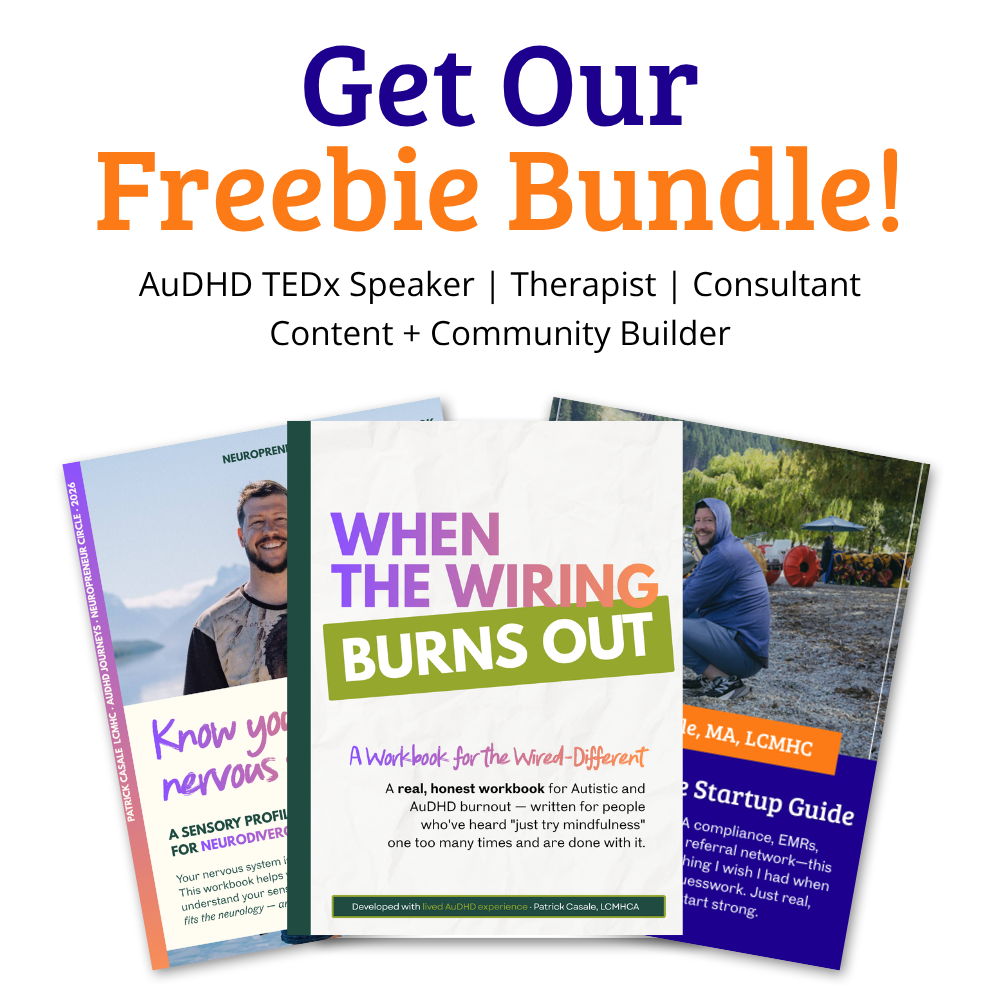
Get a practical podcasting workbook for therapists considering starting a podcast, created by Patrick Casale, host of the podcasts The Neurodivergent Entrepreneur and Divergent Conversations.
You'll get a practical structure for therapists who want to start a podcast but don’t want to rush, perform, or build something they can’t sustain.
Grab your free copy: ndpod.org/Free-Podcasting-Workbook
✨ Move Beyond Private Practice As A Neurodivergent Entrepreneur
Move Beyond Private Practice As A Neurodivergent Entrepreneur is a FREE 5-part mini-course designed for therapists who want sustainable financial independence beyond one-on-one work.
Access your free mini-course here: ndpod.org/Neurodivergent-Entrepreneur
Transcript
PATRICK CASALE: Hey, everyone. Welcome back to the All Things Private Practice podcast. I'm joined today by Kendra Vargas, LCPC, PMHC, culturally responsive, inclusive psychotherapist, clinical supervisor, and consultant with over a decade of experience in the mental health field. She has worked across diverse settings, including community mental health and private practice.
Founder of Authentically You Psychotherapy, love the name. Kendra runs a solo practice, which is turning into a group practice, offering both individual therapy and support groups, providing consultation services and trainings on topics such as developing and integrating groups into private practice settings, as well as various topics on perinatal mental health. She is certified in perinatal mental health and holds a certification through Postpartum Support International. She currently runs Fertility Skills and Support group, which has been active for over six years, supporting individuals utilizing assisted reproductive technologies such as IUI, IVF, and surrogacy for family planning, which is an area she has a deep personal connection and compassion for.
Additionally, she facilitates a pregnancy after infertility group to help those navigating pregnancy after a challenging fertility journey.
Well, thank you so much for coming on. Oh, you also have a fertility journal on Amazon and Etsy, hosts in-person retreats, and has a deep passion for supporting others. So, yeah, it sounds like, when I read your bio, that we are going to be talking about infertility today.
KENDRA VARGAS: I think so, yes.
PATRICK CASALE: So, anything I missed that you want to share with the audience?
KENDRA VARGAS: No, I feel like there's so much there. And no, I think that really speaks to all the things that I'm actively doing and trying to continue to do in my work, yeah.
PATRICK CASALE: So, I think it sounds like, and correct me if I'm wrong, this niche of yours is near and dear to your heart. I imagine you have personal experience with this, or someone close to you does as well.
KENDRA VARGAS: Yeah.
PATRICK CASALE: Yeah.
KENDRA VARGAS: Yeah, yeah. I personally navigated the journey of infertility, probably starting around like 11, no longer than that, gosh, 15, 16 years ago. My husband and I tried to conceive on our own for a good six years, and continued to have failed pregnancy test after failed pregnancy test. Couldn't really identify what was going on and what was impacting our inability to conceive. And finally, saw a fertility doctor who my OB recommended.
And I just remember I cried because back then, this was maybe 11 years ago. All I knew of was, like, celebrities doing IVF. And like, there was no one in my world that was on that journey. So, I just assumed it wasn't something that was going to be available to us. And thankfully, it was.
I am in Illinois. And we're kind of a safe state, and there's a lot of insurances that do offer benefits for IVF. And we were one of those. So, I was really grateful for that. So, we used IVF for our daughter. My daughter is now nine years old.
PATRICK CASALE: Wow.
KENDRA VARGAS: So, yes, it was a long journey to get there. And then, fast forward to about five years ago, when I turned 40, we wanted to try for another, and we had some frozen embryos. And second time around didn't go the same as the first. We had some fails. We had some canceled cycles due to COVID. And we kind of, which is a lot of the focus of the work I work with individuals, is that we decided to end the journey and kind of figure out what do we do with these embryos? And what is life going to be with just one versus this idea of two that we had?
So, yeah, that journey led me through the years to shift my focus from the child adolescent population to infertility, and also pregnancy postpartum. But I'd say within that niche, definitely in fertility.
PATRICK CASALE: Yeah. Thank you so much for sharing that. I imagine it's been a vulnerable, grief-ridden journey and along the way. And there's probably been a lot of obstacles that you've had to overcome. When you were going through this 11 years ago, it sounds like it was a quite lonely experience, if there wasn't a lot of models, aside from actors and celebrities out there who were on this same journey.
KENDRA VARGAS: Yeah, yeah, it was. You know, I have the best supports in my world, friends, family, colleagues, but unless you know someone who's like in it and really gets it on that level, people couldn't understand how to support me. And, you know, their support was great, but, yeah, it was really isolating. And it is a very specific type of loneliness that comes with it. And you know, the great thing is, but just been getting through it all, and I feel like it turned into this passion and mission for me that I just couldn't, like, keep that to myself. And which is why I work in my field now.
But yeah, it was isolating. It was hard to hold joy for others when they became pregnant, and also balance the jealousy, and the sadness, the grief, right? And back then, you know, trying to hold both was something that was really difficult. And so, yeah, it was very challenging. Relationships changed. I kind of grew apart from some, got closer to others. And there wasn't a lot out there. I was always searching for supports.
PATRICK CASALE: Yeah, for sure. And you know, I admire when people use their own pain, and experiences, and areas of struggle to then build into how they want to help others that are going through similar journeys, so that they don't have to go alone or feel like they're the only person that's experiencing something. I think that's always very powerful and very humanizing.
KENDRA VARGAS: For sure. And it speaks to, like, why so many of us get into this field, right? Like, it is a lot of times that, and our experiences that, yeah, like, what started as very, like, personal pain and just really challenging times, it's been really cool to see it evolve into a mission and a business that is continuing to grow, but it's always so deeply aligned with my purpose [INDISCERNIBLE 00:07:28].
PATRICK CASALE: Right. So, present day, what does that look like, you know, not only in practice, but in what you're doing? So, how does that show up, and what are some of the things that you're doing with that experience?
KENDRA VARGAS: Yeah, yeah. I think kind of to rewind just a bit, is when I did finally have a positive pregnancy test through the IVF, I was transitioning, kind of terminating, from the fertility clinic. And my fertility doctor was like, "What could we have done differently? Is there any other ways we could have supported you?"
And like, it was just it was so lonely. Like, sitting in the waiting area knowing that all these people were all sitting here going through probably very similar things, and just everyone sits in silence. And I was like, "You know, like, I'm going to specialize in this one day. And then, I'm going to create a group. And there's going to be a group. And the people are going to have this space where they can just can just talk about it and have these shared experiences."
And she was like, "Will you let me know when you get that group going? Because I'm going to support you." And she's still one of my biggest support still this day. So, I used to specialize more so with like children, adolescents, with a lot of like ADHD, neurodivergence, anxiety, depression. And this experience that I went through just continued to like, I just wanted to learn more. I wanted to get trained.
And so, I started a fertility group first, because I just felt like that was something I could have benefited from. And it started out as a very, like, closed six-week group that had a topic for each week. And at the end of the group, there were, like, four women in the group. And they were like, "We don't want to stop. Like, we still need each other." And like, "This is the only space we have with people who really get it."
So, that was six years ago as of last month, and the group has just transitioned into an ongoing open support group. So, then I got certified in perinatal mental health through Postpartum Support International. I started slowly, kind of, transitioning my clientele into this niche.
And 2022 is when I started my practice, Authentically You Psychotherapy, which is very niched. I'd say it's definitely niched in perinatal mental health. So, infertility, pregnancy, postpartum, parenting, pregnancy loss, but I do have probably, like, a stronger niche within that niche of infertility.
PATRICK CASALE: Right.
KENDRA VARGAS: Yeah.
PATRICK CASALE: [INDISCERNIBLE 00:10:00].
KENDRA VARGAS: Yeah.
PATRICK CASALE: So, with that said, you niche down. You're like, "Okay, this group's been going for six years. There's clearly a need for this. There's clearly a need for this ongoing support." And first, where are you located? Again, I don't even know the answer to that.
KENDRA VARGAS: Oh, yeah. I'm in Illinois. I'm in the Chicago land area. My practice is in Oak Park, but I also offer telehealth. So, the Chicago land area.
PATRICK CASALE: I got it. Okay, so this group, is that open to people everywhere? Or is that just Illinois-specific?
KENDRA VARGAS: Yeah, it's just Illinois-specific. And I keep it pretty small. Even though it's an open, ongoing group, it caps at seven participants because it is a really intimate space. This is the one group that I rarely have to market for it. I'm pretty much in this area just known for this group now. So, I typically have a wait list for this group.
But, you know, at one point I opened it up in the beginning, I was like, "Oh, I've got all these group members." Like, we got to 10. And then, it was like trying to make sure everyone had the space. And I was like, "That's not going to work."
PATRICK CASALE: Yeah.
KENDRA VARGAS: So, the sweet spot seems to be seven. We just met last night. And we always go a little over, but I'm fine with that. So, I just always want to make sure people have the space.
But yeah, it's seven group members that come on every other week and talk about, like, where they're at in their journey. They utilize each other for support, for resources, for, you know, ways to advocate themselves, all kinds of things. So, yeah, it's really a special space. I don't know if I can ever give that group up.
PATRICK CASALE: Yeah, it sounds really powerful. And for those of you listening, I think so often, right? If we are earlier on in our journeys and we don't really know who we are as therapists, or helpers, or entrepreneurs, it's harder to conceptualize, like, how do I niche down like this and really get specific?
And I think so often, like I've said before, that our niches are often versions of ourselves. And it's not necessarily always about all of the training and letters after your name. I think it's what you bring to the table in terms of your own experiences and how you hold space for other people so that they don't feel so alone.
KENDRA VARGAS: Totally. You said that very well. I agree. So, as of last week, I'm officially a group practice. I hired my first employee, which is crazy. Thank you. But over time, I've been asking my group members, because I know at some point I'm probably going to have to either transition this group to someone else or… And so, I'll ask them, as I often do, just for feedback and ideas and just to kind of check in with them. I'm like, "You know, what is it that feels good about, like, who your group facilitator is? Like, what are you looking for?"
And they're like, "Well, like, lived experience." Like, the fact that you've been through it. And I was like, "Well, yeah, but like, what about, like, the training, and the certifications?" And, like, "I mean, yeah, sure. But like, you get it because you've been through it." I'm like, "Shit. So, now, like, I've got to put that in my marketing, I guess, I don't know."
PATRICK CASALE: You do.
KENDRA VARGAS: Yeah, yeah, yeah. I was like, "Oh, my gosh, that's really interesting to hear." Every single person was like, "We love that you share that you've been through it. And we know we don't have to explain certain things to you. We know you get it."
And, you know, I'm all about decolonizing some of these ethics out here. And, like, I do use self-disclosure when it's appropriate. And I think it's been really helpful in growing this niche in my business, for sure.
PATRICK CASALE: I think it's 100% helpful. And I would argue that until the day I die, or my license is not taken away, because I think relatability is accessibility. And I think that for people who are struggling with very specific experiences, instead of just going to someone who is more of a generalist, who can openly say, "I get it." It helps bring that barrier down. It helps bring that vulnerability down. It helps create a sense of trust before they even meet you. Because it's like, I don't have to go and explain everything. I don't have to go in thinking I'm going to feel misattuned, misunderstood, told that I'm, you know, blowing this out of proportion, or that it's too much. And that can be said for so many different areas of struggle, right?
Like, for me, I know that I need to ensure that my therapist is autistic and ADHD affirming, and I really can't settle for anything else. So, I need to know they get it, because otherwise it sounds like you're just sitting there trying to explain your entire life's history without potentially being understood, and it's a horrible feeling.
KENDRA VARGAS: Right. Yes, yes, which also we need that history, right? Like, it is that constant check in with ourselves, too, of like, okay, do not project my stuff, right? Like, obviously, there's always that work around that, but, yeah, it is. It's that automatic connection. It's that automatic and kind of similar like in a group, right? It's like, there's people who understand this because they've lived it, and it's an automatic "I get it" feeling. So, yeah, I love that you said relatability is accessibility. That's really strong, yeah.
PATRICK CASALE: Yeah, you know, for our group practice, all of our clinicians are encouraged to self-disclose within reason and within their own, like, sense of safety. But in reality, that means that when clients call us or text us, they're like, I know that, let's say Claire, is going to get it because they identify on their page as an ADHD gender expansive therapist. And it's like, "Yep, good. Sounds like a great fit."
And I just think it eliminates some of that barrier of almost, like, this power dynamic and differential that exists within like therapeutic spaces, especially if we're working from a decolonization lens.
KENDRA VARGAS: 100%, yes. I agree, yeah. You know, and I'm trying to continue one of the things as part of ADHD, right? I get all these ideas, and I want to grow in all these different ways, and get them all out there.
I created the journal because that was also something. It's called Fertility and Beyond. And that one, I wanted to make sure people had the space to work through and process whatever's coming up while they're considering using an assisted reproductive technology, while they're in it, while they're making choices of which direction to go, how they're navigating supports, how they're taking care of themselves.
So, like, it's prompted. And then, there's like, mental health tips as well. And another big part of it also is just to make sure that it's an inclusive journal that anyone on their family-building journey can use. Because the reality is, the definition of infertility is not an inclusive one. Unfortunately, it centers very much cisgender, heterosexual couples and doesn't leave room for, you know, single parents by choice, LGBTQIA+. And so, that was something that was really important to me, too.
So, I'm constantly trying to find ways, looking back at my experience, and then, obviously, the work that I do with my clients, really listening to what their needs are. And again, that's my brain of like, "Ooh, I can create that. What can I do with that?" Right? So, the journal has been that.
Another group that I run to is, it's a pregnancy after infertility group. And that group got started probably two or three years ago, because two group members who left my group, they got pregnant, and they went to, like, you know, just like a general pregnancy group. And they said they were automatically disconnected when there was this girl that came on. It was like, "Oh, my God, we weren't even trying. And I just, like, got pregnant." And they were like, "Oh, that's a hell no." Like, "That's fertile world folks. I don't understand that world."
So, they came to me and they're like, "We think you should start a group." And I'm like, "Oh, don't tell me that." So, I started that group, too. But that's been a really special space too, where there's a different anxiety that comes along after you've, depending on what that journey's been just to get to that place. So, I'm constantly trying to listen to the needs, right? Of others, and ways that I can create other opportunities along that niche.
PATRICK CASALE: I like that. And I think, you know, it's a check and balance, you know, especially when we have all these good ideas. And there's a space to fill and a need to fill. And it's like, okay, how do I ensure that I do the things that feel impactful, but also don't overextend? And I think that's a constant-
KENDRA VARGAS: Oh, my gosh.
PATRICK CASALE: …balancing act, especially for ADHDers who are like, "Ooh, new idea, ooh, creative idea, ooh, I can do multiple things at once." And then, all of a sudden, it's like, "Oh, maybe I'm not doing any of these." Or, like, "They're not going well." So, it's just a balancing act.
And I think it's important for ADHDers, especially, to follow the passion and to follow the interest, because interest-based nervous systems mean we're going to be more excitable about the things that light us up, and we need to, like, pay attention to that. But we're only one human, so our energy can only go in so many different directions.
KENDRA VARGAS: Yeah, you know, we can just record that part. And I can replay it every day, because that is B to a T. And that's partially why I hired. I knew my limit. And also, I know you are very close with Gabrielle, who is my coach. You know, I was like, I'm grateful to be in a position to have referrals coming in very regularly. I am so grateful for that.
PATRICK CASALE: Totally.
KENDRA VARGAS: And I know my limit. And she's the one who helped me. I hosted my first fertility retreat this year right here in Illinois. And it was a full-day retreat. And it was one of the best days like of my life. And it was like, "Oh my gosh, this is incredible. Like, how can I do more of this?" So, it's something I want to do annually.
And then, I'm like, "Oh, it could be a weekend. It could be right in…" I get how the retreat idea can, like, really grow, but I'm like, "I'm just going to stick with this and keep it going." But that's been a really cool space too, because so many of the people that came, they were just like, first of all, it was a day of, like, self-care and like, all these different like services that they could do along with their journey, like acupuncture, and yoga, and like, specific poses they can do at different parts of the treatment process. And we did some hands-on grounding things. We did some journaling. Like, it was such a beautiful day, of, like, all the feelings for people, like anger, throwing things, right? Like, just talking through things, crying through things. And it was just cool, because it was another… It's like the group again, right? Which that group experience, of like, "Holy cow, you guys all get it."
And then, to see the relationships that built from that day, that people are still connected and like, some of them are pregnant together now. And I'm just like, "Oh my gosh." Like, I get the retreat life. Like, I get it. So, that was something else that, you know, Gabrielle really helped me with in terms of, like, hey, yes, you're getting all these referrals. Like, yes, you have this niche. Like, what is something else you can do that won't take up your weekly spots? It's like an ongoing thing. And that's been really helpful, too, to find those spaces. And it's so-
PATRICK CASALE: Absolutely, it's special. And, you know, being able to do that, right? I think there's ripple effect when we step out of one-on-one therapy and start to expand into like other streams of income. There can be a lot of guilt that gets created because you're like, well, if I'm going to have to give up client sessions to step away, because energy and time are the two resources we don't get more of. And it's like, if I'm going to step away, how do I have this impact that then impacts more people?
And that's what you're saying with group work, or workbooks, retreats, everything has a ripple effect, where it's like, this is not maybe direct one-on-one therapy care. But it has this effect on the community at large, and it actually creates even more of an amplification.
And that's something I have to anchor into. For myself, when I stepped away from doing therapy, I felt very guilty, I felt very ashamed. And then, in reality, I was like, I'm really helping significantly more people using my energy, how it's best designed to be used. And that was a really big turning point for me.
KENDRA VARGAS: Yeah, yeah. I think I can relate to that, for sure. That was a moment, you know, processing after that retreat, and just kind of using the journal I created for journaling sessions, and like seeing it all being used in this beautiful way, where everyone's just leaning on each other. And it was really cool to process all of that afterwards. And all of that clicked, or it was like, "This is how I show up best. This is how I continue to align with my mission, my values, my passion, my purpose, in these ways that are don't have to be direct one-on-one."
Yeah, and I mean, it's just been really cool. I'm definitely on my, like, you know, journey of still figuring a lot of it out.
PATRICK CASALE: For sure.
KENDRA VARGAS: But I think there's a lot that has been figured out that feels really good, too.
PATRICK CASALE: I love that, yeah. And I think that will change in iterations of career. You know, it evolves over time, and whatever this season of career looks like may not look like the next season, and the next season. And there are different iterations, especially for those of us who are more entrepreneurial, because for me, my biggest fear is doing the same thing over and over and over again for the rest of my life, and feeling stuck and stagnant. And that I cannot tolerate.
So, honoring my system needs and acknowledging that what it needs is very different than what someone else's might need. Someone might need more, like, security, safety, consistency. And I am definitely going to take more risks and probably push myself out of my comfort zone more often.
KENDRA VARGAS: Yeah, and it's cool when you find the people, right? Like, even just being on this podcast and like, the people that I've met along the way, I'm so in alignment with that, and to find those people and to, you know, just lean into those supports, and build those relationships. It's just like, that's my favorite part of all this. And I just think that's really cool. When you do find people that are aligned in that and get it and help, like you talked about earlier, kind of limiting that ability to jump into some of that guilt and like, "Oh, maybe I should, you know, am I doing the right thing?" Or, "Oh, I'm not seeing clients. This is what we're trained to do, right? Like, this is all that I've known." And so, it's really cool that to be surrounded by that community, too.
PATRICK CASALE: 100%. Couldn't say it better. Well, Kendra, it's been a great time having you on here and getting to know you and sharing some of your stories. So, please share with the audience where they can find what you're doing. And we'll link that in the show notes for everybody, too, so that you all have easy access to Kendra's links and information.
KENDRA VARGAS: Yeah, yeah. So, I'm probably most active on my Instagram for Authentically You Psychotherapy, my practice. The Instagram name is @ayoupsychotherapy. So, @ayoupsychotherapy.
The website which is in the process. So, hubby is web developer, web designer as well. And we have lots of busy things in our day-to-day. So, that's in the process of being updated, but that website is aypsych.com.
I do have a Facebook group page that's growing. It's called Private Practice Therapy Collective, and it's specifically for people that are interested in groups and want to talk about groups. And then, I also host a monthly consultation group for people that are interested in groups, and building, and marketing, and implementing groups into their practice. That's on my website, like reaching out for that as well.
And then, I'd say the last thing is Amazon, that journal that I was kind of referring to earlier. It's called Fertility and Beyond. And that's on Amazon. And yeah, that's probably it.
PATRICK CASALE: We will link all of that information so that you all have access to everything that Kendra just listed. Really appreciate you coming on on a Friday and making this time.
KENDRA VARGAS: Thank you so much. Thanks for having me. This has been wonderful.
PATRICK CASALE: You're very welcome. To everyone listening to the All Things Private Practice podcast. New episodes are out on Saturdays on all major platforms and YouTube. Like, download, subscribe, and share. Doubt yourself, do it anyway.
FREE PRIVATE PRACTICE GUIDE
Join the weekly newsletter for private practice tips, podcast updates, special offers, & your free private practice startup guide!
We will not spam you or share your information. You can unsubscribe at any time.





![Episode 264: Creating Through the Chaos of a Neurodivergent Life [featuring Bre "BR3"]](https://kajabi-storefronts-production.kajabi-cdn.com/kajabi-storefronts-production/file-uploads/sites/2147507511/images/a14004-cc3d-8aba-5fb8-2442fdfc650_TNDE_YouTube_episode_264.jpg)
![Episode 263: Your Symptoms Are Real—Even When Medicine Doesn’t Have The Answers [featuring Dr. Zachary Spiritos]](https://kajabi-storefronts-production.kajabi-cdn.com/kajabi-storefronts-production/file-uploads/sites/2147507511/images/84bc15-1ce4-1a0b-8f85-f5812bce75_TNDE_YouTube_episode_263.jpg)
![Episode 262: Your Brain Isn’t the Problem. The System Needs Reimagining. [featuring Dr. Mel Houser]](https://kajabi-storefronts-production.kajabi-cdn.com/kajabi-storefronts-production/file-uploads/sites/2147507511/images/42c858d-0b15-7581-e6ac-f636e7a1fa1_TNDE_YouTube_episode_262.jpg)
![Episode 261: Dragons, Dopamine, and Autistic Special Interests [featuring Mandi Dixon]](https://kajabi-storefronts-production.kajabi-cdn.com/kajabi-storefronts-production/file-uploads/sites/2147507511/images/25ae562-4a0a-44e-04f6-4caeaa5c8bd_TNDE_YouTube_episode_261_new_.jpg)