
Show Notes
In this episode, Patrick Casale sits down with Blaise Harris, an EMDR-certified therapist, former firefighter, podcast host, speaker, and author, to talk about taking up space, fighting imposter syndrome, and staying authentic in the mental health profession—especially as a first responder and Black therapist—and beyond.
3 key takeaways:
- Relatability Matters More Than Jargon: Both Blaise Harris and Patrick Casale share that being authentic, relatable, and accessible with clients is more effective—and much more healing—than overloading sessions with clinical jargon.
- Imposter Syndrome is Universal—Do It Anyway: Even highly accomplished professionals struggle with self-doubt and the pressure to "play small." Doubt yourself and do it anyway.
- Building Community Fuels Growth: Relationships and professional networks are everything. Having colleagues that encourage you, support you, and nudge you past your inner critic truly enables personal and professional growth.
More about Blaise:
Blaise Harris is an EMDR certified licensed mental health counselor and former firefighter with over 14 years of service as a first responder and is the founder and owner of G Squared Consulting and Counseling Services. Harris has a passion for helping others and hopes to end the stigma surrounding mental health amongst first responders and in the community. Blaise hosts a biweekly podcast called The Dope Black Therapist, where he shares practices, tools, coping mechanisms and addresses issues regarding mental health. Blaise is also an international speaker and the author of “Becoming the Dope Black Therapist.”
- Website: thedopeblacktherapist.com
🎙️Listen to more episodes of The Neurodivergent Entrepreneur Podcast
🎙️Spotify
🎙️Apple
🎙️YouTube Music
▶️ YouTube
✈️ Check out available Retreats
🗨️ Join the free Empowered Escape FB Community
A Thanks to Our Sponsors: The Receptionist for iPad!
I want to thank The Receptionist for iPad for sponsoring this episode.
The Receptionist for iPad is a HIPAA-ready digital check-in system that eliminates the need to walk back and forth from your office to the waiting room to see if your next appointment has arrived. Clients or patients can check in for their appointments, and you'll be immediately notified by text, email, or your preferred channel. Break free from interruptions and make the most of your time, because it is valuable. Start a free 14-day trial of the Receptionist for iPad by going to thereceptionist.com/privatepractice. Make sure to start your trial with that link to get your first month free if you decide to sign up.
Free Gifts for Our Listeners
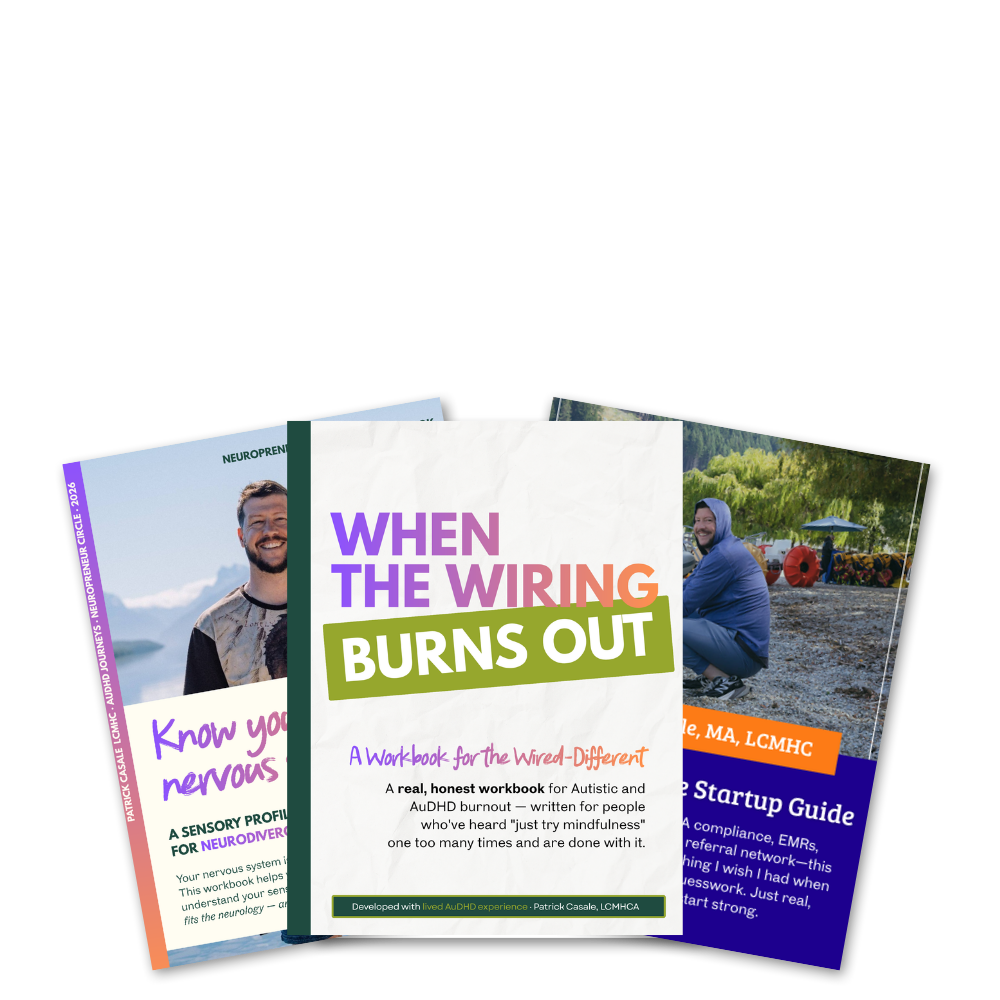
Get a practical podcasting workbook for therapists considering starting a podcast, created by Patrick Casale, host of the podcasts The Neurodivergent Entrepreneur and Divergent Conversations.
You'll get a practical structure for therapists who want to start a podcast but don’t want to rush, perform, or build something they can’t sustain.
Grab your free copy: ndpod.org/Free-Podcasting-Workbook
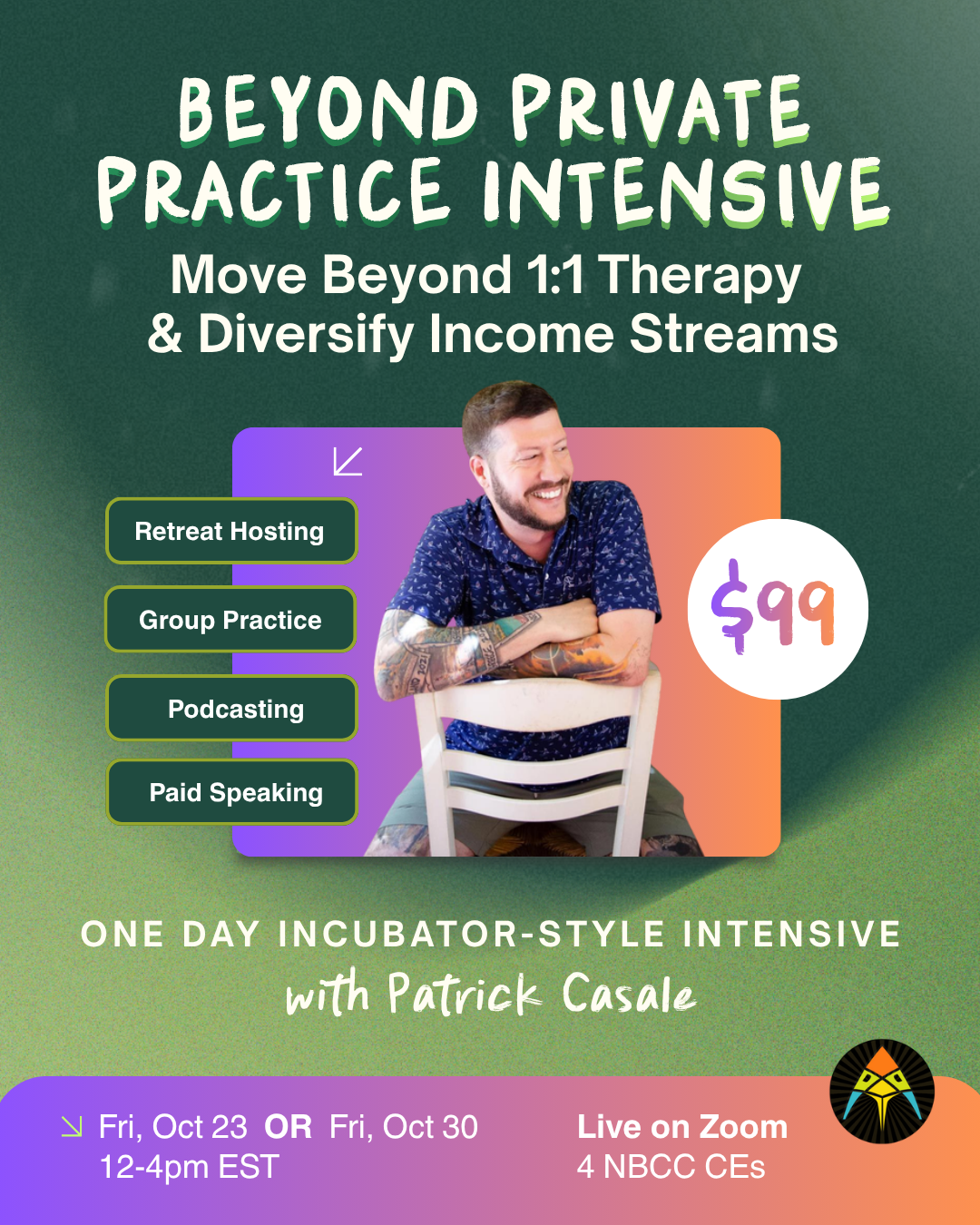
✨ Move Beyond Private Practice As A Neurodivergent Entrepreneur
Move Beyond Private Practice As A Neurodivergent Entrepreneur is a FREE 5-part mini-course designed for therapists who want sustainable financial independence beyond one-on-one work.
Access your free mini-course here: ndpod.org/Neurodivergent-Entrepreneur
Transcript
PATRICK CASALE: Hey, everyone. Welcome back to the All Things Private Practice podcast. I am joined today by a good friend, colleague, repeat guest, Blaise Harris, who is an EMDR certified licensed mental health counselor, a former firefighter with over 14 years of service as a first responder, and is the founder and the owner of G Squared Consulting and Counseling Services.
Harris has a passion for helping others and hopes to end the stigma surrounding mental health amongst first responders and in the black community.
Blaise hosts a bi-weekly podcast called The Dope Black Therapist, where he shares practices, tools, coping mechanisms and addresses issues regarding mental health.
Blaise is also an international speaker now and the author of Becoming the Dope Black Therapist. And I named all that stuff because you did not name this when we were speaking in Scotland. I was like, "You all, Blaise has a podcast. He's got a book."
BLAISE HARRIS: Man, and it's so wild. It's like, you're not the only person who calls me out on that. I have a friend who I grew up with, by the name of Ty. And she says, "Blaise, say it all. Say it all." And I'm like, "[INDISCERNIBLE 00:04:07]." But then, you know, since Scotland, though, I have been taking your advice and Todd's advice. And it's just like, it's not bragging, especially if you earned it.
And you know, a lot of people who have these accolades feel like they still have to play small, and so they won't take up too much space. And I think I'm finally at a point where I'm not afraid to take up space.
PATRICK CASALE: I love that. And I love that, because so many people can benefit from your voice and your message. And I told you this after Scotland, that I thought you were one of the best speakers at the event, publicly on a recorded version. So, that's just the truth.
You know, I did not expect to have to go after someone who was going to both sing and rap on stage. And I was like, "Oh fuck, I do not have that charisma at all."
BLAISE HARRIS: I didn't expect to be between two damn powerhouse speakers who have experience of them speaking overseas and internationally like you all. I was sitting there struggling like hell, like, "What am I going to do? What am I going to do?"
PATRICK CASALE: [CROSSTALK 00:05:16]. The way you just make things relatable is such an incredible strength that a lot of people don't have, because a lot of people, when they feel like maybe some of that insecurity creeping in, or that self-doubt, or that imposter syndrome, they default to like, being really clinical heavy or like, “I need to go really heavy on the knowledge right now.”
And I think there's a place for that. But the reality is, most people really resonate with the relatable, authentic aspects of people's journeys. And you've got a fascinating one. Like, I never heard some of the stuff you shared when you were up on stage in Scotland. And like, just acknowledging some of the struggle that you've come through to get to where you are now, and how open and vulnerable you are publicly about, I think that is just like role modeling 101. And my hat is definitely off to you.
BLAISE HARRIS: Thanks. Thanks, man. I think it's one of those things where it was really scary being authentic because I didn't know how it was going to be received.
PATRICK CASALE: Sure.
BLAISE HARRIS: You know? And I think that's a big problem that a lot of people run into, especially if it's like, you know, hey, we're mental health counselors, and licensed professional counselors, and therapists, and whatever. We're supposed to carry ourselves in a certain way, you know? And that's not me. I'm not clinician dialect heavy when it comes to certain things. I keep it real with people because I think that's what people appreciate the most.
You know, I will throw some clinical terms and stuff in there from time to time, but at the same time, also I'm able to relate it to the people that I'm talking to, so they can actually understand it, you know? And I think that's a superpower. And I think that is one of those things where a lot of therapists, especially new ones, feel like they have to be able to quote the DSM-5 and everything front to back.
And I'm like, you know, I can't do that. I still got to look at the book. I want to be sure I get the right diagnosis of what I'm going through here.
PATRICK CASALE: 100%, me too. I mean, I just preach it, you know? Like, I think, I said this earlier today on a different episode, but relatability equals accessibility. And if you understand who you're trying to speak to, and help, and support, you have to match that vibe. You have to be able to be relatable. You cannot get really clinical jargon-heavy where most people don't even know what 95% of those fucking words mean.
BLAISE HARRIS: Exactly, exactly. And that's another thing. In grad school, you know, we're taught certain ways to speak in terms of certain ways we have to approach our clients. And one of my professors, when we're doing our meetups, I would cuss in our set, in our sessions, you know, with my other students. And he was like, "Don't cuss." "What? I'm amongst my colleagues and classmates, and I still have to be prim and proper when I'm doing this"
And he said, "Well, people aren't going to take you seriously." And my thought process was, I want to work with firefighters, police, EMS, and dispatchers. Cussing, you know, that's our first language. Regular English is our second language, you know? And that's how we speak amongst each other. That's how we put emphasis on the story, that's how we put emphasis on a call that we write, or whatever. And the people that I want to speak with, that's how they speak. So, I'm going to speak as if I'm speaking to them.
And the one time I went, and I was clinical, and I was like, "Yes. How does it make you feel?" My client looked at me, and this was an intern. He was looking at me like, "The hell happened to you?
PATRICK CASALE: Yeah, what happened to you?
BLAISE HARRIS: Yeah, “What the hell is wrong with you?” And it's like, "No, I don't like this. Go back." Yeah. And since then, that's how I speak. And I think when I tell people, even when I do consultations, they're, "Oh, excuse, pardon, allow me to cuss." I say, "Man, you say what you want to say, how you want to say it. You're not going to say anything that's going to make me clutch my pearls." You know, if you're a saint, be a saint, if you cuss like a sailor, cuss like a sailor. I'm going to listen either way. And you should see their shoulders drops like, "Oh God, thank you."
PATRICK CASALE: I know, right? And it's like, okay, now I know I can be myself, and now I know that I can be vulnerable, because otherwise, I'm too in my head trying to think about how you want me to respond and how to interact in this environment.
And I know, honestly, like as someone who looks like me, I don't really have to worry about what I say very often, but I know what you shared in Scotland was like, when you went for a promotion in the fire department, you were told like, like, what did they say? You're too cocky or too arrogant?
BLAISE HARRIS: Yeah, they told me I was cocky and overconfident.
PATRICK CASALE: That's it, yeah.
BLAISE HARRIS: And that plays in my head every time I speak, every time I try to put myself out there for a workshop or submit a proposal for any type of thing, that always plays in my head. "Blaise you're too cocky, you're too overconfident."
And me being cocky and overconfident was because I was rapping and singing during my lessons, you know? And that was too much for a lot of people. But when I was firm and proper, and I toned it down a little bit, and I came with examples and props for my lesson, I got a job, you know? It was in a different department, and, you know, because I thought that they would hear the same thing.
The reality was, they allowed me to be my authentic self, because they saw what I could do, and saw what I was bringing, and the fact that I had so much personality, the fact that I had so much energy, and had no problem speaking in front of people, or working with kids, or with older folks, or whatever, teaching them how to be safe when it came to fire. They appreciated that, you know? And we thrived because of that, you know?
The program was already excellent. I just added to the excellence, you know? And I added to the excellence because I was Blaise.
PATRICK CASALE: I love that. The program was already excellent, and I added to its excellence.
BLAISE HARRIS: Mm-hmm (affirmative).
PATRICK CASALE: You got so many good [INDISCERNIBLE 00:12:01]. But you're absolutely right. So, by being your authentic self and being able to just be you, I imagine that you are such a great fucking employee where it was like this has got to be someone we need as a part of our team. And I think we do better work when we are able to be ourselves. I think that we prevent a lot of burnout when we are able to be ourselves. I think we are more relatable. Like, the list goes on and on and on.
And I think there's so much like gatekeeping and tone policing in the mental health profession in general. I mean, you just mentioned you're EMDR certified, right?
BLAISE HARRIS: Mm-hmm (affirmative).
PATRICK CASALE: So, you've had to go through the consultation programs and the training programs. There's a lot of gatekeeping in training programs in general, about like, how you can show up, what's okay, what's not okay.
BLAISE HARRIS: And that's one of those things, is like, I think if we want to change those spaces, we actually have to be in those spaces. And that's one of the things that, again, it's scary to do, is because of so many people who have been doing it for so long, and who have a chokehold on what's supposed to happen, you know? And how it's supposed to happen and whatnot. And that's one of those things that, you know, I'm trying to, you know what? Let me stop saying trying, what I am doing is putting myself in those spaces where, yes, I'm uncomfortable as hell.
PATRICK CASALE: Sure.
BLAISE HARRIS: And there's always going to be, am I good enough for this? You know? And I'm a approved consultant and trainer through Andrea for EMDR consultation, and I put my first group out. It's coming up on Sunday. I already got four people signed up. I'm like, "Holy shit."
PATRICK CASALE: That's amazing.
BLAISE HARRIS: Right? And I'm like, what I'm supposed to do now? You know? But the goal eventually is to be able to teach EMDR, you know? To be able to teach in these programs and stuff, you know? I don't know very many black male EMDR instructors, if I know any.
PATRICK CASALE: I'm trying to think off the top of my head, yeah, I don't know any off the top of my head.
BLAISE HARRIS: You know? But I know a lot of brothers who do EMDR, you know? But it's like, we kind of get to that part, we stop. And I think that's one of those things it's like, we stop because, okay, I'm comfortable right here.
PATRICK CASALE: For sure.
BLAISE HARRIS: I'm trying to be uncomfortable. I'm trying to be uncomfortable enough so when the challenges and everything do arise, okay, I can handle this. It's a lot like when I was a firefighter. Okay, I might not know everything, but I know the basics, and I can handle whatever comes my way.
PATRICK CASALE: Absolutely.
BLAISE HARRIS: I want to be able to be that same way when it comes to EMDR consultations, and when it comes to, you know, speaking, when it comes to planning these workshops, I have the basic foundation to be successful in this thing. So, as uncomfortable as I am, I'm going to keep working this bitch until I'm comfortable at it.
PATRICK CASALE: Hell yeah. I think anchoring into that is important, you know, foundationally. To say, you know, I know I'm comfortable enough to be proficient at this. I also know that I'm going to work my ass off to be really fucking good at this.
And I think we often forget, like, how many people are just really bad at their jobs or, like, the things that they achieve. But the difference between a lot of us and them is, like, they're willing to just put themselves out there.
BLAISE HARRIS: Yeah, yeah.
PATRICK CASALE: I'm like, I'll watch, like, certain speakers, I'll listen to certain podcasts, I'll watch certain trainers, or just in general, I'm like, "This is so bad."
BLAISE HARRIS: Yeah, yeah.
PATRICK CASALE: They don't seem to care one iota.
BLAISE HARRIS: No, no. And it's like, they could be mediocre as hell and still do good things. And here we are dope as hell and afraid to take up space because this mediocre person is in the front as you should. And I think that stifles a lot of us, yeah.
PATRICK CASALE: It just doesn't feel right when you think about it that way. And you're like, "Wait, I've got some stuff to offer. I do some stuff really well, you know?"
BLAISE HARRIS: And that's the thing is. But again, it's that monster in the back of your head is talking so much shit and telling you that, "Oh, you ain't shit." Or, "You can't do this." Or, you like, you know, that cocky and overconfident, like they told me. It continues to be a barrier at times where I'm trying to kick it in the face, and most days I do, at the same time, though, that voice can still be extremely loud, especially if you're going through some things and you're starting to worry and you're starting to, you know, have so many doubts. But like I said, I have a friend who told me, doubt yourself, do it anyway.
PATRICK CASALE: Sounds like a tool. You know, that's the same guy who must have subconsciously put you on the last day of the summit as a speaker for exposure therapy, so that you had to sit through the first three days and be like, "Oh man, I am really going to suck."
BLAISE HARRIS: That was definitely what was going through my head.
PATRICK CASALE: So, when I was doing the Italy summit last year, I want to come back to what you said, but I don't want to lose this thought. I was the last speaker. Some of it was probably ego, of like, this is the event that I dreamed up. I'm going last. Some of it was just because, like, I like to absorb what's happening around me before I speak about something. That was the bigger portion of it.
But I remember Yunetta, our mutual friend, coming up to me behind the scenes on stage, and she's like, "Okay, so you're going to suck. Everyone else has been really fucking good. It's understandable that you will easily be the worst one out of all 12 of us. So, get up there." And I was just like, "What the fuck?"
And I will be honest, like, because it was so unexpected, it really did help me in terms of how I like to just laugh at myself and make jokes about myself. It was like, "Oh, this is actually kind of nice. Like, this makes me feel a lot more calm." And so, shout out to you, Yunetta, if you're listening. She did ask me if she could do that to me before my TEDx. And I was like, "No, go away."
BLAISE HARRIS: Absolutely not.
PATRICK CASALE: “Right now, I really feel overwhelmed. Go away.”
BLAISE HARRIS: Yes.
PATRICK CASALE: Circling back what you said. So, you were saying, I just want to make sure I heard it correct, when we were talking about doubting yourself, doing it anyway. And you do have to kind of embrace that mentality, right? And I think for you, when you're saying like, when you're having a hard day, when your mental health is struggling, when something unexpected happens, that is really when that inner child wounding, that messaging, that trauma, that criticism, that self-doubt really starts to creep in. And it comes in fast.
BLAISE HARRIS: Yes. And it's like a Mack truck driving, you know, 115 with no barriers in place. And your car is sitting right there. And I was just like, "Oh, God, no." But then, it's just like, "I got this, I got this, I got this." You know?
And it's like you said, absorbing all of the energy of the other speakers before you go on. That's exactly what was going on. During that whole retreat, it seems like every speaker was talking directly to me, you know? That was one of those things… I missed a couple the first few because of travel, but the ones that I heard was, you know, show up as yourself, be your authentic self, tell your story. The way that you tell your story, and how you tell your story, is going to attract the people that needs to attract, and going to repel the other ones that need to repel, right?
And I was like, holy shit. And it's like, holy shit. Why are you cussing at me right now? But it's just like, that's what I needed to hear. And like hearing Dr. Dominique go on before me, and I've always watched her, but seeing her live was just like, "Bro, that is, oh my God." I'm like, "Oh, I'm energized. I'm magnetized. Let's go, let's do this." You know.
And then, when I finally got up and you introduced me, I was like, "Oh shit. All that shit is gone." But soon as I got the mic and you handed me the mic, everything disappeared. All of that noise, like, vanished. It was like, gone. And I was just like, I'm on. Let's get it popping.
PATRICK CASALE: I love that because I thought you looked and felt so comfortable up there. Maybe you didn't. But just the beauty of podcasting from home is when my wife comes home and the dog is going nuts, and I'm trying to [INDISCERNIBLE 00:23:07]. So, anyway, were you comfortable?
BLAISE HARRIS: Yes, I was. But, you know, at the same time, it's like I had, like, 100 pairs of eyes looking at me. And a lot of those eyes I didn't know. And, you know, a lot of building who I was before, a lot of people still had no clue what was going on. And it's always nerve-wracking until I start speaking. And then, if I make somebody laugh, then I was like, "Okay, I got [INDISCERNIBLE 00:23:39]." And I was like, "Okay, I got that. That's that joke landed. That joke land in the [PH 00:23:45] field. Yeah, so, and it went really well.
And, you know, I have a another Yunetta story. You know, she told me while I sat down, and, I was, you know, had a couple of books, and I was getting ready to get them out. She's like, "If I could smack you, I would." I said, "Why? For what reason?" She was like, "Blaise, you did a phenomenal job. You're an excellent speaker. Why would you be scared?"
PATRICK CASALE: Yep.
BLAISE HARRIS: I was like…
PATRICK CASALE: That's so funny. Like, Yunetta, if you're listening to this, and I hope you fucking are. Like, all of the times that I had to console her throughout the last year, of like, "You're good enough to be the keynote, like, you know, your stuff, Yunetta." It's amazing how much we can support one another, but how hard it can be to sometimes see the best version of ourselves.
BLAISE HARRIS: Absolutely, absolutely. Yeah, I tell people all the time, it's like we're so used to the negative self-talk, and the negative actions, and all of those things. That's like our norm, you know? It's the chaos. We're used to the chaos. I mean, the chaos. Every time I could do that. then it's like, when you start to be, you know, to walk in your greatness, it's like that's when the discovery comes in. It's like, "No, no, something's supposed to be wrong."
And so, it's like we almost self-sabotage, and before we start doing the thing, instead of just like, you know, this is how it's supposed to be. It's supposed to be a smooth road. It's not supposed to have potholes and shit all in your damn way, you know? It's supposed to be smooth shit. When you try to get away, you go, yeah, there's going to be some curves, there's going to be some hills, there's going to be some valleys and stuff, but at the same time, the shit is still fucking smooth. And it's okay.
PATRICK CASALE: Yeah, 100%. And I think, like, I almost want to say, like, the more we put ourselves in these positions, the more we put ourselves through that discomfort, the easier it becomes. And some of that is kind of true, but then there are so many extenuating factors that we don't have control over that can really create the opposite effect, or rattle us, or make us feel otherwise.
And for you, this is my hope is that you continue to put yourself out there. You continue to submit to different conferences, to different places to speak, because you have a gift. And I think people need to hear it.
And, you know, I just think that when we acknowledge that in other people, and they're still struggling with self-doubt, and imposter syndrome, or perfectionism, it is like you want to shake them, you know? It's like, "Oh my God, I feel like the world needs to hear your story." And then, it's like, "Oh, man, that was shit." So, I just want to say that.
And also, man, like, I think relationships are everything. And had we not met in person in Portugal, I don't know if we'd meet again in Scotland, because I didn't really know you. You know, I saw your name pop up in some North Carolina Facebook groups, but I had no idea who you were. To just be able to sit and talk with you and just listen to you speak, and just see how you are so supportive of other people I was like, "This dude is amazing. Like he really needs to be on some of these circuits."
And I think that's also helpful when that really harsh inner critic shows up is we need our supports. We need our accountability partners. We need the people who are in our corner who are like, "Not today. We're not allowing that shit to happen today."
BLAISE HARRIS: Yeah, you're absolutely right. And I think that's one of the things that I really enjoy about the retreats, but also just being in the groups, where I get to see everybody else do the things as well.
You know, I still speak with several other folks who I met on that trip to Portugal, and we still encourage each other, you know, on so many different levels, you know. And even from Scotland, you know, the connections that I made there, it's like people say, "Hey, let's do this. Let's collab on this. Let's make this stuff happen." And so many opportunities are presenting themselves, you know, because I have taken what I've learned from everyone there, and I'm actually applying it instead of sitting on it.
PATRICK CASALE: Absolutely.
BLAISE HARRIS: You know? And just like letting them gather dust. And I'm actually utilizing every tool that I've gotten from those people. And that's made ways for opportunities, you know? I applied for three conferences a couple of weeks ago. One of them I already got [CROSSTALK 00:28:19]-
PATRICK CASALE: [CROSSTALK 00:28:19].
BLAISE HARRIS: Yeah, man, I got one of them. I got confirmed already for one of them. So, you know, so that's great. So, I'm excited about that, you know?
PATRICK CASALE: Got to use that momentum to keep it going, too.
BLAISE HARRIS: Yeah.
PATRICK CASALE: And to those of you listening, you know, it's daunting to submit the application. It's daunting to submit the proposal. There's a lot of vulnerability in putting yourself out there, there's vulnerability and rejection, and it is a part of the process. And it really is about, like, continuing to remind yourself that you do know what you're talking about, that you are confident, that you are competent, that you belong there, and you deserve to take up space. And I think that it has to be a constant reminder, especially when things feel like a struggle, when things feel heavy, when it's like, easier to just say, "I can't do this. This application is too hard. I feel too overwhelmed by the potential of getting a yes." That can be really scary too. [CROSSTALK 00:29:16]-
BLAISE HARRIS: [CROSSTALK 00:29:16]-
PATRICK CASALE: …yes, but you got to do it.
BLAISE HARRIS: But I got to do it. And I can't sit here and wait on it either. It's like, I got to get to this thing now and start working. But then, it's like, once you start doing the work, though, you start to see, I do understand this. I do know this. I do have this. I can break this thing down. You start to allow that leader, that bad ass that's inside of you to come out instead of, you know, making him play, making him or her or them play small, you know? You are allowing yourself to be that authentic you, because it's you in this presentation, it's you who the people are going to see, it's you who is going to leave that lasting impact.
And the dope part about it is you is dope. You is awesome. You know, you are all of these things that you are afraid to be, regardless of if you want to utilize it or not. That's all inside you. You cannot change that.
PATRICK CASALE: No, that's really well said. That's a really important reminder. That's a good mic drop moment for the end of this episode. Okay, here's your platform now to share what you've got going on. We're going to list it in the show notes too incase Blaise forgets anything on purpose.
BLAISE HARRIS: I'm not going to forget it on purpose. I'm going to list it all. The Becoming the Dope Black Therapist is available on Amazon. You can get your copy of that already. I am going to be speaking at the Clinician's Connection Conference in Virginia Beach of April 30th to May 1st of 2026. So, I'm super excited about that.
PATRICK CASALE: Hell yeah.
BLAISE HARRIS: You know? I am working with several local groups around here, working with BIPOC men, you know, trying to teach them how to address their mental health and not be afraid to address it.
You know, working with an event with, you know, victims of domestic violence, and talking about, you know, how to not be afraid of dating or getting back out there in the world, and showing what a healthy relationship can look like, you know? I'm super excited about that one.
And you know, my men's group is on hold right now because my son is doing flat… He made the JB football team. So, that's on hold. However, I am doing a community workout for BIPOC Fathers and BIPOC men, in general, where we are working on our physical and our mental fitness every Sunday. You know, it's so dope, and I love doing that, and it grows every week.
And then, yeah, the podcast is still going on. The podcast is available, comes out every other Sunday on Apple and Spotify, and all these other podcast platforms that you got.
And if you want to learn more, you could always check out my Instagram @the_dopeblacktherapist. My YouTube page is growing as The Dope Black Therapist, and on Instagram. I think that's it.
Oh, and you can also visit thedopeblacktherapist.com if you want to book consultations for EMDR, if you want to book me for workshops, or speaking engagements, and all that stuff as well. All of this stuff's available, so you can check all of that information out there.
PATRICK CASALE: Love it.
BLAISE HARRIS: Think I got it.
PATRICK CASALE: I think you got it all. And we'll include all of that information in the show notes, so that you have access to everything Blaise just listed. It's been a long day. I appreciate you coming on, man, and making the time. And I really am rooting for you and every single thing that you do, and I'm really proud to call you a friend, and I'm really proud to see where this journey takes you over the next year or two.
BLAISE HARRIS: Well, thanks, brother. I appreciate you always. Thank you for your friendship and just for your encouragement, your constant and consistent encouragement. Thank you.
PATRICK CASALE: Nauseating relating encouragement, non-stop. And to everyone listening to All Things Private Practice, episodes are out on all major platforms and YouTube on Saturdays. Like, download, subscribe, share. Doubt yourself, do it anyway.
FREE PRIVATE PRACTICE GUIDE
Join the weekly newsletter for private practice tips, podcast updates, special offers, & your free private practice startup guide!
We will not spam you or share your information. You can unsubscribe at any time.





![Episode 264: Creating Through the Chaos of a Neurodivergent Life [featuring Bre "BR3"]](https://kajabi-storefronts-production.kajabi-cdn.com/kajabi-storefronts-production/file-uploads/sites/2147507511/images/a14004-cc3d-8aba-5fb8-2442fdfc650_TNDE_YouTube_episode_264.jpg)
![Episode 263: Your Symptoms Are Real—Even When Medicine Doesn’t Have The Answers [featuring Dr. Zachary Spiritos]](https://kajabi-storefronts-production.kajabi-cdn.com/kajabi-storefronts-production/file-uploads/sites/2147507511/images/84bc15-1ce4-1a0b-8f85-f5812bce75_TNDE_YouTube_episode_263.jpg)
![Episode 262: Your Brain Isn’t the Problem. The System Needs Reimagining. [featuring Dr. Mel Houser]](https://kajabi-storefronts-production.kajabi-cdn.com/kajabi-storefronts-production/file-uploads/sites/2147507511/images/42c858d-0b15-7581-e6ac-f636e7a1fa1_TNDE_YouTube_episode_262.jpg)