Show Notes
Navigating private practice as a neurodivergent therapist, parent, and business owner is complex—and sometimes, the most important growth comes in those moments when we allow ourselves to pause, reassess, and adapt.
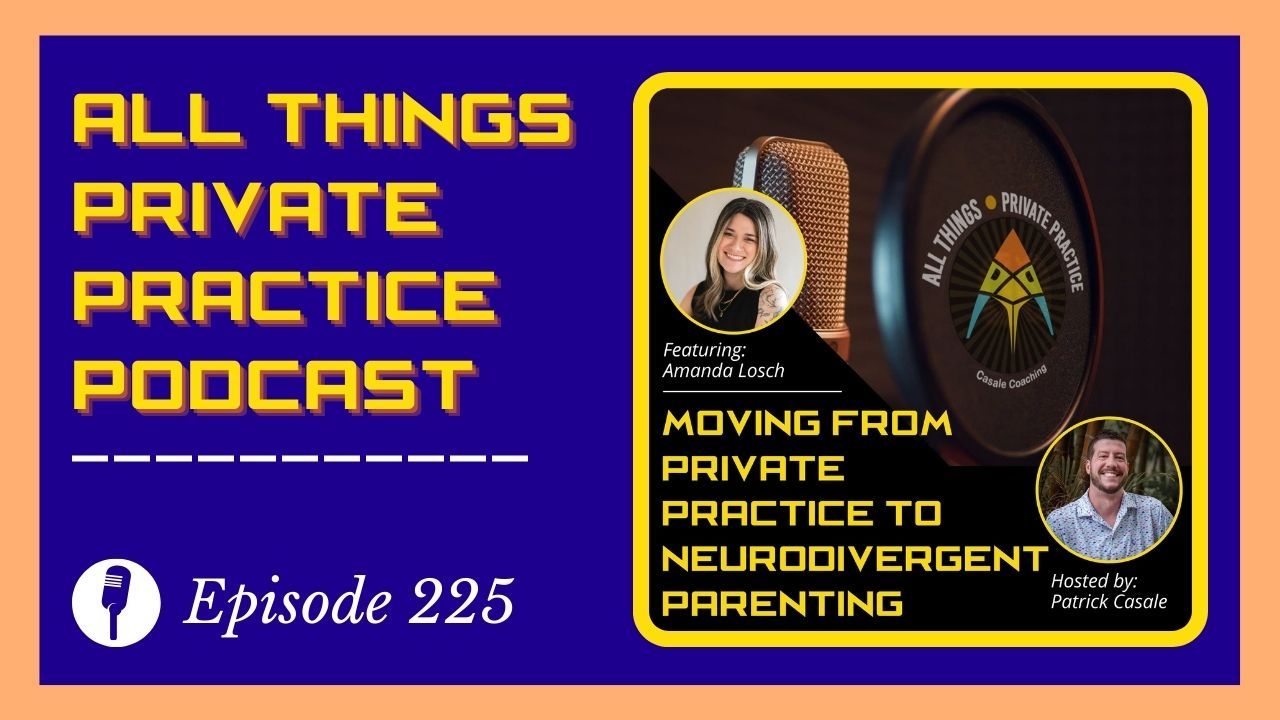
In this episode, Patrick Casale talks with Amanda Losch, neurodivergent therapist and mother, about the choice to step away from direct client work to focus on family, health, and community impact, and how this shift has come with grief, relief, and a redefining of professional identity.
Here are 3 key takeaways:
- Grief and Relief Can Coexist: Stepping back from a role you’ve worked hard to build may bring up conflicting emotions. Allow yourself to hold both the grief of letting go and the relief of honoring your needs without shame.
- Redefining Impact: Our ability to help doesn’t end when we step away from direct practice. Supporting the neurodivergent community, advocating for accessibility, and sharing lived experiences creates ripple effects—sometimes bigger than one-on-one sessions.
- Work with Your Energy, Not Against It: Accepting the natural ebb and flow of creativity, motivation, and energy can lead to better self-compassion. Instead of striving for an unrealistic “balance,” meet yourself where you are, appreciate your unique rhythms, and give yourself permission to rest.
If you’re in the thick of change or burnout, you’re not alone. Sometimes the best way forward is through curiosity, flexibility, and a little less self-judgment.
More about Amanda:
Amanda is an AuDHD therapist and private practice owner living in the Chicago suburbs, specializing in developmental trauma. Amanda recently took time away from direct practice to become a caregiver to her neurodivergent family. Between drop-offs and naps, she is building a resource network in her community for neurodivergent families, as well as providing education on safety, accessibility, and inclusion to local organizations. She enjoys exploring the intersection of neurodivergent parenting, chronic health, and developmental trauma. You can find content about the realities of parenting a neurodivergent family on Instagram @complex.motherhood, and you can find local resources (if in the Chicagoland area) on @ndfamilyguide.
- Instagram: @complex.motherhood + @ndfamilyguide
- Website: Ndfamilyguide.com
🎙️Listen to more episodes of The Neurodivergent Entrepreneur Podcast
🎙️Spotify
🎙️Apple
🎙️YouTube Music
▶️ YouTube
✈️ Check out available Retreats
🗨️ Join the free Empowered Escape FB Community
A Thanks to Our Sponsors: The Receptionist for iPad!
I want to thank The Receptionist for iPad for sponsoring this episode.
The Receptionist for iPad is a HIPAA-ready digital check-in system that eliminates the need to walk back and forth from your office to the waiting room to see if your next appointment has arrived. Clients or patients can check in for their appointments, and you'll be immediately notified by text, email, or your preferred channel. Break free from interruptions and make the most of your time, because it is valuable. Start a free 14-day trial of the Receptionist for iPad by going to thereceptionist.com/privatepractice. Make sure to start your trial with that link to get your first month free if you decide to sign up.
Free Gifts for Our Listeners
Get a practical podcasting workbook for therapists considering starting a podcast, created by Patrick Casale, host of the podcasts The Neurodivergent Entrepreneur and Divergent Conversations.
You'll get a practical structure for therapists who want to start a podcast but don’t want to rush, perform, or build something they can’t sustain.
Grab your free copy: ndpod.org/Free-Podcasting-Workbook
✨ Move Beyond Private Practice As A Neurodivergent Entrepreneur
Move Beyond Private Practice As A Neurodivergent Entrepreneur is a FREE 5-part mini-course designed for therapists who want sustainable financial independence beyond one-on-one work.
Access your free mini-course here: ndpod.org/Neurodivergent-Entrepreneur
Transcript
PATRICK CASALE: Hey, everyone. Welcome back to the All Things Private Practice podcast, joined today by Amanda Losch. She is an AuDHD therapist and private practice owner living in the Chicago suburbs, specializing in developmental trauma.
Amanda recently took time away from direct practice to become a caregiver to her neurodivergent family. Between drop offs and naps, she is building a resource network in her community for neurodivergent families and providing education on safety, accessibility, and inclusion to local organizations.
She enjoys exploring the intersection of neurodivergent parenting, chronic health, and developmental trauma. You can find content about the realities of parenting and neurodivergent family on Instagram @complex.motherhood. And you can find local resources if in the Chicago land area @ndfamilyguide. We'll have that in the show notes. And welcome to the show.
AMANDA LOSCH: Thank you so much for having me.
PATRICK CASALE: So, we've been, like, talking back and forth on Instagram for a couple of months, it seems like, and I've been traveling, about collabing. And then, I was like, “Why don't you just come on the podcast? Because that might be a bit easier.”
AMANDA LOSCH: Yeah.
PATRICK CASALE: So, yeah, I'm happy to have you here. I wanted to talk about doing all the things as a neurodivergent therapist, business owner, you're a mother, parent. There's a lot. And we've been talking about a lot. So, yeah.
AMANDA LOSCH: Yeah, it's definitely something that has changed my practice dramatically. And I'm very happy that I have the flexibility of private practice, because I've been able to make a lot of changes over the years to fit the evolving needs of my family. And that kind of came to a head at the beginning of the summer, when I took a step away from seeing clients, direct practice, and I'm focusing more on something that fits better into the rhythm of my life right now.
PATRICK CASALE: Sure.
AMANDA LOSCH: But even still, I'm just hanging on.
PATRICK CASALE: I feel for you, you know, as someone who's not a parent. You know, I know there's an extra layer there. And I think a lot of people can resonate to just hanging on right now. And so, when you stepped away from practicing back in the summer, what kind of emotions are going on? What kind of feelings are kind of percolating?
AMANDA LOSCH: The first one that came up, I think, was Greece, because at the beginning of the year, I had reopened a physical practice. I closed about one year into COVID. So, I was just paying for an office to sit empty. So, this was the first time I had a physical space again. And both my children were about to be in daycare. So, it was like, “Oh, a focus on my career. I'm coming back after, like, four years of being postpartum, new parent.” And then, it became necessary for my family's needs, but also due to my own capacity to say no to seeing clients.
So, there was a lot of grief that came up initially. And maybe even some relief, because the amount of energy and emotional capacity that my family was needing was so high that making more room to give it to each individual client was killing me.
PATRICK CASALE: Sure. Yeah, absolutely. And I can empathize with that. And stepping away, you know, I think when I stepped away from seeing clients back in 2022 my coaching practice was taking off, but I just had a second major throat surgery. And one of my vocal cords was paralyzed in the process. And I felt like I was abandoning the profession that I had worked really hard for.
AMANDA LOSCH: Yeah.
PATRICK CASALE: And there was a lot of grief, especially around identity, of like, who am I if I'm not practicing as a mental health therapist? Like, I've worked so hard to get this license, and all these hoops. And I had been so wrapped up in that as like, this is who I am as a human. And there was grief, and that release, and that acknowledgement that this season of life is over for now. And there was also relief, like you were mentioning. Like, there was like, this big exhale of like, “But it feels like a lot of pressure that I'm releasing and letting go of.”
AMANDA LOSCH: Well, it's one of those jobs where you have to be able to be highly present, to be able to have the ability to hold so many different pieces in your mind at one time. And I was feeling like the level of care that I was providing wasn't up to par with what I wanted it to be and what they needed it to be.
So, you know, there's always those days where you kind of like dream about, like, what would it be like to work at Starbucks and not have to hold all of these things? But at the end of the day, it is such a privilege to be able to do that.
And so, some of those bigger questions that you were mentioning, like, I've kind of been in this role my whole life, in some ways. And so, it's been interesting to find parts of my identity and to get to know different parts of myself outside of being a therapist. So, a little bit of the both and there, for sure.
PATRICK CASALE: The both and is such a therapist [CROSSTALK 00:06:32]-
AMANDA LOSCH: Kind of.
PATRICK CASALE: Right? It's one of my favorites, because I think there is such a duality in everything that we do, and holding both sides of it, there's heaviness. And there is the realization of this job is so meaningful, but I have to, like you said, be present to do it well, right?
And for me, and probably for you, I don't want to put words in your mouth, like if I can't do it with every ounce of energy that I have, I can't allow myself to do it, because I have to be all in.
AMANDA LOSCH: Right. It's too important. People are inviting you into the hardest and most beautiful parts of their life. And so, that's not something I've ever taken lightly. And that's something that really matters to me. And so, when there's any compromising to that, absolutely hard to step away, but necessary to step away at the same time.
And then, like, there's this other piece, too, that has been kind of coming up of like, I've spent the last 10 years helping other people heal from their own childhood, and now I'm allowing myself to focus on creating a childhood for my children that they'll still need to heal from, I'm sure. They're like not perfect in any way, shape, or form, but allowing that to be the focus has been a bit of a helpful reframe for me.
PATRICK CASALE: I love that. I love that. And I think stepping back, right? Whenever we have this big shift, whether it's career wise, professionally, personally, and we experience that grief, we also experience that almost new season of life. And it sounds like being able to move into that space for yourself to say, I'm going to offer my kids and my family a very different experience by being present, by using the skills that I have. I can offer that and I can cultivate that. And I think that means helping your community in a different way, right? Opposed to one-on-one therapy, 60-minute increments of time have a ripple effect in a different way.
And I see some of your videos about like, kind of going over accessibility, or lack there of, of different places that you visit as a family. And I think that's so cool, because it offers the community a glimpse into this world. And it allows them to say, like, “Oh, this is something I have to pay attention to.” Or, “I'm really glad to know this.” Or, “This is really helpful.” And you're actually supporting people in a different way, instead of doing one-on-one therapy.
AMANDA LOSCH: Thanks. Yeah, that my hope. I've learned that as a neurodivergent parent of a neurodivergent child, we can't necessarily just go places and do things in the same way that everybody else can. And so, I was really wondering, like, is this place going to be safe for my child? Is there a risk of eloping here? Is there open water? Is this fenced in? What supports are available for them?
And so, I began asking those questions and figuring out, hey, here are some spaces that really work for families like ours, and here are spaces that really need some support. And so, this fits into my day-to-day life better. I review places, I'm building a directory of neuro-affirming providers, just trying to answer this question of like, we are a neurodivergent family, what do we do now?
Because, like, I am a therapist. I've been in this field for a long time, and I struggled with it. And so, if it's hard for me, I had to assume a lot of other families are working really hard to figure out what to do. So, hopefully this is a way that I can still contribute, like you mentioned, even if it's not one-on-one therapy.
PATRICK CASALE: Yeah, yeah. And I think that's beautiful, of like an evolution transformation. And for me, that's been a process, you know? Like, I had to come to terms with, okay, if my voice is forever impacted, and it's getting a lot better, actually now, but like, that was three years ago, what does this mean for me in a career where, like, I'm speaking a lot, where I am podcasting, where I'm speaking at conferences, when I'm coaching, when I'm hosting retreats. Like, everything shifted and having to almost like, restructure and reconfigure my entire life, but also, having the privilege to say, I get to step back and restructure and reconfigure my entire life, I don't ever take that for granted.
And it's been a evolution. And you know, there's seasons to this life as like an entrepreneurial therapist or a small business owner. I don't think I ever was going to be a one-on-one therapist my entire life, even if I didn't have the health stuff come up. I just think that ultimately, I was going to get too bored of it, of doing the same thing over and over and over again.
And I think just absorbing way too much energy, in general, and coming out of sessions so unbelievably depleted energetically that, like, it just wasn't working for my lifestyle anymore.
And I imagine, as a parent, having similar experiences where you're like, I have to leave session, and now I have to focus attention elsewhere in different parts of my life and really dig deep in energy reserves that I may not have.
AMANDA LOSCH: Oh yeah. The well was so overdrawn. Like the last, let's see, maybe two and a half years as my child, we were questioning diagnosis, going through the process, figuring out how to support them, has been such a journey. And the amount of emotional labor, like finding places, asking questions, advocating, but then, also, being present enough to manage these meltdowns, these shutdowns, these behavioral challenges that we didn't understand. You know, you close your laptop on the session, you open the door, I work from home, and then, it's all waiting for you until 10:00 PM, then they wake up in the middle of the night, wake up at six in the morning. Like, I still feel so overdrawn, even without seeing clients. But you mentioned, like the health stuff, my mental and my physical health was declining at such an accelerated pace.
PATRICK CASALE: Yeah, yeah. I can relate to that. Even as a person who owns my own businesses, and gets to set my own hours, and all the things like we live in a capitalist society, there feels like there's pressure all the time to be creating or doing more. I have to make money. Like, it's just a reality for me. And my health is deteriorating all of the time. I get sick all of the time. And it's really hard.
And I often talk with Dr. Neff on my other podcast, Divergent Conversations, we talk about the privilege of being able to work from home, and own our own businesses, and set our own hours. And you know, I am very aware that a lot of people listening may not have that privilege, and have to go to a nine to five, or have to go to a structured workplace. And you know, my heart goes out to all of you who don't have the ability to work from home, or set your own hours, or have control over the situation, because I don't know what I would do without that. I don't think I would be able to do it.
AMANDA LOSCH: When I worked in a community agency setting, I found it so incompatible with my needs. It was so rough. And, you know, there's a certain amount of years you've kind of got to put your pay your dues in that sense. And I am very fortunate that I've been able to shift to private practice. And I did that out of necessity, because I wasn't able to pay my mortgage doing that. Yeah, it can be really challenging without the supports in place, and even with the supports in place too.
PATRICK CASALE: Yeah, absolutely. I think back to my agency days, I don't miss them at all. I don't know how I survived the two and a half years that I did. I've told stories on this podcast before about the burnout, and ending up in the hospital, and being concerned about like, how am I going to get my hours done this week while I'm in the hospital? How am I going to [CROSSTALK 00:16:36]-
AMANDA LOSCH: [CROSSTALK 00:16:36].
PATRICK CASALE: And I was a managing director at the time of a program, a 24-hour crisis program, that didn't close. So, I'm like, “How do I make sure we're staffed? And like, do A, B and C while lying in the hospital bed?” And it's just like, this is not sustainable.
And this was now pre-autism ADHD discovery. So, like, I really didn't have a sense of, like, why things felt so overwhelming all of the time. And I just assumed, like it's me. Like, there's something that I'm doing wrong here. And like I'm the reason I'm struggling so badly.
And, you know, coming to terms with that, and unpacking a lot of that internalized ableism, and just re-learning, and re-constructing a lot of my own beliefs around disability, and just acknowledging like I am not designed to go to a crisis environment 12 hours a day, four days a week, and work in a setting like that ever again. I don't think I would survive it.
AMANDA LOSCH: Yeah, yeah. I cannot imagine being in a hospital bed and trying to manage all the logistics of that. I wasn't in a hospital bed for that reason, but for my physical health, yes, I was in and out of all sorts of facilities trying to get answers pre-discovery as well. And I felt like I was getting on a better path with that once I got out of the agency setting, and then I became a parent, and had a really similar experience there, of like, this is the first time I haven't been able to take breaks from sound, to be able to have alone time. This is the first time I haven't been able to just use my coping skills.
And I found myself asking that same question of like, why is this so hard for me? This must be a personal issue if, like, at the time I had just one child, now I have two. And I was like, I'm looking around, and everyone's like, this is the most beautiful thing that's ever happened to me. And I'm like, I'm dying out here. I don't know what to do.
And so, having that framework to understand myself in definitely allows me to shame myself less and to adopt like a more realistic view of what I need, and how I can and can't move through the world. But it's definitely such a difficult place to be in when you're, this is something that I always say in my model of therapy, like internalizing the failure of the environment. It's a failure of self so deeply. And then, you have your discovery and you're like…
PATRICK CASALE: Yep. If only all of these things were different, then things would be a little bit more manageable.
AMANDA LOSCH: Right.
PATRICK CASALE: Yeah, it's tough. So, I know a lot of people who are late in life diagnosed or discovering their autism or ADHD was because they became parents, and because all of a sudden what you're experiencing, like that sensory overwhelm being pretty constant and unavoidable, or seeing it in your kiddo, is that what led to discovery? Or was it a different pathway?
AMANDA LOSCH: It was kind of both. So, I was diagnosed with ADHD in high school, so that was information that I had going in. However, when my son started experiencing a lot of these challenges that we didn't understand or trying to get more support on, they had recommended that we get an autism evaluation.
And you notice a lot of the same things that they're experiencing as part of your own internal experience. You're like, “Oh, that seems like something I would do.” Or, “I react that way.” Or, “I felt that way.” Or, I really understand what he's experiencing in a way that my husband was struggling to understand. And so, we ended up kind of going through that process together, and ended up having diagnoses a couple of weeks from each other on the autism front, and really entered into this new chapter of modifying our family's needs and expectations just about a little over a year ago together.
So, some of the information was new. Some of the information has been hanging around since high school, but it was definitely a very interesting experience to have that missing piece finally come together after all these years.
PATRICK CASALE: Yeah, yeah, yeah, for sure. And being able to see it with your child as well, and then, having the ability to step back as a therapist and someone who's trained in a lot of strategy and support, it's interesting to, like, reevaluate everything in your life, and like we've been talking about on Instagram, but still experiencing these massive pendulum swings of burnout, and depletion, and over exertion, and pushing beyond limitation. It's fucking messy.
AMANDA LOSCH: It is. And I think one of the things that I like that we were talking about is coming towards acceptance of our own energy patterns. So, for me, I had this expectation that there was, like, this magic ratio that I would hit, that I would achieve work-life balance, or things would feel sustainable for me. But what I was noticing is that I would have, like, a couple of weeks where I was very motivated. I was, like, hyper focused. I was working on things kind of all the time. And then, I would crash and sort of moving back and forth between, I'm so invested, I'm so into this, I'm very motivated, and I can't get off the couch.
And I struggled at first to see that as just like a normal part of how my brain and body works. I was like, “This isn't right. Like, how can I get towards that magic ratio?” And now I'm trying to understand, like, okay, maybe this is just how I am. And can I work with this system? Can I learn to expect this crash? Can I support myself through it? And then, how do I, you know, move out of it on the other end, has become a much better way of viewing myself in my energy pattern than shaming myself for not being. I don't even know what is typical, but what I thought was typical.
PATRICK CASALE: I love that, yeah. And that's a great, great reframe in that. And I've done a lot of the same. It's taken a lot of work, but I have acknowledged that, like, I work in bursts. Like I will get bursts of energy. I will get bursts of creativity. They will not last forever. I know I need to maximize them. And I've also allowed myself to acknowledge that they will be fleeting.
And I used to grieve that. I used to grieve the fact that, like, I know this will not be here forever. I won't feel this way for a long, extended time. But now I'm just appreciating the fact that they exist. And when I have the energy, and the capacity, and the creativity, I know I will do really special, spectacular things.
And otherwise, I'm like on my couch watching the same cooking competitions, Lord of the Rings, other things that are special interests, and like allowing myself to just exist in those seasons of life. And it's been really changing and life-altering for me to be able to have acceptance over that.
AMANDA LOSCH: Absolutely. So, I do a model of therapy called NARM, which is the neuro-effective relational model. One of the things we talk about is like this ebbing and flow of expansion and contraction, and that both of those things are necessary, like an inhale and an exhale. So, I like the idea of, like, on that exhale, we're being creative, we're being productive, and then we kind of pull back in our contraction, and we trust that the expansion will come again.
PATRICK CASALE: Yes.
AMANDA LOSCH: Versus that scarcity mindset, which is really easy for me to get into. So, yeah, it's been a journey of like, accepting and then, also, trusting, and allowing myself to do that, instead of again forcing myself or efforting towards this different model. It just doesn't work for me.
PATRICK CASALE: Yeah, I absolutely love that, that expansion versus contraction and acknowledging like it's kind of a cycle, right? Like-
AMANDA LOSCH: Yeah.
PATRICK CASALE: …that creativity will come back. I can't exactly say when. But, like I have to trust that, because when I try to force it, that is when I destroy myself. And that's when unhealthy habits take over. That's when sleep gets even worse than it usually is. That's when like become more dysregulated more easily, and just acknowledging like, okay, there is an ebb and flow.
And right now, what my body has been telling me with all of the illnesses, and getting sick constantly, and traveling, and being in airports, and airplanes and all around the world for the last four years is you've pushed way beyond your limits, and you now need to move into a season of dormancy and hibernation. But it is not a permanent state. And I think that is important for me to remind myself of, because otherwise I will try to push myself out of it prematurely and cause even more damage and destruction. And I think that's just a lot of self-compassion that is hard a lot of the time, but also, a lot of acceptance, and patience, and just permission.
AMANDA LOSCH: Right. Yeah, I think that's another thing we talk a lot about in NARM as well, which is like, where do we have agency? Like, when my body and my mind can't keep up, I don't have the same physical agency that I usually do, but I do have this capacity in my own mind to relate to myself in a different way. And so, what if I didn't shame myself? What if I didn't guilt myself? What if I didn't pressure myself or tried to? Like, where can I still find those small pockets of agency?
And for me that a lot of times looks like I do a lot of laying playing with my kids. Like, I'm playing here and we're playing a game that allows me to do that, or, like, when I have really bad migraine, like, my kids, know, to get me my head ice, and I'm still, like, doing the motions that go along with our songs, and trying to participate in a modified way, and letting that be enough. Realistically, that's what my 100% is right now. And so, you know, is it possible to give myself a bit more understanding and take the pressure off a bit in those moments? So, we just can't be on 100% of the time.
PATRICK CASALE: No, I love that. I really do. And I'm sure a lot of people listening will find that to be unbelievably helpful in it. It's just giving yourself permission to exist, right? To show up as you can. And to remove that guilt and shame, that's so challenging for so many of us, but that is really, truly, not only loving ourselves, but really setting that foundation and modeling that behavior too.
AMANDA LOSCH: Yes, yeah. There's a lot of reasons why that's hard. And I think that intersects with a lot of the developmental trauma work that we do. And so, sometimes I like to say, like, even if I catch myself shaming myself, can I not shame myself for shaming myself? A little bit inception. But like, what's the level that we can start at if you come into a moment of awareness and realize you're sort of beating the crap out of yourself, can we just notice that? And then, pull back a little bit, even that is agency, even that is taking a step towards caring for ourself in a different way. So, I've definitely had to start there with a lot of things.
PATRICK CASALE: I love that. It's really a great takeaway. As we kind of move into our wrap up, anything that you want to leave people with that are listening, that are in neurodivergent families, that are trying to balance all of the things in terms of how they move forward? And maybe something they could start putting into place going forward as well.
AMANDA LOSCH: I think that that piece about beginning to notice with curiosity, like I sometimes ask myself about the tone of my thoughts, which is like, why am I doing that? Versus wonder why I'm doing that? You know? Like, hat shift in tone feels so important. And so, sometimes like in therapy, we call it like curious judgment instead of just judgment. So, if we can begin to build some awareness and pair that with some curiosity, and begin moving ourselves down the scale, if we're starting at like self-rejection and intense judgment, just take little steps over time. It's a big jump to go right towards. I unashamedly love everything about myself [CROSSTALK 00:30:22]-
PATRICK CASALE: Right.
AMANDA LOSCH: …where those like micro steps that we can take to notice, and be curious, and be with ourselves a little bit more, a little bit more, and a little bit more.
PATRICK CASALE: I love that. And for all of you listening, you know, you all know Ted Lasso is a favorite of mine, so his be curious, not judgmental quotes always come to mind. So, I can always frame it that way. And that's super helpful. And I really love that.
So, thank you for making the time, and just coming on, and using some of our limited energy together. And, yeah, share with the audience where they can find what you're doing, because the stuff you're offering in social media communities is really, really cool. And I've really enjoyed watching all of the things that you're creating and putting out into the world.
AMANDA LOSCH: I appreciate that. If you are interested in having community around being a neurodivergent parent, you can follow my Instagram. It's @complex.motherhood. And if you are in the Chicago area and you are looking for resources, support, and in person community, you can follow on Instagram @ndfamilyguide. So, we got different kinds of community, whether you're virtual or in person, there's hopefully a little bit for everyone, no matter where you are.
PATRICK CASALE: I love that. And we'll have all of that linked in the show notes, so that you have easy access to everything Amanda said. And I really appreciate you coming on and making the time.
AMANDA LOSCH: Yeah, absolutely. Thanks for having me.
PATRICK CASALE: You're welcome. To everyone listening to the All Things Private Practice podcast, new episodes are out on Saturdays on all major platforms and YouTube. Like, download, subscribe, share. Doubt yourself, do it anyway. And we'll see you next week.
FREE PRIVATE PRACTICE GUIDE
Join the weekly newsletter for private practice tips, podcast updates, special offers, & your free private practice startup guide!
We will not spam you or share your information. You can unsubscribe at any time.





![Episode 264: Creating Through the Chaos of a Neurodivergent Life [featuring Bre "BR3"]](https://kajabi-storefronts-production.kajabi-cdn.com/kajabi-storefronts-production/file-uploads/sites/2147507511/images/a14004-cc3d-8aba-5fb8-2442fdfc650_TNDE_YouTube_episode_264.jpg)
![Episode 263: Your Symptoms Are Real—Even When Medicine Doesn’t Have The Answers [featuring Dr. Zachary Spiritos]](https://kajabi-storefronts-production.kajabi-cdn.com/kajabi-storefronts-production/file-uploads/sites/2147507511/images/84bc15-1ce4-1a0b-8f85-f5812bce75_TNDE_YouTube_episode_263.jpg)
![Episode 262: Your Brain Isn’t the Problem. The System Needs Reimagining. [featuring Dr. Mel Houser]](https://kajabi-storefronts-production.kajabi-cdn.com/kajabi-storefronts-production/file-uploads/sites/2147507511/images/42c858d-0b15-7581-e6ac-f636e7a1fa1_TNDE_YouTube_episode_262.jpg)
![Episode 261: Dragons, Dopamine, and Autistic Special Interests [featuring Mandi Dixon]](https://kajabi-storefronts-production.kajabi-cdn.com/kajabi-storefronts-production/file-uploads/sites/2147507511/images/25ae562-4a0a-44e-04f6-4caeaa5c8bd_TNDE_YouTube_episode_261_new_.jpg)